Our readers keep the lights on and my smoothie glass nicely filled. As an Amazon Associate, I earn from qualifying purchases.
Stamped concrete is meant to look like stone, brick, or tile — but once the sealer fails, the pattern fades, the color washes out, and stains start sinking into the surface. A good sealer locks in that decorative finish, keeps water beading off, and stops the concrete from turning dull or yellow from the sun. The right choice depends on whether you want a quick-dry option you can finish in an afternoon or a pro-grade wet-look formula that transforms the surface entirely.
I’m Mohammad Maruf — the co-founder and writer behind WellFizz. This guide is built by comparing the manufacturers’ published specifications and the patterns across verified customer reviews, so you get each pick’s real strengths and trade-offs instead of marketing spin.
The difference between a sealer that enhances your stamped concrete and one that leaves a milky haze comes down to the formula, finish type, and how it handles foot traffic and weather. Here is the breakdown of every best concrete sealer for stamped concrete that actually performs as advertised.
How To Choose The Best Concrete Sealer For Stamped Concrete
Stamped concrete is a textured, decorative surface — not a plain gray slab. That means you cannot just grab any can of concrete sealer off the shelf. The wrong sealer can cloud the pattern, peel off within a season, or make the surface dangerously slick. Here is what to focus on when picking a sealer that works with your stamped finish instead of against it.
Solvent-Based vs. Water-Based: Which Sealer Chemistry Works
Solvent-based acrylic sealers, like the Armor AR500, penetrate deeper and create that dramatic “wet look” high-gloss finish you see on showroom patios. They darken the concrete significantly and bond aggressively to the surface — great for driveways and exposed outdoor concrete. The catch is stronger fumes (higher VOC levels, which means more Volatile Organic Compounds that evaporate into the air) and a longer dry time. Water-based formulas, like the MasonryDefender, are low-odor, clean up with soap and water, and dry much faster — often in under two hours. They produce a more subtle satin finish rather than a glossy mirror, and buyers report they are easier to work with on larger patios without overwhelming yourself with chemical smell.
Finish Sheen: Satin vs. High Gloss vs. Wet Look
The sheen level is not just cosmetic — it changes how the sealer performs under sunlight and foot traffic. High-gloss and wet-look sealers (the DOMINATOR SG+ line, for example) make the stamped pattern pop with a deep, reflective shine that looks stunning on smooth paver surfaces. The downside is that glossy surfaces can feel slicker after rain, and they show scratches and wear more visibly over time. A satin finish (what the MasonryDefender delivers) dials down the shine to a low, natural luster that hides minor imperfections and feels safer underfoot — a smart choice for walkways and steps where slip resistance matters more than dramatic shine.
UV Resistance and Yellowing Prevention
Nothing ruins the look of freshly sealed stamped concrete faster than a sealer that turns amber or yellow after a few months in direct sunlight. If your stamped concrete gets full afternoon sun, avoid cheap off-the-shelf sealers that lack UV stabilizers (additives that block damage from ultraviolet light). The best products for sunny driveways or patios are formulated with non-yellowing acrylic resins (like the Armor AR500 and the DOMINATOR SG+) that stay water-clear for years. Buyers confirm this matters: one reviewer noted that a previous sealer turned yellow within a season, while the high-end acrylic option stayed perfectly clear through snow, sun, and rain.
Coverage Rate and Practical Yield
Manufacturers often list coverage at 250–400 square feet per gallon per coat — but real-world results are almost always less. Stamped concrete is textured, meaning the sealer fills the pattern grooves before it coats the flat surfaces. Owners mention that actual coverage runs closer to 200 square feet per gallon for a single coat on stamped surfaces, and closer to 175–200 square feet for a proper two-coat job that fills every recess. If your patio or walkway is larger than 400 square feet, you need at least 2 to 3 gallons to achieve full protection without skimping on the coat thickness that actually prevents peeling.
Quick Comparison
On smaller screens, swipe sideways to see the full table.
| Model | Category | Best For | Key Spec | Amazon |
|---|---|---|---|---|
| Armor AR500 | Solvent-Based | Wet-look gloss on outdoor stamped concrete | 700 VOC professional grade | Amazon |
| MasonryDefender Stamped Concrete Sealer | Water-Based | Safe, low-odor DIY satin finish | 8.92 pounds per gallon | Amazon |
| Rain Guard CLEAR-SEAL | Urethane/Acrylic | Vertical stamped surfaces and craft projects | 1.5-hour dry time | Amazon |
| DOMINATOR SG+ (1 Gal) | Water-Based | Ultra-high-gloss showroom paver finish | Fast dry 45 min between coats | Amazon |
| DOMINATOR SG+ (2.5 Gal) | Water-Based | Large-area high-gloss patio sealing | 2.5 gallon bulk value | Amazon |
In‑Depth Reviews
1. Armor AR500 High Gloss Wet Look Sealer
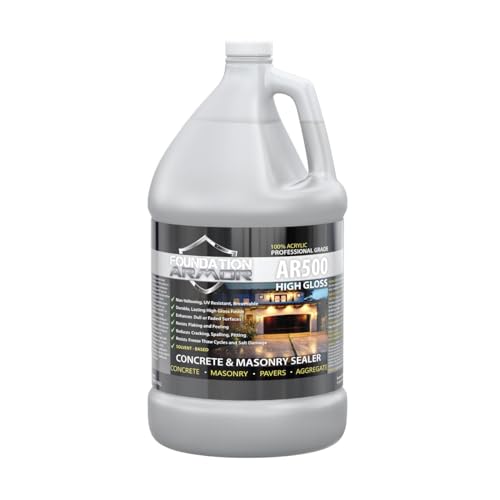
175–225 square feet per gallon coverage and the highest gloss in this lineup make the Armor AR500 the top pick for homeowners who want a commercial-grade, permanently wet look on outdoor stamped concrete driveways, patios, or walkways and are willing to work with solvent fumes to get it. It is a solvent-based acrylic that darkens concrete dramatically without any milky residue, making patterns pop like no other sealer here.
Buyers confirm it goes further than many competitors on textured stamped concrete; one reviewer used it on 1920s stamped concrete after cleaning, stripping old sealer, and applying a wood dye stain, calling the sealer step “the easiest part.” The formula resists UV yellowing, road salts, and freeze-thaw cycles, so a stamped patio stays glossy through snow, rain, and direct sun without turning amber — it lasts longer against the sun than the water-based MasonryDefender, based on buyer reports.
The honest catch: this is a solvent-based product with 700 VOC content, meaning strong fumes require good ventilation or a respirator, and its thicker consistency can clog a sprayer after about 20 minutes without immediate cleaning. Still, for pure gloss longevity and color enhancement on exterior stamped concrete, the AR500 delivers the most dramatic transformation in this review.
Why it’s great
- Creates dramatic “wet look” high-gloss finish that darkens and enhances color immediately
- Non-yellowing formula resists UV damage and road salts for years
- Self-priming — just apply a single coat to refreshed sealed surface
Good to know
- High 700 VOC content means strong fumes — requires mask and ventilation
- Sprayers may clog after 20 minutes; you must clean immediately
- Solvent-based cleanup requires mineral spirits, not soap and water
2. MasonryDefender Stamped Concrete Sealer
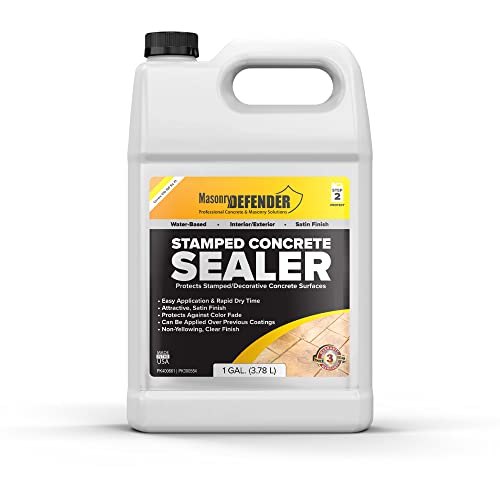
Against the top-pick Armor AR500’s high-gloss wet look and solvent-based durability, the MasonryDefender delivers a satin finish that beads water with far less odor and simpler cleanup — water-based, low-odor acrylic versus solvent-based, requiring soap and water instead of solvents. It dries fast enough that one buyer applied two coats to 900 square feet of stamped concrete walkway in a single day, a pace the AR500’s longer recoat times and ventilation demands cannot match. The trade-off is a deliberate reduction in shine depth, trading mirror gloss for a natural luster that is easier for DIY homeowners to apply safely without a respirator.
Customers note that this sealer handles the real-world texture of stamped concrete well — one reviewer used the MasonryDefender on a stamped concrete walkway with steps, applying two coats with a 3/8-inch roller (a roller with a 3/8-inch nap, meaning the fabric thickness), and needed about 3 gallons for roughly 900 square feet total. They noted that light rain that fell six hours after the first coat caused no bubbling or peeling, and the final finish made water bead up on the surface while remaining non-slip underfoot. The satin sheen looks natural and polished without the over-the-top gloss that shows every footprint.
Choose this over the Armor AR500 if you have a mid-size patio or walkway (under 500 square feet) and want color protection and water resistance without the hassle of solvent fumes or sprayer cleanups — the MasonryDefender’s low-odor, water-based formula and soap-and-water cleanup make it the safer, more convenient pick for first-time stamped concrete sealers who prefer a natural satin sheen over a high-gloss wet look.
Where it shines
- Water-based, low-odor formula — safe for DIY use without a respirator
- Dries fast enough for two coats in one day on stamped surfaces
- Clear satin finish enhances color without looking overly shiny or slick
Worth noting
- One gallon weighs 8.92 pounds — heavier than some competitors
- Satin finish may not satisfy buyers seeking a dramatic high-gloss wet look
- Needs three gallons for large projects over 600 square feet
3. Rain Guard CLEAR-SEAL
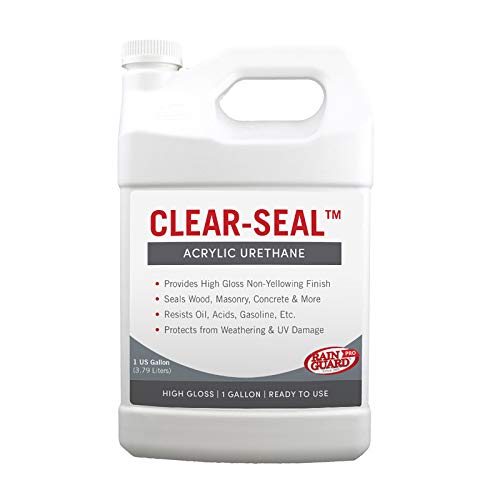
When you need a sealer that dries fast enough for you to walk on stamped concrete within two hours — like for a basement floor or craft project that goes back into use the same day — the Rain Guard CLEAR-SEAL is the speed champion. This is a urethane/acrylic hybrid (a blend of urethane and acrylic resins) that is thin as water, so it soaks into the concrete rather than sitting on top, and reviewers point out it dries to the touch in about 1.5 hours. One buyer mentioned: “Excellent sealant. Easy apply, dries in 1.5 hours. Looks fantastic on basement floor.”
The CLEAR-SEAL is not designed for heavy foot traffic on patio surfaces — the manufacturer explicitly recommends it for vertical surfaces, decorative stenciled floors, and craft projects where a thick protective coat is not the goal. Buyers confirm that it goes on very thin and runny (one called it “very messy” for brush-on craft work), which means it is best applied with a sprayer rather than a roller for even coverage on stamped concrete walls or architectural details. It does not darken colors as aggressively as 100% acrylic sealers, so stamped patterns keep their original tone while gaining a subtle, waxy shine — this makes it a better choice for indoor detail work than the DOMINATOR SG+, which is meant for outdoor pavers.
Choose the CLEAR-SEAL if your project is decorative indoor stamped concrete, a stamped retaining wall, or a basement floor where fast turnaround matters more than high-traffic durability. Skip it for outdoor driveways or patios that see regular walking — one of the dedicated acrylic sealers will serve you better there. With a 1.5-hour dry time and a thin-as-water formula, this is the fastest-drying sealer in the guide.
What stands out
- Dries in just 1.5 hours — fastest turnaround in this list
- Urethane/acrylic blend provides a tough clear coat with subtle shine
- Thin consistency soaks into decorative concrete without hiding the pattern
The trade-offs
- Runs thin like water, making brush application messy without a sprayer
- Best for vertical surfaces and indoor use — not rated for heavy foot traffic
- Some shoppers say it dries to a dull natural finish, not high gloss as advertised
4. DOMINATOR SG+ (1 Gal)

The single number that matters most in this category is recoat speed: the DOMINATOR SG+ scores a 45-minute recoat time, the fastest in this lineup, making a large stamped patio or paver driveway a realistic one-day project. This is a water-based acrylic that produces an ultra-high-gloss “wet look” finish that rivals solvent-based sealers like the Armor AR500, but without the harsh fumes. It is designed specifically for decorative concrete and concrete pavers, not for generic slabs, meaning the formula is tuned for textured, colored surfaces.
One limitation is that achieving that showroom gloss requires extreme preparation. Buyers who have used the DOMINATOR SG+ report the prep process is the hardest part: you need the surface to be 70–85°F with near-zero humidity, a full 48-hour dry window before sealing, meticulous cleaning, and application via a backpack sprayer or a fine sprayer followed by back-rolling with a foam roller. One buyer warned that actual coverage is around 200 square feet per gallon, not the 400 the label claims — so a large driveway may need a second gallon. That said, the final appearance is stunning: deep color enhancement, water beading, and a shine that looks freshly poured even years later.
If you are willing to put in the prep work and follow the manufacturer’s detailed application videos, the DOMINATOR SG+ delivers the glossiest water-based finish you can buy. This is the pick for paver patios and stamped driveways where you want a jaw-dropping result and understand that a perfect finish requires perfect surface conditions — skip it if you need a quick weekend project without detailed sanding and a 48-hour dry window, making the price-to-value read clear: you pay in labor and conditions for the glossiest result possible.
The upsides
- 45-minute dry time between coats makes it a fast one-day application
- Water-based formula with low VOCs — no harsh odor during use
- Ultra-high-gloss wet look that rivals solvent-based sealers on pavers
Keep in mind
- Real-world coverage is about 200 sq ft/gal, not the claimed 400
- Requires strict 70–85°F temperature and low humidity for best results
- Prep work is extensive — sanding, cleaning, and 48-hour dry time required
5. DOMINATOR SG+ (2.5 Gal)
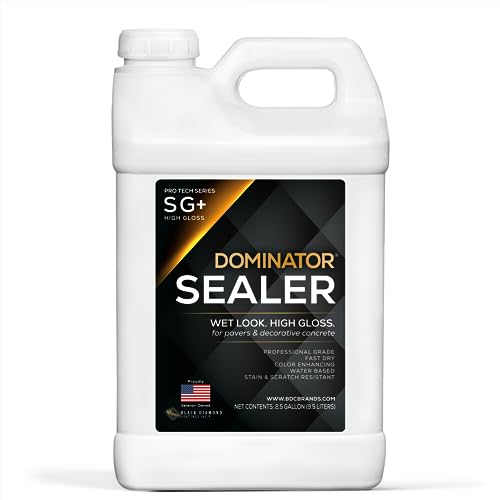
The 2.5-gallon jug of DOMINATOR SG+ fixes the main problem with the single-gallon version: coverage. Because buyers report that a gallon covers only about 200 square feet per coat (half the official claim), a large stamped concrete patio or paver driveway of 500 to 800 square feet needs at least 2.5 gallons for two full coats — and this bulk size saves you from buying two separate one-gallon cans at a higher combined cost. Everything that makes the SG+ great — the 45-minute recoat time, the water-based low-odor formula, the high-gloss wet-look finish — applies identically here, just at a larger scale.
Buyers using the 2.5-gallon size on large paver patios report that the process requires patience but pays off. One reviewer detailed finishing a large area by applying two coats via sprayer, noting that the sealer initially goes on milky white and clears to a deep gloss over the course of a week. They were specific about the prep: weeding between pavers, sanding, and meticulous cleaning before application. The result was a beautiful showroom gloss that looked fabulous even in dry weather, not just when wet. The company’s application videos proved accurate and helpful for first-time large-area sealing.
If your stamped concrete or paver surface is larger than 400 square feet, the 2.5-gallon DOMINATOR SG+ is the most practical way to achieve the wet-look finish without having to buy multiple small containers and risk inconsistent batches. The main reason to choose the 2.5-gallon over the 1-gallon version is scale — nothing else changes. This is for homeowners who want the absolute best gloss on a large patio and are ready for serious prep work, rather than a quick satin finish like the MasonryDefender offers.
Why we’d pick it
- Bulk 2.5-gallon size covers large patios and driveways efficiently
- Same fast 45-min dry time and water-based low-odor formula as the 1-gal version
- Delivers extreme high-gloss wet-look finish on decorative concrete pavers
A few caveats
- Prep work is demanding — sanding, cleaning, and 48-hour dry required
- Milky-white application dries clear over a week, requiring patience
- Not suitable for uneven stamped surfaces that cannot be thoroughly prepped
Understanding the Specs
Solvent-Based vs. Water-Based
Solvent-based acrylics (like the Armor AR500) use chemicals that penetrate concrete deeper and create a stronger bond, which is why they produce that dramatic “wet look” gloss and extreme durability on driveways. The compromise is they emit strong fumes — you need plenty of airflow and a respirator — and clean-up requires mineral spirits. Water-based acrylics (like the MasonryDefender and DOMINATOR SG+) use water as the carrier instead of harsh solvents, so they smell mild, dry faster, and rinse off with soap and water. The drawback is that water-based sealers generally produce a satin or moderate gloss rather than an ultra-deep mirror shine, though the DOMINATOR SG+ gets impressively close.
VOC Content
VOC stands for Volatile Organic Compounds — the chemicals that evaporate into the air as the sealer dries and creates that strong paint-thinner smell. Higher VOC products (like the Armor AR500 at 700 VOC) are banned for sale in some states with strict air-quality rules (California, for example). Lower-VOC and water-based products have fewer airborne chemicals, meaning you can use them indoors or in enclosed spaces without overwhelming the room with fumes. Always check your local VOC regulations before ordering, especially if you live in a state that restricts solvent-based coatings for homeowner use.
FAQ
Can I use a regular concrete sealer on stamped concrete?
How long does stamped concrete sealer last before needing reapplication?
Why does my sealed stamped concrete look white or hazy after drying?
Is it safe to apply a solvent-based sealer indoors on stamped concrete?
Do I need to use a sprayer, or can I roll on stamped concrete sealer?
Final Thoughts: The Verdict
For most people sealing a stamped concrete patio, walkway, or driveway, the concrete sealer for stamped concrete winner is the Armor AR500 because it delivers that unmistakable “wet look” gloss and long-lasting protection that makes the pattern pop. If you want low-odor application and a natural satin finish that still beads water, grab the MasonryDefender Stamped Concrete Sealer. And for the absolute highest-gloss water-based finish on a large paver patio, the DOMINATOR SG+ delivers the deepest shine — just be ready for the prep work.

Mo Maruf
I created WellFizz to bridge the gap between vague wellness advice and actionable solutions. My mission is simple: to decode the research and give you practical tools you can actually use.
Beyond the data, I am a passionate traveler. I believe that stepping away from the screen to explore new environments is essential for mental clarity and physical vitality.