Our readers keep the lights on and my smoothie glass nicely filled. As an Amazon Associate, I earn from qualifying purchases.
A garage floor takes a beating. Tires roll over it, tools drop on it, oil stains seep into its pores, and concrete dust kicks up with every footstep. That dust is more than just a nuisance — it’s tiny, abrasive particles that settle on everything from car interiors to stored boxes. A proper concrete sealer locks the surface, binds loose particles, and creates a barrier that makes cleaning simple and preservation effortless.
I’m Mohammad Maruf — the founder and writer behind WellFizz. I’ve spent hundreds of hours analyzing concrete sealer compositions, reading technical bulletins, and comparing real-world application results to identify which formulations actually hold up in a garage environment.
This guide breaks down the key differences between film-forming acrylics, penetrating silane-siloxanes, and densifying lithium-silicates so you can pick the best concrete sealer for garage that matches your floor’s condition and your finish preferences.
How To Choose The Best Concrete Sealer For Garage
Not every sealer is built for a garage. Outdoor driveway sealers prioritize weather resistance, while basement sealers focus on moisture block — your garage demands a mix of abrasion resistance, chemical tolerance, and easy re-coatability. The wrong sealer can peel, yellow, or fail to bind dust within six months. Here’s what actually matters.
Sealer Chemistry — Acrylic vs. Penetrating vs. Densifier
Acrylic sealers form a thin plastic film on the surface. They create a glossy or satin wet look, enhance color, and handle stain resistance well — but they can peel under hot tire friction or repeated moisture vapor pressure from below. Penetrating sealers, made from silanes and siloxanes, soak into the concrete pore structure and react chemically to form a water-repellent barrier below the surface. They leave no film, so nothing to peel, and the concrete retains its natural texture and slip resistance. Densifiers like lithium-silicates harden the top layer of concrete by reacting with free lime, reducing dust generation and increasing abrasion resistance — ideal as a primer or standalone treatment for new or powdery floors.
Finish and Appearance — Satin, Wet Look, or Natural
Your garage’s lighting and use case dictate which finish fits. A satin or low-gloss acrylic gives a subtle sheen that reflects light without looking glossy — it hides tire marks better than a high-gloss film. A wet-look acrylic dramatically darkens concrete and makes colors pop, but it shows tire scuffing faster and requires more frequent maintenance to keep that appearance. Penetrating sealers leave a zero-sheen, invisible finish — the concrete looks exactly like unsealed concrete but repels water like waxed glass. Densifiers also maintain a natural flat appearance and are the best choice if you plan to apply a topcoat acrylic later as a primer layer.
Coverage Rate and Application Windows
Garage floors are rarely perfectly smooth — broom-finished surfaces, cracks, and varying porosity all affect how much sealer a given square footage actually consumes. Acrylic sealers typically cover 175–225 square feet per gallon on smooth concrete but drop to 100–150 on rough, broom-finished slabs. Penetrating sealers range from 90–400 square feet per gallon depending on porosity; densifiers tend toward the lower end because the concrete absorbs the water-thin formula like a sponge. Check dry times carefully — acrylics often accept light foot traffic within one to two hours but full vehicle traffic requires 24 to 48 hours, while some penetrating formulas allow light traffic after two hours but need a full cure before parking a heavy vehicle.
Quick Comparison
On smaller screens, swipe sideways to see the full table.
| Model | Category | Best For | Key Spec | Amazon |
|---|---|---|---|---|
| Polar Dust Proof Concrete Sealer | Acrylic | Dust-proofing & indoor garages | 1.32 gal, covers 270 sq ft (two coats) | Amazon |
| MasonryDefender Concrete Sealer | Silane-Siloxane | Water repellency & natural look | 1 gal, covers 90–150 sq ft | Amazon |
| AQUA-X 11 Clear Sealer | Silane-Siloxane | Large coverage & low odor indoor use | 1 gal, covers 100–400 sq ft on concrete | Amazon |
| Armor AR350 Low Gloss Sealer | Solvent Acrylic | Wet look color enhancement | 1 gal, covers 175–225 sq ft | Amazon |
| Armor SX5000 WB Sealer | Silane-Siloxane | Zero color change & long-term protection | 1 gal, covers 175–225 sq ft | Amazon |
| Ghostshield 4500 Densifier | Lithium Silicate | Hardening powdery concrete & dust reduction | 1 gal, covers up to 250 sq ft undiluted | Amazon |
| Lithi-Tek 9500 Ultra Concentrate | Densifier + Waterproofer | Heavy-duty densifying & waterproofing | 1 gal concentrate makes 5 gal | Amazon |
In‑Depth Reviews
1. Polar Dust Proof Concrete Sealer

The Polar Dust Proof sealer uses a 100% acrylic formulation with deliberately low viscosity — a design choice that lets it penetrate deep into concrete pores instead of just sitting on the surface. That penetration creates a strong mechanical bond that locks dust particles in place, which is exactly what a garage floor with chronic dusting needs. The satin sheen is subtle enough to avoid looking like a wet floor while still making the concrete surface feel smoother underfoot and easier to sweep.
At 1.32 gallons per container and a two-coat coverage of roughly 270 square feet, this unit hits a sweet spot for a two-car garage. Each coat dries to the touch within one to two hours, so you can apply both coats in a single afternoon and drive a car onto the surface the next day. Users consistently report that the musty concrete odor disappears after application, and the glossy finish that develops over two coats handles foot traffic and light rolling loads without scuffing.
Application is straightforward — no etching needed, and a standard roller or brush works fine. The main thing to note is that this sealer is not designed to be overpainted. It’s a standalone treatment for bare concrete or stone, not a primer for floor paint. If your garage floor is already painted or epoxied, this formulation will not adhere properly and may peel.
Why it’s great
- Low viscosity delivers deep penetration for superior dust binding.
- Fast one-hour recoat time lets you finish in a single afternoon.
- Satin sheen enhances appearance without a slippery wet look.
Good to know
- Cannot be used as a base coat for floor paint — bare concrete only.
- Container size is non-standard 1.32 gallons, so measuring coverage for odd-shaped garages requires careful calculation.
2. MasonryDefender Concrete Sealer
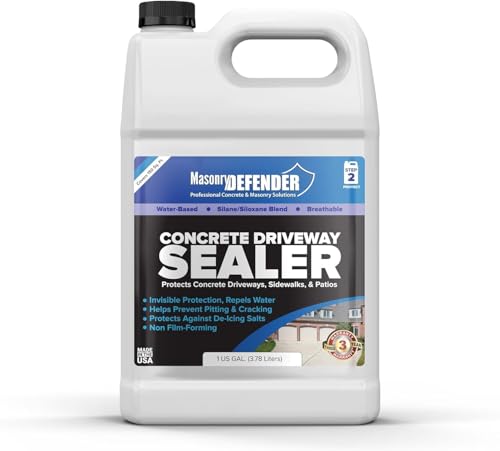
The MasonryDefender uses a silane-siloxane blend that chemically bonds with the concrete’s silicate structure to form a hydrophobic barrier deep within the pore walls — not on top of them. This means water beads up and rolls off the surface while the concrete continues to breathe, releasing internal vapor pressure that would otherwise cause film-forming sealers to bubble and peel. For a garage floor exposed to road salt tracked in from winter driving, this chemistry is critical because it blocks chloride ions from penetrating the concrete and causing freeze-thaw spalling.
Coverage is rated at 90 to 150 square feet per gallon, which is lower than acrylic sealers because the penetrating formula gets absorbed into porous concrete rather than spreading across it. The application is simple — clean the concrete thoroughly, then spray it on with a low-pressure garden sprayer. The liquid is thin like water and soaks in fast, so you won’t see puddles. After drying, the floor looks completely unchanged — no gloss, no sheen, no color shift — but water pools into tight beads that stay on the surface for days.
Multiple user reports confirm that the water-beading effect remains strong even after three years of exposure to rain and foot traffic, and treated areas resist dirt accumulation significantly better than untreated adjacent concrete. The one caveat is that over-application can leave blotchy wet-looking patches that take longer to dry, so a light even coat with a good sprayer pattern is essential.
Why it’s great
- Chemically bonds within concrete pores — nothing to peel or wear off the surface.
- Invisible finish preserves the natural texture and color of your garage floor.
- Blocks chloride ions and salt damage from winter road exposure.
Good to know
- Coverage is on the lower side; a standard two-car garage may need two gallons.
- Over-application creates temporary wet patches that require extra drying time.
3. AQUA-X 11 Clear Penetrating Sealer

The AQUA-X 11 is a water-based penetrating silicone sealer that stands out for its extremely low VOC content — users report no harsh odor during application, making it a viable option for attached garages where fumes would drift into living spaces. The formula is designed to resist stains, concrete spalling, freeze-thaw damage, and salt deterioration while leaving a natural, invisible finish. It achieves this by bonding with the substrate and repelling water without forming a surface film, so the concrete remains slip-resistant and breathable.
Coverage is generous — rated at 100 to 400 square feet per gallon on concrete and up to 800 square feet per gallon on denser stone surfaces. A single coat is sufficient for most garage floors, though highly porous or broom-finished slabs may require a second coat. The dry time is impressive: one hour for foot traffic and two hours before driving vehicles over the sealed surface, assuming temperatures stay above 50°F. This fast turnaround makes it ideal for garage owners who can’t keep their car parked outside for a full 24-hour cure window.
One real-world consideration is the packaging — the lid is notoriously tight and may require a large wrench or vice grip to open. Once open, the application is smooth with a pump sprayer, and the water-beading effect is visible within minutes. Users note that the sealer resists staining from typical garage spills like citronella oil and motor oil, though heavy petroleum-based fluids should still be wiped up quickly.
Why it’s great
- Near-zero odor and low VOCs make it safe for attached garage applications.
- Fast two-hour dry time allows same-day vehicle traffic.
- Exceptional coverage range — one gallon can treat up to 400 sq ft on concrete.
Good to know
- Packaging lid is extremely difficult to open; plan for a tool to break the seal.
- Cannot be applied when temperatures are expected to drop below 50°F within 48 hours.
4. Armor AR350 Low Gloss Wet Look Sealer

The Armor AR350 is a solvent-based acrylic sealer engineered specifically to create a low-gloss wet-look finish that dramatically darkens and enriches concrete color — it makes a drab gray garage floor look like polished stone. The formulation uses high-quality US-manufactured resins that form a non-yellowing film on the surface, providing a hard protective layer against abrasion from foot and vehicle traffic, road salts, UV rays, and chemical spills. It’s available in three VOC formulations (700, 350, and 50 VOC) so you can stay compliant with your state’s environmental regulations while getting the same core performance.
Coverage is rated at 175 to 225 square feet per gallon, and the sealer is self-priming — no separate primer coat needed. Application is best done with a 3/8-inch or 1/2-inch nap roller for textured surfaces, though a sprayer works for smooth slabs. The solvent smell is strong and requires proper ventilation or a respirator for indoor garage work, but the odor dissipates within roughly one hour outdoors. After curing, the low-gloss film resists ant intrusion, handles weekly mopping without degrading, and refreshes easily with a single coat when it’s time to reseal.
The most common user feedback is that one coat dramatically transforms the appearance, but a second coat deepens the wet look and evens out coverage on stamped or textured concrete. The film is durable enough to last several years on a garage floor, but note that rubber mats placed directly on the cured sealer can bond to it over time and may damage the film when removed. The AR350 also performs poorly if applied over a previously sealed floor that used a different chemistry — stripping the old sealer first is recommended.
Why it’s great
- Produces a dramatic wet-look color enhancement that transforms faded or drab concrete.
- Self-priming formulation saves time and material cost on application.
- Available in multiple VOC levels to meet any state’s environmental requirements.
Good to know
- Strong solvent odor requires a respirator and good ventilation during indoor application.
- Rubber mats can bond to the cured film and may peel it when removed.
5. Armor SX5000 WB Water-Based Silane-Siloxane Sealer

The Armor SX5000 WB is a professional-grade water-based silane-siloxane sealer that reduces water absorption by up to 95% without altering the appearance, color, or texture of the concrete — it’s the gold standard for garage owners who want invisible protection. The chemistry reacts with the concrete below the surface to form a water-repellent barrier that blocks moisture, oil, and salt from penetrating the slab. Because there is no surface film, there is nothing to peel, yellow, or wear off over time, and the finish remains completely matte so the floor looks exactly like bare concrete that happens to repel water like a lotus leaf.
Coverage is 175 to 225 square feet per gallon, and the formula is ready to use straight out of the container — no mixing or dilution. Application with a pump sprayer is straightforward, and the water-based carrier means cleanup requires only soap and water. The sealer dries within two to four hours depending on temperature and humidity, and the full chemical cure that provides maximum water repellency takes about 24 hours. Users report that the water-beading effect is immediate after drying and lasts for multiple years — several reviews confirm the floor still beads water after seven years of exposure.
The SX5000 WB is DOT-approved for use on concrete infrastructure, which speaks to its durability under real-world traffic loads. The main limitation is that it cannot be applied over a surface previously sealed with a film-forming acrylic — the sealer will not penetrate through the acrylic layer. If your garage floor has an old acrylic coating, you must strip or grind it off before applying this penetrating sealer.
Why it’s great
- Penetrates and protects below the surface with zero film to peel or yellow.
- Zero VOCs and no odor make it completely safe for enclosed spaces.
- DOT-approved formulation proven to withstand heavy traffic and harsh conditions.
Good to know
- Not compatible over pre-existing acrylic sealers — old coatings must be fully removed.
- Premium price point reflects the molecular engineering — expect to pay more per gallon than standard acrylics.
6. Ghostshield Lithi-Tek 4500 Densifier and Hardener
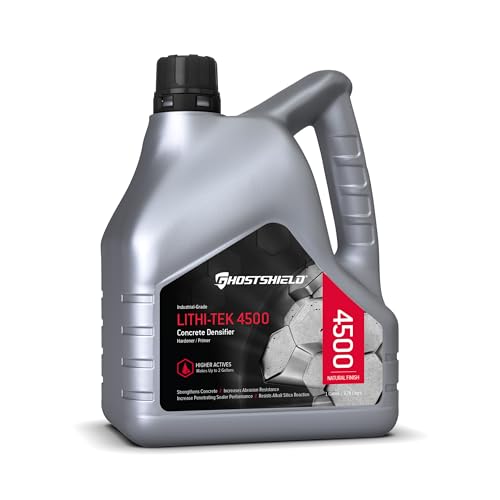
The Ghostshield Lithi-Tek 4500 is not a traditional sealer — it’s a lithium-silicate densifier that chemically reacts with the free lime in concrete to create a permanently hardened surface layer. For garage floors that were poorly finished, poured with too much water, or have been sanded and now dust chronically, this product literally transforms the concrete chemistry so that the top 1/16 to 1/8 inch becomes significantly denser and more abrasion-resistant. Users report a measurable reduction in concrete dusting after treatment, and the manufacturer claims abrasion resistance increases by up to 50%.
Application is simple: spray the thin water-like liquid onto clean dry concrete and keep it wet for 15 to 20 minutes so it can fully penetrate, then rinse off any residue before it dries. The treatment is permanent — it doesn’t wear off or require reapplication — and it does not alter the surface appearance at all. The floor looks and feels exactly the same, but it no longer generates dust with every sweep. Many users use the 4500 as a primer before applying a film-forming sealer like Armor AR350, because the densified surface requires significantly less topcoat material to achieve full coverage.
The 4500 is water-based with zero VOCs and no odor, making it completely safe for attached garages. It is also effective as a standalone treatment for garage floors that don’t need waterproofing but do need dust control. The one thing to note is that this is not a waterproofing product — it densifies but does not repel water. If water beading is your goal, you’ll need to follow up with a penetrating sealer like the SX5000 WB or a topical acrylic.
Why it’s great
- Permanently hardens concrete and eliminates dust generation from the slab itself.
- Acts as an excellent primer, reducing the amount of topcoat sealer needed by up to half.
- Zero VOCs and no odor — safe for enclosed garage spaces.
Good to know
- Does not provide water repellency on its own — it densifies, not waterproofs.
- Requires wet-on-wet saturation technique; over-application can leave a white crystalline residue if not rinsed.
7. Lithi-Tek 9500 Ultra Concentrate Sealer & Densifier
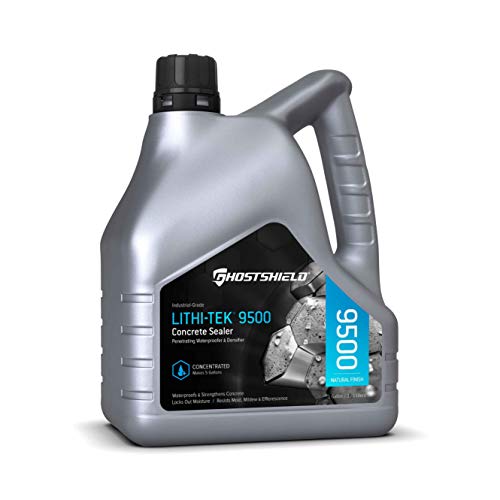
The Lithi-Tek 9500 is an industrial-grade penetrating sealer that accomplishes two things simultaneously — it densifies the concrete surface like a lithium-silicate while also forming a hydrophobic barrier that repels water and reduces moisture vapor transmission. This dual-action makes it unique among the products in this guide. It increases concrete abrasion resistance by up to 50%, prevents efflorescence (the white powdery salt deposit that appears on concrete surfaces), reduces hydrostatic pressure, and blocks water vapor intrusion. For a garage floor exposed to groundwater moisture or frequent wash-downs, this concentrate provides a level of protection that single-action sealers cannot match.
The ultra-concentrate format is extremely efficient: one gallon of the 9500 mixes with four gallons of water to make five gallons of ready-to-use sealer, which treats up to 1,000 square feet per coat. That means a single bottle can cover a large three-car garage floor with plenty left over for touch-ups. Application requires a clean, dry surface and temperatures above 50°F with no wind. The mixed liquid is applied wet-on-wet with a garden sprayer, and it dries clear with a completely natural matte finish — no gloss, no color shift. Users report effective water beading that causes rain and spills to pool on the surface rather than soaking in.
The primary user caution is that this product is designed for concrete not exposed to deicing salts; if your garage is attached to a driveway treated with rock salt in winter, the salt can damage the densified surface over time. Also, because it is a concentrate, measuring the correct water-to-product ratio is critical — too much water dilutes the active ingredients and reduces waterproofing performance. The 9500 is best suited for garages where moisture control and surface hardening are equally important, and where the owner is comfortable with a slightly more involved mixing process.
Why it’s great
- Combines densifying and waterproofing in a single application — eliminates the need for a separate primer and sealer.
- Concentrate format treats up to 1,000 square feet per gallon of concentrate, dramatically reducing cost per square foot.
- Prevents efflorescence and reduces moisture vapor transmission through the slab.
Good to know
- Not recommended for concrete surfaces exposed to deicing salts — the salts can degrade the densified layer.
- Requires precise dilution; incorrect water ratio reduces both densifying and waterproofing performance.
FAQ
Can I apply a concrete sealer over an old painted garage floor?
How long does a concrete sealer last on a garage floor?
Will a concrete sealer make my garage floor slippery?
Final Thoughts: The Verdict
For most users, the best concrete sealer for garage winner is the Polar Dust Proof Concrete Sealer because it combines fast-drying acrylic penetration with a satin finish that actually stops dust and improves the floor’s appearance without looking overly glossy. If you want zero change to your floor’s look and need long-term water repellency, grab the Armor SX5000 WB. And for a garage with chronic dusting where you need permanent hardening first, nothing beats the Ghostshield Lithi-Tek 4500 as a base treatment followed by your choice of surface sealer.

Mo Maruf
I created WellFizz to bridge the gap between vague wellness advice and actionable solutions. My mission is simple: to decode the research and give you practical tools you can actually use.
Beyond the data, I am a passionate traveler. I believe that stepping away from the screen to explore new environments is essential for mental clarity and physical vitality.