Our readers keep the lights on and my smoothie glass nicely filled. As an Amazon Associate, I earn from qualifying purchases.
A basement concrete floor that never stops dusting or feels perpetually damp isn’t just a nuisance — it compromises the air you breathe and limits how you use the space. The right sealer stops that cycle by locking the substrate from within, not just coating the surface.
I’m Mohammad Maruf — the founder and writer behind WellFizz. I’ve spent many hours dissecting the chemical formulations, coverage rates, and real-world performance data behind basement concrete sealers to help you choose the exact formula for your moisture level and floor condition.
Whether you need a penetrating water repellent, a densifying concentrate, or a liquid rubber barrier, this guide cuts through the noise to reveal the top contenders for the best concrete sealer for basement conditions.
How To Choose The Best Concrete Sealer For Basement
Selecting the wrong sealer can trap moisture inside your slab, causing delamination, white efflorescence stains, or a tacky film that never cures. Basement concrete faces unique challenges — hydrostatic pressure from below, high relative humidity, and the constant abrasion of foot traffic. You need a chemistry that works with those conditions, not against them.
Penetrating vs. Film-Forming Sealers
Penetrating sealers (silanes, siloxanes, and lithium silicates) react inside the concrete pores to create a hydrophobic barrier that blocks liquid water while allowing water vapor to escape. This breathability is critical in basements where moisture wicks up through the slab. Film-forming sealers (acrylics and epoxies) sit on the surface and can peel or blister when vapor pressure builds underneath — a common failure mode in below-grade spaces.
Coverage Rate and Solids Content
A gallon of sealer typically covers anywhere from 90 to 225 square feet depending on the porosity of the concrete and the solids concentration in the formula. Higher solids content generally means a thicker barrier per coat, but you need enough open pores for penetration. For basement floors with a smooth trowel finish, stick with low-viscosity formulas designed to soak in rather than pool on top.
Cure Time and Odor
Basements often have limited ventilation, so low-VOC, water-based formulas are the safer choice. Solvent-based sealers can release strong fumes that linger for days. Water-based silane-siloxane blends cure within a few hours to a touch-dry state, allowing you to return furniture or begin renovations the same day.
Quick Comparison
On smaller screens, swipe sideways to see the full table.
| Model | Category | Best For | Key Spec | Amazon |
|---|---|---|---|---|
| Lithi-Tek 9500 Ultra Concentrate | Premium Penetrating | Densifying & waterproofing | 5 gallons per 1-gal concentrate | Amazon |
| Armor SX5000 WB | Premium Water-Based | Long-term water repellency | Reduces absorption by up to 95% | Amazon |
| Ames Blue Max Liquid Rubber | Elastomeric Membrane | Below-grade moisture barrier | 1200% elongation | Amazon |
| Rust-Oleum Moisture Stop | Fortifying Sealer | Prepping for epoxy paint | Seals against radon gas | Amazon |
| MasonryDefender All Purpose | Silane-Siloxane | Waterproofing brick & stone walls | 1 gallon covers 90-150 sq. ft. | Amazon |
| MasonryDefender Water Repellent | Deep Penetrating | General outdoor basement walls | Water beading on rough concrete | Amazon |
| Polar Dust Proof Sealer | Acrylic Film | Dust-proofing garage & shop floors | Satin finish, dries in 1-2 hours | Amazon |
In‑Depth Reviews
1. Lithi-Tek 9500 Ultra Concentrate
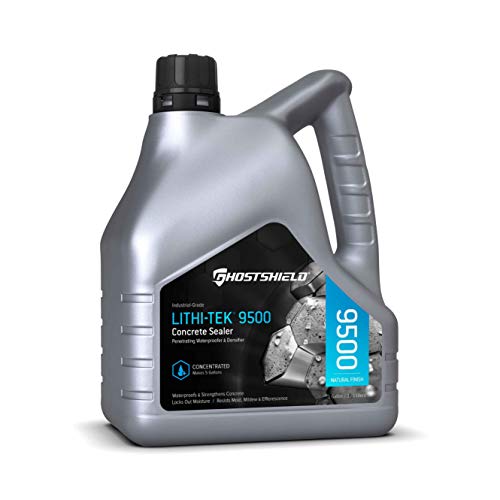
Lithi-Tek 9500 is a proprietary lithium-silicate densifier that penetrates deep into the concrete matrix and reacts chemically to block moisture vapor transmission while strengthening the slab by up to 50%. One gallon of ultra-concentrate mixes with four gallons of water to yield five gallons ready-to-use — treating up to 1,000 square feet per coat. This makes it the most economical premium option for large basement floors with chronic dusting or efflorescence.
The formula reduces hydrostatic pressure from below, which is the leading cause of flaking and coating failure on below-grade slabs. Users report that the water-beading effect is immediate and that the surface becomes noticeably harder after curing. Because it densifies rather than films, there is no risk of peeling or whitening under heavy foot traffic or wheeled equipment.
Application requires a clean, dry surface and ambient temperatures above 70°F for proper reaction. The wet-on-wet technique works best — apply the second coat while the first is still damp. Cleanup is simple with soap and water, and the low odor makes it tolerable in enclosed basement spaces.
Why it’s great
- Densifies while waterproofing for dual-action protection
- Ultra-concentrate covers up to 1,000 sq. ft. per coat
- Reduces hydrostatic pressure and vapor intrusion
Good to know
- Requires precise dilution ratio mixing
- Needs clean, dry concrete and warm conditions
2. Armor SX5000 WB Water-Based Silane-Siloxane Sealer

Foundation Armor’s SX5000 WB is a professional-grade water-based silane-siloxane formula that chemically bonds below the surface to reduce water absorption by up to 95%. It leaves no surface film and does not alter the look or feel of the concrete — critical for homeowners who want invisible protection. One gallon covers 175-225 square feet, and the sealer is rated to last 7-10 years before reapplication is needed.
The low-viscosity carrier allows deep penetration into dense basement slabs, and the water-based carrier means virtually no odor during application. Users consistently report dramatic water beading that persists for days after rain, and the matte finish keeps the floor looking natural. It also resists algae and fungal growth in humid basement environments.
Application requires a clean, absorbent surface and a pump sprayer. The sealer soaks in quickly, so you can apply a second coat within minutes. It meets strict VOC standards, so it is safe to use in occupied basements with limited fresh-air exchange.
Why it’s great
- High-performance water repellency with zero odor
- Does not change the concrete’s appearance or texture
- Long service life reduces reapplication frequency
Good to know
- Higher upfront cost per gallon
- Not suitable for polished or previously sealed floors
3. Ames Blue Max Liquid Rubber Waterproofer

Ames Blue Max is not a penetrating sealer — it is a thick, elastomeric liquid rubber membrane that cures into a flexible, waterproof coating with 1200% elongation. This makes it the go-to choice for basement walls and floors with active moisture seepage or visible cracks, where a penetrating sealer alone cannot bridge the gap. The blue color helps you verify coverage during application.
The formula bonds aggressively to concrete, wood, and metal, forming a continuous barrier that withstands hydrostatic pressure. It is non-toxic and VOC-compliant in all 50 states, but it is UV-sensitive, so any exterior applications require a top coat. Inside a basement, however, this sensitivity is irrelevant, and the rubber layer provides unmatched protection against liquid water intrusion.
Application with a brush, roller, or sprayer is straightforward, but the material is thicker than penetrating sealers, so multiple thin coats yield better results than one heavy coat. Users note that surface prep is critical — any dust or laitance will prevent adhesion. Once cured, the membrane remains flexible enough to accommodate minor slab movement without cracking.
Why it’s great
- Forms a thick, flexible rubber membrane over cracks
- Exceptional adhesion to concrete surfaces
- Low odor and non-toxic for indoor use
Good to know
- Requires thorough surface preparation
- Needs a top coat if exposed to direct sunlight
4. Rust-Oleum 301239 Concrete Moisture Stop Fortifying Sealer

Rust-Oleum’s Moisture Stop is a penetrating fortifying sealer specifically designed to be applied before an epoxy or paint topcoat. It sinks into the concrete, bonds loose particles, and blocks moisture migration, radon gas, and efflorescence. One gallon covers up to 200 square feet, and the product requires a 45-minute dwell time for full penetration before any excess is removed.
Users who followed up with Rust-Oleum epoxy paint report zero delamination even on slabs with significant hydrostatic pressure. The sealer does not alter the surface appearance, so it works invisibly underneath a decorative coating. Multiple customers confirm it effectively sealed floors that had previously failed due to moisture pushing through paint layers.
The formula dries quickly — within a few hours — and produces minimal odor compared to solvent-based primers. It is best applied with a roller or brush, and a second coat may be necessary on highly porous or badly dusting concrete.
Why it’s great
- Designed to prepare floors for epoxy or paint
- Blocks moisture vapor and radon gas
- Dries fast with low odor
Good to know
- Not a standalone finish — needs a topcoat
- Dwell time must be followed exactly
5. MasonryDefender All Purpose Brick Stone & Concrete Sealer

This silane-siloxane formula from MasonryDefender works on concrete, brick, limestone, granite, and cultured sandstone, making it a strong candidate for basements with mixed masonry walls and a concrete floor. The clear penetrating sealant does not change the natural appearance of any substrate while providing a waterproof barrier that stops moisture ingress.
Application with a pump-up garden sprayer is straightforward, and the sealer dries quickly without leaving a glossy residue. Users specifically note that it stopped active water seepage through a stone porch post in a basement setting, demonstrating its effectiveness against liquid water. The coverage rate of 90-150 square feet per gallon is typical for penetrating silane-siloxane blends.
One recurring tip from users is to shake the container thoroughly before use, as the solids can settle and create clumps that clog spray nozzles. Once applied, the sealer offers strong initial water beading, though long-term durability depends on the porosity of the underlying material.
Why it’s great
- Works on multiple masonry surfaces in one application
- Transparent finish preserves natural appearance
- Effective at stopping active water seepage
Good to know
- Requires vigorous shaking to prevent clumping
- Coverage varies significantly by porosity
6. MasonryDefender Concrete Sealer – Deep Penetrating Water Repellent
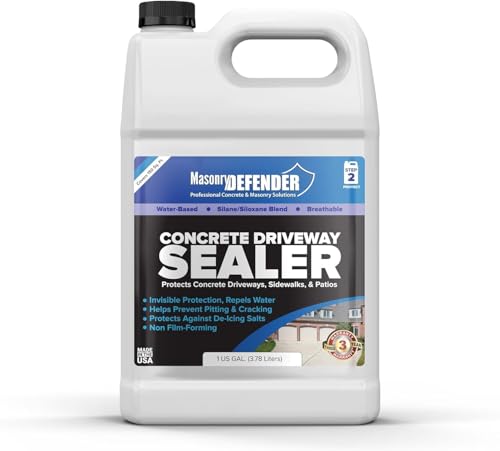
This entry-level penetrating sealer from MasonryDefender uses silane-siloxane technology to create a water-repellent barrier that allows concrete to breathe. It is formulated for driveways, sidewalks, and patios but is equally effective on basement walls and floors that see occasional moisture. The clear, non-glossy finish means it disappears visually after application.
Users report that water beads up and rolls off treated surfaces immediately, and the product remains effective for years — one reviewer noted that their driveway squares still repelled dirt and mold better than untreated areas after three years. The sealer is easy to apply with a low-pressure garden sprayer, and cleanup requires only water.
Coverage is listed at 90-150 square feet per gallon, which is on the lower end for penetrating sealers. The product is best suited for concrete that is clean, dry, and slightly rough to allow proper absorption. Overapplication can leave wet-looking stains, so light, even coats are recommended.
Why it’s great
- Breathable formula prevents trapped moisture issues
- Clear, non-glossy finish preserves concrete look
- Effective water beading with long-lasting results
Good to know
- Lower coverage rate than some competitors
- Overapplication can cause temporary staining
7. Polar Dust Proof Concrete Sealer Clear

Polar’s Dust Proof sealer is a 100% acrylic formulation that creates a durable, satin-finished surface coating rather than a deep penetrant. It excels at stopping concrete dusting — that gritty powder that lifts off unsealed floors with every step — and leaves a subtle sheen that brightens basement and garage spaces. The low-viscosity carrier allows it to penetrate shallow pores before curing into a bonded film.
Reviewers consistently praise its ability to eliminate dust problems that plagued their homes after new construction. One user noted that two coats stopped the musty odors and moisture tracking from a concrete balcony. The sealer dries within 1-2 hours per coat, covering up to 25 square meters per 5-liter container. It is safe for indoor use and has a low odor profile.
The acrylic film sits on the surface, so it is not the best choice for slabs with high hydrostatic pressure or active water intrusion. Heavy traffic areas may show wear over time, and reapplication will eventually be needed. But for dust control and a clean appearance in low-moisture basements, it delivers reliable results at a budget-friendly cost.
Why it’s great
- Effectively eliminates concrete dusting
- Fast drying time between coats
- Satin finish enhances floor appearance
Good to know
- Surface film may wear under heavy traffic
- Not ideal for slabs with active moisture
FAQ
Can I apply a concrete sealer over a floor that already has paint or epoxy?
How long do penetrating basement sealers last before reapplication?
Will a penetrating sealer stop efflorescence on basement walls?
Final Thoughts: The Verdict
For most users, the best concrete sealer for basement winner is the Lithi-Tek 9500 Ultra Concentrate because it densifies and waterproofs simultaneously while offering the highest coverage per dollar of any premium option. If you want invisible water repellency without altering the concrete’s surface, grab the Armor SX5000 WB. And for active moisture seepage or cracked walls where a penetrating sealer won’t bridge the gap, nothing beats the Ames Blue Max Liquid Rubber Waterproofer.

Mo Maruf
I created WellFizz to bridge the gap between vague wellness advice and actionable solutions. My mission is simple: to decode the research and give you practical tools you can actually use.
Beyond the data, I am a passionate traveler. I believe that stepping away from the screen to explore new environments is essential for mental clarity and physical vitality.