Our readers keep the lights on and my smoothie glass nicely filled. As an Amazon Associate, I earn from qualifying purchases.
Specs are compiled from manufacturer listings and verified buyer reviews and can change over time — please confirm the key details on the product page before buying.
Picking the wrong blade for cutting concrete, brick, or pavers means you get slow progress, burning dust, and a blade that goes dull before the job is halfway done. The right blade lets your saw cut fast and clean without fighting the material. This guide breaks down seven concrete saw blades across the price and performance spectrum.
I’m Mohammad Maruf — the founder and writer behind WellFizz. This guide is built by comparing the manufacturers’ published specifications and the patterns across verified customer reviews, so you get each pick’s real strengths and trade-offs instead of marketing spin.
Whether you are cutting pavers for a patio, slicing reinforced concrete on a jobsite, or trimming stone veneer for a renovation, the right concrete saw blade determines how fast and clean your work gets done — and these seven picks cover every common saw size and budget tier.
Quick Picks
- Makita B-69624 7″ Diamond Blade, Segmented, General Purpose — Best Value
- Diablo DMADST0600 6″ Diamond Segmented Turbo Cut-Off Blade — Top Performer
- Delta Diamond Boss Hog 10″ Turbo Premium Diamond Blade — Smooth Finish Pick
- ORIXTREME 14″ Diamond Concrete Saw Blade, Segmented General Purpose — Budget Champion
- BOSCH DB1241S 12″ Standard Segmented Rim Diamond Blade — Speed Demon
- EDiamondTools 14″ All Purpose Diamond Saw Blade — Production Pick
- Diablo DMADST1400 14″ Diamond Segmented Turbo Cut-Off Blade — Premium Pick
How To Choose The Best Concrete Saw Blade
Choosing a concrete blade starts with your saw’s arbor size and the material you are cutting. The blade’s rim type — segmented, turbo, or continuous — determines cut speed versus edge smoothness.
Match the Diameter and Arbor to Your Saw
Your saw can only accept one blade diameter and one arbor hole size. A 7-inch blade fits most angle grinders, while 12-inch and 14-inch blades go on larger masonry saws and cutoff machines. Arbor sizes commonly come in 5/8″, 7/8″, 1″, and 20mm — check your saw’s manual before buying.
Segmented vs Turbo vs Continuous Rim
A segmented rim blade clears dust fast and cuts aggressively — ideal for rough cuts in concrete, brick, and block. A turbo rim blade uses a serrated edge for a smoother finish while cutting fairly fast. A continuous rim blade gives the cleanest, most chip-free edge, typically used for tile and stone, but cuts slower. For general concrete work, segmented or turbo rims are the most practical.
Segment Height and Diamond Bond Quality
Taller segments (10mm to 15mm) expose more diamond particles during the blade’s life, so the blade lasts longer before the segments wear down. A softer diamond bond works best on hard materials like cured concrete because it releases dull diamonds faster, exposing fresh sharp ones. A harder bond is better for softer, abrasive materials like asphalt or green concrete.
Quick Comparison
| Model | Best For | Diameter | Arbor Size | Rim Type | Amazon |
|---|---|---|---|---|---|
| Makita B-69624 | General purpose masonry | 7 in | — | Segmented | Amazon |
| Diablo DMADST0600 | Cordless angle grinder cutting | 6 in | 5/8 in & 7/8 in | Segmented Turbo | Amazon |
| Delta Boss Hog 10″ | Smooth finish on pavers | 10 in | 5/8 in & 7/8 in | Turbo | Amazon |
| ORIXTREME 14″ | Big jobsite cuts on a budget | 14 in | 1 in & 20mm | Segmented | Amazon |
| Bosch DB1241S | Quick paver cutting with circ saw | 12 in | 1 in & 20mm | Segmented | Amazon |
| EDiamondTools 14″ | Reinforced concrete & iron | 14 in | 1 in | Segmented | Amazon |
| Diablo DMADST1400 | Heavy production cutting | 14 in | 1 in & 20mm | Segmented Turbo | Amazon |
In‑Depth Reviews
1. Makita B-69624 7″ Diamond Blade, Segmented, General Purpose

A lightweight 7-inch blade that punches above its size for everyday masonry cutting.
At just 0.38 kilograms, this Makita blade is the lightest among all seven picks, versus the 1.75-kilogram 14-inch ORIXTREME, which makes it an easy fit for a handheld circular saw or angle grinder without wearing out your arm. The maker claims taller segments (50 percent taller than standard models) deliver faster cuts and a longer life, and buyers report it cuts 2-inch deep concrete pavers easily with cooling water, noting no heat, warp, or bind during consistent use.
The 14 teeth give you more cutting edges than the 7-inch Makita’s closest competitor with fewer teeth, though the small diameter means it is not a candidate for deep cuts in thick foundation walls. Buyers add that it handles stucco over concrete block like butter when paired with a vacuum for dust control — a strong sign for anyone doing exterior trim work.
One reviewer noted cutting a concrete foundation wall and noted the blade handled both sides easily with the arbor ring, calling it a good investment that outperforms bargain-brand alternatives. The limited cutting depth on a full 8-inch wall is the one real limit here — for deep pours, you would need a larger-diameter blade.
Standout Strengths
- Very light at 0.38 kg — easy to control on angle grinders
- Buyers confirm clean cuts in pavers, stucco, and foundation walls
- 14 teeth provide a finer cut than lower-tooth-count competitors
The Catch
- 7-inch diameter limits cutting depth for thick foundation work
- Not ideal for large-format production cutting on walk-behind saws
The call for: Anyone who needs a light, reliable blade for concrete pavers, stone veneer, and stucco on a compact 7-inch saw — it balances price and performance without weighing you down.
The limit: If you regularly cut full-depth 8-inch foundation walls or need a blade for a 14-inch saw, step up to a larger diameter.
2. Diablo DMADST0600 6″ Diamond Segmented Turbo Cut-Off Blade
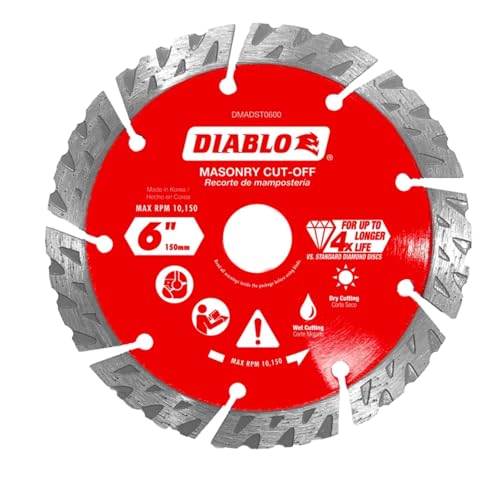
A 6-inch turbo blade that buyers swear by for clean, fast cuts on cordless grinders.
Diablo claims the SPEED-Edge slot design delivers up to 30 percent faster cuts than standard segmented discs, and the 60 percent taller segments pack superior diamond grit that they say provides up to 4X longer life than competitors. Buyers regularly back this up — one reviewer says “I use it on my cordless angle grinder cutting thin veneer stone — best blade out there period!” Another calls it the best blade for cutting mud-set tile, especially in older homes with thick mortar, noting it requires very little effort.
Unlike the segmented rim on the Makita above, this blade uses a segmented turbo design that blends aggressive material removal with a smoother finish, making it a versatile choice for both rough cuts and slightly more refined edges. At 3.84 ounces, it weighs less than the 7-inch Makita at 0.38 kilograms, so you barely feel it running on a small grinder.
One reviewer was so impressed they bought additional blades for fabricator friends. The main trade-off is the 6-inch cutting depth — shallow compared to any 10-inch or 14-inch blade — so this is a specialist tool for thin materials like veneer stone, mortar beds, and brick faces.
Pros at a Glance
- Weighs only 3.84 oz — extremely light on cordless grinders
- Owners mention it stays sharp and lasts long through heavy use
- Segmented turbo design balances speed and smoothness
Trade-Off
- 6-inch diameter means very limited depth for thicker concrete
- Not meant for walk-behind saws or deep cuts in foundation walls
Reach for it when: You need a nimble, aggressive blade for a cordless angle grinder cutting thin stone, tile mortar beds, or veneer — this is the one dedicated owners keep buying.
Switch to a larger blade if: Your project involves cutting concrete slabs thicker than 2 inches; the small diameter maxes out fast.
3. Delta Diamond Boss Hog 10″ Turbo Premium Diamond Blade

A 10-inch turbo blade that customers note cuts pavers like butter and leaves a clean finish.
Reviewers point out this blade cuts pavers like butter and stays sturdy enough for smoothing brick edges, though one buyer mentioned a DeWalt blade they tried cuts easier than the Boss Hog. The continuous turbo rim design is built for wet or dry use, and the cooling holes help prevent overheating during extended runs on a masonry saw or circular saw. At 0.1 inches thick versus the 14-inch ORIXTREME at 0.13 inches, this blade helps produce a slightly narrower kerf and less wasted material on precision cuts.
Delta backs this with a lifetime warranty against warping, cracking, and material defects — as long as the blade has at least 50 percent wear left, they will replace it if it fails to cut properly or the segment-to-core bond separates. That is a rare level of confidence for a blade in this price range. One reviewer used it to dry-cut granite slab up to 1.5 inches thick and said it performed well with no deflection.
Another buyer used it for smoothing concrete edging on a mitre saw and reported no detectable wear after dozens of blocks. The only note from the reviews: it can produce slight chipping on edge cuts if you push the feed rate too fast, so steady feed pressure is key for a perfect edge.
What Shines
- Buyers consistently praise smooth cuts on pavers, stone, and concrete edging
- Lifetime warranty against warping, cracking, and bond separation
- Cooling holes keep the blade running cooler on long cuts
What to Watch
- One reviewer reports a DeWalt blade cuts easier; the Boss Hog requires steady feed
- Occasional light chipping if you push the cut too fast
The honest take: This is a durable, smooth-cutting turbo blade for masonry and paver projects where finish matters, backed by a lifetime guarantee that takes the risk off you.
The one caveat: If absolute fastest cut speed is your priority, a segmented blade will outrun it — the Boss Hog trades top speed for a cleaner edge.
4. ORIXTREME 14″ Diamond Concrete Saw Blade, Segmented General Purpose

A 14-inch segmented blade that delivers big cuts at a fraction of premium blade prices.
With 24 teeth and a 15mm segment height, this blade has 24 teeth versus the 14-tooth Makita 7-inch blade, giving it more cutting edges in contact with the material per rotation — which helps it chew through thick paving bricks and reinforced concrete fast. At 1.75 kilograms and 0.13 inches thick, it is the heaviest blade in the lineup, versus the 0.1-inch Delta Boss Hog, meaning it will stand up to rough production cuts on a walk-behind saw or chop saw.
One owner reported the blade lasted through about 80 cuts of 2 5/8-inch brick before getting dull and cutting slower — just enough to finish one job with a single blade. The same reviewer noted it is much cheaper than the -plus blades at home improvement stores, making it a compelling budget pick for a one-project purchase. Another said it made quick work of thick paving bricks all day long on a portable chop saw.
The arbor comes with a 1-inch to 20mm bushing, so it fits both standard US and metric saw arbors without an adapter purchase. The main downside reported is wear life: at roughly 80 brick cuts per blade, it does not match the longevity of premium options like the Diablo DMADST1400 or the EDiamondTools blade for heavy production work.
Why It Works
- 24 teeth cut aggressively through thick brick and reinforced concrete
- 15mm segment height provides decent lifespan for the price
- Included 1-inch to 20mm arbor bushing fits US and metric saws
The Catch
- Shoppers say dulling after roughly 80 cuts in brick — not for daily production
- Heavy at 1.75 kg — you will feel it on handheld saws
Best for: The homeowner or contractor who needs a big 14-inch blade for a single job or occasional use and wants to spend significantly less than premium blades.
Not for: Full-time production crews cutting miles of concrete every week — the wear life will leave you swapping blades too often.
5. BOSCH DB1241S 12″ Standard Segmented Rim Diamond Blade
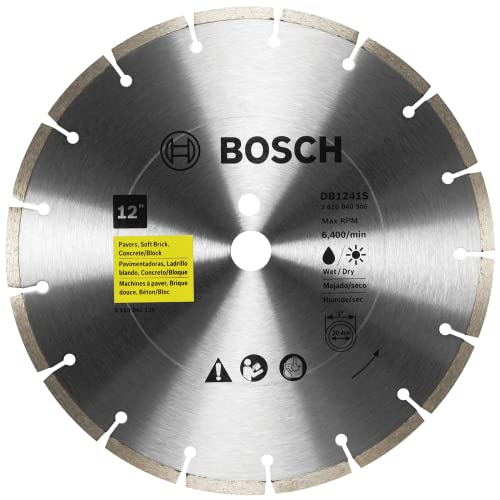
A 12-inch segmented blade that buyers report halves cutting time on concrete pavers.
Bosch tensioned the steel core for stability at high RPM, and the taller segment height is designed to extend blade life through more cuts. Buyers confirm the speed — one reviewer says it cuts 2-inch concrete pavers quickly and smoothly compared to their previous blade. The 1-inch arbor also accepts a 20mm bushing, giving you flexibility across universal circular saws and masonry saws.
Unlike the 14-inch ORIXTREME which leans budget-friendly, this Bosch blade sits at a premium mid-range price point and has a medium diamond bond designed for general-purpose cutting in materials ranging from soft brick to concrete block. One reviewer used it to cut through concrete with a garden hose running over the cut to keep the blade cool and capture dust — a practical wet-cutting setup that buyers recommend to boost blade life.
Another buyer installed it on a circular saw to cut concrete blocks and reported it worked as expected with clean cuts and no issues. The one caution from reviews: a buyer who used it to cut wall tile for a full kitchen renovation noted it seemed to wear after the tile installation was complete, suggesting it is better suited for concrete and block than for very dense ceramic or porcelain tile.
Fast Facts
- Owners mention cutting time reduced by more than half on concrete pavers
- Tensioned steel core for stability and straight cuts at speed
- Fits both 1-inch and 20mm arbors
One Limit
- Customers note noticeable wear when cutting dense wall tile — best for concrete and block
- 12-inch size means less depth than 14-inch blades for deep cuts
Pick this for: Fast, aggressive cutting of concrete pavers, blocks, and soft brick — the speed improvement reviewers point out makes it a strong choice for time-sensitive jobs.
Look elsewhere for: Daily production cuts in reinforced concrete or for cutting hard porcelain tile; the medium bond is not tune for those materials.
6. EDiamondTools 14″ All Purpose Diamond Saw Blade

A 14-inch workhorse that chewed through 90 feet of concrete and kept cutting.
This blade is designed for hard reinforced concrete, asphalt, granite, terrazzo, and even ductile iron piping — a wider material range than most of the general-purpose blades on this list. With a cutting depth of 4-5/8 inches and a 10mm segment height, it is built for deep, sustained cuts on a high-speed handheld saw or a lightweight walk-behind saw. One buyer reports cutting 90 feet of 4-5-inch thick concrete with the blade, noting it still has tons of life left after that run.
Another reviewer was using a cheap cut-off saw that “cut nothing” with the original blade, then switched to this EDiamondTools blade and cut through a 6-8 inch thick patio. The 24 teeth match the ORIXTREME 14-inch blade in tooth count, but the EDiamondTools blade carries a premium price tag that reflects its more durable bond matrix designed for harder materials and longer continuous use.
A basement remodeler used the 16-inch version of this blade to cut 90 feet of 6-inch concrete with an electric saw and said it was slow but adequate, with the blade still usable after the cut. Their honest note: it is very expensive but cheaper than hiring out the work. The biggest downside is the price — this is a production-grade investment, not a one-project disposables blade.
Production Strengths
- Shoppers say cutting 90 feet of concrete and the blade still has plenty of life
- 4-5/8 inch cutting depth handles deep slab cuts
- Can cut ductile iron piping — not just concrete and masonry
Consider This
- Premium price point — not a budget-friendly option
- One customer observed it was slow on 6-inch concrete compared to a larger blade
Go with this if: You are cutting reinforced concrete slabs, iron piping, or granite regularly and need a blade that lasts through multiple jobs — buyers confirm the longevity justifies the investment.
skip it if: You are cutting occasional brick or pavers and do not need the hard-material capability; a cheaper segmented blade will do the same job for less.
7. Diablo DMADST1400 14″ Diamond Segmented Turbo Cut-Off Blade
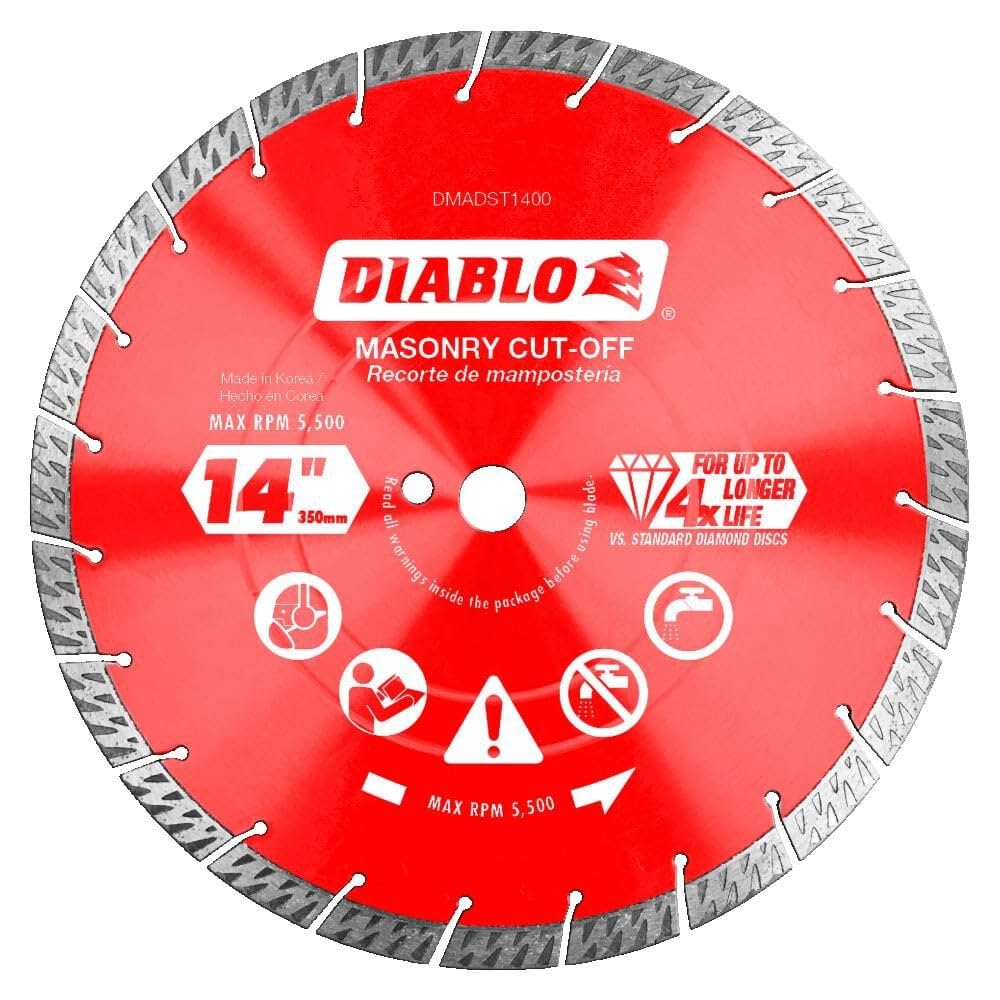
A 14-inch heavy hitter that one reviewer says beats + Husqvarna blades.
Diablo claims the SPEED-Edge slot design reduces vibration and delivers up to 30 percent faster cuts than standard segmented discs, paired with 60 percent taller segments stuffed with superior quality diamonds for a bond they rate at up to 4X longer life. One buyer with experience on expensive brands says “this is the best blade I’ve purchased so far, and I have purchased plus blades from Husqvarna and other name brands — I’ll be using these until they switch their design.” That is a decisive endorsement from someone who has tried the highest-tier competition.
At 4.25 pounds, this is the heaviest 14-inch blade among the picks, reflecting its hardened disc body and dense diamond segments. It fits both 1-inch and 20mm arbors (with a 20mm bushing included), and the max RPM of 5,500 is within spec for most walk-behind cutoff saws. One reviewer described the cutting action as “una bestia” — Spanish for “a beast” — noting it cuts almost everything aggressively, though detailed cuts are not its strength because it cuts aggressively.
The trade-off is straightforward: this is a premium production blade for crews who need fast, durable cutting on heavy materials day after day. Unlike the EDiamondTools blade that handles ductile iron, this Diablo is tune for concrete, brick, and block — it does not list iron piping in its compatible materials. Buyers consistently report fast cutting speeds and long life, with no complaints about warping or segment loss.
Heavy-Duty Wins
- One reviewer says it outperforms + Husqvarna blades for cutting speed and life
- 60% taller segments with premium diamond bond for long service life
- Hardened disc body absorbs vibration during sustained cuts
Heads-Up
- Heavy at 4.25 pounds — too much for extended handheld use
- Not designed for ductile iron; keep it on concrete, brick, and block
Verdict: If you run a crew cutting concrete and masonry daily and want a blade that outlasts and cuts faster than high-end competitors, the Diablo DMADST1400 is the production-grade pick that buyers who tried everything else keep choosing.
The honest caveat: For occasional DIY use, this is overkill — you will not wear it out before the job is done, but you are paying for durability you will not use.
Understanding the Specs
Blade Diameter and Arbor
The diameter (7 in, 10 in, 12 in, or 14 in) decides the maximum cutting depth your saw can reach — a 14-inch blade cuts deeper than a 7-inch blade. The arbor is the center hole that fits onto your saw’s shaft. Common sizes are 5/8 in, 7/8 in, 1 in, and 20mm. Many blades include bushings to fit multiple arbor sizes, but you must confirm your saw’s arbor before you buy — a blade that does not fit is useless.
Segment Height and Rim Type
Segment height is the vertical height of the diamond-impregnated material on the blade’s edge. Taller segments (10mm, 15mm) mean more diamonds are exposed over the blade’s life, so it lasts longer. The rim type — segmented (gullets between segments for fast, rough cuts), turbo (serrated edge that cuts fairly fast with a smoother finish), or continuous (smooth edge for clean, chip-free cuts) — matches the rim to the material. For general concrete cutting, segmented and turbo rims are the practical choice.
FAQ
Can I cut concrete dry, or do I need water?
What is the difference between a segmented rim and a continuous rim blade?
Will a 7-inch blade fit my angle grinder?
What does the arbor size mean, and how do I find mine?
How long should a concrete saw blade last?
Is a turbo blade better than a standard segmented blade?
Can I cut rebar or iron with a concrete saw blade?
What is the right blade thickness for my saw?
Does the number of teeth matter on a diamond blade?
Can I use a concrete blade on a miter saw?
Final Thoughts: The Verdict
For most people, the best concrete saw blade overall is the Makita B-69624 because it combines a light weight at 0.38 kilograms with 14 teeth and buyers who confirm clean cuts across pavers, stucco, and foundation walls — an excellent balance of performance and value for everyday masonry work. If you want blazing speed on big paver projects, grab the Bosch DB1241S — buyers report quicker cutting than their previous blade. And for heavy production cutting where a blade needs to outlast the job, the standout is the Diablo DMADST1400, which one reviewer says beats + Husqvarna blades for speed and longevity.
How We Picked
We do not accept paid placement. Every pick is matched to a real buyer and a real use-case; we do not hands-on test units.
Sources & Methodology
Specifications: manufacturer listings and product documentation. Review insights: verified customer reviews, as of July 2026. Pricing: not shown on this page (it changes often); check the current price via the retailer link.
As an Amazon Associate, WellFizz earns from qualifying purchases. This does not affect which products we feature.

Mo Maruf
I created WellFizz to bridge the gap between vague wellness advice and actionable solutions. My mission is simple: to decode the research and give you practical tools you can actually use.
Beyond the data, I am a passionate traveler. I believe that stepping away from the screen to explore new environments is essential for mental clarity and physical vitality.