Our readers keep the lights on and my smoothie glass nicely filled. As an Amazon Associate, I earn from qualifying purchases.
Every homeowner with a concrete driveway, patio, or sidewalk knows the pattern: a thin crack appears, winter widens it, and by spring you’re staring at a jagged gap that collects weeds and looks worse than the year before. The frustration isn’t the crack itself—it’s that the last filler you tried shrunk, crumbled, or washed out before the season turned. A proper concrete patch doesn’t just hide the damage; it bonds chemically with the substrate, handles freeze-thaw movement, and stays put for years without requiring a second coat before the next rain.
I’m Mohammad Maruf — the founder and writer behind WellFizz. I’ve spent hundreds of hours cross-referencing technical data sheets, analyzing polymer formulations, and reading through real-world use cases to sort which concrete patch products actually justify their place on your shelf.
Whether you’re fixing a hairline crack on a new slab or sealing a gap that’s been expanding for three winters, the best concrete patch comes down to matching the right chemistry to your specific surface and climate conditions.
How To Choose The Best Concrete Patch
Not all concrete patch products are interchangeable. The chemistry that works for a vertical basement wall crack will fail on a horizontal driveway seam exposed to truck traffic and road salt. Before you buy, match the repair material to the specific demands of your surface, environment, and crack geometry.
Flexibility vs. Rigidity
Outdoor concrete expands and contracts with temperature swings. A rigid patch that dries rock-hard will shear off at the edges after the first hard frost. Synthetic rubber and silane resin formulations retain elasticity, allowing the repair to move with the slab without losing adhesion. For interior floors with stable temperatures, rigid fortified vinyl polymer patches offer excellent compressive strength without the same risk of edge lift.
Crack Width and Depth
Hairline cracks under 1/8 inch require low-viscosity liquid fillers that can wick deep into the fissure. Wider gaps over 1/4 inch benefit from granular or pre-mixed pastes that bridge the opening without sagging. Deep holes over an inch may require a sand or foam backer rod before the patch material goes in to prevent excessive shrinkage and material waste.
Bonding vs. Filling
A filler merely occupies the void. A bonding agent chemically links the patch to the existing concrete. Products containing acrylic-polymer latex or synthetic rubber compounds typically offer higher peel and tensile strength, making them suitable for structural repairs like reattaching broken edges or filling spalled areas that bear weight.
Quick Comparison
On smaller screens, swipe sideways to see the full table.
| Model | Category | Best For | Key Spec | Amazon |
|---|---|---|---|---|
| Autosel Concrete Crack Filler (3-Pack) | Silane Resin Gel | Self-leveling outdoor driveway cracks | 39 fl. oz., cures in 24–48 hours | Amazon |
| Magic Crack Filler 2.5LB | Granular Powder | Dry, no-mess application on slabs | 2 lb., water-activated powder | Amazon |
| Bluestar Flexible Hairline Crack Filler | Synthetic Rubber Liquid | Micron-sized hairline cracks | 7 fl. oz., flexible in all weather | Amazon |
| SIKA SikaLatex R | Acrylic-Polymer Admix | Bonding adhesive for mortar repairs | 1 gal., 500 psi bond strength | Amazon |
| DAP Phenopatch Pre-Mix | Fortified Vinyl Polymer | Budget-friendly deep crack filling | 1 qt., dries hard in ~12 hours | Amazon |
In‑Depth Reviews
1. Autosel Concrete Crack Filler (3-Pack)
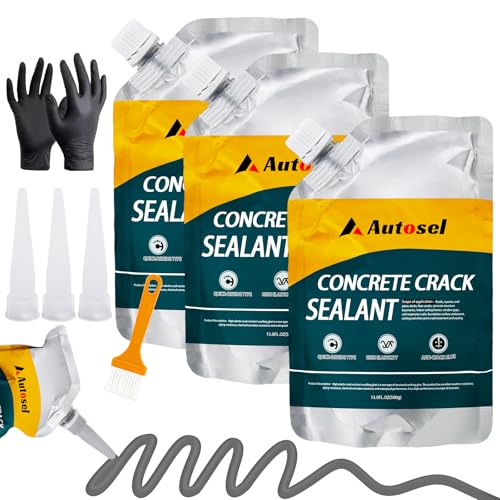
The Autosel three-pack delivers 39 fluid ounces of silane resin gel spread across three squeeze bottles, making it the most generous mid-range option for homeowners tackling multiple cracks or longer driveway seams. The gel is thin enough to self-level into horizontal gaps without effort, yet it cures into a flexible seal that survived heavy rain tests without peeling or lifting. Users noted that the gray color doesn’t perfectly match aged concrete, but the material’s waterproof barrier and UV resistance compensate for the slight aesthetic compromise.
One practical detail that sets this pack apart is the inclusion of brush caps and gloves, reducing the setup friction of a weekend repair job. The self-leveling behavior means you don’t need to trowel or spread—just attach the nozzle, squeeze, and let gravity do the work. For cracks wider than 1 inch, backer rod or sand is recommended to prevent the gel from sinking too deep before curing.
Reviews consistently highlight that the filler dries flexible rather than brittle, which is critical for outdoor slabs that shift with ground movement. The 24-to-48-hour cure window is standard for this chemistry, but the material remains workable long enough to adjust the fill level before it sets completely.
Why it’s great
- Self-leveling formula saves trowel work on horizontal cracks
- Flexible cure resists freeze-thaw edge lift
- Three-bottle pack covers multiple repairs without waste
Good to know
- Gray color may not match older weathered concrete
- Not suitable for cracks wider than 1 inch without prefill
2. SIKA SikaLatex R Concrete Adhesive Glue

This is not a crack filler—it’s a bonding adhesive meant to be mixed with Portland-cement mortar or concrete to create a fortified repair compound. The acrylic-polymer latex formulation delivers 500 psi bond strength, which is why it’s the go-to choice for reattaching broken concrete edges, bonding new mortar to old slabs, and priming surfaces before a structural patch. Users report that repairs made with this admix held for years, surviving full exterior renovations and freeze-thaw cycles that would destroy standard fillers.
The gallon jug goes a long way when used as an admixture at the recommended dilution rate, and it can also be brushed onto damp concrete as a bonding grout before applying the patching material. One critical caveat is the 1-year shelf life—buyers should check the expiration date on the label before mixing a batch. The material stores easily for DIYers, but it’s designed for projects where adhesion strength matters more than cosmetic color matching.
Multiple reviews from both homeowners and tradespeople confirm that this product delivers on its tensile strength claims. It’s particularly effective for vertical repairs where gravity works against the patch, since the adhesive grip holds the mortar in place during curing. The white liquid dries clear and won’t create a vapor barrier, making it safe for covered concrete applications.
Why it’s great
- 500 psi bond strength for structural concrete repairs
- Works as both an admixture and a bonding primer
- Resists damage from repeated freeze-thaw cycling
Good to know
- Requires mixing with cement mortar—not a standalone filler
- One-year shelf life; must verify expiration before use
3. Magic Crack Filler 2.5LB Granular Powder
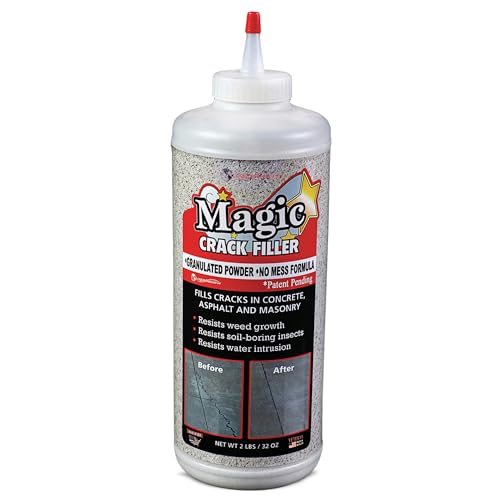
The Magic Crack Filler breaks the conventional mold by arriving as a dry granular powder that activates with nothing more than water. You pour the granules into the crack, tamp them down with a card, and mist the surface repeatedly over an hour. The material self-levels and hardens into a rubbery yet firm fill that blends surprisingly well with raw concrete. Users consistently note that the color match is close enough to make repairs nearly invisible, especially on gray slabs that haven’t been stained or sealed.
Unlike liquid fillers that require precise mixing ratios and cleanup of drips, this system is genuinely low-mess. The powder can be applied to both hairline and larger cracks—several reviewers prefilled deep voids with sand before topping with the granules to avoid excessive material use. The formula resists water intrusion, which is the primary mechanism that causes winter crack expansion and spalling.
One recurring observation is that the filler cures to a slightly different shade than older concrete, but most buyers consider this a fair trade-off for the ease of application and the fact that no mixing buckets, trowels, or solvents are involved. The product has no shelf life concerns since it’s a dry powder, making it a reliable option to keep on hand for spot repairs as cracks appear through the year.
Why it’s great
- No mixing—just pour, tamp, and mist with water
- Works on cracks from hairline to over an inch wide
- Color blends naturally with untreated gray concrete
Good to know
- Larger cracks may need sand prefill to avoid sinking
- Requires multiple water applications during first hour
4. Bluestar Flexible Concrete Hairline Crack Filler

The Bluestar filler is purpose-built for the narrowest category of concrete damage—hairline cracks under 1/8 inch wide. Its micron-sized synthetic rubber formulation is thin enough to wick into fissures that thicker pastes would simply skim over. No mixing or special tools are required; the liquid squeezes directly from the bottle and levels with a putty knife. Users applying it on new concrete floors and screened porch gaps found that the material stayed flexible after curing, accommodating temperature shifts without re-cracking.
One intelligent design choice is offering both gray and light gray shades, giving buyers a better chance at matching their specific slab color. The 7-ounce bottle is compact, but the yield is surprisingly high for hairline work—a single bottle can treat dozens of linear feet of thin cracks. The flexibility retention in hot and cold weather is supported by multiple user reports of successful application through seasonal transitions.
A minority of users noted that the filler can shrink slightly after the first year, requiring a touch-up application. This appears to be a function of how deep the original crack was and whether the material fully penetrated to the base. For surface-level hairline repairs, it holds well, but deeper narrow cracks may need two passes to achieve a flush finish that lasts.
Why it’s great
- Micron-sized formula penetrates hairline cracks effectively
- Two gray shade options for better color matching
- Retains flexibility across hot and cold weather cycles
Good to know
- May shrink slightly after one year in deep cracks
- Not suitable for gaps wider than 1/4 inch
5. DAP Phenopatch Pre-Mix Concrete Patch

The DAP Phenopatch offers a straightforward approach to filling deep and wide cracks with a pre-mixed fortified vinyl polymer paste. It comes ready to use straight from the quart container, which makes it an easy entry point for first-time DIYers who don’t want to measure or mix. The material dries hard within about 12 hours, forming a solid fill that can withstand passenger car traffic across a driveway patch. Users with no prior concrete experience successfully repaired patio holes by applying the paste by hand or with a trowel and achieving a smooth finish.
The trade-off for entry-level simplicity is longevity. Multiple reviews report that the patch lasts 3 to 4 years before cracking or lifting, particularly in freeze-thaw climates. The color is a brighter gray that darkens over time but rarely matches the original slab perfectly. Some patches lifted after a single winter, suggesting that the rigid vinyl polymer does not expand and contract at the same rate as the surrounding concrete.
For budget-conscious homeowners who need to fill a few isolated cracks and understand that this is a medium-term fix rather than a permanent solution, the Phenopatch delivers decent value. The pre-mixed consistency eliminates the guesswork of water ratios, and the 1-quart size is enough for multiple small repairs without leftover material going to waste.
Why it’s great
- Pre-mixed paste requires no measuring or blending
- Dries hard in about 12 hours for same-day traffic
- Affordable quart size covers multiple small repairs
Good to know
- Rigid formula may crack after 3-4 freeze-thaw cycles
- Color mismatch with existing concrete is common
FAQ
Can I use a concrete patch on a vertical wall crack without it dripping?
How long does a concrete patch last before it needs replacement?
Final Thoughts: The Verdict
For most users, the best concrete patch winner is the Autosel Concrete Crack Filler 3-Pack because it combines self-leveling convenience, silane resin flexibility, and three-bottle coverage at a fair middle-market price point. If you need a bonding adhesive for structural mortar repairs, grab the SIKA SikaLatex R. And for a zero-mess, mix-free application that any homeowner can execute without prior experience, nothing beats the Magic Crack Filler 2.5LB.

Mo Maruf
I created WellFizz to bridge the gap between vague wellness advice and actionable solutions. My mission is simple: to decode the research and give you practical tools you can actually use.
Beyond the data, I am a passionate traveler. I believe that stepping away from the screen to explore new environments is essential for mental clarity and physical vitality.