Our readers keep the lights on and my smoothie glass nicely filled. As an Amazon Associate, I earn from qualifying purchases.
Specs are compiled from manufacturer listings and verified buyer reviews and can change over time — please confirm the key details on the product page before buying.
Concrete moisture problems do not announce themselves until the floor coating peels, adhesive fails, or mold grows behind the baseboard. A concrete moisture meter helps you find hidden damp spots before you spend money on repairs — it measures how much water is still trapped in a slab from curing or a leak, so you know whether you can safely lay flooring, paint, or seal. The challenge is picking one that works on concrete (most cheap meters are tuned for wood only), reads deep enough through a dense slab, and gives you a clear answer without a technical manual.
I’m Mohammad Maruf — the founder and writer behind WellFizz. This guide is built by comparing the manufacturers’ published specifications and the patterns across verified customer reviews, so you get each pick’s real strengths and trade-offs instead of marketing spin.
A good best concrete moisture meter needs to match the depth and material you are testing, whether you are a contractor checking a slab before flooring or a homeowner chasing a damp basement corner.
Quick Picks
- Wagner Meters C555 Pinless Concrete Moisture Meter — Top Performer
- Tramex Concrete Moisture Encounter CME5 — Pro Grade
- Proster 2-in-1 Pin & Pinless Moisture Meter PST309-CA — Versatile Dual
- POROMETISTO Pin & Pinless Moisture Meter WTS01Pro — All-in-One Kit
- Neoteck Spherical Inductive Moisture Meter NTK209 — Curve-Friendly
- Neoteck 2-in-1 Dual Probe Moisture Meter MT69 — High-Accuracy Dual
- Proster Rechargeable Moisture Meter PST276-US — Budget Champion
How To Choose The Best Concrete Moisture Meter
Most concrete moisture meters fall into two types — pinless (non-invasive sensors that scan the surface from above) and pin-type (two small needles you push into the material). For concrete work, pinless is the usual choice because you do not want to poke holes in a slab. But meters differ by depth, scale, and how they handle interference. These three factors separate a trustworthy tool from one that gives you a blinking number you cannot rely on.
Detection Depth
A meter that only reads 5 mm deep tells you about just the surface — useless if moisture sits deeper in the slab where it can still cause adhesive failure. Look for a depth rating of at least 20 mm (about 3/4 inch); 40 mm is better for a standard residential slab. The Wagner C555 and the Tramex CME5 measure deeper into exposed concrete, which is why professionals lean on them for flooring prep.
Pinless vs. Pin Mode (and Which Scale Matters)
Pinless meters give you a relative reading, usually on a 0–100 scale or a color-coded dry/risk/wet indicator. That is enough to find problem spots — you sweep the slab, note where the number jumps, and compare one area to another. If you need a precise absolute moisture percentage (like confirming the concrete is below 4.5% before epoxy), you need a meter that also offers a pin mode with calibrated scales for building materials. The Neoteck 2-in-1 and the Proster 2-in-1 both give you that dual approach. For concrete alone, the Wagner and Tramex give you the confidence of a known brand among floor inspectors without needing pins at all.
Calibration and Interference Awareness
Every pinless meter requires a quick air-calibration before use — press a button while holding the sensor in the air, away from metal. Skip this step, and every reading will be off. More important: rebar, metal mesh, nails, or even conductive salts in concrete can spike a false reading. A good meter does not magically filter these out, but knowing about them means you can sweep a few inches to the side to confirm. The Wagner C555 and Tramex CME5 are less prone to confusion from surface salts because of their tuned frequency for concrete versus generic building-material sensors.
Quick Comparison
| Model | Best For | Detection Depth | Modes / Scales | Power Type | Amazon |
|---|---|---|---|---|---|
| Wagner Meters C555 | Pro concrete floor inspection | Top portion of exposed slab | Relative (1–100) + ambient | 1 x 9V battery | Amazon |
| Tramex CME5 | Non-destructive analog + reporting | 20–100 mm | Analog (carbide-equivalent) | — | Amazon |
| Proster 2-in-1 PST309-CA | DIY dual-mode with concrete mode | Up to 40 mm | Pin (abs) + Pinless (relative) | Lithium-ion (USB-C) | Amazon |
| POROMETISTO WTS01Pro | Versatile job-site reader | 20–40 mm | Pin (abs) + Pinless (relative) | 3 x AAA batteries | Amazon |
| Neoteck NTK209 | Curved / uneven surfaces | 5–40 mm | Pinless only (relative 0–100) | USB rechargeable | Amazon |
| Neoteck MT69 | High-accuracy dual probe | Up to 40 mm (pinless) | Pin (abs) + Pinless (relative) | 1200mAh Li-ion (USB-C) | Amazon |
| Proster PST276-US | Entry-level 5-mode sweeper | Up to 40 mm | Pinless only (5 modes + Index) | Lithium-ion rechargeable | Amazon |
In‑Depth Reviews
1. Wagner Meters C555 Pinless Concrete Moisture Meter
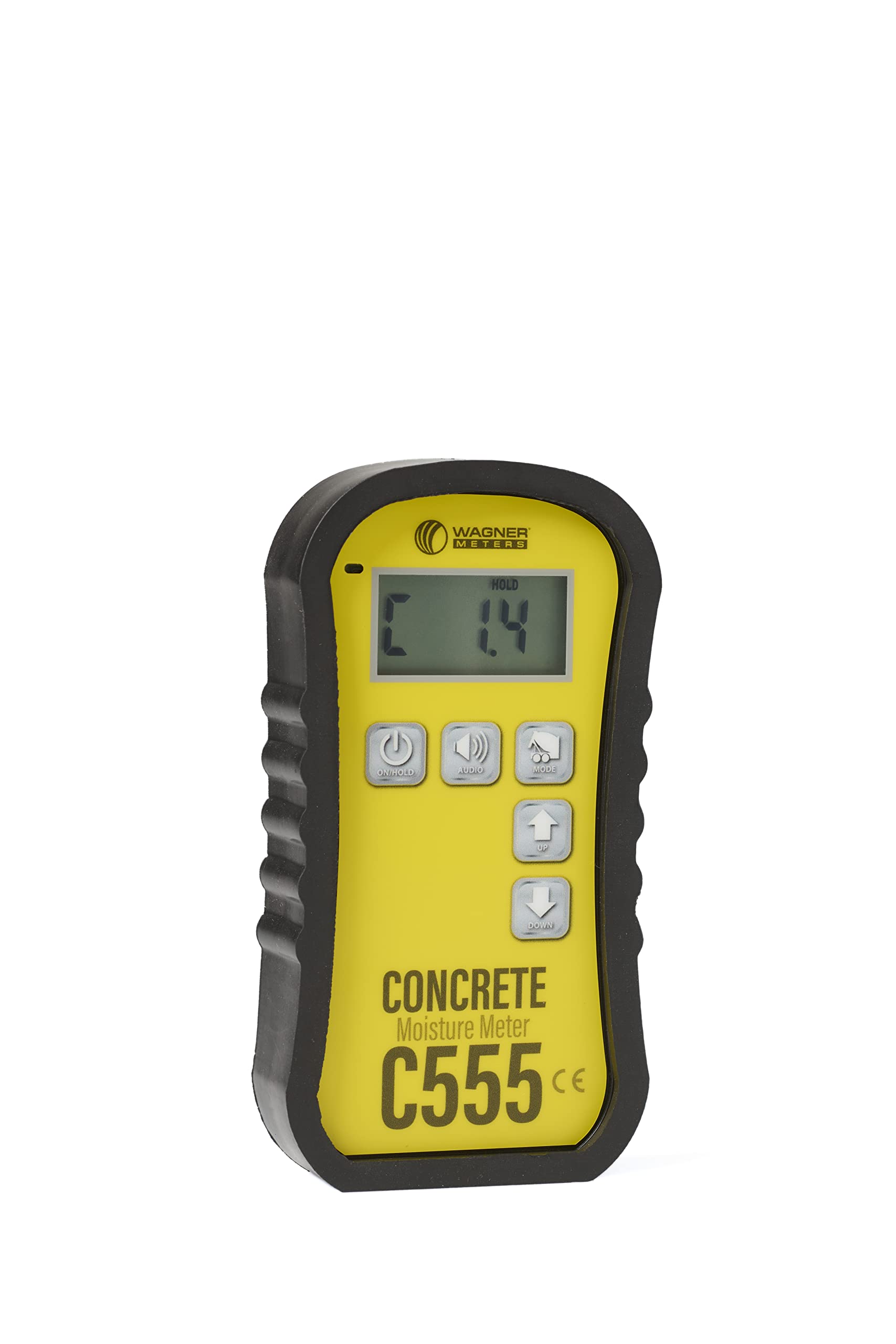
The specialist that refuses to guess on concrete, brick, or gypsum.
Unlike every other meter on this list, the C555 does not pretend to work on wood — it is built for concrete, brick, and gypsum only. That narrow focus makes its readings more trustworthy on those materials. You press it flat against the exposed slab (no tile, carpet, or vinyl over the top), and it gives you a relative moisture indication on a 1–100 scale to help map wet spots before you place an in-situ RH test (a probe inserted into a drilled hole to measure relative humidity inside the slab). It also measures ambient temperature, humidity, and dew point (the temperature at which moisture in the air starts to condense on surfaces), so you know whether the environment is ready for flooring adhesive.
Buyers report that it is noticeably more affordable than the Tramex CME5 while delivering similar accuracy — one inspector said they prefer its operation and find it comparable to the pricier brand. The catch is that this meter only reads uncoated concrete; if you need to test through a floor covering or get an ASTM F2170 in-slab reading, you need Wagner’s Rapid RH L6 Smart Sensors instead.
Why pros choose it
- Focused concrete/brick/gypsum sensor — no irrelevant wood modes to misinterpret.
- Built-in dew-point calculation helps spot condensation risks before installation.
- Adjustable alarm (0.0%–6.9%) sounds when moisture crosses your threshold.
- Comes with an on-demand calibrator, rubber boot, and carrying case.
Limitations to know
- Only for bare concrete — cannot read through tile, vinyl, carpet, or paint.
- Relative scale (1–100) rather than a direct moisture percentage.
- Runs on a single 9V battery (included) instead of USB rechargeable.
- Heavier than the budget options at 1.48 lbs.
Stick with it if: You are a flooring contractor, inspector, or serious DIYer testing exposed concrete slabs and want a reliable, non-destructive tool that skips the noise of multi-material meters. The depth reading covers the top portion of the slab, which is exactly where moisture issues hit adhesive bonds.
Look elsewhere if: You need to test through finished flooring, measure a precise moisture percentage, or check wood and drywall — this meter cannot do any of those.
2. Tramex Concrete Moisture Encounter CME5
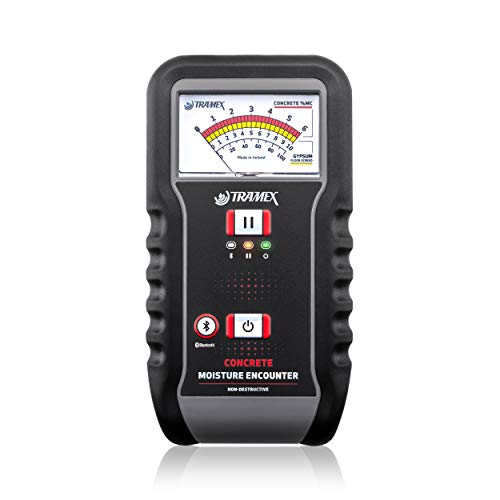
The old-school analog reader that talks to your phone via Bluetooth.
Tramex has been the reference name in concrete moisture testing for years, and the CME5 keeps it simple: you press its flat sensor down on the concrete, and an analog needle gives you a reading equivalent to the standard carbide method (a chemical test that measures moisture by the pressure from a reaction), following ASTM F2659 (a standard for non-destructive moisture testing of concrete). There is no digital menu or mode-switching — just press, read, and move on. The real advantage is Bluetooth connectivity, which lets you geotag readings in the Tramex app, create visual moisture maps, and timestamp reports — essential for commercial jobs that need documented evidence.
Buyers consistently say it is the easiest meter to use — one owner said they had been searching for moisture meters for a long time and found that with the CME5, all you do is press down on the concrete and the reading appears. The optional deep probe (sold separately) extends measurement down to 100 mm inside the slab, deeper than any other meter here can reach. The analog needle means you are not fighting a digital display that washes out in sunlight, but you also cannot get a precise numeric percentage on the screen — you read the needle position and match it to the printed scale.
The CME5 measures moisture across a range of 20–100 mm, but it ships as a non-destructive instrument only; the pin probe is an add-on. If your process requires absolute in-slab percentages, budget for that extra probe.
What stands out
- Carbide-equivalent analog reading trusted for ASTM F2659 compliance.
- Bluetooth app creates printable moisture maps with geotags and timestamps.
- Optional probe reaches 100 mm deep — deeper than any other pick on this list.
- Ergonomic, durable build that feels natural in the hand.
The trade-offs
- No direct digital percentage; you read the analog needle against a reference scale.
- The deep moisture probe is sold separately, adding to the cost.
- Heavier than most options at 0.5 kg (about 1.1 lbs).
- Not intended for wood/drywall — concrete, screeds, and anhydrite only (anhydrite is a type of calcium sulfate used in self-leveling floor screeds).
Best for professionals who report: If you need ASTM-standard documentation with moisture maps and timestamped readings for a client file or warranty, the CME5’s Bluetooth reporting is class-leading at this price tier.
skip it if: You just need a quick spot-check and do not plan to use the app or the optional deep probe — the analog-only output may feel less precise than a digital number.
3. Proster 2-in-1 Pin & Pinless Moisture Meter PST309-CA
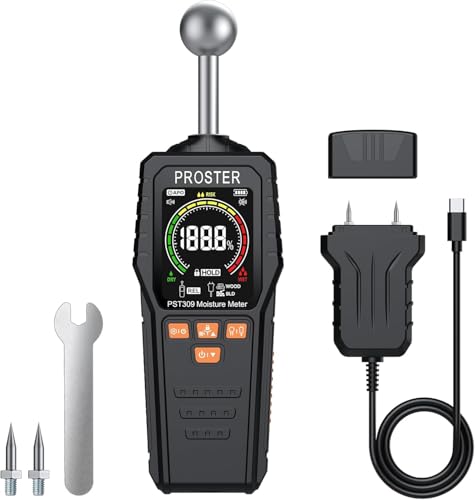
A dual-mode design that gives you relative sweeps and absolute pin readings in one tool.
The PST309-CA bridges the gap between quick non-invasive scanning and precise spot-checking. In pinless mode, it reads relative humidity distribution up to 40 mm deep into the material — you can sweep a concrete slab or plaster wall to find where moisture is concentrated. When you find a hot spot, switch to pin mode, insert the probes, and get an absolute moisture percentage: 5% to 52% for wood, 2% to 30% for building materials like concrete and gypsum. That dual reading is why this meter appeals to renovation contractors who jump between wood subfloors and concrete slabs in the same day.
Owners mention using it to inspect fifth-wheel travel trailers for hidden leaks and say it detected moisture problems in two units before they were purchased, saving a significant amount of money. The 3-color bar graph and buzzer alarm make it obvious when you hit a wet area without staring at the screen. One honest note: the custom alarm thresholds need a quick setup for each material type, so read the manual before your first job. The dust and water-resistant build (rated for 0–45°C) keeps it working on messy job sites.
Why it is a strong mid-range pick
- Both pinless (40mm relative) and pin (absolute %) in one device.
- Customizable alarm thresholds for wood, gypsum, and cement materials.
- Rechargeable lithium battery with USB-C — no buying 9V batteries.
- Automatic shutdown after 30 minutes saves charge.
A couple of considerations
- Pinless mode gives relative readings only — you must map multiple points.
- The user interface requires a few minutes of learning for threshold setup.
- Weighs 12.3 ounces, which is heavier than the basic Proster PST276-US.
Reach for this if: You need one tool that can do both a fast, damage-free sweep of a concrete floor and an absolute pin check on wood framing, all without swapping devices. The dual-mode versatility and USB-C recharging make it practical for everyday job-site use.
Pass it up if: You exclusively test bare concrete and do not need pin readings at all — the single-mode Wagner C555 or Tramex CME5 may give a more specialized concrete result for the same or less money.
4. POROMETISTO Pin & Pinless Moisture Meter WTS01Pro
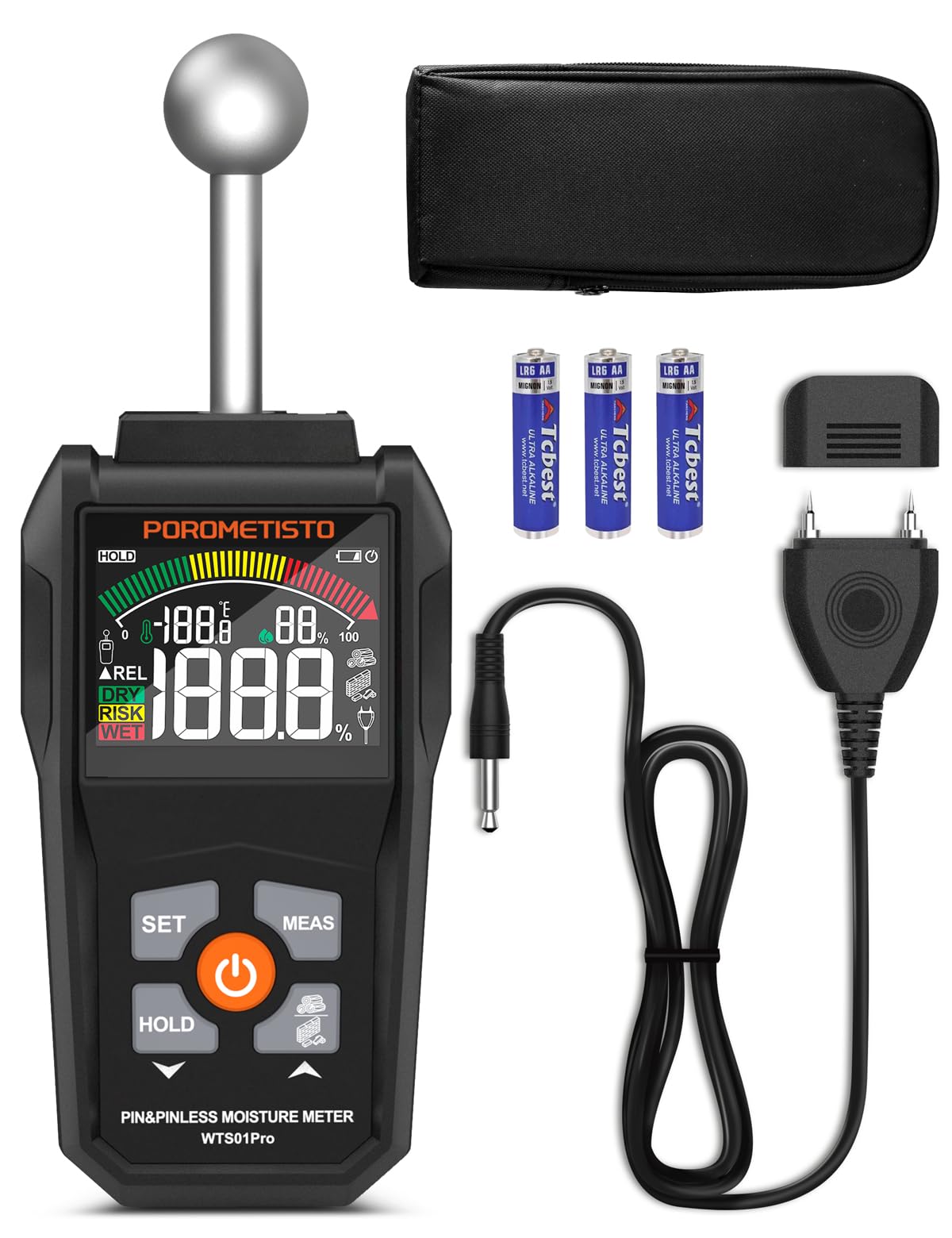
A complete kit with a remote probe for hard-to-reach spots and a shockproof body for job sites.
What sets the POROMETISTO apart from other dual-mode meters is the included 40-inch remote probe — a wired sensor that lets you check moisture inside wall cavities, behind cabinetry, or in tight corners where the main unit cannot fit. The spherical pinless sensor scans 20–40 mm below the surface, while the pin mode gives absolute percentages for wood (6%–60%) and brick (1.5%–33%). It also measures ambient temperature and humidity right on the VA color screen (vertical alignment LCD, a type of display with wide viewing angles), which helps you judge whether the room environment itself is too humid for flooring work.
Customers note that the self-calibration runs each time you switch modes, keeping readings consistent across materials. One reviewer noted how the non-invasive sensor was a “lifesaver” for detecting a roof leak and pinpointing moisture pooling behind drywall, saving them from tearing out large sections. The meter comes with a storage cloth case, screwdriver, three AAA batteries, and the remote probe — everything you need from the start except a fresh set of backup batteries. The catch is that the pin mode on wood lacks species-specific calibration (different types of wood like oak vs. pine have different densities and thus different moisture scales), so comparing two different types of lumber requires careful interpretation rather than absolute trust in the number.
What makes it handy
- 40-inch remote probe reaches behind walls, into ducts, and under cabinets without moving the main unit.
- VA color screen with 3-color bar graph and alarm is easy to read in dim conditions.
- Rugged rubber casing (7.87 x 2.91 x 1.3 inches) can handle drops on the job site.
- Includes a 1-year free replacement warranty from POROMETISTO.
Honest caveats
- Wood pin readings lack species-specific compensation, so cross-species comparison is less reliable.
- Runs on 3 x AAA alkaline batteries, not rechargeable — buy good ones or use rechargeable NiMH.
- Interface and manual have a learning curve; some buyers found the menu flow imperfect.
Grab this for: A combination of concrete sweeps, wall-cavity inspections with the remote probe, and general building-material checks where the rubberized build and warranty add confidence. It is a well-rounded kit for a DIYer or light contractor.
Skip this if: You need precise species-adjusted wood readings or a rechargeable battery — the Proster PST309-CA or Neoteck MT69 offer USB-C power and more mature wood scales in a lighter package.
5. Neoteck Spherical Inductive Moisture Meter NTK209

The spherical sensor that hugs curved masonry without slipping or losing contact.
Most pinless meters have a flat sensor pad that struggles on rounded surfaces like brick pillars or uneven stone. The Neoteck NTK209 uses a spherical (ball-shaped) inductive sensor that naturally contours to curved and uneven surfaces, giving you a stable reading where a flat unit would rock and give false results. It measures from 5 mm up to 40 mm deep across materials including gypsum, cement base, wood, tile, and leather, with a ±2.5% accuracy rating on the relative scale. The 0–100 display with a three-color LCD (green/yellow/red) makes it immediately obvious whether you are in the dry zone or the danger zone.
Reviewers point out that it “quickly identified basement moisture source (40-100% RH), aiding decision on sump pump vs. epoxy primer” — a real-world use case that shows how the relative scale can help you choose between two expensive solutions. Another reviewer who owns a flat-sensor meter confirmed that the Neoteck reads exactly the same on flat areas but works far better on curved brick and mortar joints. The 30-minute auto-shutdown and USB-C rechargeable battery mean you will not come back to a dead meter after lunch.
Where it shines
- Spherical sensor maintains contact on curved, uneven, or rounded masonry surfaces.
- Adjustable alarm thresholds for three moisture levels (low/medium/high).
- USB rechargeable at 170 grams — light and easy to carry in a tool bag.
- Auto-calibrates at startup, minimizing setup time.
Where it falls short
- Pinless-only — cannot give an absolute moisture percentage for concrete.
- Relative 0–100 scale requires manual comparison with the manual’s table to interpret.
- Upper temperature rated at 55°C, which is fine for most indoor use but not extreme environments.
Choose this if: You work with curved, textured, or uneven masonry — brick arches, stone walls, concrete pillars. The spherical sensor is the only one here that handles that shape without losing contact. At 170 grams and USB rechargeable, it is also among the most portable options.
Not for you if: You need absolute moisture percentages on concrete or the ability to switch to pin mode. This meter is a dedicated relative-sweep tool, ideal for mapping but not for precise certification.
6. Neoteck 2-in-1 Dual Probe Moisture Meter MT69
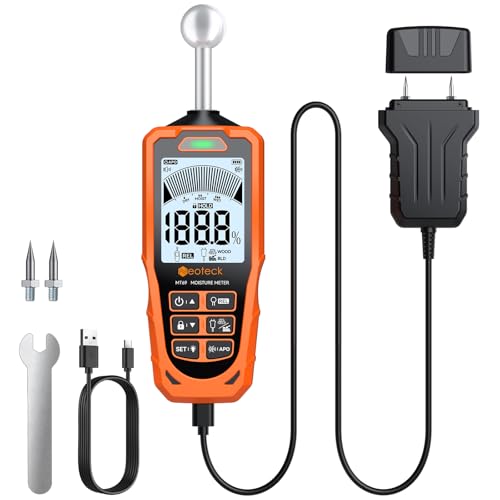
The dual-probe meter with a ±2.5% pin accuracy that locks in precise readings for concrete and wood alike.
Neoteck’s MT69 pairs a spherical pinless sensor (40 mm detection depth) with a separate pin probe that delivers ±2.5% accuracy on absolute moisture readings — one of the tightest precision specs on this list. For concrete, the pinless mode gives a quick relative sweep to find wet areas, and when you need a hard number, the pin mode reads building materials from 0–30% absolute with fixed alerts: Dry 2–7.9%, Moist 8–11.9%, Wet 12–30%. That split lets you use the non-invasive scan for speed and the pin probe for confirmation without carrying two separate tools.
Shoppers say the probe function is “useful for flooring and water damage detection” and call the design solid, easy to use, and affordable. The 1200mAh rechargeable battery with USB-C means a full day of heavy use on one charge — a notable upgrade over smaller batteries in budget meters. One detail worth flagging: the pinless mode requires the sensor to be pressed perfectly flush and vertical. If you tilt it or scan near an edge (less than 5 mm from a corner), the reading can spike falsely. Clean the measurement area, hold it flat, and the meter gives consistent results across concrete, cement, and gypsum. This model has tighter pin accuracy than the Proster PST309-CA, making it the better choice for pre-coating verification.
Standout strengths
- ±2.5% accuracy on pin mode for concrete (0–30%) and wood (0–52%).
- Large 1200mAh battery with USB-C keeps running through a long workday.
- Customizable dry/moist/wet thresholds for three material types.
- Mute function for silent inspections in occupied buildings.
Points to be mindful of
- Pinless mode gives relative values only, not absolute moisture content.
- Requires air calibration every time you switch to pinless mode — easy to forget.
- Readings may be affected by metal (nails/rebar), salts, or rough debris on the surface.
Best for: A serious DIYer or inspector who needs both a fast pinless sweep and a highly accurate pin reading, all in one rechargeable unit. The ±2.5% pin accuracy is the best among the dual-mode meters here, making it suitable for pre-coating verification.
Not ideal if: You only work on concrete floors and never need pin readings — the Wagner C555 is simpler and more specialized for that single job. Also, avoid if you cannot follow the calibration steps; skipping calibration invalidates every reading.
7. Proster Rechargeable Moisture Meter PST276-US

The entry-level, 5-mode pinless reader that is light enough to carry everywhere.
If you just need a simple relative moisture reader that works on concrete, wood, plaster, cement, and drywall without switching tools, the PST276-US packs five dedicated modes (Index, Concrete, Cement, Plaster, Wood) into a lightweight 160-gram body. The pinless sensor reads up to 40 mm deep, and the 3-color LCD backlight (green = dry, yellow = risk, red = wet) along with an audible alarm makes interpretation instant. The hold function freezes the reading so you can write it down or photograph it, and the built-in rechargeable lithium battery removes the need to buy replacement batteries — a clear win over disposable-cell meters.
Buyers call it “a moisture meter with 5 modes, 40mm depth, alarm, and rechargeable battery” and note that it works as intended for basic sweeps. Compared to the Neoteck NTK209, the Proster weighs 160 grams versus 170 grams — a small difference, but noticeable if you are holding it overhead for extended sweeps. The trade-off for the low entry cost is that this is a pinless-only relative meter; you will not get absolute moisture percentages, and the 0–100 scale needs manual conversion using the included reference table. It also shares a common limitation with all budget pinless meters: metal (nails, rebar, pipe) within the 40 mm detection field will produce a false reading, so sweep an inch to either side to confirm any hot spot.
Why it earns its spot
- Five material-specific modes (Concrete, Cement, Plaster, Wood, Index) in one unit.
- At 160 grams it is the lightest pick here — easy on the wrist for long sweeps.
- Rechargeable lithium battery eliminates ongoing battery cost.
- 3-color screen + audible alarm make it very beginner-friendly.
Where you compromise
- Pinless-only — no absolute percentage or pin probe for deep verification.
- Scale 0–100 requires manual conversion against the material reference table.
- No customizable alarm thresholds; you are locked to the factory defaults.
The right pick when: You are a homeowner or hobbyist who wants a fast, affordable way to check for damp spots in concrete, drywall, or wood without spending on pro-grade features. The 5-mode presets mean you get approximately correct readings for each material.
Not the one for: Anyone who needs absolute moisture content, pin-probe verification, or adjustable thresholds for job-site certification. Move up to the Proster PST309-CA or the Neoteck MT69 if you need measurable proof.
Understanding the Specs
Detection Depth
This is the distance (measured in millimeters) that the sensor can “see” into the material. A 40 mm depth rating means the meter reads moisture roughly 1.5 inches below the surface. For a standard concrete slab, you want at least 20–40 mm — shallow enough to catch surface moisture that affects coatings, deep enough to miss the normal slab-bottom dampness. The Tramex CME5 goes the deepest here with an optional probe reaching 100 mm (4 inches), which matters for thick structural screeds (a layer of concrete or mortar applied over a base to create a level surface).
Pinless vs. Pin Mode
Pinless meters use electromagnetic fields to measure moisture without touching the surface — fast and damage-free, but they give only relative numbers (like 0–100 or dry/yellow/red). Pin meters push two small needles into the material and measure electrical resistance, giving you an absolute moisture percentage (e.g., 4.2%). For concrete, pinless is standard because drilling a slab just to check moisture is impractical, but pin meters are useful for exposed lumber or for double-checking a suspicious pinless reading on a test patch.
FAQ
Can a concrete moisture meter read through tile or vinyl flooring?
What is the difference between relative and absolute moisture readings?
Will rebar or metal mesh inside concrete cause a false reading?
How deep does a concrete moisture meter need to read?
Can I use a wood moisture meter on concrete?
How do I calibrate a pinless concrete moisture meter?
What does ASTM F2659 mean for moisture meters?
How long does a concrete moisture meter battery last?
Can I use the pin mode on a dual meter to test fresh concrete?
Final Thoughts: The Verdict
Across the board, the best concrete moisture meter winner is the Wagner Meters C555 because it is built specifically for concrete, brick, and gypsum — no irrelevant modes, no guesswork on wood settings, and it delivers the kind of focused, repeatable readings that flooring inspectors trust on bare slabs. If you want both a pinless sweep and absolute pin verification in one USB-C rechargeable tool, grab the Neoteck MT69. And for a contractor who needs ASTM-compliant documentation with Bluetooth moisture mapping and an optional deep probe, the standout is the Tramex CME5.
How We Picked
We do not accept paid placement. Every pick is matched to a real buyer and a real use-case; we do not hands-on test units.
Sources & Methodology
Specifications: manufacturer listings and product documentation. Review insights: verified customer reviews, as of July 2026. Pricing: not shown on this page (it changes often); check the current price via the retailer link.
As an Amazon Associate, WellFizz earns from qualifying purchases. This does not affect which products we feature.
Related Guides

Mo Maruf
I created WellFizz to bridge the gap between vague wellness advice and actionable solutions. My mission is simple: to decode the research and give you practical tools you can actually use.
Beyond the data, I am a passionate traveler. I believe that stepping away from the screen to explore new environments is essential for mental clarity and physical vitality.