Our readers keep the lights on and my smoothie glass nicely filled. As an Amazon Associate, I earn from qualifying purchases.
Specs are compiled from manufacturer listings and verified buyer reviews and can change over time — please confirm the key details on the product page before buying.
You need a concrete mixer that gets the job done without rust flaking into your pour or a motor dying on the third batch. That means looking past the marketing at the motor power in watts, the drum size in cubic feet, and what real owners experienced after heavy use. This guide breaks down the honest strengths and real trade-offs of eight current models so you can pick one you can rely on for your project.
I’m Mohammad Maruf — the founder and writer behind WellFizz. This guide is built by comparing the manufacturers’ published specifications and the patterns across verified customer reviews, so you get each pick’s real strengths and trade-offs instead of marketing spin.
Finding the right tool for a slab or a weekend wall means matching the machine to your work. That is what this guide to the best concrete mixer helps you do.
Quick Picks
- BILT HARD Cement Mixer 4 Cu.Ft. Poly Drum — Best Overall
- BILT HARD Electric Cement Mixer, 4 Cubic Ft. Steel — Pro Grade
- SPECRAFT Electric Cement Mixer, 4.9 Cu.Ft — Best Design
- Oarlike 5 Cubic Ft Electric Cement Mixer — Large Capacity
- Fujampe Generic Portable 4.2 Cu Ft Concrete Cement Mixer — Best Value
- SPOWAY 5.0 Cu. Ft Electric Cement Mixer — Lowest Price, Big Drum
- ZeHuoGe 4.2 Cu. Ft Electric Cement Mixer — Mid-Range Pick
- TABU 3 Cu.Ft. Electric Cement Mixer — Budget Entry
How To Choose The Best Concrete Mixer
Picking a concrete mixer is less about the brand name and more about matching the machine to the scale of your work. Here is what actually matters.
Drum Capacity: Small vs Large Batches
Drum size is measured in cubic feet (cu. ft.), a unit of volume. It tells you the maximum volume the drum can hold — though you will rarely fill it all the way. A 3 cu. ft. unit handles about two 60-pound bags per batch, while a 5 cu. ft. model can take three 80-pound bags. Larger drums mean fewer cycles, but they are heavier and harder to move.
Motor Power: Watts and Horsepower
Motors in this category range from 250W (1/3 HP) to 650W (4/5 HP). Wattage (W) measures electrical power; horsepower (HP) is a mechanical power unit, where 1 HP equals 746W. A more powerful motor handles thicker, stiffer concrete mixes without stalling. For light mortar or animal feed, a 250W unit works fine. For heavy bagged concrete, aim for at least 500W. Pay attention to RPM (revolutions per minute) — lower RPM usually means more torque (twisting force) for the tough mixes.
Portability and Build Quality
Wheel size, frame material, and total weight decide how easy it is to move around. Look for steel frames with powder-coated finishes for rust protection. Larger wheels (9-10 inches) roll better over rough ground. A safety lock on the tilt mechanism keeps the drum steady while you pour, and a triangular base adds stability on uneven terrain.
Quick Comparison
| Model | Best For | Drum Capacity | Motor Power | Weight | Amazon |
|---|---|---|---|---|---|
| BILT HARD Poly 4 Cu.Ft. | Rust-proof reliability | 4.0 cu. ft. (mix 2.3) | 500W | 90.4 lb | Amazon |
| BILT HARD Steel 4 Cu.Ft. | Heavy-duty home use | 4.0 cu. ft. | 550W | 90.4 lb | Amazon |
| SPECRAFT 4.9 Cu.Ft | Wheelbarrow-style portability | 4.9 cu. ft. | 375W | 103.8 lb | Amazon |
| Oarlike 5 Cu Ft | Large batch capacity | 5.0 cu. ft. | 550W | — | Amazon |
| Fujampe Gen120 | Value and proven longevity | 4.2 cu. ft. | 1/2 HP | — | Amazon |
| SPOWAY 5.0 Cu. Ft | Budget large drum | 5.0 cu. ft. | 650W | — | Amazon |
| ZeHuoGe 4.2 Cu. Ft | Medium-duty value | 4.2 cu. ft. | 110V | 79.5 lb | Amazon |
| TABU 3 Cu.Ft. | Budget small jobs | 3.0 cu. ft. | 250W | 62 lb | Amazon |
In‑Depth Reviews
1. BILT HARD Cement Mixer 4 Cu.Ft. Poly Drum

You avoid paint chips in your concrete because this drum is poly (a heavy-duty plastic) — rust-proof and hose-cleanable.
The biggest headache with steel-drum mixers is the paint chipping and rusting inside the barrel after a few uses. This BILT HARD sidesteps that entirely with a heavy-duty poly drum that resists dents, cracks, and rust — and it cleans up in minutes with a hose. The motor is a 500W 120V 4.3A unit that spins at 24.0 RPM (revolutions per minute), slower than some competitors, giving it more torque (twisting force) to handle stiff concrete mixes without stalling. Buyers report the 10-inch flat-free tires roll easily over rough ground with no inflation needed, and the steel frame has a durable powder-coat finish. One buyer used it on a 10x12ft slab, mixing 2x 80lb concrete bags plus 2 gallons of water per batch, and ran it continuously for half a day with no issues. The mix capacity is 2.3 cubic feet inside the 4.0 cubic foot drum, so you know exactly what to load.
Unlike the steel-drum TABU model that weighs 62 lb, this unit comes in at 90.4 pounds — heavier, but you get the poly durability and a larger capacity. There is a small trade-off: one reviewer noted the drum arrived slightly oblong, but the company was responsive about it, and the mixer still worked fine after using over 50 bags of cement.
Why it stands out
- Poly drum is rust-proof and easy to clean — no paint chips in your concrete
- 10-inch flat-free tires roll easily without maintenance
- Mixed over 50 bags of cement with no performance drop, owners mention
What to watch for
- Plastic drum may arrive slightly out-of-round, though it functions fine
- Moving it when full is difficult due to the low-profile design
Grab it if: you want a rust-free, low-maintenance mixer for regular use with concrete bags up to 80 lbs each.
Think twice if: you need a machine for heavy-duty commercial use day in and day out — this is built for homeowners and serious DIYers, not continuous pros.
2. BILT HARD Electric Cement Mixer, 4 Cubic Ft. Steel

A 550W steel workhorse that ran 10 hours straight with zero complaints from one owner.
If you favor a traditional steel drum, this BILT HARD gives you a 550W motor (120V 5A) that spins the drum at 26.7 RPM — faster than the poly model and with more raw power for heavy mixes. The 4 cu. ft. drum handles a max load of about 180 lb, according to one reviewer who mixed 2x 60lb bags of stiff concrete and reported the motor stayed strong and the frame felt stable.
Assembly comes with lettered parts bags and a video guide, which customers note makes the process smooth. One owner ran it for almost 10 hours continuously with no problems at all. The 9-inch wheels and triangular steel bracket provide good stability even on uneven ground. A few owners pointed out the drum volume gets tight at a full load, and pouring into a wheelbarrow can be a bit sloppy, but the powder-coat finish cleans up easily. Compared to the SPECRAFT wheelbarrow-style mixer below, this BILT HARD is lighter at 90.4 pounds versus 103.8 pounds, and the motor is more powerful (550W vs 375W) for about the same price range. But the steel drum does mean you will need to watch for paint chips — though none of the reviews here report that issue yet.
Heavy hitter: A 550W motor and steel build that delivers pro-level mixing power for home use, as long as you pair it with clear instructions or a video guide.
Ideal for: landscaping projects, continuous mixing sessions, and anyone who prefers steel drums. skip it if: you want a rust-proof poly drum or need to move it around daily — the 90 lb weight is manageable but not easy.
3. SPECRAFT Electric Cement Mixer, 4.9 Cu.Ft
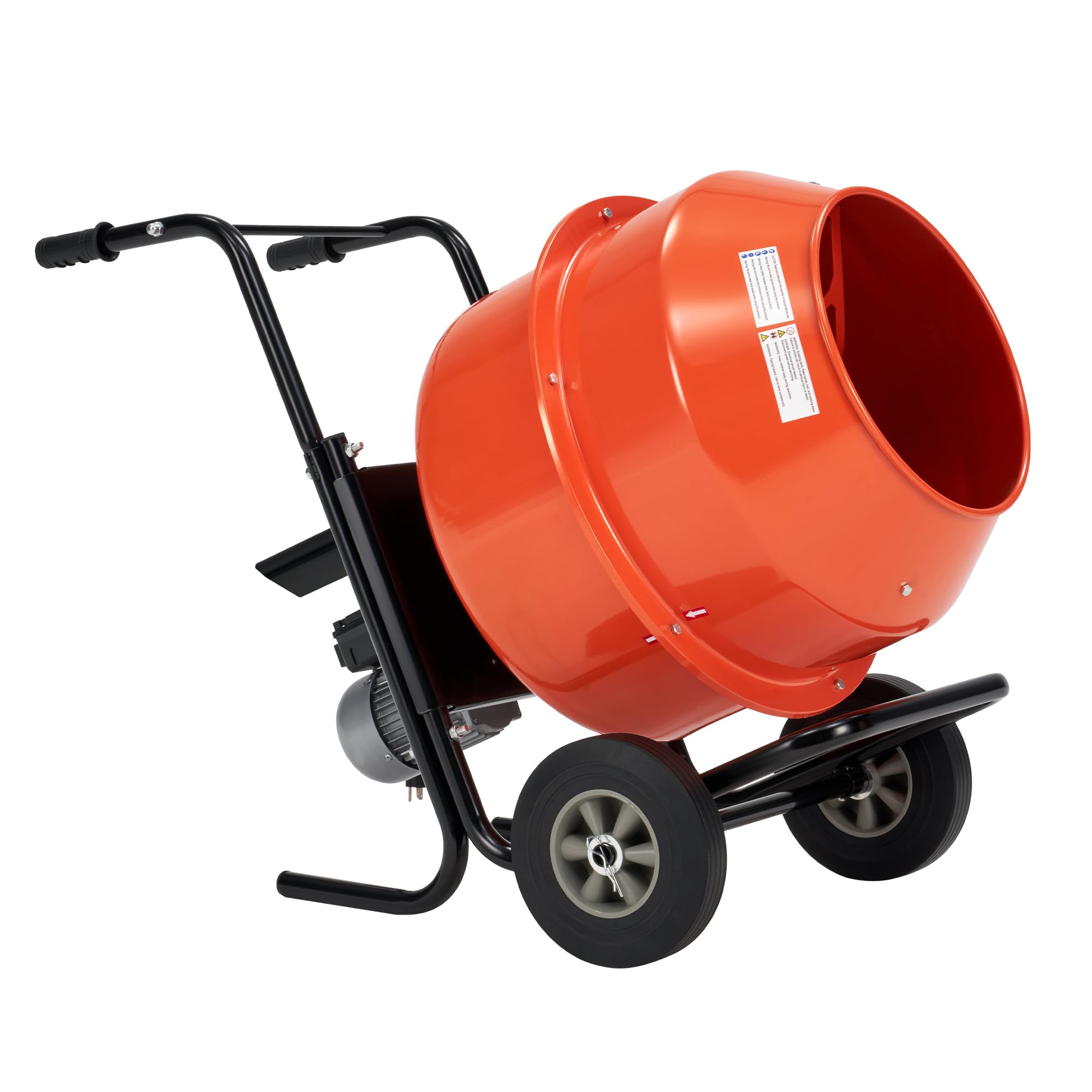
A wheelbarrow-style frame that mixes and hauls in one step — no separate wheelbarrow needed.
Most mixers force you to pour into a wheelbarrow, then move it. This SPECRAFT skips that step entirely — the wheelbarrow-style frame and ergonomic handle let you wheel the whole mixer to your pour site. The 375W motor runs at 29.5 RPM and drives a 4.9 cu.ft. steel drum with a 22.4-inch opening that makes loading easy. While the 103.8-pound weight makes it the heaviest unit here, the wheelbarrow design means you are rolling it, not carrying it.
Reviewers point out that it mixes three 60lb bags at a time comfortably, and one buyer mentioned adding 3/4 water first prevents sticking. The reinforced Q235 steel frame and rust-resistant coating hold up outdoors. The trade-off is motor power — at 375W, it is noticeably weaker than the 550W BILT HARD steel model, so it is better suited for mortar and stucco than stiff concrete mixes. One owner also noted the paint started peeling before first use, though the unit itself worked fine. Versus the 4.2 Cu. Ft ZeHuoGe at 79.5 lb, this SPECRAFT has a slightly larger drum (4.9 vs 4.2 cu. ft.) and a more portable frame, but weighs 24 pounds more and has less motor wattage.
Unique advantage
- Wheelbarrow-style frame eliminates the need for a separate transport
- 22.4-inch drum opening makes loading dry bags very easy
- Shoppers say it saves the back on medium and small jobs
Design catch
- 375W motor is less powerful than many competitors at this price point
- Paint quality on the drum has been called cheap by some owners
Best for: mortar, stucco, and medium-sized jobs where you want to move the mixer without a separate wheelbarrow. Not for: heavy bagged concrete or continuous pro-grade use.
4. Oarlike 5 Cubic Ft Electric Cement Mixer
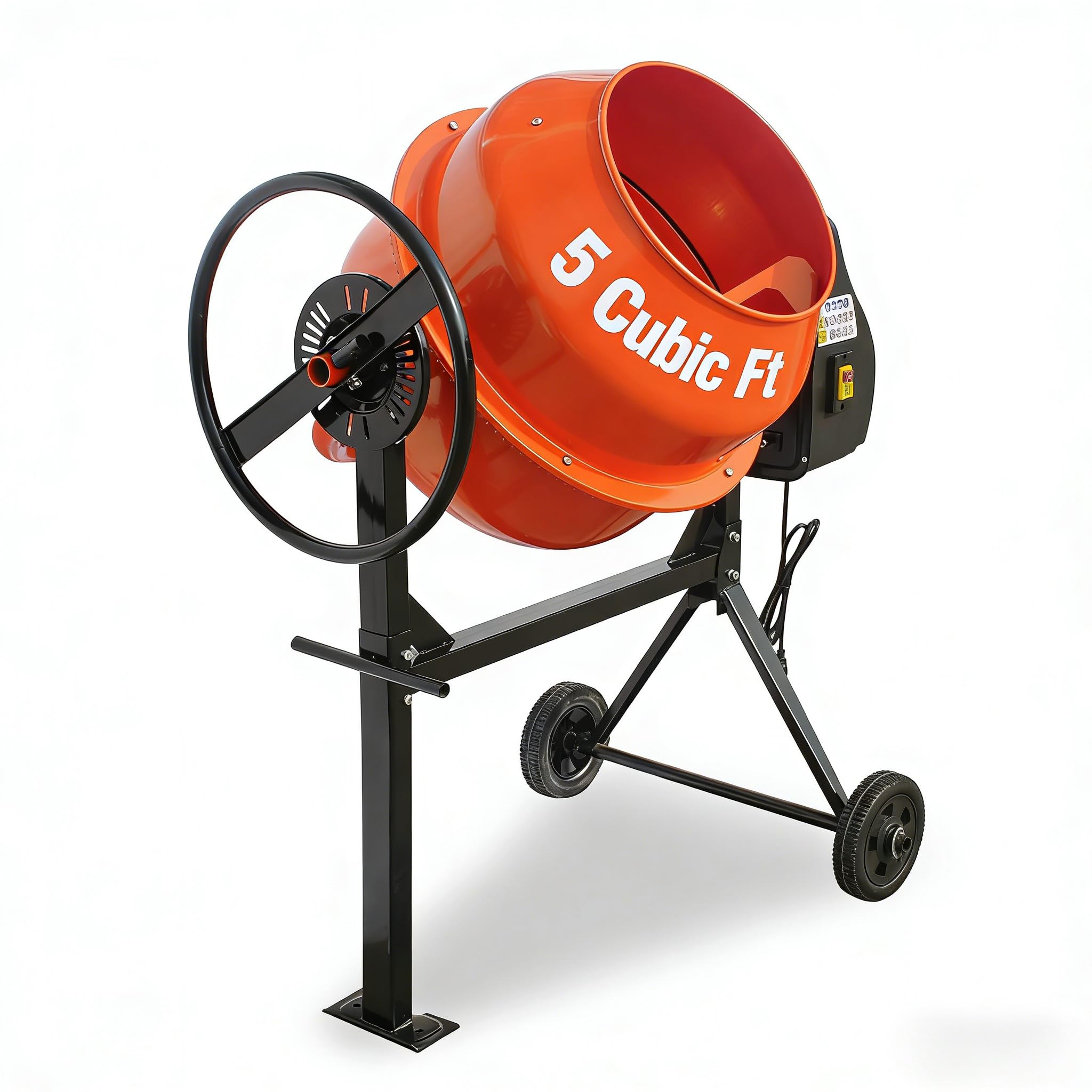
A 5-cubic-foot drum with a 220-lb load capacity — one reviewer mixed 120 bags without a breakdown.
This Oarlike mixer brings one of the largest drums you will find in a portable unit — 5 cubic feet — paired with a 550W copper-core motor (0.75 HP, where 1 HP = 746W) that spins at 2800 RPM. The mixing load capacity is 220 pounds, meaning you can realistically handle three 60-pound bags per batch and occasionally four if you watch the consistency. One owner reported mixing about 120 bags straight with no breakdown and was pleasantly surprised by the durability.
The heavy-duty steel frame has a powder-coated finish for corrosion resistance, and the two 9-inch wheels offer good shock resistance on job sites. Assembly is straightforward with lettered hardware bags, though the instructions could be clearer about the rubber gasket (a seal between drum parts) placement between the drum top and bottom. A couple of buyers noted the motor heats up noticeably during extended use, wishing the case had more ventilation. Against the SPOWAY 5.0 Cu. Ft unit, this Oarlike has a slightly different motor spec (550W vs 650W) but has been used for far more bags (120 vs 60 before failure reports) — suggesting better real-world reliability. The 5 cubic foot drum is larger than the 4.2 cu. ft. Fujampe model, so you make fewer batches for bigger pours.
Batch beast: A 5 cu. ft. drum and 550W motor that chewed through 120 bags of concrete for one reviewer, making it a strong contender for large DIY pours if you manage the motor heat.
Reach for it if: you are mixing large volumes (slabs, footings) and want a drum that can take three 60lb bags plus some room. Look elsewhere if: ease of assembly is critical — the manual has gaps, and gasket placement is not explained.
5. Fujampe Generic Portable 4.2 Cu Ft Concrete Cement Mixer

One owner used it for 3 years of heavy work and bought another — that is the track record here.
This Fujampe (sold as Generic on Amazon) has one of the strongest track records in this lineup. The 4.2 cu. ft. drum pairs with a 1/2 HP motor that spins at 36 RPM — noticeably faster drum rotation than many competitors, which helps get consistent mixes quickly. The alloy steel construction and triangular stand provide stability, and the low-profile height makes it easy to pour into forms or wheelbarrows.
One buyer who used it for three years of heavy work bought a second unit, calling it the “BEST VALUE for a cement mixer.” Another reviewer said it mixes large amounts quickly and cleans up simply by hosing it down. The motor has enough power that one owner used it in both 100°F heat and snow without issues. There is a catch, though: one customer observed the belt slipped off the drum due to a cheap sheet metal part, requiring a spacer washer to fix, and the assembly instructions are not great. At 4.2 cu. ft., it matches the ZeHuoGe below in capacity but costs less and has proven longevity that the ZeHuoGe does not yet have. Compared to the 5 cu. ft. Oarlike, this model has a 4.2 cu. ft. capacity but gains in portability and proven track record.
Why it wins on value
- One owner used it for 3 years of heavy work and bought another — real longevity proof
- 36 RPM drum speed for fast, consistent mixes
- Works well in extreme heat and cold, per reviews
Value trade-offs
- Belt pulley can slip off due to thin sheet metal; simple but annoying fix
- Assembly instructions are poor, requiring some mechanical expertise
Best for: budget-conscious buyers who want a machine that has proven it can last years. pass on it if: you want a straightforward out-of-box assembly experience.
6. SPOWAY 5.0 Cu. Ft Electric Cement Mixer
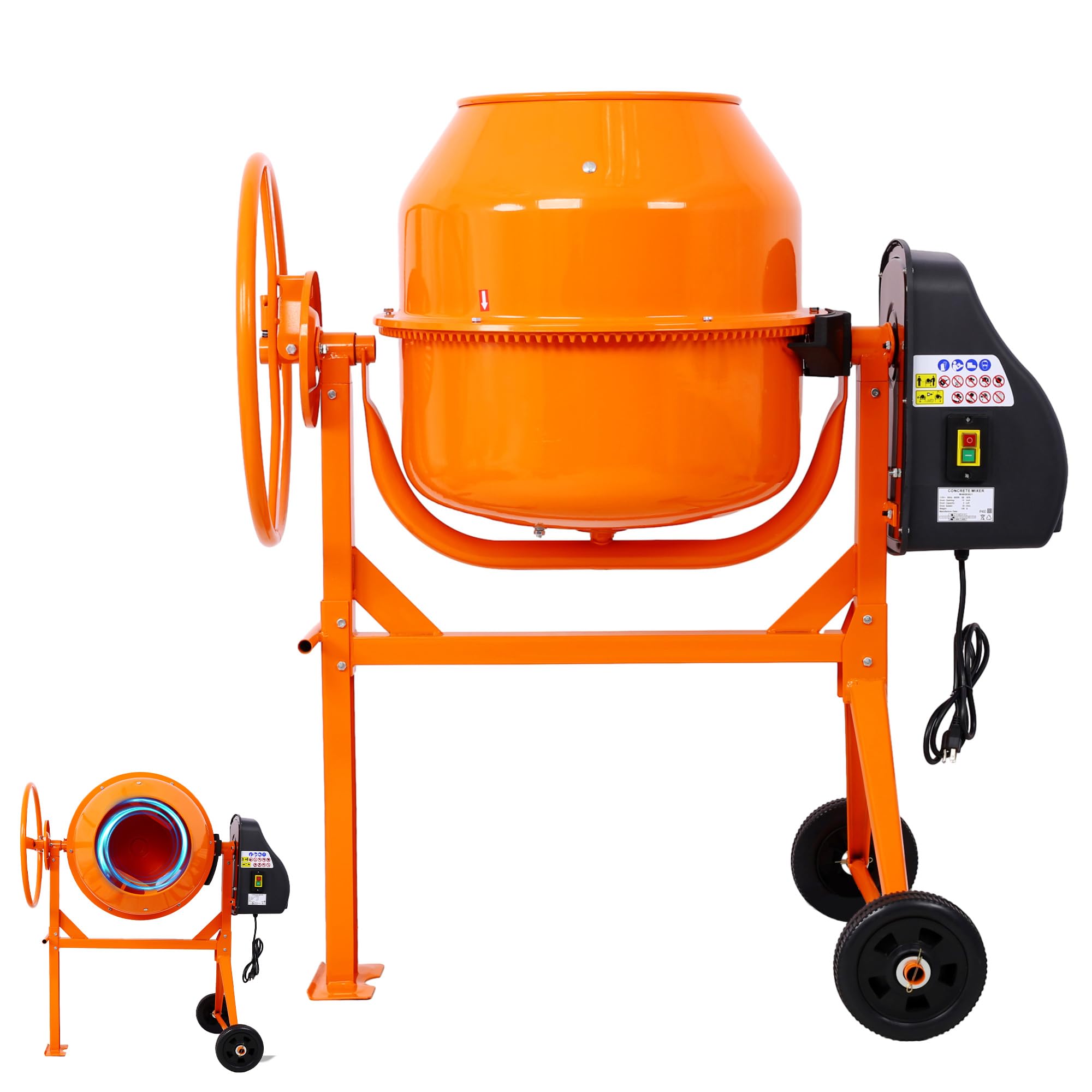
A 5.0 cu. ft. drum and 650W motor at an entry-level price — but buyers report paint chips and motor failures.
The SPOWAY hits a balance for buyers who want a large drum without spending premium money. At 5.0 cubic feet, it matches the Oarlike’s drum size — 67% larger than the 3.0 cu. ft. TABU model — and the 650W motor is the most powerful on paper here. The product dimensions are 44 x 22 x 47.99 inches, making it a substantial machine that needs a bit of space to operate.
Here is the reality check from buyers: one owner reported the paint on the interior drum surface chips off starting around the third or fourth bag, which means you are pulling paint flecks out of your concrete. Another review was blunt: “Stopped working after mixing 60 bags of concrete. Motor doesn’t run.” A different buyer said the unit functions as expected for general work but warned against using it for finish work because of the paint chipping. Not a single reviewer reported long-term reliability — the feedback is almost entirely about early failures. Compared to the Oarlike 5 Cu Ft which costs more but managed 120 bags, or the Fujampe that lasted 3 years of heavy use, the SPOWAY is best viewed as a budget entry into the large-drum category — one that may get you through a single project but not much more. The 44-inch length is longer than the TABU’s 38.2 inches, so check your storage space.
One-project wonder: The largest drum and most powerful motor at the lowest price, but paint chipping inside the drum and motor failure after 60 bags are dealbreakers for any long-term use.
Only for: a single big pour where you can accept paint chips in the mix and are okay replacing the machine afterward. Not for: finish work, multiple projects, or anyone who wants a mixer that lasts.
7. ZeHuoGe 4.2 Cu. Ft Electric Cement Mixer
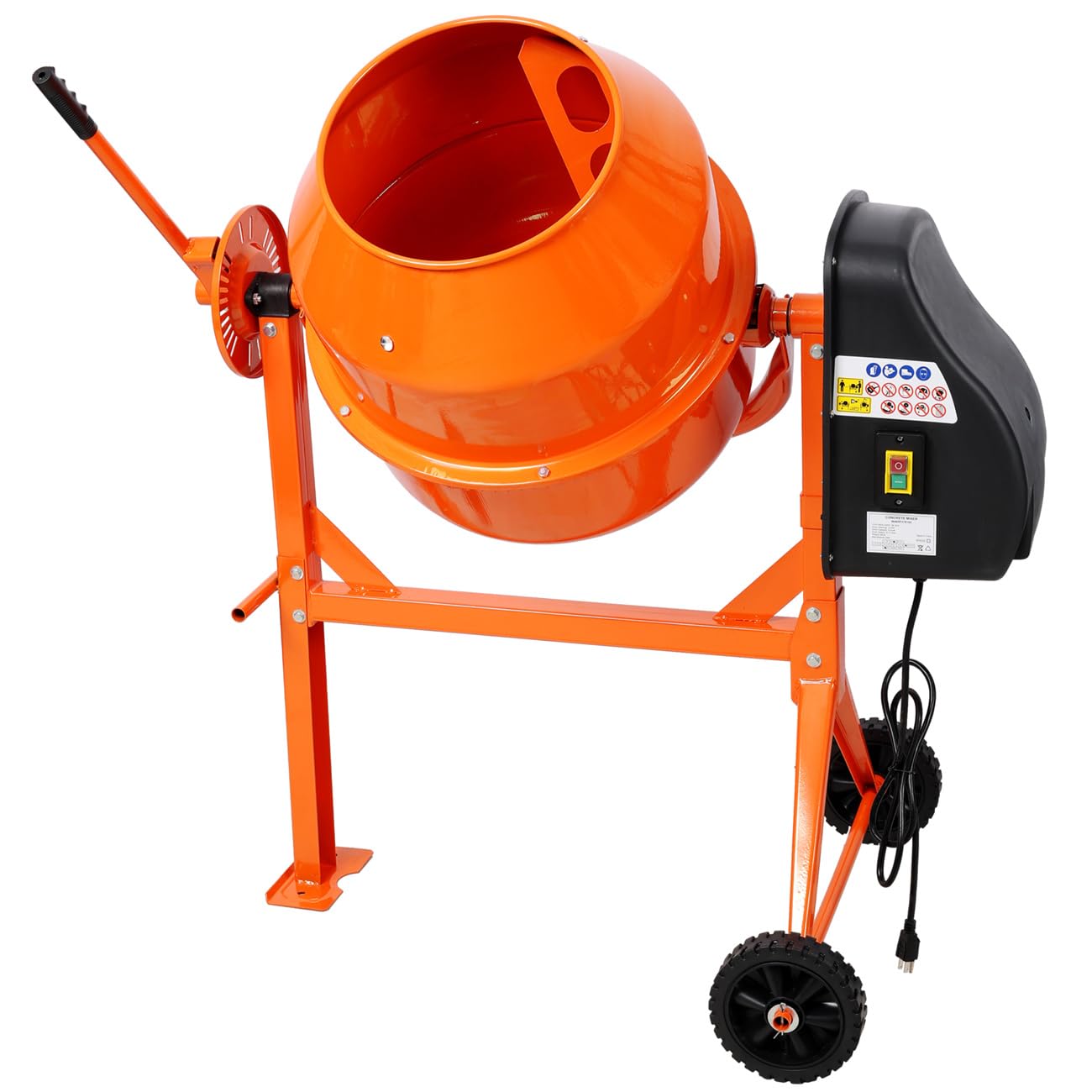
A 4.2 cu. ft. direct-drive mixer that cut batch time in half for one buyer — but assembly is a gamble.
The ZeHuoGe uses a 110V/60Hz electric direct-drive motor (a simple design where the motor turns the drum directly without belts), which is often more reliable than belt-driven units. At 79.5 pounds, it is heavier than the 62-lb TABU and lighter than the Oarlike, hitting a decent middle ground for portability. The 4.2 cu. ft. drum capacity is enough for mixing 4x80lb bags (half a wheelbarrow), according to one buyer, who said it cut mixing time by half.
Assembly is where the trouble starts. Multiple reviewers called out missing parts, terrible instructions, and a drum that leaked badly from the start — one owner had to apply silicone seal to fix it. Another found an internal wire disconnected that required opening the housing. The mixer itself, once put together, has been reliable for some: one reviewer ran it for 1 month straight on 12-hour daily shifts and called it solid. But that is a risky gamble for the average buyer who just wants to mix some concrete. Versus the SPOWAY above, this ZeHuoGe has a smaller drum (4.2 cu. ft. vs 5.0 cu. ft.) and a less powerful motor (110V direct-drive vs 650W), but the direct-drive setup could be more durable long-term if you get a good unit. The 41.5 x 27.75 x 50.75-inch dimensions are more compact than the 44-inch SPOWAY.
Potential upside
- Direct-drive motor is simpler mechanically than belt-driven competitors
- Mixes 4x80lb bags and cuts batch time in half, per one buyer
- One unit ran 12 hours daily for a month without issues
Real concerns
- Multiple reports of leaking drums, missing parts, and bad instructions
- Top-heavy design when mixing; base stability is questionable
Consider it if: you are mechanically handy and can fix leaks, missing fasteners, and wire disconnections — the motor itself may be fine. Avoid if: you want a reliable out-of-box experience for your weekend project.
8. TABU 3 Cu.Ft. Electric Cement Mixer
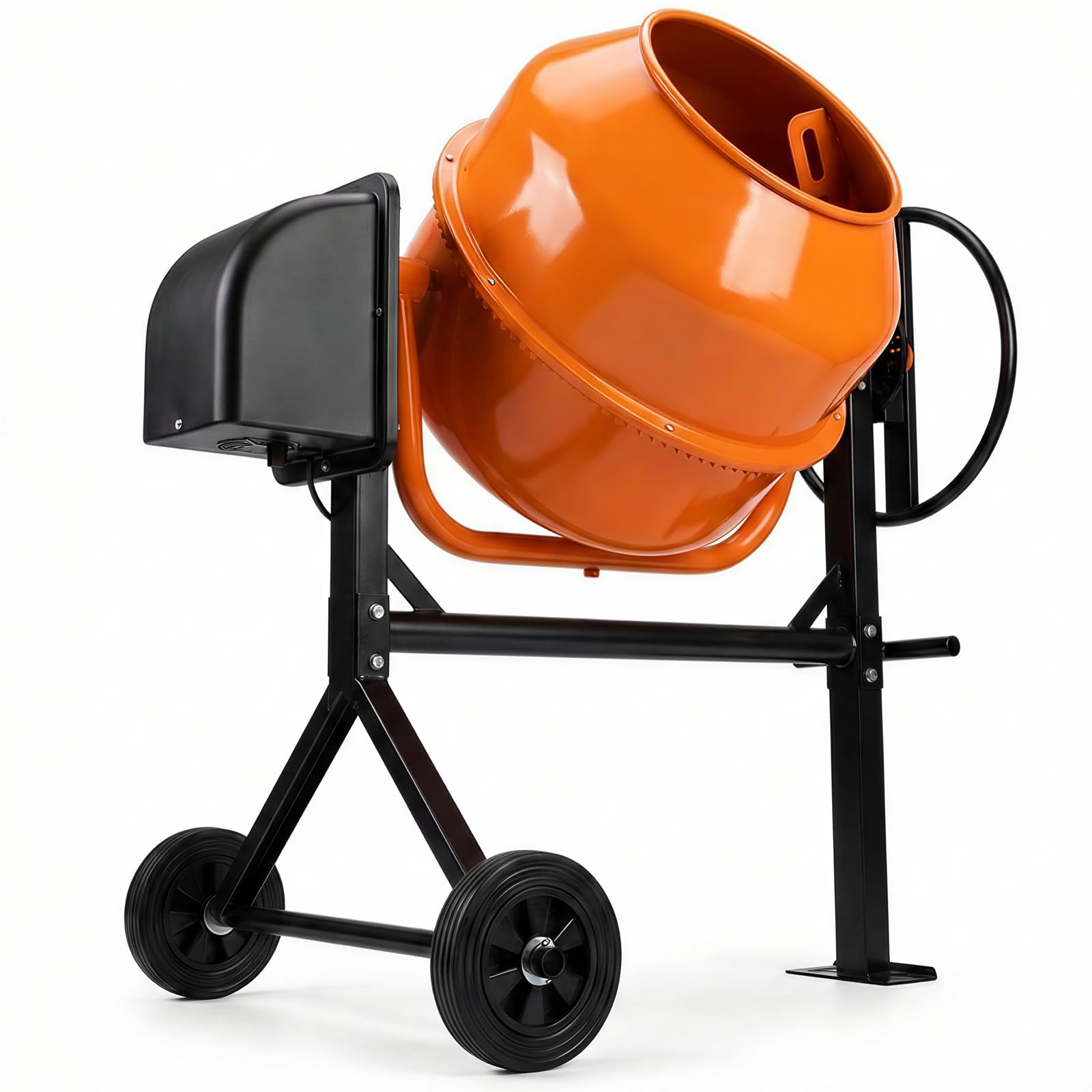
A compact 3 cu. ft. mixer at 62 lb, but it broke on first use with an 80lb bag, per one buyer.
The TABU is the smallest and lightest unit here at 3.0 cu. ft. and 62 pounds, making it easy to move around and store. The 250W motor (1/3 HP) drives the drum, and the 15-inch drum diameter makes adding dry mix simple. The product dimensions are 38.2 x 37.4 x 22.4 inches, which is 15% less in total volume than the SPOWAY’s 44-inch length, so it fits in a compact garage corner.
The honest picture from buyers is rough. One review was straightforward: “Broke on first use mixing 1 bag of 80lb concrete; internal motor failure.” The buyer confirmed correct assembly but said customer service required costly return shipping and refused video proof of the defect. Another owner warned the center bearing “sounds like it will break any day” and hoped it would last through their project. A few lighter-use buyers had better luck — one uses it for mixing chicken grain and called it a good value — but the majority point to reliability issues even with small loads. Against the 4.2 cu. ft. Fujampe, the TABU holds 3.0 cu. ft. and has a much weaker motor (250W vs 1/2 HP), but costs less and weighs 62 lb versus the heavier competition. If your only use is mixing small batches of mortar or animal feed, it may serve — but for bagged concrete, the failure risk is high.
Risky starter: Light, compact, and cheap, but failed on first use with a single 80lb concrete bag for at least one buyer — the 250W motor simply cannot handle stiff mixes.
Only for: lightweight jobs like mixing chicken feed, seeds, or very small mortar batches with 60lb max bags — never 80lb concrete. Skip if: you plan to mix standard bagged concrete for any slab, walkway, or foundation work.
Understanding the Specs
Drum Capacity (Cu. Ft)
This is the maximum volume of the drum, measured in cubic feet. It tells you the theoretical top end, but you will never fill it completely — the usable mix capacity is usually 60-70% of the drum size. A 3 cu. ft. drum handles 1-2 bags of concrete per batch, while a 5 cu. ft. drum can take 3-4 bags. Larger drums mean fewer cycles, but they also mean heavier machines that are harder to move.
Motor Power (Watts / Horsepower)
Motor power determines whether your mixer can handle stiff concrete without stalling. A 250W (1/3 HP) motor is fine for light mortar, stucco, and agricultural mixing. A 500W-550W (around 2/3 HP) motor handles standard bagged concrete. The 650W SPOWAY is the most powerful on paper, but reliability matters more than raw wattage — a well-built 500W motor from a proven model is better than a 650W motor that fails after 60 bags. Lower RPM typically means more torque for tough mixes.
Weight and Portability
Weight matters because you will move a concrete mixer more often than you think — to storage, to different parts of the site, or into a truck. Options range from 62 lb (TABU) up to 103.8 lb (SPECRAFT). The heavier units are more stable during mixing but harder to transport. Look for wheel size: 9-10 inch wheels roll better over rough ground and grass. Flat-free tires save you from maintaining air pressure. A wheelbarrow-style frame (like the SPECRAFT) lets you roll the mixer directly to the pour area.
Drum Material: Steel vs Poly
Steel drums are traditional and durable, but the paint on the interior often chips off after a few bags, leaving flakes in your concrete that can ruin finish work. Poly drums (plastic) resist dents, cracks, and rust completely, and they clean up by just hosing out. The trade-off is that poly drums can arrive slightly out of round from shipping, though it rarely affects performance. For finish work like countertops or exposed aggregate, a poly drum is the safer bet to avoid paint contamination.
FAQ
What size concrete mixer do I need for a small patio or walkway?
Can I use a concrete mixer for mixing stucco or mortar?
How many 80lb bags of concrete can a 5 cu. ft. mixer handle per batch?
How do I prevent concrete from sticking inside the drum?
Is a poly drum better than a steel drum for concrete mixing?
What does the safety lock on a concrete mixer do?
How long do concrete mixers typically last with regular home use?
Can I mix animal feed or seeds in a concrete mixer?
Final Thoughts: The Verdict
Across the board, the best concrete mixer winner is the BILT HARD Poly 4 Cu.Ft. — its rust-proof poly drum and 500W motor deliver a reliable, low-maintenance experience for concrete, mortar, and feed without paint chips or rust worries. If you want the largest drum for big pours, grab the Oarlike 5 Cu Ft. And for a proven value that has stood up to years of real work, the standout is the Fujampe Gen120.
How We Picked
We do not accept paid placement. Every pick is matched to a real buyer and a real use-case; we do not hands-on test units.
Sources & Methodology
Specifications: manufacturer listings and product documentation. Review insights: verified customer reviews, as of July 2026. Pricing: not shown on this page (it changes often); check the current price via the retailer link.
As an Amazon Associate, WellFizz earns from qualifying purchases. This does not affect which products we feature.
Related Guides

Mo Maruf
I created WellFizz to bridge the gap between vague wellness advice and actionable solutions. My mission is simple: to decode the research and give you practical tools you can actually use.
Beyond the data, I am a passionate traveler. I believe that stepping away from the screen to explore new environments is essential for mental clarity and physical vitality.