Our readers keep the lights on and my smoothie glass nicely filled. As an Amazon Associate, I earn from qualifying purchases.
Filling those gaps with the wrong material leads to re-cracking, shrinkage, or a patch that stands out worse than the original flaw. A quality concrete leveler solves this by bonding permanently, moving with the slab, and creating a smooth, seamless surface that looks professional and holds up against weather and traffic.
I’m Mohammad Maruf — the founder and writer behind WellFizz. I’ve spent hundreds of hours analyzing product formulations, reading real-world application reports, and comparing the tensile strength, elasticity, and cure times of the top concrete repair compounds on the market to separate the reliable formulas from the ones that fail within a season.
This guide narrows the field to the most effective options so you can repair with confidence. Whether you need a fast-drying patch for a deep pothole or a flexible sealant that handles freeze-thaw cycles, the best concrete leveler must offer strong adhesion, weather resistance, and a smooth finish that blends with the existing surface.
How To Choose The Best Concrete Leveler
The right concrete leveler depends entirely on where you’re applying it, how wide the gap is, and what kind of traffic the surface sees. A rigid patch that works fine on a basement floor will shatter on a driveway exposed to freeze-thaw cycles. Here are the three factors that matter most before you buy.
Elasticity and Movement Capacity
Concrete expands and contracts with temperature changes, and rigid fillers will crack under that stress. Look for a leveler that advertises high elasticity or a movement capacity of at least 25 percent — this means the cured compound can stretch and compress without losing its bond. Rubberized or polyurethane formulas typically offer the best flexibility for outdoor slabs and walkways.
Self-Leveling vs. Trowel-Grade
Self-leveling liquids flow into gaps and settle flat on their own, making them ideal for horizontal cracks on driveways and patios where a smooth finish is required. Trowel-grade pastes are thicker and better suited for vertical surfaces or deep potholes that need to be built up in layers. If you’re working on a sloped surface, a self-leveling compound may run out before curing, so a thicker patch is the safer choice.
Bond Strength and Cure Time
A leveler that dries too fast may not have time to penetrate deep into the crack, leading to weak adhesion. A formula that takes days to cure is impractical for high-traffic areas. The sweet spot is a material that sets within two hours and reaches full cure in 24 to 48 hours. Polymer-modified and epoxy-based patches generally offer the strongest bond to existing concrete and resist peeling under heavy loads like vehicles.
Quick Comparison
On smaller screens, swipe sideways to see the full table.
| Model | Category | Best For | Key Spec | Amazon |
|---|---|---|---|---|
| LUVBOATE 4.5LB | Self-Leveling | Large cracks on driveways | 74 oz, MS Polymer, 24-48h cure | Amazon |
| YKF 4-Pack | Self-Leveling | Multiple repair projects | 4.4 lbs, acrylic, 4 pouches + scrapers | Amazon |
| DAMTITE BondsOn | Trowel-Grade Patch | Thin resurfacing & feather-edges | 12 lb powder, spreads to 1/16″ | Amazon |
| Rust-Oleum EPOXYShield | Epoxy Patch | Garage floors before epoxy paint | 24 oz, low odor, 8h full cure | Amazon |
| Henry ARDEX LP | Pre-Mixed Patch | Small indoor floor dips | 1 gallon, trowel-on, 6-8h dry | Amazon |
| NIEFARG Crack Filler | Flexible Sealant | Weed prevention in driveways | 35.3 fl oz, rubber, waterproof | Amazon |
| Sikaflex 1C SL 12-Pack | Polyurethane Sealant | Expansion joints & commercial slabs | 10 oz tubes x12, 25% movement | Amazon |
In‑Depth Reviews
1. LUVBOATE 4.5LB Self-Leveling Concrete Crack Filler

The LUVBOATE 4.5LB formula sits at the intersection of professional-grade adhesion and DIY-friendly application. Its MS Polymer base delivers high elasticity that accommodates ground movement and frequent traffic without pulling away from the crack walls. The self-leveling behavior means you simply inject the liquid into the gap and let physics do the smoothing — no trowel work required for horizontal surfaces.
Weather resistance is a standout here. The cured sealant forms a waterproof barrier that holds up against UV exposure and extreme temperature swings, making it suitable for driveways, patios, and even flat roofs. Users report the color is a bit lighter than typical aged concrete, but they note that the difference tends to blend over time as dust and dirt settle into the surface texture.
At 74 ounces in a single container, this is one of the better bulk values in the mid-range category. The included scraper and gloves reduce the need for separate tool purchases. The only tradeoff is that very wide cracks may require multiple applications because the liquid self-levels to a thin film rather than building up in one pour.
Why it’s great
- High flexibility MS polymer formula handles expansion and contraction without cracking
- Self-leveling design creates a smooth finish with minimal effort
- Waterproof barrier protects against rain, snow, and ice infiltration
Good to know
- Color may appear slightly lighter than the existing concrete surface
- Deep or wide gaps may need two passes to fill completely
2. YKF Concrete Crack Filler 4-Pack (4.4 lbs)
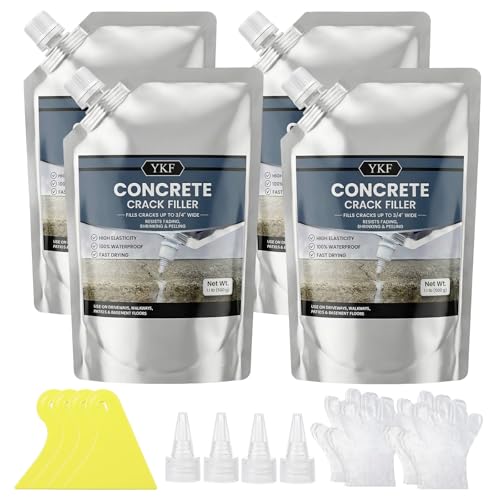
The YKF 4-Pack is built for the homeowner who has more than one crack to fill. With four 1.1-pound pouches and four smoothing scrapers included, this kit lets you tackle an entire driveway or garage floor without worrying about running out mid-project. The acrylic-based liquid flows into gaps up to three-quarters of an inch wide and cures to a flexible rubber-like consistency that moves with the slab.
What sets this pack apart is the temperature tolerance. The formula remains stable from negative 40 up to 180 degrees Fahrenheit, which means it won’t shrink in summer heat or become brittle during winter freezes. Users consistently mention that the self-leveling action works well on flat surfaces, though on sloped areas the liquid may run before it sets, so a backer rod is recommended for deeper joints.
The lower cost per ounce compared to single-pouch options makes this a smart buy for anyone planning ongoing maintenance. The only frequent complaint is that each pouch is relatively small — covering roughly several short cracks each — so for a single massive gap, you may still need to combine pouches to get sufficient depth.
Why it’s great
- Excellent value with four pouches and scrapers in one kit
- Handles extreme temperatures from -40°F to 180°F without degrading
- Cures to a flexible bond that resists re-cracking under movement
Good to know
- Not ideal for sloped surfaces — self-leveling liquid may run downhill
- Each pouch covers only a few moderate cracks; large jobs consume multiple pouches quickly
3. DAMTITE BondsOn Vinyl Concrete Patch (12lb)
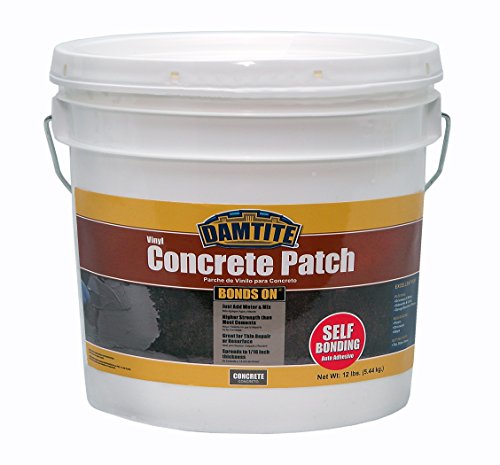
The DAMTITE BondsOn is a powder mix that requires only water to activate, giving you control over the final consistency in a way that pre-mixed liquids cannot match. The vinyl resin additive boosts compressive strength beyond what standard cement offers, and the material spreads to a feather edge as thin as one-sixteenth of an inch without crumbling. This makes it the go-to choice for resurfacing spalled concrete or blending patch edges into the surrounding slab.
Application requires a bit more technique than a squeeze-pouch filler. The working time is decent — around 10 to 15 minutes — but the patch hardens quickly, so mixing in small batches is recommended. Users who pre-wet the repair area report significantly better adhesion, especially on vertical surfaces like steps and brick parging. The finish dries smooth and can be sanded or rubbed with a rub brick if the texture needs adjustment.
Coverage is rated at 10 square feet at an eighth-inch thickness, making the 12-pound pail suitable for medium-sized repair zones rather than hairline cracks. The main drawbacks are the need for mixing tools and the fact that the dry powder is lighter in color than most aged concrete, though this can be addressed with a concrete colorant if a perfect match is required.
Why it’s great
- Higher compressive strength than typical cement patches
- Spreads to a feather edge as thin as 1/16 inch for seamless blending
- Works on vertical surfaces with proper surface pre-wetting
Good to know
- Requires mixing with water and measuring — not a ready-to-use formula
- Dries lighter than most aged concrete; may need pigment for color matching
4. Rust-Oleum 215173 EPOXYShield Concrete Patch (24-Ounce)
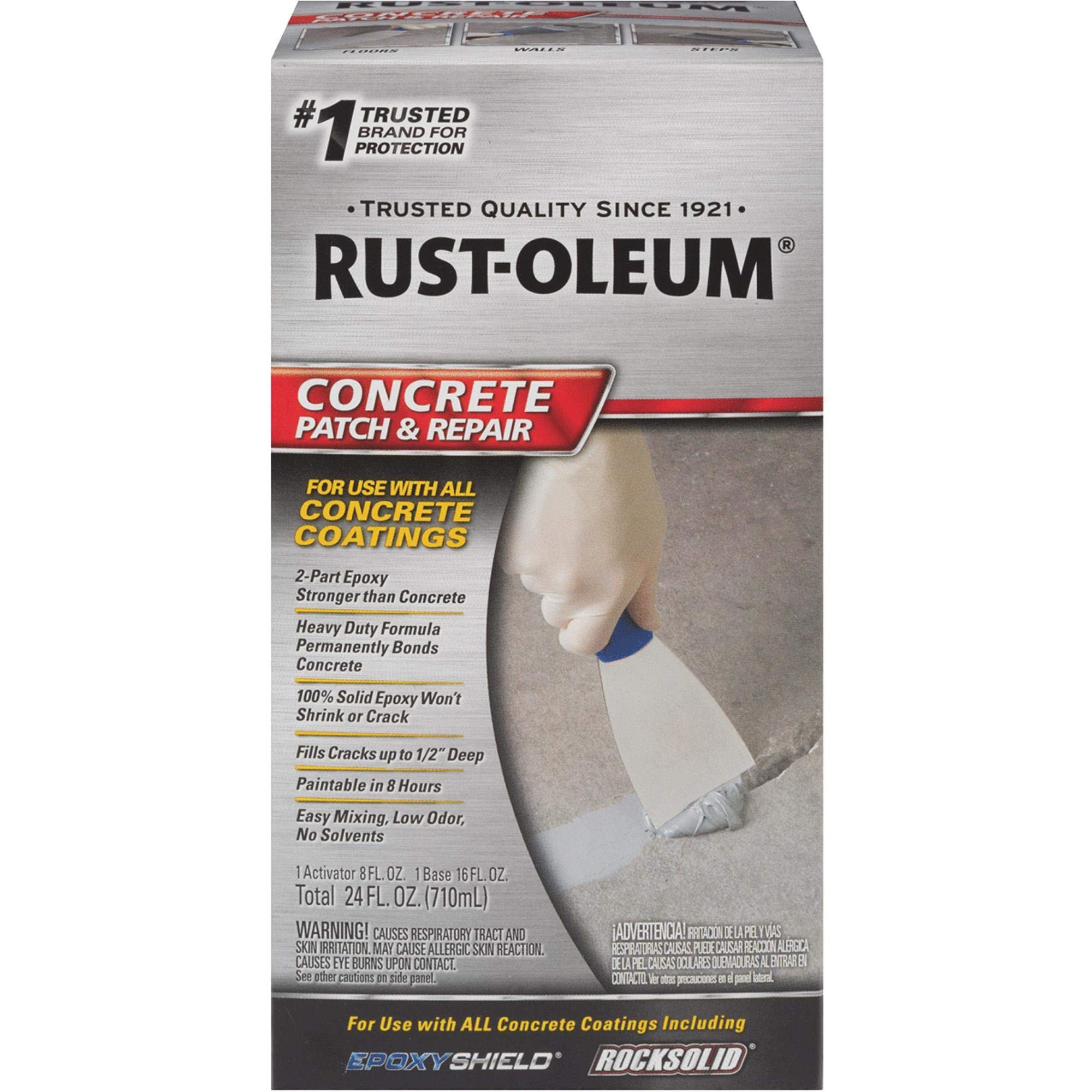
The Rust-Oleum EPOXYShield Patch is specifically engineered as a preparatory layer for epoxy floor coatings. It bonds permanently to concrete, does not shrink while curing, and provides a smooth substrate that prevents the topcoat from cracking over underlying flaws. The low-odor formula makes it tolerable for indoor garage work where ventilation may be limited.
Users report a working time of roughly 20 to 25 minutes, which gives you room to trowel the patch into place and feather the edges before it sets. For cracks deeper than a quarter inch, multiple thin coats are necessary because applying too thick a layer significantly extends the drying time. Once fully cured — about eight hours — the patch becomes rock hard and can be sanded if needed before painting.
A common trick among experienced users is to apply the patch using a pastry bag or a small funnel to minimize waste and keep the application precise. The finish dries to a slightly shiny, darker gray than the surrounding concrete, but this is irrelevant if you plan to coat the entire floor with epoxy. The 24-ounce can covers roughly 40 linear feet of standard crack width.
Why it’s great
- Designed to bond with epoxy floor coatings for a seamless finish
- Low-odor formula reduces fumes during indoor application
- Rock-hard cure that withstands vehicle traffic without crumbling
Good to know
- Thick applications take much longer to dry — use thin coats only
- Shiny darker finish may not match bare concrete cosmetically
5. Henry ARDEX LP Pre-Mixed Floor Patch (1 Gallon)
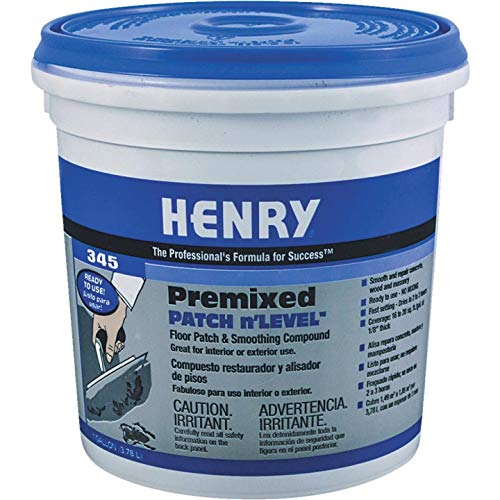
The Henry ARDEX LP is a pre-mixed, trowel-grade patching compound that comes ready to use straight out of the pail. It is not a self-leveling liquid — you spread it with a trowel and feather the edges manually — but that gives you precise control over the thickness in small areas. This makes it the preferred option for fixing localized dips and indentations in indoor subfloors before laying tile, vinyl, or carpet.
The recommended application thickness is one-eighth to one-quarter inch per coat. For deeper repairs exceeding a quarter inch, a powder mix with hardener is a better choice. When applied correctly, the patch dries within six to eight hours to a hardness comparable to light concrete.
Users consistently praise how easy it is to work with for small floor repairs like filling the footprint left by an old kitchen island. The product ships in a one-gallon pail, which is adequate for patches around two feet by four feet at the recommended thickness. Shipping damage is the most common issue reported — the pail lid can break open in transit, so inspect the seal upon arrival.
Why it’s great
- Pre-mixed and ready to use — no measuring or blending required
- Dries to a hard, sandable surface suitable for floor coverings
- Excellent for small indoor patches like subfloor dips and indents
Good to know
- Not self-leveling; requires trowel work to achieve a flat surface
- Thicker coats take significantly longer to dry — stick to 1/4 inch per layer
6. NIEFARG Concrete Crack Filler (35.3 Fl Oz)
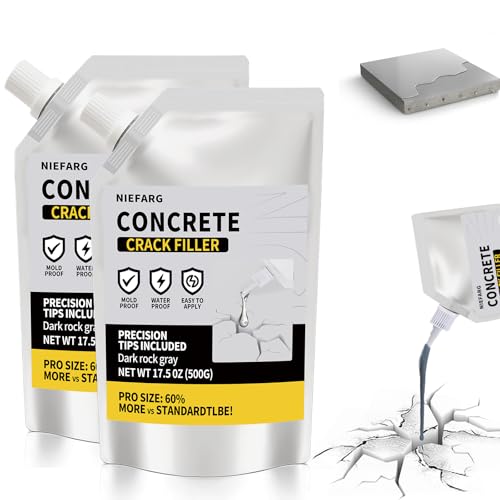
The NIEFARG Crack Filler is a rubber-based, ready-to-use sealant designed specifically for surface cracks on driveways, patios, and sidewalks. Its high-elasticity formula expands and contracts with temperature shifts, preventing the common failure mode where rigid cement fillers crack open again within a few months. The waterproof, oil-resistant barrier also blocks weed and grass growth from settling into the repaired gaps.
Application is straightforward — no mixing, no tools beyond a cleaning brush and a smoothing tool. The filler sets in about two hours and reaches full cure within 24 to 48 hours. Users consistently highlight the ease of use, with several reporting that even first-time DIYers achieved professional-looking results. The main caveat is that the pouch can be somewhat difficult to squeeze for those with limited hand strength, especially as the tube empties.
At 35.3 fluid ounces, this is a budget-friendly option designed for moderate crack loads. The rubberized finish stays flexible indefinitely, but the color is a uniform gray that may appear slightly darker than the surrounding concrete. For weed control between expansion joints, this formula is particularly effective because the flexible seal leaves no gap for seeds to take root.
Why it’s great
- High-elasticity rubber formula prevents re-cracking from ground movement
- Block weed growth by sealing gaps completely against moisture and dirt
- No mixing required — apply directly from the pouch
Good to know
- Squeezing the pouch can be challenging for users with weaker grip strength
- Color is slightly darker than aged concrete, though it blends over time
7. AWF PRO Sikaflex 1C SL 10 oz Limestone (Pack of 12)

The Sikaflex 1C SL is a premium-grade, single-component polyurethane sealant designed for horizontal expansion joints in commercial and residential slabs. It meets federal specification TT-S-00230C and ASTM C-920 standards, confirming its performance under demanding conditions. The self-leveling formula cures to a tough, flexible consistency that accommodates up to 25 percent joint movement without tearing or losing adhesion.
Application requires a caulking gun — preferably a battery-powered model for consistent flow — because the consistency is about as thick as honey. The sealant self-levels slowly after being dispensed, creating a smooth surface without needing to be tooled. Users advise using foam backer rod in deeper joints to reduce the amount of sealant consumed, as the material is expensive per cartridge. Each 10-ounce tube covers roughly two linear feet of a joint that is half an inch deep and one and a half inches wide.
The 12-pack brings the per-cartridge cost down versus buying individually, but this is still the highest upfront investment on this list. The value becomes clear when you need long-term performance on critical joints like pool decks, warehouse floors, or plaza pavements where a failed sealant means expensive water damage repairs. The color is a light limestone gray that blends reasonably well with bare concrete over time.
Why it’s great
- Meets stringent ASTM and federal standards for structural joint sealing
- 25 percent movement capacity handles extreme expansion and contraction
- Self-leveling behavior creates a professional finish without tooling
Good to know
- High per-cartridge cost adds up quickly on large jobs
- Thick consistency requires a quality caulking gun for even application
FAQ
Can I drive over a self-leveling concrete patch immediately after it dries?
What causes a concrete leveler to crack after application?
Do I need to use a backer rod before applying concrete leveler?
Final Thoughts: The Verdict
For most users, the best concrete leveler winner is the LUVBOATE 4.5LB Self-Leveling Crack Filler because it combines MS Polymer flexibility, waterproof performance, and enough volume to handle a full driveway without needing a second purchase. If you want a mix-it-yourself patch for feather-edge resurfacing, grab the DAMTITE BondsOn. And for commercial-grade expansion joints that must last for years, nothing beats the Sikaflex 1C SL 12-Pack.

Mo Maruf
I created WellFizz to bridge the gap between vague wellness advice and actionable solutions. My mission is simple: to decode the research and give you practical tools you can actually use.
Beyond the data, I am a passionate traveler. I believe that stepping away from the screen to explore new environments is essential for mental clarity and physical vitality.