Our readers keep the lights on and my smoothie glass nicely filled. As an Amazon Associate, I earn from qualifying purchases.
Specs are compiled from manufacturer listings and verified buyer reviews and can change over time — please confirm the key details on the product page before buying.
Drilling into concrete is a different game than wood. A standard drill spins fast but lacks the punch to crack aggregate — you end up pushing, burning bits, and making little progress. A concrete hammer drill delivers a short, rapid piston-like blow that fractures the material as the bit turns. Pick the right one, and you go through a foundation wall like a knife through butter. Pick wrong, and you waste time and dull bits.
I’m Mohammad Maruf — the founder and writer behind WellFizz. This guide is built by comparing the manufacturers’ published specifications and the patterns across verified customer reviews, so you get each pick’s real strengths and trade-offs instead of marketing spin.
Whether you are anchoring a heavy shelf into cinder block or breaking up a slab for a plumbing run, these seven picks represent the strongest contenders in the concrete hammer drill category right now, with real owner experience backing every claim.
Our Picks at a Glance


How To Choose The Best Concrete Hammer Drill
The most important distinction in this category is between a standard hammer drill and a rotary hammer. A standard hammer drill uses a cam-action mechanism that delivers a weak, high-frequency vibration — fine for occasional brick or masonry. A rotary hammer uses a piston-driven electro-pneumatic mechanism that delivers far more impact energy per blow. For reinforced concrete, slab work, or anchor holes deeper than an inch, you want a rotary hammer. The picks below include both types, clearly noted.
Impact Energy: The True Measure of Power
Look at the impact energy rating, measured in foot-pounds (ft-lbs) or Joules. A rotary hammer with 2.6 ft-lbs of impact energy, like the BOSCH RH328VC, can drill a half-inch rebar hole in seconds. A standard hammer drill has no impact energy rating at all — it relies on motor torque alone. For anchoring into a foundation, aim for 2 ft-lbs or higher. For light chipping or small diameter holes in block, a standard hammer drill may be enough.
Chuck Type: SDS-Plus vs SDS-Max vs Keyed
The chuck determines which bits fit and how fast you swap them. SDS-Plus is the most common standard for medium-duty rotary hammers — bits slide in, lock automatically, and transfer impact energy efficiently. SDS-Max is larger and designed for heavy demolition, with bigger bits. Standard keyed chucks on hammer drills accept round-shank masonry bits but slip under high vibration. If you plan to drill more than a few holes, choose an SDS-Plus model for bit retention and dust protection.
Quick Comparison
| Model | Best For | Amperage | Drilling Capacity (Concrete) | Impact Energy | Amazon |
|---|---|---|---|---|---|
| BOSCH RH328VC SDS-plus Rotary Hammer★ Best Overall | Best Overall | 8 Amps | 1-1/8 inches | 2.6 ft-lbs | Amazon |
| SHIELDPRO SDS-Plus 13 Amp Rotary HammerValue & Kit | Value & Kit | 13 Amps | 1-1/4 inches | — | Amazon |
| SKIL HD182001 Hammer Drill | Budget Entry | 7.5 Amps | — | — | Amazon |
| Bosch 1191VSRK Hammer Drill | Lightweight Precision | 7 Amps | — | — | Amazon |
| DOVAMAN RH15A SDS Rotary Hammer | 4-Mode Versatility | 12.5 Amps | 1-1/4 inches | 5.2 ft-lbs (7 Joules) | Amazon |
| DEWALT DW511 Hammer Drill | Trusted Brand | 7.8 Amps | — | — | Amazon |
| Berserker 42M SDS-Max Rotary Hammer | Demolition Power | 13 Amps | 1-9/16 inches | 7.38 ft-lbs (10 Joules) | Amazon |
In‑Depth Reviews
1. BOSCH RH328VC 1-1/8 Inch SDS-plus Rotary Hammer
Our pick — over 4.5★ from 750+ verified ratings; the strongest balance of quality and price.
The featherweight that punches through concrete like a much heavier machine.
The BOSCH RH328VC is the crowd favorite for a reason — it weighs just 7.7 lbs but delivers 2.6 ft-lbs of impact energy (the force of each blow from the piston, so it cracks aggregate fast). Its Active Vibration Control works in both the hammer mechanism and the grip area, so your hands and arms feel less fatigue after drilling a dozen anchor holes. The 8 Amp motor runs cool even during extended use, and buyers report it drills a half-inch rebar hole in about 15 seconds — work that previously took ten minutes with a spade drill.
The three‑mode selector lets you switch between rotation‑only, rotary hammer, and hammer‑only for light chipping. The Vario‑Lock feature allows you to rotate the chisel to twelve different positions, which is handy for tile removal. The integral clutch reduces torque reaction (the sudden twist of the tool) if the bit binds. It accepts SDS‑Plus bits (a type of shank that slides in and locks automatically), and you can use an adapter for standard bits. While the rubber impact cushion can crack under very heavy chipping, most owners say the tool “goes through concrete and stone easily.” That balance of compact size, vibration control, and real power is why this Bosch outperforms many bulkier alternatives. Compared to the SHIELDPRO below, the Bosch is 4.6 lbs lighter (7.7 lbs vs roughly 16.6 lbs) and still drills wood up to 3.54 inches (versus the SHIELDPRO’s 1 inch), showing its versatility on softer materials.
The Power‑to‑Weight Edge
- Weighs 7.7 lbs — easy to handle overhead or in tight spaces
- Active Vibration Control reduces fatigue during long sessions
- Three operating modes plus Vario‑Lock chisel adjustment
- Integral clutch protects against torque reaction
Honest Trade‑offs
- Rubber impact cushion can crack under heavy chipping use
- Requires SDS bits or adapter for standard round‑shank bits
- Lacks a dedicated drill‑only mode for wood without impact
Reach for this if: you want a professional‑grade rotary hammer that handles medium‑duty concrete drilling and chipping without wearing you out.
Think twice if: your work is exclusively light masonry — a standard hammer drill at half the weight may be enough.
2. SHIELDPRO 1-1/4 Inch SDS-Plus 13 Amp Rotary Hammer
The kit that comes with everything you need for a concrete project — and saves you a rental fee.
The SHIELDPRO offers tremendous value: a 13 Amp motor, three drill bits (8mm, 10mm, 12mm), a flat chisel, a point chisel, grease, spare carbon brushes, and a portable case. Owners mention using it for 30‑40 hours breaking a concrete slab for a septic line, with the tool performing reliably the entire time. The double function switch design separates hammer and rotation controls, aiming to extend service life. The first project for many buyers involves drilling four 5/8‑inch holes through a four‑inch slab, which one owner says it does “easily.”
The kit includes grease to lubricate the gear train, which should help longevity. Downsides: the tool is heavy at 7.56 kg (roughly 16.6 lbs), and the manual is confusing for first‑time SDS drill users. It also lacks variable speed — you get one speed and one speed only. Compared to the BOSCH RH328VC, this SHIELDPRO has 13 Amps versus the Bosch 8 Amps and drills concrete up to 1‑1/4 inches, but it weighs roughly 16.6 lbs versus the Bosch’s 7.7 lbs. Best suited for dedicated concrete or demolition jobs where weight is less of a concern.
Kit Value class-leading: includes bits, chisels, grease, and case — everything except the extension cord.
Weight and Speed: heavy at around 16.6 lbs; no variable speed trigger, so you get full power or nothing.
Best for: DIYers tackling a one‑time concrete slab or foundation job who want a complete kit without renting.
Skip if: you need a lightweight tool for overhead work or variable speed for precise bit starting.
3. DOVAMAN RH15A SDS Rotary Hammer Drill
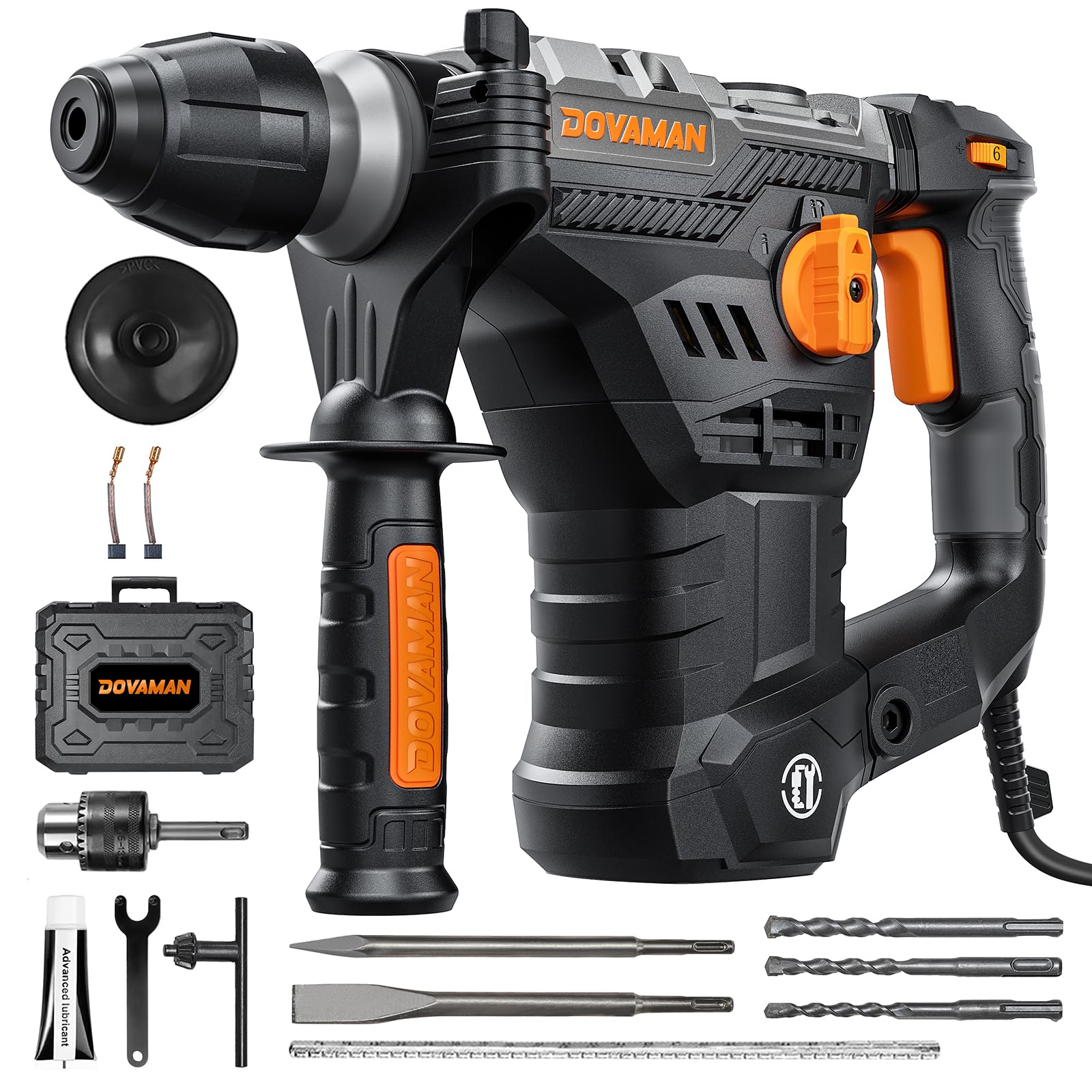
Four modes, 5.2 ft‑lbs of impact, and a safety clutch that protects the motor from overload.
The DOVAMAN RH15A stands out with four function modes: chiseling (hammer‑only), hammer drill, drill‑only, and chisel position adjustment. That means you can break up tile, drill concrete, drive into wood, and rotate the chisel angle — all with one tool. The 12.5 Amp motor delivers 5.2 ft‑lbs (7 Joules) of impact energy and reaches 0‑900 RPM with 0‑4,350 BPM (blows per minute, telling you how fast it hammers). Its vibration damping technology (VDT) suppresses vibration effectively, and the rubber overmold with microtexture provides a secure grip even with sweaty hands.
The safety clutch prevents the motor from suffering overload under high force — a real advantage when a bit binds in rebar. The heat‑dissipation system and anti‑dust structure help extend service life. Owners say it “quickly hammers through concrete,” though they note cheap masonry bits can mushroom quickly — three bits for a dozen holes in a basement floor. The unit weighs 12.3 lbs bare, so it is not a lightweight, but the 360‑degree adjustable handle and depth gauge improve control. Compared to the BOSCH RH328VC, the DOVAMAN delivers 5.2 ft‑lbs of impact energy versus the Bosch’s 2.6 ft‑lbs for heavier breaking work, but it is heavier and less suited for overhead drilling.
Multi‑Mode Advantage
- Four modes cover chiseling, drilling, and hammer drilling
- Safety clutch prevents motor burnout during high force
- 12.5 Amp motor with 5.2 ft‑lbs impact energy
Kit and Bits Caveat
- Bare weight of 12.3 lbs; tiring for long overhead use
- Included masonry bits wear quickly; plan to buy better ones
- No drill‑only for wood without impact (uses SDS‑Plus adapter)
Reach for this if: you need one tool that chips tile, drills concrete, and bores into wood with adjustable chisel positioning.
Think twice if: portability is critical — this is a stationary‑job tool, not a carry‑around.
4. Bosch 1191VSRK 1/2‑Inch Single‑Speed Hammer Drill

A 4.1‑lb standard hammer drill that sneaks into concrete work without the bulk of a rotary hammer.
This Bosch is not a rotary hammer — it is a standard hammer drill with a cam-action mechanism (a spring-loaded hammer that vibrates quickly). But at 4.1 lbs and 7 Amps, it offers the highest performance‑to‑weight ratio in its class. The two‑mode selector switches easily from rotation‑only to hammer drill, and the variable‑speed trigger gives you precise control when starting a bit on slick tile or metal. The 360‑degree auxiliary handle and built‑in quick‑release depth gauge provide good flexibility for a tool this size.
Owners have used it to drill 20 holes in a foundation easily, though the tool gets hot after about four holes in hard concrete — it needs short cooling breaks. That is the nature of a standard hammer drill: enough power for softer masonry and occasional concrete, but not designed for sustained heavy drilling. As owners put it: “Worked great to drill 1/2-inch holes in cement.” The catch: durability feedback is mixed, with some reporting reliability issues. This is strictly for smaller‑diameter jobs in softer materials.
Ultralight for Concrete: at 4.1 lbs, it is half the weight of most rotary hammers, perfect for overhead anchor work.
Not a Heavy Lifter: overheats with sustained hard concrete drilling; best for occasional or small‑diameter holes.
Best for: electricians or homeowners drilling a handful of anchor holes in brick, block, or soft concrete.
Skip if: you are drilling through a four‑inch reinforced slab or need to chip away tile — get a true rotary hammer.
5. SKIL 7.5‑Amp 1/2‑Inch Corded Hammer Drill (HD182001)

The cheapest way into hammer drilling — and it holds its own through 16 holes in aggregate concrete.
The SKIL HD182001 is a standard hammer drill with a 7.5 Amp motor, a 1/2‑inch heavy‑duty keyed chuck (a gear-tightened collar that holds the bit), and a side assist handle. It switches between drilling and hammer drilling with a simple selector. Despite the budget price, customers note drilling 16 holes (4 inches deep) in aggregate concrete (concrete with gravel in it) in roughly 10 seconds each, with no issues. The 5.2‑lb weight keeps it manageable for one‑handed control, and the two‑finger variable‑speed trigger and lock‑on button help with extended drilling.
However, this is a budget tool with budget durability. Multiple reviewers point out motors burning out within days of use, and the build quality draws mixed feedback — some find it well‑built, others note it feels weak for a 7.5A drill. The keyed chuck can also loosen under high vibration. It works well for occasional use, like installing a few anchors or drilling into brick siding, but it is not built for continuous heavy work. Compared to the BOSCH RH328VC, the SKIL is a standard hammer drill versus a true rotary hammer — its wood drilling capacity is about 12 millimeters versus 3.54 inches, showing the difference in torque delivery.
Budget‑Friendly Power
- Drills 4‑inch deep holes in aggregate concrete in ~10 seconds
- Dual‑mode switch for drilling and hammer drilling
- 12‑inch dimensions and 5.2 lbs make it easy to pack
Durability Risk
- Reports of motors burning out quickly under heavy use
- Keyed chuck can loosen with vibration
- Standard hammer drill — not suited for serious concrete work
Reach for this if: you need a cheap hammer drill for a single project or small‑diameter holes in soft masonry.
Think twice if: you plan to drill more than a couple dozen holes or work with reinforced concrete — invest in an SDS rotary hammer.
6. DEWALT 1/2‑Inch 7.8‑Amp Hammer Drill (DW511)
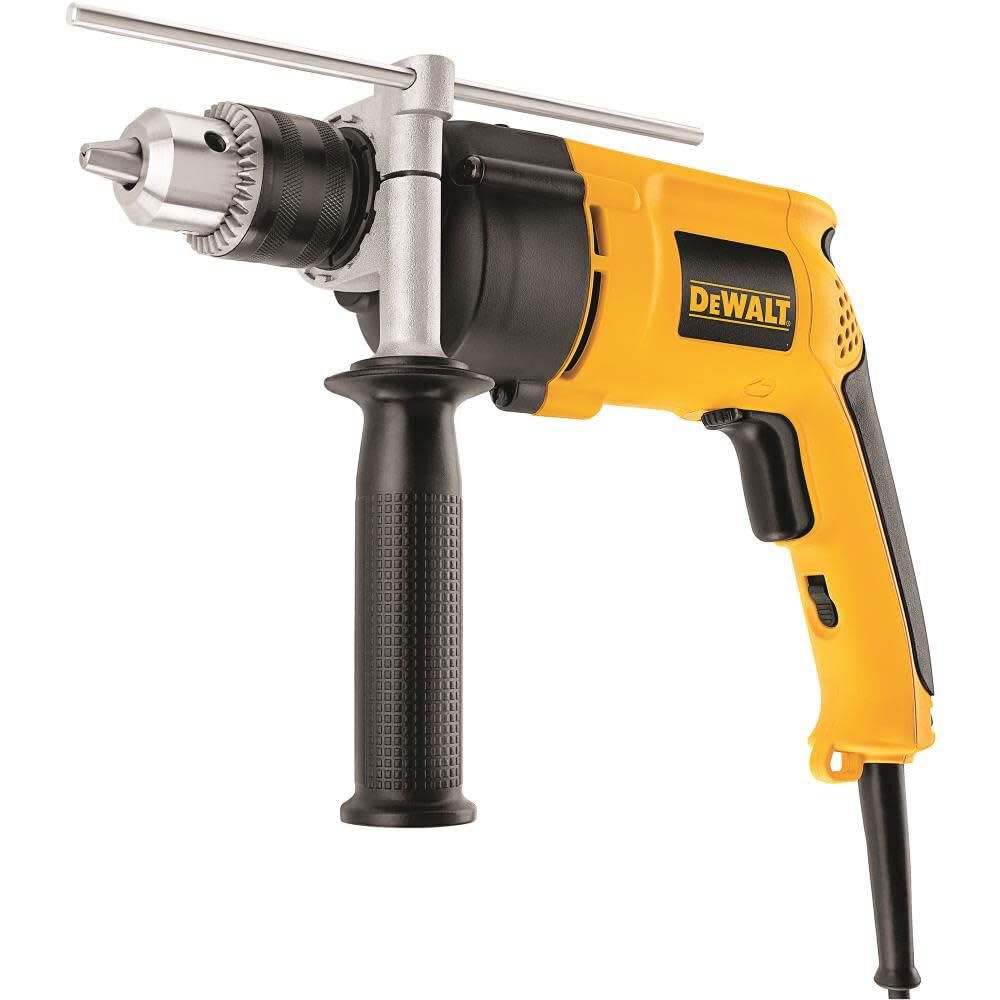
A lightweight, US‑made standard hammer drill that punches above its size for small concrete jobs.
The DEWALT DW511 is a standard hammer drill with a 7.8 Amp motor, variable speed trigger, and a dual‑mode selector for drill or hammer drill. At 4.3 lbs, it is designed for extended use without arm fatigue. The 360‑degree side handle with depth rod gives you good control for drilling into block or brick. Shoppers say drilling 50 holes in a tough stump in 5 minutes, and it handles concrete block work quickly and competently. The built‑in stop feature helps when drilling through subfloor and concrete.
However, with larger masonry bits, owners warn the drill overheats quickly — you need to be patient and let the tool rest. Durability gets mixed marks: some say it lasts for years, others report failure after two uses. It is also heavier than expected (5 lbs, despite the 4.3‑lb rating). No case is included, but the tool fits in a standard tool chest. Compared to the SKIL HD182001, the DEWALT has a slightly higher amperage (7.8 vs 7.5) and a lighter design (4.3 lbs vs 5.2 lbs), but both are standard hammer drills — not true rotary hammers.
Brand Quality at a Price: the DEWALT name carries an established reputation, and owners confirm it works well for brick and block.
Not for Heavy Concrete: overheats quickly with large masonry bits; best for smaller holes in softer material.
Best for: homeowners and DIYers who want a proven brand for occasional brick, block, and small‑diameter anchor holes.
Skip if: you need to drill through foundation‑grade concrete repeatedly — a rotary hammer is the right tool.
7. Berserker 42M SDS‑Max Heavy Duty Rotary Hammer

A 16‑lb brute with 7.38 ft‑lbs of impact — it is closer to a demo hammer than a drill.
The Berserker 42M is an SDS‑Max rotary hammer designed for demolition‑level work. Its 1,600‑Watt, 13 Amp motor produces 7.38 ft‑lbs (10 Joules) of impact energy, enough to chisel through a 4‑5 inch concrete slab easily. It operates with two modes: hammering with rotation and hammering only — there is no drill‑only mode, so this is strictly for concrete, brick, and rock. The SDS‑Max bit system provides tool‑free bit changes and dust protection. The 360‑degree adjustable handle and anti‑vibration technology help reduce fatigue, but at 16 lbs, fatigue is inevitable.
Owners describe it as “more tool than I bargained for.” It comes with a 7/8-inch SDS‑Max drill bit, flat and point chisels, an SDS‑Max to SDS‑Plus adapter, three SDS‑Plus bits, grease, and a carrying case. The rotatable handle can be difficult to turn, and the included carrying case is flimsy. A notable quirk: it does not use a grounded three‑prong plug, which raises questions about worksite safety compliance. Nevertheless, for someone breaking a concrete floor or drilling large anchor holes in a shop floor, the Berserker delivers genuine demolition power without the price tag of Hilti.
Demolition‑Level Performance
- 7.38 ft‑lbs impact energy; busted through 5‑inch concrete without pushing down
- Comes with SDS‑Max drill bit, chisels, and adapter for SDS‑Plus bits
- 24‑month warranty provides confidence
Weight and Trade‑offs
- 16 lbs — extremely heavy; requires two hands at all times
- No drill‑only function; not usable for wood or metal drilling
- Non‑grounded plug; rotatable handle can be stiff
Reach for this if: you need a budget‑friendly demolition hammer for breaking concrete slabs, drilling large holes in foundations, or heavy chipping.
Think twice if: you need a versatile tool for multiple materials, or if you plan to work overhead — 16 lbs gets old fast.
Understanding the Specs
Impact Energy (ft‑lbs / Joules)
This is the single most important number for concrete drilling. It measures the force of each blow from the piston mechanism — higher numbers mean faster drilling in hard aggregate. A rotary hammer with 2.6 ft‑lbs can handle rebar‑reinforced concrete; one with 7.38 ft‑lbs is demolition‑grade. A standard hammer drill does not have this spec at all, relying on rotation speed instead.
SDS‑Plus vs SDS‑Max
These are the two main shank standards for rotary hammer bits. SDS‑Plus is the most common for medium‑duty work — bits are widely available and fit most homeowner‑grade machines. SDS‑Max is larger, for bigger bits and higher impact energy; used in demolition‑class tools. They are not interchangeable without an adapter, which slightly reduces impact transfer.
FAQ
Can I use a standard hammer drill for concrete or do I need a rotary hammer?
What does impact energy mean and how much do I need?
What is the difference between SDS‑Plus and SDS‑Max?
Does a concrete hammer drill also work as a regular drill for wood and metal?
How important is a safety clutch on a hammer drill?
How much weight can I expect in a concrete hammer drill?
Can I use a concrete hammer drill for chiseling or light demolition?
How long does a corded concrete hammer drill last?
What accessories come with a good concrete hammer drill kit?
Final Thoughts: The Verdict
Across the board, the top concrete hammer drill pick is the BOSCH RH328VC because it delivers genuine rotary‑hammer power in a 7.7‑lb package with excellent vibration control — making all‑day concrete work far less punishing. If you want a complete kit with bits, chisels, and a case for a single major project, grab the SHIELDPRO 13 Amp SDS‑Plus. And for demolition‑grade impact that breaks concrete slabs without the Hilti price, the Berserker 42M SDS‑Max is the one to reach for.
How We Picked
We do not accept paid placement. Every pick is matched to a real buyer and a real use-case; we do not hands-on test units.
Sources & Methodology
Specifications: manufacturer listings and product documentation. Review insights: verified customer reviews, as of July 2026. Pricing: not shown on this page (it changes often); check the current price via the retailer link.
As an Amazon Associate, WellFizz earns from qualifying purchases. This does not affect which products we feature.
Related Guides

Mo Maruf
I created WellFizz to bridge the gap between vague wellness advice and actionable solutions. My mission is simple: to decode the research and give you practical tools you can actually use.
Beyond the data, I am a passionate traveler. I believe that stepping away from the screen to explore new environments is essential for mental clarity and physical vitality.