Our readers keep the lights on and my smoothie glass nicely filled. As an Amazon Associate, I earn from qualifying purchases.
Specs are compiled from manufacturer listings and verified buyer reviews and can change over time — please confirm the key details on the product page before buying.
A garage floor takes a beating — hot tires, oil drips, dropped tools, and winter slush. The right coating resists chemicals and cleans up with a hose, turning a stained slab into a surface you actually want to look at. The challenge is choosing between epoxy, acrylic, and polyurethane formulas when every can claims to be “durable.” This guide breaks down the real trade-offs so you pick the paint that stays put.
I’m Mohammad Maruf — the founder and writer behind WellFizz. This guide is built by comparing the manufacturers’ published specifications and the patterns across verified customer reviews, so you get each pick’s real strengths and trade-offs instead of marketing spin.
Your garage floor endures car tires, dropped tools, and chemical spills, so you need a paint that can handle that specific abuse. The right concrete garage floor paint depends on matching the formula type to how you use the space — whether it is a workshop, a parking bay, or a basement hangout.
Our Picks at a Glance


How To Choose The Best Concrete Garage Floor Paint
The wrong coating peels within months, leaving you with a bigger mess than you started with. Here are the three specs that decide whether your floor looks great for years or becomes a regret.
Formula Type: Epoxy vs. Acrylic vs. Polyurethane
Two-part epoxy (you mix a resin and a hardener) creates a thick, impact-resistant layer that bonds to concrete like glue. It handles hot tire pickup and chemical spills better than any single-part paint. Water-based acrylic formulas are cheaper and easier to apply, but they sit on top of the concrete rather than soaking in — meaning they can peel under heavy loads or moisture. Polyurethane blends (like the Rust-Oleum one-part epoxy acrylic) sit in the middle: more durable than plain acrylic, less fuss than mixing two cans.
Coverage and Coats
A gallon of paint typically claims 250 to 400 square feet, but porous or rough concrete drinks up more. Most owners find they need two coats to hide the old surface, which halves the advertised coverage. Buying a 5-gallon pail for a two-car garage (roughly 400-500 sq ft) is often the smarter move than squeezing a single gallon across the whole floor and ending up with patchy spots.
Slip Resistance and Cure Time
Epoxy and acrylic both become slick when wet. A non-slip additive (often sold separately or included as a grit packet) turns a glossy floor into a safe one, especially near entry doors where rainwater collects. Cure time matters just as much: some coatings claim “walk-on in 8 hours” but need 72 hours before parking a car. Ignoring the full cure window is the fastest way to ruin a fresh coat.
Quick Comparison
| Model | Best For | Type | Coverage | Dry / Cure Time | Amazon |
|---|---|---|---|---|---|
| Rust-Oleum EpoxyShield★ Best Overall | Basement & garage makeovers | 2-Part Epoxy | 250 sq ft per kit | 8h walk / 24h foot traffic | Amazon |
| Glidden Grab-N-GoBest Value | Budget refreshes | Latex | 350-400 sq ft per gal | 2-4h touch / 24h cure | Amazon |
| INSL-X TuffCreteBest for Stains | Stained, non-opaque look | Acrylic Stain | 300-400 sq ft per gal | Fast dry | Amazon |
| KILZ Slip-Resistant | Pool decks & walkways | Textured Coating | 40-60 sq ft per gal | 1h touch / 72h full cure | Amazon |
| EVOLVE Porch & Floor | Large outdoor areas | Acrylic Latex | 5-gal pail | 1h touch | Amazon |
| Everflow MPC Epoxy | Showroom-quality gloss | 100% Solids Epoxy | 240 sq ft per kit (one coat) | 48h full cure | Amazon |
| Rust-Oleum Concrete & Garage | Outdoor driveways | 1-Part Epoxy Acrylic | 300-400 sq ft per gal | 5 days full cure | Amazon |
| RUST BULLET DuraGrade | Heavy vehicle traffic | Single-part urethane | 300-350 sq ft per gal per coat | 24h full cure | Amazon |
| ArmorPoxy Garage Epoxy Kit | Complete DIY garage project | 100% Solids Epoxy | 300 sq ft per kit | 24h cure / 72h vehicle | Amazon |
In‑Depth Reviews
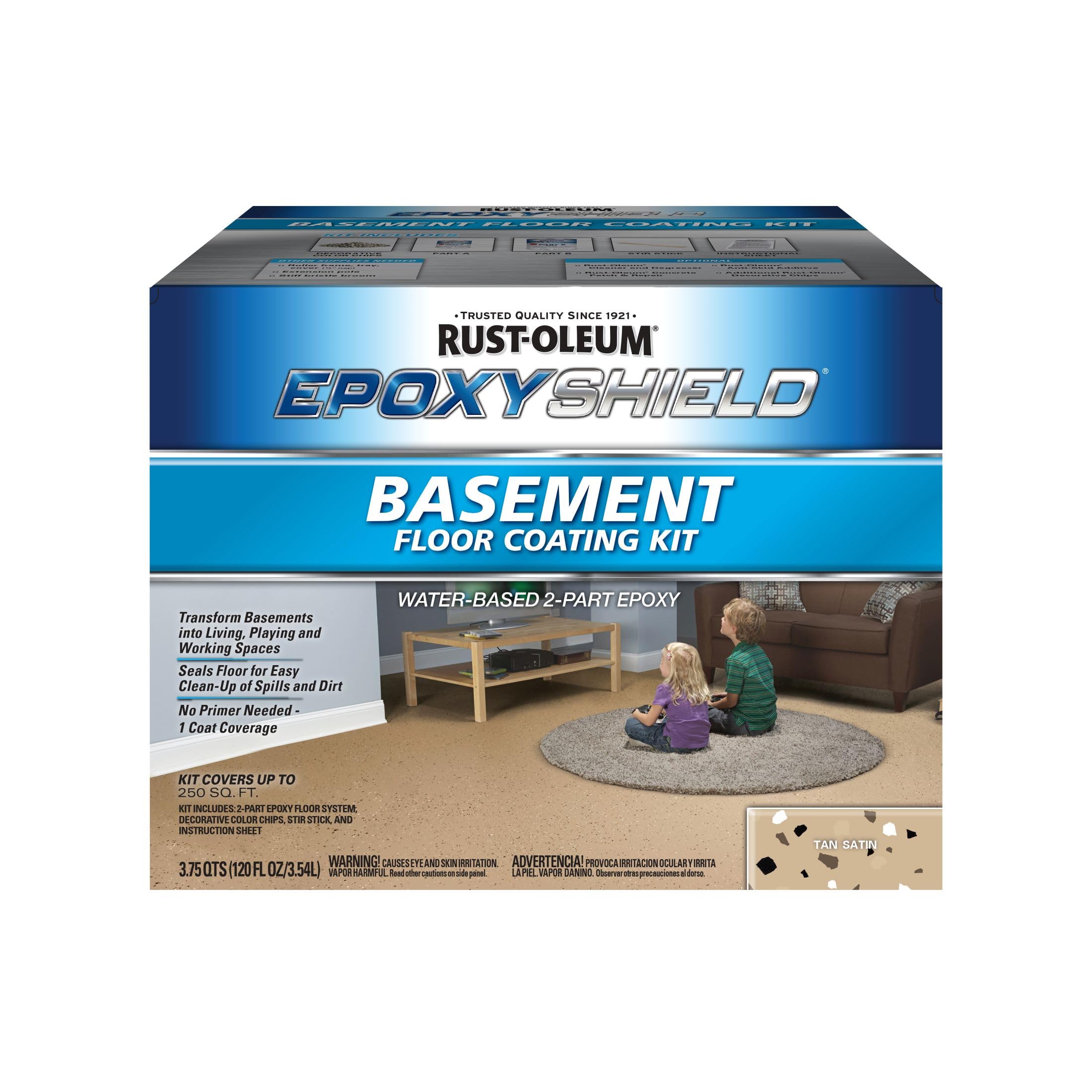
1. Rust-Oleum 391281 EpoxyShield Basement Floor Coating Kit
Our pick — over 4★ from 500+ verified ratings; the strongest balance of quality and price.
The epoxy kit that turns a tired basement floor into a showroom surface in one coat.
This crowd-favorite is a two-part, water-based epoxy that skips the primer step entirely. The kit includes the activator, base, decorative color chips, and a stir stick, so you are not chasing extra purchases mid-project. Buyers report the satin finish transforms dull concrete into a professional-looking floor that is easy to clean and resists stains from oil and wear. The 250-square-foot coverage per kit is honest; several buyers measured closer to 289 square feet on smooth floors, meaning you might actually get a little more than advertised.
The catch is the slippery surface when wet. Multiple owners warn that the finish becomes slick after rain or a wash-down, and they recommend mixing in a non-slip additive before application. The two-part mixing also demands strict attention — you have about 16 hours of pot life, but once spread thin the working window shrinks to 20-30 minutes. Prep is non-negotiable: cleaning with TSP, etching the concrete, and repairing cracks separates a floor that lasts from one that flakes. The review summaries back this up, with appearance and quality earning the most praise by far, while durability draws mixed comments — almost always tied to how well the concrete was prepared beforehand.
At 4.4 stars across over 500 ratings, this kit holds a stronger score than the budget options below and gives you real epoxy chemistry (not just tinted acrylic) at a price well below the premium 100% solids kits. It is the strongest all-rounder for anyone who wants a garage or basement floor that actually looks like a renovation, not a touch-up.
What owners praise most
- One-coat coverage with no primer needed — the satin finish looks professional.
- Walk-on ready in 8 hours and accepts foot traffic in 24 hours.
- Low odor during application compared to solvent-based epoxies.
The honest trade-offs
- Becomes very slippery when wet; buy a non-slip additive separately.
- Working time is short once the epoxy is spread thin.
- Coverage drops on rough or porous concrete — you may need two kits for a two-car garage.
Reach for this if: you want a true epoxy floor without paying the premium for a 100% solids kit — the best balance of price, durability, and finish.
Think twice if: your garage sees standing water regularly, or you want a non-slip surface right out of the can without mixing in an additive.
2. Glidden Grab-N-Go Porch and Floor Paint
A ready-mixed latex paint that covers a big area for very little money — no mixing required.
At roughly one-third the price of the epoxy kits here, this Glidden paint is the entry-level option for a garage refresh on a tight budget. It is a single-part latex formula (no activator to mix) that claims up to 400 square feet of coverage per gallon. Owners say it applies well with a roller, has a low odor during application, and holds up acceptably when a clear sealant is applied over the top. The satin finish hides minor imperfections and the brown color hides dirt better than light grays.
The trade-off is durability. This is a paint, not a coating — it sits on the surface rather than bonding chemically like epoxy. Owners mention it works well for temporary upgrades or low-traffic areas, but a few received cans that were partially hardened or poorly mixed, leading to a lumpy application. The “fast drying” claim also gets pushback from owners who found it dried at the same pace as regular interior paint. The coverage is generous at 350-400 square feet per gallon, so one gallon can cover a single-car garage with two coats if the concrete is smooth.
Think of this as the right choice when your floor is already in decent shape and you want a cosmetic upgrade without the complexity of a two-part system. skip it if you park a car on the floor daily or you need a surface that resists chemical spills — the latex formulation will not hold up to gas or oil the way an epoxy will.
What works
- Excellent coverage per gallon — stretches further than any epoxy kit here.
- Low odor and easy soap-and-water cleanup.
- Scratch-resistant finish for the price.
What to watch for
- Some cans arrive poorly mixed or partially hardened — inspect before starting.
- Needs a clear sealant on top to hold up in high-traffic areas.
- Not for heavy vehicle traffic or chemical spills.
Grab it for: a low-cost refresh of a low-traffic garage floor, workshop, or craft room where durability is not the top concern.
Look elsewhere if: you park a car on the floor, deal with oil drips, or want a surface that lasts beyond a year without peeling.
3. INSL-X TuffCrete Waterborne Acrylic Concrete Stain
A water-based stain that soaks into concrete rather than coating it — think dye, not paint.
Unlike the thick epoxy paints above, this acrylic stain penetrates the concrete to create a color that is part of the surface, not a film on top. That means no peeling when moisture pushes up from below (a common issue with solid paints on basement slabs). The low-sheen finish looks natural and hides imperfections because it does not build up a thick layer. Owners describe the application as beginner-friendly — it self-primes and self-seals — and the 300 to 400 square feet per gallon covers generously. One buyer diluted it 20 percent with water and sprayed it for a light, random look across a large patio.
Durability is where opinions split. Some customers note the stain holds up well on porches and patios, while others say it peels in spots where the concrete was not etched or where water pooled. The review summaries confirm this mixed durability feedback: about half the owners love the natural look and easy application, and the other half wish they had used a film-forming epoxy instead. This is not a product for a garage floor that gets oil drips or heavy tool drops — the stain is thin by design and will not bridge cracks or resist abrasion like a thick coating.
If your goal is a color shift on a porch, walkway, or basement floor that does not look painted, this is the best choice here. For a working garage floor that needs to survive car jacks and solvent spills, stick with the epoxy options.
Why owners like it
- Self-priming and self-sealing — no extra products needed.
- Soaks into concrete so it does not peel like a surface film.
- One coat can give a stain effect; two coats give opaque color.
Where it falls short
- Not built for high-traffic garages or chemical spills.
- Durability is inconsistent — prep and moisture levels matter a lot.
- Some colors arrive different from the listing (the gray pearl had a blue tint some owners disliked).
Choose this for: patios, porches, and basement floors where you want a natural stone look and are not parking on it.
Skip it for: a working garage with vehicle traffic, oil, or heavy abrasion — this is a stain, not a protective coating.
4. KILZ Decorative Slip-Resistant Concrete Coating

A thick, speckled coating that adds grip and hides cracks — but drinks up gallons fast.
KILZ took a different approach here: instead of a smooth paint, this is a heavy-bodied textured coating that dries to a stone-like, speckled finish. It is designed to fill hairline cracks and resist hot tire pickup, UV damage, and household chemicals. The slip resistance is built into the texture, so you do not need to buy a separate additive. Owners who used it on porches and pool decks report it looks fresh for years — one buyer had it on a porch for over five years with no prep beyond a power wash.
The main shock is coverage. This coating covers only 40 to 60 square feet per gallon, which is roughly one-sixth of what a typical floor paint delivers. A two-car garage (around 500 square feet) would need over 8 gallons for a single coat. Multiple owners confirm the coverage matches the spec, but the sticker price adds up fast. Application is also finicky: the manufacturer requires a 1/4-inch adhesive roller, but experienced owners say a specific black foam roller (Rust-Oleum #306214) gives a better texture. Apply it in shade below 80°F or it dries too fast to work smoothly.
The ratings — 3.8 stars across over 900 ratings — reflect the split. Appearance earns consistent praise, but application and value get the most mixed feedback. This is a product that works brilliantly on small areas (a porch, a walkway, a pool surround) but becomes impractical for a full garage floor unless you budget for many gallons and a lot of labor.
top-tier features
- Built-in slip resistance — no separate additive needed.
- Fills hairline cracks and resists hot tire pickup and UV damage.
- Dries to the touch in 1 hour; light foot traffic in 24 hours.
The practical downsides
- Very low coverage — 40-60 sq ft per gallon makes large projects expensive.
- Application is picky about roller type and temperature.
- Some reviewers point out peeling on smooth concrete that was not etched.
Reach for this if: you have a small patio, walkway, or pool deck that needs texture and slip protection — it excels there.
Think twice if: you need to coat a full garage floor. The coverage makes it cost-prohibitive compared to epoxy kits.
5. EVOLVE Porch & Floor Paint, 5-Gallon
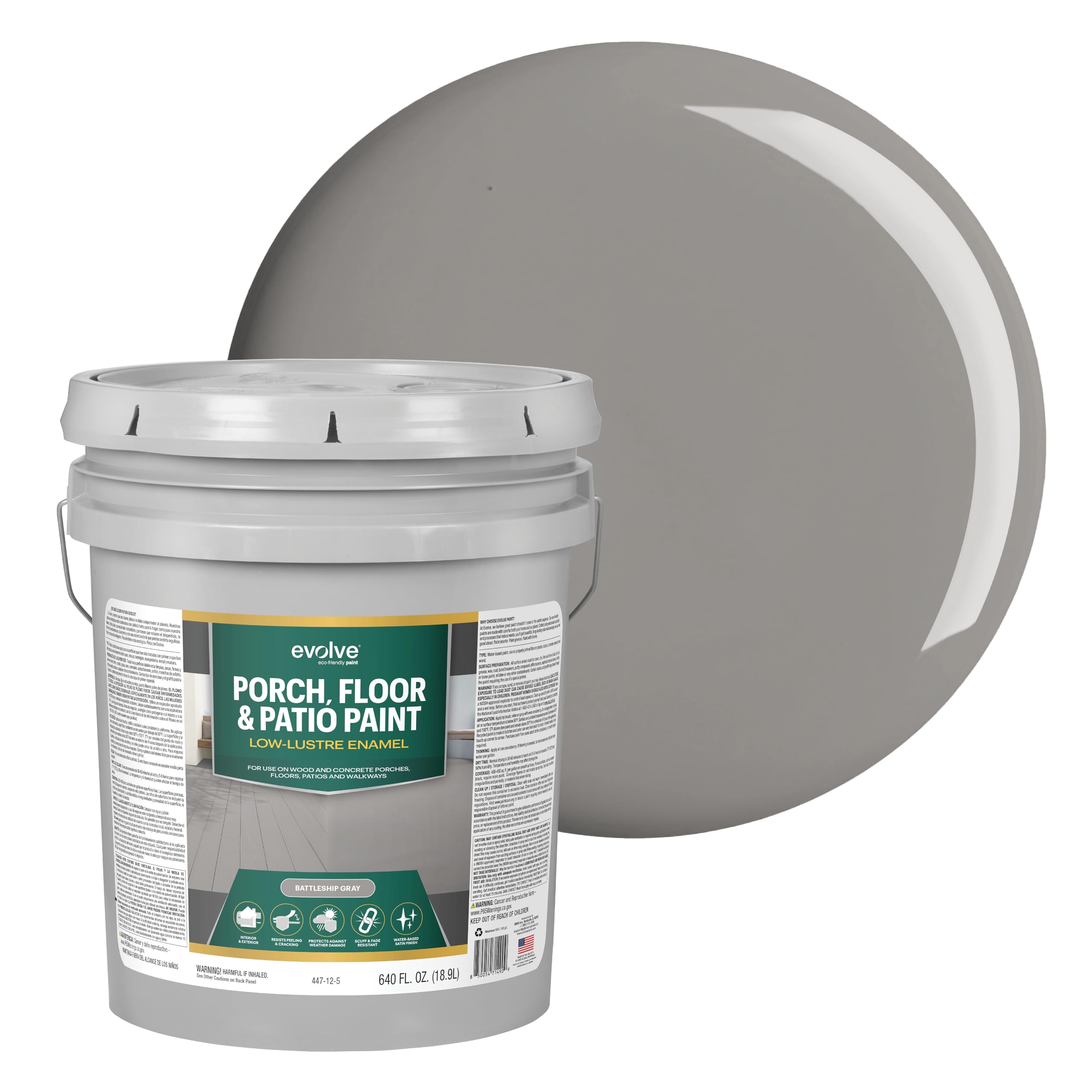
A 5-gallon bucket of acrylic latex that covers big outdoor areas while staying affordable per square foot.
When you are painting a large porch, patio, or basement floor, buying by the gallon gets expensive fast. This 5-gallon pail of EVOLVE paint is a low-VOC, water-based acrylic latex that covers large surfaces with a semi-gloss finish. The formula is scuff- and scratch-resistant, and it is designed for both indoor and outdoor use on concrete, wood, and masonry. Owners say it applies smoothly and provides good coverage, with the battleship gray color looking slightly darker than shown on screen — a common note in the reviews.
The durability feedback is mixed. Some shoppers say the paint holds up well under foot traffic and outdoor conditions, while others say it peeled or washed away when water hit it after only 24 hours of drying time. The color accuracy is also a point of contention: about as many owners say the color is exactly right as say it is off. The 5-gallon format is a double-edged sword — it saves money per ounce, but if the product does not work for your specific floor, you are stuck with a lot of unusable paint. The lid design also earned complaints for being extremely difficult to open, requiring tools and help.
This paint sits between the budget Glidden option and the premium epoxy kits. It is a solid choice for large low-traffic areas like a covered porch or a basement rec room, but it is not built for the abuse a garage floor takes from car tires and chemicals. If you need a coating that withstands vehicle weight, the RUST BULLET or ArmorPoxy options below are better suited.
The big advantages
- 5-gallon pail covers a large area in one purchase — good value per square foot.
- Low VOC and soap-and-water cleanup make indoor use comfortable.
- Scuff- and scratch-resistant formula for residential foot traffic.
The drawbacks
- Reports of paint washing off when exposed to water too soon.
- Color accuracy is inconsistent — the battleship gray is darker than the listing shows.
- Lid is notoriously difficult to open; budget for a tool and some muscle.
Best for: large porch, patio, or basement floors where foot traffic is the main concern and vehicle traffic is not a factor.
Not ideal for: a working garage with parked cars, oil spills, or heavy tools — the acrylic latex formulation is not thick enough for that abuse.
6. Everflow MPC-100 Epoxy Resin Coating
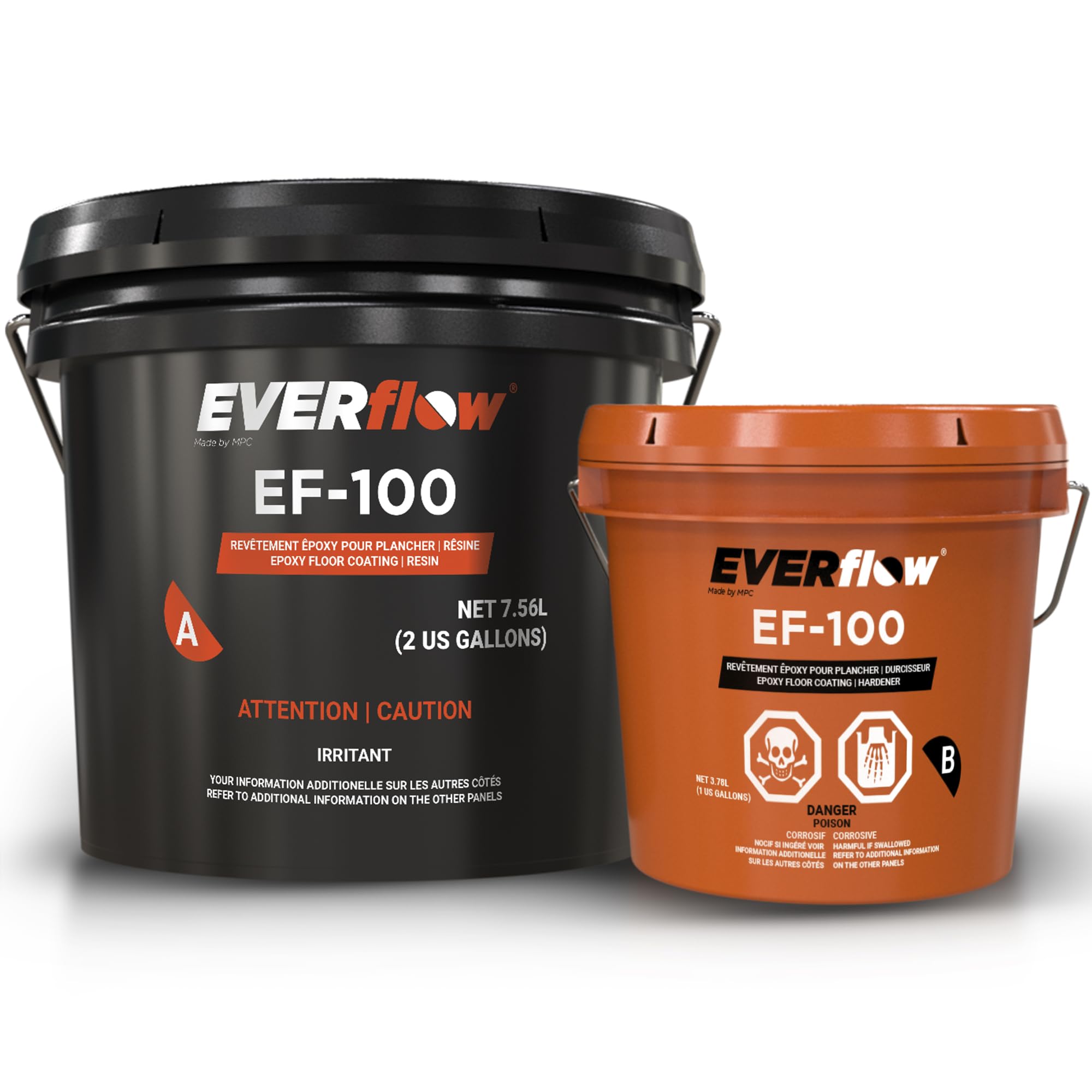
A 100% solids epoxy that self-levels into a surface that looks like thick glass — no solvents, no shrinkage.
This is serious epoxy. The MPC-100 is a 100% solids, two-component, self-leveling resin — meaning it contains no water or solvents that evaporate and shrink the film. The result is a thick, glossy coating that fills small imperfections and creates a smooth, glass-like surface. Owners who used it on garage floors and pole barns report it transformed the space completely. One buyer covered 900 square feet with four kits, using chips and a second coat, and says the floor still looks new after 19 months of active use. The 48-hour full cure time is longer than water-based options, but the durability payoff is substantial: the cured coating resists abrasion, impact, and chemicals at a level no single-part paint can match.
The catch is the learning curve. Mixing 100% solids epoxy is temperature-sensitive — one reviewer had a bucket solidify in 5 minutes, smoking and cracking, while an identical batch worked fine. Working time is 20-30 minutes once the epoxy is spread thin, and you need spike shoes if you plan to walk on it while applying a second coat. The reviews are split between owners who got a flawless, professional finish and a small number who experienced a defective batch. The manufacturer came under fire in one review for refusing a refund on a solidified batch.
At a price point above the Rust-Oleum EpoxyShield, this is for the owner who wants the absolute toughest, glossiest floor possible and is willing to follow precise instructions. The quality and finish are the top-rated aspects by a wide margin — owners who get it right are thrilled.
Why enthusiasts love it
- Self-leveling formula creates a smooth, glass-like surface with no roller marks.
- 100% solids means zero shrinkage and excellent chemical resistance.
- Can be used with broadcast flakes for a custom showroom look.
The difficult side
- Temperature-sensitive mixing — working time is short and inconsistent for beginners.
- Spike shoes and precise measuring tools are mandatory, not optional.
- A defective batch is rare but costly; check the return policy before buying.
Perfect for: a serious DIYer who wants a show-quality garage floor and will follow the temperature and mixing instructions exactly.
Too risky for: a first-timer or someone who wants a simple roll-on paint — the learning curve is real, and mistakes waste expensive material.
7. Rust-Oleum Concrete & Garage Floor Paint and Primer
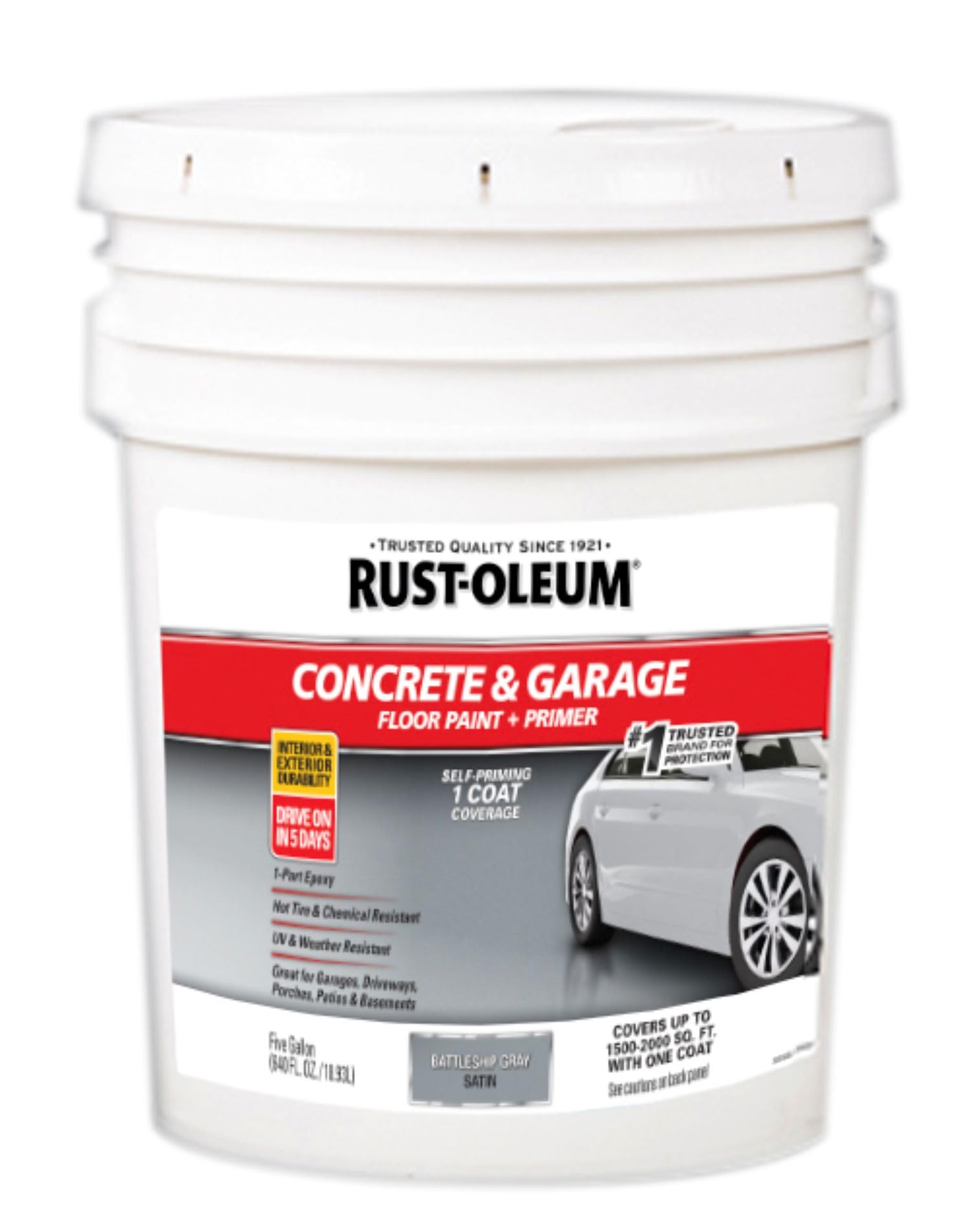
A single-part epoxy acrylic that gives you better durability than plain paint without the mixing hassle of two-part epoxy.
This is Rust-Oleum’s middle ground: a one-part epoxy acrylic that combines the adhesion of epoxy with the convenience of a ready-mixed paint. No activator to combine, no timer running once mixed. The 5-gallon pail covers 300-400 square feet per gallon, making it a practical choice for a two-car garage or a large driveway. The satin finish gives concrete a “wet and fresh” look, as owners describe it, and the formula is UV- and weather-resistant for outdoor use.
Where this product stumbles is real-world durability. Several buyers report that the cured paint scratches off with a fingernail, even after the full 5-day cure time. One buyer prepped the concrete thoroughly with Rust-Oleum’s own branded products and still found that shoe prints left permanent marks and a nail scratch removed the paint down to bare concrete. The coverage also gets mixed marks: some owners needed two coats to get even color, which cuts the effective coverage in half. The 5-day full cure time is also longer than any other product on this list, meaning you need to keep the garage empty for nearly a week.
Think of this as a step up from the basic latex paints (Glidden, EVOLVE) but a step below the two-part epoxy kits (EpoxyShield, MPC-100). It is best for outdoor concrete that sees weather but not heavy vehicle traffic — a driveway that needs to look good without the complexity of mixing epoxy.
The strong points
- One-part formula — just open, stir, and roll. No mixing or pot life to track.
- UV- and weather-resistant for outdoor use without yellowing.
- Makes concrete look “wet” and fresh with a satin finish.
The weak points
- Some owners mention the cured surface scratches off with a fingernail.
- Full cure takes 5 days — the longest cure time on this list.
- Coverage may require two coats, reducing the claimed 300-400 sq ft per gallon.
Good for: an outdoor driveway or patio that needs UV protection and a fresher look, with less work than a two-part epoxy.
Skip if: your garage sees daily car traffic, tool drops, or chemical spills — the surface is not tough enough for that abuse based on owner reports.
8. RUST BULLET DuraGrade Concrete

An industrial-strength single-part coating that skips the etching step and takes vehicle weight without flinching.
RUST BULLET’s DuraGrade is the closest thing here to a “apply and forget” heavy-duty coating. It is a single-part urethane formula (not epoxy, not latex) that bonds directly to clean, dry concrete without acid etching or a primer coat. The gloss finish is UV- and weather-resistant, and the manufacturer claims it resists impact from heavy foot and vehicle traffic without chipping or peeling. Owners back this up: the durability and quality are the most-praised aspects. One buyer used it on a garage floor with heavy vehicles and reported no tire lift, even with power washing as the prep method (not following the instructions exactly).
The trade-off is the application difficulty. The paint is thick — owners note it requires a sturdy wide roller and can develop air bubbles if applied too thickly. The fumes are potent, and the product does not wash off skin with soap; you need mineral oil or disposable tools. Coverage is realistic at 300-350 square feet per gallon per coat, but the thickness means you may get less on rough concrete. The product also hardens in the can if you do not finish the job in one day, so plan your project carefully. The value-for-money aspect draws mixed feedback: owners agree it works, but the price per gallon is significantly higher than the Rust-Oleum one-part options.
For a garage floor that actually holds a car every day and sees oil drips and jack stands, this is a stronger choice than the one-part epoxy acrylic paints above. It is not as thick or glossy as the 100% solids epoxy kits, but it is far easier to apply and does not require perfect temperature control during mixing.
what separates it
- No etching or primer needed — clean the concrete and apply directly.
- Handles heavy vehicle traffic without hot tire pickup.
- UV- and weather-resistant for indoor and outdoor use.
The real downsides
- Thick consistency makes application tricky — air bubbles are common if you overwork it.
- Strong fumes require a respirator and good ventilation.
- Leftover paint hardens in the can; you must finish the whole project in one day.
Best for: a working garage with daily car parking, oil changes, and heavy tools — it is the toughest single-part coating here.
Think twice if: you need a glossy showroom finish. The gloss is good, but it is not the glass-like look of a 100% solids epoxy.
9. ArmorPoxy Garage Epoxy Floor Kit

A 17-piece kit that is designed to be the only box you need for a professional-looking garage floor — no extra trips to the store.
ArmorPoxy packs everything into one box: the 100% solids epoxy, a decorative flake mix, a non-slip additive, an etching solution, a roller, and a squeegee. The idea is that a homeowner can open the kit, watch the instructional video, and produce a three-layer epoxy floor without calling a contractor. The 100% solids formula is the same chemistry as the premium MPC-100 above — it bonds permanently to concrete and resists hot tire pickup, cracks, and peeling. Owners who succeeded report a “sleek finish” and professional results that transformed their garage.
The kit does have rough edges. Several owners note that the included squeegee is cheap and tore during use, and the epoxy cans lack measurement markings, making it easy to get uneven color between batches. The 300-square-foot coverage per kit is realistic for one coat, but a standard two-car garage (about 500 square feet) needs two kits. A few owners in humid climates report the clear top coat stayed tacky and the floor peeled after light use, recommending Rust-Oleum instead. The customer service response to a damaged shipment was positive — one buyer had a crushed kit replaced with an extra gallon sent free months later.
At the highest price point on this list, the ArmorPoxy kit competes directly with the Everflow MPC-100. It offers a more complete DIY package (flakes, rollers, non-slip grit) but the execution has more rough edges. If you want a true do-it-yourself weekend project and do not mind improvising on the cheap tools, this kit delivers. If you prefer to buy your own quality rollers and measure precisely, the MPC-100 may give a cleaner result.
Kit highlights
- 17-piece kit includes etching solution, flakes, non-slip additive, and tools.
- 100% solids epoxy — chemical-proof and resists hot tire pickup.
- Takes about 3 days to install; instructions and video guide the process.
Kit complaints
- No measurement markings on epoxy cans — easy to mix uneven batches.
- Included squeegee is cheap and prone to tearing.
- Some customers note peeling in humid conditions; primer may be necessary.
Reach for this if: you want a complete kit with flakes and non-slip grit included — convenient for a first-time epoxy installer.
Look elsewhere if: you want precise control over the finish and can source your own tools; the MPC-100 is more forgiving for experienced DIYers.
Understanding the Specs
100% Solids vs. Water-Based Epoxy
A 100% solids epoxy contains no water or solvents that evaporate during curing. The entire liquid volume hardens into a dense plastic film — there is no shrinkage, and the coating fills minor cracks and pits. Water-based epoxies (like the Rust-Oleum EpoxyShield) are easier to apply and clean up with soap, but some of the volume evaporates, leaving a thinner film. For a garage floor that sees heavy use, 100% solids delivers a tougher, thicker armor. For a basement or light-use floor, water-based epoxy is simpler and still far more durable than latex paint.
Hot Tire Pickup and Why It Matters
When you park a car on a fresh paint job, the heat from the tires can soften the coating and cause it to lift and stick to the rubber — that is hot tire pickup. Low-quality paints peel off in patches the first time you drive over them. Two-part epoxies and the RUST BULLET single-part formula are formulated to resist this. Latex porch paints and basic acrylics will often fail the hot tire test. If you park a car in the garage, look for explicit “hot tire resistant” language on the label.
FAQ
Can I paint over old peeling garage floor paint?
Do I really need to etch the concrete before painting?
How long should I wait before parking a car on a freshly painted garage floor?
What is the difference between a concrete stain and a concrete paint?
How do I prevent the floor from being dangerously slippery when wet?
What happens if my concrete has a moisture problem?
Can I use an epoxy coating on a floor that has been painted before?
Why does my paint look patchy after one coat?
Is a satin or gloss finish better for a garage floor?
Final Thoughts: The Verdict
For most buyers, the concrete garage floor paint winner is the Rust-Oleum EpoxyShield because it delivers genuine two-part epoxy durability in a one-coat application at a price that undercuts the premium kits. If you want a simpler, no-mix option that handles vehicle traffic, grab the ArmorPoxy Garage Epoxy Kit is the one to reach for if you want a custom flake finish without hunting down extra supplies.
How We Picked
We do not accept paid placement. Every pick is matched to a real buyer and a real use-case; we do not hands-on test units.
Sources & Methodology
Specifications: manufacturer listings and product documentation. Review insights: verified customer reviews, as of July 2026. Pricing: not shown on this page (it changes often); check the current price via the retailer link.
As an Amazon Associate, WellFizz earns from qualifying purchases. This does not affect which products we feature.
Related Guides

Mo Maruf
I created WellFizz to bridge the gap between vague wellness advice and actionable solutions. My mission is simple: to decode the research and give you practical tools you can actually use.
Beyond the data, I am a passionate traveler. I believe that stepping away from the screen to explore new environments is essential for mental clarity and physical vitality.