Our readers keep the lights on and my smoothie glass nicely filled. As an Amazon Associate, I earn from qualifying purchases.
Specs are compiled from manufacturer listings and verified buyer reviews and can change over time — please confirm the key details on the product page before buying.
A crack in your foundation is a direct path for water, radon (a radioactive soil gas), and other soil gases to enter your basement. A bad patch can peel, shrink, or wash out in a season, leaving you back where you started. This guide compares seven products built for foundation repair — not generic concrete touch-ups — so you pick the one that actually stops the leak and stays put.
I’m Mohammad Maruf — the founder and writer behind WellFizz. This guide is built by comparing the manufacturers’ published specifications and the patterns across verified customer reviews, so you get each pick’s real strengths and trade-offs instead of marketing spin.
Every product here targets a different phase of the job: surface cracks, deep-wall injections (where you inject a filler into the crack to fill it from the inside), or hairline sealing. We break down which formula suits your situation, how fast it sets, and what buyers actually discovered after application. That is the straight story on concrete for foundation repair.
Our Picks at a Glance

How To Choose The Best Concrete For Foundation Repair
Choosing the right material depends entirely on what kind of crack you are dealing with. A thin hairline crack that seeps water during rain needs a low-viscosity injection (a thin liquid that flows easily) that can penetrate deep. A wide gap or spalled area (where concrete has chipped off) needs a high-build patch that bonds to vertical walls without sagging. Below are the three specs that determine which product will actually solve your problem.
Crack Width and Depth
The width of the crack dictates if you need a gel, a liquid, or a hydraulic cement (a powder you mix with water that hardens quickly). Hairline cracks (under 1/8 inch) require a thin, self-leveling liquid that flows into the gap. Wider cracks and holes (up to 1/2 inch or more) call for a paste or powder that you mix and trowel on. For deep foundation wall cracks that go all the way through, an expanding polyurethane foam injection kit (a system that injects foam into the crack) is the only method that fills the void from the inside out.
Curing Time and Working Conditions
If you are working on an active leak where water is present, you need a product that sets in minutes — hydraulic cement and polyurethane foam both react with water to cure faster, not slower. For dry cracks, a slower-curing polymer gel (24–48 hours to full cure) typically gives a more flexible, permanent seal. Check the product’s “tack-free” time (when the surface becomes dry to the touch): some are ready for foot traffic in 3 hours, while others need overnight protection.
Waterproofing and Flexibility
Foundation walls expand and contract with temperature and moisture. A rigid patch will crack again within a year. Look for a product described as “flexible” or “elastomeric” (meaning it can stretch and move) — usually a polyurethane or polymer-resin formula — that moves with the concrete. The waterproof rating matters too: a “waterproof” seal prevents hydrostatic pressure (the pressure from water in the soil) from pushing the patch out, which is the most common failure point in foundation repair.
Quick Comparison
| Model | Best For | Style | Cure Time | Material | Amazon |
|---|---|---|---|---|---|
| Red Devil 0641★ Best Overall | Surface-level patch | Pre-Mixed Paste | — | Blend | Amazon |
| Autosel Self-LevelingAlso Great | Multi-pack for multiple cracks | Liquid | 1–3 hr tack-free | Silane Resin | Amazon |
| ninesung Concrete Patch | Fast-drying spot repair | Powder | Sets in 30 min | Hydraulic Cement | Amazon |
| MuzeFansi Crack Filler | Self-leveling hairline cracks | Gel | 3 hr touch-dry | Polyurethane | Amazon |
| Hydra Stop 300 (10′) | Active leaks in foundation walls | Injection Kit | Expands on contact | Polyurethane Foam | Amazon |
| Hydra Stop 300 (20′) | Longer cracks with active flow | Injection Kit | Expands on contact | Polyurethane Foam | Amazon |
| RadonSeal DIY Kit | Drill-free hairline sealing | Injection Kit | 24 hr full cure | Low-Viscosity Urethane | Amazon |
In‑Depth Reviews
1. Red Devil 0641 Concrete Repair Patch (1 Gallon)
Our pick — over 4★ from 7,500+ verified ratings; the strongest balance of quality and price.
The ready-to-use tub that generations of homeowners have trusted.
For a simple, no-mix patch on a dry surface crack, the Red Devil 0641 is the most straightforward option here. It comes pre-mixed in a 1-gallon tub, so you open the lid, trowel it on, and clean up with soap and water. The formula dries to a light-to-medium gray that blends with typical concrete, and the maker promises it won’t shrink or crack after curing. With 7,735 ratings (the highest volume on this list), it is the most-reviewed concrete patch by a wide margin — a sign of long-term buyer trust.
The product dimensions are 7 x 7 x 8 inches — the largest single-unit form factor here, but heavy enough to feel substantial. It is made in the USA and works indoors or outdoors. The limitation is that this is a surface patch, not an injection. For a thin crack in a foundation wall, you would need to widen it to get the paste in, which is more work. It also does not handle active water leaks.
Compared to the Autosel, the Red Devil is a single application versus seven, and it is a paste (not self-leveling), so you need to smooth it by hand. But for a classic, reliable patching job on a step or driveway, it remains a solid choice.
What Stands Out
- Pre-mixed, ready to use right out of the tub
- Won’t shrink or crack — a key promise for permanent repair
- Cleans up with soap and water
What It Lacks
- Not self-leveling — requires hand troweling
- Not suitable for active water leaks or deep wall cracks
Who it fits: Homeowners who want a simple, American-made, pre-mixed paste for patching a dry, shallow crack in concrete — no mixing, no special tools.
Who should pass: Anyone dealing with a wet basement wall or a long hairline crack that needs a liquid filler.
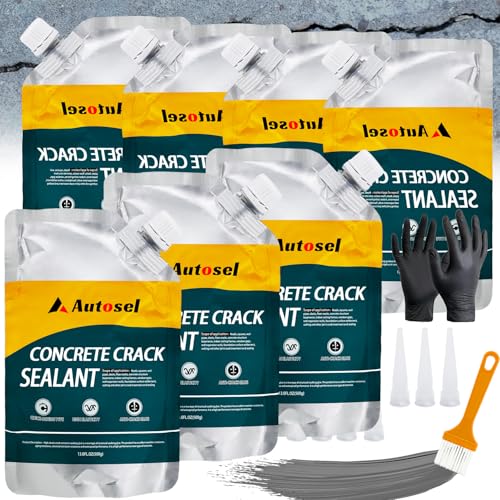
2. Autosel Self-Leveling Cement Crack Filler (7-Pack)
The multi-pack that handles a season’s worth of cracks in one order.
Seven bottles at once means you can seal a season’s worth of cracks in a single purchase. The self-leveling liquid (a thin resin that flows into gaps on its own) fills hairline gaps without troweling and forms a waterproof seal — tack-free in 1–3 hours and fully cured in 24-48 hours, so you are not blocking the garage all weekend. Each bottle comes with its own brush and glue nozzle, plus a black glove, so you can hand one to a helper without sharing tools.
The silane resin (a flexible, water-resistant plastic compound) formula is designed to stay flexible through freeze-thaw cycles, which is the main reason rigid patches fail. The catch is that this is a surface-level filler; it will not handle an active, pressurized water leak in a foundation wall. That needs the injection kits below.
For the number of cracks you get to seal at once, this is the most economical way to buy a premium silane resin product. Unlike the Red Devil 0641, which is a single pre-mixed gallon, the Autosel gives you seven separate applications, so each stays fresh until opened.
Why It Works
- 7 individual bottles — great for treating multiple cracks over time
- Self-leveling liquid fills cracks without troweling
- UV-resistant and waterproof barrier withstands rain and snow
What To Watch
- Not designed for active leaks or pressurized water
- Full cure takes 24–48 hours
Best for: Buyers who have several surface cracks (driveway, sidewalk, garage floor) and want to seal them all at once without buying multiple separate products.
Not for: Anyone dealing with a wet, actively leaking foundation wall — that needs an injection kit like the Hydra Stop 300.
3. Hydra Stop 300 Foundation Crack Repair Kit (10′)
The injection system that turns a leaky basement crack into a dry memory.
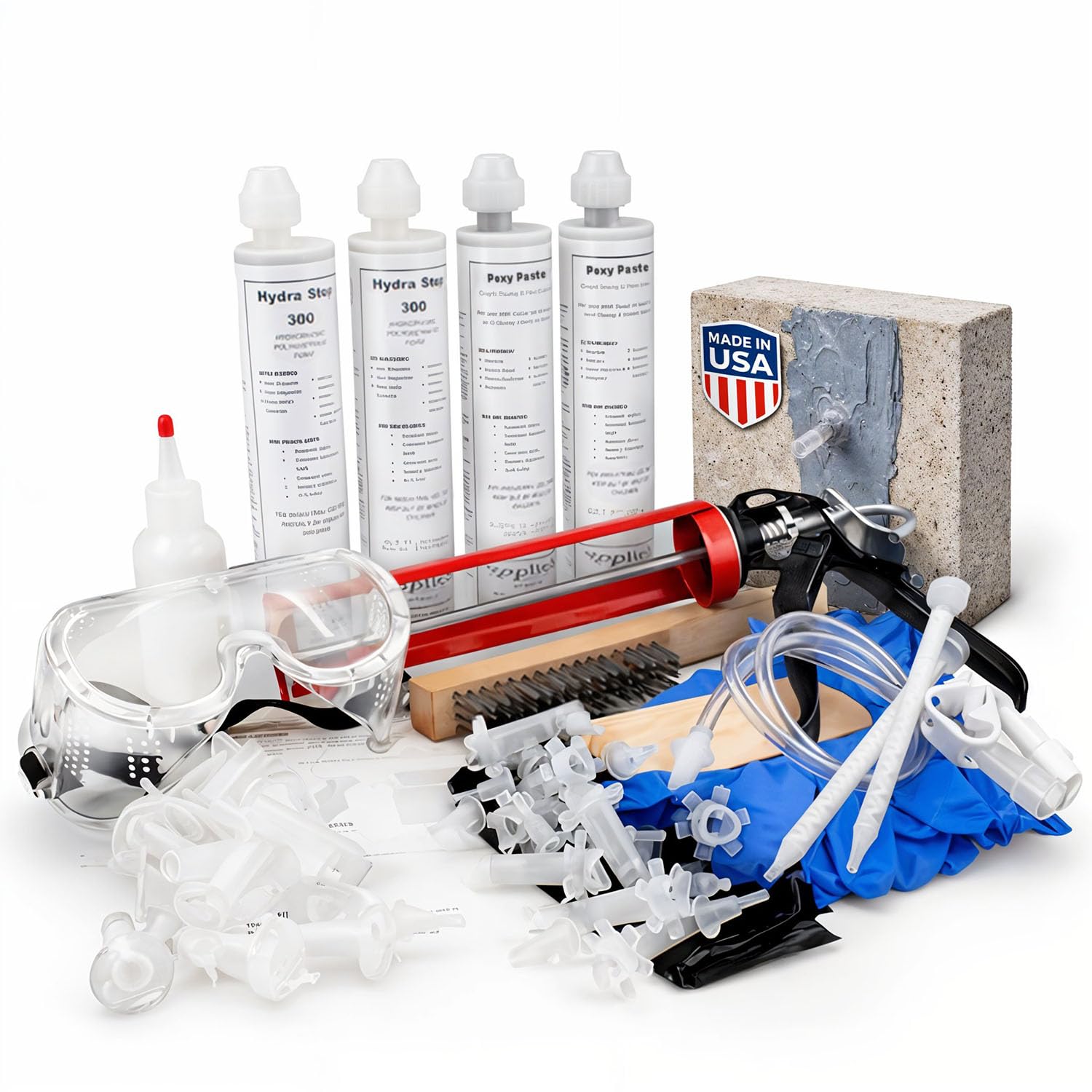
When water is actually coming through a foundation wall, a surface patch is useless — the hydrostatic pressure (the force from water in the soil) will push it right out. The Hydra Stop 300 kit solves this by injecting a two-part polyurethane foam that reacts with the water itself to expand and fill the entire crack from the inside. The kit includes 2 tubes of Hydra Stop 300 foam, 2 tubes of Poxy Paste crack sealant, 15 surface ports, a caulk gun, 2 pairs of nitrile gloves, safety glasses, a drop cloth, 10 wooden sticks, 10 corner ports, a wire brush, and a flexible injection hose assembly — everything you need for a single repair run up to 10 feet long.
Buyers report the foam locks into place permanently, creating a flexible waterproof seal that stops basement leaks for good. At 6 pounds, the kit is heavy enough to signal it is serious gear, but it is still portable for a DIY homeowner. The trade-off is that this is a single-use system: once the foam cures, leftover material in the tubes hardens, so you need to use it in one session. It is also the most expensive method here, but far cheaper than calling in a foundation contractor.
It weighs exactly the same as the short-handled version of the Autosel filler — 6 pounds — but the comparison ends there. This is a different class of repair: injection versus surface fill.
Key Strength
- Expanding polyurethane foam fills deep, active cracks from inside
- Includes full accessory set — caulk gun, ports, gloves, safety glasses
- Trusted brand (Applied Technologies) with over two decades in waterproofing
Key Limitation
- Single-use kit: leftover foam hardens in the tube
- Best for one 10-foot crack — longer gaps need the 20-foot version
Reach for this if: You have an active water leak in a poured concrete foundation wall and want a permanent, professional-grade fix without hiring a crew.
Look elsewhere if: Your cracks are dry, hairline, and on a driveway — a self-leveling liquid filler will do the job at a fraction of the cost.
4. RadonSeal DIY Foundation Crack Repair Kit (20 ft)
The zero-drill solution that seals hairline cracks and blocks radon too.
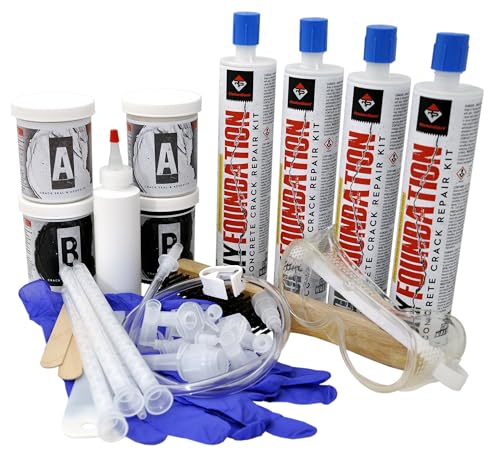
If the idea of drilling into your foundation makes you nervous, this kit is built for you. The low-viscosity urethane (a thin, runny plastic resin) injects through a standard caulking gun — no drilling, no dust, no structural disruption. It is designed specifically for poured concrete walls, leaking form ties (the metal rods used in forms when concrete was poured), and cove joints, and it fills hairline cracks (up to 0.5 inches wide) that other products cannot reach. The closed-cell foam (a foam with sealed pockets that resists water and gas) cures in 24 hours.
A unique advantage here is the dual protection: the manufacturer states the seal acts as a barrier against water and radon/soil gases. Buyers with a radon concern appreciate that this single repair addresses both threats. At 1.0 count, the kit includes surface sealer, injection foam, ports, and accessories — everything is in the box. The catch is the 24-hour cure time, which is longer than the Hydra Stop 300’s instant expansion, so you need the area undisturbed for a full day.
Compared to the Hydra Stop 300, the RadonSeal offers a gentler approach for smaller, drier cracks at a slightly higher price — but it adds the radon barrier, which the Hydra Stop does not claim.
No-drill setup: No drilling needed — injects directly through a caulking gun, minimal disruption to your home. Radon barrier: Stops both water seepage and radon/soil gases, a rare dual-purpose seal. Waiting period: The 24-hour full cure time means the area must stay untouched for a day.
The decisive benefit: If you are sealing a dry hairline crack and radon is a concern, this is the only product on the list that addresses both — a smart insurance policy.
The main caveat: Not suitable for active leaks; the low-viscosity formula works best on dry or damp cracks, not flowing water.
5. Hydra Stop 300 Foundation Crack Repair Kit (20′)
Double the reach for the same proven injection system.
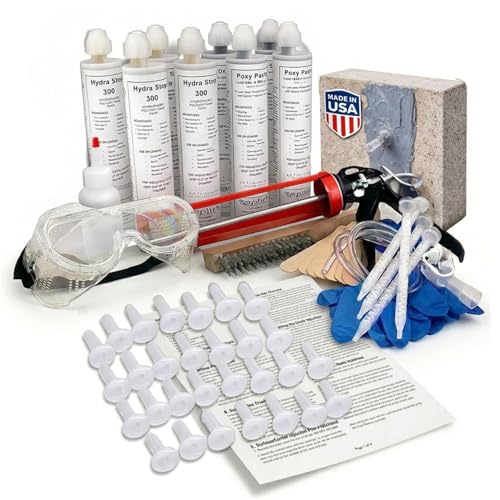
If the 10-foot kit above is the right idea but your crack runs longer, this 20-foot version is the obvious upgrade. It uses the same Hydra Stop 300 polyurethane injection foam that reacts with moisture to expand and lock into place, creating a durable, flexible barrier that stops basement leaks permanently. The product dimensions (14 x 6 x 14 inches) make the kit large enough to hold the extra material, but it still ships as a manageable box.
Manufactured by Applied Technologies (specialists in foundation repair since 1998), the kit comes as a complete system: surface sealant, ports, injection hose assembly, and accessories. Buyers who used the 10-foot kit and needed more coverage appreciate that the 20-foot version means one box does it all without buying a second kit. The catch, as with the smaller kit, is the single-use nature — you need to commit to doing the entire job in one session.
Unlike the Autosel or MuzeFansi fillers, this is still strictly for active wall leaks, not driveways.
Longer reach: Covers up to 20 feet of foundation crack in one kit — no need to buy a second box mid-job. Same trusted technology: Identical expanding polyurethane foam that stops active water leaks on contact. Single-use commitment: Leftover foam hardens in the tube, so you need to plan a single uninterrupted session.
Pick this if: You have a long, continuous crack (20 feet or close to it) in your basement wall that leaks actively — it saves you from buying two separate 10-foot kits.
skip it if: Your crack is under 10 feet — the 10-foot kit costs less and wastes less material.
6. MuzeFansi Concrete Crack Filler (3-Pack)
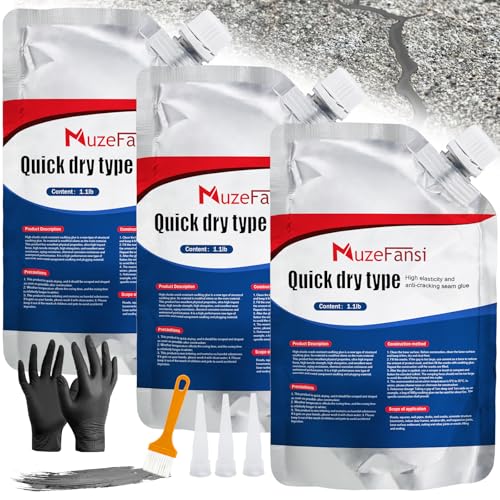
The polyurethane gel that stays flexible so cracks stay sealed.
Unlike a cement-based patch that hardens to a rigid crust, this is a polymer-resin gel (a flexible plastic compound) designed to flex with seasonal movement. It is self-leveling, so you can apply it with a caulking gun and let it flow into the crack without spreading. Touch-dry in 3 hours and fully cured in 24–48 hours, it forms a tough waterproof barrier that resists UV rays and chemical corrosion. The package includes 3 tubes, each with a 2 x 2 x 2 inch form factor — compact and easy to store.
At just 2 pounds total for all three tubes, it is significantly lighter than the Red Devil or Autosel options. That light weight means each tube covers a limited area — ideal for sealing multiple isolated hairline cracks, not a long continuous gap. Buyers appreciate that it bonds to wood and metal too, so it has uses beyond concrete. The trade-off is that the gel is not thick enough for large holes or spalled corners; it is strictly a crack filler.
Compared to the Autosel (7 tubes, silane resin) and the Red Devil (1 gallon, pre-mixed paste), the MuzeFansi is the most specialized — built for flexibility and adhesion, not volume. If you have a crack that keeps re-opening, this flexible gel is your answer.
Flexibility advantage: The polyurethane gel resists temperature swings, preventing cracks from reopening — something rigid cement cannot do. Multi-surface bonding: Adheres to concrete, brick, tile, wood, and metal, giving it wider utility. Coverage note: Each tube is small; plan for one tube per 2–3 feet of crack.
Best application: Use this for hairline cracks in concrete that have re-cracked after a rigid patch — the flexible seal moves with the slab and stays intact.
Wrong tool for: Large gaps, active leaks, or filling holes — this is a gel, not a structural filler.
7. ninesung Concrete Patch Repair (32 oz)
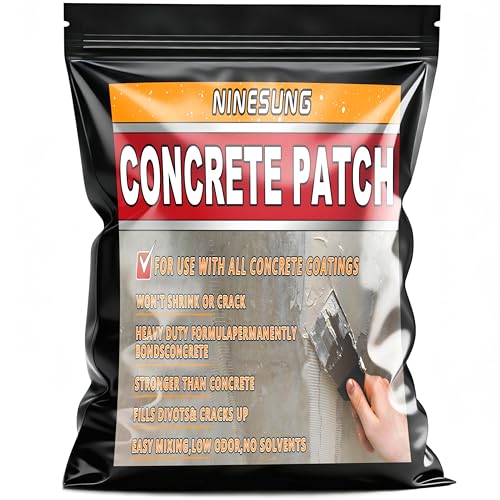
The mix-it-yourself hydraulic cement that sets in half an hour.
If you need a fast, cheap fix for a small hole or spalled area (where concrete has chipped away), this powder-based patch does the job. Just add water, mix into a smooth mortar, and apply. The hydraulic cement (a powder that hardens by reacting with water) formula sets in 30 minutes, so you can patch a step or curb and use it the same day. The maker says it can be painted or sealed after 24 hours. At 1 lb, it covers about 1+ square foot, which is modest but adequate for spot repairs.
The powder form has a clear advantage over pre-mixed tubs: it stays fresh on the shelf indefinitely until you add water. A 3.6/5 rating from 16 reviews is the lowest on the list, mostly because the product is newer (less feedback) rather than because of quality defects. Buyers who used it on small foundation spalls report it bonds securely and does not shrink. The main limitation is the same as the Red Devil — this is a surface patch, not an injection, so it does not solve water entry through wall cracks.
At 1-pound coverage per bag, it is the smallest-volume option here, far behind the Autosel’s 7-bottle kit or the RadonSeal’s 20-foot kit. But for a single, fast repair on a dry spot, it is the most cost-effective entry point.
Budget Perk
- Fast-setting hydraulic cement — sets in 30 minutes
- Non-shrink formula dries rock-hard
- Powder form has unlimited shelf life before mixing
Trade-Off
- Lowest review count (16 ratings) — limited long-term feedback
- Only covers 1+ sq ft per bag
Who it fits: Homeowners on a tight budget who need a quick, one-spot repair on a dry driveway or sidewalk and do not mind mixing powder.
Who it does not fit: Anyone with a leaking foundation wall, a long crack, or a need for flexible movement — this cement is rigid after curing.
Understanding the Specs
Injection vs. Surface Patch
An injection system (like the Hydra Stop 300 or RadonSeal) uses a nozzle and ports to push foam or urethane deep into a crack — essential for stopping water that is actively leaking through a foundation wall. A surface patch (Red Devil, ninesung, Autosel, MuzeFansi) sits on top of the crack and bonds to the outer face. For dry, shallow cracks a patch is fine. For wet or deep cracks, injection is the only permanent fix.
Cure Time and Full Cure
“Tack-free” time is when the surface is dry to the touch (1–3 hours for the Autosel, 3 hours for MuzeFansi). “Full cure” is when the material has reached its maximum strength and can bear traffic or pressure (24–48 hours for most gels, 24 hours for RadonSeal, 30 minutes for the ninesung hydraulic cement). Polyurethane injection foams expand and set on contact with moisture, so there is no waiting — but the area must remain undisturbed while the foam cures internally.
FAQ
Can I use a surface patch on a wet foundation crack?
What is the difference between hydraulic cement and polyurethane foam?
How long does concrete patch last on a foundation wall?
Can I apply concrete filler in cold weather?
How do I know if my foundation crack is structural or just cosmetic?
Will a self-leveling filler work on a vertical wall?
How many tubes do I need for a 10-foot crack?
Is it safe to use concrete patch near a sump pump?
Final Thoughts: The Verdict
Across the board, the concrete for foundation repair winner is the Autosel Self-Leveling Cement Crack Filler (7-Pack) because it gives you seven bottles of silane resin filler for a single price — the best coverage for the money when you have multiple dry surface cracks to seal. If you want active water-leak stopping power, grab the Hydra Stop 300 10′ Injection Kit. And for a hairline crack that also concerns radon, the standout is the RadonSeal DIY Foundation Crack Repair Kit.
How We Picked
We do not accept paid placement. Every pick is matched to a real buyer and a real use-case; we do not hands-on test units.
Sources & Methodology
Specifications: manufacturer listings and product documentation. Review insights: verified customer reviews, as of July 2026. Pricing: not shown on this page (it changes often); check the current price via the retailer link.
As an Amazon Associate, WellFizz earns from qualifying purchases. This does not affect which products we feature.
Related Guides

Mo Maruf
I created WellFizz to bridge the gap between vague wellness advice and actionable solutions. My mission is simple: to decode the research and give you practical tools you can actually use.
Beyond the data, I am a passionate traveler. I believe that stepping away from the screen to explore new environments is essential for mental clarity and physical vitality.