Our readers keep the lights on and my smoothie glass nicely filled. As an Amazon Associate, I earn from qualifying purchases.
Specs are compiled from manufacturer listings and verified buyer reviews and can change over time — please confirm the key details on the product page before buying.
When the old filler in your driveway cracks or washes out, you are left with a gap that lets in weeds, water, and ants. The right sealant stops that quickly, and your main choice is simple: a self-leveling liquid that pours into the gap, or a rubber strip you hammer into place. Below are five picks ranked by how well they hold up through rain, freezing, and daily traffic.
I’m Mohammad Maruf — the founder and writer behind WellFizz. This guide is built by comparing the manufacturers’ published specifications and the patterns across verified customer reviews, so you get each pick’s real strengths and trade-offs instead of marketing spin.
You get honest, data-backed picks that sort the messy chemistry from the simple rubber and point you straight to the best concrete expansion joint sealant for the size and shape of your own cracks.
Our Picks at a Glance


How To Choose The Best Concrete Expansion Joint Sealant
Picking the wrong filler means you will be back at the hardware store within a year. Here are the two main forks in the road that decide the right product for your job.
Liquid vs. Rubber Strip: Which path fits your gap?
Self-leveling polyurethane sealants (like the Sikaflex products) pour into horizontal joints and cure into a flexible rubbery solid. They bond directly to the concrete, so they stay put even when the slab shifts. The catch is that most liquids run downhill — if your driveway has a slope, the sealant will puddle at the low end and leave the high side bare.
Joint width and depth control everything
A sealant labeled for 1/2-inch maximum gap fill will waste itself in a 1-inch-wide joint. Rubber strips come in fixed widths (1/2-inch, 3/4-inch, 1-inch) and you pick the size that matches your measured gap. For liquid sealants, you need to install a foam backer rod first in deep joints so the sealant only fills the top half-inch — otherwise, you use three times as many tubes as necessary.
How much movement the sealant can take
Concrete expands and contracts with temperature. A sealant with ±25% joint movement capacity (like the AWF PRO Sikaflex) handles seasonal shifts without tearing. Rubber strips handle movement differently — they sit loose in the gap and compress or expand with the concrete instead of stretching.
Quick Comparison
| Model | Best For | Material | Joint Movement | Unit Count | Amazon |
|---|---|---|---|---|---|
| SIKA Sikaflex-1a 24-Pack★ Best Overall | Large jobs, damp concrete | Polyurethane | ±35% | 24 cartridges | Amazon |
| AWF PRO Sikaflex 12-PackPremium Pick | Premium horizontal joints | Polyurethane | ±25% | 12 tubes | Amazon |
| RTHIEAI 25-ft Rubber Strip | Long, straight joints (25 ft) | EPDM Rubber | Compresses naturally | 25.0 Feet | Amazon |
| Kingdder Rubber Strip (10 ft) | Small driveway gaps | EPDM Rubber | Compresses naturally | 10.0 Feet | Amazon |
| Autosel Concrete Crack Filler | Quick repatch of small cracks | Silane Resin | High elasticity | 2 bags | Amazon |
In‑Depth Reviews
1. SIKA Sikaflex-1a Self-Leveling Concrete Sealant, 24-Pack
Our pick — 4.5★ from 700+ verified ratings; the strongest balance of quality and price.
A polyurethane sealant that flexes with the ground under your feet and handles temperature shifts better than any other pick here.
The reason it leads the list is the ±35% joint movement capacity (the percentage the cured sealant can stretch or compress before tearing). That is the widest range in this guide, so it handles seasonal concrete expansion better than the AWF PRO’s ±25% rating. It is a single-component, self-leveling sealant designed for horizontal joints where the maximum depth is 1/2-inch or less, which fits most driveway, sidewalk, and garage-floor expansion joints.
Buyers report that the sealant takes about 24 to 48 hours to fully dry and cure. The manufacturer lists a tack-free time of 3 hours (the surface becomes non-sticky to the touch) and a final cure of seven days for full depth. One reviewer noted that adding sand helped it blend completely with their driveway. The white color works best for light concrete; on darker surfaces you may want to test a small patch first.
At 24 cartridges, this pack is built for large jobs — if you have a single crack, you are better off with a smaller multi-pack. The product also meets ASTM C920 (an industry standard for elastomeric joint sealants) and NSF/ANSI Standard 61 for potable water, so it is certified safe around drinking water systems.
Why it leads the list: The ±35% movement range is the widest here, so this sealant stretches and compresses with seasonal concrete shifts better than any other pick. The 24-count carton handles a whole driveway in one order, outlasting the AWF PRO’s ±25% range.
The trade-off: It is a premium liquid — on sloped surfaces it will run downhill before it cures, leaving thin spots at the high end.
Reach for this if: You have a flat driveway or garage floor with joints up to 1/2-inch deep and want a long-lasting polyurethane bond that resists weathering.
Look elsewhere if: Your concrete slopes more than a few degrees, or you only need to seal one or two short cracks — a 24-pack is overkill for small repairs.
2. AWF PRO Sikaflex 1C SL, 10 oz Tubes (12-Pack)
A fast-curing polyurethane that pours like honey, sets like firm rubber, and blends into gray concrete.
It earns the premium label because it has an accelerated cure time (the surface gets tack-free faster than standard polyurethane) and comes in a limestone color that blends into gray concrete better than the white of the SIKA 24-pack. This is the Sikaflex 1C SL formula — single component, self-leveling, premium-grade polyurethane that cures to a tough, durable, and flexible consistency. It handles ±25% joint movement, which covers standard residential concrete expansion without issue. A buyer described the consistency as “about the thickness of honey” and said it levels out so smoothly you barely need to touch it.
The 12-tube count gives you 120 total ounces (10 ounces each), which is a mid-range volume — enough for a multi-section driveway but not the industrial scale of the 24-pack. It meets ASTM C-920, Type S, Grade P, Class 25 (a specific rating for joint sealants), and federal specification TT-S-00230C, Type I, Class A.
The main real-world caution: this sealant runs on slopes just like any self-leveling liquid. One reviewer specifically called it “not good for concrete that is sloping, because it runs out too easily.” For flat joints, it is excellent; for sloped surfaces, consider a rubber strip instead.
Why it earns the premium label: Accelerated cure time (faster tack-free than standard polyurethane) plus the limestone tint that disappears into gray concrete better than white or dark alternatives.
The honest drawback: At 10 ounces per tube and ±25% movement (lower than the standard Sikaflex-1a’s ±35%), you get less stretch and less coverage per dollar compared to the larger 24-pack of the basic SIKA model.
Best for: Horizontal expansion joints on flat sidewalks, balconies, and terraces where you want a fast-setting, match-the-concrete finish.
skip it if: Your joint is on a grade or you need the widest possible movement tolerance — the ±25% is fine for most homes but falls short of the ±35% on the standard Sikaflex-1a.
3. RTHIEAI Flexible EPDM Rubber Strip (25 ft, 1-inch Wide)

A 25-foot rubber strip you cut to size and hammer into place — no chemicals, no cure time, no mess.
This is the longest single-piece rubber strip on the list: 25 feet of EPDM rubber (ethylene propylene diene monomer, a synthetic rubber that resists weather and aging), 1 inch wide, designed for concrete crack repair and replacement. You simply lay the strip into the gap and press firmly with your hand or a carpenter’s hammer. The EPDM material does not dry out and crack the way many liquid-applied sealants eventually do.
Owners mention that it is very DIY-friendly — one reviewer cut it with scissors and completed 15 strips in about an hour on a 1970s pool deck. The manufacturer highly recommends using a trial pack (ASIN B0CDRCXQDS) to test fit the width before ordering the full 25-foot roll, because the strip is softer than some samples and may not stay in the gap if the joint is too wide.
Compared to the Kingdder strip below, this one gives you 25 feet versus 10 feet — a 2.5x length advantage for larger jobs. The material sits slightly below driveway height, so car tires run over it instead of peeling it up.
Why it wins for long runs: A single 25-foot roll covers the length of a standard two-car driveway joint, and installation takes minutes with zero chemical cure time.
The one issue: When the rubber strip arrives it can be “like a twisted rubber snake” according to one review — it may need heat from summer sun to settle flat and stay even in the gap.
Reach for this if: You have a long, straight expansion joint on a flat surface and want a fast, no-chemical fix that stays flexible.
Look elsewhere if: Your joint is wider than 1 inch or varies in width by more than 1/8 inch — the strip needs a consistent gap to fit snugly.
4. Kingdder Concrete Expansion Joint Filler (10 ft, 1 inch Wide)

A 10-foot EPDM strip for small gaps that need quick weeding relief and a tool-free install.
At 10 feet long and 0.75 inches thick, this Kingdder strip is built for a single driveway gap or the joint between the garage floor and the foundation. It is made from flexible, strong EPDM rubber and is available in three widths (1/2-inch, 3/4-inch, and 1-inch) so you can match your measured crack.
A reviewer said it solved their weed problem — “I was so tired of spending my time each week pulling these weeds” — and the strip slid right in after they cleaned out the dirt. The same reviewer noted that car tires leave marks on the surface of the strip, which is a cosmetic issue you get with most rubber joint fillers.
Compared to the RTHIEAI strip, this one is 15 feet shorter (10.0 feet vs 25.0 feet — a two-and-a-half-times length gap). If your job is a single garage threshold or a short driveway seam, the 10-foot strip is enough without leftover waste.
Why it fits here: The price and length are right for a small-job owner who wants a quick, tool-free install and does not need 25 feet of material.
The trade-off: At 10 feet, you cannot cover a full two-car driveway in one piece — you would need to buy two rolls, which pushes you toward the RTHIEAI or a liquid sealant for longer runs.
Best for: A single driveway expansion joint or a gap between the garage floor and the house foundation, where 10 feet is just enough and you want a no-mess, no-cure option.
Consider the RTHIEAI instead if: Your joint runs the full length of a driveway — the 25-foot RTHIEAI strip covers that in one roll without splicing.
5. Autosel Concrete Crack Filler, Self-Leveling (2-Pack)
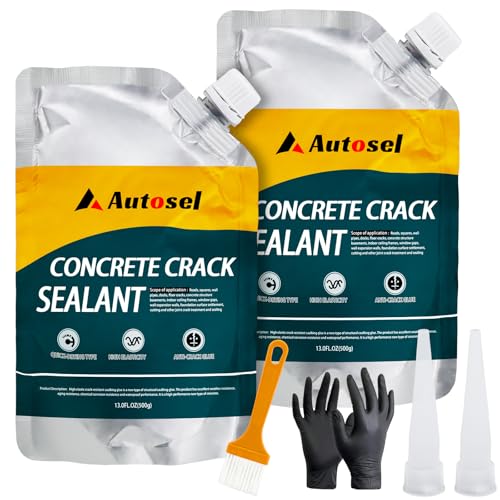
A two-bag, self-leveling gel that cures smooth enough to hold through a rain shower, for a lower price than polyurethane.
This Autosel crack filler is a silane resin gel (a polymer that bonds to concrete and cures flexible) that comes in two 13.0 fl oz bags, each with its own brush and glue nozzle. The self-leveling design means you apply it to a horizontal crack and it spreads on its own — no extra troweling needed. The manufacturer says it significantly reduces curing time compared to traditional sealants, and a buyer confirmed that it “cured smooth in 24h, held through rain.”
The material cures to a flexible, not brittle, finish that resists water, UV, and freezing. It bonds with concrete, brick, tile, and stone, so you can use it on patios, garage floors, steps, and sidewalks. Customers note a few caveats: it needs to be stirred thoroughly before use because the adhesive sinks to the bottom; it leaves a glossy dark gray finish that can attract debris; and on sloped surfaces the liquid runs slightly, requiring sand to matte it down.
Compared to the polyurethane options above, this silane resin is less expensive but also less durable. One reviewer estimated it lasts roughly five years outdoors, while polyurethane sealants and EPDM strips typically last longer in direct sun and freeze-thaw cycles.
Why it is a good budget pick: The two-bag pack covers multiple small cracks quickly, and the self-leveling action gives a smooth finish without skill.
The honest catch: It is a GE-like silane resin, not a true polyurethane — the cure is less elastic over time, and the glossy gray finish stands out against old, faded concrete.
Reach for this if: You need a quick, low-cost fix for hairline to 1/4-inch cracks on a flat patio or sidewalk and you do not mind a slightly shiny finish.
pass on it if: Your cracks are wider than 1 inch or you need a color match for aged gray concrete — the glossy dark gray will show.
Understanding the Specs
Joint Movement Capacity
This number, written as “±25%” or “±35%”, tells you how much the cured sealant can stretch or compress before it pulls away from the concrete. Concrete expands in summer heat and contracts in winter cold. A sealant with ±35% movement handles more thermal shift than ±25%, which is important on long driveways where the ends move more than the middle. If you live in a climate with wide temperature swings, aim for ±35%.
EPDM Rubber vs. Polyurethane
EPDM rubber strips are solid lengths of synthetic rubber that you press into a dry gap. They do not bond chemically to the concrete — they sit in the space and get compressed when the slab moves. Polyurethane sealants bond directly to the concrete walls of the joint, so they resist being pushed out by water pressure or frost. Polyurethane lasts longer in freeze-thaw cycles; EPDM is faster to install and contains no VOCs (volatile organic compounds that cause fumes during curing).
FAQ
Can I apply a self-leveling sealant on a sloping driveway?
How long does a polyurethane expansion joint sealant last?
Do I need a backer rod before applying the sealant?
Can I use a concrete expansion joint sealant for vertical cracks?
How do I remove old, dried-up joint filler before applying new sealant?
Are EPDM rubber strips reusable if I remove them?
Can I paint over a cured polyurethane sealant?
What is the difference between Sikaflex 1A and Sikaflex 1C SL?
Final Thoughts: The Verdict
If you want one dependable pick, the concrete expansion joint sealant winner is the SIKA Sikaflex-1a 24-Pack because it offers the highest joint movement (±35%), a proven polyurethane formula, and enough material to handle a full driveway in one order. If you want a premium fast-cure liquid that blends into gray concrete, grab the AWF PRO Sikaflex 1C SL 12-Pack. And for a no-chemical, 25-foot rubber strip that installs in minutes, the standout is the RTHIEAI EPDM Rubber Strip.
How We Picked
We do not accept paid placement. Every pick is matched to a real buyer and a real use-case; we do not hands-on test units.
Sources & Methodology
Specifications: manufacturer listings and product documentation. Review insights: verified customer reviews, as of July 2026. Pricing: not shown on this page (it changes often); check the current price via the retailer link.
As an Amazon Associate, WellFizz earns from qualifying purchases. This does not affect which products we feature.
Related Guides

Mo Maruf
I created WellFizz to bridge the gap between vague wellness advice and actionable solutions. My mission is simple: to decode the research and give you practical tools you can actually use.
Beyond the data, I am a passionate traveler. I believe that stepping away from the screen to explore new environments is essential for mental clarity and physical vitality.