Our readers keep the lights on and my smoothie glass nicely filled. As an Amazon Associate, I earn from qualifying purchases.
Specs are compiled from manufacturer listings and verified buyer reviews and can change over time — please confirm the key details on the product page before buying.
If you are cutting, grinding, or chasing concrete indoors, the airborne silica dust is not just a mess — it is a serious health hazard that hangs in the air for hours. A regular shop vac recirculates the finest particles right back into the room, which is why you need a vacuum built from the ground up for concrete dust: one with a true HEPA filter, automatic filter cleaning, and the suction to keep your workspace actually clean, not just quieter.
I’m Mohammad Maruf — the founder and writer behind WellFizz. This guide is built by comparing the manufacturers’ published specifications and the patterns across verified customer reviews, so you get each pick’s real strengths and trade-offs instead of marketing spin.
Whether you are a contractor chasing OSHA Table 1 compliance or a homeowner tackling a weekend grind, you need a concrete dust vacuum that traps 99.97% of particles at 0.3 microns — and this guide breaks down the eight best options by real-world performance, capacity, and ease of use.
Our Picks at a Glance


How To Choose The Best Concrete Dust Vacuum
Not every “shop vac” is safe for concrete dust. The fine silica particles that get kicked up during cutting and grinding are small enough to pass straight through a standard vacuum filter and blow right back into your lungs. Choosing the right concrete dust vacuum means prioritizing three things: true HEPA filtration, automatic filter cleaning to prevent clogging, and suction specs that match your tools.
HEPA Filtration: The Non-Negotiable Start
A vacuum for concrete dust must have a true HEPA filter that captures at least 99.97% of particles at 0.3 microns. This is not a marketing claim — it is a safety threshold. Without it, the finest dust (the kind you cannot see settling) stays airborne. Check the product specs for “HEPA” and look for a filter that is not an add-on but part of the original design with a proper seal.
Automatic Filter Cleaning: The Productivity Factor
Fine dust clogs standard filters fast, sometimes within minutes, dropping suction to near zero. Extractor-grade vacuums solve this with an automatic filter clean — a mechanism that pulses air back through the filter (often every 15 to 30 seconds) to knock off the dust cake. This keeps the suction consistent without you stopping to knock or replace the filter mid-job. Some models let you disable the pulsing if the noise bothers you, which is a nice touch for indoor work.
CFM, Water Lift, and Capacity
CFM (cubic feet per minute) tells you how much air the vacuum moves — higher CFM means better airflow to capture dust at the source. Water lift (measured in inches) tells you how hard the vacuum pulls against resistance, such as a narrow hose. For concrete work, look for at least 100 CFM paired with a water lift over 80 inches. Capacity matters too: an 8 to 14-gallon tank means fewer trips to dump the bin, and a larger tank also gives the dust more time to settle before the filter clogs.
Tool Activation and Portability
Power tool actuation (auto start/stop) lets you plug your grinder or saw into the vacuum so it runs only when the tool runs — no wasted energy and no forgetting to turn it on. Corded models offer unlimited runtime and stronger suction, while cordless models give you freedom on a jobsite without power nearby. Also consider hose length: a 13 to 15-foot hose lets you move the tool around without dragging the whole vacuum behind you.
Quick Comparison
| Model | Best For | Capacity | CFM / Water Lift | Hose Length | Amazon |
|---|---|---|---|---|---|
| Festool CT Midi I HEPA★ Best Overall | Pro-grade dust-free sanding | 3.9 gal | 130 CFM / — | — (smooth hose) | Amazon |
| Bosch VAC140AHPremium Pick | Biggest capacity for heavy jobs | 14 gal | 150 CFM / 97 in | 9.85 ft | Amazon |
| Bosch VAC090AHBest Value Pro | Balanced power and value | 9 gal | 150 CFM / 97 in | — (long hose) | Amazon |
| Fein Turbo I HEPA Pro | Quiet, powerful extraction | 5.8 gal | 151 CFM / 98 in | 13 ft | Amazon |
| DEWALT DWV010 | Large capacity auto-clean | 8 gal | 150 CFM / — | 15 ft | Amazon |
| Mosquito-America Backpack | Mobility for cleanup | 10 qt (2.5 gal) | 106 CFM / — | 4 ft | Amazon |
| DEWALT DCV585B | Cordless portability | — (handheld) | 125 CFM / — | 8 ft | Amazon |
| Makita VC4210L | Quiet pro-grade extraction | 11 gal | 148 CFM / 92 in | 13 ft | Amazon |
In‑Depth Reviews
1. Festool 574837 CT Midi I HEPA Bluetooth Dust Extractor
Our pick — over 4.5★ from 500+ verified ratings; the strongest balance of quality and price.
The gold standard for keeping air clean while sanding and grinding concrete
The Festool CT Midi is the unit every other dust extractor is measured against, and for good reason — buyers report that sanding with this extractor “peaked at 2ppm vs 45ppm with previous setup,” which is the kind of real-world improvement that changes how you work. It delivers 130 CFM of suction through a smooth anti-static hose with a conical geometry that prevents snagging, and the integrated Bluetooth technology lets battery packs or a remote trigger the vacuum automatically when you start a tool. The 3.9-gallon capacity is small compared to the DEWALT DWV010’s 8-gallon tank — at 3.9 gallons versus 8 gallons — so you will empty the bag more often on big concrete jobs, but the trade-off is a compact footprint that fits easily into a van or under a bench.
The build quality is the most-praised feature, with owners consistently calling it top-tier. The onboard hose holder and Sys-dock with T-Loc for Systainer storage keep the worksite organized. The catch is the price: this is the most expensive option here, and the hose needs adapters for non-Festool tools. Also, key accessories like a boom arm are only available on the larger CT36+ model, a frustration for those who want to expand later. But for anyone who prioritizes respiratory health and zero dust escape, the consensus is clear — it is worth it.
What wins people over is the combination of adjustable suction to minimize noise and the auto-start feature that ensures extraction runs every time the tool runs. The value for money gets mixed opinions (some see it as steep, others as a health investment), but the quality score is the strongest positive feedback of any aspect.
What Owners Love
- Bluetooth auto-start keeps dust captured the instant the tool starts
- Smooth anti-static hose eliminates shocks and snagging
- Compact size with Systainer and hose storage
What to Consider
- 3.9-gallon capacity is small — expect frequent bag changes on heavy concrete jobs
- Expensive accessories and adapters required for non-Festool tools
- Missing boom arm support available on larger Festool models
Your best bet if: you want hospital-level air quality during sanding and grinding — the health benefit is the real story here.
Think twice if: you need to run a full day of concrete cutting without stopping to swap bags, or you are on a tight budget.
2. Bosch VAC140AH Portable 14 Gallon Dust Extractor
The big tank that keeps you working longer between bag changes
When you are grinding concrete on a historic masonry project from Maine to Virginia, you need a vacuum that does not make you stop every hour. The Bosch VAC140AH holds a massive 14 gallons — the largest capacity in this list — which directly means fewer trips to dump the bag and more time with the tool in your hand. It delivers 150 CFM with a sustainable 97-inch static water lift, and the automatic filter clean kicks in every 15 seconds to keep that suction strong even when the dust is thick. The HEPA filter captures 99.97% of particles at 0.3 microns, and the PRO+GUARD system helps you move toward OSHA Silica Table 1 dust compliance, which is critical for professional concrete contractors.
The tool activation feature lets you use the power tool’s switch to turn the vacuum on and off, and the Power Broker dial lets you match suction to the application — useful when switching from a grinder to a detail sander. Owners highlight the excellent dust control during concrete grinding and the versatility for both work and home use. The main drawback is the auto-clean cannot be fully disabled — it fires a thump even when you power off — and at this price point, you are investing in a serious piece of equipment that is heavy to load and unload.
Built for endurance: with 14 gallons and 150 CFM, this Bosch is the volume king — ideal for crews running non-stop concrete cutting or grinding.
The compromise: the auto-filter thump cannot be turned off completely, and the weight makes it less portable than smaller options.
Reach for this if: you need maximum capacity for all-day concrete work and value OSHA-ready filtration.
Look elsewhere if: you move your vacuum between floors or sites constantly and need something lighter.
3. Bosch VAC090AH Portable 9 Gallon Dust Extractor
the balance of pro-grade extraction without the flagship price
The Bosch VAC090AH is essentially the little brother of the VAC140AH, sharing the same 150 CFM airflow and 97-inch static water lift but in a more manageable 9-gallon package. The automatic filter clean runs every 15 seconds to maintain suction on fine concrete dust, and like its bigger sibling, it includes a HEPA filter that traps 99.97% of particles at 0.3 microns. Owners mention that it captured over 99% of dust from cutting fiberglass, drywall, and grinding thinset — and they love that the auto-clean thump can be disabled during quiet-work periods. The power tool activation works smoothly with miter saws, track saws, and routers, and the hose fits Festool ports snugly without an adapter, a nice bonus for mixed-brand shops.
What makes this a standout value is the combination of high-end specs and real-world approval from a large owner base. Dust control is the most-praised aspect by a wide margin, and quality and performance follow close behind. The noise level gets mixed feedback — the filter pulse is noticeable — but the suction power is consistently described as impressive. The only real gripe is that given the price, a fuller set of attachments would be welcome; the hose and basic accessories cover most jobs, but you may want to pick up a few extras.
Strengths
- 150 CFM suction with sustainable 97-inch water lift
- Auto filter clean every 15 seconds (can be disabled)
- Fits Festool ports without adapters
Trade-Offs
- Auto-clean pulse is noisy — not ideal for noise-sensitive environments
- Lacks a full set of attachments for the price
Grab it for: the best balance of power, capacity, and HEPA certification — the crowd favorite for a reason.
skip it if: you need the absolute largest tank (look at the VAC140AH) or if extreme quiet is your top priority.
4. Fein Turbo I HEPA Pro Set Wet/Dry Dust Extractor

The quietest powerhouse that does not let dust escape
The 5.8-gallon tank sits between the compact Festool and the larger Dewalts, and the 98-inch water lift means it can pull dust through long hose runs without losing suction. Customers note it “doesn’t let the dust escape” even when sanding down drywall texture, and the auto-start outlet with soft-start prevents power spikes when connecting tools. The 13-foot anti-static hose and 19-foot cord give you exceptional reach without dragging the machine.
Where it falls short of the Festool is in hose storage — there is no built-in hose management, and looping the hose around the attachments is awkward and tends to fall off. The accessory kit is decent but not comprehensive, and the user interface is basic push-button rather than touch. Still, for anyone who wants close-to-Festool performance at a lower price point, this is the strongest contender. Owners consistently say it is “far superior” to a standard shop vac and that they regret not switching sooner.
Standout spec: 151 CFM at 66 dB — the best airflow-to-noise ratio in this lineup.
Honest trade-off: no dedicated hose storage, and the controls are simpler than premium rivals.
Choose this if: you want the highest suction in a quiet package for indoor concrete or drywall work.
Pass on it if: neat hose storage and touch controls are dealbreakers for your workflow.
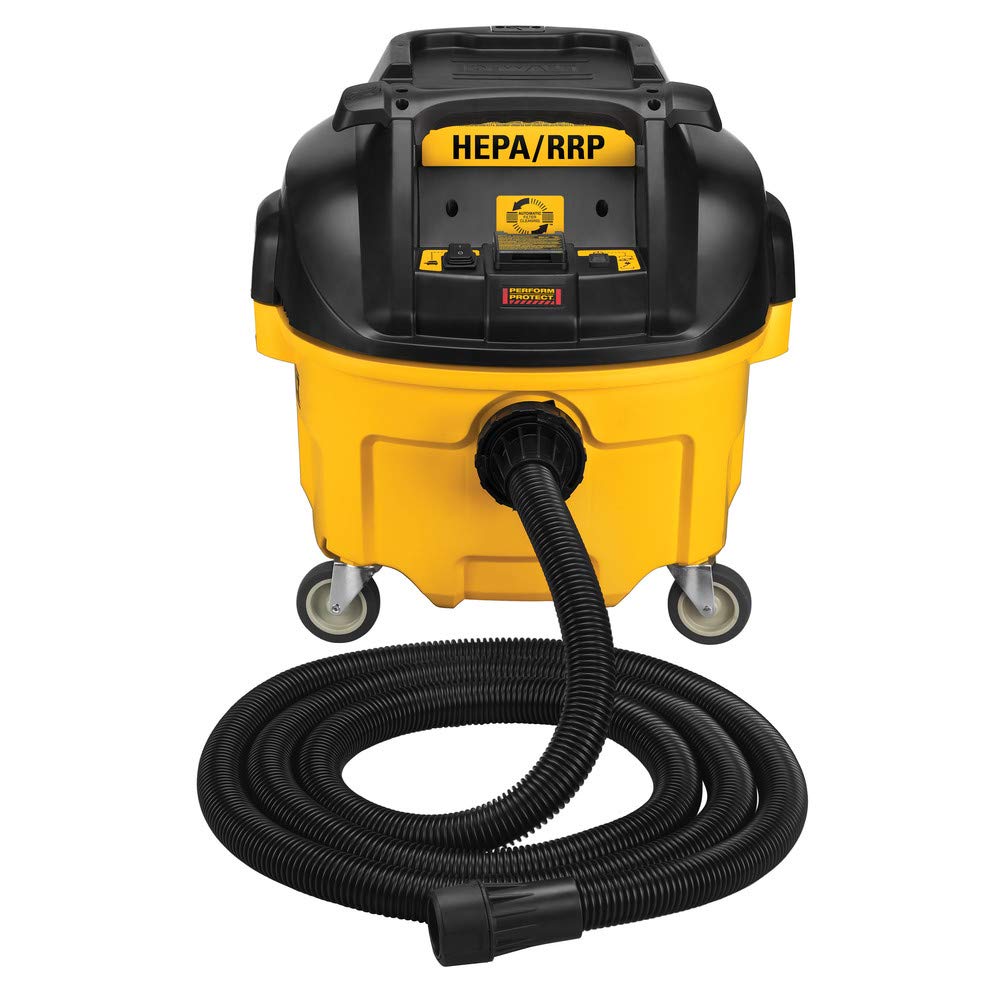
5. DEWALT DWV010 HEPA Dust Extractor with Automatic Filter Cleaning
The 8-gallon value king with automatic filter cleaning
The DEWALT DWV010 is the workhorse choice for anyone who needs a HEPA-rated concrete dust vacuum without spending Festool or Bosch money. Its 15-amp motor delivers 150 CFM of airflow — matching the Bosch units — and the automatic filter clean pulses every 30 seconds to keep suction steady through long grinding sessions. The 8-gallon capacity is a balance: larger than the Festool’s 3.9 gallons (at 8 gallons versus the Festool’s 3.9 gallons) but not as bulky as the 14-gallon Bosch. The 15-foot anti-static hose is the longest in this lineup, giving you 15 feet of reach versus the Fein’s 13 feet, so you can move around the jobsite without dragging the unit everywhere. Reviewers point out it is “great for getting the really fine dust and debris,” noting it performs much better than a regular shop vac.
Performance is the most-praised aspect overall, with dust collection also getting strong positive feedback. Owners love that the Power Tool Actuation turns the vacuum on and off with the tool, and the self-cleaning feature is a genuine time-saver on heavy jobs. The catch is that suction is slightly lower than a standard shop vac — it is designed for fine dust, not bulk pickup — and the hose is stiff and hard to store. Some buyers also report a high-pitched squeal during operation, and the accessories are friction-fit rather than locking. If you need an affordable, reliable HEPA extractor that you can beat on, this is it.
Why It Wins
- 150 CFM with auto filter clean every 30 seconds — consistent suction
- 8-gallon tank holds more than double the Festool’s capacity
- 15-foot anti-static hose for maximum reach
Known Quirks
- Suction is lower than a standard shop vac — best for fine dust, not bulk
- Noise includes a high-pitched squeal for some users
- Hose is stiff and accessories are friction-fit, not locking
Pick this for: the best bang-for-buck in a corded HEPA extractor with auto-clean and a long hose.
Avoid if: you need ultra-quiet operation or locking, pro-grade attachments.
6. DEWALT FLEXVOLT 60V MAX Dust Extractor (DCV585B)

The only cordless HEPA extractor that meets OSHA Table 1 for tuckpointing
When you are working on a rooftop or an outdoor slab with no power in sight, the DEWALT DCV585B is the only cordless option here that delivers 125 CFM with a true HEPA filter and automatic filter cleaning. It is designed to be OSHA Table 1 compliant for up to 5-inch tuckpointing and surfacing applications when paired with an appropriate dust shroud — a rare claim for a battery-powered unit. The wireless tool control remote lets you start and stop the vacuum from your tool, and the dual automatic filter cleaning kicks in every 20 seconds (or 15 seconds, depending on the setting) to keep the HEPA filters clear. Owners say it is quiet, portable, and “works great with the cordless Dewalt drywall sander,” making it a favorite for finish work where cord management is a hassle.
The big trade-off is runtime: with a 2.0Ah 60V battery, you get roughly 20 minutes of run time. That is enough for quick drywall sanding or small concrete patches, but for a full day of grinding, you will need a handful of 9Ah batteries — which gets expensive fast. The 8-foot hose is shorter than the corded competitors, and the automatic filter cleaning causes a brief drop in suction that can be annoying during continuous drywall work. Performance and suction are the most-praised aspects, but value for money gets negative marks — this is a niche tool for a specific cordless use case.
What Works
- 125 CFM with HEPA in a cordless form factor — OSHA Table 1 ready
- Wireless remote for tool-triggered operation
- Quiet and portable for quick jobs
What to Know
- ~20-minute runtime on a 2.0Ah battery — plan for multiple batteries
- Auto filter clean pulse can interrupt continuous drywall sanding
- Expensive when you factor in battery costs
Ideal for: mobile tradespeople who need HEPA extraction where there is no power — tuckpointing, rooftop work, outdoor slabs.
Not for: all-day concrete grinding or anyone not already invested in the DEWALT FLEXVOLT battery system.
7. Makita VC4210L 11 Gallon Wet/Dry HEPA Dust Extractor

Quieter than a standard shop vac with pro-grade automatic cleaning
The Makita VC4210L is the choice for anyone who wants Festool-like performance in a larger, quieter package. Its 12-amp motor generates 148 CFM of suction with 92 inches of water lift, and the two-stage filtration system starts with a main flat filter that captures 99.95% of particles 2 microns and larger, followed by the HEPA filter that captures 99.97% at 0.3 microns. The automatic filter cleaning cycles every 20 seconds (with a distinctive pop or thump sound), and you can disable it by switching to wet mode — a clever workaround for noise-sensitive work. Owners consistently say it is quieter than both Rigid and DeWalt shop vacs, and it maintains suction after 12 hours of mixed debris without clogging. The 11-gallon tank is substantial, and the included 13-foot anti-static hose plus a full set of adapters makes it ready to connect to most tools from the start.
The most-praised aspect is performance, with dust removal and suction following closely. Durability gets mixed reviews — some buyers report it breaking down after heavy use, while others find it tough and reliable. The auto-clean thump every 20 seconds is a common point of feedback; most owners find it tolerable or disable it, but it is worth knowing before you buy. Also, the 1.5-inch hose limits pickup of large debris, so this is strictly a fine-dust extractor, not a general purpose shop vac for construction debris.
Performance standout: 148 CFM with two-stage HEPA filtration and auto-clean — quieter than most competitors.
A real caveat: durability feedback is split, and the 1.5″ hose does not handle large debris.
Choose the Makita if: you want a quieter, high-performance extractor with a large tank and auto-clean that can be disabled.
Look elsewhere if: you need a single vacuum for both fine dust and construction cleanup — this is specialized.
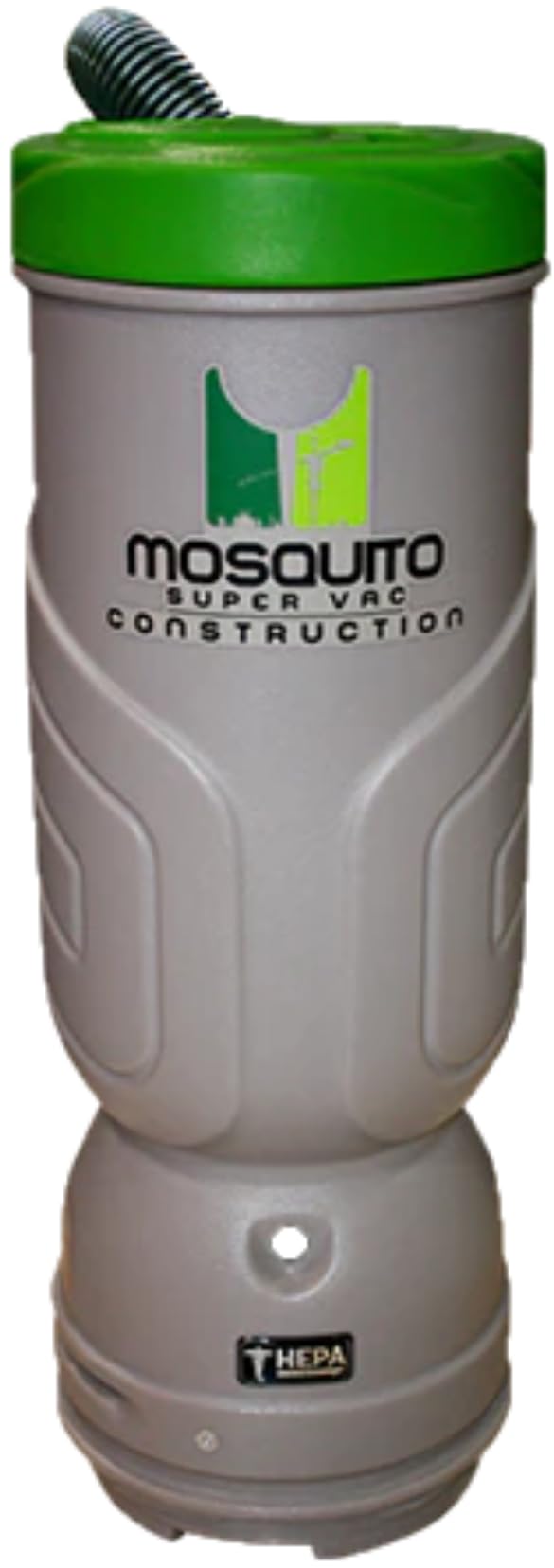
8. Mosquito-America Construction Backpack Vacuum (Model 10-1013-SG)
The lightweight backpack that lets you move fast on cleanup duty
The Mosquito-America backpack vacuum takes a different approach: instead of a rolling canister, it straps onto your back at just 10 pounds, giving you hands-free mobility for cleanup in construction, demolition, and restoration. The 12-amp, 1400-watt motor delivers 106 CFM of suction — lower than the canister extractors, but enough for fine concrete dust when paired with the included HEPA filter. It is CRI SOA-GL GOLD certified, capturing 99.97% of particles at 0.3 microns, and it converts to a blower with three included nozzles. The six-piece toolkit (54-inch aluminum wand, floor tools, dusting brush, upholstery tool, crevice tool) covers a wide range of cleanup scenarios, and the lifetime warranty on the body plus 7 years on the motor is a strong confidence signal. Made in the USA, it appeals to buyers who prioritize domestic manufacturing.
Owners love the lightweight design and strong suction for the size, calling it “incredibly lightweight” and effective for commercial use. The negative feedback is significant: some units broke at the straps after months of use, and one owner reported the lid does not lock well, which is a safety concern for mold remediation. The low review volume (25 ratings at 3.4 stars) makes it harder to recommend with confidence compared to the heavily-reviewed Bosch and DeWalt options. If you need a hands-free backpack for quick concrete dust cleanup, it is worth considering, but look carefully at the strap durability and lid latch before buying.
High Points
- 10-pound backpack design leaves hands free for tools and debris
- 106 CFM with HEPA filter — certified for fine dust capture
- Lifetime body warranty and 7-year motor warranty
Low Points
- Strap durability is inconsistent — some units broke after months
- Lid latch can be unreliable, a safety risk with hazardous dust
- Low review volume makes long-term reliability uncertain
Best for: restoration and cleanup crews who need to move fast without dragging a canister — the hands-free design is unique.
Skip it for: primary concrete grinding extraction or if you need proven long-term durability from thousands of owners.
Understanding the Specs
HEPA Filtration
HEPA stands for High-Efficiency Particulate Air. It is not just a fancy filter label — it means the vacuum captures at least 99.97% of particles that are 0.3 microns in size or larger. Concrete dust includes silica particles smaller than 10 microns, so only a true HEPA filter (not a “HEPA-type” or “HEPA-style”) will trap them. Every vacuum on this list has a genuine HEPA filter, but always check the fine print: some vacuums include a HEPA filter as standard, while others require you to buy it separately.
CFM and Water Lift
CFM (cubic feet per minute) measures how much air the vacuum moves — think of it as the volume of air flowing through the hose. Water lift (measured in inches) measures how hard the vacuum pulls against resistance, like a narrow hose or a clogged filter. For concrete dust extraction, you want both: higher CFM captures dust at the source before it spreads, and higher water lift ensures the dust actually moves through the hose. A good target is at least 100 CFM and 80+ inches of water lift for concrete grinding and cutting.
Automatic Filter Cleaning
Fine concrete dust clogs standard vacuum filters within minutes, killing suction. Automatic filter cleaning solves this by periodically pulsing air back through the filter — often every 15 to 30 seconds — to knock the dust cake loose. This keeps the suction strong and the filter usable for much longer. Some models let you disable the auto-clean when the noise bothers you or when you need dead-silent operation. This feature is the single biggest difference between a “shop vac” and a true dust extractor for concrete work.
OSHA Table 1 Compliance
OSHA Table 1 is a set of engineering and work practice controls for construction activities involving silica dust. If a vacuum is listed as “OSHA Table 1 compliant,” it means it meets the specific airflow, filtration, and cleaning requirements to protect workers from silica exposure when used with the right tools and shrouds. This matters for professional contractors because it provides a “presumed” compliant method — meaning if you follow Table 1 exactly, OSHA presumes you are in compliance without needing extra air monitoring.
FAQ
Can I use a regular shop vac for concrete dust?
What does automatic filter cleaning do and do I need it?
How does the Festool CT Midi compare to the DEWALT DWV010?
Is higher CFM always better for concrete dust?
Can concrete dust vacuums handle wet spills too?
How often do I need to replace the filter bags?
What is the difference between a dust extractor and a shop vac?
Does the Mosquito-America backpack vacuum work for concrete grinding?
Which concrete dust vacuum is best for OSHA silica compliance?
How long do corded concrete dust vacuums typically last?
Final Thoughts: The Verdict
For most people, the concrete dust vacuum winner is the Festool CT Midi I HEPA because its Bluetooth auto-start, anti-static hose, and exceptional dust containment set the standard for health and performance on fine dust. If you want the best balance of power and value, grab the Bosch VAC090AH — it delivers 150 CFM, auto filter clean, and HEPA filtration at a mid-range price point. And for all-day concrete grinding with maximum capacity, the Bosch VAC140AH is the one to reach for, with its 14-gallon tank and rugged build designed to keep you working without interruption.
How We Picked
We do not accept paid placement. Every pick is matched to a real buyer and a real use-case; we do not hands-on test units.
Sources & Methodology
Specifications: manufacturer listings and product documentation. Review insights: verified customer reviews, as of July 2026. Pricing: not shown on this page (it changes often); check the current price via the retailer link.
As an Amazon Associate, WellFizz earns from qualifying purchases. This does not affect which products we feature.
Related Guides

Mo Maruf
I created WellFizz to bridge the gap between vague wellness advice and actionable solutions. My mission is simple: to decode the research and give you practical tools you can actually use.
Beyond the data, I am a passionate traveler. I believe that stepping away from the screen to explore new environments is essential for mental clarity and physical vitality.