Our readers keep the lights on and my smoothie glass nicely filled. As an Amazon Associate, I earn from qualifying purchases.
Pouring fresh concrete over an old slab often ends in a peeling, cracked mess if the two layers refuse to lock together. A quality concrete bonding agent solves this by chemically fusing new material to existing surfaces, preventing delamination and extending the life of repairs, overlays, and patches. Getting the right formula for your specific substrate and exposure conditions is the difference between a permanent fix and a do-over.
I’m Mohammad Maruf — the founder and writer behind WellFizz. I’ve spent countless hours analyzing the chemistry, tensile bond strength data, and real-world performance specs of concrete bonding agents to help you choose the right product for your project.
After evaluating latex admixtures, PVA-based primers, and epoxy patches across dozens of use cases, this guide breaks down the top performers to help you find the best concrete bonding agent for your specific repair or overlay job.
How To Choose The Best Concrete Bonding Agent
Selecting the right bonding agent depends on your substrate, exposure conditions, and the type of material you are applying over it. Paint-on primers work well for horizontal overlays, while multi-purpose admixes serve vertical repairs and high-traffic areas better.
Chemistry Matters: PVA vs. Acrylic vs. Epoxy
Polyvinyl acetate (PVA) agents offer strong initial tack and work well on interior surfaces but break down when exposed to prolonged moisture. Acrylic latex fortifiers deliver better freeze-thaw resistance and are the standard for exterior projects. Epoxy-based patches provide the highest mechanical strength and are ideal for structural repairs with deep cracks or heavy loads.
Open Time and Workability
The interval between applying the bonding agent and placing fresh concrete, known as open time, dictates your workflow. Agents with a short open time require immediate pouring, while formulations like Weld-Crete allow you to apply up to ten days before casting. For staged pours or complex formwork, a longer open time prevents rushed installation.
Bond Strength and Material Compatibility
Bond strength is measured in psi, with most acrylic agents achieving between 300 and 500 psi on properly prepared substrates. High-psi ratings matter for areas subject to vehicular traffic or thermal cycling. Always verify the agent is compatible with your base material — old brick, glazed tile, painted stucco, or smooth metal each require a specific chemical grip.
Quick Comparison
On smaller screens, swipe sideways to see the full table.
| Model | Category | Best For | Key Spec | Amazon |
|---|---|---|---|---|
| SIKA SikaLatex R | Acrylic Fortifier | Exterior overlays & freeze-thaw zones | 500 psi bond strength | Amazon |
| Larsen Weld-Crete | PVA Primer | Long open-time pours | 1 hr to 10 day open time | Amazon |
| XIM UMA Bonder | Acrylic Primer | Smooth non-porous surfaces | Low-odor formula | Amazon |
| Rust-Oleum EPOXYShield Patch | Epoxy Patch | Crack repair & garage floors | 8-hour full cure | Amazon |
| Damtite Concrete Super Patch | 2-Part Patch | Deep spalls & high-traffic areas | Waterproof finish | Amazon |
In‑Depth Reviews
1. SIKA SikaLatex R

The SIKA SikaLatex R is a one-gallon acrylic latex fortifier that functions both as a bonding primer and a cement admixture. Its 500 psi tensile bond strength creates a dense, vapor-permeable layer that resists freeze-thaw cycling, making it a reliable choice for exterior concrete steps, driveway overlays, and masonry repairs exposed to winter weather. The no-dilution-ready formula simplifies preparation — simply brush or roll it onto a clean, damp substrate before placing fresh mortar or concrete.
Users report holding brick replacements for years until full renovation, and attaching ceramic fixtures to concrete with a 24-hour cure. The 30-day full cure time is typical for acrylic-based products and requires patience before heavy loading. The white liquid dries clear and does not create a vapor barrier, which is critical for slab-on-grade applications where moisture vapor transmission matters.
For DIYers tackling exterior patios or foundation cracks, this gallon covers approximately 150 to 200 square feet as a bonding coat. The 8.5-pound pail stores well for follow-up projects, though the 1-year shelf life means you should check the manufacture date before purchase. It is among the most versatile single-can solutions for both overlay and grout applications.
Why it’s great
- Freeze-thaw resistant formula ideal for exterior use
- Works as bonding coat and cement admixture in one product
- No dilution needed, reducing prep time
Good to know
- Full cure takes 30 days for maximum strength
- 1-year shelf life requires checking expiration
2. Larsen Products Weld-Crete

Larsen Weld-Crete is a blue PVA homopolymer bonding agent that stands apart for its exceptionally long open time — you can apply it and wait anywhere from one hour to ten days before placing concrete. This feature is invaluable for staged pours where reinforcement steel and formwork must be set after the agent dries. The formula bonds new concrete, stucco, tile mortar beds, and terrazzo to structurally sound surfaces including brick, block, tile, metal, and even soundly adhered paint.
Real-world users confirm excellent adhesion for exterior stucco over painted surfaces and for patching masonry around window cutouts. The quart can covers approximately 50 to 75 square feet, making it suitable for medium-scale repairs rather than large slabs. The product meets ASTM C-932 tensile, C-78 flexural, and C-1042 shear bond standards, giving structural confidence for vertical applications like shear walls.
One key detail is its reactivity with moisture — the PVA base can degrade over time if exposed to standing water, so this agent is best for protected exterior applications or interior work. The non-bleeding blue tint helps you see coverage during application. For professionals who need scheduling flexibility between bonding and pouring, the ten-day window is unmatched.
Why it’s great
- Unmatched 10-day open time for flexible project scheduling
- Bonds to difficult surfaces like metal, tile, and old paint
- Meets multiple ASTM structural bond standards
Good to know
- PVA base less moisture-resistant than acrylics over long-term exposure
- Quart size only suitable for small to medium repairs
3. XIM UMA Acrylic Bonder and Primer/Sealer

XIM UMA is an acrylic bonder and primer specifically engineered for hard, glossy, non-porous surfaces where standard primers fail. It excels at bonding to laminate, Formica, cultured marble, and previously painted slick finishes before applying epoxy or acrylic topcoats. The low-odor formula and excellent leveling make it comfortable for indoor countertop refinishing projects where ventilation is limited.
Customer reports confirm that two to three light coats of UMA create a tenacious grip on smooth laminate that passes the fingernail scrape test — a common benchmark for adhesion. The primer also works as a base coat on MDF for epoxy countertops, with users noting no peeling after full curing. Its compatibility with all topcoat paints means you are not locked into a specific brand for the final finish.
The quart can covers about 60 to 80 square feet per coat, and the product performs well in low-temperature and high-humidity conditions, extending the application season for unheated garages. It is not a traditional concrete bonding agent for structural pours, but for refinishing concrete countertops, overlays on existing coatings, or sealing porous patches before paint, it is a superior adhesive primer. The matte white finish requires thorough mixing to avoid streaks on smooth substrates.
Why it’s great
- Superior adhesion to glossy, non-porous surfaces like laminate and tile
- Low odor and compatible with all topcoat paints
- Works in low temperature and high humidity
Good to know
- Not a structural bonding agent for thick concrete overlays
- Requires 2-3 light coats for best results on smooth substrates
4. Rust-Oleum EPOXYShield Concrete Patch
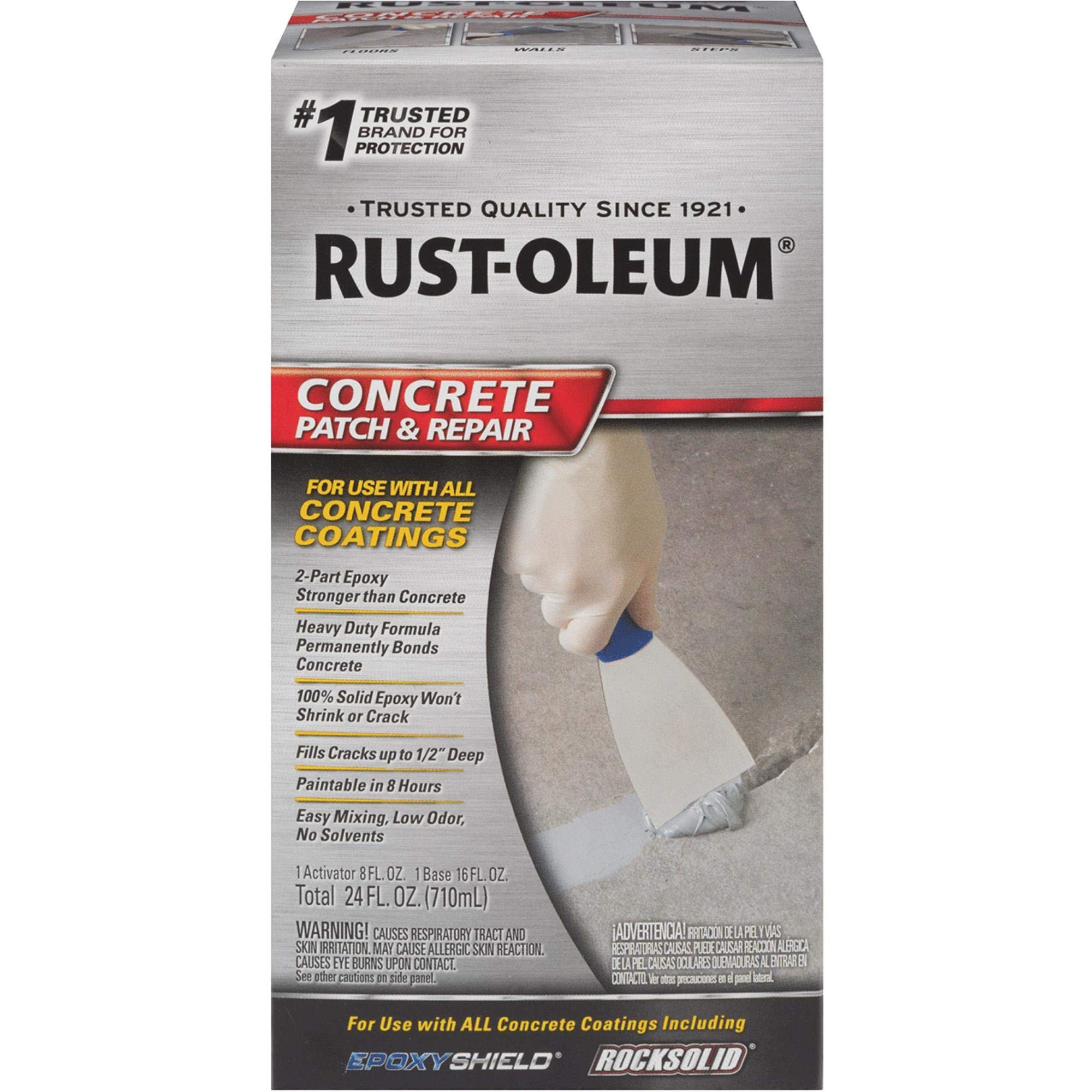
Rust-Oleum EPOXYShield Concrete Patch is a low-odor, solvent-free epoxy formulated to permanently bond concrete without shrinking or cracking. Designed for floors, walls, steps, and masonry, it offers a 20-to-25-minute working window and a full cure in just eight hours — much faster than the acrylic alternatives. The 24-ounce can is ideal for repairing cracks up to one inch deep, spalled garage floors, and chips in concrete steps.
Users consistently report the patch dries harder than cement and holds up for years under vehicular foot traffic with no failure. For deep cracks, two coats are recommended, with some homeowners mixing in black blasting sand to extend the material and match the aggregate appearance. The longer working time allows careful application using a pastry bag or putty knife, reducing waste on small repairs.
One caveat is the patch dries shiny and slightly darker than the surrounding concrete, which may be noticeable on visible flat surfaces. Cleanup requires solvents before curing, as the epoxy sticks aggressively to tools. For garage floor crack filling before epoxy painting or for repairing structural spalls that must withstand tire loads, this is the fastest-curing, strongest option in the lineup.
Why it’s great
- Full cure in 8 hours — fastest in this comparison
- Permanently bonds without shrinking or cracking
- Low odor, solvent-free formula for indoor use
Good to know
- Dries shiny and darker than surrounding concrete
- Requires solvents for cleanup before curing
5. Damtite Concrete Super Patch
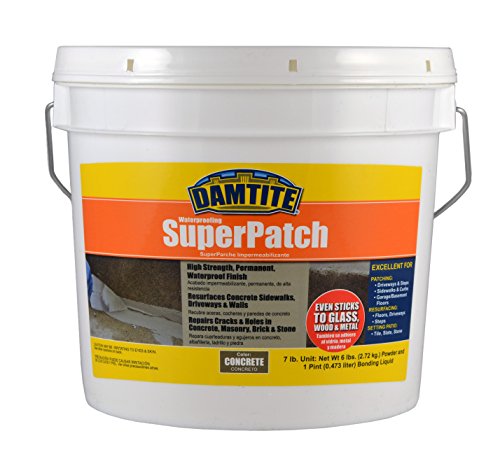
Damtite Concrete Super Patch is a two-part system combining a powder mix with a pint of bonding liquid to create a high-strength, permanent, waterproof patch. Designed for spalls deeper than half an inch, it resurfaces concrete sidewalks, driveways, walls, and repairs cracks in concrete, brick, stone, and masonry. The 7-pound pail covers approximately 105 cubic inches — enough for half a dozen medium spalls or several linear feet of crack repair.
Users repairing 40-year-old exposed garage pads report that the material mixes easily with a drill, remains workable for about 10 to 15 minutes, and cures rock-hard without shrinkage. The adjustable consistency — achieved by controlling the powder-to-liquid ratio — lets you create a stiffer mix for vertical repairs or a flowable mix for horizontal fills. Many homeowners extend the material by layering pebbles or crushed gravel into deep cavities before capping with the patch.
The waterproof finish holds up under direct foot traffic and weather exposure, and the cured surface can be sanded with 60-grit paper to smooth transitions. Some users note the patch dries lighter than the existing concrete, so color matching may require stain or paint. The separate powder and liquid offer longer shelf life than pre-mixed pastes, but the 10-minute working time demands fast, efficient placement.
Why it’s great
- Permanent, waterproof finish for outdoor and high-traffic areas
- Adjustable consistency for vertical and horizontal repairs
- Two-part design extends shelf life and allows mixing control
Good to know
- 10-minute working time requires quick placement
- Dries lighter than surrounding concrete in many cases
FAQ
Can I apply a concrete bonding agent over old paint?
How long does a concrete bonding agent take to cure before pouring new concrete?
Do I need to dampen the surface before applying a bonding agent?
Final Thoughts: The Verdict
For most users, the best concrete bonding agent winner is the SIKA SikaLatex R because it combines freeze-thaw resistance, 500 psi bond strength, and dual-use as a primer and admixture, making it the most versatile option for exterior residential repairs. If you need a long open time for a complex pour with reinforcement and formwork, grab the Larsen Weld-Crete. And for deep spalls on garage floors or driveways that require a waterproof, permanent repair, nothing beats the Damtite Concrete Super Patch.

Mo Maruf
I created WellFizz to bridge the gap between vague wellness advice and actionable solutions. My mission is simple: to decode the research and give you practical tools you can actually use.
Beyond the data, I am a passionate traveler. I believe that stepping away from the screen to explore new environments is essential for mental clarity and physical vitality.