Our readers keep the lights on and my smoothie glass nicely filled. As an Amazon Associate, I earn from qualifying purchases.
Specs are compiled from manufacturer listings and verified buyer reviews and can change over time — please confirm the key details on the product page before buying.
Water creeping through a basement wall or a chimney that lets rain inside is a stress that keeps you up at night. The right sealer stops moisture permanently; the wrong one traps it and accelerates damage. This guide cuts through chemical jargon to identify which formula bonds to concrete block and which is overpriced marketing.
I’m Mohammad Maruf — the founder and writer behind WellFizz. This guide is built by comparing the manufacturers’ published specifications and the patterns across verified customer reviews, so you get each pick’s real strengths and trade-offs instead of marketing spin.
You will learn the difference between film-forming and breathable sealers, why siloxane matters for block walls, and which concentrate saves you money on big jobs — all to choose the right concrete block sealer without wasting a drop.
Quick Picks
- Siloxa-Tek 8500 Ultra Concentrate — Best Overall
- PROSOCO Sure Klean Weather Seal Siloxane PD — Long-Term Pick
- RadonSeal Plus Concrete Sealer — Penetrating Power
- MasonryDefender All Purpose Brick Stone & Concrete Sealer — Smart Value
- MasonryDefender Chimney Brick Sealer — Chimney-Focused
- Polar Dust Proof Concrete Sealer — Budget Pick
How To Choose The Best Concrete Block Sealer
A concrete block wall is more porous and textured than a smooth poured slab, so not every sealer works the same way. The wrong choice traps moisture behind the block, causing spalling and freeze-thaw cracks.
Breathability vs. Film-Forming
A breathable sealer lets water vapor trapped inside the block escape while blocking liquid water from entering. This is the only safe choice for vertical block walls, chimneys, and basements. Film-forming sealers (usually acrylic) sit on the surface and can peel or blister if moisture pushes from behind.
The Active Ingredient: Silane vs. Siloxane vs. Acrylic
Look for the chemical on the label. Silane and siloxane formulas penetrate deep into the pores and react with the concrete to form a water-repellent barrier inside the block. Acrylic sealers (like the Polar Dust Proof) create a thin plastic film on the surface — they work for horizontal indoor floors where vapor is not an issue, but they are not the best bet for outdoor block walls.
Coverage and Concentration
A standard gallon covers roughly 80 to 150 square feet on porous block. Concentrated products (like the Siloxa-Tek 8500) boast higher active ingredient levels (the maker claims “6x higher actives”) and can be diluted, meaning one gallon makes five gallons of ready-to-use sealer. For large projects, concentrate saves money if mixed correctly.
Quick Comparison
| Model | Best For | Volume | Dry Time | Chemistry | Amazon |
|---|---|---|---|---|---|
| Siloxa-Tek 8500 Ultra Concentrate | Best Overall | 1 Gallon (makes 5) | — | Silane/Siloxane | Amazon |
| PROSOCO Sure Klean Weather Seal Siloxane PD | Long-Term Protection | 1 Gallon (3.85 kg) | — | Siloxane | Amazon |
| RadonSeal Plus Concrete Sealer | Internal Block Sealing | 5 Gallons | 5 days (full cure) | Blended Silicate | Amazon |
| MasonryDefender All-Purpose Brick Stone & Concrete Sealer | Vertical Masonry | 1 Gallon (8.56 lbs) | Quick-dry | Silane-Siloxane | Amazon |
| MasonryDefender Chimney Brick Sealer | Chimneys & Brick Walls | 1 Gallon (128 oz) | 2-6 hours | Siloxane | Amazon |
| Polar Dust Proof Concrete Sealer | Indoor Dust Control | 1.32 Gallon (5 kg) | 1-2 hours | Acrylic | Amazon |
In‑Depth Reviews
1. Siloxa-Tek 8500 Ultra Concentrate

One gallon of concentrate that stretches to five, built for the jobs that demand deep penetration.
This pick offers serious longevity on driveways, pool decks, or exposed block walls. The maker claims this formula carries “6x higher actives than any other water based concrete sealer”, which means the silane/siloxane molecules are packed tighter for deeper penetration. It is DOT-approved (meaning the Department of Transportation has tested it to resist road salts and chlorides), so if your concrete block is near a salted walkway or a vehicle, this takes the winter beating.
Buyers report using it every three years on a saltwater pool deck and still seeing water bead up like glass after a couple of seasons. Coverage is stated at 250 square feet per gallon per coat, but because this is a concentrate you mix it yourself — one 8.7-pound jug makes five gallons of ready-to-use sealer. That is a big savings for a large project, though the upfront price (mid-range to premium) filters out casual weekenders who just want to seal a single wall.
Deep reach: The high-actives formula penetrates past the surface so it resists wind-driven rain and freeze-thaw damage without changing the concrete’s appearance or leaving a slick surface.
The friction point: You have to mix the concentrate yourself and apply a second coat while the first is still wet — not a grab-and-spray product for a rushed afternoon.
Reach for this if: You have a large area (like a driveway or saltwater pool deck) and want one product that does not need reapplying every season.
Look elsewhere if: Your job is a single small chimney repair — the concentrate’s mixing step and cost outweigh the convenience of a ready-to-use gallon.
2. PROSOCO Sure Klean Weather Seal Siloxane PD

A siloxane sealer that stays on the job for over a decade without trapping moisture behind the block.
PROSOCO is a heavy hitter in the professional masonry world, and this Weather Seal is a water-based siloxane designed for vertical brick and concrete block — exactly the scenario where a film-former can fail. The maker estimates a service life of “more than 10 years”, which bests most consumer-grade sealers by a wide margin. It penetrates deeply to help block walls resist cracking, spalling, and staining from water intrusion while staying breathable (so vapor inside the block can escape).
At a weight of 3.85 kilograms per gallon, it is lighter than the Polar Dust Proof sealer (which comes in at 5 kilograms), but do not let that fool you — siloxane is about chemistry, not weight. Unlike the MasonryDefender or Polar picks, the PROSOCO is a white liquid that dries clear, and its 5.75 x 5.75 x 12 inch can is compact enough to ship without drama.
What stands out
- Service life estimated at more than 10 years — the longest claim in this list
- Breathable formulation prevents trapped-moisture damage on vertical block
- Professional-grade brand trusted by commercial contractors
What holds it back
- Higher sticker price than the MasonryDefender options for a single gallon
- Meant mainly for vertical surfaces — not the best for a horizontal garage slab
Grab it when: You want a set-and-forget sealer for a brick or block wall that you don’t want to touch again for a decade.
skip it if: You need one product for both a vertical wall and a horizontal slab — the RadonSeal or the all-purpose MasonryDefender cover both.
3. RadonSeal Plus Concrete Sealer
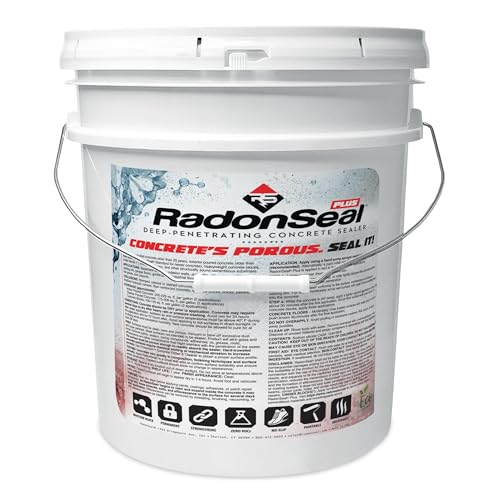
A silicate-formula that reacts inside the concrete to seal capillaries, not just the surface.
Unlike the siloxane sealers above that coat the pore walls, RadonSeal Plus is a blended silicate that chemically reacts inside the concrete to form an internal seal. This means it will not peel, blister, or wear away — it becomes part of the block itself. At 48 pounds for a 5-gallon pail, this is a heavy shipment, but it covers up to about 1000 square feet (per the maker), making it the best bang for big basement floors and foundation walls.
Owners mention it reduced humidity, hardened weak concrete, and closed small cracks on basement slabs. One reviewer noted their friend’s radon reading dropped from 40x to half the safe level after application. The trade-off is the cure time — the maker recommends allowing 10 days for full cure before painting or coating, and even customers note the floor was still drying after five days. Unlike the Siloxa-Tek, this is not a concentrate you mix; it sprays on ready-to-use with a garden sprayer.
Internal reaction: Because it reacts inside the block, it actually strengthens and hardens porous concrete (the maker says it “chemically densifies”) rather than just sitting on top.
The real limit: One buyer mentioned that coverage seemed less than claimed — 10 gallons barely did 1,000 square feet for a single coat, so plan for a bit less coverage than the stated “up to ~1000 sq ft per 5 gallons”.
Best suited for: A basement floor or poured foundation wall where you want moisture reduction plus radon mitigation, and you can spare the longer cure time.
Not ideal for: A quick weekend job on a decorative brick wall — the silicate reaction and cure time are overkill for a vertical surface that just needs water repellency.
4. MasonryDefender All Purpose Brick Stone & Concrete Sealer

A silane-siloxane blend that solved one buyer’s basement seepage after professional repairs failed.
This is the mid-range workhorse that does not ask you to pay concentrate premium. It is a silane-siloxane (the same chemistry class as the Siloxa-Tek but in ready-to-use form) and weighs 8.56 pounds per gallon — nearly identical to the Siloxa-Tek’s 8.7 pounds, which tells you the active-load is comparable despite the price difference. Coverage is 90-150 square feet per gallon, slightly tighter than the Chimney Brick Sealer version, but you get it across more surface types: concrete, brick, stone, limestone, and granite.
One buyer wrote that it “solved persistent water seepage from basement ceiling under stone porch post after failed repairs”, which is exactly the kind of masonry job this sealer is built for. Another noted that it coats terra cotta pots to prevent freeze-thaw damage and moss growth. The catch: some buyers wish it gave a shiny finish (it stays completely transparent and matte), so if you want a gloss or satin sheen, you are looking at the wrong product.
Why it wins
- Proven real-world performance — stopped seepage that other methods could not fix
- Wide material compatibility beyond just block (limestone, granite, sandstone)
- Easy spray application with quick drying
The drawback
- Some reviewers point out application is clumpy if you don’t shake extremely well before use
- No glossy finish — stays invisible, which some people want but others dislike
Pick this if: You need a versatile, ready-to-use silane-siloxane that works on multiple stone types and has a track record of solving stubborn water problems.
pass on it if: You need a sealer for horizontal surfaces that get heavy foot traffic — the acrylic-based Polar or the internal-seal RadonSeal might serve you better.
5. MasonryDefender Chimney Brick Sealer
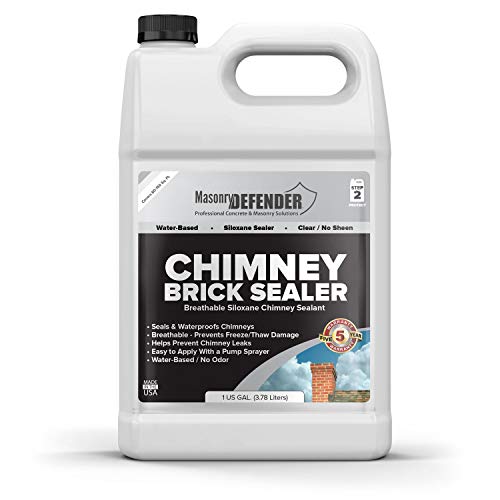
A non-film-forming siloxane that lets your chimney breathe while keeping rain out.
Named after its primary use-case, this sealer is a water-based siloxane (the same core chemistry as the PROSOCO) formulated specifically for vertical exterior masonry. The key spec here is the breathability: it is non-film-forming, meaning it does not trap moisture inside the brick. That matters because a chimney cycles through heat and cold, and trapped moisture is what causes the freeze-thaw damage that flakes the face of your brick. Coverage is 80-150 square feet per gallon for two coats, and it dries to the touch in 2-6 hours, versus the Polar acrylic at 1-2 hours.
The dry time is also 2-6 hours compared to the Polar acrylic at 1-2 hours. This means your project takes longer, but the payoff is a permanent bond with the masonry rather than a surface film. Unlike the All-Purpose MasonryDefender, this one is aimed at vertical-only surfaces (wall, chimney, stucco, stone) and is not marketed for horizontal paving, so stick to its lane.
Breathable bond: The siloxane molecules let trapped moisture escape as vapor while blocking liquid water from entering — the best compromise for a chimney that sees both rain and internal combustion gases.
The bottleneck: 2-6 hours between coats plus “continued strengthening over several weeks” means you cannot rush this job if you want full protection before a rainstorm.
Reach for this when: You have a brick chimney or a vertical stone wall that gets direct rain and you want a sealer that will not peel off after one winter.
Pass it by if: You are sealing a basement floor or a horizontal patio — the RadonSeal or the All-Purpose MasonryDefender fit that job better.
6. Polar Dust Proof Concrete Sealer

An acrylic film-former that tackles dust on garage floors but cannot breathe like a siloxane.
This is the odd one out in a list of breathable sealers — and for good reason. The Polar Dust Proof is a 100% acrylic formulation that creates a satin-finished film on the surface rather than penetrating the pores. Its job is different: it dust-proofs concrete floors in garages, warehouses, and kitchens. It has a low viscosity, meaning it is thin enough to soak into the top layer, but it still forms a surface coating rather than a chemical bond. The matte satin finish is a clear advantage if you want a subtle sheen on an interior floor.
Weighing 5 kilograms for a 1.32-gallon bucket, it is heavier than the 3.85-kilogram PROSOCO and the 8.56-pound (approx 3.88 kg) MasonryDefender All Purpose — you are paying for a bigger volume of liquid. But unlike those, this is not meant for vertical brick walls that need to breathe. One buyer note: it must not be used with floor paint and should be applied on its own, so do not use it as a primer. The dry time is the fastest in the lineup at 1-2 hours per coat, which suits indoor projects where you need the garage usable the same day.
What works
- Fastest dry time (1-2 hours) — back in service the same day
- Provides a satin finish that looks clean on indoor floors
- Dust-proofs concrete effectively, reducing airborne particles in a workshop
What does not
- Not breathable — can trap moisture behind the film on block walls
- Cannot be used with floor paint, limiting future finishing options
Best for: An indoor garage or workshop floor where the goal is dust control and a fast turn-around, not exterior-grade water repellency.
Not for: An outdoor block wall, chimney, or basement wall — those need a penetrating siloxane or silicate (PROSOCO, Siloxa-Tek, or RadonSeal) to avoid trapped-moisture damage.
Understanding the Specs
Silane vs. Siloxane vs. Acrylic
These three words tell you everything about how the sealer works. Silane molecules are tiny and penetrate deepest into the concrete pores; they are often blended with siloxane for a balance of depth and water-repellency. Siloxane is slightly larger but still penetrates well and forms a chemical bond that repels water without blocking vapor. Acrylic is a plastic polymer that dries into a thin film on top — it works for indoor dust-proofing but is not breathable, so it can blister on outdoor block walls when water vapor pushes up from behind.
Dry Time and Recoat Window
Dry time matters not just for convenience but for how the sealer bonds. The MasonryDefender Chimney Brick Sealer takes 2-6 hours to dry to the touch, while the Polar acrylic dries in 1-2 hours. A fast-drying sealer is great for getting a floor back in use, but a slower chemical cure (like the RadonSeal’s 10-day recommendation) often means the sealer is reacting inside the concrete rather than just evaporating solvent. Check the manufacturer’s recoat window carefully — some products require a second coat while the first is still wet.
FAQ
Do I need a breathable sealer for concrete block walls?
How many coats of concrete block sealer do I need?
Can I use a concrete sealer on both interior floors and exterior walls?
How long does a concrete block sealer last before I need to reapply?
What is the difference between a concentrate and a ready-to-use sealer?
Will a concrete block sealer change the color of my brick or stone?
Can I paint over a concrete block sealer?
What does “siloxane” mean on the label?
Is a 5-gallon pail better value than multiple gallons?
Can I apply concrete block sealer in cold weather?
Final Thoughts: The Verdict
Across the board, the concrete block sealer winner is the Siloxa-Tek 8500 Ultra Concentrate because one gallon makes five, the silane/siloxane chemistry penetrates deep for years of protection, and the DOT approval means it handles road salts better than any other pick. If you want a set-and-forget product with a 10-year service life, grab the PROSOCO Sure Klean Weather Seal Siloxane PD. And for a basement slab where internal sealing and radon reduction are the priority, the standout is the RadonSeal Plus.
How We Picked
We do not accept paid placement. Every pick is matched to a real buyer and a real use-case; we do not hands-on test units.
Sources & Methodology
Specifications: manufacturer listings and product documentation. Review insights: verified customer reviews, as of July 2026. Pricing: not shown on this page (it changes often); check the current price via the retailer link.
As an Amazon Associate, WellFizz earns from qualifying purchases. This does not affect which products we feature.

Mo Maruf
I created WellFizz to bridge the gap between vague wellness advice and actionable solutions. My mission is simple: to decode the research and give you practical tools you can actually use.
Beyond the data, I am a passionate traveler. I believe that stepping away from the screen to explore new environments is essential for mental clarity and physical vitality.