Our readers keep the lights on and my smoothie glass nicely filled. As an Amazon Associate, I earn from qualifying purchases.
Specs are compiled from manufacturer listings and verified buyer reviews and can change over time — please confirm the key details on the product page before buying.
Every concrete anchor bolt looks tough in the package, but the real test comes when you torque it down and trust it with something heavy — a garage lift, a sill plate, a steel post. The wrong pick either snaps, spins, or pulls out, leaving you with a hole you cannot reuse. This guide sorts through the real-world grip, the honest material specs, and the installation quirks that separate anchors that just sit there from anchors that actually hold.
I’m Mohammad Maruf — the founder and writer behind WellFizz. This guide is built by comparing the manufacturers’ published specifications and the patterns across verified customer reviews, so you get each pick’s real strengths and trade-offs instead of marketing spin.
The four concrete anchor bolts below cover everything from a quick 4-pack sleeve anchor for light duty to a 50-piece bulk wedge set for heavy projects, each chosen for a specific job you might be facing. Whether you are bolting down machinery or framing a wall, knowing which anchor type fits your concrete and your load makes the difference between a lasting install and a call-back job — that is what this guide to the concrete anchor bolts worth your money is all about.
Quick Picks
- Red Head TruBolt 1/2 x 3-3/4 Inch Wedge Heavy-Duty Concrete — Top Performer
- Wensilon 3/8×4 50Pcs Inch Standard Fasteners — Best Value
- 3/8 Concrete Anchors, Zinc-Plated Carbon Steel 3/8 Wedge — Crew Favorite
- Vestil AS-383-4PK Steel Concrete Sleeve Anchor Bolts 4 Pack — Quick Install
How To Choose The Best Concrete Anchor Bolts
Picking the right concrete anchor bolt is about matching three things: the type of anchor, the diameter and length, and the material it is made from. Here is what to look at before you buy.
Wedge vs. Sleeve: Which Anchor Type for Your Job
Wedge anchors expand at the bottom of the hole as you tighten the nut, creating a strong mechanical lock in solid concrete. They are ideal for heavy loads like machinery, structural supports, and sill plates. Sleeve anchors expand along their whole length, making them easier to install in shorter holes or shallower slabs, but they generally hold less weight. If the data says “wedge”, expect higher holding power in dense concrete; if it says “sleeve”, expect a quicker install in lighter duty.
Pick the Right Diameter and Length
The bolt diameter you need is directly tied to the load you are carrying. A 1/2-inch anchor has a diameter of 0.5 inches, while a 3/8-inch anchor has a diameter of 0.38 inches, which translates into significantly more shear and tensile strength. The length matters too — you need enough embedment into the concrete (typically at least 1 inch of anchor body below the surface) for the expansion mechanism to grip. Always check the “Item Diameter” and “Item Dimensions” in the specs before choosing.
Material and Finish Affect Longevity
Most concrete anchors are made from carbon steel with a protective finish. Zinc plating is the standard for indoor and dry applications — it resists surface rust from humidity, but it is not rated for continuous outdoor exposure or salty environments. Stainless steel anchors (like the Red Head TruBolt) offer far better corrosion resistance for outdoor or wet locations, though they come at a premium. For everyday framing or garage work indoors, a zinc-plated or galvanized steel anchor is usually enough.
Quick Comparison
| Model | Best For | Diameter | Length | Count | Amazon |
|---|---|---|---|---|---|
| Red Head TruBolt 1/2 x 3-3/4 | Heavy-duty structural hold | 0.5 inches | 3-3/4 inches | 10 | Amazon |
| Wensilon 3/8×4 50Pcs Wedge | Bulk framing and slabs | 0.38 inches | 4 inches | 50 | Amazon |
| 3/8 Concrete Anchors Horiznext 30pk | Medium-duty wedge for crews | 0.38 inches | 3 inches | 30 | Amazon |
| Vestil AS-383-4PK Sleeve Anchor | Quick light-duty installs | 0.38 inches | 3 inches | 4 | Amazon |
In‑Depth Reviews
1. Red Head TruBolt 1/2 x 3-3/4 Inch Wedge Heavy-Duty Concrete Anchors, 10 PCS
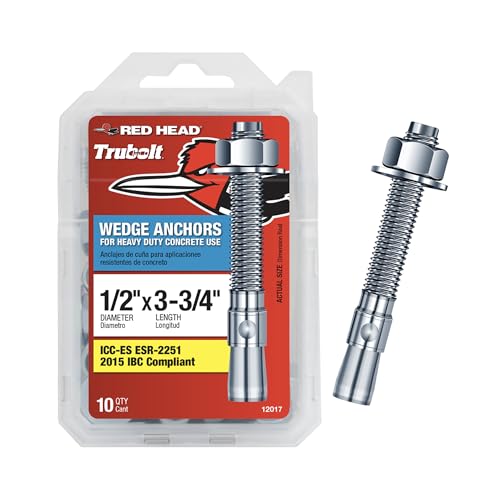
The thickest anchor here, built for loads that make lesser bolts snap.
This is the anchor you reach for when “hope it holds” is not an option. The Red Head TruBolt uses a 0.5-inch diameter body, compared to the 0.38-inch Vestil sleeve anchors, giving it substantially more bite in solid concrete. It has ICC-ES Approval (ESR-2251) for use in uncracked concrete, which is a building-code certification you want behind a garage lift or a structural sill plate. The stainless steel construction also means it resists rust far longer than the zinc-plated options, making it a strong choice for outdoor or damp locations. Buyers report that after drilling a 1/2-inch hole and seating the anchor flush, tightening the nut locks it in place without any pull-out — one general contractor called these “my favorite anchors.”
Installation is straightforward but demands precision: drill a 1/2-inch hole to the full depth of the anchor, then tap it in with a hammer. The 10-piece count is lower than the bulk packs below, but you are paying for a premium structural hold rather than volume. If your project involves machinery, steel posts, or any application where a failure means damage or injury, this is the one.
What Lifts It Above
- 0.5-inch diameter delivers the highest shear strength in this roundup
- Stainless steel resists corrosion much better than zinc-plated options
- ICC-ES ESR-2251 certification for building-code compliance
- Contractors consistently praise its grip and ease of use
The Trade-Offs
- Only 10 anchors per pack, so it is pricier per bolt than bulk options
- Requires an exact 1/2-inch hole — no room for pilot-bit error
- Not for use in block, brick, or hollow materials
The winner for structural loads. If you are bolting down a lift, mounting heavy machinery, or framing a load-bearing wall, this stainless steel wedge anchor gives you the highest confidence hold. The 10-pack is overkill for a single shelf — a small sleeve anchor is better for quick patching.
2. Wensilon 3/8×4 50Pcs Inch Standard Fasteners for Heavy-Duty Zinc Wedge Anchors

Fifty anchors that cost less per bolt than a coffee, ready for framing a house.
If you are attaching bottom plates, framing out a basement, or securing a long run of metal plates, this 50-pack of 3/8-inch wedge anchors will likely be the most cost-effective route. Each anchor is 4 inches long — a full inch longer than the Vestil sleeve anchors and the Horiznext wedges, giving you deeper embedment for better grip in thicker concrete slabs. The Wensilon anchors are made from carbon steel with a galvanized finish, which owners mention is “comparable to Home Depot but cheaper.” One reviewer noted they were “easy as Ramset for attaching 2×4 to concrete slab,” tightening the nut until it sank through the wood without any spin-out. You will need a 1/4-inch masonry bit for the pilot hole, not the full 3/8-inch that other wedge anchors require — double-check that before you start.
The sheer volume here (50 anchors compared to the Vestil 4-pack) makes this the smart pick for anyone who wants a stockpile without multiple reorders. The trade-off is that these are 3/8-inch diameter, so they cannot match the sheer strength of a 1/2-inch bolt like the Red Head TruBolt for extreme loads. The maker also cautions they are suitable for concrete only — not for block or brick foundations.
Why This Pack Wins
- 50 anchors per box — the highest count in this roundup, perfect for big jobs
- 4-inch length provides deeper embedment than 3-inch alternatives
- Galvanized finish adds extra rust resistance vs. standard zinc plating
- Buyers praise the consistent sizing and excellent grip
Watch For
- Requires a 1/4-inch masonry bit, not the anchor diameter — easy to get wrong
- 3/8-inch diameter caps the maximum load vs. a 1/2-inch wedge
- Not rated for brick or block materials
Best for framing crews who want to buy once. If you are laying down sill plates or framing a full basement and want at least 50 anchors in one box, this galvanized wedge pack delivers top value per bolt. A 50-pack is wasted on a single shelf — grab a small sleeve anchor pack for light work.
3. 3/8 Concrete Anchors, Zinc-Plated Carbon Steel 3/8 Wedge Anchors Bolts with Washer and Nut (30 pcs)

A middle-ground wedge pack that holds strong without overbuying for medium jobs.
This is the anchor set that splits the difference between the 4-piece sleeve pack and the 50-piece bulk buy. With 30 wedge anchors at 3/8-inch diameter and 3 inches long, it is a practical count for a crew doing a few days of sill-plate work or bolting down posts. The zinc-plated carbon steel construction gives solid everyday corrosion resistance, and buyers confirm the threads and nut are accurately sized. One buyer mentioned the wedge “grabbed tightly to secure the building wall plate to the slab,” and another used them to install a winch on a concrete slab that held up to pulling a 3,600-pound car. The 3-inch length is shorter than the Wensilon 4-inch anchor, so it is best for standard slab depths rather than thick, poured foundations where deeper embedment helps.
A notable plus: these are true wedge anchors with an expansion head, so you get the mechanical lock at the bottom of the hole rather than the full-length expansion of the Vestil sleeve anchor. That means higher pull-out resistance in solid concrete. The catch is that at 30 pieces, the per-bolt cost is slightly higher than the 50-pack Wensilon, so if you need more than 30, the bulk option is the better value.
Solid Points
- True wedge anchor expansion for high pull-out resistance
- 30-piece count hits the balance for medium-scale jobs
- Customers note no rust after a week of rain
- Held a 3,600-pound car during winch mount without failure
Limitations
- 3-inch length is shorter than the 4-inch Wensilon, limiting embedment in thick slabs
- Slightly more expensive per bolt than the 50-pack if you are buying in volume
- Zinc plating is adequate indoors but not for continuous outdoor exposure
Dependable wedge for medium duty. If you need a solid wedge anchor for a weekend project or a crew-size install, this 30-pack gives dependable holding power without excess waste. The 3-inch length means check your slab depth before buying — it may not get enough embedment in very shallow concrete.
4. Vestil AS-383-4PK Steel Concrete Sleeve Anchor Bolts 4 Pack 3/8 In. x 3 In.
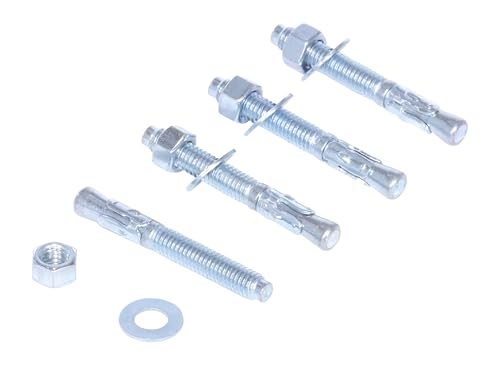
The easiest anchor to install when you just need a few bolts and a fast weekend job.
Unlike the wedge anchors above that require expansion at the bottom of the hole, this sleeve anchor design expands along the full length of the bolt as you tighten it, making it one of the simplest concrete anchors to set correctly. At 3/8-inch diameter and 3 inches long, it is built for light-duty tasks: fastening a safe to a garage floor, mounting a small shelf, or securing a signpost. One buyer described the process simply: “used 3/8″ masonry bit on my hammer drill and then put these in with a 3lb hammer.” Another buyer warned the top is “a little malleable,” which means you need to be careful not to deform the head with excessive hammering — but the design gives some leeway if you tap rather than smash. The item dimensions are 0.38 x 0.38 x 3 inches, making it the smallest physical anchor here, and it is the only Grade 2 fastener in the roundup.
The obvious limitation is the count: at 4 pieces, this pack is only a fraction of the 50-piece Wensilon set. You are paying for convenience and the simpler sleeve mechanism, not bulk. If your project calls for more than four anchor points, you will need multiple packs, and the per-bolt cost rises quickly. The zinc-plated alloy steel is fine for indoor use, but you would want the stainless steel of the Red Head for outdoor hold.
What Makes It Easy
- Sleeve design expands fully for simpler, quicker installation than wedge anchors
- Reviewers point out a 3lb hammer and a masonry bit are all you need
- Grade 2 hardness is adequate for light-duty household holds
- Compact 3-inch length fits shallow slabs
When It Falls Short
- Only 4 anchors per pack — compared to the 50-piece Wensilon
- Top is prone to deforming if over-hammered
- Not ideal for high-load structural work or outdoor exposure
Fastest pick for a one-off job. If you are mounting a safe, a single bracket, or a sign and want the fastest install with minimal tools, this 4-pack sleeve anchor is your go-to. For a full sill plate or heavy machinery, the holding power of a wedge anchor (like the Red Head or Horiznext) is far more reliable.
Understanding the Specs
Diameter and the Real Load Difference
The diameter of your anchor bolt (shared as “Item Diameter” in the spec sheets) directly controls how much shear force it can withstand before snapping. A 1/2-inch bolt has a larger cross-section than a 3/8-inch bolt, so it resists bending and breaking far better under heavy loads. That is why the Red Head TruBolt at 0.5 inches is the go-to for structural work, while the 0.38-inch wedge and sleeve anchors are better for medium or light duty. The rule is simple: match the bolt diameter to the weight of what you are fastening, and never undersize for a critical hold.
Wedge vs. Sleeve — How They Actually Hold
A wedge anchor works by expanding a clip at the very bottom of the hole when you tighten the nut, creating a deep mechanical lock that resists pull-out. That makes it ideal for solid concrete and heavy loads. A sleeve anchor expands along most of its embedded length, distributing the grip more evenly but with less concentrated force at the bottom. Sleeve anchors are faster to install and more forgiving in shallow or uneven holes, but they typically offer lower pull-out strength than a comparable wedge anchor. Always check the product label: if it says “wedge anchor,” expect higher holding power; if it says “sleeve anchor,” expect quicker setup.
FAQ
What size drill bit do I need for a 3/8-inch concrete anchor?
Can I use wedge anchors in brick or block?
How deep should the hole be for a 3-inch concrete anchor?
What is the difference between zinc-plated and galvanized anchor bolts?
Will these anchors rust if used outdoors?
How many anchors do I need for a sill plate?
Can I reuse a concrete anchor after removal?
What does Grade 2 hardness mean for an anchor bolt?
Final Thoughts: The Verdict
If you want one dependable pick, the concrete anchor bolts winner is the Red Head TruBolt because its 1/2-inch diameter and stainless steel build deliver the highest structural confidence for anything from garage lifts to sill plates. If you want a bulk pack that keeps costs low for framing a whole basement, grab the Wensilon 50-pack. And for a quick light-duty install where you just need four sleeves and a hammer, the standout is the Vestil 4-pack.
How We Picked
We do not accept paid placement. Every pick is matched to a real buyer and a real use-case; we do not hands-on test units.
Sources & Methodology
Specifications: manufacturer listings and product documentation. Review insights: verified customer reviews, as of July 2026. Pricing: not shown on this page (it changes often); check the current price via the retailer link.
As an Amazon Associate, WellFizz earns from qualifying purchases. This does not affect which products we feature.
Related Guides

Mo Maruf
I created WellFizz to bridge the gap between vague wellness advice and actionable solutions. My mission is simple: to decode the research and give you practical tools you can actually use.
Beyond the data, I am a passionate traveler. I believe that stepping away from the screen to explore new environments is essential for mental clarity and physical vitality.