Our readers keep the lights on and my smoothie glass nicely filled. As an Amazon Associate, I earn from qualifying purchases.
Specs are compiled from manufacturer listings and verified buyer reviews and can change over time — please confirm the key details on the product page before buying.
Choosing a concrete acid stain feels like a leap of faith. You pick a color on a screen, but the real result depends entirely on your slab’s age, mix, and porosity — the same chemical reaction that makes it permanent also makes it unpredictable. This guide cuts through the guesswork by focusing on what actually happens when the liquid hits your concrete: coverage, reaction strength, and the final look owners describe.
I’m Mohammad Maruf — the founder and writer behind WellFizz. This guide is built by comparing the manufacturers’ published specifications and the patterns across verified customer reviews, so you get each pick’s real strengths and trade-offs instead of marketing spin.
You want a rich, variegated finish that bonds permanently with your floor, not a layer you can scratch off. That is exactly what a concrete acid stain delivers — a true chemical reaction that turns ordinary cement into something that looks naturally layered and deeply aged.
Our Picks at a Glance

How To Choose The Best Concrete Acid Stain
Every concrete surface is a chemical fingerprint. Acid stain works by reacting with the lime and minerals already in your slab — so the same bottle on two different driveways can yield two different colors. The trick is learning which variables you can control.
Understand Coverage And Dilution
A single gallon typically covers between 100 and 300 square feet, but that number shifts with the concrete’s texture and how much you dilute the liquid. Porous, thirsty slabs drink up more stain, so you may need extra volume. The rule across every product in this category: always buy more than your square-footage math suggests, and test a small patch first.
Know Your Concrete’s Composition
Limestone-based concrete (common in newer construction) reacts differently than a sand-and-gravel mix. The mineral content determines whether you get a deep black, a warm brown, or a rusty orange. No manufacturer can guarantee the final hue — the slab itself is the final ingredient.
Match The Finish To The Project
Acid stain produces a translucent, marbled look — it is not paint. If you want a uniform solid color, you need a different product. But if you want a naturally aged, variegated surface that draws compliments, this is the route. It works indoors on countertops and floors, outdoors on patios and walkways, and it holds up to UV light without fading.
Quick Comparison
| Model | Best For | Coverage Per Gallon | Color | UV Stable | Amazon |
|---|---|---|---|---|---|
| Contractors Choice Coffee Bean★ Best Overall | Color correction on pink concrete | 100-200 sq ft | Coffee Bean (Dark Brown) | — | Amazon |
| CC Concrete Coatings Vivid Acid Stain | High-coverage, reliable reactions | 200-300 sq ft | Ebony | — | Amazon |
| Concrete Resurrection Black Walnut | Deep, dramatic dark tones | 100-200 sq ft | Black/Walnut | Yes | Amazon |
| Active Elements Red Rock | Warm, earthy terra cotta tones | 100-200 sq ft | Red Rock | Yes | Amazon |
In‑Depth Reviews
1. Contractors Choice Coffee Bean (Dark Brown)
Our pick — over 4★ from 30+ verified ratings; the strongest balance of quality and price.
The stain that turned a pink retaining wall into rich dark brown — this is a color-correction specialist.
This one comes with a real-world story that sums up its strength: an owner ordered pre-colored brown concrete for a retaining wall, but after curing the wall came out pink. Two to three coats of this stain fixed it completely. That scenario — fixing bad color, covering mistakes, or deepening a shade that came out wrong — is where Contractors Choice shines.
It is a professional-grade acid stain for interior and exterior projects, from patios to countertops to driveways. One gallon covers 100 to 200 square feet depending on dilution and the porosity of your concrete. The manufacturer is direct about the warning: this is not paint. It penetrates and reacts, giving a translucent marbled look. A few owners found the coverage lighter than expected and needed a second gallon for deeper color, but most praise the ease of application and the final color. The product description explicitly requires a sample test before committing to a full job — and that honesty is a sign of a product that takes its chemistry seriously.
Best for fixing bad pours: If your slab came out the wrong color, this is the stain owners turn to — the dark brown Coffee Bean color covers beautifully in 2-3 coats.
Keep an extra gallon handy: Several owners needed multiple applications and a second gallon to reach their desired depth of color.
Choose it if: you need to correct a bad concrete color or deepen a weak shade into a rich dark brown.
skip it if: you want a one-coat guarantee — the coverage is honest at 100-200 sq ft and may require a second pass.
2. CC Concrete Coatings Vivid Acid Stain (Ebony)
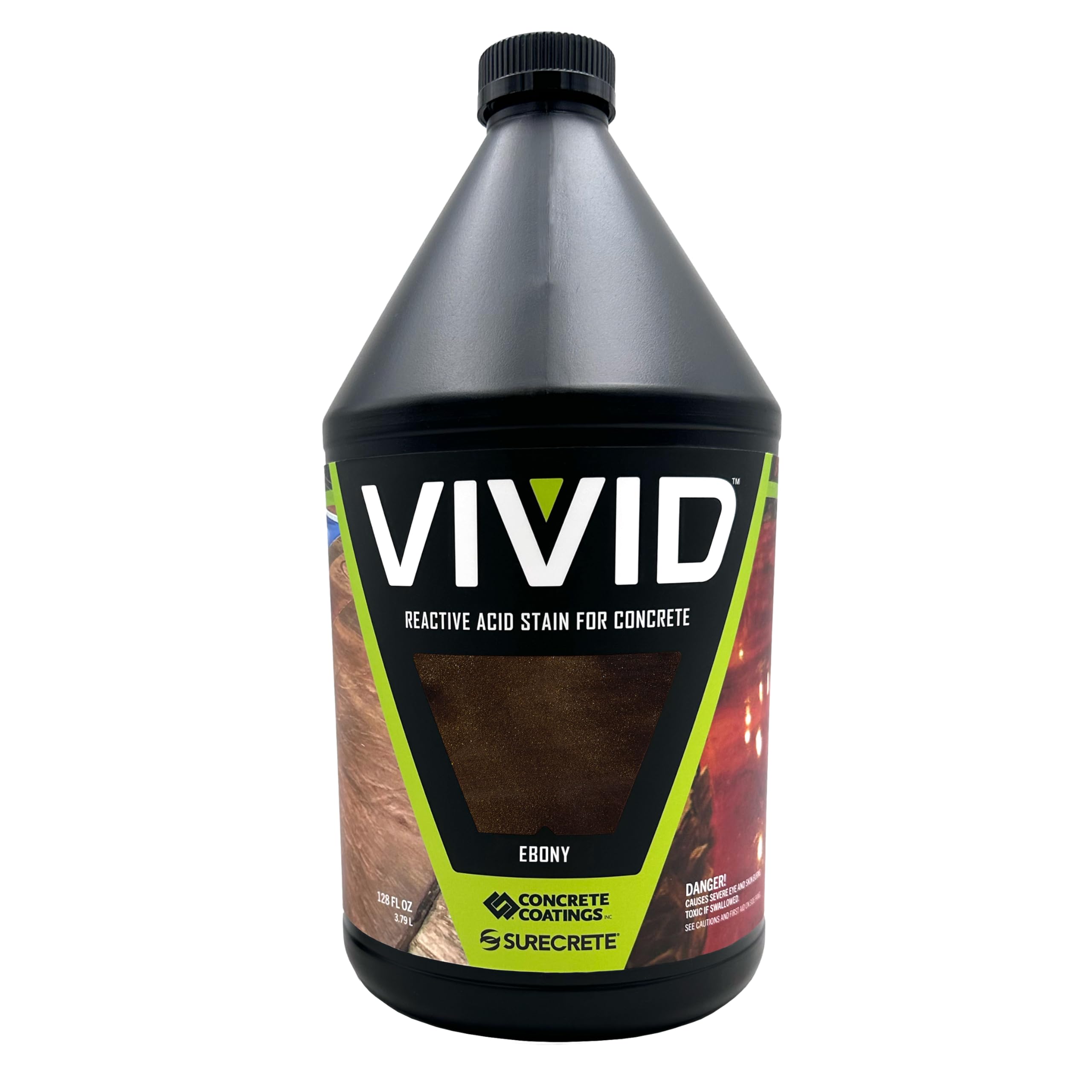
The most-reviewed acid stain on the list with the widest coverage per gallon and a crowd-trusted reaction.
This is the stain that shows up most often in owner conversations — nearly 3,000 people have weighed in on it. That means fewer gallons to buy and less waste on a medium-sized floor or patio.
What owners consistently describe is reliability. The product worked even on concrete that had color mixed in before pouring — one owner saw results quickly after neutralizing with ammonia. Experienced users point out that the aggregate type in your slab (limestone high in magnesium gives a different reaction — jet black with gray mottling instead of brown — but they praise the quality of the reaction itself. The finish is described as an antiqued marble effect, which is exactly what acid stain is built to do.
The honest trade-off is that results vary significantly with prep and concrete type. A few people who expected a uniform color were disappointed, and the product is non-returnable once used. But the consensus, built across far more reviews than any other pick here, is that this is the most consistent acid stain on the market when you follow the directions and test first.
What Owners Keep Coming Back For
- Widest coverage range at 200-300 sq ft per gallon — you need less product
- Works on concrete that already has color in the mix, per owner reports
- Proven results on older surfaces and tough slabs like crushed limestone
Where To Be Careful
- The final color depends heavily on your concrete’s mineral makeup — test first
- Non-returnable due to hazardous material classification once used
- Requires thorough prep and neutralization with ammonia for best results
Reach for it when: you want the widest coverage per dollar and a stain that has been battle-tested on thousands of slabs.
Look elsewhere if: you need a guaranteed color match — this is chemistry, not paint, so your slab writes the final result.
3. Concrete Resurrection Black Walnut (1 Gallon)

The stain owners describe as “defiantly dark” — it goes deep brown, almost black, and keeps reacting for hours.
This is the pick for anyone who wants a serious, moody dark floor. As one owner put it, “Black walnut, defiantly dark. If you’re looking for dark brown almost black this is it.” The stain continues working after application, reacting deeper into the concrete for hours — so the longer you let it sit, the richer the color gets. It is UV stable, meaning it won’t fade over time on sun-exposed patios or walkways.
A gallon covers 100 to 200 square feet, and the manufacturer recommends multiple colors, dilution, and varying cure times to create natural-looking variations. The real story here is contrast: the Black Walnut stain is a more dramatic, dark-leaning option than the Coffee Bean from Contractors Choice, but it carries a slightly higher risk — some owners, particularly on older 27-year-old concrete, saw barely any color change, while on the right slab the same product produced a “variegated, natural-looking, can’t scratch off” finish that draws compliments.
UV stable and weather-ready: This is the only pick in this tier that explicitly lists UV stability — ideal for driveway, patio, and exterior concrete projects.
The concrete mix is everything: A handful of owners saw weak results on old or limestone-heavy slabs, while others got a stunning deep black. Sample test is non-negotiable here.
Go for it when: you want a dark, dramatic finish that looks natural, not painted, and you are willing to test your slab’s reaction first.
Think twice if: your concrete is old or has unknown mineral content — results on 27-year-old slabs have been disappointing for some owners.
4. Active Elements Red Rock (1 Gallon)

A warm red-orange-terra cotta stain that rewards patience — owners say to let it sit in the sun for two days.
This is the only warm-toned stain in the lineup, giving a red rock hue that leans toward orange and terra cotta rather than the dark browns and blacks of the other picks. One owner captured the technique perfectly: let it sit in the sun for two days, rinse with Dawn soap and baking soda, and you get a full, rich color with no loss. The same owner warned against rinsing too early — the chemical reaction needs heat and time to develop fully.
Active Elements is a professional-grade acid stain, UV stable, suitable for patios, walkways, countertops, and driveways. One gallon covers 100 to 200 square feet. The honest reality is that this is the least-reviewed pick here, and the color variability is the wild card — one owner on concrete pad for a gazebo applied it and saw a yellow result instead of the expected red rock, while others praised the deep warmth of the final color. The product warning is direct: this is not paint, it penetrates and reacts, so a sample test is the only safe bet.
What Works
- Warm red and terra cotta tones are unique in this lineup — no dark brown monotony
- Buyers report great results with patience: two hot days of sun and a simple soap rinse
- Professional-grade, UV stable for exterior use on patios and walkways
What To Watch For
- Color can shift to yellow on some concrete types, far from the expected red rock
- The smallest review pool here, so the data is thinner — the crowd consensus is less established
- Requires careful handling: runoff can stain adjacent surfaces and is difficult to remove
Best for: homeowners who want a warm, earthy red tone and are open to experimenting with sun exposure and application technique.
Not for: anyone who needs a predictable, guaranteed color — this stain is the most variable of the four, and yellow surprises are a real risk.
Understanding the Specs
Coverage Per Gallon
Most acid stains list a range between 100 and 300 square feet per gallon per coat. The lower end (100 sq ft) applies to porous, thirsty slabs that absorb the stain quickly. The higher end (200-300 sq ft) works on dense or sealed concrete where the liquid pools and spreads further. Your actual number depends on how much you dilute the stain and how porous the surface is. Always buy extra — running out mid-project is the most common regret owners mention.
UV Stability
A UV stable stain will not fade or shift color when exposed to direct sunlight over months and years. This matters most for exterior jobs — driveways, patios, walkways — where the slab takes full sun. Not every acid stain advertises UV stability; if the spec sheet does not mention it, assume the finish may lighten over time outdoors. Interior floors and countertops are less affected by UV exposure.
FAQ
Will a concrete acid stain look exactly like the color on the bottle or the chart?
Can I apply acid stain over painted or sealed concrete?
How long does the staining process take from start to finish?
Is acid stain safe to use indoors?
What is the difference between an acid stain and a water-based concrete stain?
How many coats of acid stain do I need?
Will the acid stain harm my lawn or plants if it runs off?
Can I use acid stain on vertical surfaces like walls and countertops?
What happens if I do not neutralize the stain after applying it?
Can I return leftover acid stain after opening?
Final Thoughts: The Verdict
Across the board, the concrete acid stain winner is the CC Concrete Coatings Vivid Acid Stain because it offers the widest coverage per gallon at 200-300 square feet and has by far the largest owner consensus behind it — nearly 3,000 ratings confirm it works on everything from new slabs to cinder blocks. If you want a deep, dramatic dark brown that leans almost black on the right concrete, grab the Concrete Resurrection Black Walnut. And for a warm red or terra cotta tone that changes the mood of a patio entirely, the Active Elements Red Rock is the one to reach for — if you are willing to test your slab’s chemistry first.
How We Picked
We do not accept paid placement. Every pick is matched to a real buyer and a real use-case; we do not hands-on test units.
Sources & Methodology
Specifications: manufacturer listings and product documentation. Review insights: verified customer reviews, as of July 2026. Pricing: not shown on this page (it changes often); check the current price via the retailer link.
As an Amazon Associate, WellFizz earns from qualifying purchases. This does not affect which products we feature.
Related Guides

Mo Maruf
I created WellFizz to bridge the gap between vague wellness advice and actionable solutions. My mission is simple: to decode the research and give you practical tools you can actually use.
Beyond the data, I am a passionate traveler. I believe that stepping away from the screen to explore new environments is essential for mental clarity and physical vitality.