Our readers keep the lights on and my smoothie glass nicely filled. As an Amazon Associate, I earn from qualifying purchases.
Specs are compiled from manufacturer listings and verified buyer reviews and can change over time — please confirm the key details on the product page before buying.
If your current computer speakers sound thin or rattle when a movie explodes, you are missing more than half the audio experience. A dedicated subwoofer handles the low frequencies your desktop speakers simply cannot reach, turning flat sound into something you actually feel in your chest. This guide breaks down seven computer subwoofer setups, from compact value picks to studio-grade units, so you can match one to your desk size, your listening habits, and your budget.
I’m Mohammad Maruf — the founder and writer behind WellFizz. This guide is built by comparing the manufacturers’ published specifications and the patterns across verified customer reviews, so you get each pick’s real strengths and trade-offs instead of marketing spin.
You are about to see exactly which models deliver clean bass without muddying the mids, which ones fit a cramped desk, and which wired-versus-wireless features actually matter. By the end, picking the right computer subwoofer for your setup will feel straightforward, not overwhelming.
Our Picks at a Glance


How To Choose The Best Computer Subwoofer
A subwoofer for your computer is not just about loudness — it is about filling out the low end your desktop speakers leave behind. Three specs define how well it fits your desk and your ears.
Woofer Size and Driver Power
You get deeper bass from an 8-inch woofer (the speaker cone that pushes air) than from a smaller driver. The Edifier T5s reaches down to 35Hz (35 vibrations per second), while the PreSonus Eris Sub 8BT goes even lower to 30Hz — so you feel the deepest rumbles in action games. A 5.25-inch driver gives punchy bass but cannot hit those sub-bass notes you feel in your chest. Choose the size based on if you want desk-shaking explosions or tighter, more controlled low end.
RMS vs Peak Power
RMS (continuous power) tells you how loud the subwoofer can play without distortion over time. Peak power (the brief maximum burst) is a marketing number that is always higher. A unit like the Logitech Z623 lists 200 Watts RMS, while the Bluedee lists 80W peak power — the Logitech will stay clean at higher listening levels because its continuous rating is far more meaningful. Always check RMS first when comparing two models.
Connectivity and Placement
Wired connections (RCA or 3.5mm) give you zero-lag sound — crucial for gaming. Bluetooth 5.4, found on the Nylavee and Bluedee, adds wireless convenience for music from your phone, but introduces a tiny delay that can throw off rhythm games. Also check the subwoofer’s physical dimensions: a 12-inch wide box like the Logitech sub needs floor space beside your desk, while compact units tuck under a desk far more easily.
Quick Comparison
| Model | Best For | Power Output | Woofer Size | Connectivity | Amazon |
|---|---|---|---|---|---|
| Logitech Z623★ Best Overall | THX-Certified Room-Filling | 400W Peak / 200W RMS | — | RCA + 3.5mm | Amazon |
| Edifier T5sAlso Great | Studio-Grade Active Sub | 70W RMS | 8 Inches | RCA | Amazon |
| PreSonus Eris Sub 8BT | Music Production & Hi-Fi | 100W RMS | 8 Inches | Bluetooth 5.0 + RCA + 1/4″ TRS | Amazon |
| Bluedee 2.1 | Balanced Desktop Value | 80W Peak | — | Bluetooth 5.4 + USB + AUX | Amazon |
| Nylavee 2.1 | Clear Vocals with Sub Bass | 60W Peak / 30W RMS | 5.25 Inches | Bluetooth 5.4 + AUX | Amazon |
| FIFINE A22 | RGB Gaming Immersion | — | — | Bluetooth + Optical + AUX + OTG | Amazon |
| OR O R O W 2.1 | Budget Entry with Bluetooth | 40W Peak | 16 cm | Bluetooth 5.0 + AUX + USB | Amazon |
In‑Depth Reviews
1. Logitech Z623 2.1 Speaker System
Our pick — over 4.5★ from 11,000+ verified ratings; the strongest balance of quality and price.
THX-certified power that easily fills a living room, let alone a desk setup.
The Logitech Z623 is an old-school heavy hitter. Its 400 Watts peak (200 Watts RMS, the continuous power it can sustain) keeps audio clean even when you crank it for a party or a large room — it is the only system here with THX certification, meaning it passed strict performance standards. The subwoofer alone handles 130 Watts, and each satellite speaker outputs 35 Watts. Three separate inputs (RCA and 3.5mm) let you plug in your PC, a game console, and a phone at the same time.
Unlike the Edifier or PreSonus, the Z623 is a complete 2.1 system — you get both satellite speakers and the subwoofer in one box. That makes it the simplest path to big sound without hunting for separate components. Customers note the subwoofer (11.2 x 12.0 x 10.5 inches) is substantial, so measure your desk footprint before buying.
Measured against the Bluedee’s 80W peak, the Logitech delivers 400W peak — but it is also far larger and draws more desk space. The Z623 lacks Bluetooth entirely, so all connections are wired.
What You Get
- 400W peak / 200W RMS power keeps sound clean at high volumes in big rooms
- THX certification means tested performance for movies and games
- Complete 2.1 system with satellites included — no extra components to buy
Trade-Offs
- No Bluetooth or wireless — every connection requires a cable
- Large subwoofer footprint needs dedicated floor or desk space
The all-in-one power play: You want maximum volume and THX-certified sound without assembling separate components.
Pass if: you need wireless streaming or your desk space is tight — the sub is a big box and Bluetooth is absent.
2. Edifier T5s Powered Active Subwoofer
Studio-grade sub that disappears under the desk and transforms your desktop sound.
The Edifier T5s is built for people who want deep, clean bass without the boxy rattle of cheaper units. Its 8-inch long-throw woofer pushes down to 35Hz — that is low enough to reproduce the thrum of a movie soundtrack or the sub-bass in electronic music. The 70W RMS output (driven by a Class-D amplifier) stays distortion-free at moderate listening levels, which is exactly right for a desk setup.
Flexibility is the hidden strength here. The low-pass filter adjusts from 30Hz up to 160Hz, so you can dial in exactly where the subwoofer hands off to your main speakers. A phase selector (0° or 180°) helps you align the sub with your satellites to avoid a hollow, canceled-out sound. Buyers report the wood-grain finish and compact footprint (18mm MDF cabinet with front-firing driver) look more like furniture than a computer accessory — it blends in rather than sticking out.
Unlike the all-in-one Logitech Z623, the Edifier T5s is a dedicated subwoofer — you need your own desktop speakers to pair with it. That makes it the right pick only if you already own decent satellites or plan to buy a separate set.
Where It Shines
- 8-inch long-throw woofer delivers 35Hz deep bass — you feel the rumble
- Adjustable low-pass filter (30Hz–160Hz) and phase selector (0°/180°) for precise integration with any speakers
- Auto-standby mode kicks in after 15 minutes of inactivity, saving power
What to Consider
- No built-in satellite speakers — you need your own desktop speakers or monitors
- RCA-only connection limits modern wireless streaming unless you add an adapter
Reach for this if: you already own decent desktop speakers and want to add clean, adjustable deep bass without changing your whole setup.
Look elsewhere if: you need a complete 2.1 all-in-one system with satellites included — the Edifier T5s is a subwoofer only.
3. PreSonus Eris Sub 8BT

Accurate low end for music production that also thumps for movies and games.
The PreSonus Eris Sub 8BT is built for accuracy first. Its 8-inch woven glass-fiber driver pushes down to 30Hz — that is deeper than the Edifier T5s — and the 100W Class-AB amplifier keeps everything clean at higher volumes. If you produce music, you’ll hear the exact sub-bass content without the flabby boost that consumer subwoofers add. Owners mention it tightens up mixes significantly when paired with studio monitors.
Connection options are unusually generous for a studio sub: balanced ¼-inch TRS inputs for pro audio gear, unbalanced RCA for consumer devices, and a front-panel ⅛-inch aux input for your phone. Bluetooth 5.0 adds wireless streaming, though purists will keep the wired path for zero-lag monitoring. The high-pass filter on the outputs ensures your main speakers only receive frequencies above the crossover point — clean separation that stops the low end from turning muddy.
At 100W RMS it has significantly more continuous power than the Nylavee’s 30W RMS, making it far better suited for larger rooms. The trade-off is pure price — this is the most expensive unit here.
Accuracy over flash: The Eris Sub 8BT is a tool, not a toy — no RGB, no presets, just adjustable crossover and phase. That is exactly right if you mix audio or want sub-bass that does not lie.
One caveat: At roughly 12 inches deep the cabinet needs real floor space, and the power-saver mode auto-engages after 40 minutes of idle time — a longer wait than the Edifier’s 15-minute trigger.
Best for: music producers, audio engineers, or anyone who prioritizes flat, accurate bass over thumping consumer bass boost.
Not ideal if: you want a complete 2.1 set with satellites in the box — this is a standalone subwoofer that needs partners.
4. Bluedee Computer Speakers with Subwoofer
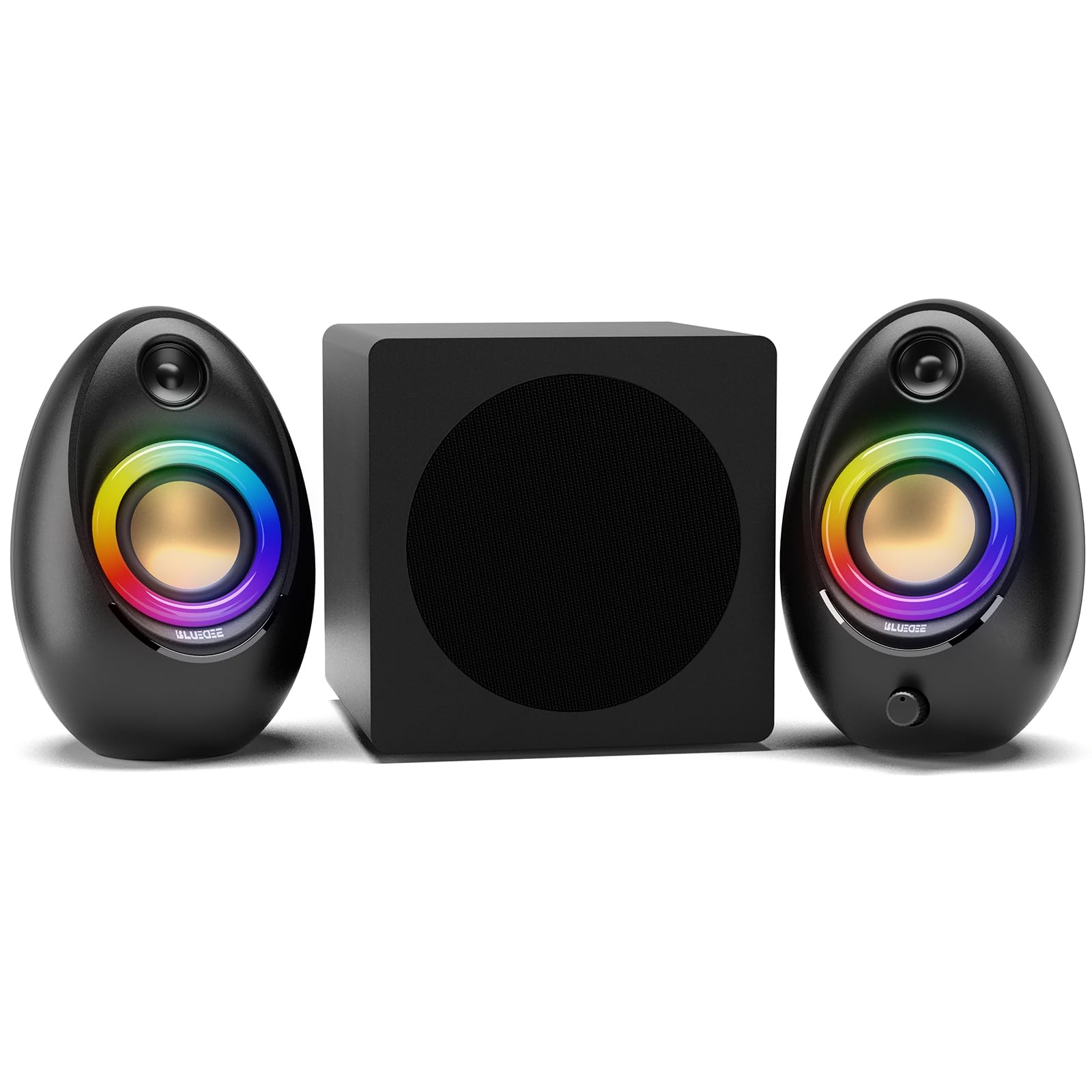
A value-minded 2.1 set that keeps vocals clear while adding bass.
The Bluedee 2.1 system sits neatly between budget plastic kits and premium component setups. Its 80W peak power (with a dedicated subwoofer that handles low frequencies) delivers punchy bass without overwhelming the mids and highs — useful for work-from-home calls where vocal clarity matters, as well as movies and gaming. Built-in DSP tuning (a digital processor that adjusts the frequency curve) reduces distortion and harsh highs, giving a smoother sound than many similarly priced units.
Connection flexibility is the real selling point: Bluetooth 5.4, USB-A, USB-C, and 3.5mm AUX — you can plug in a modern laptop (USB-C), a gaming PC (USB-A), or a phone (Bluetooth) without hunting for adapters. The all-in-one knob controls volume, playback, and lighting. The Bluedee has 80W peak compared to the Nylavee’s 60W peak, though both are solid mid-range options.
Reviewers appreciate the desk-friendly RGB lighting, which includes both dynamic colors and a static glow that is subtle enough for a professional workspace. The plastic enclosure means it is light, but the plastic body does not feel as premium as the Edifier’s MDF cabinet.
Versatility on a budget: USB-C, USB-A, Bluetooth 5.4, and AUX all in one box — you will not need a separate adapter for any modern device you own.
The catch: at 80W peak (not RMS), it cannot match the Logitech Z623’s room-filling headroom. Keep it for a medium-sized desk setup, not a large living room.
Reach for this if: you want a complete 2.1 desktop system with modern connectivity (USB-C!) and a restrained RGB look that fits both gaming and work setups.
Skip if: you need maximum continuous power for a large room — the Z623 or a studio sub will serve you better.
5. Nylavee Computer Speakers with Subwoofer
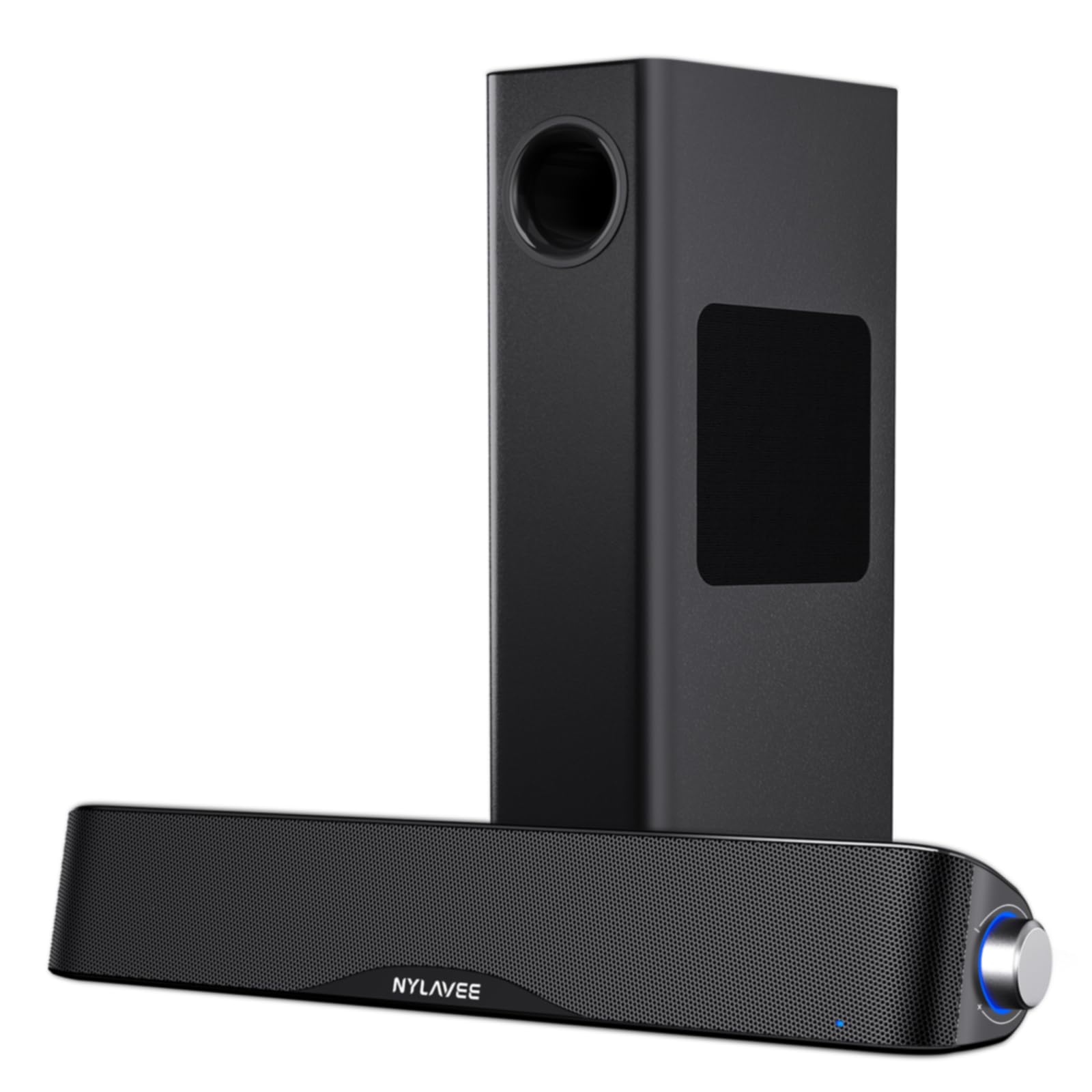
A soundbar-plus-sub combo that prioritizes clear dialogue over boomy bass.
The Nylavee system takes a different approach from most 2.1 sets. Instead of two separate satellite speakers, it pairs a single desktop soundbar (with dual soft-dome silk tweeters and full-range drivers) with a separate 5.25-inch subwoofer. That soundbar design keeps vocals and mids exceptionally clear — useful for Zoom calls, podcast listening, or movies where dialogue matters more than explosions. The 60W peak power (30W RMS) is modest, but the subwoofer’s dedicated 5.25-inch driver adds defined bass without drowning out the mids.
Bluetooth 5.4 gives wireless versatility, while the 3.5mm AUX input offers a zero-lag wired option for gaming. Reviewers point out the side-mounted control knob is simple: power on/off, mode switching, volume, and reset in one place. At 60W peak compared to the Bluedee’s 80W peak, the Nylavee is better matched to smaller desks where you value clarity over raw volume.
The ABS (acrylonitrile butadiene styrene) plastic enclosure is durable but does not have the dampening qualities of a wooden subwoofer cabinet. The sub stays tight and controlled, though.
Why It Stands Out
- Soundbar-plus-sub design puts dialogue and vocals front and center
- Soft-dome silk tweeters reduce harshness in the upper frequencies
- Bluetooth 5.4 provides the latest wireless standard for a clean connection
Limitations
- Peak power of 60W (30W RMS) limits maximum volume in larger rooms
- ABS plastic enclosure does not dampen vibration as effectively as wood or MDF
Right for: desk setups where clear speech and balanced sound matter more than chest-thumping bass — great for remote workers and podcast listeners.
Not for: gamers who want rich, room-shaking explosions or large rooms that need higher continuous power.
6. FIFINE AmpliGame A22

RGB-heavy gaming set with optical input and EQ modes tuned for action.
The FIFINE A22 is designed for gamers who want the lights to sync with the action. Its 2.1 channel setup — dual satellite speakers plus a dedicated subwoofer — creates a stereo soundstage where the reviews note that explosions have real weight and footsteps stay directional. Eighteen different RGB lighting modes pulse and shift to the beat of your music or the intensity of in-game sound effects, and a long press on the button turns the lights off entirely when you need dark focus.
Connection options are unusually broad for the price: OTG (On-The-Go USB), optical (digital audio), AUX (analog), and Bluetooth. The optical input is rare at this level and gives you a clean digital pipeline from a TV or monitor — useful if your console or PC sits farther away. A dedicated EQ button cycles through Game, Movie, and Music modes, each tuned for its content. Unlike the Bluedee and Nylavee, the FIFINE’s controls are touch-based rather than a physical knob.
The enclosure is plastic, which keeps the weight down but does not match the acoustic dampening of wood or MDF. Peak power is not specified in the data, so compare by listening to audio samples or reviews if raw volume is your priority.
Gamer-centric build: optical input, 18 RGB modes, and three EQ presets (Game/Movie/Music) tailored for action — features most budget 2.1 sets skip entirely.
Honest trade-off: touch controls can be less satisfying than a physical knob for quick volume adjustments during gameplay.
Pick this for: a gaming desk where RGB lighting that syncs with audio is a must-have, and you want the flexibility of an optical digital connection.
Skip if: you need a physical volume knob or the acoustic quality of a wooden subwoofer cabinet — the A22 uses plastic throughout.
7. OR O R O W Computer Speakers with Subwoofer

Surprisingly solid bass from a wood-cabinet sub at the lowest entry price.
The OR O R O W (branded as OROW) 2.1 set is the budget champion here, and it has one trick that many pricier plastic sets miss: a wooden subwoofer cabinet. Wood naturally dampens vibration and noise better than plastic, so the 40W peak output feels punchier and cleaner than the wattage number suggests. Five dynamic RGB lighting modes sync to your audio’s rhythm, and the lights can be turned off entirely if you prefer a clean, dark desk.
Bluetooth 5.0 handles wireless streaming from a phone or tablet, while the 3.5mm aux and USB inputs cover wired connections. The satellite speakers are compact enough to free up desk space. Unlike the Bluedee or Nylavee, there is no USB-C port — the connection options are more basic, which is reasonable at this tier. Shoppers say the 40W peak is enough for a bedroom or small office, but the sub’s low end starts to lose definition at higher volumes compared to the Bluedee’s 80W peak or the Nylavee’s 60W peak.
The brand name is unusual and the build quality reflects the price point — the plastic satellites feel lighter than the Bluedee’s. But the wooden subwoofer genuinely lifts the audio experience well above what you expect at this budget level.
What Stands Out
- Wooden subwoofer cabinet reduces vibration and noise for cleaner bass than plastic alternatives
- Five RGB lighting modes sync with audio for a budget-friendly light show
- Bluetooth 5.0 and USB/Aux inputs cover the essential connections
Where It Cuts Corners
- 40W peak power is the lowest in this lineup — definition drops at higher volumes
- Plastic satellite speakers feel less durable than all-wood or metal builds
Make the call if: your budget is tight and you want a 2.1 set with a real wooden subwoofer that sounds better than any plastic option at this price.
Not for: medium-to-large rooms or anyone who listens at high volumes regularly — the 40W peak runs out of steam.
Understanding the Specs
Peak vs RMS Power
Peak power is the maximum wattage a subwoofer can handle in a very short burst — a marketing number that is always higher than real continuous output. RMS (Root Mean Square) is the power the subwoofer can sustain without distortion. For example, the Logitech Z623 lists 400W peak but only 200W RMS. When comparing two subs, always check the RMS number first. A unit with higher RMS plays louder and cleaner for longer.
THX Certification
THX is a set of rigorous performance standards for audio gear. A speaker system that passes THX certification, like the Logitech Z623, has been tested for accurate frequency response, low distortion, and consistent volume levels across a large listening area. Not all subwoofers need THX, but if you want reliable, cinema-quality sound at high volumes, a THX-certified unit brings tested assurance that a non-certified model cannot promise.
FAQ
Can I use a computer subwoofer with my TV or gaming console?
Does a bigger woofer always mean better bass?
Bluetooth or wired — which is better for a computer subwoofer?
How much power (RMS) do I need for a desktop subwoofer?
Will a subwoofer disturb my neighbors or housemates?
What is the difference between a passive subwoofer and an active subwoofer?
How do I connect a subwoofer that only has RCA inputs to my computer?
Can I add a subwoofer to existing computer speakers that do not have a sub out port?
Final Thoughts: The Verdict
For most buyers, the computer subwoofer winner is the Edifier T5s because it delivers deep, clean 35Hz bass in a compact MDF cabinet with adjustable low-pass and phase controls — a studio-grade addition that pairs with any desktop speakers you already own. If you want a complete all-in-one 2.1 system with THX-certified power that fills a large room, grab the Logitech Z623. And for the best value in a modern wireless-and-wired desktop 2.1 setup, the Bluedee blends 80W peak power, Bluetooth 5.4, USB-C connectivity, and clean DSP-tuned audio at a price that undercuts everything with comparable features.
How We Picked
We do not accept paid placement. Every pick is matched to a real buyer and a real use-case; we do not hands-on test units.
Sources & Methodology
Specifications: manufacturer listings and product documentation. Review insights: verified customer reviews, as of July 2026. Pricing: not shown on this page (it changes often); check the current price via the retailer link.
As an Amazon Associate, WellFizz earns from qualifying purchases. This does not affect which products we feature.
Related Guides

Mo Maruf
I created WellFizz to bridge the gap between vague wellness advice and actionable solutions. My mission is simple: to decode the research and give you practical tools you can actually use.
Beyond the data, I am a passionate traveler. I believe that stepping away from the screen to explore new environments is essential for mental clarity and physical vitality.