Our readers keep the lights on and my smoothie glass nicely filled. As an Amazon Associate, I earn from qualifying purchases.
Tired of thin, tinny audio that makes explosions sound like snapped twigs and bass lines vanish into thin air? A subwoofer or dedicated bass driver separates a mundane desktop setup from an immersive entertainment hub where you can actually feel the low-end rumble during games, movies, and music.
I’m Mohammad Maruf — the founder and writer behind WellFizz. I’ve spent countless hours analyzing frequency response curves, driver sizes, and amplifier specs to help you find the set that delivers the low-end punch your ears and desk have been craving.
After comparing seven distinct models, from compact satellites to full bookshelf designs, I’ve identified the models that deliver the most satisfying bass for your setup. This guide breaks down the top contenders for the best computer speakers with bass you can buy right now.
How To Choose The Best Computer Speakers With Bass
Bass isn’t just about volume—it’s about depth, control, and how the low frequencies integrate with the midrange and treble. A speaker that simply rumbles without clarity will muddy dialogue and vocals. Understanding a few core specs separates a great-sounding system from a noisy one.
Driver Size and Configuration: 2.0 vs. 2.1
A 2.1 system includes a dedicated subwoofer, which handles frequencies below roughly 100-150 Hz. This frees the satellite speakers to focus on mids and highs, resulting in clearer dialogue and a more defined soundstage. A 2.0 system with larger woofers (5 inches or more) can also produce satisfying bass, but it often sacrifices some low-end extension. For pure, room-filling rumble, a 2.1 setup is typically the better choice. The subwoofer’s driver size—6.5 inches is a common sweet spot—directly influences how much air it can move.
Power Ratings: RMS Over Peak Wattage
Peak wattage is a marketing number. RMS (Root Mean Square) power tells you the continuous, clean output a system can sustain. A system with 30W RMS per channel will deliver noticeably deeper, tighter bass than a system rated at 100W peak but only 10W RMS. Pay close attention to the subwoofer’s RMS rating, as that driver demands the most power to produce low frequencies without distorting.
Connectivity and Inputs
Most PC speakers rely on a 3.5mm AUX connection. For higher-quality audio, look for USB digital input—it bypasses your computer’s internal sound card and delivers a cleaner signal to the speakers. Bluetooth 5.4 offers low enough latency for casual gaming and music streaming, but wired connections remain the gold standard for distortion-free, lag-free performance.
Quick Comparison
On smaller screens, swipe sideways to see the full table.
| Model | Category | Best For | Key Spec | Amazon |
|---|---|---|---|---|
| Klipsch ProMedia 2.1 | Premium 2.1 | THX certified, immersive gaming & movies | 6.5″ side-firing subwoofer, 200W peak | Amazon |
| MEVOSTO DS19 | Premium 2.0 | Studio-grade sound, USB digital audio | 5″ woofer, 36W RMS, silk dome tweeter | Amazon |
| Nylavee 2.1 | Mid-Range 2.1 | Deep bass from a soundbar-style satellite | 5.25″ subwoofer, 60W peak power | Amazon |
| Bluedee 2.1 | Mid-Range 2.1 | Balanced sound with DSP tuning | DSP-tuned, 80W peak, dedicated subwoofer | Amazon |
| FIFINE AmpliGame A22 | Budget 2.1 | Compact 2.1 with RGB audio sync | 2.1 channel, 18 RGB modes, AC powered | Amazon |
| Edifier G1000 II | Budget 2.0 | Compact design with EQ modes | 2.5″ full-range driver, triple EQ modes | Amazon |
| OHAYO 60W | Value 2.0 | Hi-Fi bookshelf style with MDF cabinet | 3″ carbon fiber driver, 30W x 2 RMS | Amazon |
In‑Depth Reviews
1. Klipsch ProMedia 2.1 THX Certified Computer Speaker System

The Klipsch ProMedia 2.1 remains the benchmark for desktop audio after nearly two decades for good reason. Its 6.5-inch side-firing ported subwoofer produces 200 watts of peak power, delivering bass you can physically feel in your chair during explosions and deep synth lines. The MicroTractrix horn-loaded tweeters in the satellites ensure the high frequencies remain crisp and directional, preventing the low-end from overwhelming the soundstage.
THX certification confirms the system meets rigorous standards for distortion-limited output and frequency response. The control pod gives you separate subwoofer gain and master volume, letting you dial in the exact bass level without affecting the satellites. The satellites are slightly forward in the upper mids—some users EQ this down—but after a brief burn-in period, the soundstage opens up with precise instrument placement.
The system is wired-only (3.5mm input), which is a trade-off for its pure analog signal path. The speaker connection clips on the satellites can be fragile if you frequently move them, and the power LED is aggressively bright. Neither issue detracts from the core performance; this is the set that sets the bar for nearfield bass response.
Why it’s great
- Legendary THX-certified performance with room-filling, tactile bass
- Separate subwoofer gain allows precise bass tuning
- 200W peak power handles any content without distortion
Good to know
- Wired-only connection; no Bluetooth or USB input
- Satellite speaker clips can be delicate
- Power LED is very bright with no dimming option
2. MEVOSTO DS19 Active Bookshelf Speakers

The MEVOSTO DS19 delivers the most controlled bass of any 2.0 system on this list, thanks to its 5-inch dedicated woofers and 36W RMS continuous power. The USB digital input bypasses your computer’s internal DAC entirely, delivering lossless, low-latency audio that eliminates the slight audio delay some users report with Bluetooth. The silk dome tweeters produce smooth, non-fatiguing highs even at elevated listening levels.
What sets the DS19 apart is the 10-level bass and treble adjustment knobs on the front panel. You can boost the low-end without introducing boxiness—a common issue in cheaper bookshelf designs. The natural wood enclosure adds acoustic resonance that plastic cabinets can’t match, reducing unwanted vibration at high volume. The included remote control is a welcome convenience for adjusting settings from your chair.
The Bluetooth connection is solid, but the USB input is the star here for PC users. A few owners noted the bass can become overwhelming if you push the knob past midpoint, but the ten-step control makes it easy to find the sweet spot. There is no subwoofer line-out, so this is strictly a 2.0 system—if you want a separate sub, look at a 2.1 setup instead.
Why it’s great
- USB digital audio delivers lossless, low-latency sound
- 10-level bass & treble adjustment offers premium control
- Natural wood cabinet improves acoustic resonance
Good to know
- No subwoofer line-out for expanding to a 2.1 system
- Bluetooth has a small audio delay compared to USB
- Bass knob past midpoint can overpower the mids
3. Nylavee 2.1 PC Speakers System
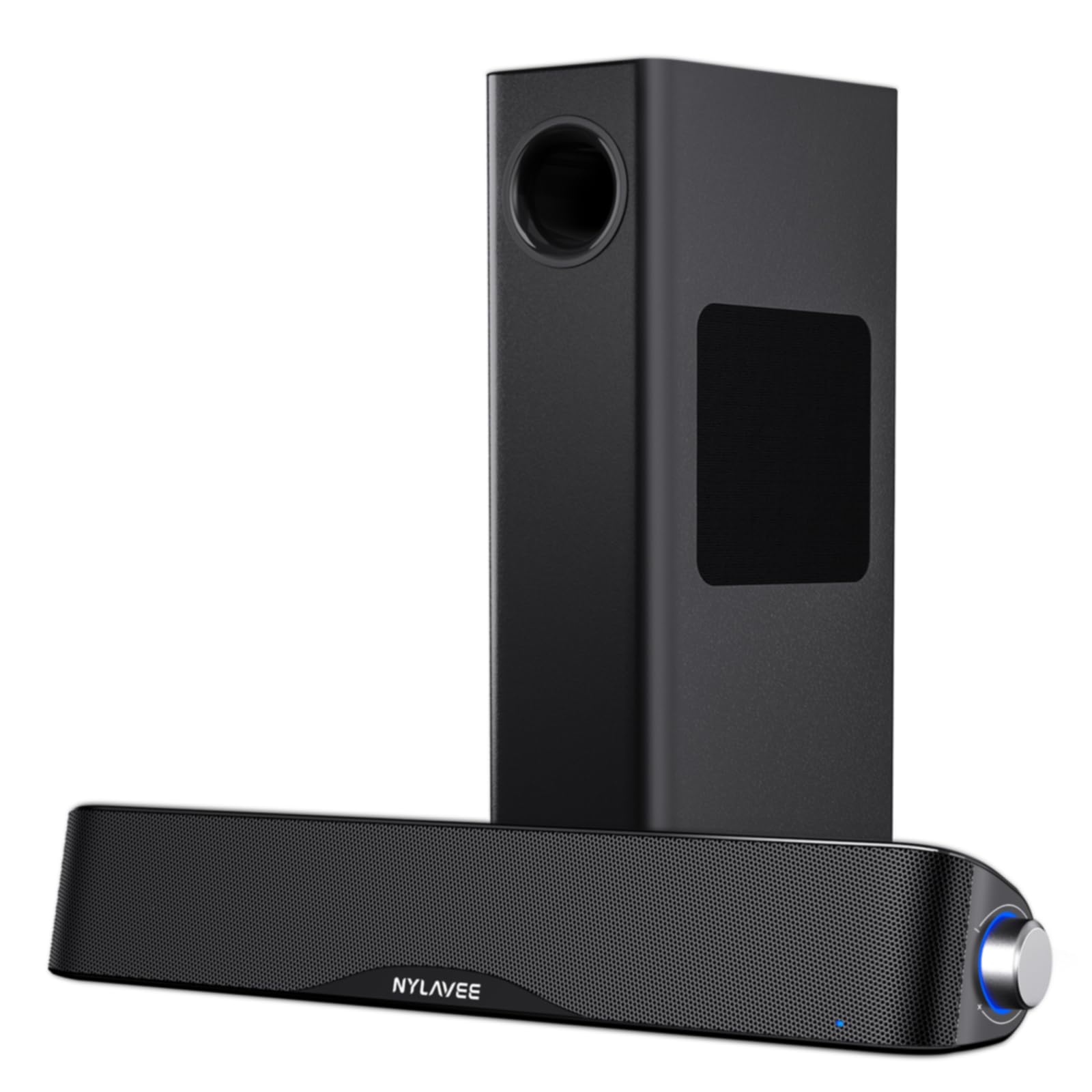
The Nylavee 2.1 uses a unique soundbar-style satellite speaker paired with a standalone 5.25-inch subwoofer rated at 60W peak power. This configuration delivers surprisingly deep, impactful bass for its footprint—the subwoofer produces clean low-end extension down to around 40 Hz without the muddy overhang common in budget subwoofers. The dual soft-dome silk tweeters in the soundbar keep vocals and high frequencies crisp.
Setup is genuinely plug-and-play: connect the subwoofer to the soundbar via the included RCA cable, plug in power, and connect via 3.5mm AUX or Bluetooth 5.4. The side-mounted control knob handles power, volume, input switching, and reset functions—one-handed operation that doesn’t interrupt your session. The low-profile soundbar design saves desk space compared to dual satellite speakers.
The ABS plastic enclosure on the soundbar feels durable, but the subwoofer’s MDF-like construction gives it reassuring heft. Bluetooth 5.4 works reliably up to about 30 feet, though purists will prefer the wired 3.5mm connection for zero latency. The system lacks USB digital input, so audio quality depends on your computer’s internal sound card.
Why it’s great
- Powerful 5.25″ subwoofer with deep, clean bass extension
- Soundbar-style satellite saves desk space
- Simple one-knob control for all functions
Good to know
- No USB digital input; relies on 3.5mm or Bluetooth
- Soundbar is made of ABS plastic, not wood
- Subwoofer placement requires floor space near the desk
4. Bluedee 2.1 Computer Speakers with Subwoofer
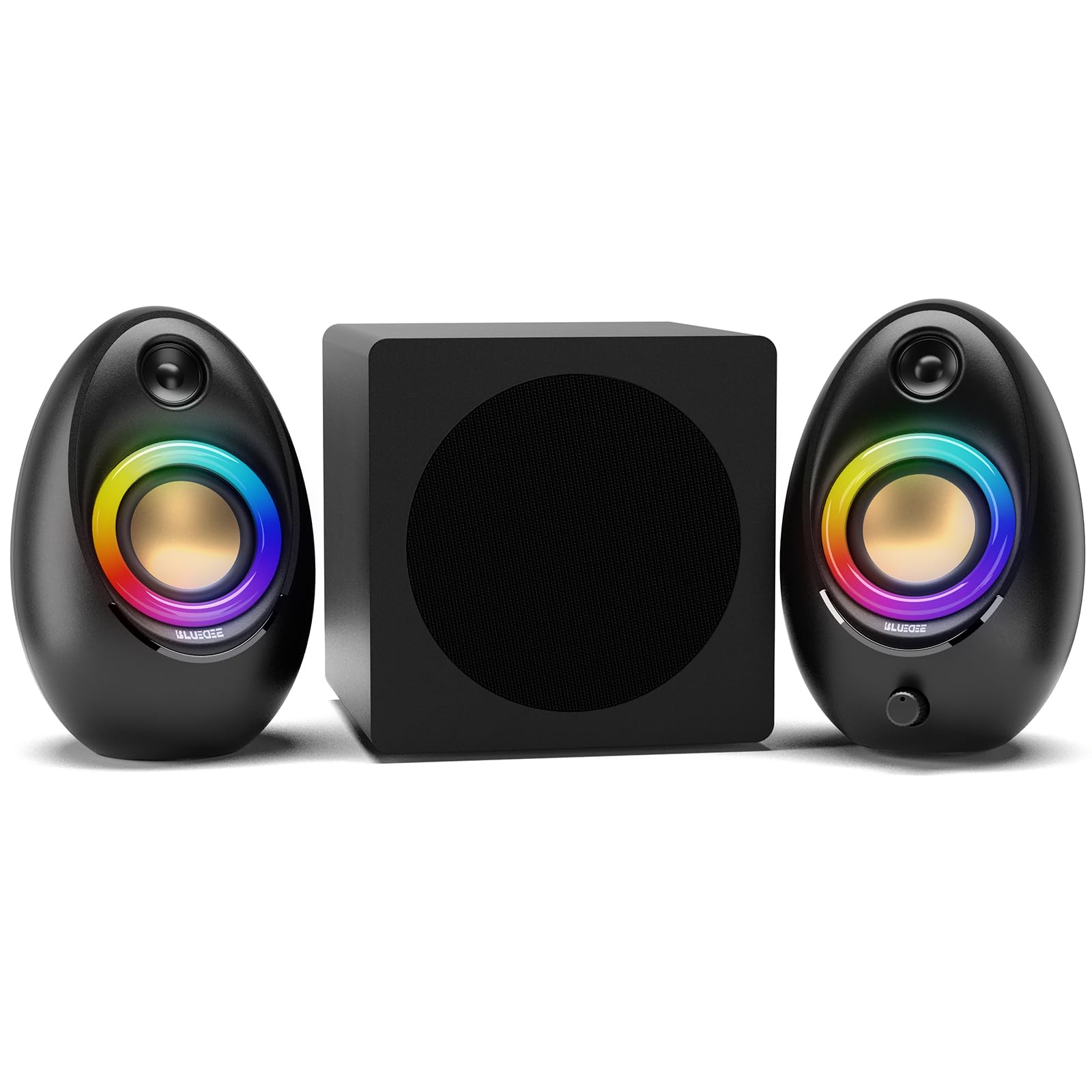
The Bluedee 2.1 delivers the best overall value proposition in this guide, combining a dedicated subwoofer with DSP tuning that prevents the low-end from distorting at higher volumes. The 80W peak power rating translates to clean, punchy bass that enhances music beats and game explosions without muddying the midrange. The satellite speakers remain clear even when the subwoofer is working hard.
Connectivity is unusually generous for this price tier: Bluetooth 5.4, USB-A, USB-C, and 3.5mm AUX inputs. The all-in-one control knob manages volume, playback, lighting effects, and mode switching—no fumbling with separate buttons. The RGB lighting is desk-friendly, offering dynamic colors or a soft static glow that doesn’t distract during work sessions.
The plastic enclosure is functional but doesn’t feel premium. A few users noted the startup noise is slightly audible, though it doesn’t affect playback. The subwoofer’s compact size fits under most desks, but its power output means you’ll feel the bass in a small to medium room without needing to max out the volume. For the price, the bass-to-clarity ratio is exceptional.
Why it’s great
- DSP tuning keeps bass clean and distortion-free
- Versatile inputs: Bluetooth, USB-A, USB-C, and AUX
- Compact subwoofer fits under most desks
Good to know
- Plastic enclosure feels less premium than wood cabinets
- Slight audible startup/power-on noise
- RGB lighting cannot be fully disabled, only dimmed
5. FIFINE AmpliGame A22 2.1 Gaming Speakers

The FIFINE AmpliGame A22 is built for gamers who want both audio immersion and visual flair. The 2.1 channel setup uses a dedicated subwoofer plus two compact satellite speakers, delivering stereo sound that makes footsteps and environmental cues spatially distinct. The bass is present and punchy—though it doesn’t reach the lowest depths of larger subwoofers—and the dialogue stays crisp thanks to the dedicated satellite drivers.
The RGB lighting is the headline feature here: 18 dynamic modes including audio-sync, breathing, and color cycle. The lights pulse in time with the music or game audio, adding a layer of visual feedback that enhances immersion. You can turn the lights off completely with a long press if you prefer a dark, focused room—a thoughtful touch many competing gaming speakers omit.
Connectivity covers AUX, Bluetooth, USB-C (OTG), and optical inputs, making it compatible with PCs, consoles, and mobile devices. The top-mounted buttons control EQ modes (Game, Movie, Music), volume, and playback without software. A few users reported AUX connection noise, so the optical or USB-C input is the cleaner option. The compact satellite size—roughly palm height—fits even the most cluttered desk setups.
Why it’s great
- Audio-sync RGB lighting adds immersive visual feedback
- Compact satellites fit tight desktop spaces
- Multiple inputs: AUX, Bluetooth, USB-C, and optical
Good to know
- Bass is punchy but not as deep as larger subwoofers
- AUX connection can introduce buzzing on some PCs
- Satellite speakers feel light; plastic enclosure
6. Edifier G1000 II Desktop Computer Speakers
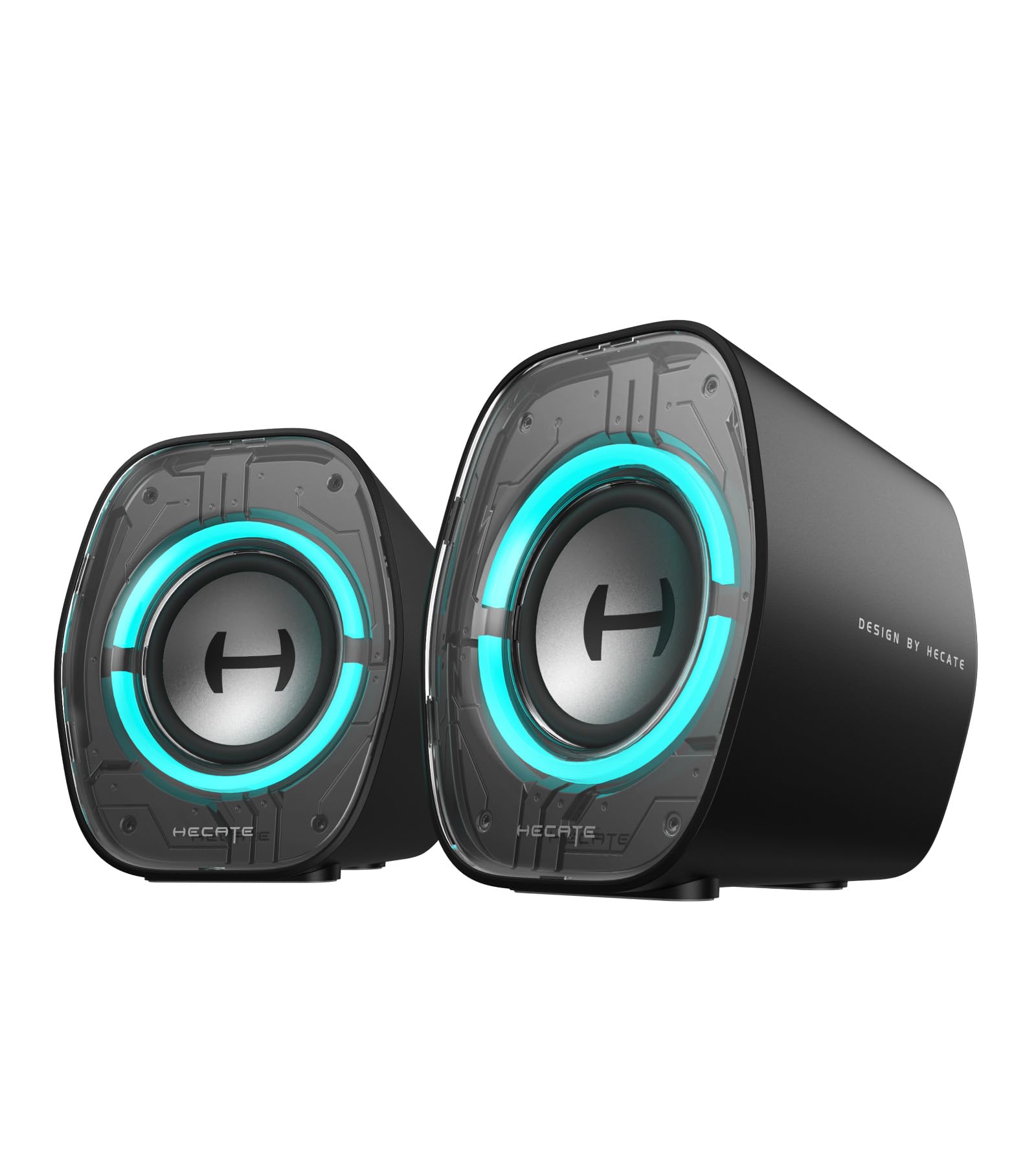
The Edifier G1000 II proves you don’t need a massive subwoofer to get satisfying bass from a desktop 2.0 setup. Its 2.5-inch full-range driver, paired with a racetrack bass reflex port, produces surprisingly deep low-end extension for its ultra-compact 3.6-inch width. The 10-degree tilted baffle angles sound toward your ears and reduces desk reflections, creating a more focused nearfield listening experience.
The triple EQ modes (Music, Gaming, Movie) are expertly tuned—Gaming mode emphasizes footsteps and environmental cues without boosting the bass into distortion, while Movie mode adds a wider soundstage. The top-mounted buttons give you direct access to volume, EQ, lighting, and input switching without needing the EDIFIER ConneX app, though the app adds deeper customization if you want it.
Bluetooth 5.4 delivers ≤40ms low-latency audio, which is usable for casual gaming but still slightly behind a wired connection. The plastic enclosure is lightweight, and the 1.5m USB cable is short for larger desks. The bass, while impressive for the size, doesn’t match the depth of a dedicated subwoofer system. These are ideal for ultra-clean desk setups where every inch of space counts.
Why it’s great
- Exceptional bass extension from a 2.5″ driver and reflex port
- Triple EQ modes are well-tuned for different content
- Compact, tilted design saves desk space and reduces reflections
Good to know
- Bass depth is limited compared to a 2.1 system
- 1.5m USB cable may be too short for some setups
- Plastic enclosure feels less premium than wood options
7. OHAYO 60W Computer Speakers

The OHAYO 60W speakers bring genuine bookshelf speaker construction to the desktop—their MDF wood enclosures dramatically reduce box resonance compared to plastic alternatives, resulting in cleaner mids and tighter bass. The 3-inch carbon fiber full-range driver paired with a 0.75-inch carbon fiber silk dome tweeter delivers a frequency response spanning 20Hz to 22.8kHz, giving you audible sub-bass extension that most budget 2.0 speakers completely miss.
The rear bass port amplifies low-end depth without the muddy output that plagues poorly ported designs. The integrated independent sound card ensures detailed playback even at low volumes—a rarity at this price point. Input options include Bluetooth 5.3, AUX, RCA, USB, and even TRS, making it the most connection-versatile 2.0 speaker on this list. The front-panel volume knob doubles as power control, and separate treble/bass knobs give you on-the-fly tuning.
The 30W x 2 RMS power rating (60W peak) fills a medium room without strain. The lower-mid to upper range is strong, but the deepest sub-bass still can’t match a dedicated subwoofer. USB input produces noticeably better sound quality than 3.5mm AUX, so use it if your PC supports it. The wood cabinet adds weight—a premium feel that’s rare at this tier.
Why it’s great
- MDF wood cabinet dramatically reduces resonance
- Carbon fiber drivers deliver clean, extended bass response
- Multiple inputs including USB, RCA, and TRS
Good to know
- Deep sub-bass still falls short of a 2.1 subwoofer
- AUX input sounds noticeably thinner than USB
- Wood cabinet makes them heavier than plastic alternatives
FAQ
Do I need a 2.1 system to get good bass from computer speakers?
How do I eliminate buzzing or distortion from my computer speakers?
What does THX certification mean for computer speakers?
Is Bluetooth good enough for gaming audio with bass?
Final Thoughts: The Verdict
For most users, the best computer speakers with bass winner is the Klipsch ProMedia 2.1 because its THX-certified 6.5-inch subwoofer delivers visceral, room-filling bass that no other desktop system at this size can match, with satellite clarity that keeps dialogue crisp. If you want USB digital audio for pristine low-latency sound, grab the MEVOSTO DS19. And for the deepest bass at the most aggressive budget-friendly price, nothing beats the Bluedee 2.1 system.

Mo Maruf
I created WellFizz to bridge the gap between vague wellness advice and actionable solutions. My mission is simple: to decode the research and give you practical tools you can actually use.
Beyond the data, I am a passionate traveler. I believe that stepping away from the screen to explore new environments is essential for mental clarity and physical vitality.