Our readers keep the lights on and my smoothie glass nicely filled. As an Amazon Associate, I earn from qualifying purchases.
The speakers built into your laptop or monitor are designed for beeps and alerts, not for music, dialogue, or immersion. You don’t need a massive sound system to fix that, but you do need to stop tolerating the thin, lifeless audio that ships with most computers—especially when a dedicated pair of desktop speakers can deliver a genuinely better experience for surprisingly little money.
I’m Mohammad Maruf — the founder and writer behind WellFizz. I’ve spent countless hours combing through customer feedback, technical specs, and real-world performance data on the most popular budget desktop audio solutions to separate the truly capable from the merely decorative.
A great pair of affordable desktop speakers can transform your daily computing, whether you’re gaming, streaming, or on back-to-back video calls. This guide covers the five best computer speakers under 50 that actually deliver on their promises.
How To Choose The Best Computer Speakers Under 50
Shopping in this budget bracket means trade-offs are unavoidable. The key is knowing which trade-offs matter for your specific desk setup and use case. Here are the three most important considerations before you click “buy.”
Driver Design and Bass Reproduction
At this price point, you won’t find large woofers or dedicated subwoofers. Instead, the best budget speakers use clever engineering like passive radiators or ported enclosures to create the illusion of deeper bass. A passive radiator—a non-powered cone that vibrates from the pressure of the main driver—can produce noticeably richer low-end than a sealed speaker of the same size. If you watch action movies or play games, prioritize a model with a passive radiator or a bass port.
Power Source: USB vs. External Adapter
Nearly every speaker in this range is USB-powered, which keeps the wire count low and the desk clean. The catch is that a standard USB 2.0 port provides only 2.5 watts of power. Speakers that rely solely on USB for both power and audio can feel quiet or strained at high volume. Models that use USB for power but accept a dedicated 3.5mm audio input from your computer’s headphone jack tend to have a cleaner signal path. A few premium options draw more power via USB-C, which can push slightly higher volumes.
Connectivity and Compatibility
Most budget speakers use a simple USB-A cable for power and a 3.5mm aux cable for audio. This works with almost every PC, laptop, and even some gaming consoles. Newer models sometimes include a USB-C cable for power or a USB-C audio connection that carries both power and sound in one wire—ideal for modern laptops without a USB-A port. Always check whether the speaker requires a separate 3.5mm cable or if it sends audio through the USB connection alone, as this affects compatibility with devices like the PS5 or certain docking stations.
Quick Comparison
On smaller screens, swipe sideways to see the full table.
| Model | Category | Best For | Key Spec | Amazon |
|---|---|---|---|---|
| Creative Pebble 2.0 | Compact Desktop | Near-field listening, desk clarity | Passive radiator + 45° angled drivers | Amazon |
| Bluedee Desktop Speakers | USB-C Audio | Single-cable modern setups | 16W peak, USB-C power + audio | Amazon |
| Amazon Basics Stereo 2.0 | Simple Utility | Basic desktop audio upgrade | Bottom radiator, inline volume control | Amazon |
| Redragon GS520 | RGB Gaming | Gaming setups with lighting | Touch-controlled RGB, 6 LED modes | Amazon |
| OFFSIR 2-in-1 | Modular Soundbar | Tight desk spaces, flexible placement | Detachable dual-drivers combine into soundbar | Amazon |
In‑Depth Reviews
1. Creative Pebble 2.0
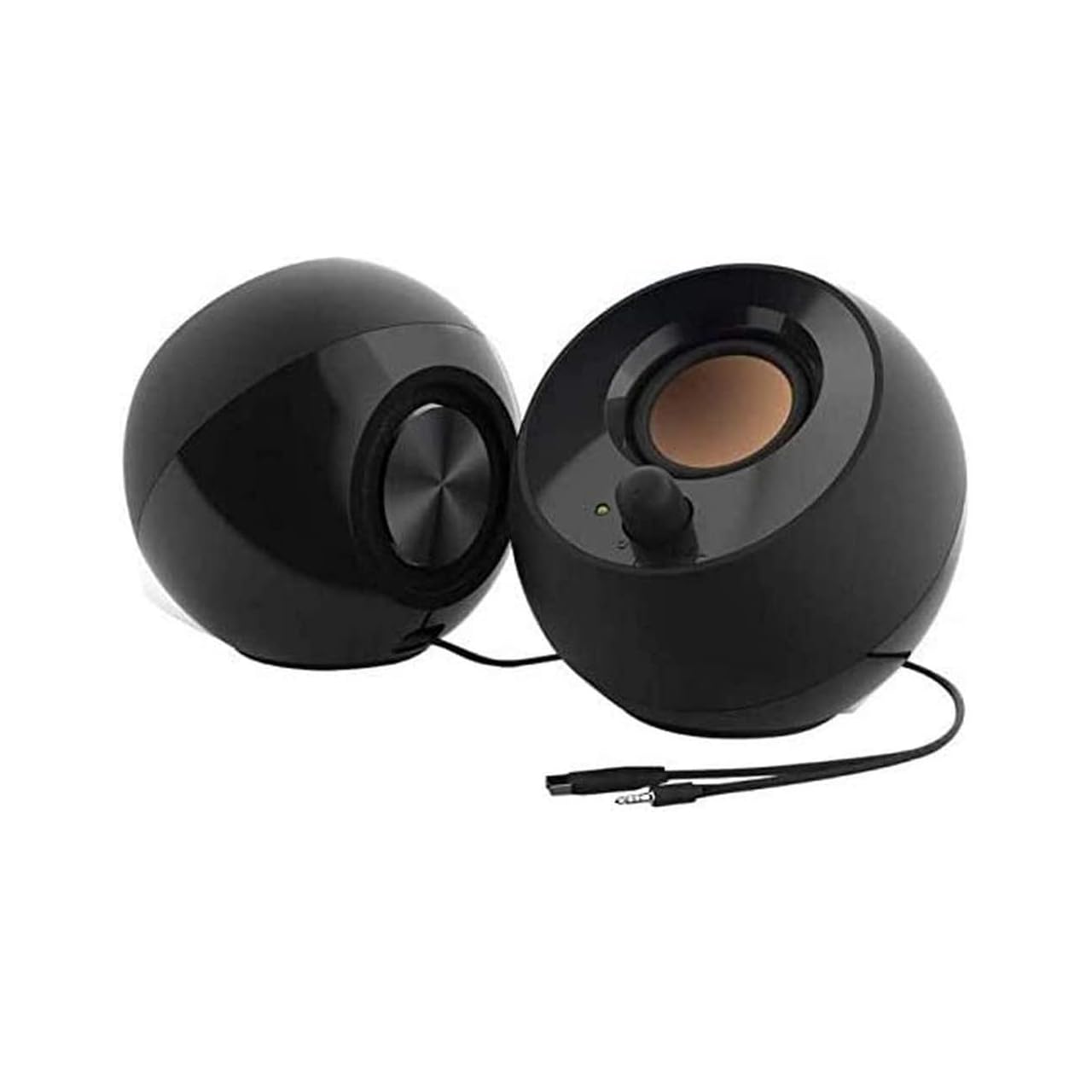
The Creative Pebble 2.0 has become a reference point for budget desktop audio, and for good reason. Its most distinctive physical feature—the 45-degree upward tilt of the drivers—positions the sound to fire directly toward your ears instead of your monitor or your chest. Combined with a rear-facing passive radiator, this speaker produces bass that feels substantial for its compact, rounded shell.
Real-world listening confirms a clean, natural mid-range and crisp treble that avoids the harsh, boxy tone common at this price point. The sound field is best when you’re seated directly in front of the speakers—within about 2 to 3 feet—making them ideal for personal desk setups rather than filling a large room. Setup is truly one-cable: USB handles both power and audio, and there’s no power brick or wall adapter to hide.
Volume knob placement on the right speaker has a minor ergonomic flaw: pressing it can tilt the speaker forward. Users report that using a dedicated USB power adapter rather than a laptop port unlocks noticeably higher volume ceilings. Overall, the Pebble 2.0 offers the best balance of clarity, bass depth, and desk-friendly design in this tier.
Why it’s great
- Exceptionally clear near-field sound with deeper bass than any sealed competitor at this size
- Angled drivers improve ear-level projection without requiring separate stands
- Requires only one USB cable for both power and audio, keeping the desk clutter-free
Good to know
- Volume knob is front-mounted and can cause the unit to tilt when pressed
- Max volume benefits from a dedicated USB power source rather than a laptop port
2. Bluedee Computer Speakers

The Bluedee Computer Speakers stand out for their forward-looking connectivity. A single USB-C cable handles both power and audio, which is a genuine convenience for modern laptops and desktops that have phased out 3.5mm jacks. The compact towers—roughly 6 inches tall—include a 16W peak driver pair that delivers balanced, clear sound capable of filling a small room.
Listeners consistently praise the clarity of vocals and treble, though the bass is balanced rather than punchy—there’s no passive radiator or port here, so don’t expect thumping lows. The front-facing volume knob offers smooth 0-to-100% adjustment, and a built-in 3.5mm headphone jack lets you switch between speaker and private listening without reaching behind your computer. Touch-sensitive RGB lighting can be toggled on or off with a tap, making it suitable for both gaming setups and professional workspaces.
The metal-and-plastic build feels more substantial than the price suggests, and non-slip pads keep the speakers planted during louder playback. Bluedee backs the unit with a lifetime quality assurance, which is unusually strong for this price category. If you want a single-cable solution with flexible placement and reliable build, this is the top contender.
Why it’s great
- USB-C connectivity carries power and audio in one cable, ideal for modern laptops
- Integrated headphone jack on the speaker for quick private listening
- Strong build quality with metal accents and lifetime manufacturer support
Good to know
- Bass is balanced and clean but lacks the impact of a passive radiator design
- Peak volume, while sufficient for a desk, may feel slightly conservative for larger rooms
3. Amazon Basics Stereo 2.0

The Amazon Basics Stereo 2.0 speakers are the definition of a no-nonsense value proposition. The design is straightforward—two compact satellite speakers with a metal-like finish and a padded scratch-resistant base. The inline volume control on the cable is a practical touch that lets you adjust levels without reaching for the speakers themselves, and a blue LED confirms power status.
Sound quality is clean and clear for everyday use, with enough volume to comfortably fill a bedroom or small office. The bottom radiator adds a noticeable “springy” bass character that improves the low-end presence compared to a completely sealed design. Users consistently report that these speakers are a clear upgrade from built-in laptop audio, with better clarity for dialogue, music, and video calls. They are USB-powered and accept a 3.5mm audio input, making them compatible with nearly any computer.
Bass depth is moderate rather than deep—the bottom radiator helps but doesn’t match the quantity of a larger passive radiator design. The speakers also lack any extra features like RGB, a headphone jack, or multi-device switching. For a simple, effective desktop audio upgrade that costs less than most accessories, the Amazon Basics pair delivers exactly what it promises.
Why it’s great
- Inline volume control on the cable keeps adjustments convenient and accessible
- Bottom radiator adds bass presence beyond what sealed budget speakers offer
- Simple USB + 3.5mm setup works instantly with nearly any PC or laptop
Good to know
- Bass is improved over sealed designs but still moderate rather than deep
- No RGB, headphone jack, or multi-device connectivity features
4. Redragon GS520 RGB

The Redragon GS520 ANVIL speakers aim squarely at gamers who want both improved audio and a lighting effect that matches their rig. The speakers feature a brushed-material aesthetic with an aluminum-style finish that looks more premium than the ABS plastic underneath. A touch-sensitive strip on top controls six RGB modes, including the ability to turn the lights off entirely, which is a welcome option for those who prefer a cleaner look during work hours.
Audio performance is solid for the price: clear mid-range with no noticeable static, and volume that goes surprisingly loud without distortion. Music tracks sound full, and dialogue in games and streams comes through intelligibly. The 2.0 channel stereo core handles most genres well, though the small driver size means bass is moderate—fine for gunshots and score music, but not for bass-heavy electronic or hip-hop at high volume. The unit is USB-powered with a 3.5mm audio connection, and the 31-inch cable between speakers offers flexible placement on a standard desk.
A few users have reported intermittent cutouts or static after several months, suggesting some variability in long-term durability. The lightweight plastic construction also means the speakers can slide around if bumped. For a short-to-medium-term gaming desk upgrade with customizable aesthetics, the GS520 offers strong initial performance for its tier.
Why it’s great
- Six-mode touch-controlled RGB adds gaming atmosphere without requiring software
- Clean sound with no static and good volume headroom for its size
- Brushed-material design and aluminum accents look more expensive than the price
Good to know
- Some units have exhibited audio cutouts after extended use
- Lightweight ABS construction can slide easily on a smooth desk surface
5. OFFSIR 2-in-1 PC Speakers
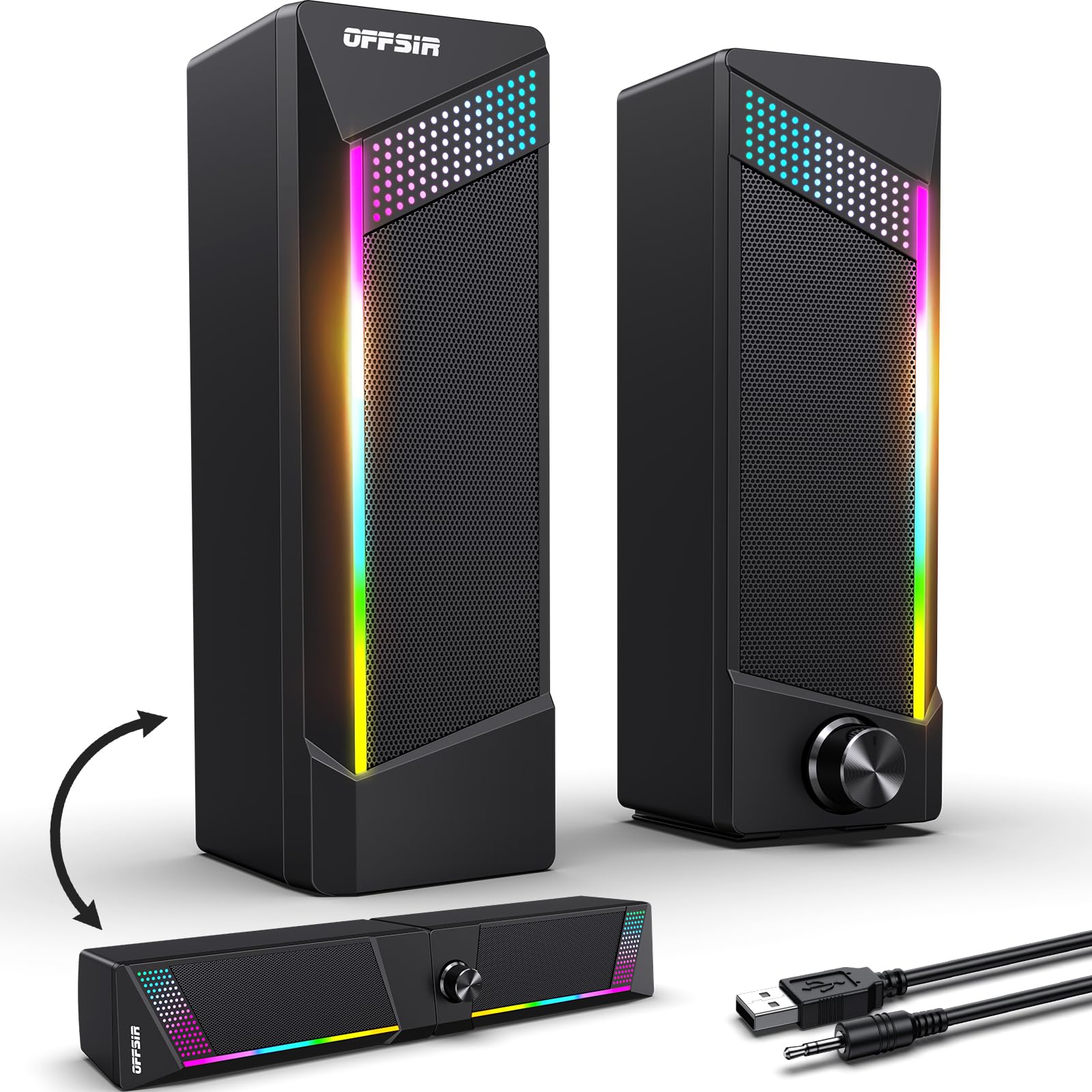
The OFFSIR 2-in-1 PC Speakers solve a unique space puzzle: you can use them as two separate stereo speakers flanking your monitor, or snap them together to form a single compact soundbar. This modularity makes them a strong candidate for ultra-tight desks, cramped dorm rooms, or anyone who frequently reconfigures their workspace. The units are small enough to fit beneath dual 32-inch monitors, which is a feat that larger 2.0 setups can’t match.
Sound quality leans toward clear and serviceable rather than immersive. Dual 5W drivers deliver balanced treble and mid-range with adequate volume for personal listening. Bass is present but light—the design prioritizes compactness over low-end impact. The RGB lighting offers four preset modes that change with a touch on the top surface, though the colors are pre-programmed and cannot be customized to specific shades. A single knob on the front controls both power and volume, which feels more intuitive than separate buttons.
Critical nuance: when separated, the two speakers operate in mono rather than true stereo, so the spatial separation benefit is diminished. This is a common trade-off in modular designs. The cables are long enough to accommodate most desk layouts, but the USB and aux cables are partially bonded and cannot be fully separated. For ultra-compact setups where a traditional soundbar is too wide and separate speakers take up too much depth, the OFFSIR’s flexibility is the defining feature.
Why it’s great
- Modular design converts between separate speakers and a single soundbar
- Compact footprint fits under dual large monitors without blocking the screen
- Single knob control for power and volume is simple and intuitive
Good to know
- Separated speakers operate in mono rather than true stereo separation
- Bass is light and non-customizable RGB presets may not match all setups
FAQ
Can I use USB-powered speakers with a PS5 or Xbox?
Why do my speakers sound quieter on USB power alone?
Is a 2.1 system with a subwoofer worth the extra desk space?
Final Thoughts: The Verdict
For most users, the computer speakers under 50 winner is the Creative Pebble 2.0 because its angled drivers and passive radiator deliver the best near-field clarity and bass for the money in a compact, one-cable design. If you want a single USB-C cable that powers and plays audio for a modern laptop, grab the Bluedee Desktop Speakers. And for ultra-tight desk spaces where every inch counts, nothing beats the modular flexibility of the OFFSIR 2-in-1.

Mo Maruf
I created WellFizz to bridge the gap between vague wellness advice and actionable solutions. My mission is simple: to decode the research and give you practical tools you can actually use.
Beyond the data, I am a passionate traveler. I believe that stepping away from the screen to explore new environments is essential for mental clarity and physical vitality.