Our readers keep the lights on and my smoothie glass nicely filled. As an Amazon Associate, I earn from qualifying purchases.
Specs are compiled from manufacturer listings and verified buyer reviews and can change over time — please confirm the key details on the product page before buying.
A tiny desk does not mean you have to put up with thin laptop audio or a giant soundbar. You want clear mids and actual bass without the speakers eating your workspace or plugging up every outlet. This guide cuts through the noise to show you which compact sets actually sound good — and which ones just happen to be small.
I’m Mohammad Maruf — the founder and writer behind WellFizz. This guide is built by comparing the manufacturers’ published specifications and the patterns across verified customer reviews, so you get each pick’s real strengths and trade-offs instead of marketing spin.
You will find a USB-powered set for a dorm, a retro pixel speaker for your gaming desk, and the best audio for the money. This is your guide to the computer speakers small that balance footprint and fidelity without the hype.
Quick Picks
- Creative Pebble 2.0 USB-Powered Desktop Speakers — Best Overall
- FUNLOGY Speaker – 14W Stereo PC Speakers — Top Performer
- Amazon Basics Stereo 2.0 Speakers — Best Value
- ROSON Computer Speaker (A-293) — Smart Design
- Sanyun SW102 Computer Speakers — Compact Champ
- Divoom MiniToo Retro PC-Style Speaker — Most Versatile
How To Choose The Best Computer Speakers Small
Small speakers force a trade-off between size and bass. Most cheap sets use tiny drivers (the cone that produces sound) that distort when you turn up the volume. The key is to look for a design that packs a larger driver or a passive radiator (a second unpowered cone that vibrates to produce deeper low-end tones) inside that compact frame. You also need to check if the speaker is USB-powered — which keeps your desk cable-free but limits total output — versus a unit that plugs into a wall outlet for more power. Finally, small speakers shine in near-field listening, meaning you sit about two to three feet away, so focus on models tuned for that close-up balance.
Driver Size vs. Passive Radiator
A larger driver, measured in millimeters or inches, can move more air for fuller sound. But a tiny speaker with a passive radiator can fake that bass response — the radiator vibrates freely to reinforce low frequencies without needing more power. You will see both approaches in the picks below. The Creative Pebble 2.0 uses a rear-facing passive radiator, while the FUNLOGY uses a 48mm driver with its own radiator to punch above its weight class.
USB Power vs. Wall Power
USB-powered speakers draw all their energy from your computer’s port, which typically delivers 5V at 500mA. That is fine for moderate volume at your desk, but if you crank it for a movie or a loud game, you might notice the bass drops off. A few models can use a dedicated USB wall adapter (like a phone charger) for more headroom. Buyers of the Creative Pebble note that volume doubles when you plug it into a power adapter instead of the PC’s USB port.
Near-Field Listening is the balance
Small tweeters (the part that handles high frequencies) are designed for close-range sound. If you place them at ear level and about an arm’s length away, you get a clear stereo image with surprising detail. If you push them across the room, the sound thins out fast. The Sanyun SW102 recommends setting the speakers in an equilateral triangle with your head for the best 360-degree stereo effect.
Quick Comparison
| Model | Best For | Total Output | Driver Size | Connectivity | Amazon |
|---|---|---|---|---|---|
| Creative Pebble 2.0 | Best Overall | Not specified (USB-powered) | 12.6 cm dynamic driver | USB | Amazon |
| FUNLOGY Speaker | Best Value / Punchiest Sound | 14W | 48mm dual full-range driver | USB + 3.5mm | Amazon |
| Amazon Basics 2.0 | Budget Starter | Not specified (USB-powered) | Dynamic driver (size not listed) | USB + 3.5mm | Amazon |
| ROSON A-293 | Front Volume Control | 3W x 2 | Dynamic driver (size not listed) | USB + 3.5mm + headphone jack | Amazon |
| Sanyun SW102 | Best Bass per Inch | 5W x 2 | 40mm dynamic driver | USB + 3.5mm | Amazon |
| Divoom MiniToo | Novelty / Multifunction | 5W near-field | Not listed (small single driver) | Bluetooth 5.3, USB, TF card | Amazon |
In‑Depth Reviews
1. Creative Pebble 2.0 USB-Powered Desktop Speakers

The little white puck that redefined what a speaker can sound like.
You get clear, natural audio for near-field listening (about two to three feet from your ears), and you do not need a power brick on your desk. The Creative Pebble 2.0 uses a single USB cable for both power and audio. A rear-facing passive radiator (an unpowered cone that vibrates with the air inside the cabinet) adds bass that most speakers this size cannot touch. Buyers report “excellent sound quality for size and price” and call the clarity “shocking for.” The 45-degree angled drivers aim the sound up toward your ears, which makes a noticeable difference when you sit at a desk.
One real trade-off: the volume is softer than you might expect when running from a standard PC USB port. A reviewer noted that volume doubles when you plug it into a dedicated USB power adapter. Also, the volume dial on the front is the whole front face of the right speaker — turning it can tilt the speaker slightly. Still, the Pebble 2.0 beats the FUNLOGY on clarity in the top end, though the FUNLOGY puts out more total wattage (14W vs. the Pebble’s unspecified but lower output).
This is the pair that replaces terrible built-in monitor audio. Reviewers call it “top-tier for under ” and say it “removed the need for more expensive options.” The white finish blends cleanly into a light-colored setup. You would pick this over the FUNLOGY if treble detail matters more than raw volume.
USB powered simplicity: Best top-end clarity and detail among all compact speakers reviewed by buyers — they call the sound “very transparent, airy, detailed.”
limited bass depth: Needs a USB wall adapter to reach its full volume potential; bass is moderate, not thumping.
minimalist desk setup: you want the cleanest, most detailed treble from a tiny speaker and value clarity over raw volume. The Pebble 2.0 is ideal for a white or minimalist desk.
audiophile listening: you need room-filling loudness without using a separate power adapter, or you want a retro/display-style speaker like the Divoom MiniToo.
2. FUNLOGY Speaker – 14W Stereo PC Speakers
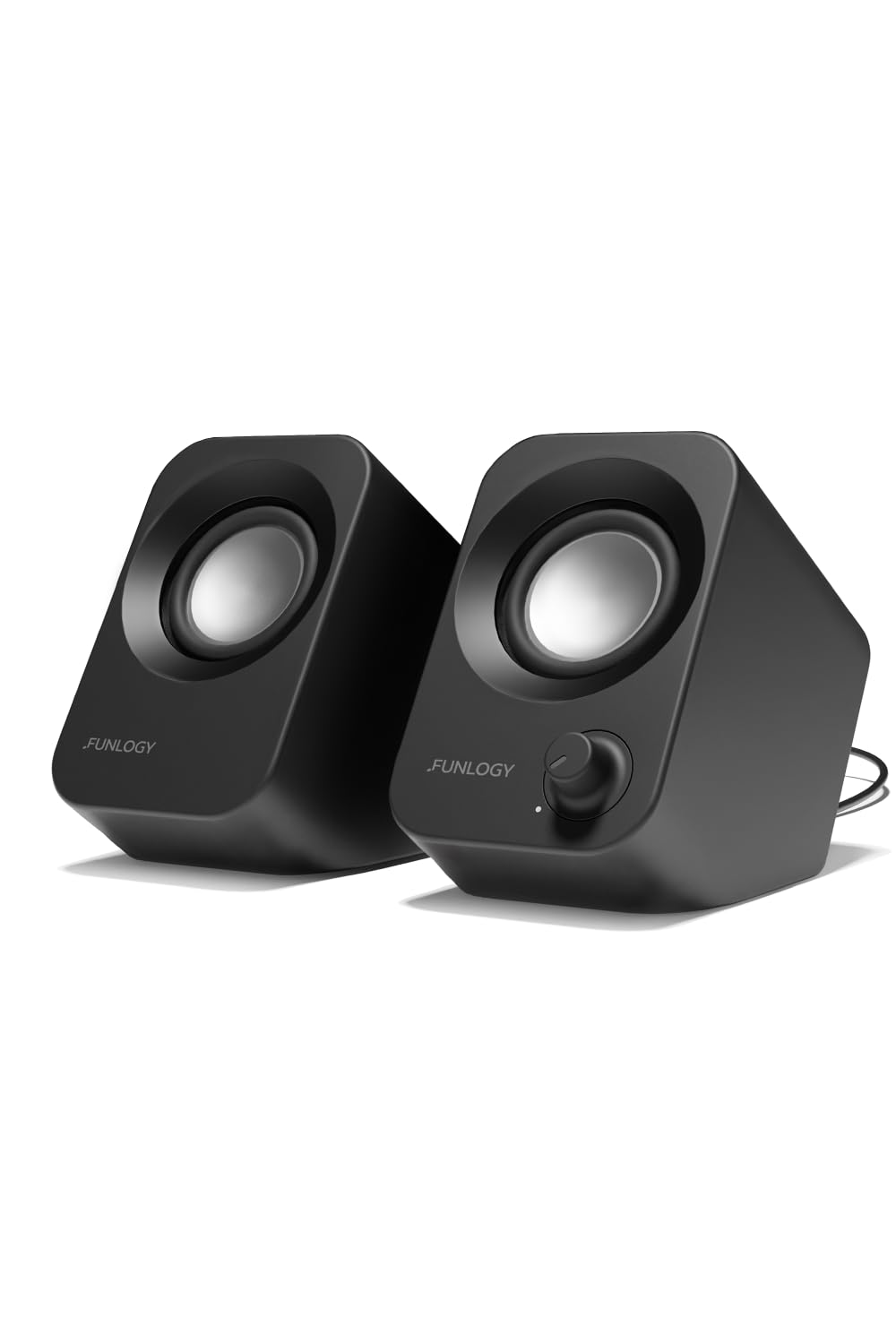
The 14W compact that turns a fist-sized package into a bass machine.
Where the Creative Pebble excels at clarity, the FUNLOGY Speaker comes in with the numbers to back up its punch. It outputs a total of 14 watts — by far the highest figure in this list — from dual 48mm full-range drivers (each covers bass, mids, and treble in one unit) and passive radiators. The 30-degree upward tilt angles the sound exactly toward your ears, a simple design trick that works: owners mention it is “loud enough for gaming” and “has real bass even at low volume.” One buyer who upgraded from Amazon Basics 2W speakers called it a “fantastic upgrade,” pointing to that 14W of headroom as the standout.
This set is physically smaller than the Creative Pebble, per one review (“slightly smaller than Creative Pebbles”), yet it delivers noticeably more power. The build quality gets a nod: it is a VGP 2024 award winner in Japan, and the gold-plated AUX input (the 3.5mm jack that carries audio signal) minimizes noise. The cables are USB and 3.5mm — nothing else, no drivers or pairing needed. One minor gripe from buyers: the cable length could be a touch longer for some setups.
If you sit at a desk and want the loudest, bassiest sound from a truly palm-sized speaker without plugging into the wall, the FUNLOGY is your pick. It beats the Creative Pebble on raw output and low-end presence, though the Pebble still leads on treble detail and transparency. This one is a no-brainer for gamers who need that extra punch during action scenes.
14W stereo output: 14W from a USB-powered unit smaller than a soda can — the highest output in the entire guide.
plastic build feel: Cables are shorter than some buyers want; the top-end clarity is slightly less refined than the Creative Pebble’s.
budget gaming audio: you need the loudest possible sound from the smallest possible package and you want real bass without a subwoofer. Great for gaming or any desk where volume matters.
premium soundstage: treble detail is your top priority, or you need longer connection cables for a wider desktop setup.
3. Amazon Basics Stereo 2.0 Speakers

The no-frills, no-learning-curve fix for a computer without speakers.
Sometimes you just need sound — clear, loud enough for a classroom or apartment, and not fussy. The Amazon Basics 2.0 set delivers exactly that. It runs off USB power, connects via 3.5mm AUX, and has an inline volume control on the cable so you can reach it under the desk without looking. Buyers describe the sound as “solid” and note that the bottom radiator (the unpowered cone that adds bass) produces a “springy bass sound” that adds low-end presence you would not expect from such a basic set. One reviewer called it a “simple, affordable fix for a computer without speakers.”
There is a catch that defines this speaker: it sounds great on a PC or laptop via USB/aux, but customers note it performs poorly on a PS5 with “low ceiling, almost no bass.” That is not unusual for USB-powered speakers on game consoles, but it is worth knowing if you want a single set for both. The Amazon Basics also lags behind the FUNLOGY on total wattage — the FUNLOGY’s 14W will get louder before distorting. However, it beats the ROSON on build and the Sanyun on simplicity.
Bottom line: this is the cheapest reliable way to get decent stereo sound with a bit of bass. The blue LED lights add a visual touch, and the scratch-free padded base keeps your desk safe. It is not the most detailed or powerful set, but it is the most straightforward. You would pick this over the Creative Pebble only if budget is the deciding factor.
reliable basic sound: Inline volume knob on the cable means you never have to reach behind a monitor to adjust levels.
no auxiliary input: Bass and overall performance drop significantly when used with a game console (PS5) compared to a PC.
office background music: you need a dead-simple, cheap speaker for a laptop or PC in an office, dorm, or classroom, and you want a volume control within arm’s reach.
critical music production: you plan to use it primarily with a game console, or you want a more powerful, bass-forward sound like the FUNLOGY.
4. ROSON Computer Speaker (A-293)

A slim, utilitarian set that puts the volume knob and headphone port front and center.
If you prefer your controls on the speaker itself — not inline on a cable — the ROSON A-293 is a rare find. The right speaker has a volume knob and a headphone jack on the front, so you can plug in your headphones directly without reaching behind your computer. The left and right speakers connect by a 31.49-inch (80 cm) cable, and the USB and AUX cables each run 39.37 inches (100 cm), giving you enough slack for a standard desktop. The speaker is rated at 3W x 2, which is lower than the FUNLOGY’s 14W, but the brand says its advanced full-range 2.0 channel stereo core delivers clear, rounded sound with no static or hum.
This unit is designed for plug-and-play with any device that has a 3.5mm jack — desktop, laptop, phone, tablet, or gaming desktop. It can also run off a standard 5V charger if your PC’s USB port is occupied. The dimensions are 6.96 x 3.34 x 3.14 inches, making it one of the taller compact speakers here, but the front-facing controls are a genuine convenience that the Amazon Basics and FUNLOGY lack. Compared to the Sanyun SW102, which focuses on bass from a smaller cabinet, the ROSON leans into clarity and ease of use. But at 3W per channel, it will not get as loud as the FUNLOGY or the Pebble (when powered by an adapter).
The headphone jack and front-panel access are what make this worth considering over the louder alternatives. You would choose this specifically to avoid cable-snake volume controls.
compact space saver: The front-facing headphone jack and volume knob let you switch from speaker to private listening without hunting for the auxiliary port on your PC.
tinny at high volume: At 3W x 2, it is the lowest power output in the guide — fine for desk-level listening, but not for filling a room.
tight desk corners: you want a clean, fuss-free setup with easy-to-reach controls and a dedicated headphone jack right on the speaker.
room filling sound: you need high volume or deep bass — the FUNLOGY or Sanyun would serve you better for those criteria.
5. Sanyun SW102 Computer Speakers

The oval-shaped speaker that packs a surprising bass punch from a 2.95-inch cube.
Do not judge the Sanyun SW102 by its tiny frame (3.94 x 2.76 x 2.95 inches). This speaker uses a built-in passive bass radiator with a closed-cavity, low-frequency aid design to produce what the brand calls “outstanding bass quality, compared to other small speakers.” The official rating is 5W x 2, which is modest on paper, but the dedicated acoustic resonator structure makes the sound feel bigger than the numbers suggest. The blue oval lamp ring around the drivers gives it a distinctive look, and the metal-and-plastic body resists vibration even at higher volumes.
The Sanyun is USB-powered and uses a 3.5mm AUX connection. It also includes independent wire control (a small volume dial on the cable). Unlike the ROSON, it does not have a headphone jack, and unlike the Amazon Basics, it does not have blue LEDs on the bottom — just the ring around the drivers. Reviewers who left feedback noted the bass quality specifically, calling it “outstanding” for a speaker this small. One buyer did note that “restricted to the small volume, bass effect still can’t compare with big speakers and professional subwoofer,” which is an honest admission built into the product description itself.
The SW102 recommends a specific placement for best stereo effect: separate the two speakers by about 1 meter, and sit about 1 meter away so you form an equilateral triangle. This is the same near-field principle the Creative Pebble uses, but Sanyun explicitly guides you to it. If you have the desk space for that triangle, this set can sound remarkably rich for its size. You would grab this over the FUNLOGY if bass-to-size ratio is your top priority.
clear midrange tones: The enclosed low-frequency design produces the deepest bass-to-size ratio in the guide — buyers specifically call the bass quality “outstanding.”
weak low frequencies: The overall output of 5W per channel means it will not get as loud as the FUNLOGY or the Pebble on an adapter; it is strictly a near-field desk companion.
podcast and talk radio: you want the most bass possible from the smallest possible cabinet and you are willing to set up your speakers in the recommended equilateral triangle position.
bass heavy genres: you need a headphone jack on the speaker, or you want higher maximum volume for gaming or movies.
6. Divoom MiniToo Retro PC-Style Speaker
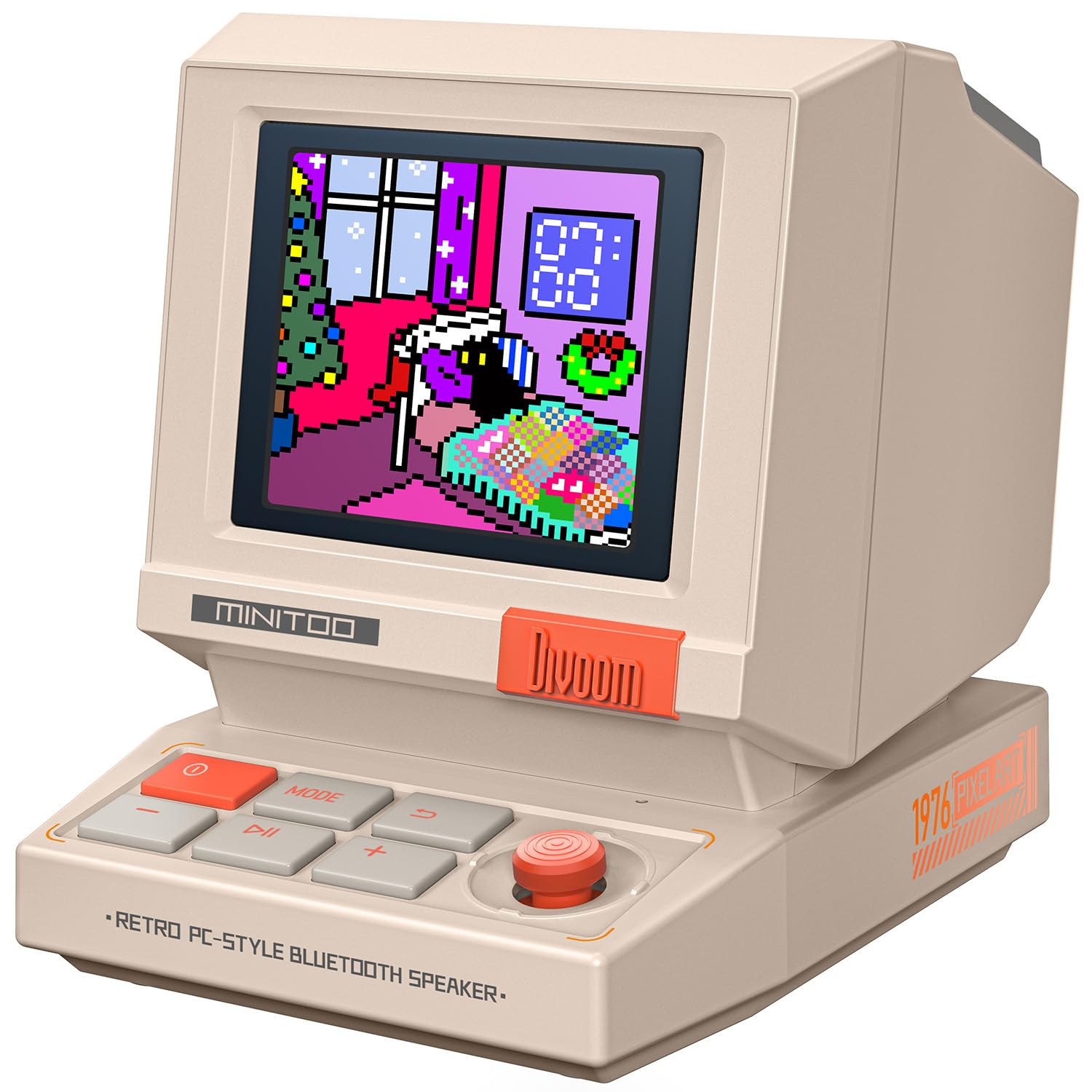
A tiny retro PC that is also a speaker, alarm clock, white noise machine, and desk toy.
The Divoom MiniToo is an outlier in this guide — not because it sounds bad, but because it is a completely different category of device that just happens to produce good near-field audio. The 90s-inspired mini PC design sits on your desk and does triple duty: a 1.77-inch pixel screen that you customize with 70+ retro clock faces and animations, a Bluetooth 5.3 speaker for music and podcasts, and a built-in alarm clock with white noise and Pomodoro timers. Reviewers point out it is “surprisingly good sound for size” and “loud, compact speaker with clock display.” The audio output is 5W near-field, which is enough for clear vocals and warm bass at a desk. It supports Bluetooth, USB audio, and TF card (a small memory card format) playback — no Wi-Fi needed.
The MiniToo is heavier than anything else here at 201.8 grams, and it is a mono unit (single channel), not stereo 2.0 like the other picks. That means you do not get a left-right soundstage, but for podcasts, study music, or ambient noise, that is rarely a problem. The real draw here is the ecosystem: the Divoom app gives you hundreds of features (games, decibel meter, live music visualizer, RSS and cloud streaming, scoreboard counter). One reviewer noted it “connects to one device at a time,” which is standard for Bluetooth but note if you switch between phone and laptop frequently.
But if your goal is pure stereo sound at the lowest price, any of the USB-powered 2.0 sets above give you better imaging and more power for less money. The MiniToo is for someone who wants a desk centerpiece first and a speaker second.
retro aesthetic charm: The app open up hundreds of features — pixel art, AI-generated text, live audio visualizations, and even games — making this a daily use item, not just a speaker.
small driver size: It is a mono, single-driver speaker, so you lose the stereo separation that every other product in this guide provides.
nostalgic desktop decor: you want a desk gadget that doubles as a speaker, alarm clock, and customizable pixel display — perfect for gamers, creators, or anyone who wants a conversation starter on their desk.
home theater audio: your priority is stereo sound, raw volume, or the lowest price. A standard 2.0 set like the Creative Pebble or FUNLOGY will serve you better for pure audio.
Understanding the Specs
Passive Radiator
A passive radiator is an unpowered cone inside the speaker cabinet that vibrates in response to the air pressure created by the main active driver. This vibration reinforces low frequencies, giving you deeper bass without needing a larger driver or a subwoofer. Look for it in small speakers if you want bass from a compact body — both the Creative Pebble and the Sanyun SW102 use this trick.
Near-Field Listening
Near-field means you sit about two to three feet from the speakers — typical desk distance. Small speakers are tuned for this range. If you move them across a room, the bass drops and the stereo effect fades. Most picks in this guide are tune for near-field performance, and the Sanyun SW102 explicitly recommends an equilateral triangle setup between you and the two speakers for the best stereo sound.
FAQ
Can I use USB-powered computer speakers with a game console like PlayStation or Xbox?
Do I need a separate power adapter or can I plug them into my computer’s USB port?
What is the difference between 2.0 and 2.1 channel speakers for a small desk?
Why do my small speakers sound tinny or distorted at higher volume?
Can I connect these speakers to a smartphone or tablet?
What does “USB-C powered” mean and is it better than standard USB-A?
What is the maximum safe listening distance for these small computer speakers?
Do these speakers work without a 3.5mm audio cable if my PC only has USB-C and Bluetooth?
How do I reduce static or hiss from my USB-powered speaker?
What is the difference between a full-range driver and a dynamic driver?
Final Thoughts: The Verdict
For the majority of shoppers, the computer speakers small winner is the Creative Pebble 2.0 because it sets the standard for clarity, value, and compact design that actually sounds good. If you want the loudest, bassiest sound from a palm-sized box, grab the FUNLOGY Speaker. And for a unique multifunction desk gadget that also plays music, the Divoom MiniToo is a creative conversation starter.
How We Picked
We do not accept paid placement. Every pick is matched to a real buyer and a real use-case; we do not hands-on test units.
Sources & Methodology
Specifications: manufacturer listings and product documentation. Review insights: verified customer reviews, as of July 2026. Pricing: not shown on this page (it changes often); check the current price via the retailer link.
As an Amazon Associate, WellFizz earns from qualifying purchases. This does not affect which products we feature.
Related Guides

Mo Maruf
I created WellFizz to bridge the gap between vague wellness advice and actionable solutions. My mission is simple: to decode the research and give you practical tools you can actually use.
Beyond the data, I am a passionate traveler. I believe that stepping away from the screen to explore new environments is essential for mental clarity and physical vitality.