Our readers keep the lights on and my smoothie glass nicely filled. As an Amazon Associate, I earn from qualifying purchases.
The thin, hollow audio from your monitor or laptop is robbing you of the depth and detail in every song, movie, and game. A dedicated set of desktop speakers transforms your workspace into a soundstage, revealing bass lines, vocal nuances, and spatial cues that built-in drivers simply cannot reproduce.
I’m Mohammad Maruf — the founder and writer behind WellFizz. I’ve spent hundreds of hours analyzing market data, customer feedback, and the technical specifications that separate mediocre computer speakers from truly great ones, from driver materials to amplifier topologies.
This guide covers seven carefully vetted models spanning entry-level to premium builds, helping you navigate the options to find the perfect audio upgrade. You are reading the definitive best computer speaker guide for desktop users who demand clarity and value.
How To Choose The Best Computer Speaker
Choosing the right desktop speakers means matching a few critical specs to your specific desk size, listening habits, and connectivity needs. Ignoring driver composition or amplifier power often leads to disappointing audio that lacks detail or distorts at moderate volume. Focus on these four factors to make a confident decision.
Driver Configuration and Material Quality
The driver is the heart of any speaker. A two-way design using a dedicated tweeter (often silk dome for smooth highs) and a mid-bass woofer (carbon fiber or treated paper for controlled punch) dramatically outperforms single full-range drivers. Carbon fiber offers high stiffness with low mass, reducing breakup distortion at higher volumes. For near-field desktop use, a 3-inch to 4-inch woofer paired with a 0.75-inch to 1-inch tweeter provides an optimal balance of footprint and frequency response.
Connectivity and DAC Integration
Your source quality matters. A built-in USB-C DAC (Digital-to-Analog Converter) bypasses your computer’s often noisy internal audio circuitry, delivering cleaner signal conversion with support for 24-bit playback. Optical input is ideal for consoles and TVs, while Bluetooth 5.3 offers low-latency wireless convenience. Prioritize models with at least one lossless wired connection for critical listening, treating wireless as a supplementary bonus.
Amplifier Power and Headroom
RMS power rating tells you how cleanly a speaker can play at its intended listening level. For a desktop environment, 40 to 80 watts total RMS is the sweet spot — enough headroom for dynamic peaks without strain. Avoid peak power marketing numbers; they misrepresent real-world continuous output. A well-designed amplifier with a signal-to-noise ratio above 85 dB will keep the noise floor quiet, revealing finer details in your audio.
Enclosure Construction and Tuning Options
Cabinet resonance colors sound. Medium-density fiberboard (MDF) enclosures are acoustically inert, reducing unwanted vibrations and allowing the drivers to produce tighter bass compared to plastic shells. Side-accessible bass and treble knobs let you compensate for room acoustics or personal preference without software. A rear-mounted bass reflex port extends low-frequency output, but leave a few inches of clearance behind the speaker for proper airflow.
Quick Comparison
On smaller screens, swipe sideways to see the full table.
| Model | Category | Best For | Key Spec | Amazon |
|---|---|---|---|---|
| Klipsch ProMedia Lumina 2.1 | Premium 2.1 | High-end immersive gaming | Low-profile subwoofer with adjustable gain | Amazon |
| Edifier R1280T | Premium 2.0 | Music listening and turntables | 42W RMS with 4-inch woofer | Amazon |
| Creative Labs T60 | Mid-Range 2.0 | Office desk and clear dialogue | Compact 2.0 with voice mode | Amazon |
| Ortizan C7 Studio Monitors | Studio Monitor | Music production and content creation | TRS balanced input and 24-bit DAC | Amazon |
| Bluedee 2.1 Speakers | Value 2.1 | Immersive movie and gaming bass | Dedicated subwoofer with DSP tuning | Amazon |
| IBALL·BOX H1 | Mid-Range 2.0 | Work-from-home clarity | Optical and USB-C with 24-bit DAC | Amazon |
| OHAYO 60W Speakers | Entry-Level 2.0 | Budget-friendly desktop upgrade | MDF wooden enclosure with Bluetooth 5.3 | Amazon |
In‑Depth Reviews
1. Klipsch ProMedia Lumina 2.1
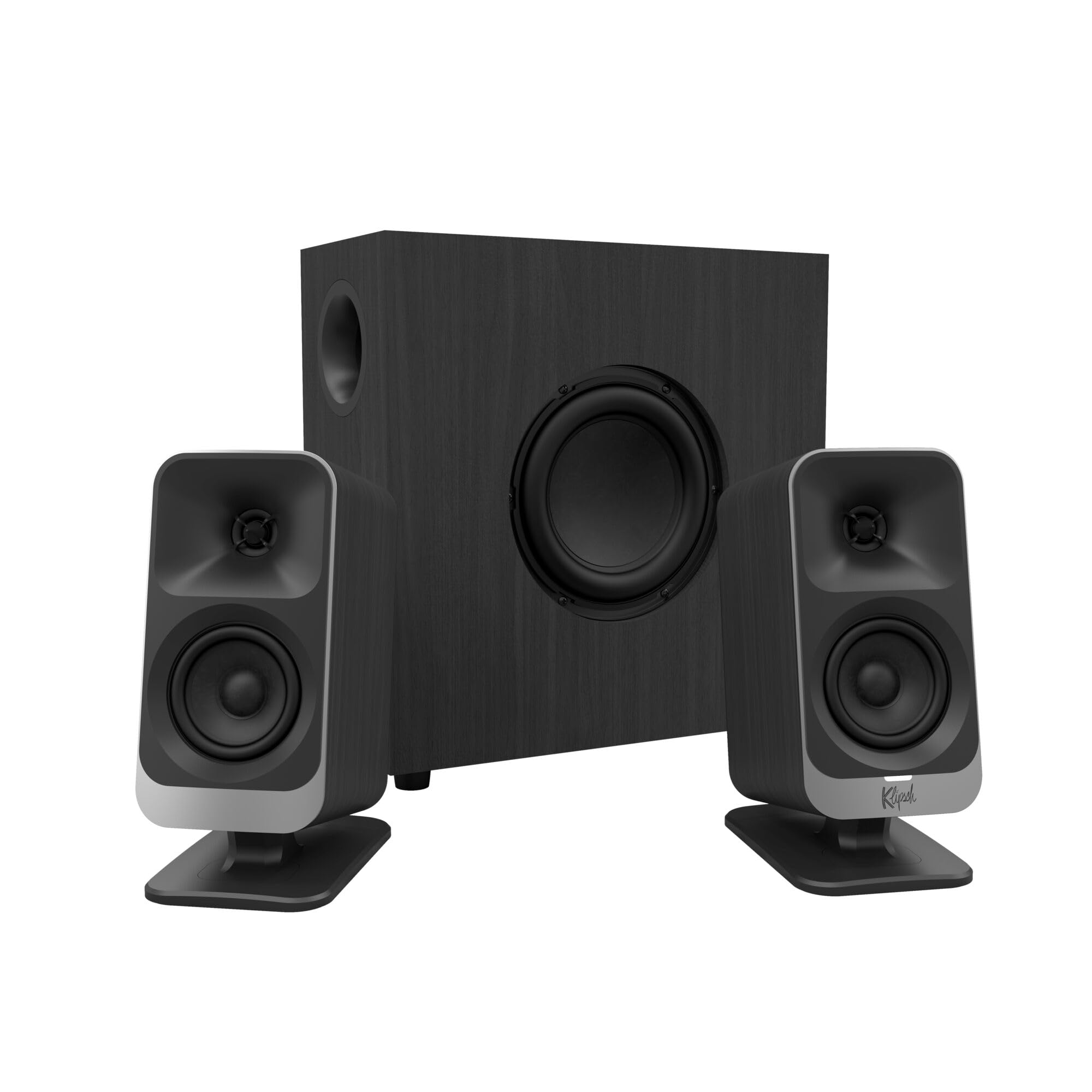
The Klipsch ProMedia Lumina 2.1 revives a legendary lineage with a completely redesigned cabinet and tiltable satellite stands that integrate cleanly into any workstation. Its low-profile subwoofer houses serious low-end punch, controlled via an adjustable gain knob and cable management channel that minimizes floor clutter.
Listening reveals crisp, articulate highs through the silk dome tweeters and a subwoofer that delivers deep, clean bass without overpowering the satellites. The USB-C input offers the highest fidelity path, while Bluetooth 5.3 and AUX provide flexibility for non-PC sources. The Klipsch Control desktop app adds precision EQ, night mode, and customizable RGB lighting that can be matched to other peripherals.
Construction feels substantial with thick wiring and screw-in connectors that resist accidental disconnection. The heavy build and advanced feature set justify its status as the premier choice for users who refuse to compromise on audio immersion at their desk.
Why it’s great
- Low-profile subwoofer delivers impactful, clean bass without dominating floor space
- USB-C input provides the cleanest audio path for PC gaming and music
- Klipsch Control app enables precise EQ tuning and RGB customization
Good to know
- PC software can present minor startup glitches that may require reinstallation
- Subwoofer gain adjustment is located on the sub itself, not on the satellite speaker
2. Edifier R1280T
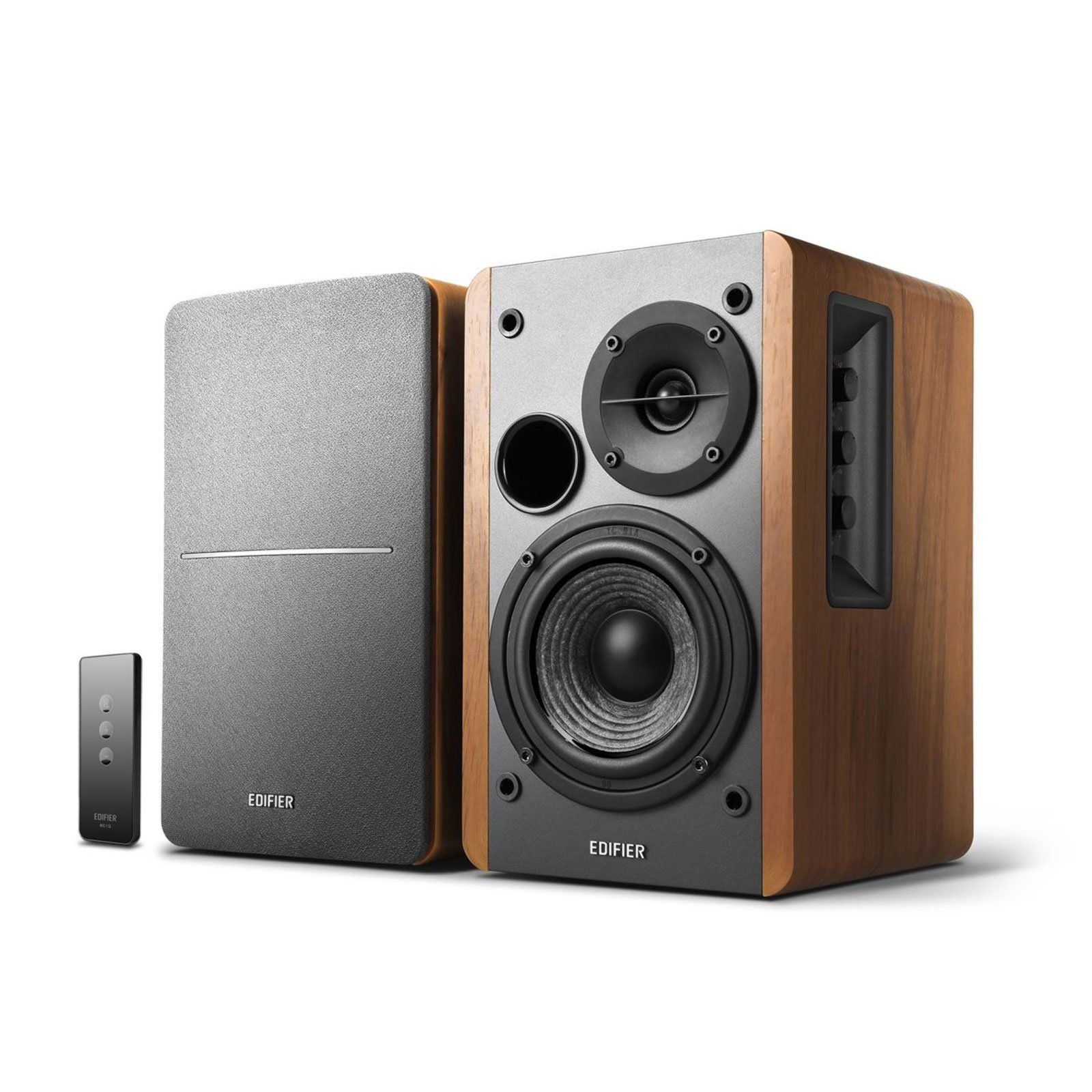
The Edifier R1280T has earned a reputation as the gold standard for budget-conscious desktop audiophiles, and for good reason. Its high-density MDF wooden enclosure with a classic wood-effect vinyl finish reduces cabinet resonance, allowing the 4-inch woofer and 13mm silk dome tweeter to produce a balanced, non-fatiguing sound signature that works for hours of music listening.
Dual RCA inputs let you connect both your computer and a turntable or other line-level source simultaneously, switching without cable gymnastics. Side-panel bass and treble knobs give you room to tailor the frequency response to your taste or compensate for room acoustics. The included remote control adds convenience for volume adjustments from your listening position.
With 42 watts RMS total output, the R1280T fills a medium room effortlessly while maintaining composure at high volumes. The absence of Bluetooth or subwoofer output may deter some users, but for pure analog signal path quality, this remains a benchmark at its tier.
Why it’s great
- Wooden MDF enclosure reduces unwanted resonance for cleaner sound
- Dual RCA inputs allow simultaneous connection to two source devices
- Side-panel bass and treble control offers easy room acoustic tuning
Good to know
- No Bluetooth or subwoofer output, strictly analog wired connectivity
- Mids and highs can sound slightly muddy compared to pricier studio monitors
3. Ortizan C7 Studio Monitors
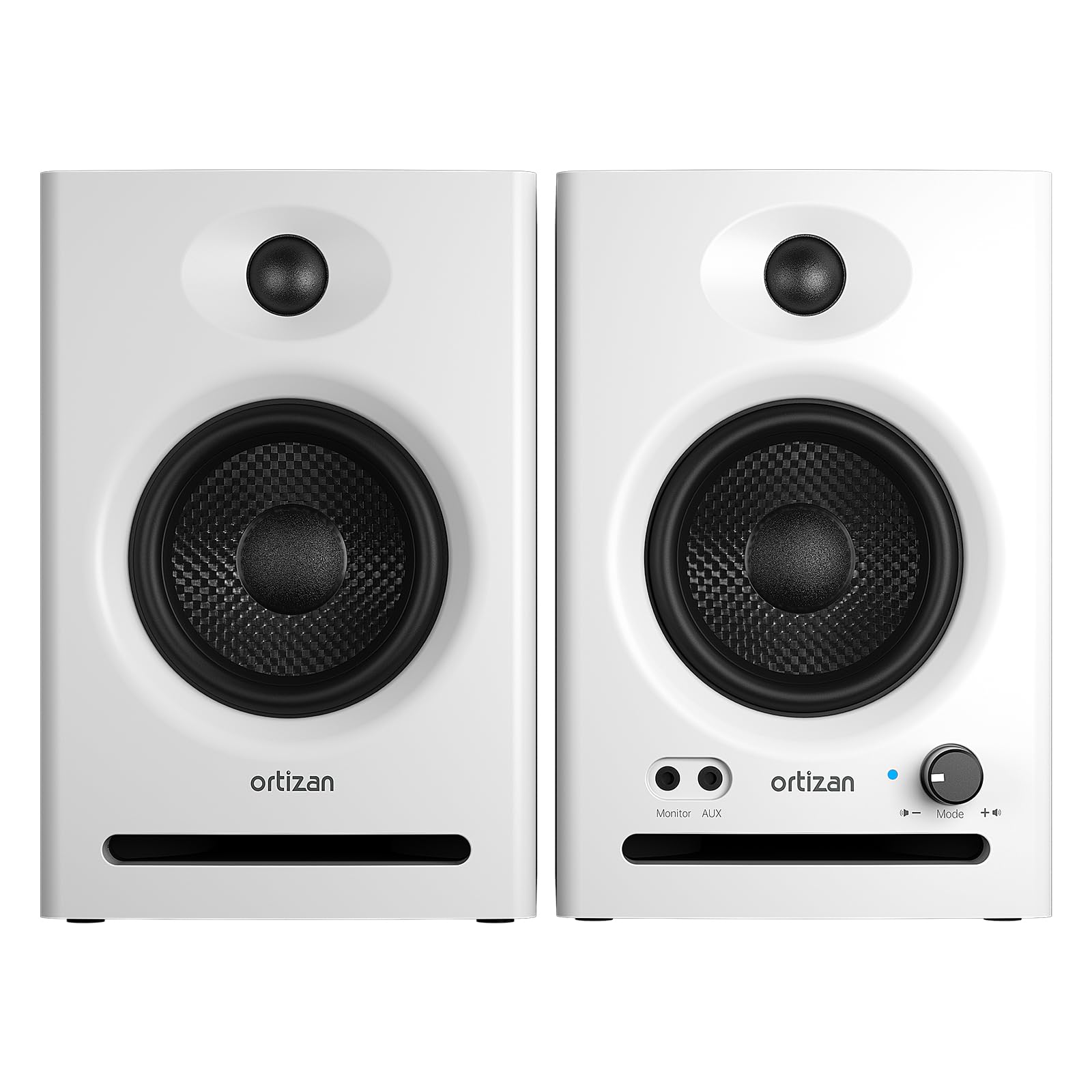
Designed for near-field music production, the Ortizan C7 monitors aim for a flat frequency response that reveals mix flaws and recording details rather than flattering them. The 3.5-inch carbon fiber woofer and 0.75-inch silk dome tweeter are tuned through dozens of laboratory adjustments to achieve a neutral curve with minimal coloration.
The inclusion of a 6.35mm TRS balanced input sets these apart from typical consumer desktop speakers, enabling direct connection to audio interfaces, mixing consoles, and instruments like electric pianos. A built-in 24-bit USB-C DAC captures digital audio directly, bypassing the computer’s analog output stage for lower noise. A front-panel headphone output and monitor/music mode switch add to their utility in small studio setups.
Bass extension reaches down to approximately 45 Hz in near-field listening, which is impressive for the driver size, though a subwoofer is still recommended for full-range monitoring. The volume knob’s stepped action can feel imprecise, and an idle hiss is faintly audible in silent passages, but the overall accuracy and connectivity are exceptional at this level.
Why it’s great
- TRS balanced input enables professional connection to audio interfaces and mixers
- 24-bit USB-C DAC preserves signal integrity for accurate monitoring
- Near-flat frequency response ideal for content creation and critical listening
Good to know
- Volume knob has a stepped, imprecise feel that makes fine adjustments difficult
- Faint idle hiss present in silent studio environments
4. Creative Labs T60

Creative Labs has long understood desktop audio, and the T60 exemplifies their focus on practicality without sacrificing quality. This compact 2.0 system fits snugly beside a 32-inch monitor while delivering a surprisingly wide soundstage and clear audio across the frequency range, with a dedicated voice mode that boosts vocal clarity for podcasts, conference calls, and dialogue-heavy content.
Connectivity covers the essentials: USB for digital audio from your computer, Bluetooth for wireless streaming from a phone, and a headphone output on the front for private listening. The analog volume knob is responsive and satisfying to use, though the digital USB volume control requires a third-party app for fine adjustments. The virtual surround feature adds spatial cues without completely collapsing the soundstage.
The plastic enclosure lacks the acoustic inertness of MDF, but the compact form factor and excellent voicing make this a strong choice for smaller desks where every inch counts. Input switching remembers the last source, and the lack of auto-shutoff means your audio stays on until you turn it off.
Why it’s great
- Voice mode significantly improves dialogue clarity for calls and podcasts
- Compact footprint works seamlessly on small desks next to large monitors
- Input switching remembers the last source for hassle-free use
Good to know
- Bluetooth supports only the SBC codec, limiting wireless audio quality
- Headphone output is located on the back panel, awkward for frequent access
5. Bluedee 2.1 Speakers
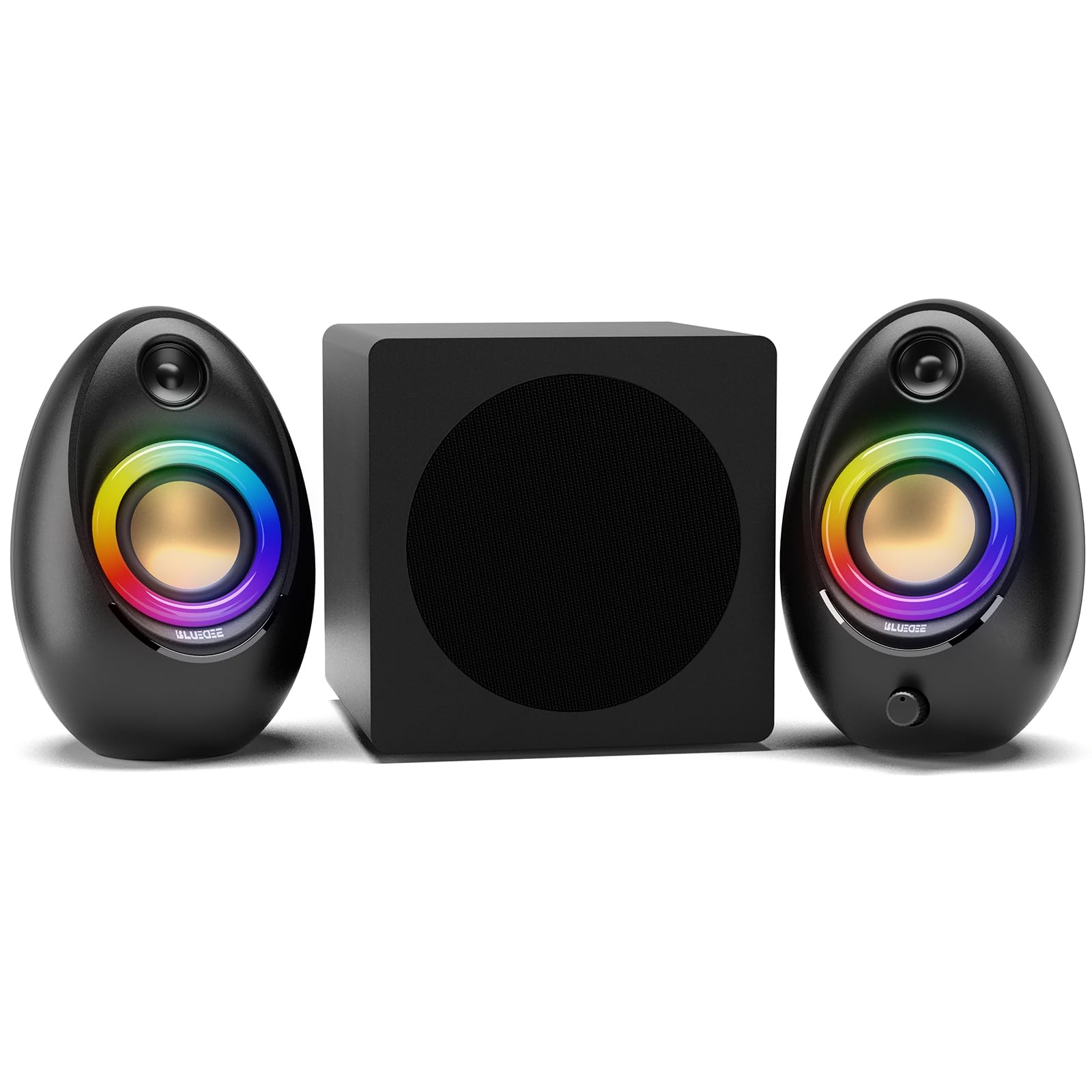
The Bluedee 2.1 system delivers an 80-watt peak experience that prioritizes deep, punchy bass without muddying the mids and highs. The independent subwoofer handles low frequencies while the compact satellite speakers focus on vocal clarity and detail, creating a clean separation that is ideal for action movies and bass-heavy music genres.
Bluetooth 5.4 provides a stable wireless connection with extended range, while USB-A, USB-C, and 3.5mm AUX inputs ensure broad device compatibility. The all-in-one control knob on the right satellite manages volume, playback, lighting modes, and input switching with intuitive rotation and clicks. DSP tuning reduces harshness in the upper frequencies, making long listening sessions less fatiguing.
Build quality is plastic but solid, and the RGB lighting adds a modern desk aesthetic without being overbearing. Setup takes roughly ten minutes out of the box. For the price, the combination of a dedicated subwoofer and versatile wired/wireless connectivity is rare and compelling.
Why it’s great
- Dedicated subwoofer delivers deep, punchy bass without muddying satellite output
- DSP tuning smooths harsh highs for comfortable extended listening
- All-in-one knob simplifies volume, playback, lighting, and source switching
Good to know
- Satellite enclosures are plastic rather than MDF, less acoustically inert
- Subwoofer is relatively compact, limiting extreme low-frequency extension
6. IBALL·BOX H1
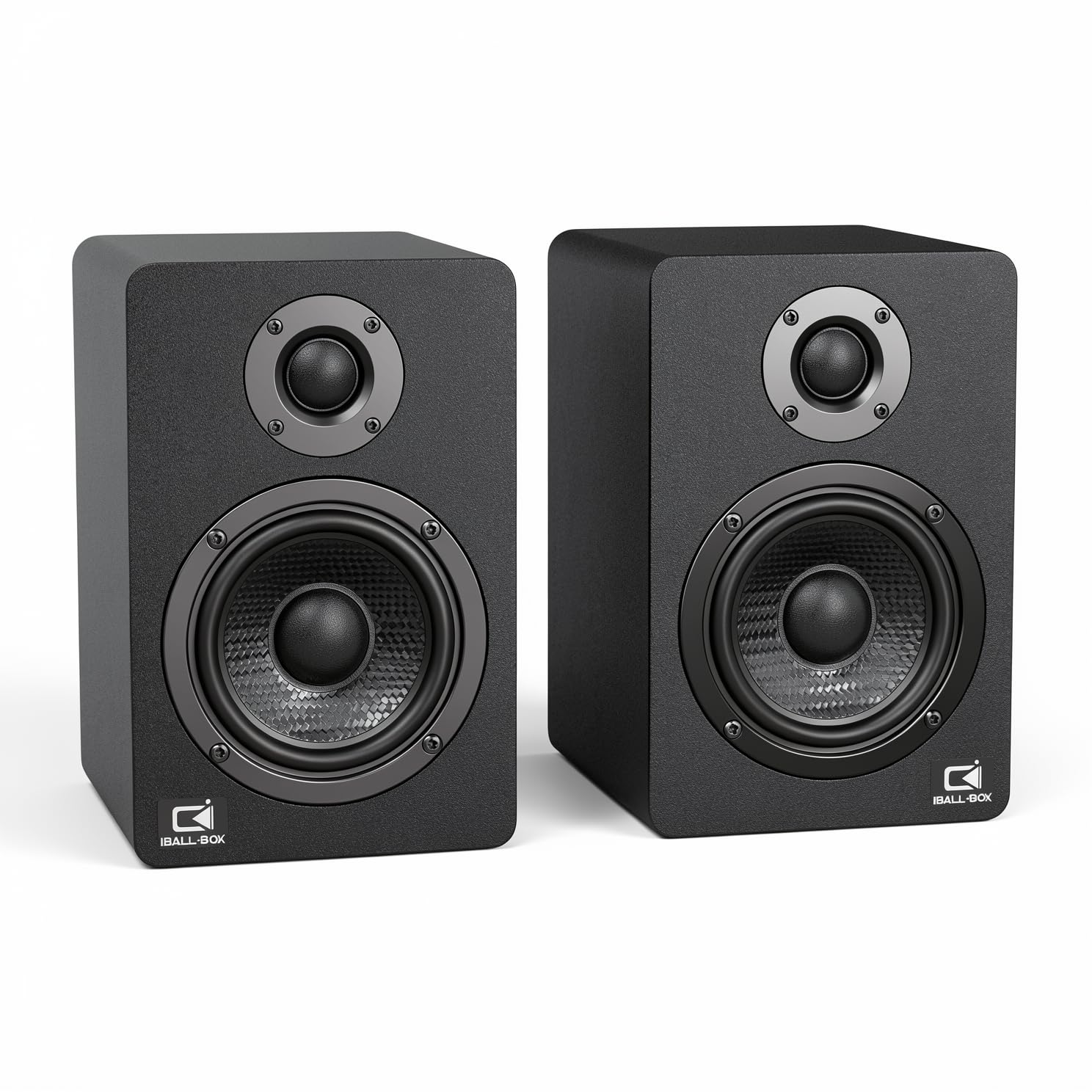
The IBALL·BOX H1 differentiates itself with an unusually broad input suite for its tier, including optical, USB-C, 3.5mm AUX, and Bluetooth. This makes it a natural upgrade for desks shared with a gaming console or TV that benefits from optical digital audio. The dual 3-inch carbon-fiber woofers and dual 1-inch silk-dome tweeters deliver a frequency response spanning 40 Hz to 20 kHz with a signal-to-noise ratio exceeding 95 dB.
Front-panel access to master volume, treble, and bass controls lets you tune the sound without reaching behind the speaker or opening software. Input selection is handled via a top knob with an LED color indicator and audio confirmation — a refined touch. The 24-bit USB-C DAC provides cleaner playback than standard analog connections, and the optical input works well with consoles, though the bevel on the optical cable connector may need careful alignment.
Reviewers consistently describe the sound as clean and impressively loud for the size, outperforming expectations and even besting more established models like the JBL 104 BT in sheer clarity and presence. A minor learning curve exists around remembering the input cycling order, but the overall package is well-engineered.
Why it’s great
- Optical and USB-C inputs enable high-fidelity digital connection to consoles and PCs
- Front bass/treble knobs allow easy acoustic tuning without software
- Clean sound with volume output that fills a room easily
Good to know
- Optical cable bevel requires careful alignment for proper insertion
- Input selection requires memorizing the top knob’s cycling order
7. OHAYO 60W Speakers

The OHAYO 60W speakers arrive as a surprising entry-level contender, chiefly due to their MDF wooden enclosure — a material choice typically reserved for more expensive models. This cabinet reduces box resonance, enabling the 0.75-inch carbon fiber silk dome tweeter and 3-inch carbon fiber driver to produce sound that is clear, stable, and free from the static that plagues plastic budget speakers.
Multiple input options including Bluetooth 5.3, RCA, AUX, and USB give the OHAYO broad compatibility with laptops, smartphones, turntables, and TVs. The front volume control knob doubles as a power switch and is easy to reach during gaming sessions. Independent treble and bass knobs on the back panel offer coarse EQ adjustments, though dialing them in requires some experimentation due to the rear placement.
The 30W per channel amplifier drives these small bookshelf speakers efficiently, drawing under 1 watt at full volume. The lack of a subwoofer means the lowest octaves are absent — 3-inch drivers simply cannot move enough air — but for everyday near-field listening, podcasts, and casual gaming, the clarity and build quality at this price point are commendable.
Why it’s great
- MDF wooden enclosure reduces resonance for clearer sound than typical plastic competitors
- Bluetooth 5.3, USB, RCA, and AUX inputs provide wide device compatibility
- Very energy efficient, drawing under 1 watt at full volume
Good to know
- 3-inch drivers lack low-bass extension; a subwoofer is needed for deep lows
- Bass and treble controls are located on the back, inconvenient for frequent adjustment
FAQ
Do I need a subwoofer for desktop computer speakers?
What is the advantage of a USB-C DAC in a computer speaker?
Can I use studio monitor speakers for casual desktop listening?
Final Thoughts: The Verdict
For most users, the best computer speaker winner is the IBALL·BOX H1 because it combines optical and USB-C digital inputs, front-panel EQ, and clean sound at a price that undercuts most premium options. If you want tactile bass and immersive gaming, grab the Klipsch ProMedia Lumina 2.1. And for music production accuracy with professional TRS connectivity, nothing beats the Ortizan C7 Studio Monitors.

Mo Maruf
I created WellFizz to bridge the gap between vague wellness advice and actionable solutions. My mission is simple: to decode the research and give you practical tools you can actually use.
Beyond the data, I am a passionate traveler. I believe that stepping away from the screen to explore new environments is essential for mental clarity and physical vitality.