Our readers keep the lights on and my smoothie glass nicely filled. As an Amazon Associate, I earn from qualifying purchases.
Every click and drag shouldn’t send a jolt of pain through your forearm. Yet for anyone grappling with lateral epicondylitis, the standard office mouse is a daily aggravator that forces your wrist into an unnatural twist and keeps the muscles around your elbow constantly tense. You need a device that changes your hand’s relationship with the desk, not just one with a softer click.
I’m Mohammad Maruf — the founder and writer behind WellFizz. I’ve spent thousands of hours dissecting ergonomic hardware specs and cross-referencing real biomechanical feedback to separate marketing claims from true therapeutic value.
Whether you’re recovering from a diagnosed strain or working to prevent one, choosing the right tool hinges on the grip angle, button actuation force, and how much forearm muscle recruitment the device demands. That’s why I’ve assembled this guide to the best computer mouse for tennis elbow.
How To Choose The Best Computer Mouse For Tennis Elbow
Standard mice force your forearm to pronate, turning the wrist flat against the desk. This rotation tenses the extensor carpi radialis brevis tendon, the exact spot where tennis elbow pain originates. A therapeutic mouse must let your hand sit in a natural handshake position—typically 55° to 80° of vertical tilt—to neutralize that torque.
Grip Angle and Posture
A fully vertical design (near 90°) keeps the radius and ulna parallel, which reduces the static load on the lateral epicondyle. Mice with adjustable tilt angles give you the freedom to rotate between tasks without forcing the same fixed posture. Avoid flat or low-angle profiles that still require forearm rotation.
Actuation Force and Button Feedback
Every click that requires a stiff press transfers shock up the forearm. Look for mice that advertise micro-force or silent switches with a low actuation weight. A loud, hard click may feel satisfying, but for an inflamed tendon, it’s a micro-insult repeated hundreds of times per hour.
Movement Reduction Through Trackball or High DPI
Every time you lift and reposition a standard mouse, your forearm muscles contract. A thumb-operated trackball allows cursor control without moving your arm, which directly reduces how often you activate the elbow extensor tendons. Alternatively, a high-DPI optical sensor lets you cover more screen area with smaller hand movements.
Quick Comparison
On smaller screens, swipe sideways to see the full table.
| Model | Category | Best For | Key Spec | Amazon |
|---|---|---|---|---|
| Evoluent VMDMW | Premium | Near-total forearm posture correction | Near-90° vertical tilt | Amazon |
| Logitech MX Vertical | Premium | Seamless multi-device workflow | 57° fixed angle, 4000 DPI | Amazon |
| Razer Pro Click V2 | Premium | Gamers needing low latency | 1000Hz polling, 30K sensor | Amazon |
| Logitech Lift (Renewed) | Mid-Range | Small to medium hands | 57° vertical, whisper-quiet clicks | Amazon |
| SABLUTE MAM1 Pro | Mid-Range | Adjustable angle flexibility | 0°/18° adjustable tilt | Amazon |
| Nulea M514 | Budget | Budget-friendly trackball entry | 65° angle, thumb trackball | Amazon |
| Ergodriven Om | Budget | Compact office with OLED feedback | OLED screen, silent micro-force clicks | Amazon |
In‑Depth Reviews
1. Evoluent VMDMW Ergonomic Vertical Mouse

Evoluent invented the vertical mouse concept back in 2002, and the VMDMW is a direct descendant of that original design philosophy. Its tilt approaches a full 90°, which forces your entire forearm into a neutral, non-rotated position more aggressively than any other model on this list. The three finger-button layout allows your index, middle, and ring fingers to sit naturally instead of clawing over one another, and the dedicated pinky rest prevents your last finger from dragging against the desk surface.
Under the hood you get a precision optical sensor with four selectable pointer speeds accessed via top-mounted buttons. The included Evoluent Mouse Manager software for Windows unlocks nearly unlimited customization of the six programmable buttons—you can assign keystrokes, launch apps, or control screen brightness. It ships with a single AA alkaline battery that lasts roughly three months under normal use. The wireless receiver stows in a standard USB-A port, though the mouse lacks onboard dongle storage.
Customer feedback highlights the dramatic relief users with tenosynovitis and lateral epicondylitis experience within days of switching. The trade-off is a glossy plastic finish that some find slippery after extended use, and the price sits at the premium end of the spectrum. Durability reports show micro-switch failures after roughly eighteen months in high-use scenarios, but the comfort improvement during that period is unmatched for severe elbow conditions.
Why it’s great
- Aggressive near-vertical tilt fully unloads the common extensor tendon
- Pinky finger support eliminates desk drag friction
- Extensive button mapping via Windows software
Good to know
- Glossy surface can feel slippery with dry hands
- No onboard storage for the wireless receiver
- Switch durability concerns reported after heavy daily use
2. Logitech MX Vertical Wireless Mouse

The MX Vertical is the most well-known ergonomic mouse on the market, and for good reason. Its 57° fixed handshake angle reduces measured forearm muscle activity by ten percent compared to a standard flat mouse, according to Logitech’s own testing with ergonomists. More importantly, the 4000 DPI high-precision sensor allows you to cover the same screen real estate with four times less physical hand movement, which directly lowers the number of times you contract the extensor muscles linked to tennis elbow.
The textured rubber surface provides a reliable grip even during all-day sessions, and the contoured thumb rest encourages a relaxed palm position. Connectivity is versatile: Bluetooth Low Energy, Logi Bolt USB, or USB-C wired charging. A full charge lasts about four months, and the quick-charge feature gives you several hours of use from a one-minute top-up. The MX Vertical also supports Logitech Flow, letting you move your cursor across three different computers seamlessly.
User reviews consistently note a short adjustment period of two to three days, after which wrist and forearm discomfort drops noticeably. The main complaints involve the lack of a tilt adjustment—it’s fixed at 57°—and the fact that the horizontal scrolling solution relies on a side button rather than a dedicated wheel. For someone with tennis elbow who works across multiple monitors and needs a polished, proven design, the MX Vertical is a top contender.
Why it’s great
- Proven 10% reduction in muscle activity vs. standard mice
- High 4000 DPI minimizes arm movement across screens
- Long battery life with fast USB-C charging
Good to know
- Fixed 57° angle is not adjustable
- Horizontal scrolling through side button is imprecise
- Large profile can tip over on cluttered desks
3. Razer Pro Click V2 Vertical Wireless Mouse

Razer is synonymous with gaming peripherals, but the Pro Click V2 is their serious entry into the ergonomic vertical mouse space. Its sculpted 6-button design places your hand in a handshake grip, and the base support elevates the wrist to minimize friction during movement. The Focus Pro 30K Optical Sensor delivers 99.8 percent resolution accuracy and tracks reliably on glass, while the 1000Hz polling rate ensures zero perceptible latency—important if you need to switch between office tasks and gaming without swapping mice.
Battery life is excellent: up to six months on a single charge under standard use, and a five-minute fast charge gives you three working days of power. Multi-device connectivity supports up to five devices via 2.4GHz HyperSpeed, Bluetooth (three hosts), or wired USB-C. The 18-zone Chroma underglow is optional and can be disabled entirely if you prefer a professional look. Razer Synapse 4 software unlocks deep customization of the six buttons, including Hypershift for dual-layer commands and one-click AI prompt macros.
Early adopter feedback praises the solid build and smooth glide, though some users note the vertical angle could be slightly steeper for optimal forearm alignment. The right-handed shape includes a pinky ledge, and the magnetic dongle tray under the body is a thoughtful touch. The primary downside reported is accidental thumb-button presses during normal use, and the weight (heavier than typical office mice) makes lifting and repositioning slightly more effortful.
Why it’s great
- Gaming-grade 1000Hz polling for responsive cursor control
- Multi-device switching across five hosts
- Six-month battery with quick-charge capability
Good to know
- Heavier than most ergonomic mice, harder to lift
- Thumb buttons are prone to accidental actuation
- Synapse software required for full customization
4. Logitech Lift Vertical Ergonomic Mouse (Renewed)

The Logitech Lift is essentially a smaller, more affordable sibling to the MX Vertical with the same 57° vertical angle. It’s specifically designed for small to medium hands, which is critical because a mouse that’s too large forces the fingers to stretch, creating tension that travels up the forearm. The softly textured rubber grip and contoured thumb rest keep your hand locked in a relaxed posture without the need to pinch or claw.
One of the Lift’s standout features for tennis elbow sufferers is the whisper-quiet button mechanism. Every click produces a muffled, low-force activation that minimizes the percussive shock transferred to the lateral epicondyle. The SmartWheel offers both free-spin and ratchet modes for precise scrolling. Connectivity options include Bluetooth Low Energy or the Logi Bolt USB receiver, and the single AA battery delivers up to two years of runtime in typical office use.
Renewed units offer significant savings while retaining the same ergonomic profile and performance as new models. User reports highlight immediate relief from wrist and forearm discomfort, though some note that the compact size may cause cramping for larger hands. The four-button layout is serviceable but limited compared to the MX Vertical’s customization options. For someone with smaller hands or a modest budget, the Lift delivers genuine therapeutic benefit.
Why it’s great
- Smaller profile fits small to medium hands without finger strain
- Near-silent button actuation reduces cumulative tendon impact
- Exceptional two-year battery life from a single AA cell
Good to know
- Too small for users with large hands
- Limited to four buttons with no extra customization
- Renewed condition means potential cosmetic blemishes
5. SABLUTE MAM1 Pro Ergonomic Wireless Trackball Mouse
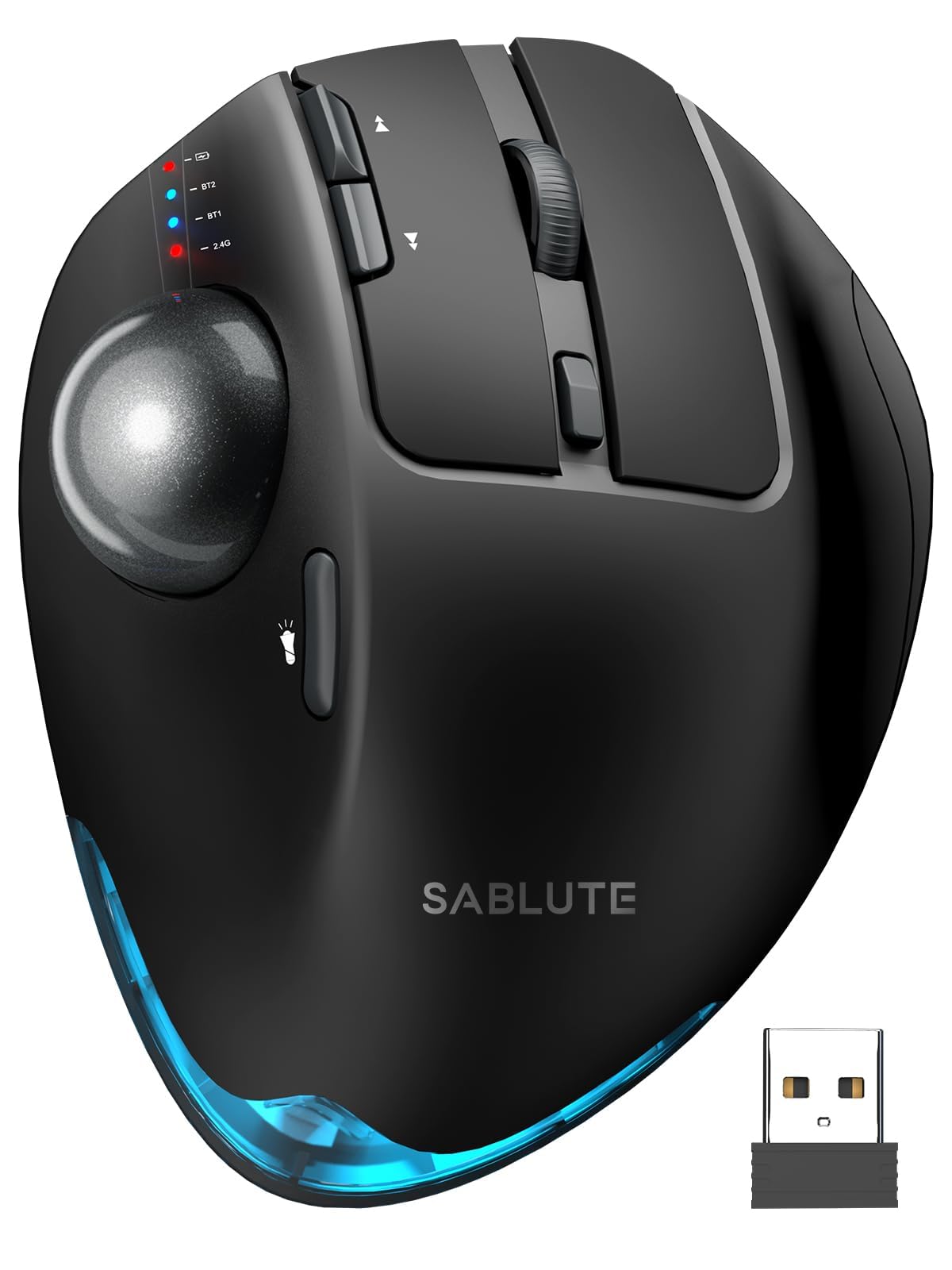
The SABLUTE MAM1 Pro takes a unique approach by offering an adjustable tilt angle—you can switch between a flat 0° orientation and an 18° raised position. This flexibility lets you vary your wrist angle throughout the day, preventing the static fatigue that can aggravate tennis elbow even when using a vertical mouse. The thumb-operated trackball means your entire arm stays stationary while the cursor moves, which is the single most effective way to reduce forearm muscle recruitment.
Five DPI levels ranging from 800 to 4800 give you precise control over cursor speed, and the driver software (Windows-only) allows for deep customization of the eight buttons. The built-in rechargeable battery charges via USB-C and lasts several weeks between charges, with an ambient backlight that can be turned off to save power. Dual Bluetooth modes plus a 2.4GHz receiver support up to three connected devices, and the receiver stores neatly in the base.
Build quality is solid for the mid-range price point, with a rubberized palm surface that resists slipping. Some users report a noticeable clanking sound from the trackball when the mouse is tilted to the left, but the adjustable angle and trackball combination makes this a strong candidate for users who want to experiment with different postures. The learning curve for thumb trackballs is around one to two weeks.
Why it’s great
- Adjustable 0°/18° tilt lets you vary wrist angle during the day
- Thumb trackball eliminates arm movement entirely
- USB-C rechargeable battery with weeks of runtime
Good to know
- Audible ball clanking sound when tilted
- Software customization is limited to Windows
- Requires adaptation period for trackball new users
6. Nulea M514 Wireless Trackball Mouse
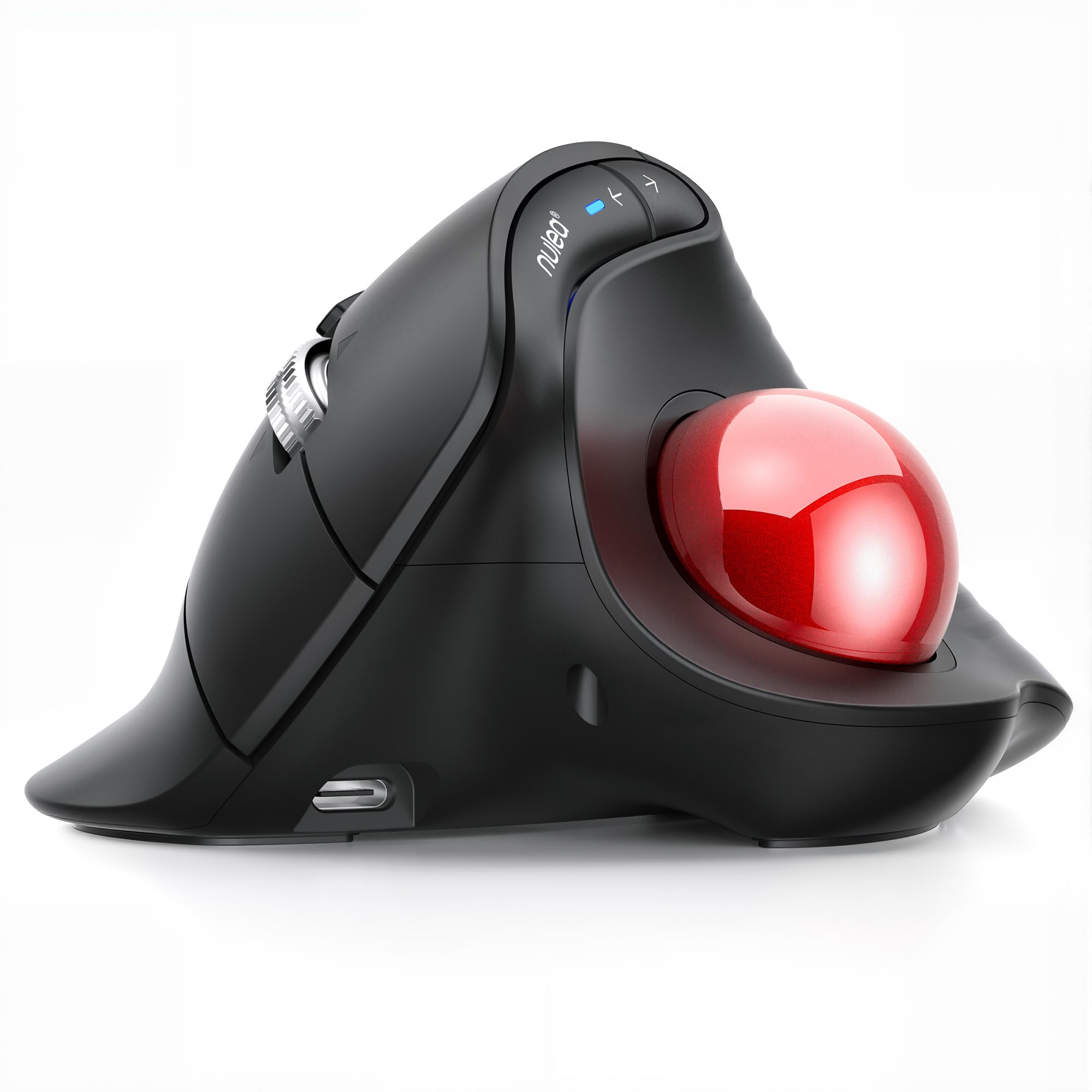
The Nulea M514 is a budget-friendly trackball mouse that punches well above its price point. Its 65° vertical angle is steeper than the Logitech Lift or MX Vertical, which provides a more aggressive handshake posture that further offloads the lateral epicondyle. Instead of dragging your arm across the desk, you operate a thumb-controlled trackball that requires only a gentle roll of your thumb to move the cursor across the screen.
Three adjustable DPI levels (600, 800, 1000) let you dial in sensitivity, and the Smart Infinite Scroll wheel automatically switches between precision and fast-scrolling modes based on how quickly you spin it. All inputs—trackball, buttons, and scroll wheel—are engineered for silent operation, which reduces the auditory and tactile feedback that can cause subconscious muscle clenching. Connectivity covers three devices via Bluetooth or USB receiver with instant switching.
Reviews frequently compare the M514 favorably to the Logitech MX Ergo, noting smoother ball bearings, easier ball removal for cleaning, and a more comfortable hand orientation. The main drawback is the lack of programmable buttons, which limits workflow shortcuts for power users. Build quality is slightly below premium models, but for the price, the M514 offers genuine ergonomic relief by minimizing the forearm motion that flares tennis elbow.
Why it’s great
- Steep 65° angle reduces forearm pronation effectively
- Silent trackball and button operation prevents fatigue from click noise
- Multi-device switching and excellent scroll wheel feel
Good to know
- No programmable buttons for custom shortcuts
- Build quality feels less premium than Logitech alternatives
- Back/forward thumb buttons are placed awkwardly
7. Ergodriven Om Vertical Ergonomic Mouse

The Ergodriven Om brings a unique feature to the vertical mouse space: an onboard OLED screen that displays your current DPI setting and battery status. No software installation is required to configure the five customizable buttons—you can assign functions like copy, paste, undo, or mute directly from the device in under ten seconds. This makes it ideal for users who want ergonomic relief without fighting with complex driver interfaces.
The vertical shape follows a compact design that works best for small to medium hands. The silent micro-force buttons require very little actuation pressure, which is crucial for minimizing the jolt that travels through the forearm with each click. Four DPI settings range from 1200 to 2400, giving you more cursor speed options than the Nulea M514. Connectivity includes both 2.4GHz dongle and Bluetooth, with a high-capacity rechargeable battery that delivers approximately five weeks per charge.
User feedback highlights the crisp button feel and smooth optical tracking, though some note the size is too small for larger hands, which can paradoxically cause wrist pain. The sensor also has an unusually high liftoff distance—over one inch—which can be annoying if you habitually pick up and reposition the mouse. For office tasks where you keep the mouse planted on the desk, the Om’s compact silhouette and zero-fuss button mapping make it a solid entry-level option for tennis elbow management.
Why it’s great
- OLED screen for on-the-fly DPI and battery monitoring
- USB/BT dual connectivity with no driver fuss
- Silent micro-force buttons reduce tendon shock
Good to know
- Compact size may be too small for large hands
- High sensor liftoff distance (>1 inch) for pick-up users
- Button customization limited to preset firmware commands
FAQ
Can a vertical mouse actually cure tennis elbow?
Is a trackball mouse better than a vertical mouse for tennis elbow?
How long does it take to adjust to a vertical or trackball mouse?
Final Thoughts: The Verdict
For most users, the best computer mouse for tennis elbow winner is the Logitech MX Vertical because it strikes the ideal balance between proven ergonomic science, high-DPI movement reduction, and polished multi-device workflow. If you want the most aggressive forearm posture correction possible, grab the Evoluent VMDMW. And for the most budget-friendly way to eliminate arm movement entirely, nothing beats the Nulea M514 trackball mouse.

Mo Maruf
I created WellFizz to bridge the gap between vague wellness advice and actionable solutions. My mission is simple: to decode the research and give you practical tools you can actually use.
Beyond the data, I am a passionate traveler. I believe that stepping away from the screen to explore new environments is essential for mental clarity and physical vitality.