Our readers keep the lights on and my smoothie glass nicely filled. As an Amazon Associate, I earn from qualifying purchases.
An off-white jacket that looks cream in the RAW file but turns beige on your display is the kind of frustration that costs retouching time. Photo editing monitors solve this by locking color to a factory-calibrated standard so what you see is what you print. The difference isn’t just in resolution — it’s in the gamut coverage and the Delta E variance that determines whether that shadow gradient clips or fades smoothly.
I’m Mohammad Maruf — the founder and writer behind WellFizz. I’ve spent hundreds of hours cross-referencing panel types, luminance uniformity reports, and verified customer benchmarks to compile this guide on the best computer monitors for photo editing.
Whether you batch-edit in Lightroom or composite in Photoshop, the right tool changes how you judge exposure and hue. This breakdown of the best computer monitor for photo editing focuses on the specs that actually affect your final output.
How To Choose The Best Computer Monitor For Photo Editing
Photo editing demands a monitor that displays colors as they exist in the file, not as the screen interprets them. The primary factors are color gamut coverage, Delta E accuracy, panel type, and connectivity for your workflow. Ignore marketing terms like “HDR10 compatible” if the monitor can’t cover a wide gamut — HDR is secondary to accurate sRGB and Adobe RGB reproduction.
Color Gamut: sRGB vs. DCI-P3 vs. Adobe RGB
sRGB is the baseline for web and social media. Adobe RGB covers more greens and cyans, essential for print photographers. DCI-P3, the video standard, is found on many modern MacBooks and is increasingly relevant for hybrid photo-video editors. A monitor that covers 99% of Adobe RGB or 95% of DCI-P3 is a reliable choice for professional work.
Delta E: The Accuracy Number
Delta E measures the difference between the intended color and what the monitor shows. A value under 2 is considered excellent and is the threshold for professional photo editing. Factory-calibrated monitors come with a report verifying this number. Avoid monitors that lack this certification, as they require expensive hardware calibrators to achieve acceptable accuracy.
Panel Type: IPS vs. VA vs. QD-OLED
IPS panels are the standard for color-critical work due to wide viewing angles and consistent brightness. VA panels offer deeper contrast but suffer from color shift when viewed off-center. QD-OLED delivers perfect blacks and vibrant colors but carries a risk of burn-in for static UI elements, making it less ideal for all-day editing with fixed panels.
Quick Comparison
On smaller screens, swipe sideways to see the full table.
| Model | Category | Best For | Key Spec | Amazon |
|---|---|---|---|---|
| Dell UltraSharp U4025QW | Premium | Ultrawide multitasking | 5K2K WUHD resolution | Amazon |
| BenQ PD2705U | Mid-Range | Calibrated accuracy | Delta E ≤3 factory report | Amazon |
| msi PRO MAX 271UPXW12G | Premium | QD-OLED deep blacks | △E < 2 color accuracy | Amazon |
| BenQ MA270U | Mid-Range | MacBook ecosystem | P3 wide color gamut | Amazon |
| Samsung ViewFinity S8 | Mid-Range | General creative work | 4K UHD with HDR10 | Amazon |
| ASUS ProArt PA279CRV | Mid-Range | Adobe RGB coverage | 99% DCI-P3 / Adobe RGB | Amazon |
| ASUS ProArt PA279CV | Mid-Range | 100% sRGB work | Quick factory calibration | Amazon |
| ViewSonic VP2756-4K | Mid-Range | Pantone validated | Delta E<2 accuracy | Amazon |
| LG 27UP850-W | Mid-Range | USB-C with 96W PD | DCI-P3 95% Color Gamut | Amazon |
| Dell 34 S3425DW | Value | Wide VA contrast | 21:9 Curved VA Panel | Amazon |
| Samsung Smart Monitor M7 | Value | Multi-purpose 4K | Smart TV integration | Amazon |
In‑Depth Reviews
1. Dell UltraSharp U4025QW

The Dell UltraSharp U4025QW is a 40-inch 5K2K ultrawide monitor with IPS Black technology, delivering a 2000:1 contrast ratio that significantly improves black depth compared to standard IPS screens. The 120Hz refresh rate and 600 nits of peak brightness make it suitable for both color-critical editing and smooth desktop navigation. Its 21:9 aspect ratio provides enough horizontal real estate for timelines, toolbars, and reference images without needing a second display.
Connectivity is robust with Thunderbolt 4, HDMI, DisplayPort, Ethernet, and a built-in KVM switch that handles multiple computers seamlessly. The factory calibration report ensures good out-of-box accuracy, though creative professionals may still want to run a hardware calibrator for precise matching across a multi-monitor setup. The wide DCI-P3 coverage supports video-grade grading.
Users consistently praise the clarity and the sheer workspace, noting that the blurriness some experience at default settings is resolved by lowering sharpness to 40. The built-in hub simplifies desk management, and the KVM switch works reliably once the network mode is disabled. The high cost is the main barrier, but its longevity and productivity gains justify the investment for serious professionals.
Why it’s great
- IPS Black technology for deeper blacks than typical IPS panels.
- Thunderbolt 4 with up to 140W power delivery.
- Built-in KVM switch for dual-computer workflows.
Good to know
- Not ideal for fast-paced gaming; refresh rate limited to 120Hz.
- Requires a deep desk (at least 30 inches).
- Downward-facing ports can be inconvenient to access.
2. BenQ PD2705U

The BenQ PD2705U is a 27-inch 4K UHD IPS monitor from BenQ’s AQCOLOR line, factory-calibrated to an average Delta E ≤3 with a physical report included. It covers 100% sRGB and Rec.709 color spaces, making it a reliable reference display for photographers who primarily output for web, print, or broadcast. The included HotKey Puck allows quick switching between color modes without diving into the on-screen display.
Connectivity includes a USB-C port with 65W power delivery, HDMI, DisplayPort, and a USB hub, plus a KVM switch for controlling two computers with a single keyboard and mouse. The ergonomic stand supports height, tilt, swivel, and pivot adjustments. The ICC Sync feature in the Display Pilot software automates color profile matching for consistent results across applications.
Users report excellent color reproduction that matches MacBook and iMac screens closely, and the KVM functionality is praised for multi-device workflows. Some note that the manual is sparse and the settings menu is not intuitive, but the color quality outweighs the learning curve. It’s a strong recommendation for editors on a mid-range budget who need reliable accuracy.
Why it’s great
- Factory calibration with Delta E ≤3 report.
- HotKey Puck for quick color mode switching.
- KVM switch for dual-computer control.
Good to know
- Average Delta E ≤3, not as tight as sub-2 competition.
- On-screen menus are clunky and manual is poor.
- HDR performance is adequate but not real HDR.
3. msi PRO MAX 271UPXW12G
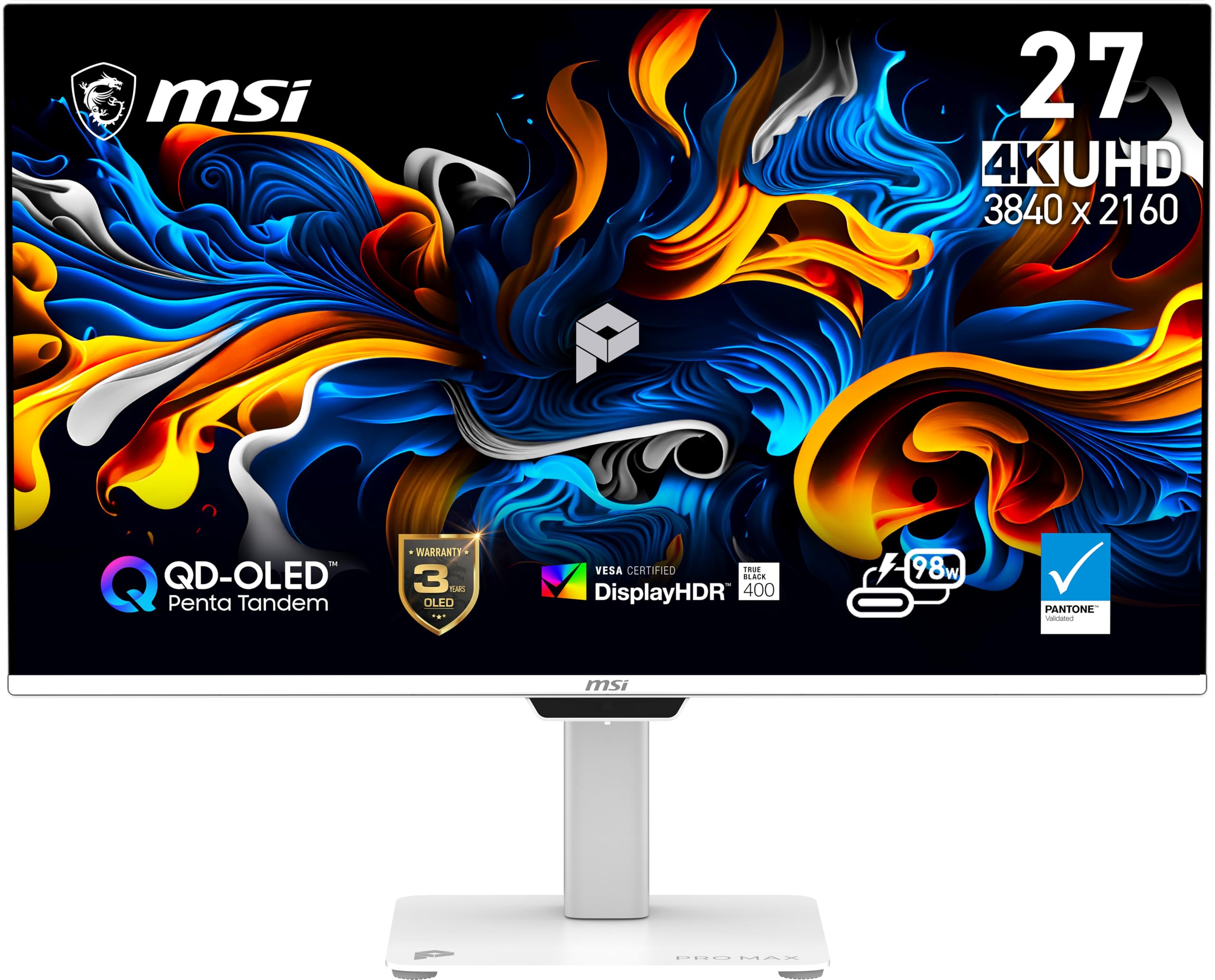
The msi PRO MAX 271UPXW12G is a 27-inch 4K QD-OLED monitor with a 120Hz refresh rate and VESA DisplayHDR True Black 400 certification. Its quantum dot OLED panel achieves an infinite contrast ratio, rendering pure blacks and vibrant colors that surpass IPS and VA panels for photo editing where shadow detail matters. The Delta E < 2 factory calibration ensures high accuracy out of the box for critical editing tasks.
Dual USB-C ports provide up to 98W and 15W power delivery, making it a true one-cable solution for MacBooks. The MSI Mac Optimization Software synchronizes color with macOS and supports shortcut keys. The built-in speakers are a bonus for casual media playback, though external monitors are preferred for critical work.
Customers are amazed by the HDR performance and color vibrancy, noting a massive improvement over standard LCD panels. Some users mention a purple tint in certain lighting conditions, which is inherent to QD-OLED technology but generally unnoticeable in normal use. The stand lacks full ergonomic adjustment compared to competitors, and burn-in risk remains a concern for static UI elements.
Why it’s great
- QD-OLED panel with infinite contrast for deep blacks.
- Delta E < 2 factory calibration for high accuracy.
- Dual USB-C with 98W power delivery and Mac optimization.
Good to know
- Potential for OLED burn-in with static UI elements.
- Stand lacks full ergonomic adjustment.
- Purple tint may be visible in some environments.
4. BenQ MA270U

The BenQ MA270U is a 27-inch 4K IPS monitor designed specifically for MacBook integration, featuring BenQ’s exclusive color tuning for P3 wide color gamut reproduction that matches the MacBook display. It connects via a single USB-C cable with 90W power delivery, also offering a second USB-C port with 15W for charging an iPad or iPhone. The integrated Mac controls allow brightness and volume adjustment directly from the MacBook keyboard.
The ergonomic stand supports height, tilt, swivel, and pivot adjustments for comfortable viewing. Its IPS panel provides consistent color across wide viewing angles, and the 4K resolution ensures sharp text and fine detail. The built-in speakers are adequate for system sounds but not for critical listening.
Users praise the seamless integration with the Apple ecosystem, noting that the monitor instantly recognizes the MacBook and maintains color consistency. One user reported a failure after seven weeks, leading to a 4-star deduction for reliability concerns. The built-in speakers are considered poor, but the color performance and Mac compatibility make it a strong Studio Display alternative at a lower price.
Why it’s great
- Color calibrated to match MacBook P3 display.
- Single USB-C cable with 90W power delivery.
- Mac keyboard controls for brightness and volume.
Good to know
- Some users report early failure issues.
- Built-in speakers are of poor quality.
- Only 60Hz refresh rate limits smooth scrolling.
5. Samsung ViewFinity S8 (S80D)

The Samsung ViewFinity S8 is a 32-inch 4K UHD monitor with an IPS panel and HDR10 support, offering a 3000:1 contrast ratio that provides good depth for an LCD display. It covers a wide color gamut and includes a height-adjustable, tilt, swivel, and pivot stand with a tool-free assembly design. The matte screen finish reduces glare, which is valuable in brightly lit editing environments.
Connectivity includes HDMI, DisplayPort, and USB-A ports, along with a USB-B upstream for hub functionality. The TÜV-certified eye care features reduce blue light and flicker for extended editing sessions. The monitor does not include built-in speakers, relying on a headphone jack for audio output.
Users find the resolution and color quality excellent for Photoshop and Lightroom, with sharp text and good contrast. The on-screen controls are described as frustrating initially but become manageable with familiarity. Some reviews note that the height adjustment range is limited, and the lack of speakers is a drawback for those who need audio without external monitors.
Why it’s great
- 32-inch 4K UHD IPS with HDR10 support.
- Tool-free stand with full ergonomic adjustment.
- Matte screen reduces glare in bright rooms.
Good to know
- No built-in speakers.
- On-screen controls are unintuitive.
- Height adjustment range may be insufficient for some.
6. ASUS ProArt PA279CRV

The ASUS ProArt PA279CRV is a 27-inch 4K HDR IPS monitor with 99% DCI-P3 and 99% Adobe RGB coverage, making it an excellent choice for print photographers and videographers who need wide color space. It is Calman Verified and factory pre-calibrated to Delta E < 2, with a calibration report included. The bright panel supports HDR content and delivers consistent luminance across the screen.
Connectivity includes DisplayPort over USB-C with 96W Power Delivery, two HDMI ports, DisplayPort in and out for daisy-chaining, and a USB hub. The ergonomic stand allows tilt, swivel, pivot, and height adjustments. The 5-year warranty (3 years plus 2 with registration) adds long-term reliability.
Customers appreciate the color accuracy and the matte screen that minimizes glare. The 60Hz refresh rate is a limitation for gaming but not for still-image editing. Some users note slight light leakage at the edges, which is typical for IPS panels and becomes unnoticeable during regular use.
Why it’s great
- 99% Adobe RGB and DCI-P3 coverage for wide color work.
- Delta E < 2 factory calibration with Calman Verification.
- USB-C with 96W power delivery and daisy-chain support.
Good to know
- Limited to 60Hz refresh rate.
- IPS glow may be noticeable in dark scenes.
- No built-in speakers included.
7. ASUS ProArt PA279CV

The ASUS ProArt PA279CV is a 27-inch 4K UHD IPS monitor with 100% sRGB and Rec. 709 coverage, Calman Verified and factory calibrated to Delta E < 2. It is designed for photographers who work primarily in the sRGB color space for web and social media output. The USB-C port delivers 65W of power to a connected laptop while carrying video and data.
The stand offers full ergonomic adjustment including 90-degree pivot for portrait mode viewing. Connectivity includes DisplayPort, HDMI, and a USB 3.1 hub with four Type-A ports. The 3-month Adobe Creative Cloud subscription is a welcome bonus for new subscribers.
Users report excellent color matching with MacBook Pro screens for graphic design and photo editing. Some note a slight green tint out of the box that is easily corrected by adjusting the tint setting by a few points. The split-screen feature is useful for comparing two inputs, but the wake-from-sleep issue with Macs required a one-time resolution.
Why it’s great
- 100% sRGB and Rec. 709 coverage for web photography.
- Delta E < 2 factory calibration with Calman Verification.
- 65W USB-C power delivery with intuitive split screen.
Good to know
- Out-of-box calibration may have slight green tint.
- 60Hz refresh rate not suitable for gaming.
- Some Mac users report wake-from-sleep glitches.
8. ViewSonic VP2756-4K
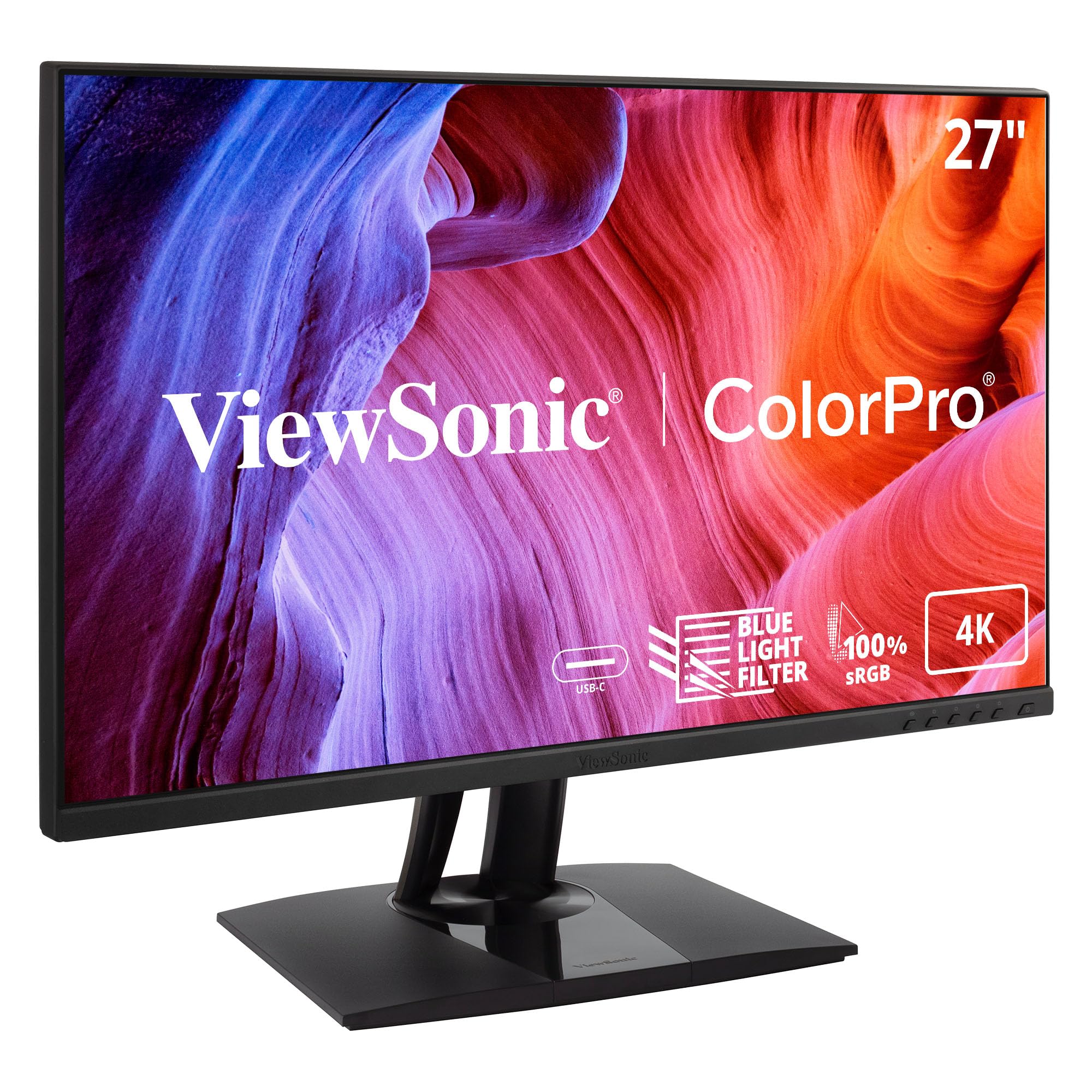
The ViewSonic VP2756-4K is a 27-inch 4K UHD IPS monitor that is Pantone Validated, meaning it can reproduce Pantone Matching System colors accurately. It covers 100% sRGB and has a Delta E < 2 rating, making it a reliable reference display for print and design work. The USB-C port delivers 60W of power and supports data, audio, and video over a single cable.
The ergonomic stand provides tilt, swivel, pivot, and height adjustments for all-day comfort. Flicker-Free technology and a Blue Light Filter help reduce eye fatigue during long editing sessions. Connectivity includes DisplayPort, HDMI, USB-A, and USB-C ports.
Users praise the color accuracy relative to the price point, noting it matches MacBook screens closely for editing. The built-in speakers are adequate for system sounds but not for critical listening. The on-screen display menu is described as clunky, but the ViewSonic software allows full PC control if the monitor is connected via USB-B.
Why it’s great
- Pantone Validated for accurate PMS color reproduction.
- Delta E < 2 factory calibration.
- USB-C with 60W power delivery and hub functionality.
Good to know
- Does not support 90-degree rotation with Mac.
- On-screen display menu is clunky.
- Built-in speakers are mediocre at best.
9. LG 27UP850-W

The LG 27UP850-W is a 27-inch 4K UHD IPS monitor with DCI-P3 95% color gamut coverage and VESA DisplayHDR 400 certification. It delivers vibrant colors and crisp resolution suitable for photo editing, with a 400 cd/m² typical brightness that provides good highlight detail. The USB-C port offers 96W Power Delivery, making it an excellent choice for MacBook users who want a single cable solution with high charging speed.
The 3-side virtually borderless design creates a clean multi-monitor setup, and the stand allows height, pivot, and tilt adjustments. AMD FreeSync is included, though the 60Hz refresh rate is more suited to productivity than fast gaming. The IPS panel provides consistent color from wide viewing angles.
Users are impressed with the color accuracy and value compared to the Apple Studio Display. Some experienced issues with the USB-C connection after firmware updates that required a specific restart sequence to resolve. HDR performance is considered fantastic for the price, though proper HDR implementation should be verified in Windows settings.
Why it’s great
- DCI-P3 95% coverage for vibrant color reproduction.
- USB-C with 96W power delivery for fast laptop charging.
- Near borderless design ideal for dual-monitor setups.
Good to know
- USB-A ports limited to 1A charging only.
- Some users report USB-C firmware issues.
- Onscreen Control app has compatibility issues with MBP.
10. Dell 34 Plus USB-C Curved Monitor (S3425DW)

The Dell 34 Plus USB-C Curved Monitor (S3425DW) is a 34-inch VA panel with a 3440×1440 resolution, 120Hz refresh rate, and 99% sRGB / 95% DCI-P3 coverage. The curved design and 3000:1 contrast ratio deliver deeper blacks than most IPS panels, making it suitable for editing in a dimly lit room. It is a mid-range option that balances color accuracy with a smoother refresh rate for occasional gaming.
Connectivity includes USB-C with up to 65W power delivery, HDMI, and USB-A ports. The ComfortView Plus feature reduces harmful blue light to ≤35% without compromising color accuracy. Built-in speakers are improved over previous generations with deeper frequency response and higher output.
Users praise the build quality and value for the price, noting the excellent VA panel color and text quality with no burn-in risk. Some find the curved screen takes getting used to but appreciate the lack of glare. A few note limited ports (no DisplayPort) and a VESA mount design that requires bracket assembly. It is a solid choice for editors who want ultrawide screen real estate without the premium price.
Why it’s great
- 21:9 curved VA panel with 3000:1 contrast ratio.
- 120Hz refresh rate with AMD FreeSync Premium.
- USB-C with 65W power delivery and improved speakers.
Good to know
- No DisplayPort connectivity included.
- VESA mount design requires bracket assembly.
- VA panel color shift at extreme viewing angles.
11. Samsung 43” Smart Monitor M7 (M70F)

The Samsung 43” Smart Monitor M7 is a 4K UHD display that functions as both a computer monitor and a smart TV with built-in streaming apps, Samsung TV Plus, and Gaming Hub. Its 5000:1 contrast ratio provides decent depth for an LCD panel, and the 4K resolution offers plenty of detail for photo editing. The Samsung Vision AI optimizes picture quality based on the content type.
Connectivity includes USB-C, HDMI, and USB-A ports, along with Wi-Fi and Bluetooth for wireless peripherals. The remote control allows easy navigation of smart features. Active Voice Amplifier adjusts dialogue volume based on ambient noise, which is beneficial for noisy environments.
Users appreciate the large, sharp screen and the ability to switch between computer and TV modes. However, some report color inaccuracy that makes it less reliable for critical photo work, and the 60Hz refresh rate is slow for gaming. Build quality issues and failure after the return window have been reported by a few customers. It is best suited for those who need a multipurpose display and do not require professional-grade color accuracy.
Why it’s great
- Large 43-inch 4K UHD with built-in smart TV functions.
- 5000:1 contrast ratio for decent black levels.
- Samsung Vision AI adapts picture to content type.
Good to know
- Color accuracy is not professional grade.
- 60Hz refresh rate is slow for fast action.
- Some users report reliability issues after return window.
FAQ
What Delta E value should I look for in a photo editing monitor?
Is a QD-OLED panel safe for photo editing with static UI elements?
Do I need a 5K monitor for photo editing, or is 4K enough?
How important is HDR certification for photo editing?
Final Thoughts: The Verdict
For most users, the best computer monitor for photo editing winner is the ASUS ProArt PA279CRV because it combines 99% Adobe RGB and DCI-P3 coverage with a Delta E < 2 calibration and 96W USB-C at a mid-range price. If you want wide gamut and USB-C convenience, the LG 27UP850-W offers 95% DCI-P3 and 96W PD. And for ultrawide screen real estate with deep contrast, the Dell UltraSharp U4025QW delivers a 5K2K workspace with IPS Black technology.

Mo Maruf
I created WellFizz to bridge the gap between vague wellness advice and actionable solutions. My mission is simple: to decode the research and give you practical tools you can actually use.
Beyond the data, I am a passionate traveler. I believe that stepping away from the screen to explore new environments is essential for mental clarity and physical vitality.