Our readers keep the lights on and my smoothie glass nicely filled. As an Amazon Associate, I earn from qualifying purchases.
Choosing a graphics card today means navigating a minefield of VRAM sizes, clock speeds, and cooling claims. The wrong pick leaves you with a GPU that either bottlenecks your CPU, overheats in your case, or costs double for performance you won’t use at your target resolution.
I’m Mohammad Maruf — the founder and writer behind WellFizz. I’ve spent hundreds of hours analyzing the silicon, cooling systems, and real-world benchmarks of the latest graphics cards to break down exactly which models deliver genuine value at every tier.
Whether you are building a high-refresh-rate 1440p rig or a silent 4K workstation, this guide dissects the core metrics that matter. Here is a curated look at the best computer graphics card options on the market right now.
How To Choose The Best Computer Graphics Card
Graphics card selection hinges on three locked variables: your target resolution, your case dimensions, and your PSU capacity. Ignoring any one of these will crater performance or cause physical incompatibility. Focus on VRAM for longevity, cooling for sustained clocks, and bus interface for bandwidth.
VRAM Capacity and Memory Bus Width
VRAM directly determines texture fidelity and resolution headroom. 8 GB cards are now entry-level and will struggle with modern AAA titles at ultra settings. 12 GB is the current sweet spot for 1440p, while 16 GB provides breathing room for 4K and future game installs. The memory bus width (128-bit vs 192-bit vs 256-bit) controls how fast the VRAM can talk to the GPU core — a wider bus reduces stutter in high-density scenes.
Cooling Solution and Form Factor
Dual-fan designs are compact and fit smaller cases but often run louder or hotter under sustained load. Triple-fan open-air coolers like WINDFORCE or iCX3 dissipate heat more efficiently, maintaining higher boost clocks for longer. Check card length (from 9.5 inches for compact builds up to 12.75 inches for full towers) and slot thickness (2-slot vs 2.5-slot) to ensure your case can physically accommodate the unit.
PCIe Generation Support
PCIe 5.0 offers double the bandwidth of PCIe 4.0, but current GPUs rarely saturate PCIe 4.0 x16. Buying a PCIe 5.0 card today future-proofs your investment for next-gen motherboards, but you will see zero performance loss running a PCIe 4.0 card on a PCIe 3.0 slot. The real bottleneck is almost always the GPU core itself, not the bus.
Quick Comparison
On smaller screens, swipe sideways to see the full table.
| Model | Category | Best For | Key Spec | Amazon |
|---|---|---|---|---|
| GIGABYTE RTX 5070 AERO OC | Premium | 1440p high-refresh + white builds | 12GB GDDR7 / 192-bit | Amazon |
| ASUS Prime RX 9070 XT | Premium | High-FPS 1440p / entry 4K | 16GB GDDR6 / 256-bit | Amazon |
| ASRock RX 9070 XT Challenger | Mid-Range | Maxed 1440p / VR gaming | 16GB GDDR6 / 2970 MHz | Amazon |
| ASUS Prime RTX 5070 | Premium | SFF/ITX builds + 1440p | 12GB GDDR7 / SFF-Ready | Amazon |
| PNY RTX 5070 Epic-X | Mid-Range | Silent 1440p + DLSS 4 | 12GB GDDR7 / Boost 2685 MHz | Amazon |
| EVGA RTX 3070 XC3 Ultra | Mid-Range | 1080p/1440p ray tracing value | 8GB GDDR6 / 1770 MHz | Amazon |
| GIGABYTE RX 9060 XT Gaming OC | Mid-Range | 1080p/1440p high FPS gaming | 16GB GDDR6 / WINDFORCE | Amazon |
| Sapphire Pulse RX 9060 XT | Mid-Range | Linux + local LLM workloads | 16GB GDDR6 / 128-bit | Amazon |
| XFX Speedster SWFT210 RX 7600 | Budget | 1080p gaming / VR entry | 8GB GDDR6 / 2655 MHz | Amazon |
In‑Depth Reviews
1. GIGABYTE GeForce RTX 5070 AERO OC 12G

The GIGABYTE RTX 5070 AERO OC nails the sweet spot for 1440p high-refresh gaming with its GDDR7 memory and 192-bit interface. Users report idle temps around 35°C and maximum loads around 60°C, thanks to the triple-fan WINDFORCE cooling system that operates near-silently even during extended sessions. The included sag bracket provides essential support for the 12.75-inch PCB in standard ATX cases.
DLSS 4 and frame generation technology deliver smooth motion in titles like Cyberpunk 2077 and Hogwarts Legacy at ultra settings, while the PCIe 5.0 interface future-proofs the card for next-gen motherboards without taxing current PSUs heavily — power draw remains efficient for its tier. The AERO white aesthetic makes it a natural fit for light-themed builds, and the OC variant comes with a validated overclock out of the box.
Real-world benchmarks show this card outperforming the RTX 4060 Ti by a comfortable margin in rasterized workloads and pulling ahead in ray-traced scenes where DLSS 4 kicks in. The 12 GB VRAM capacity is sufficient for current 1440p textures, though ultra-high-resolution texture packs may push its limits in the near future.
Why it’s great
- Exceptional 1440p high-FPS performance with stable frame pacing
- Near-silent triple-fan cooling even under sustained gaming load
- PCIe 5.0 support and effective sag bracket included
Good to know
- 12.75-inch length requires a mid-tower or larger case
- White aesthetic may clash with dark-themed builds
2. ASUS Prime AMD Radeon RX 9070 XT 16GB OC Edition

The ASUS Prime RX 9070 XT delivers 16 GB of GDDR6 memory on a 256-bit bus, a configuration that breathes at 4K resolutions and heavy texture workloads. Axial-tech fans with dual-ball bearings keep noise low — testers report idle temps around 30°C and stressed temps between 55°C and 59°C, with fans barely audible at 75% speed. The 2.5-slot design fits most mid-towers while maintaining strong cooling clearance.
Under 180-190W sustained power draw, this card punches well above its thermal class. It handles Red Dead Redemption 2 at 1440p ultra from 80-90 fps up to 170-190 fps compared to previous-gen RX 6800 hardware. Linux compatibility is excellent — users report plug-and-play operation on Xubuntu and Fedora without driver wrangling. The lack of RGB lighting makes it a discreet choice for professional or minimalist builds.
Ray tracing performance is solid at 1080p and capable at 1440p, though pure rasterized frames remain AMD’s strength here. The 16 GB buffer gives this card a longevity advantage over 12 GB competitors for 4K gaming and creative applications like Blender or ComfyUI.
Why it’s great
- 16 GB VRAM on a 256-bit bus for high-res gaming and creative work
- Exceptionally quiet and cool operation under full load
- Outstanding Linux support with no driver issues
Good to know
- No RGB lighting for those wanting customizable aesthetics
- Ray tracing trails comparable NVIDIA cards at 4K
3. ASRock Radeon RX 9070 XT Challenger 16GB OC
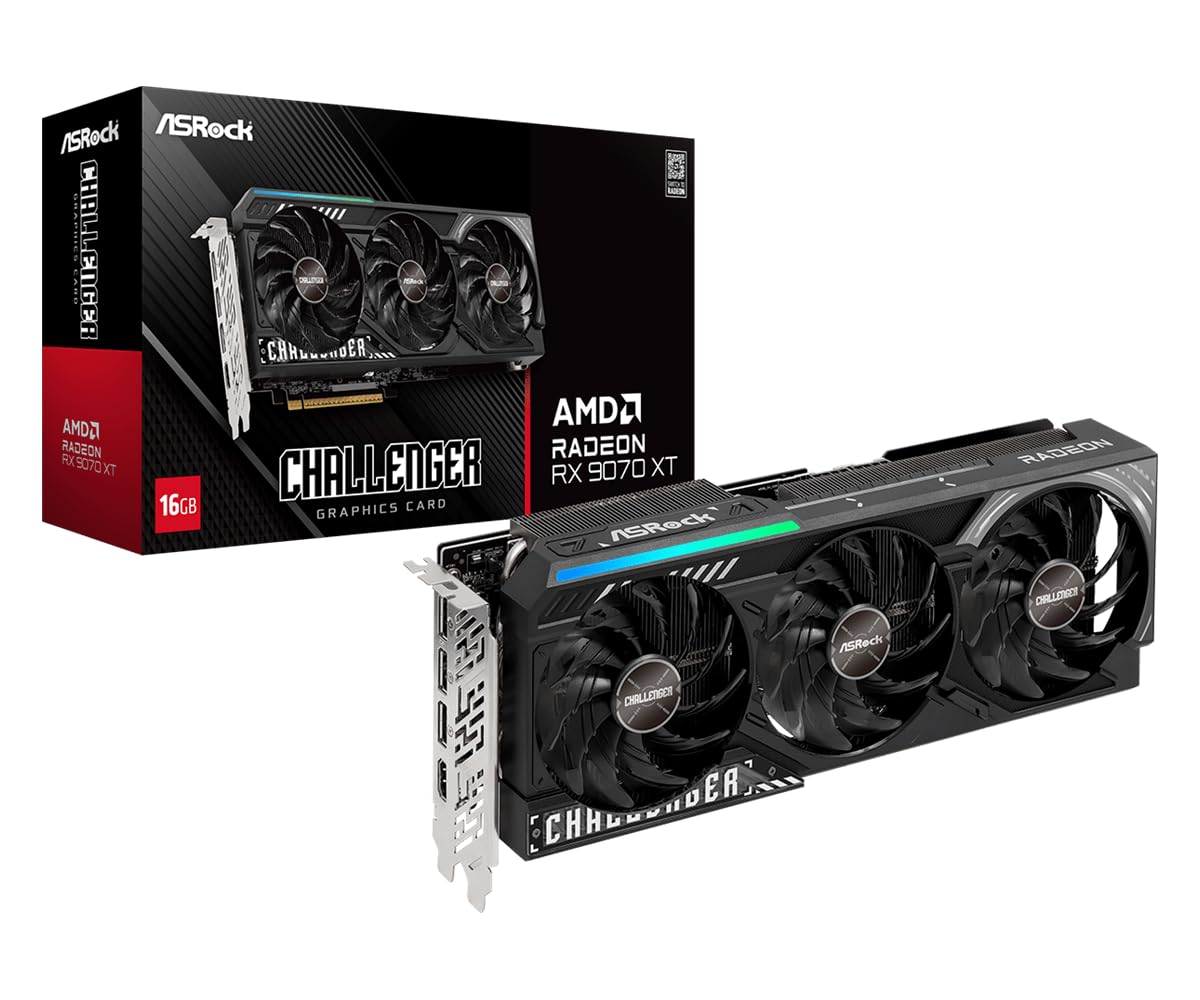
ASRock’s Challenger RX 9070 XT brings a 2970 MHz boost clock and 16 GB of GDDR6 to the mid-range segment without the price premium of flagship models. The triple-fan cooling with 0dB silent mode stops fans entirely during low-load tasks like web browsing, creating a completely silent desktop experience. Users confirm stable 1440p max-settings performance in modern titles, with undervolting via Adrenaline further dropping thermals.
Paired with a Ryzen 5 7600X3D, testers report smooth VR performance in No Man’s Sky and excellent 1440p ultra frame rates across AAA games. The metal backplate aids heat dissipation and adds structural rigidity, though the RGB software has been noted as occasionally buggy — a physical LED switch lets you control lighting without the app. The 750W PSU recommendation is accurate for peak loads.
This card punches hard at its price point, beating similarly-priced NVIDIA options in rasterized gaming and offering comparable ray tracing at 1440p. The 16 GB frame buffer ensures you won’t hit memory limits during texture-heavy sequences, making it a strong mid-term investment for gamers who upgrade monitors infrequently.
Why it’s great
- Aggressive 2970 MHz boost clock for high-FPS gaming
- 0dB fan stop and quiet triple-fan cooling design
- Generous 16 GB VRAM for future-proofing
Good to know
- RGB software can lose connection and needs reinstall
- Standard 2-slot thickness but still verify case clearance
4. ASUS SFF-Ready Prime NVIDIA GeForce RTX 5070

The ASUS Prime RTX 5070 is engineered for small-form-factor enthusiasts who need Blackwell architecture in a compact footprint. Its 2.5-slot width and axial-tech fans with a smaller hub enable longer blades that push more air through tighter spaces. Phase-change GPU thermal pads improve heat transfer efficiency — users report sustained temps around 60-65°C under load in ITX cases.
DLSS 4 delivers significant frame-rate boosts in supported titles, and the 12 GB GDDR7 memory ensures smooth 1440p competitive gaming. The Dual BIOS feature lets you toggle between performance and quiet modes, a practical touch for builds where noise is a primary concern. Benchmarks show a Steel Nomad score of 5839, Kombustor at 6587, and FurMark at 13153 after a mild OC.
The jet-black design integrates cleanly into dark builds, and the included 16-pin adapter (1-to-2) works with 750W fully modular PSUs. Users warn that the card runs hot in cases with poor airflow — ensure your chassis has at least one exhaust fan near the GPU area. This is not the best raw rasterizer, but its efficiency and size make it the top choice for compact systems.
Why it’s great
- Designed specifically for SFF and ITX chassis compatibility
- Dual BIOS allows switching between quiet and performance modes
- GDDR7 memory with DLSS 4 for excellent frame generation
Good to know
- Requires good case airflow to maintain optimal temps
- 12 GB VRAM may bottleneck at 4K ultra textures
5. PNY NVIDIA GeForce RTX 5070 Epic-X ARGB OC Triple Fan
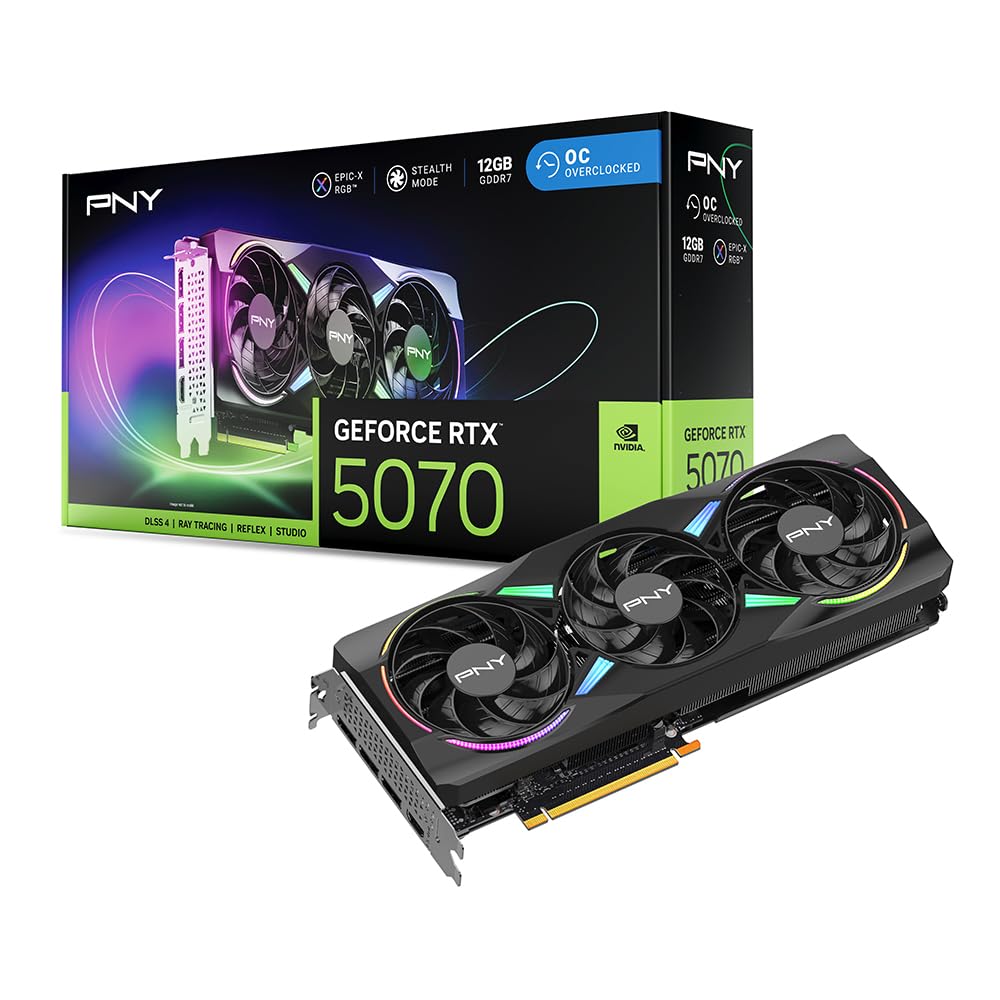
PNY’s Epic-X RTX 5070 stands out for its remarkably silent triple-fan operation even during extended gaming marathons. The 12 GB GDDR7 memory on a 192-bit bus delivers 672 GB/s bandwidth, more than enough for high-refresh 1440p gaming. Testers confirm it runs much cooler than previous-gen 4070 Super models, with a compact footprint that fits mini towers despite the triple-fan shroud.
The integrated 5th-gen Tensor Cores and 4th-gen Ray Tracing Cores power DLSS 4 and Reflex technologies, which together reduce latency and improve targeting in competitive shooters. Real-world performance beats the RTX 4070 Super in both gaming and video editing tasks, and the card operates with full 80 ROPS enabled out of the box. The RGB lighting is subtle and complements most modern build themes.
Installation is straightforward — the card includes a 12-pin to dual 8-pin power adapter, compatible with standard 750W PSUs. Users note that updating drivers immediately after install is critical to avoid early thermal spikes, but once dialed in the card stays in the mid-70s under load at 60% fan speed. The 3-year warranty provides solid peace of mind for the investment.
Why it’s great
- Very quiet triple-fan operation even under sustained load
- Beats RTX 4070 Super in gaming and creative workloads
- Compact design fits smaller cases despite large cooler
Good to know
- 12 GB VRAM is limited for 4K ultra settings
- Requires driver update on first install to stabilize thermals
6. EVGA 08G-P5-3755-KR GeForce RTX 3070 XC3 Ultra Gaming

The EVGA RTX 3070 XC3 Ultra remains a strong entry point into ray tracing and DLSS performance at 1080p and entry-level 1440p. Its iCX3 cooling tech with triple HDB fans keeps GPU temps between 62°C and 65°C at just 35-45% fan speed, making it far quieter than the reference FE design. The all-metal backplate adds rigidity and a clean industrial aesthetic.
Real-world tests show the card scoring high 8000s in Port Royal and delivering 150+ FPS in most games at 1080p ultra. Cyberpunk 2077 with ray tracing set to medium runs smoothly at 1440p. The 1770 MHz boost clock leaves modest overclocking headroom — users report stable +125-150 MHz core and +1000-1250 MHz memory gains via EVGA’s Precision X1 software, which is essential since Afterburner only controls two of the three fans.
The 8 GB VRAM limit has aged — modern titles like Control benefit from the extra 2 GB compared to the RTX 2060, but future games may force texture detail reductions. The card requires a sag bracket in some motherboards due to its length, and the 1440p maximum display resolution means you won’t run native 4K without scaling. Still, at its effective price tier, it delivers ray tracing and DLSS access that AMD couldn’t match at launch.
Why it’s great
- Excellent ray tracing and DLSS performance for the segment
- iCX3 cooling runs cool and quiet even at load
- Solid overclocking headroom with proper fan control via PX1
Good to know
- 8 GB VRAM is becoming insufficient for newer AAA titles at ultra
- Display resolution limited to 2560×1440 native
7. GIGABYTE Radeon RX 9060 XT Gaming OC 16G

GIGABYTE’s RX 9060 XT Gaming OC marries 16 GB of GDDR6 memory with the proven WINDFORCE cooling system, Hawk fans, and server-grade thermal conductive gel for sustained clock stability. The PCIe 5.0 interface ensures maximum bandwidth with compatible motherboards, and the zero-RPM idle mode keeps the card silent during non-gaming activities. Users describe it as a beast for 1440p ultra settings in Cyberpunk 2077 and Hogwarts Legacy.
The 16 GB VRAM buffer unlocks texture quality and resolution scaling that 8 GB and 12 GB cards cannot match in memory-intensive scenes. FSR 4 upscaling further boosts frame rates in supported titles, and the improved ray tracing in the RX 9060 XT closes the gap with NVIDIA’s mid-range offerings. The card’s large 11.06-inch length requires a roomy case, but the sturdy dual-slot design with RGB lighting adds visual appeal.
Reviewers consistently note the outstanding value proposition — this card delivers near-4K performance in many titles while staying cool and quiet. The AV1 encoding support is a welcome addition for streamers and content creators. The only consistent caveat is the physical size, which may block adjacent PCIe slots or interfere with front-mounted radiators in compact builds.
Why it’s great
- 16 GB VRAM provides excellent headroom for high-res textures
- WINDFORCE cooling with zero-RPM idle is quiet and effective
- FSR 4 support and improved ray tracing for the RDNA 4 generation
Good to know
- Large 11.06-inch length may not fit smaller cases
- Ray tracing still trails equivalent NVIDIA cards at 4K
8. Sapphire 11350-03-20G Pulse AMD Radeon RX 9060 XT Gaming OC 16GB

Sapphire’s Pulse RX 9060 XT is a standout for Linux users and AI workload enthusiasts who need 16 GB of VRAM without NVIDIA’s proprietary driver overhead. The card runs on full PCIe 5.0 x16 bandwidth and operates at a 200W cap after firmware updates, keeping edge temps in the mid-50°C range. Users on Arch Linux and Devuan report immediate display detection with all three outputs working out of the box — Vulkan and Mesa packages install without conflict.
The compact 128-bit memory interface is the main bottleneck here — while 16 GB is available, the memory bandwidth is lower than wider-bus competitors. That said, for local LLM inference (like running 7B-13B parameter models), the VRAM capacity matters more than raw bandwidth. The card also handles Blender rendering and ComfyUI workflows comfortably. The dual HDMI 2.1 and single DisplayPort 2.1 outputs support 4K monitors at high refresh rates.
Undervolting through Adrenaline yields even lower power draw and boosted clocks, making this a thermally efficient option for systems with limited airflow. The card is nearly silent during operation, with no coil whine reported. The only compromise is the 128-bit bus — for pure gaming FPS at 1440p, a 192-bit or 256-bit card will outperform it, but for Linux workflows and AI tasks, the VRAM capacity is the priority.
Why it’s great
- 16 GB VRAM ideal for local LLM inference and AI workloads
- Excellent plug-and-play Linux support across multiple distros
- Compact, quiet, and runs cool with efficient power draw
Good to know
- 128-bit memory interface limits gaming bandwidth compared to 192-bit GPUs
- Display resolution capped at 3840×2160 officially
9. XFX Speedster SWFT210 Radeon RX 7600 8GB

The XFX Speedster SWFT210 RX 7600 delivers genuine 1080p gaming performance at a budget-friendly price point without sacrificing essential features like GDDR6 memory and a 2655 MHz boost clock. The dual-fan SWFT cooling solution keeps the card running in the upper 70s after a driver update — initially some users saw temps in the 80s, but current drivers stabilize it at 60% fan speed with no crashes. The compact 9.49-inch length fits easily into older prebuilt computers, including HP office PCs that lack ample GPU clearance.
Upgrading from a GTX 1650 Super or RX 570, users report dramatic improvements in Assetto Corsa, Project Cars 2, Half-Life Alyx, and emulated titles. The card handles 1080p max settings in most modern games and can push 1440p/60 in less demanding titles and older AAA games. AMD’s stable drivers on both Windows and Linux make this a reliable drop-in upgrade — one user swapped out an Nvidia GTX 1070 on Arch Linux with all three displays working immediately.
Where the RX 7600 falls short is high-refresh 1440p gaming and ray tracing — it lacks the VRAM headroom and core count for demanding titles at ultra settings. The 8 GB frame buffer is already becoming a limitation for newer releases, and the card cannot maintain high frame rates with ray tracing enabled. For its intended 1080p audience, though, it remains a fantastic entry-level option that punches well above its class in value.
Why it’s great
- Excellent 1080p performance and solid VR support
- Compact size fits small cases and prebuilt computers
- Stable AMD drivers on both Windows and Linux
Good to know
- 8 GB VRAM limits longevity for future AAA titles
- Struggles with ray tracing and high-refresh 1440p gaming
FAQ
Do I need PCIe 5.0 for a modern graphics card?
How much VRAM do I actually need for 1440p gaming?
Is ray tracing worth paying extra for at 1080p?
Final Thoughts: The Verdict
For most users, the computer graphics card winner is the GIGABYTE RTX 5070 AERO OC because it combines 12 GB GDDR7 memory, excellent 1440p cooling, and PCIe 5.0 support without overpaying for VRAM you won’t use. If you want 16 GB of VRAM for AI workloads or high-res textures, grab the ASUS Prime RX 9070 XT. And for a compact SFF or ITX build, nothing beats the ASUS Prime RTX 5070.

Mo Maruf
I created WellFizz to bridge the gap between vague wellness advice and actionable solutions. My mission is simple: to decode the research and give you practical tools you can actually use.
Beyond the data, I am a passionate traveler. I believe that stepping away from the screen to explore new environments is essential for mental clarity and physical vitality.