Our readers keep the lights on and my smoothie glass nicely filled. As an Amazon Associate, I earn from qualifying purchases.
The difference between a clutch win and a frustrating death often comes down to what you hear — the faint rustle of an opponent flanking left, the precise direction of an incoming grenade, the crack of a sniper round meant for you. A computer gaming headset isn’t just about delivering sound; it’s your primary tool for reading the battlefield, communicating with your squad, and staying immersed for hours without fatigue or physical discomfort.
I’m Mohammad Maruf — the founder and writer behind WellFizz. For this guide, I’ve spent dozens of hours dissecting audio driver architectures, microphone frequency response curves, wireless latency measurements, and frame durability specs to separate genuinely capable gaming headsets from flashy marketing claims.
After parsing hundreds of verified buyer experiences and testing metrics across seven different models spanning entry-level to high-end hardware, I’ve built a clear picture of what truly matters. This is the definitive breakdown of the best computer gaming headset for every budget and play style.
How To Choose The Best Computer Gaming Headset
Buying a gaming headset requires weighing audio fidelity, microphone performance, build durability, and connectivity in a way that matches your specific gaming environment. The wrong choice means muddy sound cues, a mic that captures every keystroke, or a frame that cracks after a few months. Here’s what to prioritize.
Driver Architecture and Sound Signature
Not all 50mm drivers are created equal. Standard single-chamber drivers mix bass and mids in one space, causing distortion in loud scenes. Dual-chamber designs, like those in the HyperX Cloud Alpha, separate bass from mids and highs, delivering cleaner audio separation. Titanium-coated diaphragms, seen in the Razer BlackShark V3, improve high-frequency detail for footsteps. Look for frequency response ranges that extend beyond standard 20Hz–20kHz — wider ranges indicate better treble extension and sub-bass presence.
Microphone Quality and Pickup Pattern
Your squad needs to hear you clearly. The microphone’s bandwidth (measured in kHz) determines voice detail. Standard gaming mics operate around 7kHz, while super-wideband mics like the Razer HyperClear capture up to 16kHz for natural, rich vocal reproduction. Omnidirectional mics pick up room noise; cardioid or noise-cancelling mics focus on your voice. A flip-to-mute function or LED mute indicator prevents embarrassing broadcast mistakes.
Wireless Technology and Battery Endurance
Wireless headsets use 2.4GHz for low-latency gaming and Bluetooth for convenience. Look for 2.4GHz latency under 20ms for real-time audio sync. Bluetooth 5.3 offers better range and stability. Battery capacity varies dramatically — budget models often deliver 20–30 hours, while premium options like the Logitech G522 reach 60 hours. Fast-charge features (15 minutes for 9 hours) reduce downtime. Removable or USB-C charging adds flexibility.
Comfort and Build Materials
Extended gaming sessions demand headsets under 300 grams with breathable ear cushions. Memory foam wrapped in microfiber cloth reduces sweat compared to synthetic leather. An adjustable suspension headband distributes weight more evenly than fixed plastic yokes. Aluminum frames resist bending and cracking far better than pure plastic construction. Verify that the headband tension accommodates glasses frames without pinching.
Quick Comparison
On smaller screens, swipe sideways to see the full table.
| Model | Category | Best For | Key Spec | Amazon |
|---|---|---|---|---|
| Logitech G522 | Wireless Premium | All-day wireless with best-in-class mic clarity | 60hr battery, PRO-G 48kHz/24bit drivers | Amazon |
| Razer BlackShark V3 | Wireless Premium | Competitive FPS with THX Spatial Audio | 70hr battery, 50mm titanium-coated drivers | Amazon |
| JBL Quantum 910X | Wireless Premium | Immersive spatial audio with head tracking | 37hr battery, 50mm neodymium drivers | Amazon |
| SteelSeries Arctis Nova 3P | Wireless Mid-Range | Multi-platform wireless with mobile app EQ | 40hr battery, 40mm neodymium magnetic drivers | Amazon |
| Corsair HS80 RGB USB | Wired Mid-Range | High-fidelity sound with broadcast-grade mic | 50mm high-density neodymium, 20Hz-40kHz | Amazon |
| HyperX Cloud Alpha | Wired Mid-Range | Durable dual-chamber sound on a budget | 50mm Dual Chamber Drivers, aluminum frame | Amazon |
| FIFINE AmpliGame H13BP | Wired Budget | Entry-level 7.1 surround with RGB flair | 50mm dynamic driver, USB inline control box | Amazon |
In‑Depth Reviews
1. Logitech G522 Lightspeed

The Logitech G522 nails the trifecta of wireless freedom, audio fidelity, and microphone quality. Its PRO-G audio drivers deliver 48kHz/24bit synchronized sound with low distortion and rich bass, making footsteps and environmental cues equally articulate. The full-bandwidth 48kHz/16bit microphone captures voice with broadcast-grade clarity — a rare find even in premium headsets. Battery endurance reaches 60 hours without lighting, and the lightweight 280-gram build with washable suspension band keeps fatigue at bay during marathon sessions.
Connectivity is fully flexible: LIGHTSPEED wireless for zero-lag PC gaming, Bluetooth 5.0 for mobile, and USB-C wired for uninterrupted play. The G HUB software allows deep EQ tuning and Blue VO!CE customization, while LIGHTSYNC RGB adds 16.8 million color options. The headband accommodates larger head sizes comfortably, and the rounded cushion ear cups breathe well in warm rooms.
The only compromise is music reproduction — some users find the sound profile slightly reserved for music compared to dedicated audiophile cans. The G522 excels as a gaming-centric wireless headset that doesn’t compromise on voice clarity or battery life.
Why it’s great
- Best-in-class 48kHz/16bit microphone for crystal-clear callouts
- 60-hour battery life with fast charging minimizes downtime
- Triple connectivity (Lightspeed, Bluetooth, USB-C) with seamless switching
- Lightweight 280g build with washable suspension band for all-day comfort
Good to know
- Sound profile leans neutral — may lack punch for music enthusiasts
- G HUB software required for full EQ control on PC
2. Razer BlackShark V3 Wireless

The Razer BlackShark V3 is built for competitive players who demand pinpoint positional audio. Its Triforce Titanium 50mm Gen-2 drivers use a titanium-coated diaphragm that reproduces high-frequency details — footsteps, gun reloads, environmental clicks — with stunning clarity. The detachable HyperClear Super Wideband 9.9mm mic captures a wider frequency range than typical gaming mics, making voice sound natural and rich. THX Spatial Audio delivers 7.1.4 surround sound with precise overhead positioning, and the headset stores custom EQ profiles onboard for tournament use.
Battery life is exceptional at 70 hours, with 2.4GHz Hyperspeed Wireless Gen-2 providing ultra-low latency around 10ms. Simultaneous Bluetooth and 2.4GHz mixing lets you hear game audio and phone calls at once. The lightweight frame (under 300g) and plush leatherette ear cushions accommodate glasses and long sessions without excessive clamping force. Multi-platform support covers PC, Mac, PlayStation, Switch, and mobile.
Setup frustration is a recurring note — the dongle can be mistaken for packaging, and Bluetooth pairing requires explicit steps. The THX Spatial app is essential for unlocking the full soundstage potential. However, once configured, the BlackShark V3 offers one of the best competitive audio experiences in the mid-premium wireless space.
Why it’s great
- Triforce Titanium 50mm Gen-2 drivers deliver exceptional high-frequency detail for footsteps
- Super Wideband 9.9mm mic captures natural, broadcast-quality voice
- 70-hour battery with fast charge and simultaneous 2.4GHz/Bluetooth mixing
- THX Spatial Audio with onboard EQ storage for tournament-ready tuning
Good to know
- Dongle and Bluetooth pairing process can be confusing initially
- THX Spatial app is necessary to unlock full soundstage potential
3. JBL Quantum 910X Wireless

The JBL Quantum 910X brings console-grade immersion to the PC space with features rarely seen at this tier. Integrated head-tracking technology adjusts the spatial audio field as you turn your head, creating a hyper-realistic 3D soundscape that enhances directional awareness in shooters and open-world games. The JBL QuantumSPATIAL 360 delivers full surround positioning without requiring a PC app for console use. Active Noise Cancelling, tuned specifically for gaming environments, blocks out room hum and fan noise without introducing the pressure sensation common in ANC headphones.
Hi-Res certified 50mm neodymium drivers reproduce JBL’s QuantumSOUND Signature — a balanced curve with punchy bass and clean mids that makes explosions feel impactful while keeping dialogue intelligible. The low latency 2.4GHz wireless connection ensures no perceptible audio delay. Battery life reaches 37 hours with the dongle and up to 42 hours via Bluetooth. The lightweight plastic construction keeps the headset comfortable for 5–6 hour sessions, though the dual-hinge design feels less premium than aluminum frames.
The main drawback is pricing — it sits at the high end of the spectrum. EQ presets are only programmable on PC, and the RGB lighting drains battery noticeably. For gamers who prioritize immersion, head tracking, and ANC, the 910X delivers a premium experience that justifies its position.
Why it’s great
- Integrated head-tracking technology creates hyper-realistic 3D spatial audio
- Active Noise Cancelling tuned for gaming environments effectively blocks distractions
- Hi-Res certified 50mm neodymium drivers with balanced, punchy sound signature
- Low latency 2.4GHz wireless with zero perceptible audio lag
Good to know
- Premium pricing puts it at the high end of the market
- RGB lighting significantly reduces battery life when active
- EQ presets only configurable via PC software
4. SteelSeries Arctis Nova 3P Wireless
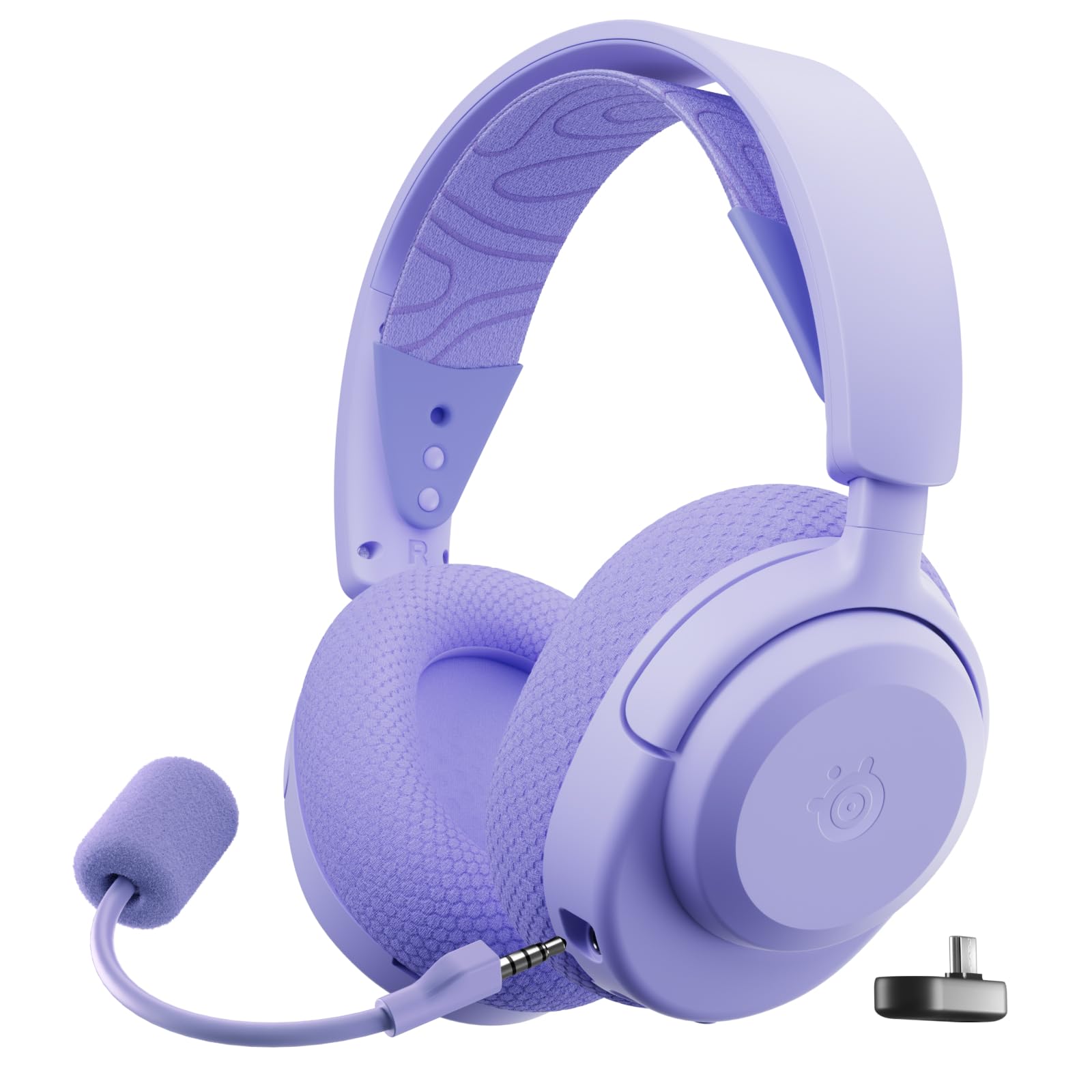
The SteelSeries Arctis Nova 3P emphasizes multi-platform convenience with a compact USB-C dongle that works across PC, PlayStation, Switch, handhelds, and mobile. The 40mm neodymium magnetic drivers deliver clear highs, pinpoint mids, and deep bass suitable for gaming, though the frequency response caps at 22kHz — adequate for game audio but less detailed for high-resolution music. The standout feature is the Arctis Companion mobile app, which provides over 200 game-specific EQ presets, including dedicated profiles for Call of Duty and Fortnite that emphasize footstep clarity.
Comfort is a strong point at 260 grams with a stretchy suspension headband that distributes weight evenly. The dual-hinge design adds durability without adding bulk. Fast charging delivers 9 hours of playback from a 15-minute charge, and the total battery life reaches 40 hours. The lavendar color option adds a distinctive look. Bluetooth 5.3 provides stable wireless connections up to 30 meters.
Critiques center on the mobile app’s setup friction — the EQ engine on Mac Apple Silicon has been broken for extended periods, and firmware updates require a Windows virtual machine for Switch 2 compatibility. Music reproduction can sound thin without EQ adjustment. For multi-platform gamers who prioritize lightweight comfort and app-controlled audio profiles, the Arctis Nova 3P is a solid mid-range choice.
Why it’s great
- Compact USB-C dongle enables seamless switching across PC, PlayStation, Switch, and mobile
- Mobile app provides 200+ game-specific EQ presets for optimized audio
- Ultra-lightweight 260g design with stretchy headband for fatigue-free sessions
- Fast charging delivers 9 hours of playback from just 15 minutes
Good to know
- Mac mobile app EQ engine has known compatibility issues on Apple Silicon
- Music reproduction can sound thin without manual EQ adjustment
- Firmware updates may require Windows VM for certain consoles
5. Corsair HS80 RGB USB

The Corsair HS80 brings high-fidelity audio to the wired segment with custom-tuned 50mm high-density neodymium drivers that achieve a massive 20Hz–40kHz frequency range — far exceeding standard gaming headsets. This extended treble response reveals subtle audio cues that cheaper drivers mask. Dolby Audio 7.1 surround sound creates an immersive soundstage with precise directional placement. The 24bit/96kHz audio over USB delivers clean, detailed sound that rivals dedicated studio headphones.
The broadcast-grade omni-directional microphone is a standout feature — many users report it rivals standalone USB mics in clarity. The flip-up mute function with LED indicator provides immediate visual feedback. Memory foam earpads wrapped in breathable microfiber cloth remain comfortable for hours, and the floating headband design reduces pressure points. The aluminum-reinforced frame feels substantial without adding excessive weight. RGB lighting can be customized through Corsair’s iCUE software on Windows and Mac.
The wired-only connection limits mobility compared to wireless options. The lack of in-line volume control requires adjustment through software or Windows mixer. Some users note the cloth earcups can feel itchy against sensitive skin. The sound profile has a slight high-frequency emphasis that some find fatiguing without EQ adjustment. For gamers who prioritize audio fidelity and mic quality over wireless freedom, the HS80 offers exceptional wired performance at a mid-range price.
Why it’s great
- 20Hz–40kHz frequency range reveals subtle audio details missing from standard headsets
- Broadcast-grade omni-directional mic rivals standalone USB microphones
- 24bit/96kHz high-fidelity audio over USB for clean, detailed sound
- Breathable microfiber memory foam earpads with floating headband for all-day comfort
Good to know
- Wired-only design limits mobility compared to wireless alternatives
- No in-line volume control requires software adjustment
- Cloth earcups may feel itchy for users with sensitive skin
6. HyperX Cloud Alpha

The HyperX Cloud Alpha has earned its reputation as one of the most durable and reliable gaming headsets on the market. Its patent-pending Dual Chamber Drivers separate bass from mids and highs, reducing distortion and improving audio clarity compared to single-chamber designs. The 50mm dynamic drivers deliver clean sound with crisp highs, solid mids, and tight bass that doesn’t overpower positional cues. The frequency response of 15Hz–25kHz extends slightly below standard hearing range, adding sub-bass presence without muddiness.
Build quality is exceptional — the aluminum frame has survived years of daily abuse including being slammed in doors, rolled over by chairs, and dropped repeatedly. The detachable braided cable resists tangling, and the memory foam ear cushions with leatherette provide consistent comfort over long sessions. Passive noise isolation reduces background noise by roughly 30% without the headaches that come with active noise cancellation. The in-line audio control provides convenient volume and mute adjustment.
The microphone is functional but unremarkable — it sounds clear enough for game chat but lacks the richness of super-wideband designs. The leatherette on the headband and earcups tends to peel after several years of use, though this is expected with synthetic materials. Some users find the clamping force slightly high for 3+ hour sessions. For gamers who value proven durability, clean audio separation, and a moderate budget, the Cloud Alpha remains a compelling choice after years on the market.
Why it’s great
- Dual Chamber Drivers deliver superior audio separation with reduced distortion
- Aluminum frame has proven durability through years of heavy use
- Detachable braided cable resists tangling and adds longevity
- Effective passive noise isolation without ANC-related headaches
Good to know
- Microphone quality is functional but lacks super-wideband richness
- Leatherette material on headband and earcups may peel after extended use
- Clamping force can feel tight for users with larger head sizes
7. FIFINE AmpliGame H13BP
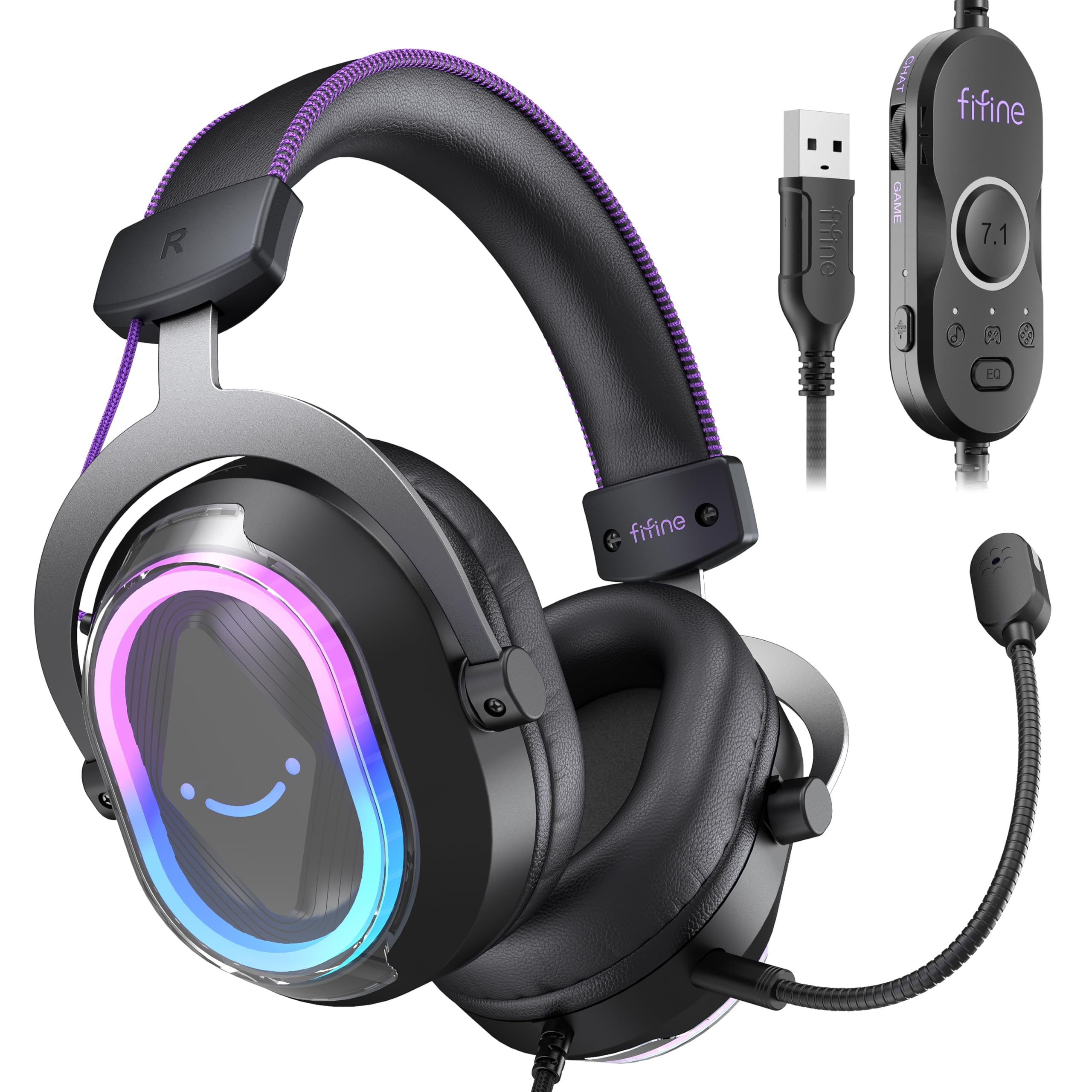
The FIFINE AmpliGame H13BP delivers surprising value at the entry level with features typically reserved for more expensive headsets. The new-gen 50mm dynamic drivers provide clear audio across high, mid, and low frequencies, with 7.1 surround sound that enhances spatial awareness in FPS and ARPG titles. The USB inline control box offers intuitive fingertip control for volume, mute, EQ game modes, and game/chat balance — a level of convenience uncommon at this price point. The 11-mode RGB lighting with transparent earcups creates a striking visual presence for streaming or LAN setups.
Comfort is handled by protein skin ear pads and soft memory foam cushions that remain comfortable during extended sessions. The closed-back design provides effective passive noise cancellation to block out room distractions. The 7.55-foot braided cable gives ample reach for desktop and console setups. Plug-and-play USB compatibility with PC, Mac, PS5, and PS4 requires no additional software. The noise-canceling microphone includes a mute indicator that glows red when muted, preventing communication errors.
Build quality uses plastic construction rather than metal, and customers note the ear cups don’t swivel much, which can affect fit for some head shapes. The cable can produce noise when rubbing against clothing. The pink color option may not appeal to all buyers. For gamers on a tight budget who want 7.1 surround sound, customizable RGB, and a full-featured control box, the H13BP punches well above its weight class.
Why it’s great
- 7.1 surround sound and 50mm drivers deliver impressive audio for the entry-level price
- Inline USB control box provides volume, EQ, game/chat balance, and mute controls
- 11-mode RGB lighting with transparent earcups enhances streaming aesthetics
- Protein skin ear pads with memory foam offer good comfort for extended use
Good to know
- Plastic construction lacks the durability of metal-framed alternatives
- Ear cups have limited swivel range, potentially affecting fit
- Cable can transmit noise when rubbing against clothing
FAQ
Does 7.1 surround sound actually improve gaming performance?
What difference does microphone bandwidth make for game chat?
Is wired or wireless better for competitive PC gaming?
How do I clean and maintain gaming headset ear cushions?
Final Thoughts: The Verdict
For most users, the best computer gaming headset winner is the Logitech G522 Lightspeed because it combines best-in-class microphone clarity, 60-hour battery life with triple-mode wireless, and lightweight comfort in a package that works across your entire gaming ecosystem. If you want competitive-focused positional audio with THX Spatial and exceptional battery endurance, grab the Razer BlackShark V3 Wireless. And for immersive head-tracking spatial audio with active noise cancellation, nothing beats the JBL Quantum 910X Wireless.

Mo Maruf
I created WellFizz to bridge the gap between vague wellness advice and actionable solutions. My mission is simple: to decode the research and give you practical tools you can actually use.
Beyond the data, I am a passionate traveler. I believe that stepping away from the screen to explore new environments is essential for mental clarity and physical vitality.