Our readers keep the lights on and my smoothie glass nicely filled. As an Amazon Associate, I earn from qualifying purchases.
Specs are compiled from manufacturer listings and verified buyer reviews and can change over time — please confirm the key details on the product page before buying.
Nothing kills a craft project faster than a computer that freezes mid-design. You drop hours into a layered SVG or a video render, and then the cursor stops moving. This guide matches the hardware to the files you actually open — Cricut patterns, 4K video timelines, or complex 3D models — so you buy something built for the work, not just a sticker on the box.
I’m Mohammad Maruf — the founder and writer behind WellFizz. This guide is built by comparing the manufacturers’ published specifications and the patterns across verified customer reviews, so you get each pick’s real strengths and trade-offs instead of marketing spin.
To keep rendering fast and prevent lag, the best computer for crafting pairs a processor with at least 6 cores with enough RAM (random-access memory, your short-term workspace) and a speedy SSD (solid-state drive) to keep your creative flow moving.
Quick Picks
- HP OmniDesk Desktop PC — Best Overall
- CyberPowerPC Gamer Xtreme GXiVR8040A19 — Desktop Power
- GEEKOM GeekBook X14 Pro Laptop — Travel Ready
- Skytech Gaming King 95 Gaming PC — Ultimate Power
- Acer Aspire Business Desktop — Budget Champion
- GEEKOM IT13 Mini PC — Compact Station
- Lenovo IdeaCentre Business Tower Desktop — Business Ready
- Apple MacBook Air 15-inch with M4 chip — Mainstream Power
- Apple MacBook Neo 13-inch with A18 Pro chip — Mac Entry Point
- Dell Pro Tower Plus Desktop — Business Power
How To Choose The Best Computer For Crafting
Before you buy, focus on three hardware pillars: the processor (CPU) to handle rendering, the RAM to keep multiple design apps open, and the storage drive to load your massive craft files in seconds rather than minutes.
CPU: The Engine Behind Your Render Times
For crafting apps like Adobe Illustrator, Cricut Design Space, or Blender, you want a processor with at least 6 cores. A 13th Gen Intel Core i5 or an AMD Ryzen 7 gives you the muscle to render previews quickly without bogging down in other tasks.
RAM: Your Multitasking Limit
16GB is the minimum for a smooth crafting workflow; 32GB lets you keep a browser, your design software, and a video render all open without stuttering. More RAM means you do not have to close your reference images every time you run a render.
Storage: NVMe SSDs Are Non-Negotiable
Large craft files — high-res SVG patterns, layered Photoshop documents, video clips — load instantly from an NVMe SSD. A 512GB or 1TB high-speed drive is your smartest upgrade, especially if you work with 4K video or complex 3D models.
Quick Comparison
| Model | Best For | CPU Speed | RAM | Storage | Amazon |
|---|---|---|---|---|---|
| HP OmniDesk | All-around Creative Power | 5.1 GHz | 32GB DDR5 | 1TB NVMe SSD | Amazon |
| CyberPowerPC GXiVR8040A19 | Rendering & Light Gaming | 2.1 GHz | 16GB DDR5 | 1TB PCIe 4.0 SSD | Amazon |
| GEEKOM GeekBook X14 Pro | Portable Crafting Workstation | 5.1 GHz | 32GB LPDDR5x | 1TB NVMe SSD | Amazon |
| Skytech Gaming King 95 | Demanding 3D & 4K Video | 5.6 GHz | 32GB DDR5 6000 | 2TB NVMe SSD | Amazon |
| Acer Aspire Business Desktop | Budget Design Starter | 4.4 GHz | 16GB DDR5 | 1TB (512GB SSD + 500GB HDD) | Amazon |
| GEEKOM IT13 Mini PC | Compact Crafting Station | 4.8 GHz | 16GB DDR5 | 1TB NVMe SSD | Amazon |
| Lenovo IdeaCentre Tower | Office & Light Craft Software | 4.4 GHz | 16GB DDR5 | 756GB (256GB SSD + 500GB HDD) | Amazon |
| Apple MacBook Air M4 15-inch | Creative On the Go | M4 chip | 16GB Unified Memory | 512GB SSD | Amazon |
| Apple MacBook Neo 13-inch | Everyday Crafting & Portability | A18 Pro chip | 8GB Unified Memory | 256GB SSD | Amazon |
| Dell Pro Tower Plus | Business Creative Work | Ultra 5 235 | 32GB DDR5 | 1TB PCIe SSD | Amazon |
In‑Depth Reviews
1. HP OmniDesk Desktop PC
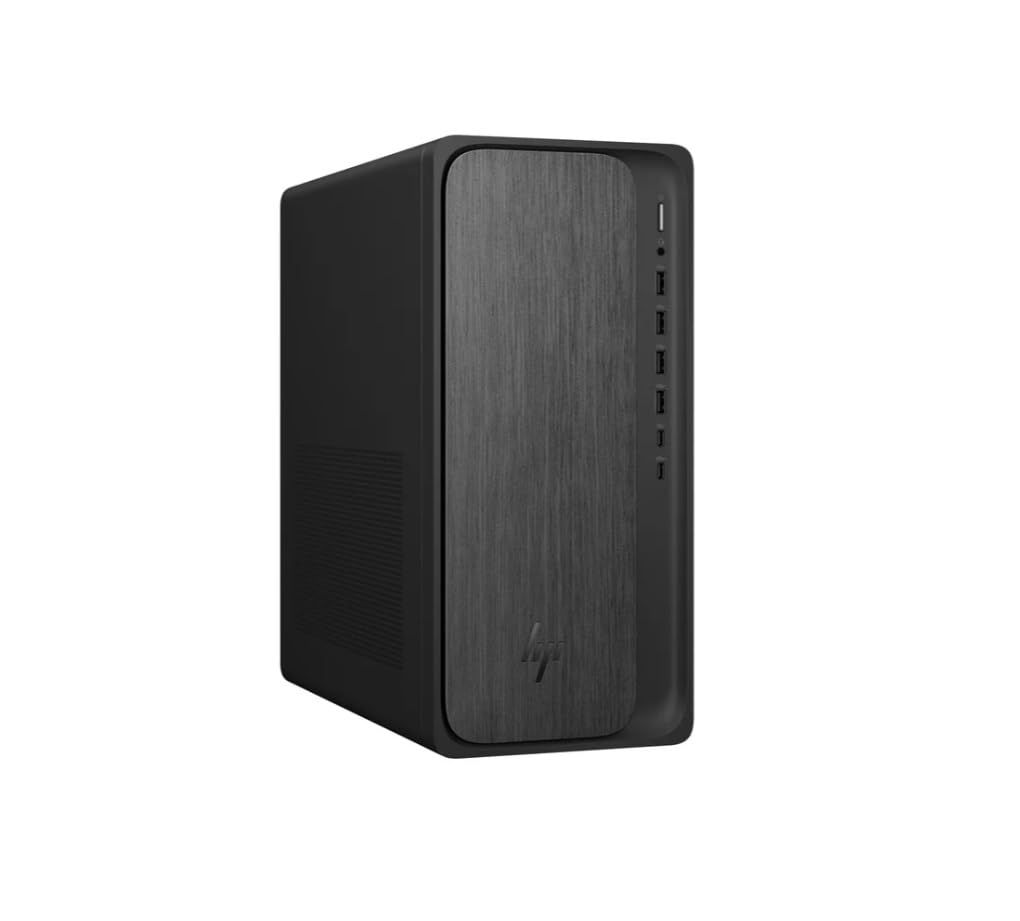
The HP OmniDesk packs 32GB of DDR5 memory — double what most mid-range desktops carry — so you keep Blender, Photoshop, and a dozen browser tabs open without the system slowing down.
With 32GB of DDR5 RAM (the latest, faster-generation memory), this HP lets you stack a video render in the background while you continue editing SVG files in Cricut Design Space. The AMD Ryzen 7 8700G (a central processor) hits up to 5.1 GHz, meaning preview renders and complex file exports finish noticeably faster than on a 4.0 GHz chip. Buyers report the built-in AMD Radeon 780M graphics (a graphics processor built into the CPU) handle light 3D modeling and 4K media playback smoothly.
At 12.40 inches deep and 6.10 inches wide, it fits on a desk without dominating the space. The included keyboard and mouse get you started immediately — though owners mention the keyboard quality lags behind the rest of the machine. Wi-Fi 6 (the current wireless standard for fast, stable connections) and Bluetooth 5.4 (short-range wireless for peripherals) are built in, so hooking up a wireless tablet or transferring files from a network drive is quick. The 1TB NVMe SSD (a very fast solid-state drive that plugs directly into the motherboard) gives you room for several large software installs and ongoing projects.
What It Does Best
- 32GB DDR5 RAM keeps multiple design apps running smoothly
- Radeon 780M integrated graphics handle 4K video playback and light 3D renders
- 1TB NVMe SSD loads large project files in seconds
A Couple of Trade-offs
- Included keyboard feels cheap for the price tier
- Integrated graphics limit heavy 3D rendering compared to the CyberPowerPC’s dedicated GPU
Who it fits: Crafters who multitask heavily between design software, want 32GB RAM from the start, and prefer a compact desktop for a clean workstation.
What to note: The bundled mouse and keyboard are not great — you will likely want to replace them early.
2. CyberPowerPC Gamer Xtreme GXiVR8040A19
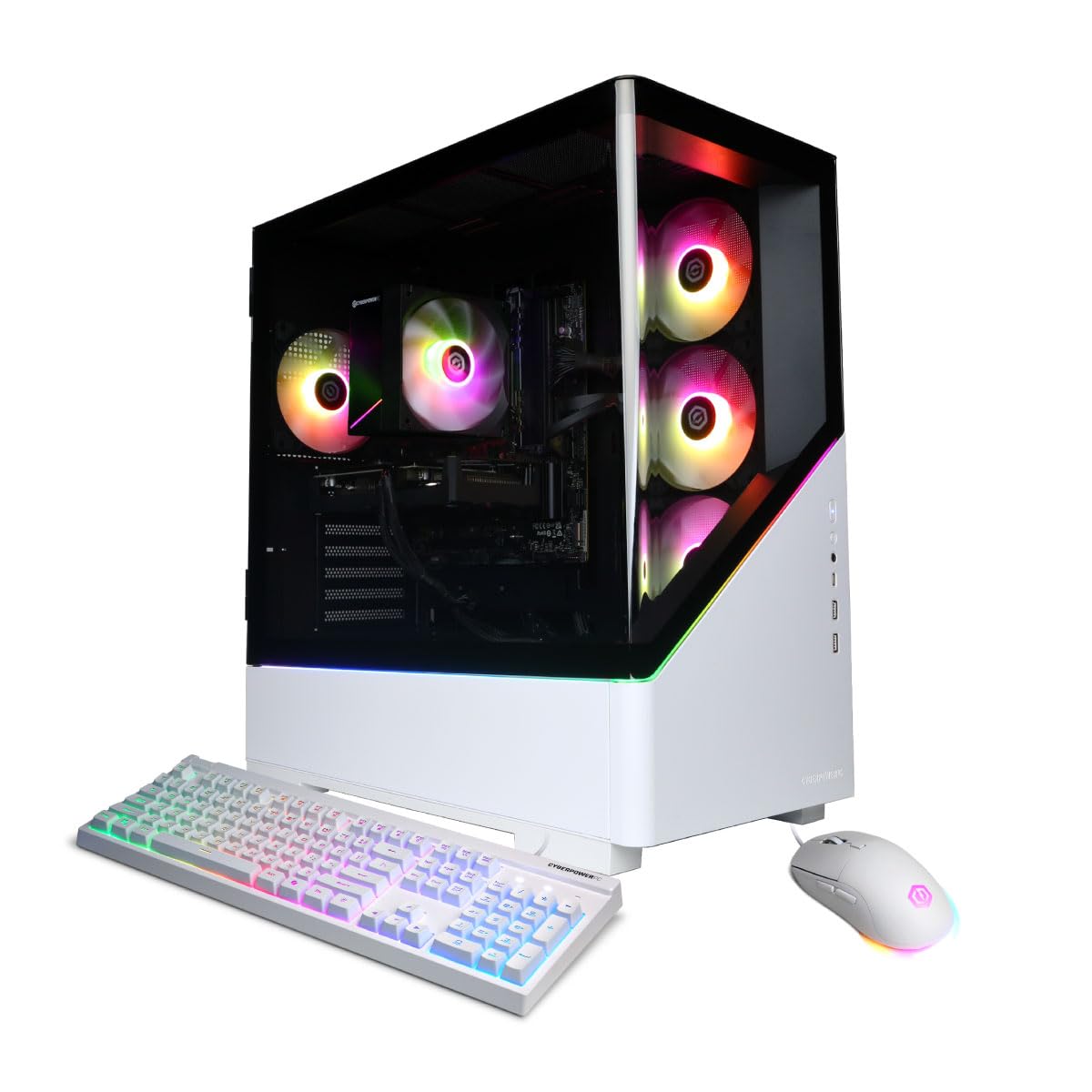
Unlike the HP OmniDesk above, this CyberPowerPC brings a dedicated graphics card — an NVIDIA GeForce RTX 5060 Ti with 8GB of GDDR7 video memory — so GPU-accelerated rendering in DaVinci Resolve or Blender does not share memory with the system.
The Intel Core i7-14700F has 20 cores (processing units), giving it raw multi-threaded strength to crunch through video exports and complex design compiles. Customers note it runs demanding games at high settings smoothly, which tells you it handles the heaviest creative workloads. The 16GB of DDR5 RAM is a baseline for crafting — enough for most tasks, but you may want to upgrade if you often run 4K video editing alongside other heavy apps. The 1TB PCIe 4.0 NVMe SSD (the fastest current SSD standard) is spacious and fast. Build quality is solid, with a tempered glass side panel and customizable RGB lighting, and buyers mention it arrives ready to go with no bloatware. The included keyboard and mouse are usable but bare-bones, and the 1-year warranty plus free lifetime tech support offer confidence.
Rendering power: The dedicated RTX 5060 Ti 8GB GPU crushes GPU-based rendering tasks that would bog down the HP OmniDesk’s integrated graphics — a clear lead for video and 3D work.
RAM note: 16GB is fine for most crafting, but if you routinely work with massive layered files, the HP or Dell’s 32GB will feel more fluid.
Best for: Crafters who need serious GPU power for rendering, 3D modeling, or video editing and want a prebuilt that can also play the latest games.
Watch for: The 16GB RAM cap may feel tight if you run multiple heavy design apps side by side.
3. GEEKOM GeekBook X14 Pro Laptop
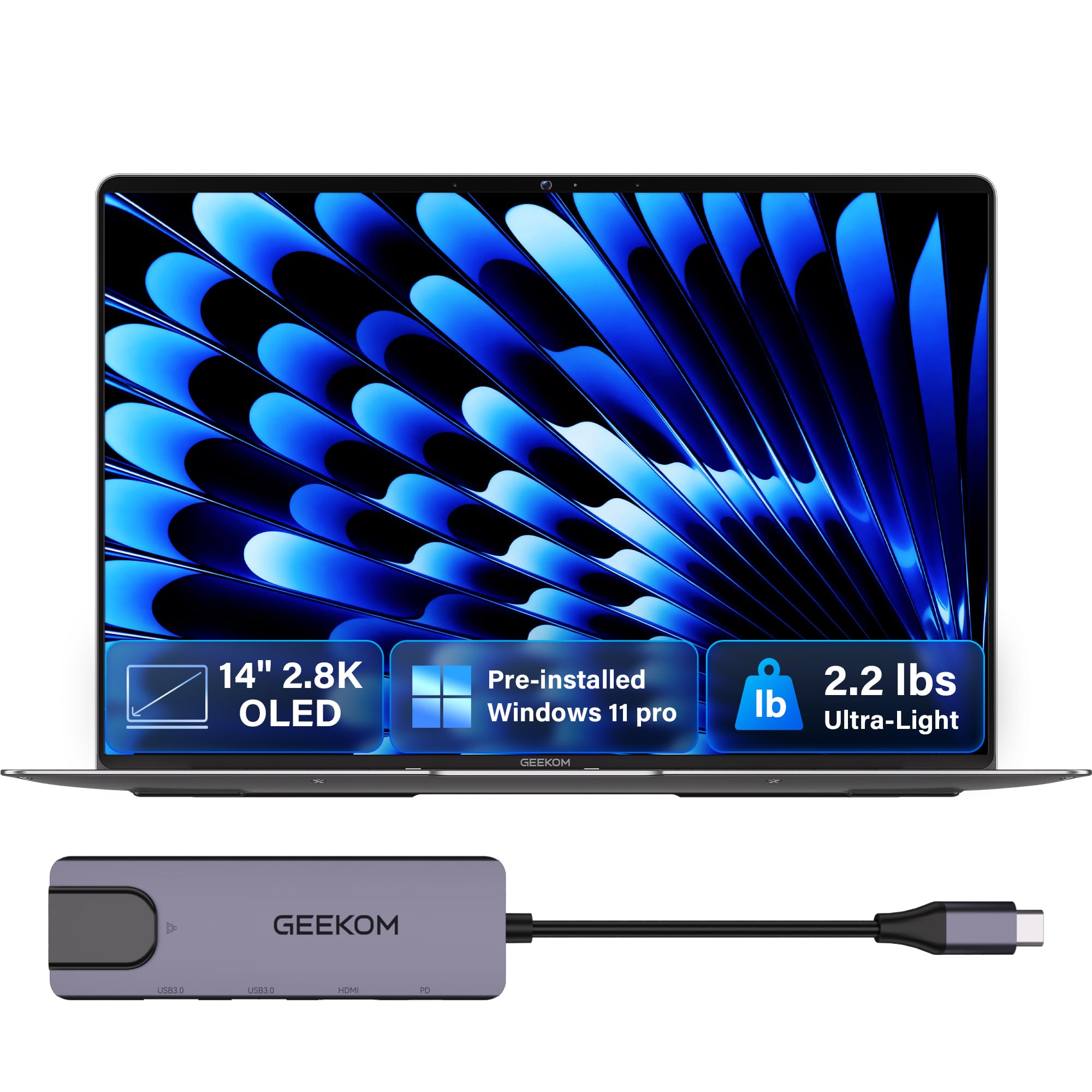
Weighing just 2.2 pounds, this GeekBook is the easiest machine to toss into a craft tote — and its 14-inch 2.8K OLED display makes your craft colors look lifelike anywhere.
The 2.8K (2880 x 1800) OLED (organic light-emitting diode, a screen type with deep blacks and vivid colors) display covers 100% DCI-P3 — a wide color space critical for designers who need to see accurate hues in fabric, vinyl, or digital patterns. The 120Hz refresh rate (how many times the screen updates per second) makes scrolling through long design timelines feel smooth, and the up to 450 nits (a unit of brightness) of brightness means you see fine details even in a bright room. The Intel Core Ultra 9 185H processor with 16 cores and 32GB of ultra-fast LPDDR5x (low-power DDR5) RAM at 7500MHz gives this laptop enough power to handle multi-layer Photoshop files, light video editing, and browser-heavy research simultaneously.
Reviewers point out the battery lasts around 12-14 hours for light browsing and about six hours for intensive work, meaning a full afternoon of crafting without hunting for a plug. This matters more for on-the-go crafters than the MacBook Neo’s 16 hours because the GeekBook’s OLED display and higher RAM make it better suited for actual design work in the field. The included docking station adds extra ports. The camera does not support Windows Hello facial recognition, but the fingerprint reader works reliably.
Display impact: The 2.8K OLED at 100% DCI-P3 means what you see on screen matches printed craft materials far better than the Lenovo’s standard 1080p screen — a real advantage for color-sensitive work.
Portability: At 2.2 pounds and with a 72Wh (watt-hour, a measure of battery energy capacity) battery, this laptop easily outlasts and out-lights the MacBook Neo for creative field work.
Ideal for: On-the-go crafters who need an accurate color display, plenty of RAM, and a featherlight build for commuting or travel.
Consider: The lack of Windows Hello facial recognition may be a minor inconvenience if you use auto-login heavily.
4. Skytech Gaming King 95 Gaming PC
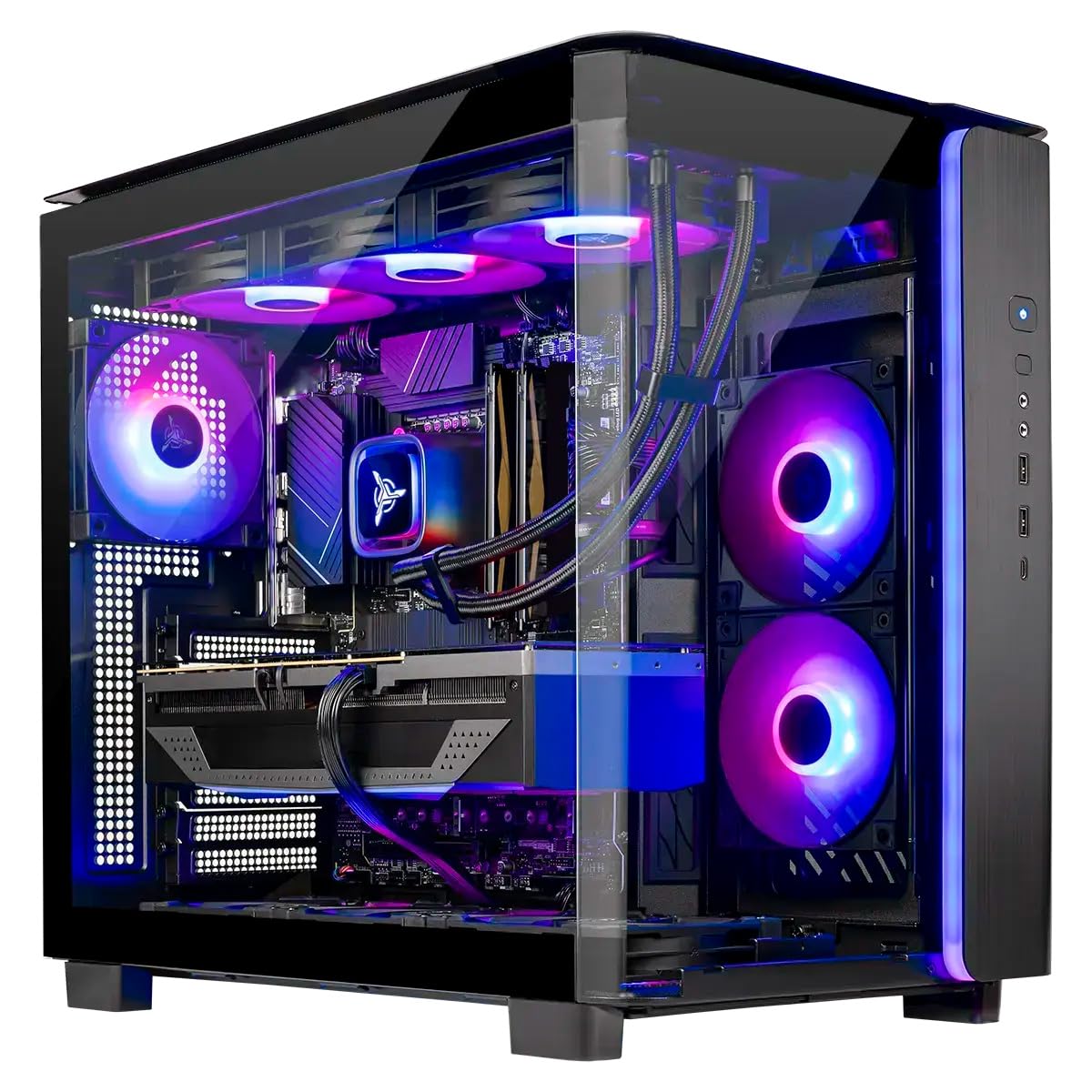
The Skytech King 95 chews through 4K video exports and massive 3D renders without breaking a sweat — it is the most powerful pick on this list, and by a long shot.
If your craft work involves 4K video editing, complex 3D modeling in Blender, or rendering large-scale vector projects, this is the one. The NVIDIA GeForce RTX 5080 with 16GB of GDDR7 VRAM (video RAM dedicated to graphics tasks) is a generation ahead of everything else here — it handles GPU-accelerated tasks like real-time ray tracing and high-resolution video transcoding with ease. The AMD Ryzen 7 9850X3D processor boosts up to 5.6 GHz, and with 32GB of DDR5 RAM at 6000MHz, you have the headroom to run multiple heavy creative apps simultaneously without slowdown.
Storage is a 2TB NVMe SSD, double what most machines offer, so you can keep your entire project library installed. The 850W Gold ATX 3 power supply and 360mm AIO (all-in-one) liquid cooler keep the system stable under sustained loads — something the HP OmniDesk’s fan-based cooling may struggle with during long renders. Reviewers report it runs AAA games at max 1440p with high frame rates — a solid signal your rendering projects will fly. The King 95 case is visually stunning with ARGB fans, but the system uses Wi-Fi 5, which is slower than the Wi-Fi 6E found on the GEEKOM IT13 below, so large file transfers over your network may lag.
Strengths
- RTX 5080 16GB GPU is class-leading for GPU rendering and 4K video editing
- 2TB NVMe SSD holds your entire project library without extra drives
- 32GB DDR5 6000 RAM and liquid cooling keep everything stable under full load
Limitations
- Wi-Fi 5 is dated — wired Ethernet is better for large transfers
- Premium price is overkill for simple SVG or photo editing
Who needs this: Professional crafters, video editors, and 3D designers who cannot afford rendering delays and want the fastest prebuilt desktop available.
skip it if: Your work is mostly Cricut patterns, photo editing, or office tasks — this is more power than you will use.
5. Acer Aspire Business Desktop
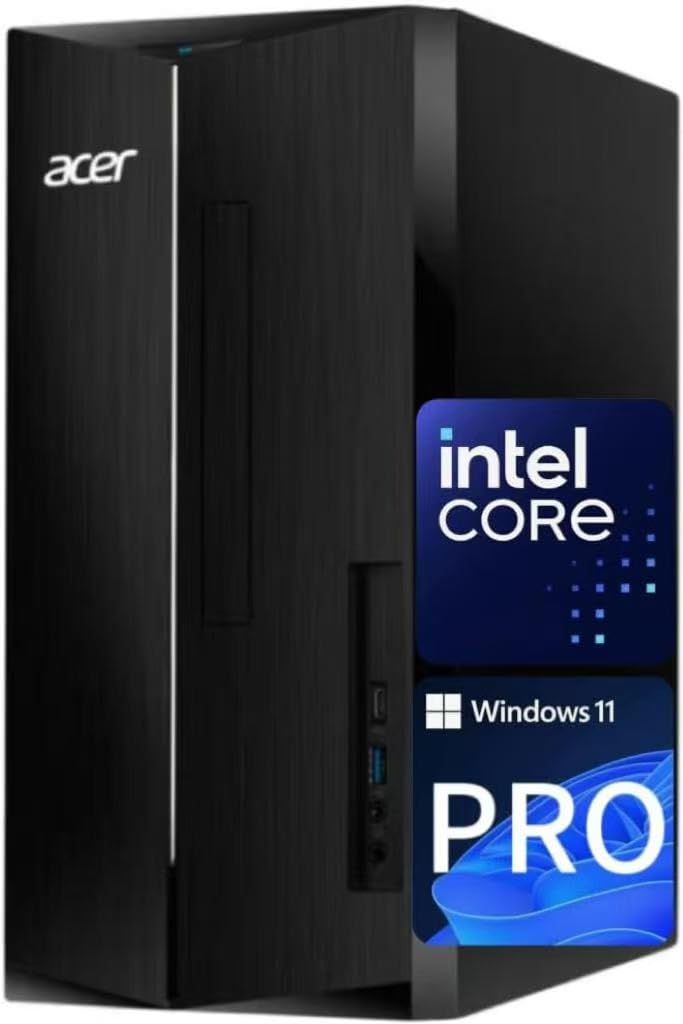
The Acer Aspire gets you 16GB of DDR5 RAM and a fast SSD without breaking your budget — it undercuts the HP OmniDesk on price while covering the essentials for 2D design.
This Acer is the most affordable option with 16GB of DDR5 RAM and a combined 1TB storage setup — a 512GB NVMe SSD for your operating system and frequent project files, plus a 500GB HDD (hard disk drive, a slower mechanical drive) for archiving completed designs. The 14th Gen Intel Core i3-14100T processor runs at 4.4 GHz, which is plenty for running Cricut Design Space, Silhouette Studio, or PhotoPad without frustration. Shoppers say the system is fast from the start and easy to set up, with one buyer mentioning the extra hard drive arrived in a box to be used as a mobile drive.
It ships with a USB keyboard and mouse, Wi-Fi 6, and Windows 11 Pro (the professional edition with extra security and management features, though most crafters can use the Home edition just fine). The integrated graphics are adequate for 2D design work and basic photo editing, but you should not expect smooth 3D rendering or video editing. The 300-watt power supply is modest, so future GPU (graphics processing unit) upgrades will be limited. For the price, this offers solid value as a dedicated crafting machine that leaves room in your budget for a quality monitor and peripherals — something the Lenovo IdeaCentre below cannot match with its smaller SSD.
Storage value: With 1TB total (512GB SSD + 500GB HDD), this Acer gives you more combined storage than the similarly priced Lenovo tower, which has 756GB.
Performance note: The i3-14100T handles design software well, but it trails the HP OmniDesk’s Ryzen 7 8700G by a wide margin for rendering tasks.
Reach for this if: You need a dedicated crafting desktop on a tight budget and your work stays within 2D design, SVG editing, and light photo retouching.
Keep in mind: The integrated graphics and 300W PSU mean this is not the base for future 3D or video editing upgrades.
6. GEEKOM IT13 Mini PC
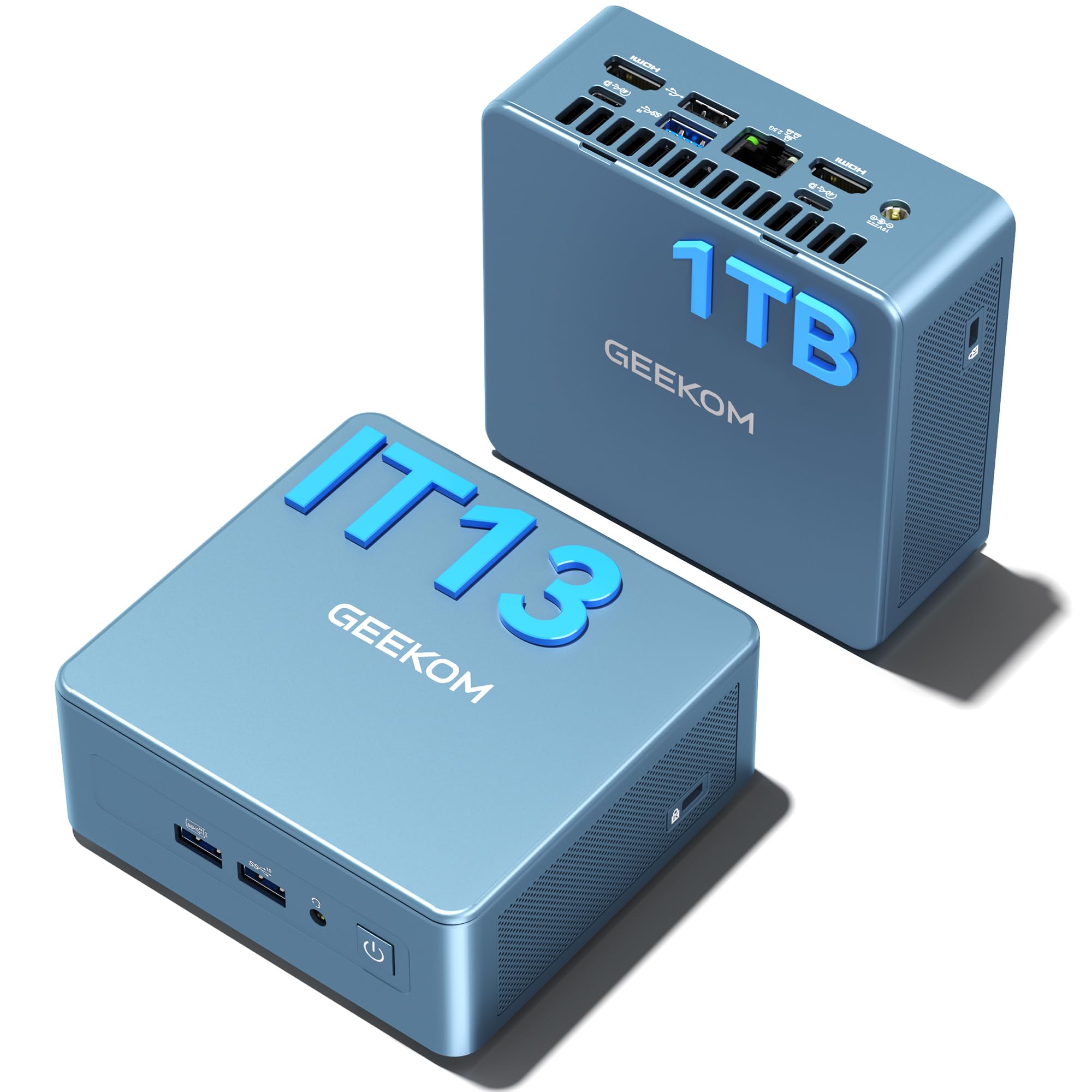
Unlike the bulky towers above, this GEEKOM IT13 is a mini PC about the size of a small notebook — yet it drives four displays and fits in your palm.
It packs a 13th Gen Intel Core i5-13600H with 12 cores that boost to 4.8 GHz — 9% more peak speed than the Lenovo tower’s 4.4 GHz, which means snappier single-threaded tasks in design software. The 16GB of DDR5 RAM is upgradeable to 96GB, giving you room to grow. Buyers report it handles dual 4K monitors without any lag, making it a quiet, responsive craft workstation that frees up desk space. The IT13 drives up to four displays via dual USB4 ports (a very fast connection standard, 40Gbps) and supports 8K output.
Wi-Fi 6E (an updated wireless standard using the 6 GHz band for less interference) and 2.5G Ethernet (wired network at 2.5 gigabits per second) keep your network transfers fast. The metal frame is rated to withstand up to 440 lbs of static pressure, so it is rugged enough for a workshop or retail counter. One reviewer noted the default fan profile can be loud, but a BIOS (basic input/output system, the low-level software that boots the computer) tweak solves it. The 3-year warranty is longer than most desktops offer, adding confidence for long-term use.
Why It Shines
- Four-display support via dual USB4 and HDMI is rare in a mini PC this size
- CPU speed (4.8 GHz) beats the Lenovo IdeaCentre (4.4 GHz) by a clean margin
- 3-year warranty gives better long-term coverage than most competitors
Catch
- May need BIOS tweaks and specific HDMI cables for optimal multi-monitor setup
- Limited internal expansion compared to a tower desktop
Perfect for: Crafters who want a powerful, compact desktop that can run multiple monitors for a multi-window design workflow without taking over the desk.
Small trade-off: Plan for some initial setup tweaking if you connect multiple displays right away.
7. Lenovo IdeaCentre Business Tower Desktop
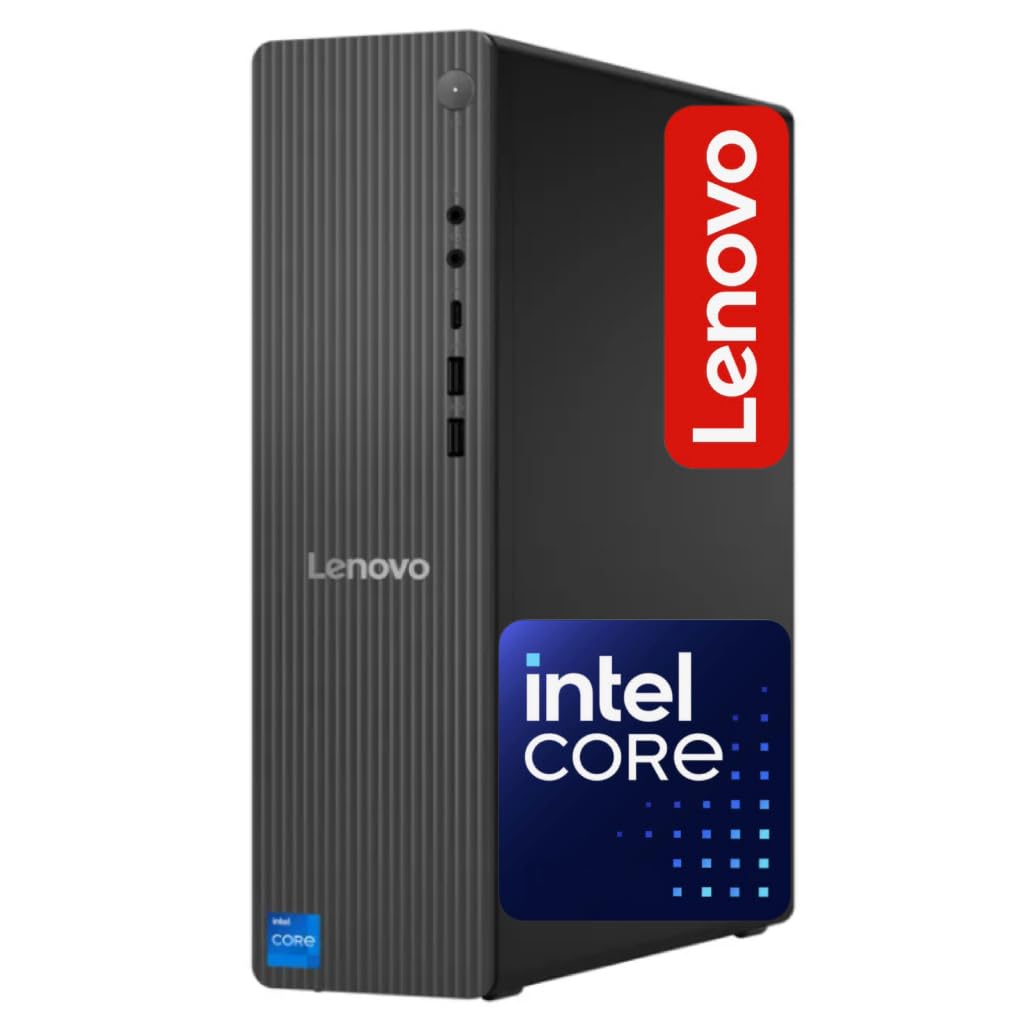
The Lenovo IdeaCentre is a dependable workplace tower that handles everyday crafting software — but its smaller SSD and potential dual-monitor headaches make it less flexible than the Acer above.
It is built around the same 14th Gen Intel Core i3-14100T as the Acer, hitting 4.4 GHz with 4 cores, but offers less total storage — 756GB split between a 256GB SSD and a 500GB HDD. The SSD is just enough for your operating system and a few design apps, but you will need the HDD for archived projects and reference images. Compared to the Acer’s 1TB setup, this gives you significantly less fast storage for active project files. One buyer mentioned trouble getting dual monitors to display and work properly, which is note if your craft workflow uses multiple screens.
The integrated graphics handle standard 2D design and office tasks well. Wi-Fi 6E and Bluetooth 5.2 (short-range wireless standard for peripherals) are modern and keep your peripheral connections fast. At 22.1 x 16 x 10.8 inches, the tower is larger than the mini PC options, but it offers more internal room for expansion. Windows 11 Pro comes pre-installed with a keyboard and mouse included.
Storage reality: With 256GB SSD + 500GB HDD, this Lenovo offers 756GB total — less than the Acer’s 1TB and the HP’s 1TB SSD, so you may hit limits sooner if you store many large project files locally.
Multi-monitor note: The 3-star review mentioning dual-monitor setup issues is a real flag if your crafting depends on a multi-screen layout.
Who it works for: Budget-conscious buyers who mainly use single-monitor crafting apps and want a Lenovo with a clean Windows 11 Pro setup.
Heads-up: The smaller SSD and potential dual-monitor headaches make it less flexible than the Acer or GEEKOM mini PC for multi-screen crafters.
8. Apple MacBook Air 15-inch with M4 chip

The MacBook Air with the M4 chip delivers a silent, fanless design and up to 18 hours of battery life — so you can craft on the go all day without a charger.
This MacBook Air runs the Apple M4 chip, which brings powerful neural engine capabilities for AI-accelerated tasks in apps like Adobe Creative Cloud and DaVinci Resolve. The 15.3-inch Liquid Retina display (Apple’s high-resolution LCD with rounded corners) supports 1 billion colors, which means your craft designs show incredibly smooth gradients and no visible banding. With 16GB of unified memory (RAM built directly into the chip for faster access), it handles multitasking between design apps, a browser, and communication tools without stuttering. Up to 18 hours of battery life means you can craft on the go all day without a charger.
Compared to the MacBook Neo below, this Air offers double the RAM (16GB vs 8GB), a larger display, and the M4 chip is significantly faster for rendering and video editing. The 12MP Center Stage camera and six-speaker Spatial Audio system are excellent for design review calls. The 512GB SSD is a healthy starting point for creative files, though you may need external storage for massive video libraries. The fanless design means it never makes noise, even under load — a clear advantage over the CyberPowerPC’s cooling fans for focused work — and reviewers praise the premium aluminum build.
What Makes It Stand Out
- 18-hour battery life outlasts most Windows laptops for all-day crafting sessions
- M4 chip provides faster app launches and smoother multitasking than the Neo’s A18 Pro
- Silent, fanless operation means zero noise interference during focused work
Limitations
- 512GB SSD fills faster if you work with large 4K video files
- No Touch Bar or extra ports beyond Thunderbolt 4 and MagSafe
Best for: Creative professionals and serious crafters who want a powerful, portable MacBook with excellent battery life, a large screen, and silent operation for uninterrupted design work.
Consider: The 8GB RAM in the MacBook Neo is a strict step down — the Air’s 16GB is the real starting point for creative multitasking.
9. Apple MacBook Neo 13-inch with A18 Pro chip

The MacBook Neo is the most affordable MacBook ever — great for web-based crafting apps, but tight for heavy design software due to its 8GB of RAM.
As the entry point into the Mac ecosystem, the MacBook Neo with the A18 Pro chip offers a durable aluminum chassis, a sharp 13-inch Liquid Retina display, and up to 16 hours of battery life. It handles web-based craft tools, light photo editing, and document creation smoothly. The 1080p FaceTime HD camera is excellent for video calls. Owners mention it is a fantastic upgrade over older budget laptops, with one reviewer calling it “super snappy” and “as fast as my Workstation/Gaming PC when loading web pages and videos.” The 8GB of unified memory is a third of what the MacBook Air (M4) offers, however.
The major trade-off for crafters is the 8GB RAM and 256GB SSD — both half of what the M4 MacBook Air provides. With 8GB, you will hit memory limits quickly if you run Photoshop, a browser with many reference tabs, plus a design app. The 256GB SSD fills fast with craft software installs and project files. The Neo does not have a backlit keyboard, and one of its two USB-C ports (a standard reversible connector) runs at USB 2.0 speeds, which slows large file transfers to external drives. It is a solid web-browsing and light-work machine, but crafters who push their hardware hard will soon feel the limits.
RAM divide: At 8GB, the Neo offers 2.0x less RAM than the Acer Aspire’s 16GB — a meaningful gap for anyone running multiple design applications simultaneously.
Storage trade: The 256GB SSD is 3.0x smaller than the MacBook Air M4’s 512GB, so you will need to offload projects to external drives sooner.
Suits: Mac-curious crafters who mainly use web-based tools, basic photo editing, and document work, and prioritize portability and battery life over heavy multitasking.
pass on it if: You regularly edit large design files, run Photoshop alongside multiple apps, or need more than 256GB of local storage.
10. Dell Pro Tower Plus Desktop
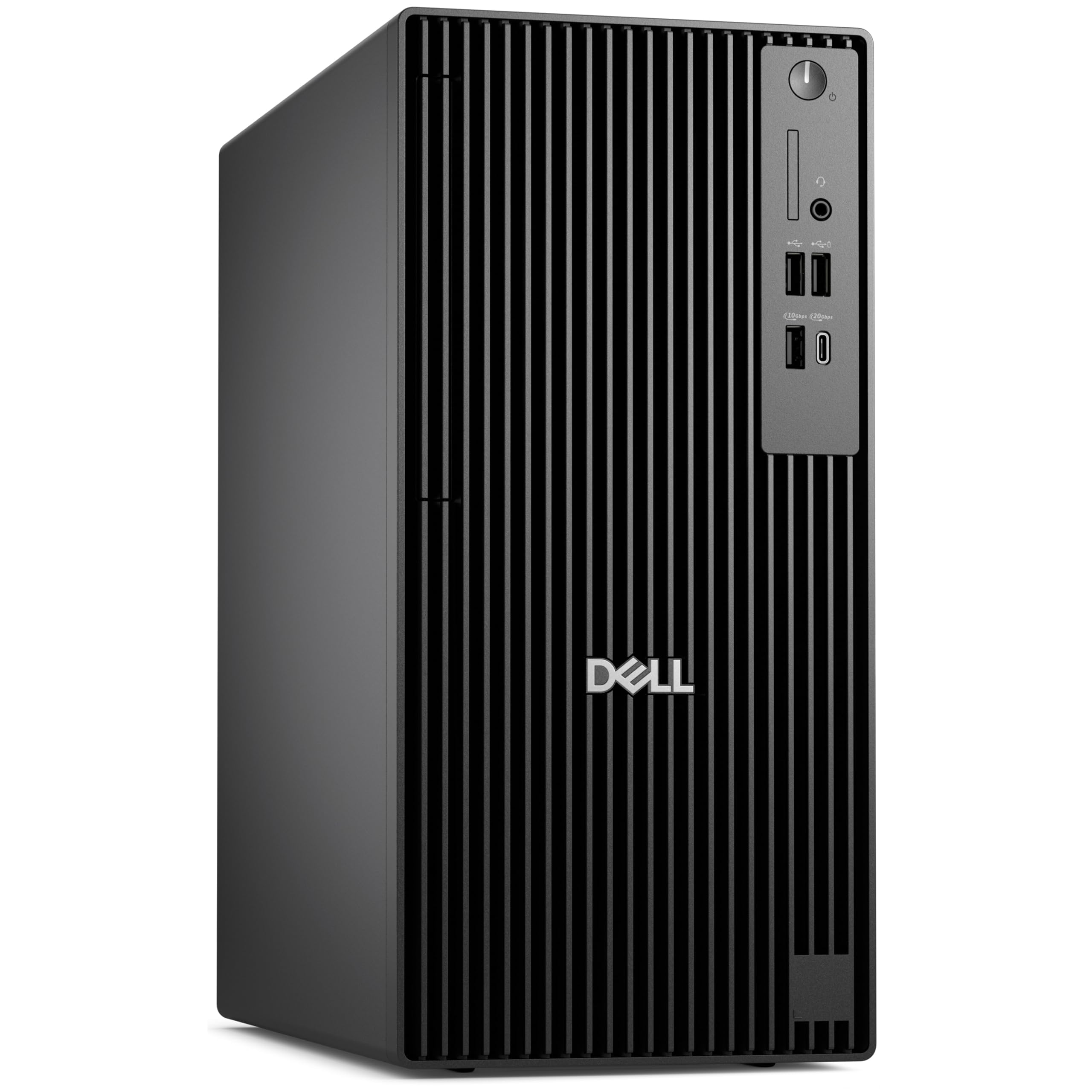
The Dell Pro Tower Plus comes with 32GB of DDR5 RAM — the same generous amount as the HP OmniDesk — paired with Dell’s business reliability for professional environments.
It uses an Intel 14-core Ultra 5 235 processor, making it well-suited for multitasking across heavy design software, web browsers, and office applications. The 1TB PCIe SSD (a high-speed solid-state drive using the PCI Express interface) provides fast boot and load times. The integrated Intel graphics handle standard 2D design and photo editing, but like the Lenovo and Acer, it lacks a dedicated GPU for 3D modeling or video editing. At 12.77 x 6.06 x 11.54 inches, it is a compact tower that fits easily on a desk or under it.
One owner reported their unit arrived bricked, though the return process was easy. The machine runs Windows 11 Professional and includes a keyboard. For crafters who need a reliable business-class desktop with ample RAM for running multiple design apps simultaneously, this Dell is a solid contender. The integrated graphics mean you should not expect smooth 4K video timeline playback during editing, but for 2D work and office crafting, it is well-matched. It is the pick for buyers who want 32GB RAM and Dell’s enterprise support without the CyberPowerPC’s dedicated GPU.
Highlights
- 32GB DDR5 RAM matches the HP OmniDesk for heavy multitasking
- Compact tower design saves desk space without sacrificing expandability
- Windows 11 Pro is ideal for business and professional environments
Concerns
- Integrated Intel graphics limit creative work to 2D design and photo editing
- One reported bricked unit, though returns were handled smoothly
Fits: Professionals who need a business-grade tower with 32GB RAM for RAM-hungry design apps and want Dell’s enterprise support infrastructure.
Worth noting: The lack of a dedicated GPU means buyers doing 3D rendering or video editing should look at the CyberPowerPC or Skytech options instead.
Understanding the Specs
CPU Cores & Clock Speed
The processor (CPU, central processing unit) is your computer’s brain. More cores let it handle multiple tasks at once — like running a design app, rendering a preview, and streaming a tutorial simultaneously. Higher clock speed (measured in GHz, gigahertz) makes each individual task faster. For crafting, aim for at least 6 cores and a speed of 4.0 GHz or higher for responsive performance.
RAM: How Much Is Enough?
RAM (random-access memory) is your workspace. 16GB is the baseline for running a single design app plus a browser comfortably. 32GB lets you keep multiple heavy apps, dozens of browser tabs, and large reference files open simultaneously. You cannot upgrade RAM on many laptops, so choose wisely upfront. Desktop towers typically allow easy RAM upgrades later.
FAQ
Do I need a dedicated graphics card for crafting software?
Is 8GB RAM enough for a crafting computer?
Can a mini PC handle large craft design files?
Do Macs work with Cricut Design Space and other craft software?
Is an SSD better than an HDD for a crafting PC?
How much storage do I need for a crafting computer?
Can I use a gaming PC for crafting?
What is the difference between DDR4 and DDR5 RAM for crafting?
Does Windows 11 Pro matter for crafting?
How long should a crafting computer last?
Final Thoughts: The Verdict
For most buyers, the computer for crafting winner is the HP OmniDesk Desktop because it delivers 32GB of DDR5 RAM, a fast Ryzen 7 processor, and Radeon 780M graphics in a compact tower that handles everything from 2D design to light 3D rendering without breaking a sweat. If you want portable power with a stunning OLED display, grab the GEEKOM GeekBook X14 Pro. And for heavy rendering and 4K video editing, the Skytech Gaming King 95 with its RTX 5080 GPU is the desktop that leaves no project unturned.
How We Picked
We do not accept paid placement. Every pick is matched to a real buyer and a real use-case; we do not hands-on test units.
Sources & Methodology
Specifications: manufacturer listings and product documentation. Review insights: verified customer reviews, as of July 2026. Pricing: not shown on this page (it changes often); check the current price via the retailer link.
As an Amazon Associate, WellFizz earns from qualifying purchases. This does not affect which products we feature.
Related Guides

Mo Maruf
I created WellFizz to bridge the gap between vague wellness advice and actionable solutions. My mission is simple: to decode the research and give you practical tools you can actually use.
Beyond the data, I am a passionate traveler. I believe that stepping away from the screen to explore new environments is essential for mental clarity and physical vitality.