Our readers keep the lights on and my smoothie glass nicely filled. As an Amazon Associate, I earn from qualifying purchases.
Specs are compiled from manufacturer listings and verified buyer reviews and can change over time — please confirm the key details on the product page before buying.
That first hard freeze can crack your sprinkler pipes if water is still sitting inside them. A compressor built for winterizing pushes a steady stream of air through each zone, forcing every drop out before ice forms. You need one with enough air volume (measured in CFM, or cubic feet per minute) to clear your pipe length, a tank big enough to hold pressure without refilling every few seconds, and a weight you can drag from the garage to the back yard in one trip.
I’m Mohammad Maruf — the founder and writer behind WellFizz. This guide is built by comparing the manufacturers’ published specifications and the patterns across verified customer reviews, so you get each pick’s real strengths and trade-offs instead of marketing spin.
Look for a compressor that delivers enough cubic feet per minute (CFM) — the rate air flows out — to push water through several sprinkler heads at once. You also want a tank that stores enough compressed air to clear each zone without stopping. Think of this as a field manual for picking a compressor for blowing out sprinklers that actually finishes the job before winter arrives.
Our Picks at a Glance

How To Choose The Best Compressor For Blowing Out Sprinklers
If you pick the wrong air compressor for winterizing, you could leave standing water in a line that freezes and splits your underground pipe. Focus on three real numbers — CFM at working pressure, tank volume, and physical weight — and the choice becomes simple.
Airflow: CFM at 90 PSI Is the Real Number
Maximum PSI (the peak pressure the tank holds) looks impressive on the box. But cubic feet per minute (CFM) at 90 PSI — the air flow you get while the tool is running — tells you whether the compressor can push a solid column of air through a long ¾-inch poly pipe. For blowing out sprinklers, you generally want at least 2.0 CFM at 90 PSI for a typical residential zone. A unit delivering 2.6 CFM or more clears heads faster and handles longer runs without stalling.
Tank Size Balances Capacity and Recharge Time
A bigger tank lets you open a whole zone and keep air moving for several seconds before the pressure drops too low to push water. For sprinkler winterization, 4.6 to 6 gallons is the balance — enough volume to clear most zones in one burst, but not so big that refilling it takes minutes between zones. Larger 8-gallon models give you a wider cushion for very long or multi-branch sprinkler systems.
Oil-Free vs. Oil-Lubed Pump
An oil-free pump means zero maintenance and no risk of oil mist getting into the air line that feeds your sprinkler pipes. That matters here because you do not want petroleum residue inside drinking water lines or affecting drip irrigation (a method that delivers water slowly to plant roots). The trade-off is that oil-free compressors are slightly louder than oil-lubed units, but for seasonal yard work that noise is rarely an issue.
Weight and Portability
Blowing out sprinklers means moving the compressor from the garage to the side yard, possibly over grass or gravel. A pancake-style compressor around 30 pounds with a built-in handle rolls or carries much easier than a heavy horizontal tank that requires two hands. Check the listed weight and handle design — if it needs a dolly to get out the back door, you will find excuses to skip the job.
Quick Comparison
| Model | Best For | CFM @ 90 PSI | Tank Size | Weight | Amazon |
|---|---|---|---|---|---|
| VEVOR 4.8 Gal★ Best Overall | Quietest run at a moderate price | 2.2 CFM | 4.8 gal | 34 lb | Amazon |
| Metabo HPT EC711SAlso Great | Highest pressure for long lines | 2.8 CFM | 6 gal | 38.5 lb | Amazon |
| Baotree 8G Air Compress | Largest tank for heavy systems | 2.8 CFM | 8 gal | 30.9 lb | Amazon |
| ECOMAX 6 Gal (0210673) | Best air volume-to-weight ratio | 2.6 CFM | 6 gal | 27.6 lb | Amazon |
| ECOMAX 6 Gal Plus Kit | Complete kit from the start | — | 6 gal | 34.17 lb | Amazon |
| VEVOR 4.6 Gal | Premium brand at a mid-range price | 2.2 CFM | 4.6 gal | 41.9 lb | Amazon |
In‑Depth Reviews
1. VEVOR 4.8 Gallon Air Compressor, 1.2HP 70 dB Ultra Quiet
Our pick — 4.5★ from 400+ verified ratings; the strongest balance of quality and price.
Low enough in decibels that your neighbors won’t glare during an early Saturday winterization.
The VEVOR 4.8-gallon compressor is rated at 70 dB, which falls into the range of a normal conversation rather than the punchy roar typical of budget air compressors. If you plan to blow out sprinklers in the morning before work or on a weekend without disturbing the household, this matters. Two silencers with thickened covers and filter cotton dampen the intake noise while also trapping fine dust that would otherwise wear down the pump.
It delivers 2.2 CFM at 90 PSI from a 900W oil-free motor. That matches the 2.2 CFM figure of the VEVOR 4.6-gallon model below, but the 4.8-gallon tank holds a touch more reserve for short sprinkler zones. The 1.2 HP motor fills the tank in under a minute — reviewers point out a 45-second fill time — so you are not standing around waiting between zones. At 34 pounds with dimensions of 20.5 x 11.4 x 20.5 inches, it takes up a modest footprint in the garage when not in use.
Buyers consistently call it quiet for its class: “Quieter than budget compressors but louder than premium ones,” one owner summarized. The tank features a three-layer rust-resistant coating, and automatic overpressure protection shuts it down if the current or storage pressure spikes. The Q235B structural steel build gives it a durable feel without being excessively heavy.
Quiet and compact
- 70 dB noise rating is notably lower than most compressors in this price bracket
- Fills the tank in about 45 seconds, keeping zone-to-zone time short
- Three-layer rust coating on the tank resists condensation damage
Lower air volume than 6-gal options
- 2.2 CFM at 90 PSI delivers 64% less airflow than the ECOMAX 6-gal at 90 PSI
- Handle is short for easy rolling, some buyers noted
Best for quiet neighborhoods: At 70 dB this compressor won’t wake up the house or annoy neighbors during early-morning sprinkler winterization.
Airflow trade-off: 2.2 CFM at 90 PSI works for shorter zones, but longer runs may need a higher-CFM unit like the Metabo HPT or the ECOMAX.
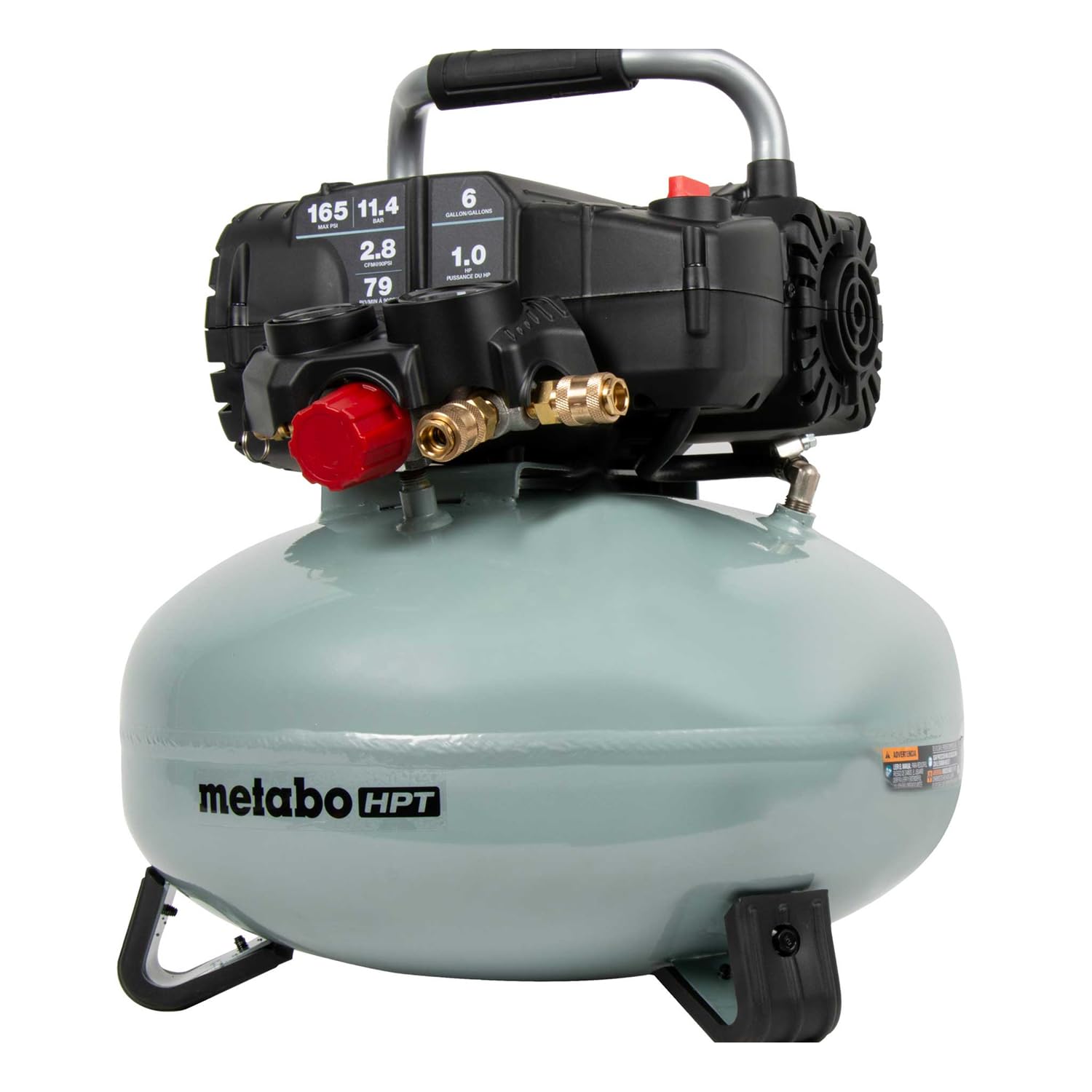
2. Metabo HPT Pancake Air Compressor, 6-Gallon 165PSI, EC711S
Strongest tank pressure in its class — 165 PSI, enough to clear long sprinkler runs on one charge.
Blowing out a full zone of irrigation pipe takes sustained pressure, and this Metabo HPT delivers a maximum of 165 PSI. That is 15 PSI more than most 150 PSI pancake compressors, giving you extra headroom to push water out of long ¾-inch lines before the tank needs to refill. It produces 2.8 CFM at 90 PSI, meaning you can open a multi-head zone and keep air moving steadily rather than waiting for the tank to catch up after every few seconds.
At 38.5 pounds it is not the lightest on this list, but the steel tool cage with a rubber grip makes it manageable to roll across a lawn. The oil-free motor needs no maintenance and starts dependably in cold weather — useful when you are winterizing just before a freeze. Buyers report it holds 150 PSI overnight without bleeding down, which means less pump cycling between zones. The noise level is listed at 73 dB (decibels, a measure of sound intensity), though a few owners note it runs closer to 83 dB indoors, still quieter than older compressors they owned.
A 46-second recovery time means you can move from zone to zone without much idle waiting. Two ¼-inch universal quick couplers let you switch between a blow gun and an air hose without hunting for a tool.
Why this wins for sprinkler winterizing
- 165 PSI — highest tank pressure here, useful for long or buried lines
- 2.8 CFM at 90 PSI delivers strong air volume to purge multiple heads at once
- 46-second recovery keeps you moving between zones
What you trade off
- At 38.5 lb, heavier than some 6-gal options
- Listed 73 dB noise level feels louder according to some buyer measurements
Best for long sprinkler lines: This compressor gives you the highest tank pressure (165 PSI) in a portable pancake design, so stubborn water in deep runs stands no chance.
Keep in mind: It weighs 38.5 lb, and the real noise level may run higher than the spec sheet suggests.
3. Baotree 8 Gallon Portable Air Compressor

Eight gallons of stored air — enough to clear a zone without the pump cycling.
When your sprinkler system has several long branches, a bigger tank prevents that moment where air pressure drops mid-zone and you have to wait for the pump to catch up. This Baotree stores 8 gallons of compressed air, which is 2 gallons more than the Metabo HPT above. That extra volume means you can open a zone valve and let a steady stream of air run longer before the tank pressure falls below usable range.
It pushes 2.8 SCFM (standard cubic feet per minute) at 90 PSI and 3.8 SCFM at 40 PSI. That matches the 2.8 CFM figure of the Metabo HPT but with 33% more tank reserve sitting in front of it. The 2 HP motor spins the pump up to 150 PSI max, and the unit weighs just 30.9 pounds despite the 8-gallon tank — that is lighter than several 6-gallon models here, which makes it surprisingly easy to haul out to the yard.
The stainless steel construction resists rust from condensation, a real concern when you are blowing humid air through a tank repeatedly during fall winterization. Buyers have not left detailed reviews yet (this is a newer model), but the spec sheet suggests a strong contender for heavy sprinkler duty.
The volume advantage
- 8-gallon tank is the largest on this list — keeps air flowing through long zones
- 30.9 pounds is light for an 8-gal compressor, easy to move
- 2.8 SCFM at 90 PSI provides solid purge force
Fresh release, few long-term reviews
- No customer reviews available yet to confirm real-world reliability
- Rating sits at 3.9/5 based on limited buyer feedback
Ideal for complex systems: If your irrigation layout has multiple branches or a long mainline, the 8-gallon reserve gives you breathing room that 6-gallon tanks cannot match.
Watch for: As a new model, there are no long-term user reports to confirm durability.
4. ECOMAX Air Compressor, Portable 6 Gallon, Max 150 PSI (Model 0210673)

Six gallons of tank capacity wrapped in a 27.6-pound frame you lift with one hand.
That weight difference matters when you are carrying it from the garage out to the sprinkler manifold in the side yard, up a step, and across damp grass. The pancake shape and rubber handle make it manageable for one person without a dolly.
It delivers 2.6 SCFM at 90 PSI, which is a solid step above the 2.2 CFM that smaller 4.6- and 4.8-gallon units manage. The ECOMAX puts out 64% more air at 90 PSI compared to the VEVOR 4.8-gallon model on this list. The oil-free pump needs zero maintenance and includes a UMC motor (a permanent-magnet design for reliable starts) in cold weather, exactly what you need when winterizing before a freeze.
Owners mention using it to blow out water hoses on farms and fill car tires without issues. The dual quick couplers let you run a blow gun and an inflation hose at the same time, which saves fumbling when working through multiple sprinkler zones. One reviewer noted the threads needed Teflon tape resealing — a quick five-minute fix you should plan on.
Specs that make a difference for yard work
- 27.6 pounds — lightest 6-gallon compressor here, easy to carry
- 2.6 SCFM at 90 PSI provides strong purge air for sprinkler lines
- Dual couplers let you switch tools without reaching for the tank
One small setup task
- Thread connections may need Teflon tape resealing before first use
- No accessory kit included — just the compressor and power cord
Best portable option: At 27.6 lb this is the easiest 6-gallon unit to carry to every zone in your yard.
One caveat: Plan a few minutes to seal the thread connections with Teflon tape before the first winterization.
5. ECOMAX 6 Gallon Pancake Air Compressor with 10-Piece Accessories Kit
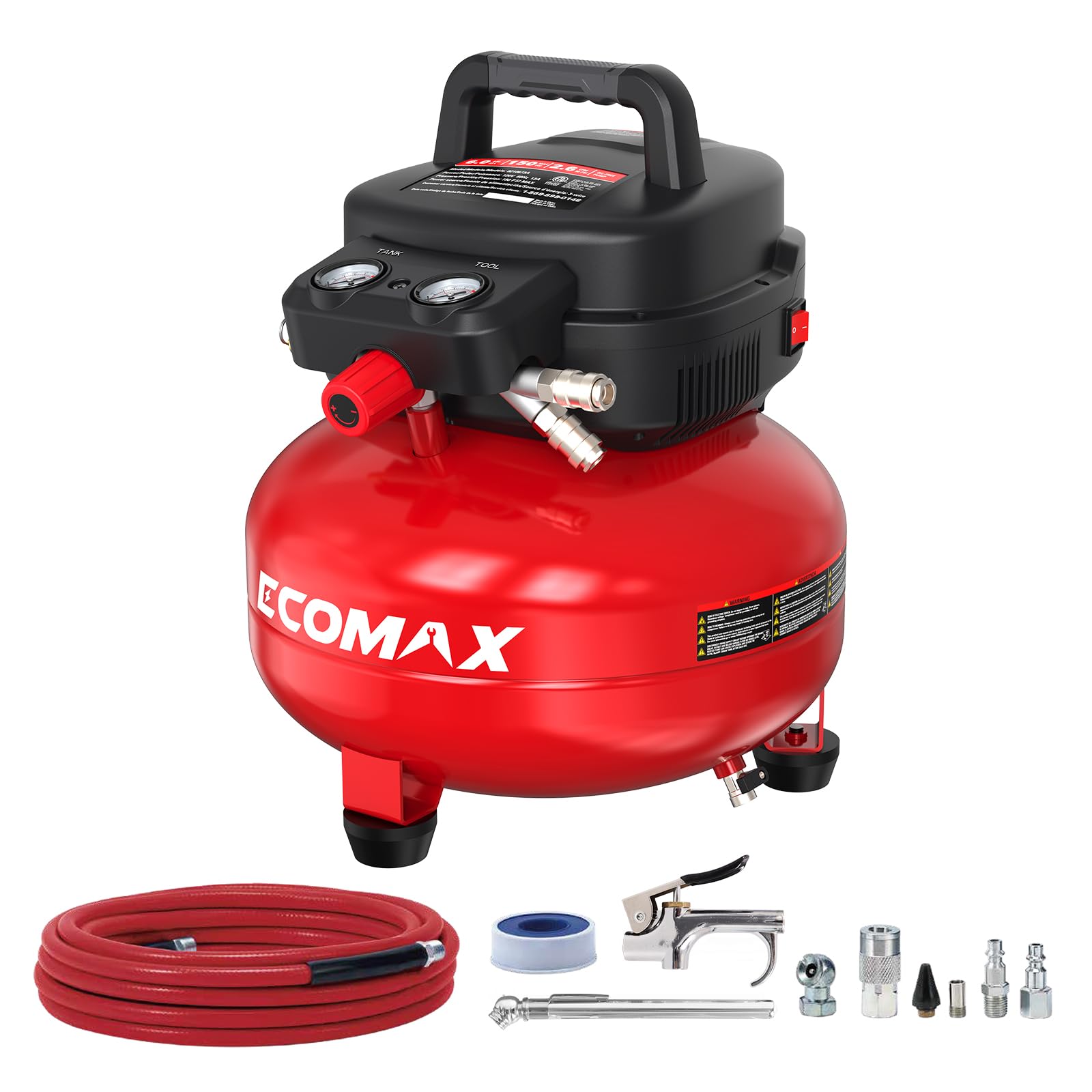
All the accessories you need arrive in the box — no second trip to the hardware store.
Most compressors ship as just the tank and motor, leaving you to buy a hose, blow gun, couplers, and tire gauge separately. This ECOMAX kit includes all ten pieces: a 25-foot ¼-inch PVC air hose, a high-performance blow gun, a tire pressure gauge, a ball foot air chuck, two couplers, and thread seal tape. For blowing out sprinklers, that means you unbox it, wrap the tape around the connections, attach the blow gun, and start purging lines within minutes.
The compressor itself is a 6-gallon unit rated at 1.5 HP with a 150 PSI max. Two gauges (tank pressure and outflow pressure) let you dial in the right air speed for your sprinkler heads without overshooting and damaging internal parts. At 34.17 pounds it is heavier than the other ECOMAX 6-gallon model on this list, but the flip-up handle still lets you tilt and roll it across a yard.
Customers note the tank carries easily and recharges reasonably quickly after sustained air release. One noted the compressor itself performed perfectly even though the accessory bundle was missing from his box — so check your package contents on delivery, but the core machine earns consistent praise.
Everything included
- 25-foot hose, blow gun, tire gauge, and couplers all in the box
- Dual gauges give separate readouts for tank and working pressure
- 1.5 HP motor recharges quickly between sprinkler zones
Heavier than the other ECOMAX 6-gal
- 34.17 pounds vs 27.6 for the ECOMAX model 0210673 — a 24% weight increase
- Some buyers reported missing accessories in their shipment
Best for first-time buyers: The included hose, blow gun, and couplers mean you buy one box instead of piecing together a kit.
Weight note: At 34.17 lb it is heavier than the standard ECOMAX 6-gallon, so expect a more substantial carry.
6. VEVOR 4.6 Gallon Air Compressor, 1HP 80dB Ultra Quiet

A familiar brand name in a compact steel tank built for basic sprinkler winterizing.
The 4.6-gallon VEVOR packs its 2.2 CFM at 90 PSI into a 41.9-pound frame with an 80 dB noise rating. It runs louder than the 70 dB 4.8-gallon VEVOR above, but the steel tank with a three-layer rust-resistant coating handles condensation better over multiple seasons. For a homeowner who wants a recognizable brand with straightforward specifications, this fits the bill for blowing out a standard residential sprinkler system.
The 650W oil-free motor drives the pump to 3300 r/min and fills the tank to a max of 120 PSI. That is enough pressure to clear most ½-inch and ¾-inch poly lines, but the 120 PSI ceiling is lower than the 150 PSI or 165 PSI tanks above, meaning you lose some headroom on very long or deeply buried runs. The intake pipe uses high-temperature silicone and stainless steel braided mesh to resist corrosion from moisture drawn into the pump.
Buyers consistently say it works well for general use and auto hobby work, with one owner noting it successfully removed Audi wheels with a ½-inch impact driver — suggesting decent torque from the 2.2 CFM flow. The suction cup feet help keep the compressor stable on a garage floor or driveway. Some buyers pointed out that the fittings use BSPP threads (British Standard Parallel Pipe) rather than US NPT (National Pipe Thread), so standard couplings will not thread on without an adapter. Factor in a set of BSPP-to-NPT adapters if you already own US-standard air tools.
Steel tank with good corrosion resistance
- Three-layer rust coating on Q235B steel handles condensation well
- Suction cup feet keep the unit stable on smooth surfaces
- Automatic overheating and overpressure protection
Thread compatibility and weight
- BSPP thread fittings require adapters for standard US NPT couplers
- 41.9 pounds makes it the heaviest unit on this list
- 120 PSI max is 30 PSI lower than most 150 PSI competitors
Best for VEVOR loyalists: A compact steel tank and a familiar brand name in a compressor that handles standard sprinkler winterizing without fuss.
Watch for: The BSPP thread fittings mean you need adapters for standard US air tool couplers.
Understanding the Specs
CFM at 90 PSI — the power that actually clears water
CFM stands for cubic feet per minute, and the number at 90 PSI tells you exactly how much air the compressor can push out while maintaining working pressure. For blowing out sprinklers, you need enough flow to keep a column of air moving through the pipe rather than letting it dribble out slowly. A unit delivering 2.2 CFM at 90 PSI can clear short residential zones, but 2.6 to 2.8 CFM at that pressure handles longer runs and multi-head branches without the air speed dropping off mid-zone.
Tank size — how long air flows before the pump kicks in
The tank stores compressed air so you can open a sprinkler zone valve and get a sustained blast of air without the motor running constantly. A 4.6-gallon tank holds enough for a few seconds of strong flow per zone. A 6-gallon tank gives you perhaps 50% more run time before pressure drops below useful levels. An 8-gallon tank offers the longest cushion, especially useful for systems with long mainlines or multiple zones that need clearing in succession without long refill pauses.
FAQ
What size air compressor do I need to blow out sprinklers?
Can I use a pancake air compressor for blowing out sprinklers?
How many CFM do I need for blowing out sprinklers?
Is an oil-free compressor better for blowing out sprinklers?
Do I need a special blow gun for sprinkler winterization?
How long does it take to blow out a sprinkler system with a compressor?
Can a 4.6 gallon compressor handle two sprinkler zones in a row?
What PSI should I set my compressor to for blowing out sprinklers?
Is a 165 PSI compressor overkill for sprinkler winterization?
Will an air compressor damage sprinkler heads?
Final Thoughts: The Verdict
For most buyers, the compressor for blowing out sprinklers winner is the Metabo HPT EC711S because 165 PSI and 2.8 CFM at 90 PSI give you the highest tank pressure and best airflow in a portable 6-gallon package. If you want the biggest tank for complex systems, grab the Baotree 8 Gallon. And for the lightest carry across the yard, the standout is the ECOMAX 6 Gallon Model 0210673 at just 27.6 pounds.
How We Picked
We do not accept paid placement. Every pick is matched to a real buyer and a real use-case; we do not hands-on test units.
Sources & Methodology
Specifications: manufacturer listings and product documentation. Review insights: verified customer reviews, as of July 2026. Pricing: not shown on this page (it changes often); check the current price via the retailer link.
As an Amazon Associate, WellFizz earns from qualifying purchases. This does not affect which products we feature.
Related Guides

Mo Maruf
I created WellFizz to bridge the gap between vague wellness advice and actionable solutions. My mission is simple: to decode the research and give you practical tools you can actually use.
Beyond the data, I am a passionate traveler. I believe that stepping away from the screen to explore new environments is essential for mental clarity and physical vitality.