Our readers keep the lights on and my smoothie glass nicely filled. As an Amazon Associate, I earn from qualifying purchases.
Specs are compiled from manufacturer listings and verified buyer reviews and can change over time — please confirm the key details on the product page before buying.
Finding a compression sock that actually stays on, doesn’t dig in behind your knee, and still fits after a full day of standing or sitting is the real challenge when you have venous insufficiency. This guide cuts through sizing confusion to give you seven medical-grade (20–30 mmHg) options that work — from easy-on zipper designs to physician-recommended stockings.
I’m Mohammad Maruf — the founder and writer behind WellFizz. This guide is built by comparing the manufacturers’ published specifications and the patterns across verified customer reviews, so you get each pick’s real strengths and trade-offs instead of marketing spin.
Your legs feel heavy and swollen by midday, and you need socks that stay up and reduce that ache without a battle to put them on. Here is a practical, honest look at the best compression socks for venous insufficiency available today.
Quick Picks
- Physix Gear Compression Socks 20-30 mmHg — Best Overall
- Benirap Breathable Compression Socks 20-30 mmHg — Best Value 2-Pack
- Ailaka Zipper Compression Socks 20-30 mmHg — Easiest to Put On
- BBFREY Medical Compression Socks 20-30 mmHg (3 Pairs) — Budget 3-Pack
- Skineez Medical Grade Advanced Healing Compression Socks — Skin-Loving Tech
- JOBST Relief 20-30 mmHg Compression Stockings, Closed Toe — Physician Recommended
- JOBST Relief Knee High Graduated Compression Socks 20-30 — Best for Warm Climates
How To Choose The Best Compression Socks For Venous Insufficiency
Venous insufficiency means your leg veins struggle to push blood back to your heart, which leads to pooling, swelling, and achiness. The right compression sock acts as an external pump to push blood back toward your heart. Here’s what to look for.
The compression level must be 20–30 mmHg or higher
Fashion-grade socks (8–15 mmHg) simply do not provide enough pressure for a medical condition. Look for a rating of 20–30 mmHg, which is considered firm medical-grade compression. This level wraps your ankle tightly and gradually releases pressure as it moves up your calf, a design called graduated compression.
Measure your calves and feet — do not guess
Sizing is the number one complaint in reviews. Measure your calf circumference at the widest point and the length from the floor to the bend of your knee. Check each brand’s size chart; one brand’s “Medium” can fit like another’s “Large.” If you are between sizes, go up a size.
Match the design to your daily life
Closed-toe socks offer full coverage and warmth. Open-toe designs let you check your toes for swelling or irritation and are easier to fit if you have long toes. Zippered versions save you from the “wrestler-in-a-cage-match” struggle but require careful positioning so the zipper does not dig in.
Quick Comparison
| Model | Best For | Compression Level | Toe Style | Special Feature | Amazon |
|---|---|---|---|---|---|
| Physix Gear | Long shifts & daily wear | 20–30 mmHg | Closed Toe | Graduated arch support | Amazon |
| Benirap (2-Pack) | Best value double pack | 20–30 mmHg | Closed Toe | 180-day free replacement | Amazon |
| Ailaka Zipper | Easy on/off for seniors | 20–30 mmHg | Closed Toe | YKK zipper | Amazon |
| BBFREY (3-Pack) | Budget-friendly rotation | 20–30 mmHg | Closed Toe | German machine knitted | Amazon |
| Skineez Medical Grade | Dry or sensitive skin | 20–30 mmHg | Closed Toe | Skin-reparative moisturizers | Amazon |
| JOBST Relief Closed Toe | Physician-recommended brand | 20–30 mmHg | Closed Toe | Reinforced heel pocket | Amazon |
| JOBST Relief Open Toe | Ventilated all-day wear | 20–30 mmHg | Open Toe | Breathable for warm weather | Amazon |
In‑Depth Reviews
1. Physix Gear Compression Socks 20-30 mmHg

The all-day companion nurses and runners call “new life” for legs.
This sock gives you medical-grade 20–30 mmHg compression that buyers report still showing ankle bones after a 12-hour shift — a real test for anyone managing venous insufficiency. The gradual pressure is strongest at the ankle and lightens as it moves up the calf, which helps push blood back toward the heart without feeling like a tourniquet at the top band.
Unlike the Benirap pack that is thinner for travel, the Physix Gear uses a cushioned sport-sock fabric with extra arch support and a toe box that leaves wiggle room for wide feet. One reviewer with stage 4 osteoarthritis described sliding them off after a 12K-step day and seeing their ankle bones for the first time in years. The trade-off is the same struggle that comes with any tight medical sock — you will want to use the rolling-up method to get them on.
These undercut the JOBST offerings significantly while delivering the same firm compression level. The main caveat: they run snug in the calf, so measure carefully.
Why they work
- Graduated 20–30 mmHg compression proven to reduce edema
- Light cushioning provides real all-day comfort on hard floors
- Top band stays put without rolling or strangling
The tricky part
- Very tight to pull on — the “wrestler” problem is real
- Calf fit can be snug for larger legs despite sizing chart
Best for daily wear: If you stand for 8–12 hours and want the swelling gone without spending premium dollars, this is your sock.
Watch for: The snug calf fit means measuring before buying is essential.
2. Benirap Breathable Compression Socks 20-30 mmHg
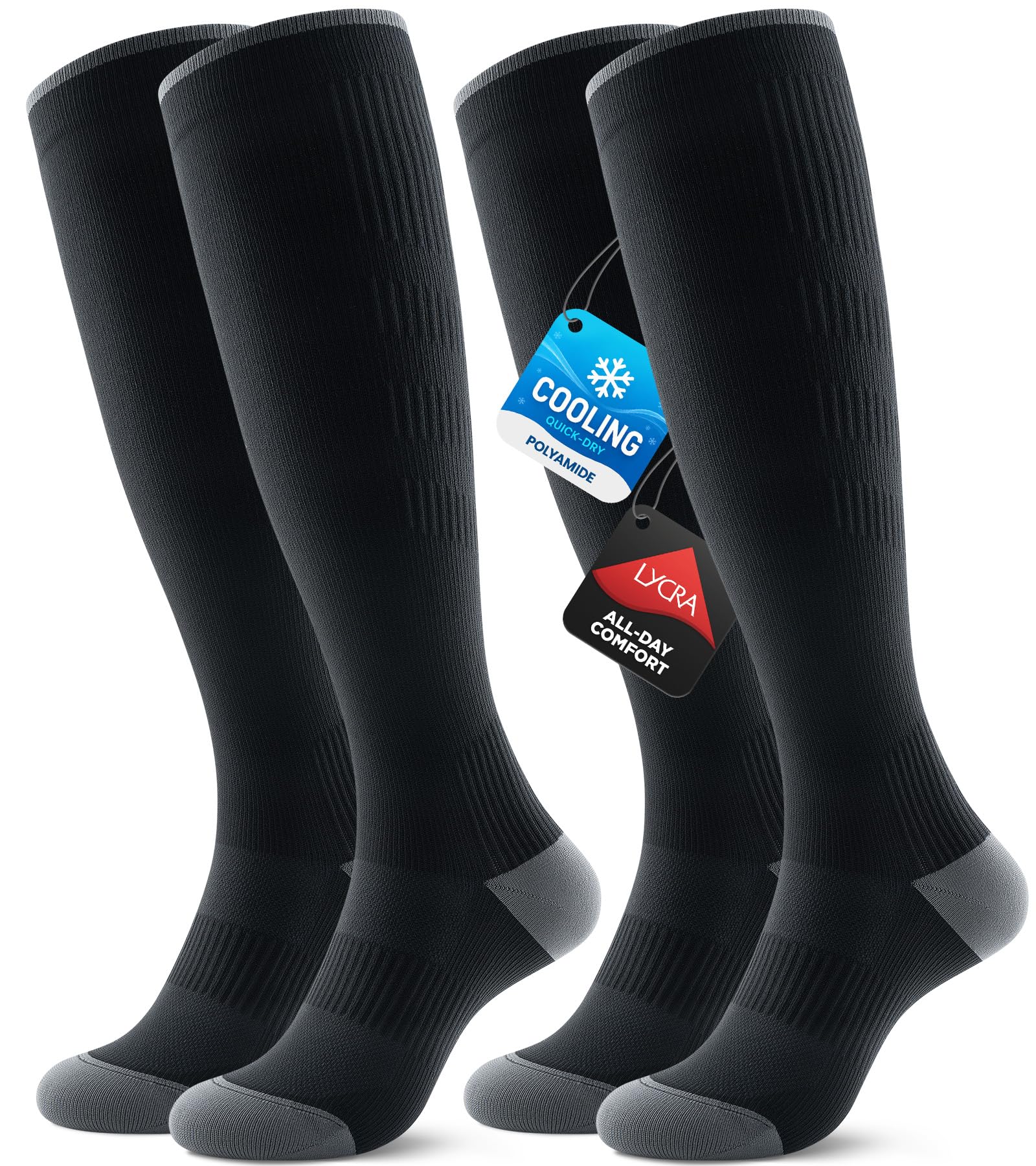
The 2-pack that avoids the “wrestler in a cage match” struggle.
This is a two-pair set, so you get a spare for roughly the same cost as a single pair of Physix Gear. The 20–30 mmHg compression (the pressure level, measured in millimeters of mercury, that reduces swelling) feels targeted around the arch of the foot, and one reviewer with “huge skaters calves” was shocked that the L/XL size slid all the way up without a fight — a genuine relief for anyone whose leg volume makes most socks unwearable.
These socks are thinner than the Physix Gear or BBFREY options, making them better for warmer months or for wearing inside dress shoes. Owners mention that the top band does not cut into the back of the knee, a common pain point with cheaper medical stockings. A QR code in the packaging gives you access to a 180-day free replacement policy, which adds confidence that the Ailaka or Skineez options do not advertise.
The catch: the “breathable” fabric means less cushioning underfoot, so if you need heavy padding for concrete floors, the Physix Gear or BBFREY 3-pack will serve you better.
Easy-on advantage
- Much easier to pull on than most 20–30 mmHg socks
- Two pairs for the price of one single pair
- Top band does not dig into the back of the knee
Lighter cushioning
- Thinner material — less shock absorption for all-day standing
- May feel warm in hot weather due to snug fit
Great for first-timers: If you have struggled to get compression socks on before, start here — the ease of entry and the two-pair value make it a low-risk trial.
Skip if: You need heavy cushioning for 12-hour hospital shifts.
3. Ailaka Zipper Compression Socks 20-30 mmHg

The zippered sock that banishes the “can’t get them on” frustration for good.
This is the pick for anyone who cannot physically wrestle a tight medical sock over their calf. Ailaka integrates a genuine YKK zipper with an extended pull handle so you can zip the sock up yourself without bending over or asking for help. At 20–30 mmHg, you get full medical-grade graduated compression, and the sock is available from Medium all the way to 5X-Large — easily the widest size range in this list.
Customers note that these are “not a challenge to put on” and that they have thrown away their traditional pull-on stockings after trying the zipper. One reviewer noted that a single pair lasted 6 months of daily rotation helping with foot swelling after an injury. The closed-toe design uses a full toe instead of a seam, which cuts down on irritation compared to some open-toe models.
The downside shared by some reviewers: Amazon occasionally ships the wrong item (tights instead of socks), and the zipper, while convenient, adds a slim layer that can feel bulky under tight trousers.
Zipper convenience
- YKK zipper with extended pull — no struggle to put on
- Full toe design is comfortable and seam-free
- Size range goes up to 5X-Large for large calves
Zipper trade-offs
- Zipper adds slight bulk under slim-fit pants
- Some reports of wrong item shipped by Amazon
Life-changing for seniors: If pulling on standard compression socks hurts your hands or back, the zipper makes this the clear winner.
Consider first: The zipper can press into your shin if the fit is too tight — size up if in doubt.
4. BBFREY Medical Compression Socks 20-30 mmHg (3 Pairs)
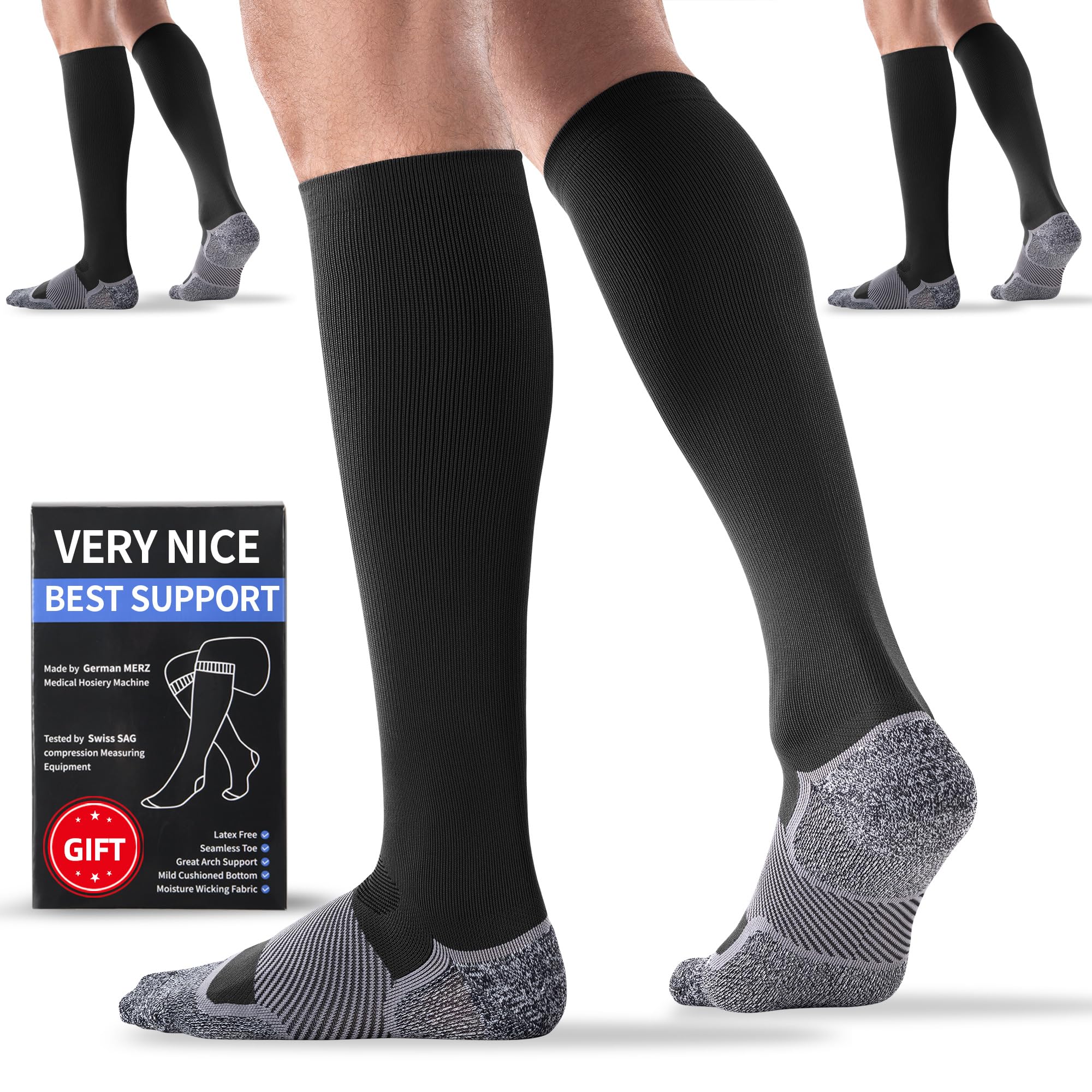
A three-pack that outperforms more expensive socks on compression and durability.
For the price of a single Skineez or JOBST, this delivers three pairs of 20–30 mmHg socks. And they are not cheap throwaways. BBFREY uses German medical sock knitting machines and a unique inlay method that holds the pressure wash after wash. One buyer called them “the value priced right” and noted they hold up better than pricier compression hose they have owned.
The socks have a smooth toe with a left-right anatomical fit, which means they are shaped specifically for your left and right feet to prevent blisters — a detail you do not see on the Benirap or Physix Gear options. The compression is true to the rating: stronger at the foot and ankle, then gradually lighter as it goes up. Reviewers point out that the top band does not cut into the leg, and the socks stay up for over 11 hours without slipping.
The only real complaint is that the gray color is very dark, almost black, so if you wanted a true light gray you might be disappointed. But for a 3-pack at this price, that is a nitpick.
Best bang for buck
- Three pairs for less than most single pairs
- Anatomically shaped left/right foot reduces blister risk
- smooth toe with flat stitching — no toe-poking
Limited selection
- Gray color is much darker than shown
- Few color/style choices available
Smart buy for rotation: If you need multiple pairs to get through a work week without doing laundry constantly, this 3-pack is the obvious choice.
Not if: You want a wide variety of colors or very light cushioning.
5. Skineez Medical Grade Advanced Healing Compression Socks 20-30 mmHg
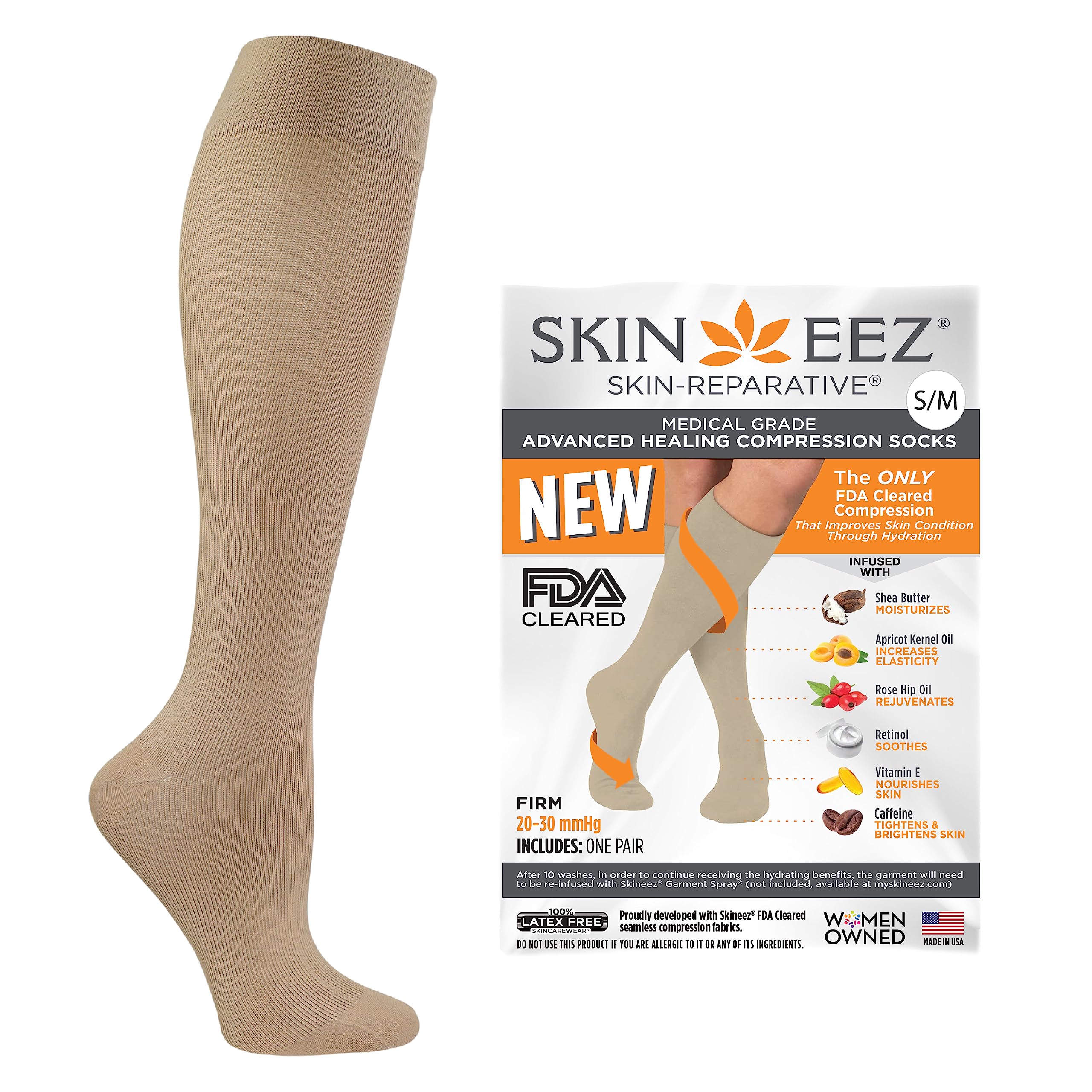
Medical-grade compression that moisturizes instead of drying your skin out.
Most compression sock fabric wicks moisture away, which can leave your legs parched after a full day. Skineez infused its 20–30 mmHg knit with shea butter, vitamin E, and rose hip oil so the sock actually rehydrates your skin as you wear it. This is a meaningful differentiator if venous insufficiency has left your lower legs dry or flaky, or if standard compression hose makes the problem worse.
The socks are made in the USA — a detail that sets them apart from every other product in this list. Shoppers say them as comfortable for all-day wear and very supportive. However, there is a notable inconsistency in sizing: one review noted that a re-order of the same S/M size a month later came with a significantly smaller fit, with the heel pocket not aligning properly and the sock not reaching the knee on a 5’11” frame.
At for a single pair, they are mid-range in price but premium in concept. If you have dry, sensitive skin and want the pressure plus skincare, this is your pick — but measure carefully and consider sizing up.
Skin-first design
- Fabric contains shea butter, vitamin E, and rose hip oil
- Made in the USA
- Firm compression for edema and varicose veins
Sizing instability
- Multiple reports of inconsistent sizing between batches
- Heel pocket alignment can be off on taller users
For dry legs: If your skin gets irritated or chapped from standard compression socks, the moisturizing knit makes Skineez worth the single-pair price.
Be warned: The sizing appears to have changed — order a size up or be prepared to return if the fit shifts.
6. JOBST Relief 20-30 mmHg Compression Stockings, Closed Toe

The brand doctors actually recommend, with a reinforced heel that ensures it stays in place.
JOBST is a name that shows up in wound care clinics and vascular specialist offices — and for good reason. This closed-toe model delivers consistent 20–30 mmHg gradient compression that one buyer mentioned “reduced my edema drastically” while wearing them 12 to 14 hours daily. The reinforced heel pocket is a clever design touch: it helps you align the sock correctly every time so the graduated compression sits exactly where it should.
Unlike the Skineez or Ailaka, this sock is machine washable and dryer-safe according to several buyers, making upkeep simpler. The fabric stays breathable — reviewers noted it does not get hot — and the top band stays up most of the day with only an occasional pull after several hours of walking. JOBST also offers a separate Men’s line, which is a rare level of fit specialization in this category.
The main catch: even with sizing up, some shorter buyers found the sock a bit too long, and taking it off is harder than putting it on. This is a premium price for a single pair — but the clinical track record and durability justify the cost.
Clinical confidence
- Trusted brand in vascular and wound care
- Reinforced heel ensures correct alignment every time
- Breathable fabric suitable for long hours
Premium price
- One pair costs more than most multi-packs
- Removing them is harder than putting them on
Best for medical need: If your doctor specifically told you to get JOBST or you want a clinically proven brand, the closed-toe Relief is the safe, effective choice.
Consider first: If you need multiple pairs or are on a tight budget, the BBFREY 3-pack gives you similar results for less.
7. JOBST Relief Knee High Graduated Compression Socks 20-30 mmHg, Open Toe
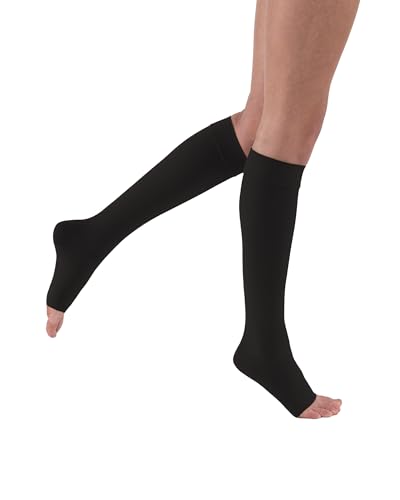
The open-toe model that keeps your feet ventilated and your compression consistent.
This is JOBST’s open-toe sibling, giving you the same 20–30 mmHg medical-grade graduated pressure but with your toes free. That is a huge advantage if you live in a warm climate — one reviewer in Florida called it “very breathable” — or if you have sensitive toes that swell and need room. The open toe also means you can wear thin ankle socks over the stocking to prevent chafing between toes, a trick that experienced users swear by.
The fabric is a nylon and spandex blend that feels soft against the skin, and the reinforced heel pocket ensures you get the sock positioned correctly every time. Buyers who use these daily for chronic venous insufficiency (CVI) report that the compression is effective all day and that the wide top band stays up without digging in. The main durability note: the socks last roughly two months of daily use before the compression starts to fade, and they can snag if you pull them up too aggressively.
This is the most expensive single pair in the list. For the premium, you get an open-toe design that no other pick here matches at this compression level.
Open-toe advantage
- Ventilated design ideal for warm weather or sensitive toes
- Physician-recommended gradient compression works all day
- Wide top band stays put without slipping
Cost and care
- Highest price per pair in this list
- Compression fades after ~2 months of daily use
- Can snag when pulling up if not careful
Best for hot weather: If you need firm medical compression but your feet cannot handle closed-toe socks in summer, the open-toe JOBST is the solution no other brand here fully covers.
Be honest: At this price, you are paying for the brand and the unique open-toe design — not for quantity.
Understanding the Specs
20–30 mmHg Compression Level
This is the measurement of pressure the sock applies to your leg, measured in millimeters of mercury. A 20–30 mmHg rating means it provides “firm” compression suitable for medical conditions like venous insufficiency, edema, and varicose veins. It is stronger than over-the-counter travel socks (8–15 mmHg) but not as intense as the prescription-only 30–40 mmHg range. The pressure is highest at your ankle and gradually decreases as the sock moves up your calf — this gradient is what actually helps push blood upward toward your heart.
Graduated Compression
Graduated means the sock is tightest at the ankle and becomes looser toward the knee. This design difference is critical for venous insufficiency: the highest pressure at the bottom pushes pooled blood out of your foot and lower leg, while the lower pressure at the top does not act as a tourniquet. Non-graduated (uniform) socks can actually trap blood rather than move it. All seven picks on this list use true graduated compression, which is why they work for circulation issues rather than just being tight socks.
Open Toe vs Closed Toe
A closed-toe sock covers your entire foot, which provides full compression and warmth — good for cold feet or all-day wear in shoes. An open-toe sock leaves your toes exposed, which helps in warm weather and lets you check for swelling or irritation without removing the sock. Open-toe designs also fit better if you have especially long toes or bunions, since the footbed length is less strict.
Reinforced Heel Pocket
This is a contoured heel section built into the sock’s knit. It acts as a visual and physical guide so you know the sock is rotated correctly on your foot. When the heel pocket is aligned with your actual heel, the graduated compression sits at the right spot on your ankle and calf. A misaligned sock (heel up on your Achilles or twisted sideways) means the compression zones are in the wrong places and you get less benefit. The JOBST and BBFREY models both emphasize this feature.
FAQ
What does 20–30 mmHg mean for venous insufficiency?
Can I wear 20–30 mmHg compression socks all day?
How do I measure my legs for compression socks?
Is it better to wear open toe or closed toe compression socks?
How long does a pair of 20–30 mmHg compression socks last?
Do these socks help with swelling from flying or long car trips?
Can I put compression socks on easily with arthritis or weak hands?
Will compression socks make my varicose veins worse?
What is the difference between JOBST Relief and Skineez compression socks?
Should I buy a 3-pack or a single pair?
Final Thoughts: The Verdict
For most users, a compression sock for venous insufficiency needs to do three things: stay up, reduce swelling, and not drive you crazy putting it on. The winner is the Physix Gear because it delivers firm 20–30 mmHg graduated compression with enough cushioned comfort for 12-hour wear — and it has the real-world reviews to prove it works for nurses, runners, and anyone whose legs feel like lead at the end of the day. If you want an easy-on solution, grab the Ailaka Zipper. And for a three-pack rotation that costs less than most single pairs, the BBFREY is the budget pick that still delivers firm 20–30 mmHg compression.
How We Picked
We do not accept paid placement. Every pick is matched to a real buyer and a real use-case; we do not hands-on test units.
Sources & Methodology
Specifications: manufacturer listings and product documentation. Review insights: verified customer reviews, as of July 2026. Pricing: not shown on this page (it changes often); check the current price via the retailer link.
As an Amazon Associate, WellFizz earns from qualifying purchases. This does not affect which products we feature.
Related Guides

Mo Maruf
I created WellFizz to bridge the gap between vague wellness advice and actionable solutions. My mission is simple: to decode the research and give you practical tools you can actually use.
Beyond the data, I am a passionate traveler. I believe that stepping away from the screen to explore new environments is essential for mental clarity and physical vitality.