Our readers keep the lights on and my smoothie glass nicely filled. As an Amazon Associate, I earn from qualifying purchases.
Stasis dermatitis creates a frustrating cycle: fluid pools in the lower legs, the skin becomes inflamed and itchy, and the constant urge to scratch only worsens the barrier. The right compression sock breaks that cycle by applying firm, graduated pressure that physically pushes fluid back toward the heart, reducing swelling and giving the skin a chance to heal.
I’m Mohammad Maruf — the founder and writer behind WellFizz. My research process involves cross-referencing compression levels, material breathability, and durability ratings across dozens of medical-grade socks to identify which models actually deliver the sustained pressure that dermatologists and vascular specialists recommend for stasis dermatitis management.
This guide focuses strictly on the best compression socks for stasis dermatitis, evaluating each option by its ability to reduce edema without aggravating sensitive, compromised skin.
How To Choose The Best Compression Socks For Stasis Dermatitis
Selecting compression socks for stasis dermatitis is not about comfort alone — it is about achieving a specific therapeutic pressure that moves interstitial fluid while avoiding irritation on skin that is already fragile. Four factors determine whether a sock helps or harms.
Compression Level — Why 20-30 mmHg Is the Target
Mild compression (15-20 mmHg) works for travel fatigue or minor swelling, but stasis dermatitis typically requires 20-30 mmHg to effectively counteract venous insufficiency. This range provides enough external force to prevent fluid from pooling in the lower leg without cutting off circulation. Always verify the mmHg rating on the product page — some socks labeled “medical grade” actually deliver less than 20 mmHg.
Fabric Composition — Breathability and Friction Matter
Inflamed skin cannot tolerate rough, non-breathable materials. A blend rich in nylon and spandex with moisture-wicking properties reduces the risk of maceration and heat rash. Cotton or cotton-rich blends can absorb sweat and hold it against the skin, which worsens dermatitis. Look for at least 60% nylon with 15-20% spandex for a smooth, cool feel.
Graduated Compression Profile — Tight at the Ankle, Loose at the Calf
Genuine graduated compression means the highest pressure is at the ankle, with pressure decreasing as the sock moves up the leg. This design mimics natural muscle pumping and actively pushes blood and fluid upward. Socks that apply equal pressure throughout the leg or that are tightest at the calf can actually impede venous return and worsen swelling.
Fit and Sizing — Measure Ankle and Calf Circumference
Stasis dermatitis often accompanies ankle and calf swelling, so standard shoe-size-based sizing fails. Use a fabric measuring tape to measure the narrowest part of the ankle (just above the ankle bone) and the widest part of the calf. Compare these numbers to the brand’s specific size chart — each brand’s “medium” can vary by several inches. A sock that is too loose offers no therapeutic benefit; one that is too tight can create a tourniquet effect above the calf.
Quick Comparison
On smaller screens, swipe sideways to see the full table.
| Model | Category | Best For | Key Spec | Amazon |
|---|---|---|---|---|
| Jobst Relief 20-30 mmHg Closed Toe | Premium | All-day medical wear | 20-30 mmHg, closed toe, reinforced heel | Amazon |
| Jobst Relief 20-30 mmHg Open Toe | Premium | Sensitive toes or toe swelling | 20-30 mmHg, open toe, unisex design | Amazon |
| VIM & VIGR Cotton Graduated | Mid-Range | Wide calves and long flights | 20-30 mmHg, cotton blend, wide calf | Amazon |
| NEWZILL Medical 20-30 mmHg | Mid-Range | Active use and athletics | 20-30 mmHg, 65% nylon, moisture-wicking | Amazon |
| Jobst Relief 15-20 Open Toe | Entry-Level | Mild swelling and maintenance | 15-20 mmHg, open toe, unisex | Amazon |
In‑Depth Reviews
1. JOBST Relief 20-30 mmHg Compression Stockings, Knee High, Closed Toe

Jobst continues to dominate the medical compression market for a reason: this closed-toe model delivers a consistent 20-30 mmHg gradient that dermatologists and vascular specialists frequently prescribe for stasis dermatitis. The reinforced heel pocket ensures the sock stays aligned during activity, preventing the twisting that can create pressure points on fragile skin. Users report wearing these socks 12 to 14 hours daily with significant reductions in ankle and foot edema, and the machine-washable construction holds up well through repeated laundering.
The fabric blend is surprisingly breathable for a medical-grade compression garment, which matters when the lower leg skin is already compromised by inflammation. Multiple color options including beige and black allow for discreet wear under work clothes. Some users with shorter legs note that standard length rides slightly too high, and the tightness at the ankle can make doffing a challenge — but the therapeutic results justify the effort.
This is the model to choose if you need reliable, all-day compression for active management of stasis dermatitis and want a brand that physicians consistently recommend. The balance of durability, pressure delivery, and comfort makes it the most versatile option for daily medical use.
Why it’s great
- True 20-30 mmHg graduated compression reduces edema dramatically.
- Reinforced heel pocket prevents alignment issues during long wear.
- Machine washable and retains shape after many cycles.
- Breathable fabric reduces skin maceration risk.
Good to know
- Standard length may be long for shorter individuals — petite size recommended.
- Requires effort to put on and remove, especially at the ankle.
- Packaging does not always explicitly state graduated compression profile.
2. JOBST Relief Knee High Graduated Compression Socks 20-30mmHg, Open Toe
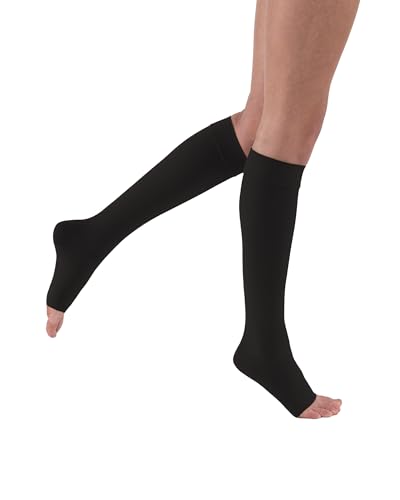
For patients whose stasis dermatitis affects the toes or who experience swelling that makes closed-toe socks uncomfortable, this open-toe variant of the Jobst Relief line solves the fit problem. The 20-30 mmHg graduated compression still provides the necessary therapeutic force to move fluid from the ankle upward, but the open design allows the toes to breathe freely and avoids the pressure on the nail beds that can occur with tight closed-toe socks. The fabric is a soft nylon-spandex blend that feels gentle against inflamed skin.
Users with chronic venous insufficiency report wearing these socks daily and finding them effective in Florida heat, suggesting the breathability is genuinely superior to thicker alternatives. The top band stays up well on thin to average legs without digging in, and a small trick — applying body lotion under the band — can further improve grip without causing irritation. Durability is good but not infinite; users note that the stockings may develop snags or lose some compression after about two months of daily wear.
If your condition is accompanied by toe swelling or if you simply prefer the freedom of an open-toe design, this Jobst model gives you the same clinically-proven compression profile as the closed-toe version without the toe constriction.
Why it’s great
- Open toe design eliminates pressure on sensitive toes and nails.
- Genuine 20-30 mmHg gradient for therapeutic edema control.
- Very breathable fabric suitable for warm climates.
- Durable enough for months of daily use with proper care.
Good to know
- Some users experience snagging during the donning process.
- Compression gradually diminishes after 2-3 months of daily wear.
- Best worn with thin ankle socks over the top to avoid toe chafing.
3. VIM & VIGR Cotton Graduated Compression Socks

VIM & VIGR offers a unique proposition in the stasis dermatitis space: true 20-30 mmHg graduated compression in a cotton blend that feels less clinical than the nylon-heavy alternatives. The cotton content absorbs moisture differently than synthetics, which may appeal to users whose skin reacts to synthetic fibers. The graduated compression starts firm at the ankle and tapers gently up the leg, effectively reducing the blood pooling and fluid retention that drive stasis dermatitis symptoms.
Users with larger calves find these socks particularly accommodating, as the wide-calf sizing provides a snug but not restrictive fit without rolling or leaving deep marks. The first 15 minutes of wear can feel slightly intense, but the fabric relaxes into a comfortable all-day fit. Several reviewers noted that these were the only compression socks their doctor recommended that they could actually tolerate wearing for long shifts or extended travel.
The trade-off with the cotton-rich blend is reduced elasticity over time compared to high-spandex options, so you may need to replace them more frequently if you wear them daily. For users who prioritize comfort and a natural fabric feel over absolute durability, these represent a strong mid-range option.
Why it’s great
- Cotton blend feels softer and more natural against sensitive skin.
- Excellent wide-calf fit without rolling or binding.
- True 20-30 mmHg graduated compression for therapeutic benefit.
- Comfortable enough for all-day wear after a short break-in period.
Good to know
- Cotton content may reduce moisture-wicking compared to nylon-rich blends.
- Elasticity may degrade faster under daily wear.
- Sizing between foot and calf can mismatch for some foot sizes — check the specific size chart carefully.
4. NEWZILL Medical Compression Socks, 20-30 mmHg

NEWZILL’s entry offers a compelling value proposition for those who need the therapeutic 20-30 mmHg range but also want to stay active. The proprietary Clima-Pro fabric — 65% nylon, 20% spandex, 15% Lycra — is aggressively moisture-wicking, which keeps the skin dry even during exercise or long shifts. This is a critical feature for stasis dermatitis management because damp skin under compression can worsen inflammation and trigger flare-ups. The graduated compression profile is designed to reduce blood pooling and improve oxygen delivery to tissues.
Users with athletic builds and muscular calves appreciate the generous stretch and fit, with many reporting that the socks stay up without sagging or rolling. The material has a smooth interior that reduces friction on compromised skin, and the woven patterns are textured on the inside but invisible from the outside — a small detail that avoids direct contact with irritated areas. Several verified buyers with venous stasis noted that the even pressure significantly reduced ankle swelling throughout the day.
While the brand is less established than Jobst in the medical community, the build quality and consistent pressure delivery put it on par with mid-range clinical options. The main consideration is that some users find the fabric slightly less breathable than the thinnest Jobst materials, particularly in hot weather.
Why it’s great
- Moisture-wicking Clima-Pro fabric reduces skin maceration risk.
- True 20-30 mmHg graduated compression for edema control.
- Comfortable fit for muscular or larger calves.
- Smooth interior minimizes friction on sensitive skin.
Good to know
- Fabric may feel slightly warmer than thinner medical-grade alternatives.
- Brand is less established in clinical settings than Jobst.
- Some users may need the included donning video for proper application.
5. Jobst Relief 15-20 Knee High Open Toe Beige Compression Stockings

This entry-level Jobst offering operates at 15-20 mmHg, which places it below the standard therapeutic threshold for active stasis dermatitis management. However, it serves a specific role: for patients whose swelling is mild, or who are in a maintenance phase after a more acute episode, the lower compression level may be sufficient to prevent fluid re-accumulation without the intensity of a 20-30 mmHg garment. The open toe design reduces pressure on the digits, and the unisex sizing works for both men and women.
The fabric is thin and breathable, making it one of the most comfortable options in the Jobst lineup for all-day wear in warm conditions. The reinforced heel offers durability, and the brand’s reputation for consistent quality means you are getting a reliable product even at the lower compression level. Users appreciate that the stockings are easier to put on and remove compared to the 20-30 mmHg versions, which can matter if hand strength or dexterity is limited.
The limitation is clear: for established stasis dermatitis with significant edema, 15-20 mmHg may not provide enough counter-pressure to move interstitial fluid effectively. This is best viewed as a maintenance or mild-support option rather than a primary treatment tool for moderate to severe stasis dermatitis.
Why it’s great
- Much easier to don and doff than 20-30 mmHg options.
- Thin, breathable fabric ideal for hot climates.
- Trusted Jobst brand quality and consistent sizing.
- Open toe design reduces pressure on toes.
Good to know
- 15-20 mmHg may be insufficient for moderate to severe stasis dermatitis edema.
- Some users find the length too long, causing the band to roll below the knee.
- Not intended as a primary treatment for active inflammation.
FAQ
Can compression socks cure stasis dermatitis?
How tight should compression socks feel for stasis dermatitis?
How long should I wear compression socks each day for stasis dermatitis?
Why is graduated compression important for stasis dermatitis?
Final Thoughts: The Verdict
For most users, the best compression socks for stasis dermatitis winner is the JOBST Relief 20-30 mmHg Closed Toe because it delivers the clinically-proven graduated compression profile that physicians recommend, in a durable, breathable package that can handle daily wear. If you need an open toe design to accommodate toe swelling or sensitivity, grab the JOBST Relief 20-30 mmHg Open Toe. And for a comfortable cotton-blend option that handles wider calves well, nothing beats the VIM & VIGR Cotton Graduated Compression Socks.

Mo Maruf
I created WellFizz to bridge the gap between vague wellness advice and actionable solutions. My mission is simple: to decode the research and give you practical tools you can actually use.
Beyond the data, I am a passionate traveler. I believe that stepping away from the screen to explore new environments is essential for mental clarity and physical vitality.