Our readers keep the lights on and my smoothie glass nicely filled. As an Amazon Associate, I earn from qualifying purchases.
Specs are compiled from manufacturer listings and verified buyer reviews and can change over time — please confirm the key details on the product page before buying.
The prickling, the burning, the numbness that makes your feet feel disconnected from your body — neuropathic leg pain turns standing, walking, and sleeping into a misery. The right sock, worn consistently, applies graduated pressure (tighter at the ankle, looser up the calf) that pushes blood back toward your heart and signals your nervous system to quiet down. But not every pair marketed as “compression” delivers the firm 20-30 mmHg (millimeters of mercury — the unit that measures how tight the sock is) that neuropathy demands. Picking the wrong one means you get zero relief for your trouble.
I’m Mohammad Maruf — the founder and writer behind WellFizz. This guide is built by comparing the manufacturers’ published specifications and the patterns across verified customer reviews, so you get each pick’s real strengths and trade-offs instead of marketing spin.
Below are the six pairs that neuropathy sufferers and the nurses who care for them consistently rely on. compression socks for neuropathy have a single job — deliver steady, therapeutic pressure from ankle to knee — and the socks here do it without slipping, pinching, or wearing out after a few washes.
Our Picks at a Glance

How To Choose The Best Compression Socks For Neuropathy
Selecting the right sock for nerve pain is not about color or fashion. It is about getting the pressure right, the length right, and the material right so you actually wear them every day. Here are the essential factors.
Compression Level — 20-30 mmHg Is the Therapeutic Zone
Mild 15-20 mmHg socks feel snug but rarely push enough blood back upward to calm nerve signals. For neuropathy, edema (swelling from fluid buildup), and varicose veins, the target is 20-30 mmHg — firm enough to squeeze the ankle hard and ease off gradually up the calf. Every product in this guide sits in that range.
Graduated Compression — Tighter at Ankle, Looser Above
A true medical compression sock is not the same tightness all the way up. It should be strongest at the ankle (100% pressure), about 70% at mid-calf, and roughly 50% at the knee. That gradient pushes venous blood toward your heart instead of trapping it in your lower legs. A sock that is uniformly tight will cut off circulation rather than improve it.
Open Toe vs Closed Toe
If your toes are numb, swollen, or extremely sensitive to touch, an open-toe (toeless) design lets your toes breathe freely and avoids the cramped feeling a closed sock can create. Closed-toe designs provide full warmth and are better for cold feet and general all-day wear. Choose based on where your discomfort lives.
Ease of Putting On — The Daily Hurdle
A 20-30 mmHg sock is genuinely difficult to pull over a heel and calf, especially if you have limited hand strength or arthritis. Zippered socks or styles with a silicone grip at the top-band make the morning struggle much shorter. If the sock is a battle to get on, you will stop wearing it — and it will stop helping.
Quick Comparison
| Model | Best For | Compression Level | Toe Style | Special Feature | Amazon |
|---|---|---|---|---|---|
| Physix Gear 20-30 mmHg★ Best Overall | Best Overall — firm all-day relief | 20-30 mmHg | Closed toe | Silky spandex, easy on/off | Amazon |
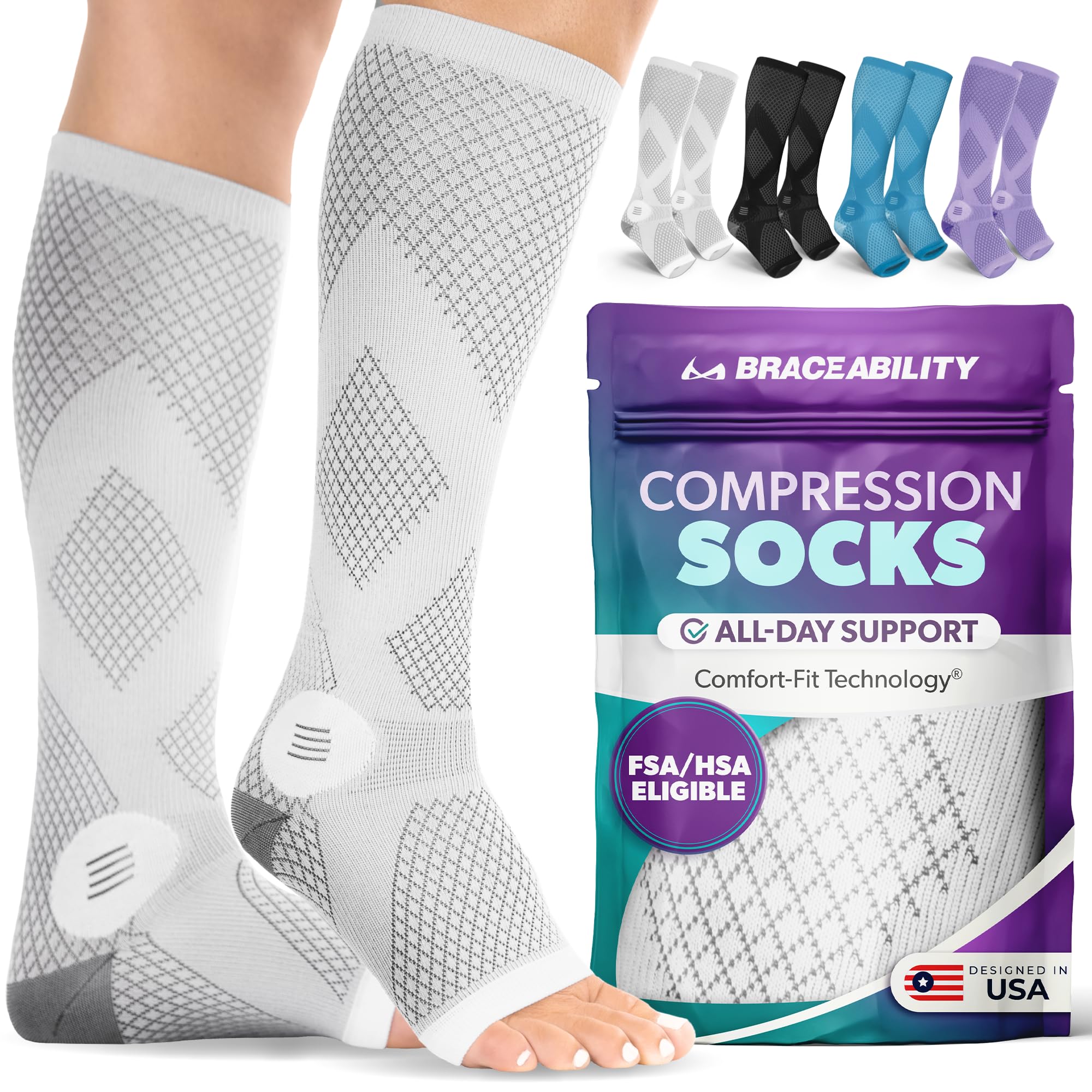
| BraceAbility Open ToeOpen Toe | Sensitive or swollen toes | 20-30 mmHg | Open toe | Breathable toeless design | Amazon |
| NEENCA Zipper | Limited hand strength or arthritis | 20-30 mmHg | Closed toe | Full side zipper | Amazon |
| SB SOX 20-30 mmHg | Wide calves & large sizes | 20-30 mmHg | Closed toe | Extended sizing up to XX-Large | Amazon |
| Lalapapa 3-Pair Wide Calf | Wide calves with cute patterns | 20-30 mmHg | Closed toe | 3 pairs, pattern designs | Amazon |
| BBFREY Medical 3-Pair | Best multi-pack value | 20-30 mmHg | Closed toe | 3 pairs, German-made machines | Amazon |
In‑Depth Reviews
1. Physix Gear Compression Socks 20-30 mmHg
Our pick — 4.5★ from 28,960 verified ratings; the strongest balance of quality and price.
The sock that thousands of nurses and neuropathy patients trust to survive 13-hour shifts without leg pain.
This sock wraps your leg in a firm 20-30 mmHg squeeze that has eliminated pain after standing or walking all day, according to owner accounts. The material feels silky and spandex-like, which makes sliding the sock on far easier than the stiff, cotton-heavy brands. The fit stays put through a full work day: no bunching at the ankle and no rolling at the top band. One reviewer who weighed over 300 pounds reported that these outperformed SB SOX for his large calves during 13-hour shifts — a direct, named comparison that speaks to the sizing range.
What wins people over is comfort — over 3,000 owners single it out, and nearly 2,200 praise the compression level itself. The quality holds up through repeated washing, with one owner reporting two years of wear before holes appeared. The one thing to know: the pack contains two pairs, not three. For neuropathy specifically, the smooth toe seam and the absence of that brutal “cut-off” feeling at the knee band make these a wear-all-day choice. If you want a 3-pack, the BBFREY gives you more pairs for a similar outlay, but the Physix Gear is the stronger all-arounder.
Why owners stick with them
- Comfort is the top praise (3,000+ call it out) — no pinching, no digging
- 20-30 mmHg eliminates leg pain after 8-plus hours, per multiple owner accounts
- Durable construction that lasts through dozens of machine washes
The honest fine print
- Pack contains only 2 pairs, not 3 — an easy miss if you are not watching
- Owners with very thin calves should size down for a snug fit
Reach for these if: you want a proven, crowd-favorite 20-30 mmHg sock that goes on easily and stays comfortable through a full day of work or travel.
Look elsewhere if: you need a 3-pack for the lowest per-sock cost — the BBFREY below gives you more pairs for a similar outlay.
2. BraceAbility Compression Socks 20-30 mmHg Open Toe
For neuropathy sufferers whose toes are too sensitive to stuff inside a closed sock.
This sock leaves your toes completely free — no compression pressure on your digits, which matters enormously if tingling or numbness is concentrated there. Owners confirm the toeless style works perfectly with sandals, and the sock delivers good compression across the arch, ankle, and calf without bunching or rolling. People with wider feet and a 16-inch calf circumference found the fit ideal, especially at a shorter height around 5’4″. The material is soft and non-binding, so the sock does not dig a red ring into your leg after hours of wear.
The thing everyone raves about is the compression (55 owners highlight it) and the fit (38 more call it out). It is purpose-built for diabetic nerve pain, peripheral neuropathy, varicose veins, and post-surgery recovery. The catch is durability — a recurring note across the reviews is that some pairs fell apart after a single wash or started unraveling at the seam after a few months. Treat these gently: hand wash or use a delicates bag, and they should last longer. If you need a sock that can survive harsh laundry cycles, this may not be the one.
Best for sensitive toes: the open-toe relief is genuine — no compression on your digits means no extra pain from the sock itself.
Handle with care: wash in a delicates bag and air-dry; the fabric is not built for aggressive machine cycles.
Pick these if: your toes cannot tolerate being covered or squeezed — the toeless design is a legitimate solution for neuropathy with digit sensitivity.
Skip if: you need a sock that survives rough washing; the durability complaints are too frequent to ignore for a heavy washer.
3. NEENCA Zipper Compression Socks 20-30 mmHg
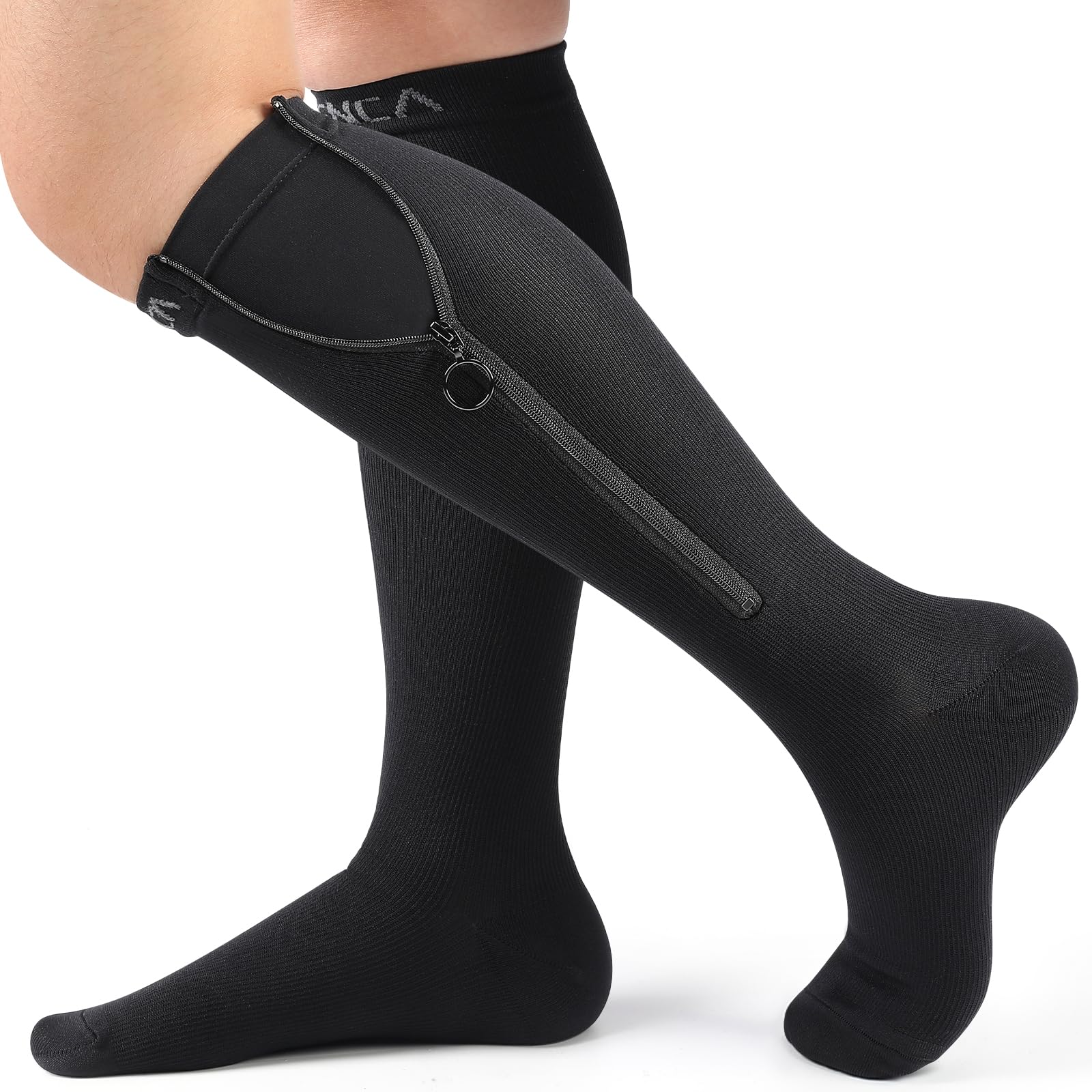
A full side zipper that transforms the daily struggle of wrestling on 20-30 mmHg socks.
If pulling a tight compression sock over your heel makes you wince, or simply is not possible due to arthritis or hand weakness, this is your answer. The zipper runs the full length of the sock, so you wrap it around your leg and zip it up — no wrestling, no tugging. The zipper has a fabric backing that does not leave marks or dig into your skin, and the pull ring at the top makes it easy to grip. The material is a 65% nylon, 15% polyester, 20% spandex blend that is lightweight, breathable, and fast-drying. Owners confirm the 20-30 mmHg stretch matches doctor-prescribed levels exactly.
The compression earns consistent praise (45 owners highlight it), and the ease of use is the secondary draw (15 call it out). One caregiver bought these for her mother, whose swollen calves measured 2 cm less after just a week of wear. The honest limitation: zipping the sock up by yourself is still tricky if you have very limited hand mobility — the zipper pull often requires two hands. Removal, however, is extremely easy. A very small number of owners also mention sizing can be tricky, so measure your calf circumference against the chart before ordering.
Zipper advantage: the side zipper is not a gimmick — it genuinely solves the biggest barrier to wearing compression socks daily for people with hand pain.
The trade-off: zipping shut solo can require help or two hands; this is easier with a partner.
Get this pair if: you or someone you care for has arthritis, hand weakness, or trouble bending — the zipper is life-changing for daily wear.
Think twice if: you need to put the sock on alone every time without any assistance; the zipper mechanism is easiest with a helper.
4. SB SOX Compression Socks 20-30 mmHg

The go-to for larger calves, with sizing that runs from 11-inch up to 24-inch circumference.
Most compression socks stop at a Large that barely accommodates a 16-inch calf. SB SOX keeps going: X-Large handles 18 to 20-inch calves, and XX-Large goes up to 24 inches. That alone makes this the most inclusive sizing of any pick here. The 80% nylon / 20% spandex fabric is lightweight and breathable — owners note it does not trap heat the way thicker cotton blends do. The top band stays put without rolling down, which is the single biggest complaint among people with muscular or wide calves. Buyers report that the sock helped reduce cold sensations and tingling in the foot from nerve issues, and that the 20-30 mmHg compression is effective without feeling restrictive.
Comfort is what owners highlight most (2,400 mention it), and quality is a close second (1,800). The sock is noticeably easier to put on than prescription-grade 30-40 mmHg options, and owners use it for everything from lymphedema management to 16-hour flights. The honest catch: ease of use is a mixed bag, with about as many owners finding it easy as finding it difficult. The fabric also picks up floor lint and pet hair more than cotton socks, so a quick pre-wash or a thin over-sock helps keep them clean.
Why large-calf buyers love them
- XX-Large fits calves 20-24 inches — a rare size that most brands ignore
- Comfort is the top reason owners return for more (2,400 praise it)
The realistic drawbacks
- Putting them on takes effort — about as many owners struggle as find it easy
- Gray color reportedly has higher compression than the black; consistency varies by color
Reach for this pair if: you have calves 18 inches or larger and have been told “one size fits all” — this is the only sock on the list that goes to 24 inches.
Skip if: you have very thin calves; you will swim in the Small even at 11-14 inches, and the fabric will wrinkle rather than compress.
5. Lalapapa 3-Pair Wide Calf Compression Socks 20-30 mmHg
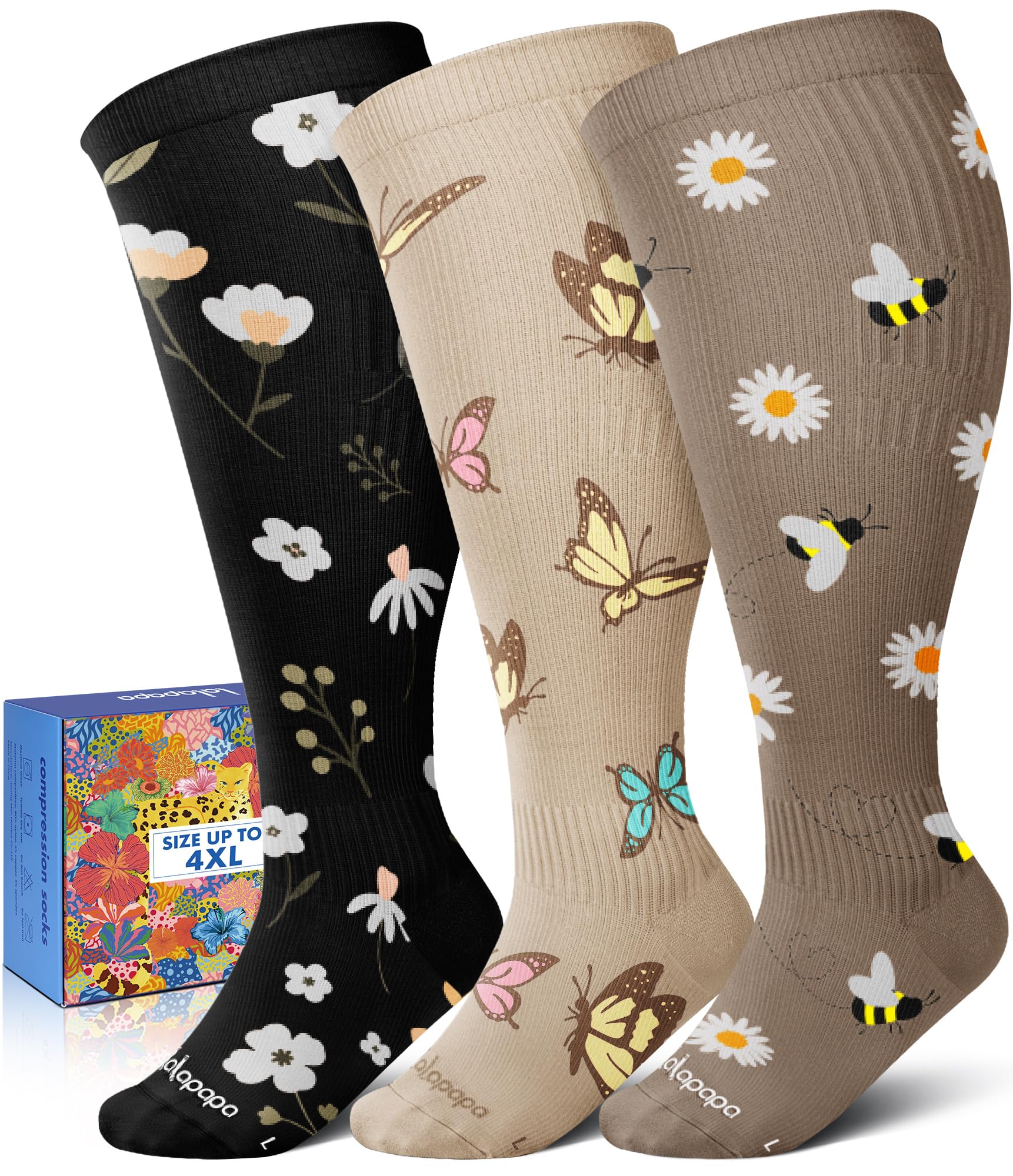
Three pairs in one box with playful patterns that make wearing compression socks feel less clinical.
These are for the person who dreads the beige medical-sock look. The designs range from bees to floral to ghost patterns, and the socks come three to a pack — a week’s rotation at a single buy. The fit is specifically cut for wide calves; owners with 18-inch calf circumference and lipedema report these fit without cutting in. The 20-30 mmHg graduated compression is effective for leg edema and neuropathy-related swelling, with owners noting their legs do not hurt after long walks. The material is soft and the stretchy top band does not dig in, which is a common pain point with other wide-calf socks.
What stands out in the feedback is fit (142 owners praise it) and comfort (85). The socks are true to size for larger legs. The catch is the pattern itself: because the designs are knitted into the fabric, they leave imprints on the skin after a few hours of wear. For most people this is just a temporary texture mark, but one owner who needed them for full nursing shifts found the imprints started to itch after an hour. If your skin is extremely sensitive, a solid-color sock like the Physix Gear may be a safer choice. The material is also heavier than the nylon-spandex blends above, so it runs warmer.
Good for wide calves: the sizing is generous and the stretch accommodates up to 18-inch calves without the top band digging in.
Pattern imprint note: the knit designs can leave marks on the skin — fine for short wear, possibly irritating for 12-hour shifts if your skin is sensitive.
Choose these if: you want three pairs at once, need a wide-calf fit, and appreciate a fun design instead of a clinical look.
Skip if: you have very sensitive skin or need a completely smooth interior surface for all-day nursing or standing work.
6. BBFREY Medical Compression Socks 20-30 mmHg (3 Pairs)
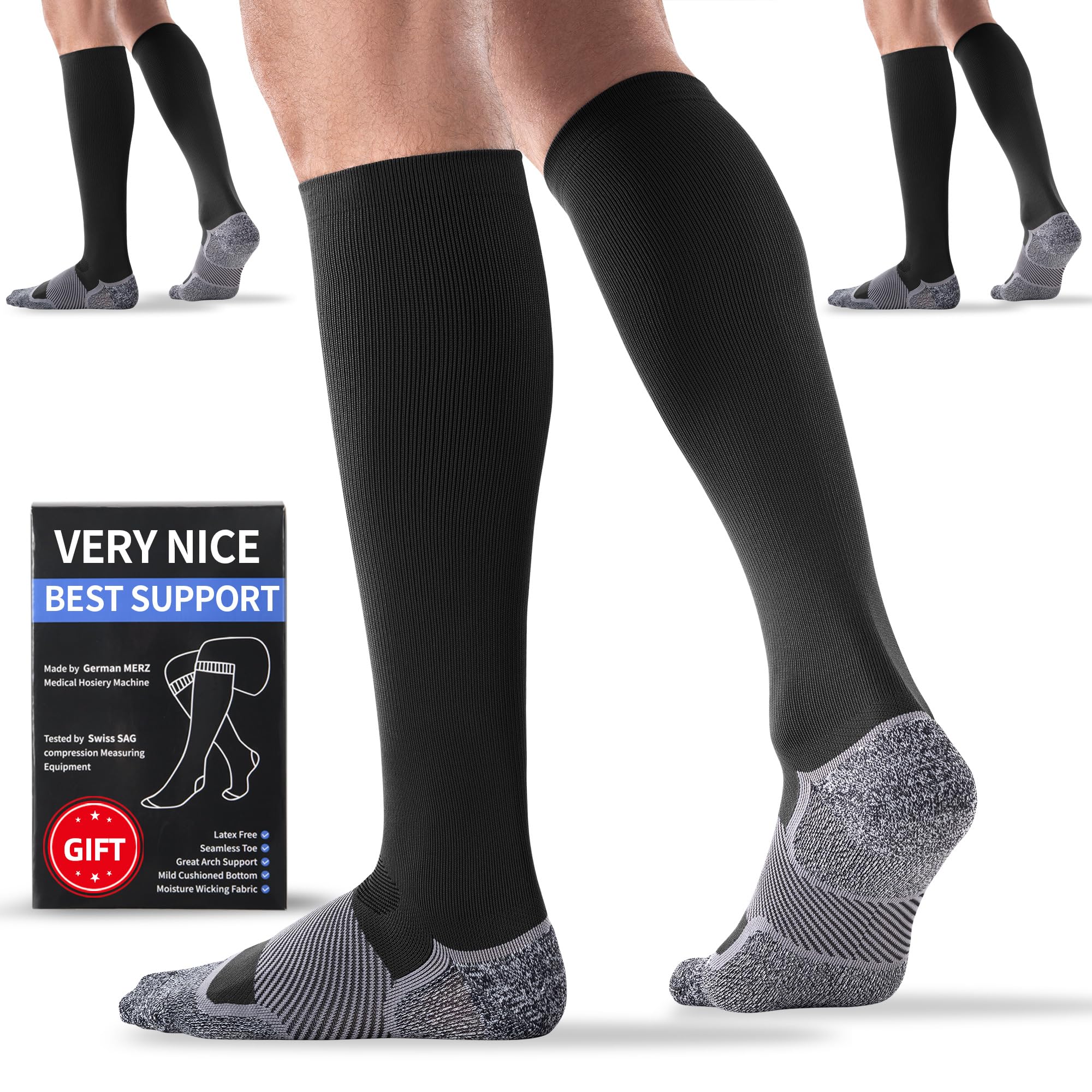
Three pairs built on German knitting machines that hold their shape and pressure longer than most.
BBFREY uses a method called “inlay knitting” on German medical sock machines, with each sock tested for consistent pressure after manufacturing. The result is a 20-30 mmHg sock that holds its compression through many wash cycles — owners mention the socks hold their shape and do not go baggy. The blend of fibers is wear-resistant and highly elastic, and the toe and heel have light cushioning that makes the sock comfortable underfoot without being bulky. The toe is smoothly stitched and has a left-right foot fit (an anatomic design that prevents blisters by matching each sock to the correct foot). For neuropathy, the firm ankle and calf support combined with the non-torturous top band means you get therapeutic pressure without that painful “squeezed” feeling at the knee.
The compression (76 owners praise it) and quality (67) lead the feedback. The sock effectively eliminates swelling and edema. The honest limitation: fit is described as mixed — some owners find the socks run small, with a Large reportedly cutting off circulation for one owner. Measure your calf and shoe size carefully against the chart on the 6th product image before ordering. Ease of use is also mixed; these are traditional pull-on socks with no zipper, so if you have trouble bending or gripping, this pack may be a daily struggle.
Why this 3-pack works
- Three pairs give you a full rotation without rebuying every week
- German knitting construction holds pressure and shape wash after wash
- Left-right anatomic fit and smooth toe prevent irritation and blisters
The honest sizing warning
- Fit is mixed — some customers note socks run small, so check the calf chart precisely
- No zipper or pull-loop, so traditional pull-on effort required; skip if you have hand pain
Best for: someone who wants a 3-pack with proven German build quality, measures their calf carefully, and does not need a zipper aid.
Not for: anyone with limited hand strength or very sensitive skin — the pull-on effort and potential tight fit make the Physix Gear or NEENCA zipper better choices.
Understanding the Specs
20-30 mmHg — What That Number Means for Your Legs
Millimeters of mercury (mmHg) measures how much pressure the sock applies to your leg. Fifteen to 20 mmHg feels like a firm hug and works well for travel or mild swelling. Twenty to 30 mmHg is the therapeutic zone doctors typically recommend for neuropathy, varicose veins, and edema — it is strong enough to push blood upward and reduce nerve-related discomfort without cutting off circulation. A sock below 20 mmHg may feel comfortable but will likely not do much for neuropathy symptoms.
Graduated Compression — The Gradient That Does the Work
Graduated means the sock is tightest at your ankle and gradually loosens as it goes up your calf toward the knee. That gradient mimics the natural muscle pump of your leg, helping blood flow back to your heart against gravity. A non-graduated “compression” sock that squeezes evenly everywhere is actually harmful — it can trap blood in your lower leg. Every product in this guide uses graduated compression, but the quality of the gradient varies by knit method; German-made machines (as used by BBFREY) tend to produce the most consistent pressure curve.
FAQ
Can compression socks really help neuropathy pain?
Is 20-30 mmHg safe for someone with diabetes?
What size compression sock do I need for wide calves?
How tight should neuropathy compression socks feel?
How long do compression socks last before losing their pressure?
Open-toe or closed-toe for neuropathy?
Can I sleep in compression socks for neuropathy?
How do I put on 20-30 mmHg socks without a struggle?
Final Thoughts: The Verdict
For most people looking for compression socks for neuropathy, the Physix Gear 20-30 mmHg is the strongest all-around pick — it combines the firm compression neuropathy needs with the soft, silky feel that makes daily wear actually bearable, backed by a massive owner base. If your toes are too sensitive for a closed sock, the BraceAbility open-toe gives you therapeutic compression without squeezing your digits. And if arthritis or hand weakness makes pulling on socks a daily ordeal, the NEENCA zipper sock transforms the whole process. Buy the one that matches your specific physical limitation, measure your calf before ordering, and you will finally get the relief you have been chasing.
How We Picked
We do not accept paid placement. Every pick is matched to a real buyer and a real use-case; we do not hands-on test units.
Sources & Methodology
Specifications: manufacturer listings and product documentation. Review insights: verified customer reviews, as of July 2026. Pricing: not shown on this page (it changes often); check the current price via the retailer link.
As an Amazon Associate, WellFizz earns from qualifying purchases. This does not affect which products we feature.
Related Guides

Mo Maruf
I created WellFizz to bridge the gap between vague wellness advice and actionable solutions. My mission is simple: to decode the research and give you practical tools you can actually use.
Beyond the data, I am a passionate traveler. I believe that stepping away from the screen to explore new environments is essential for mental clarity and physical vitality.