Our readers keep the lights on and my smoothie glass nicely filled. As an Amazon Associate, I earn from qualifying purchases.
Specs are compiled from manufacturer listings and verified buyer reviews and can change over time — please confirm the key details on the product page before buying.
If your legs feel heavy, your shoes are tight by noon, or you are hiding swollen ankles under long pants, you need compression socks that actually push fluid back up — not fashion hose that just looks the part. The real question is how much squeeze (measured in mmHg, short for millimeters of mercury — the same unit blood pressure cuffs use) you actually need to move that fluid, and whether the sock can keep that pressure up all day without cutting into your skin like a rubber band.
I’m Mohammad Maruf — the founder and writer behind WellFizz. This guide is built by comparing the manufacturers’ published specifications and the patterns across verified customer reviews, so you get each pick’s real strengths and trade-offs instead of marketing spin.
If your goal is to find the compression socks for edema that actually reduce swelling without feeling like a torture device, these four picks cover the range from gentle 15–20 mmHg support up to firm 20–30 mmHg medical-grade therapy that buyers report reveals ankle bones at the end of a 12-hour shift.
Quick Picks
- Physix Gear Compression Socks 20-30 mmHg — Best Overall
- BraceAbility Compression Socks 20-30 mmHg Open Toe — Open Toe Relief
- BBFREY Medical Compression Socks 20-30 mmHg (3 Pairs) — 3-Pair Value
- 2 Pairs Sheer Compression Socks for Women 15-20 mmHg — Lighter Touch
How To Choose The Best Compression Socks For Edema
Edema is the medical term for fluid trapped in your body’s tissues, and it gravitates to your feet and ankles because — well, gravity. Compression socks work by applying the most pressure at your ankle and gradually lessening it as the sock climbs your calf, an effect called graduated compression. This mechanical squeeze pushes the fluid back into your circulatory system so your kidneys can flush it out. You are basically giving your veins a hand when they are too tired (or too leaky) to pump that fluid upward on their own.
Choose the Right mmHg Tier
The number on the box (15–20 mmHg or 20–30 mmHg) is not a suggestion — it is the pressure measured at your ankle. For mild swelling that goes down overnight, 15–20 mmHg is enough. For pitting edema that leaves a dent when you press it, or for fluid that stays swollen all day, 20–30 mmHg is the first line of real treatment. Owners mention that 20–30 mmHg can make ankle bones visible after a shift, while 15–20 mmHg is better for prevention than reversal.
Fit Is Not Negotiable
The single biggest complaint across all compression socks — tight knee bands that cut in and socks that sag into a wrinkled mess. Both happen when you ignore the calf circumference measurement. Measure the widest part of your calf with a fabric tape, then match it against the brand’s sizing chart (every brand has its own). If you are between sizes, size up for slightly lighter compression or size down for a tighter squeeze. Never guess based on shoe size alone.
Open Toe vs Closed Toe
Open-toe designs let swollen or neuropathic toes breathe and avoid toe-seam pressure. Closed-toe styles give you full coverage and a more traditional look inside shoes. If you wear sandals or open-toe shoes, the toeless version works better. If you need warmth in winter, go closed-toe.
Material and Durability
Nylon and spandex blends (usually 85% nylon / 15% spandex) are standard because they stretch and recover shape wash after wash. Look for reinforced heel and toe areas — those spots wear through first. A good pair should survive dozens of machine washes if you air-dry them. Heat from a dryer is what kills the elastic fibers and ruins the compression.
Quick Comparison
| Model | Best For | Compression Level | Style | Pairs | Amazon |
|---|---|---|---|---|---|
| Physix Gear Compression Socks | All-day shift workers & athletes | 20–30 mmHg | Closed-toe | 1 | Amazon |
| BraceAbility Compression Socks | Neuropathy & sensitive toes | 20–30 mmHg | Open-toe | 1 | Amazon |
| BBFREY Medical Compression Socks | Everyday value & 3-pair rotation | 20–30 mmHg | Closed-toe | 3 | Amazon |
| 2 Pairs Sheer Compression Socks | Mild swelling & discreet daily wear | 15–20 mmHg | Closed-toe | 2 | Amazon |
In‑Depth Reviews
1. Physix Gear Compression Socks 20-30 mmHg

The 20–30 mmHg workhorse that one reviewer says made ankle bones visible after 12 hours on their feet.
This pair delivers the therapy-grade 20–30 mmHg squeeze that buyers with serious edema rave about. One reviewer with torn knee ligaments and stage 4 osteoarthritis saw ankle bones for the first time in six years after a 12-hour, 12,000-step shift. The graduated compression (tighter at your ankle, looser up your calf) keeps the knee band in place without rolling down or digging in, according to reviewers.
Compared to the Sheer pair’s 15–20 mmHg range, the Physix Gear socks sit in the 20–30 mmHg therapy zone. That higher pressure is where most edemas reverse rather than just stay the same. The sock is cushioned like a sport sock with arch support and fits wide feet (size 11.5 called comfortable). The catch? They are hard to pull on — one senior buyer needed a partner’s help. If your grip strength is low, the open-toe BraceAbility below may be easier.
Real swelling relief
- Genuine 20–30 mmHg that customers note reverses edema in a single shift
- Stays up all day without sagging or rolling at the top band
- Sport-sock cushioning with arch support feels substantial and durable
The tough-on struggle
- Very difficult to pull on, especially for seniors or anyone with weak grip
- Single pair only — need to buy multiples for a weekly rotation if you wear them every day
Your best bet if: you have moderate to severe edema, spend 8–12 hours standing or walking, and want the proven 20–30 mmHg grade that one reviewer credits with bringing their ankle bones back.
Heads up: getting them on is genuinely hard — you need patience or a helper — but once on, buyers forget they are wearing them.
2. BraceAbility Compression Socks 20-30 mmHg Open Toe
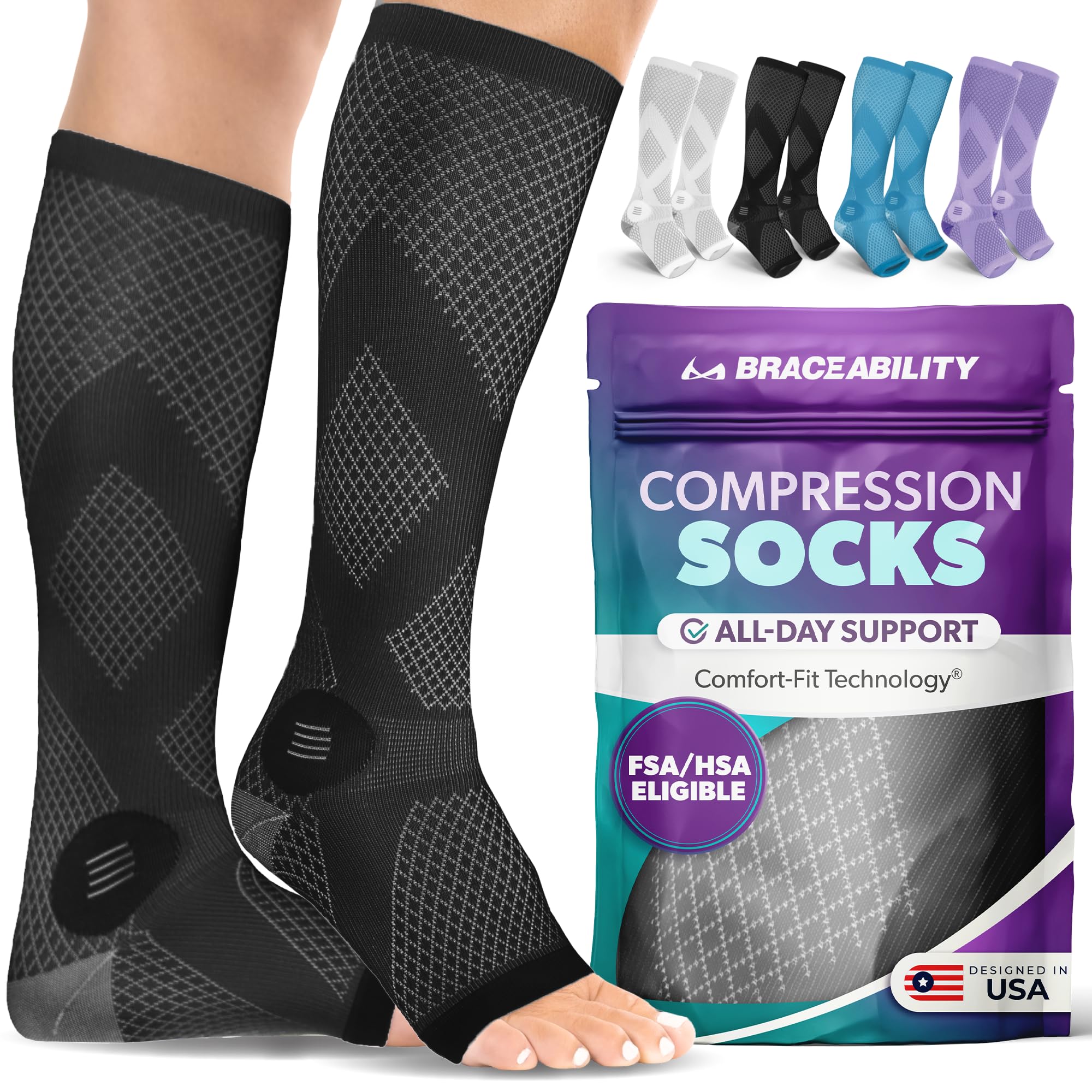
Medical-grade 20–30 mmHg in an open-toe design that keeps sensitive toes cool and sandal-friendly.
BraceAbility is the pick if your toes are swollen, numb from neuropathy, or just can’t handle being crammed inside a closed sock all day. The open-toe (toeless) design lets your toes breathe freely, and buyers confirm it works with open-toe sandals — a big deal if you can’t stand enclosed shoes on puffy feet. The graduated compression is the same firm 20–30 mmHg as the Physix Gear above, but the open front means you avoid the toe seam pressure that some closed-toe socks create.
Reviewers point out the material is soft, snug around the foot and lower shin, and “perfect compression for swelling in feet and lower shins.” At 2.56 ounces, it is lightweight enough for travel or recovery days. One reviewer recovering from severed foot tendons wore these on day 4 post-surgery and walked 6,000 steps pain-free. The trade-off: at 0.71 ounces for the Sheer pair vs. 2.56 ounces here, the BraceAbility is thicker and warmer — one buyer deducted a star because the fabric felt bulky inside closed-toe shoes. If you mostly wear sneakers or boots, the closed-toe Physix or BBFREY may fit better in footwear.
Toe-friendly relief
- Open-toe design prevents toe pressure and works with sandals
- Full 20–30 mmHg medical-grade compression that shoppers say eases foot and shin swelling
- Soft, comfortable material that buyers report feels “perfect snug” not painful
Bulky for shoes
- Thicker and warmer than sheer styles — less ideal inside tight closed-toe shoes
- Only 1 pair per purchase, and the color selection is limited
Reach for this if: your toes are swollen, tender, or you have neuropathy and need the firm 20–30 mmHg therapy without any toe-seam rubbing — especially if you wear open sandals.
Look elsewhere if: you need a sleek sheer look for dress shoes or want a bulkier fit for winter boots, this one is thicker than the average compression sock.
3. BBFREY Medical Compression Socks 20-30 mmHg (3 Pairs)
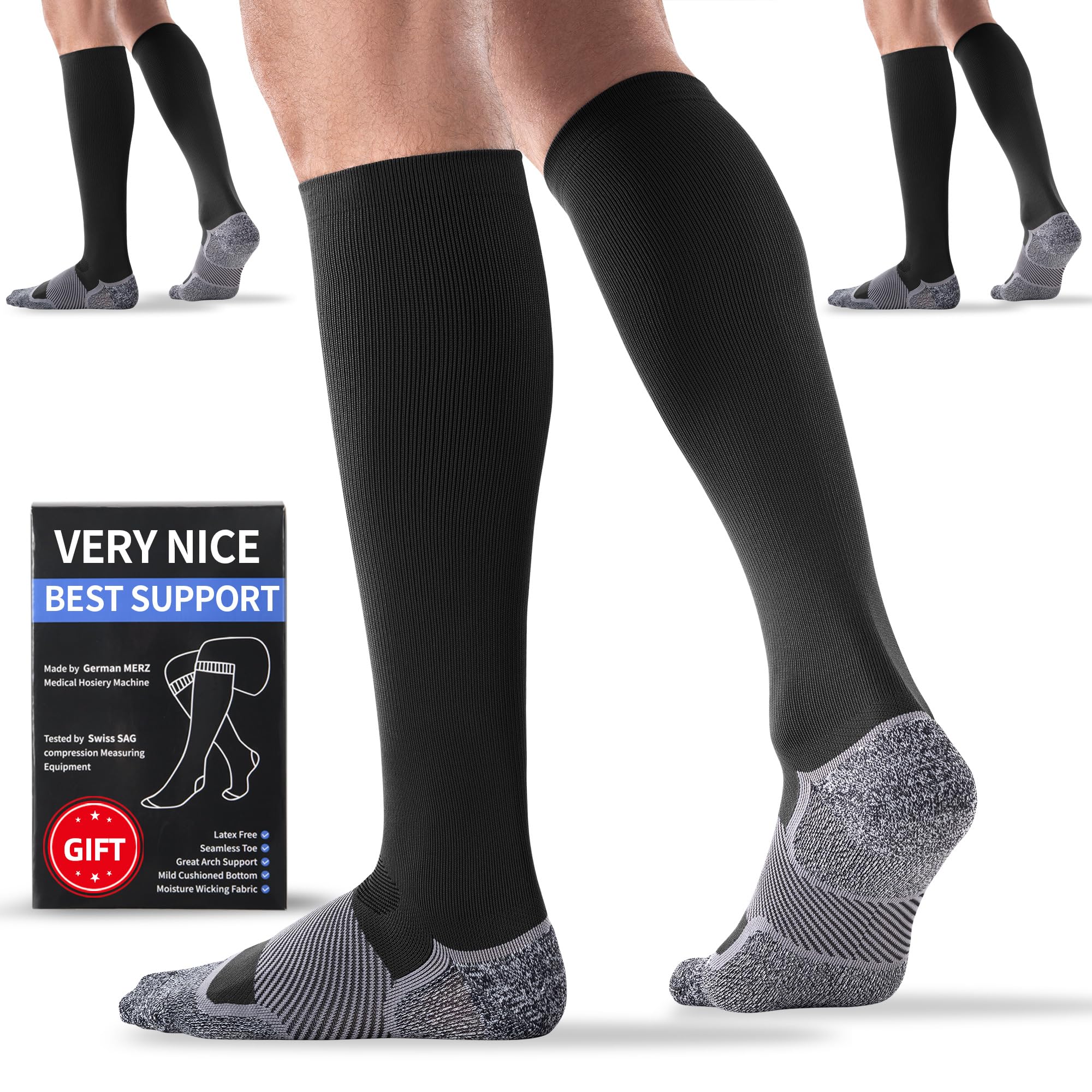
Three pairs of 20–30 mmHg socks for less than the price of one premium brand — and owners mention they perform.
BBFREY is the practical answer if you need a full weekly rotation without washing every night. For roughly the same outlay as a single pair of some premium brands, you get three pairs of 20–30 mmHg medical-grade compression. Reviewers confirm the size chart is accurate, compression is graduated, and the top band does not dig in even after 11 hours of wear. One reviewer noted these “outperform compression socks that are much more expensive.”
Unlike the Physix Gear’s single-pair design, BBFREY uses a German-machine knitting method with smooth toe stitching and light cushioning at the heel and toe for comfort. The fabric is a 70% microfiber nylon blend that buyers describe as “well-made” with “substance.” The catch? Color selection is narrow (reviewers wish for more options beyond grey) and the sizing runs limited — check the chart on image 6 of the listing before buying. But for a three-pack at this pressure grade, buyers consistently say the quality-to-price ratio is tough to top.
Rotation-ready value
- 3 pairs of genuine 20–30 mmHg compression in one purchase
- Customers note no rolling, no digging knee band, and comfort over 11-hour days
- smooth toe stitching with light cushioning for foot comfort
Limited color palette
- Few color options — mostly grey and basic neutrals, no patterns
- Sizing is chart-dependent and not universal; wrong fit means return hassle
Grab this for: the best cost-per-pair deal in 20–30 mmHg grade if you plan to wear compression socks daily and want a set you can rotate without nightly washing.
skip it if: you need specific colors or patterns, or if you prefer to buy one high-end pair at a time — this is a quantity play, not a fashion one.
4. 2 Pairs Sheer Compression Socks for Women 15-20 mmHg

An invisible, sheer option that stays put under work pants — but its 15–20 mmHg is for prevention, not reversal.
These are the pair you wear when you need compression that nobody notices. The 85% nylon / 15% spandex fabric is lightweight, sheer (they look like normal nude pantyhose), and designed for hot weather — a Florida buyer specifically mentioned they are breathable and cool in summer. The graduated compression at 15–20 mmHg is what one reviewer’s doctor noted as “no ankle fluid retention,” meaning it held existing swelling at bay rather than reversing older edema. One buyer praised them as “no difference in them and the name brand ones, except these are reasonably priced.”
Compared to the 20–30 mmHg picks above, this is a gentler squeeze — good for mild or occasional puffiness, travel, or pregnancy, but unlikely to dent pitting edema. The reinforced heel and toe add durability, and the non-binding top band stays put without digging in. However, some buyers found them too tight even when sizing up, so if your calves are muscular, measure carefully. These also come in a women’s-only sizing (unlike the unisex Physix and BBFREY) and are more delicate than the cushioned sport-sock styles.
Invisible and cool
- Sheer, nylon-like look that disappears under business attire or summer dresses
- Reviewers point out they stay up without sagging and the top band does not constrict
- 2 pairs per pack at a budget-friendly cost — good value for daily rotation
Light compression only
- 15–20 mmHg is too gentle for moderate to severe edema that needs 20–30 mmHg to reverse
- Some buyers found them uncomfortably tight even with size-up ordering
Best suited for: mild swelling, summer wear, or as a first step into compression if you are not sure you can tolerate the firmness of 20–30 mmHg.
Not for: pitting edema, post-surgery recovery, or anyone whose doctor recommended 20–30 mmHg — this is a lighter grade that maintains, not resolves.
Understanding the Specs
mmHg — The Pressure That Matters
mmHg stands for millimeters of mercury, the same unit used for blood pressure readings. In compression socks, it measures the pressure applied at the ankle. 15–20 mmHg is light-to-moderate (good for travel, mild puffiness, prevention). 20–30 mmHg is moderate-to-firm (the standard for medical edema therapy — enough to push fluid out of tissues). Higher numbers (30–40 mmHg) exist but require a doctor’s prescription. For edema, the 20–30 mmHg range is where most people see real visible change in swelling.
Graduated Compression — Why the Tight Part Is at the Bottom
Graduated means the sock is tightest at the ankle and gradually loosens as it goes up the calf. This creates a pressure gradient that pushes fluid upward, against gravity, back toward your heart. If the tightest part of the sock is the knee band (common with cheap non-graduated styles), it can actually trap fluid below the band and make swelling worse. Always check that the product description says “graduated compression” — if it does not say that, the sock may just be tight all over, which does not help edema.
FAQ
Can I wear compression socks for edema all day?
Will 15–20 mmHg socks help my edema?
How tight should compression socks feel?
Open-toe vs closed-toe for edema — which is better?
Can I wear compression socks to bed?
How do I measure my calf for compression socks?
Do compression socks lose their effectiveness over time?
Can I wear compression socks with diabetes or peripheral artery disease?
What does “20-30 mmHg” mean in plain English?
How many pairs of compression socks do I need?
Final Thoughts: The Verdict
If you want one dependable pick, the best compression socks for edema is the Physix Gear Compression Socks 20-30 mmHg because it delivers the proven therapy-grade squeeze that shoppers say visibly reverses swelling during a single shift, with cushioned comfort for all-day wear. If open-toe relief for sensitive or swollen toes is your priority, go with the BraceAbility Compression Socks 20-30 mmHg. And if you want the best per-pair value in a daily rotation, the BBFREY Medical Compression Socks 20-30 mmHg (3 Pairs) delivers quality and quantity without skimping on the pressure that matters.
How We Picked
We do not accept paid placement. Every pick is matched to a real buyer and a real use-case; we do not hands-on test units.
Sources & Methodology
Specifications: manufacturer listings and product documentation. Review insights: verified customer reviews, as of July 2026. Pricing: not shown on this page (it changes often); check the current price via the retailer link.
As an Amazon Associate, WellFizz earns from qualifying purchases. This does not affect which products we feature.
Related Guides

Mo Maruf
I created WellFizz to bridge the gap between vague wellness advice and actionable solutions. My mission is simple: to decode the research and give you practical tools you can actually use.
Beyond the data, I am a passionate traveler. I believe that stepping away from the screen to explore new environments is essential for mental clarity and physical vitality.