Our readers keep the lights on and my smoothie glass nicely filled. As an Amazon Associate, I earn from qualifying purchases.
If you’ve been prescribed 30-40 mmHg (millimeters of mercury — the standard unit doctors use to measure compression pressure) stockings, you already know the struggle: finding a pair that actually stays up, applies the right pressure, and doesn’t make you want to tear them off after two hours. That narrow compression band — the strongest medical grade you can buy without a custom fit — means the fabric has to be dense and tight, which makes comfort, durability, and fit a lot harder to get right. This guide reviews five real, proven models that target that exact 30-40 mmHg range, so you know which one actually delivers on its promises.
I’m Mohammad Maruf — the co-founder and writer behind WellFizz. This guide is built by comparing the manufacturers’ published specifications and the patterns across verified customer reviews, so you get each pick’s real strengths and trade-offs instead of marketing spin.
Whether you need them for long shifts on your feet, post-surgery recovery, or managing swelling, finding the right best compression socks 30-40 mmhg means balancing pressure, fit, and comfort without settling for a pair that slides down or wears out after a few washes.
How To Choose The Best Compression Socks 30-40 MmHg
Choosing the right 30-40 mmHg compression sock means getting a tight, medical-grade fit that doesn’t become unbearable. Here is what separates the winners from the ones you’ll shove in a drawer.
Length: Knee-High vs. Thigh-High
Knee-high socks are easier to put on and are great for everyday swelling or tired legs. Thigh-high stockings, on the other hand, pull up higher to manage edema (fluid buildup) or vein issues above the knee, but they are harder to don (put on) and are more likely to slide down if the grip band fails.
Grip Top: Silicone Dots vs. Knitted Band
A silicone dot band uses tiny rubbery bumps to stick to your skin and prevent the sock from rolling down. However, after many washes, silicone dots can lose their grip. A knitted-in wide top band relies on the fabric’s own elasticity — it is less slippery initially but can feel itchy for some people.
Toe Style: Open vs. Closed
Open-toe socks let you wiggle your toes and prevent “toe strangulation” (the fabric bunching and squeezing your toes) if you have a longer foot, but they can feel weird with sandals. Closed-toe socks look like normal stockings and keep your feet warmer, but they can feel too tight if your toes are on the longer side.
Material Blend
The nylon and spandex ratio controls both the squeeze and the breathability. A higher spandex percentage (like 28% in the JOBST) gives you a tighter, more durable fit. A higher nylon percentage (like 83% in the Truform) feels smoother and sheerer (more transparent) on the leg.
Quick Comparison
On smaller screens, swipe sideways to see the full table.
| Model | Category | Best For | Key Spec | Amazon |
|---|---|---|---|---|
| Truform Thigh High | Thigh-High | All-Day Healthcare Wear | 83% Nylon / 17% Spandex | Amazon |
| JOBST Relief Knee High | Knee-High | Premium Daily Comfort | 72% Nylon / 28% Spandex | Amazon |
| NuVein Thigh Length | Thigh-High | Post-Procedure Recovery | 2.82 oz / Closed Toe | Amazon |
| Doc Miller Knee High | Knee-High | Budget Healthcare Standing | Sizes Small to 5XL | Amazon |
| EvoNation Men’s Knee High | Knee-High | Heavy Duty / Larger Builds | 2.4 oz / 85% Nylon | Amazon |
In‑Depth Reviews
1. Truform 30-40 mmHg Compression Stockings for Men and Women, Thigh High

30-40 mmHg thigh-high compression with an 83% nylon and 17% spandex blend — buy the Truform if you are a healthcare worker or anyone needing a durable stocking for a full workday. Reviewers report wearing this same model for 18 years in healthcare, which tells you the blend holds up far better than most alternatives. The silicone beaded stay-up top keeps the stocking from rolling down, and the open-toe design means you can wear toe wedges (small foam inserts to separate toes) or just let your toes breathe without the fabric tearing.
At 4 ounces, it is noticeably heavier than the EvoNation knee-high (which is 1.6 ounces lighter), but that weight comes from the longer, full-thigh cut that gives you extra-firm graduated compression (tightest at the ankle, gradually loosening) from ankle to upper thigh. The classic opaque (non-sheer) finish looks like black tights under pants, so it works for both men and women who need a professional appearance while managing edema (fluid swelling), thrombosis (blood clots), or POTS (Postural Orthostatic Tachycardia Syndrome — a condition that causes dizziness when standing).
The dot-top grip material can cause itchiness for some wearers — a few buyers mention red marks or irritation after long use. If your skin is sensitive, you might prefer the Truform sheer version, but for proven durability, this is the pair that healthcare veterans keep coming back to.
Why it’s great
- Made in the USA with medical-grade construction that lasts years
- Open-toe design prevents tearing and fits with closed-toe wedges
- Dot-top band stays up all day without rolling down
Good to know
- Dot-grip material can cause itchiness for sensitive skin
- Flesh color is a weird yellow tone; most buyers recommend black
2. JOBST Relief Knee High Graduated Compression Socks 30-40mmHg
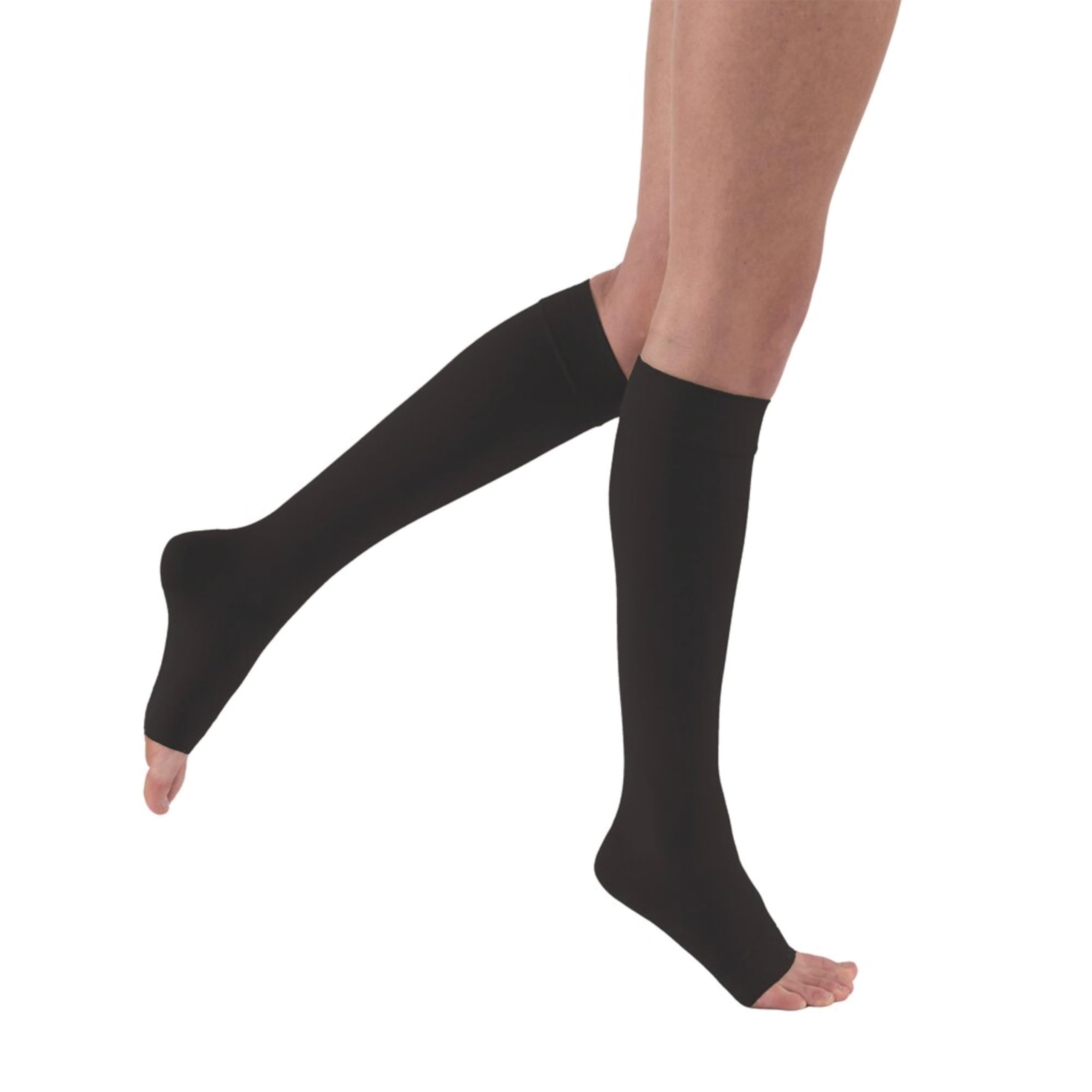
Compared to the top pick Truform, the JOBST Relief uses 15% more spandex (28% vs. 13%) in its 72% nylon and 28% spandex blend, creating a tighter, more responsive fit that feels noticeably higher-end. Buyers describe it as “thin, breathable with excellent compression” — a rare combo at this 30-40 mmHg pressure level where most socks feel like wrapping your leg in a tire inner tube.
For anyone who wears compression socks daily for venous disease (vein problems) or post-thrombosis care (recovery from a blood clot), this is the model that feels the least like a medical device. The reinforced heel pocket adds durability where most socks wear out first, and the silicone dot band keeps it from slipping — though after about six months of daily wash cycles, one reviewer noted the dots lose grip and the sock starts to roll below the knee.
It is the most expensive in this lineup, but the fabric is softer against the skin. Choose this over the top pick if your budget allows and you prioritize breathability over rugged longevity — it is the better daily companion, sharper on feel than the Truform.
Where it shines
- Thin, breathable fabric with strong compression that feels lightweight
- High 28% spandex content for a responsive, secure fit
- Reinforced heel pocket improves durability for daily use
Worth noting
- Silicone dot band can lose grip after extended machine washing
- Price is significantly higher than other 30-40 mmHg options
3. NuVein Medical Compression Stockings, 30-40 mmHg Support, Women & Men Thigh Length Hose
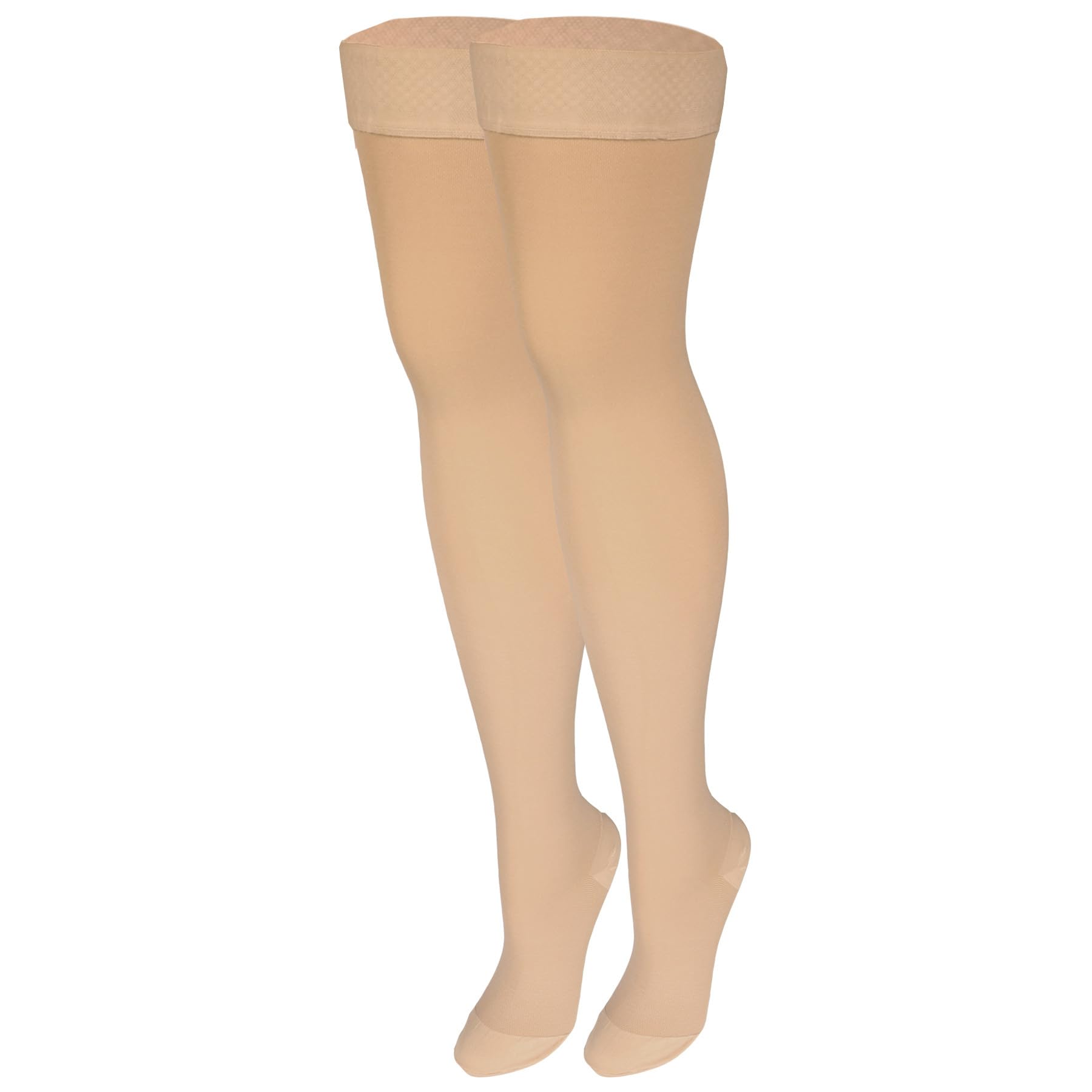
Buy the NuVein if you are recovering from a vein procedure and need a thigh-length stocking that looks natural under shorts. One buyer mentioned it fit perfectly after a vein procedure, stayed up, and was comfortable for days — exactly the kind of feedback you want when you are post-op. At 2.82 ounces, it is lighter than the Truform thigh high (4 oz), but still covers the full leg from ankle to upper thigh.
The closed-toe design prevents “toe strangulation” (the fabric bunching and squeezing your toes) that open-toe socks can cause. Buyers report the beige color looks natural enough to wear with tennis shoes and shorts, and the silicone dots on the wide top band help it stay up even on longer legs. The catch is that after about six machine washes, those same silicone dots start to lose grip — several reviewers report the stockings rolling down after a few hours of wear once the dots wear out.
For post-procedure use or if you need a closed-toe, thigh-high option, the NuVein delivers firm medical-grade support with a more discreet look than most clinical stockings, yet weighs just 2.82 ounces — lighter than the Truform thigh high by over an ounce.
What stands out
- Closed-toe design prevents toe strangulation and looks natural
- Lightweight at 2.82 oz for a thigh-length stocking
- Wide silicone dot top band helps prevent rolling
The trade-offs
- Silicone dots may lose grip after about six machine washes
- Some owners mention it slides down over long wear
4. Doc Miller Closed Toe Compression Socks for Women and Men, 30-40 mmHg

30-40 mmHg, the medical-grade threshold that prevents swelling during long shifts, is delivered here at the lowest price in this lineup. Buyers confirm the squeeze is real, with one reviewer explicitly preferring this pressure over 20-30 mmHg for healthcare standing. The nylon/spandex blend is thicker than premium brands like JOBST, but that also means it survives hot wash and dry cycles without shrinking.
The downside is in the fit details: buyers with size 6.5 feet say the sock area feels slightly large, and shorter wearers around 5’3″ report the tops fold over because the length is generous. It is available in sizes from Small to 5XL, a rare range that accommodates larger calf sizes most brands ignore. If you need a 30-40 mmHg sock that comes in plus sizes and can handle rough washing, this is a solid option.
You are getting near-prescription-level compression without the pharmacy markup, making this the best value if you need a closed-toe knee-high that works for long shifts and you aren’t worried about a slightly looser toe box.
The upsides
- Genuine 30-40 mmHg compression at a budget-friendly price
- Available in sizes Small to 5XL for larger builds
- Thicker nylon fabric withstands hot wash and dry without shrinking
Keep in mind
- Length may be too long for shorter wearers (under 5’4″)
- Toe box can feel slightly large for smaller shoe sizes
5. EvoNation Men’s Knee High 30-40 mmHg Graduated Compression Socks

What you actually get at this lower price is a sock built from 85% nylon / 15% spandex that accommodates larger calves without cutting off circulation, weighing just 2.4 ounces — 1.6 ounces lighter than the Truform thigh high, making it a featherweight option for all-day wear under work boots.
The trade-off is real: the same tight weave that gives you that extra-firm, therapeutic 30-40 mmHg pressure also makes it extremely difficult to put on and take off. Several buyers describe it as “nearly impossible” to don without a sock donner (a tool that helps you slide the sock on), and one person gave up after two uses. If you have limited hand strength or arthritis, you should skip this one. But if you can manage the wrestling match, the payoff is a sock that truck drivers say “eliminates leg stiffness after long drives” and has a loyal following — one buyer is on their sixth pair.
For heavier men or healthcare workers on long shifts who prioritize uncompromising compression, the EvoNation delivers extra firm pressure that actually helps, made in the USA, at a reasonable cost — it is the perfect budget buyer for someone who needs serious support and is willing to wrestle the sock on for the payoff.
Why we’d pick it
- Extra firm 30-40 mmHg compression that fits larger builds well
- Lightweight at 2.4 oz for comfortable all-day wear
- Made in the USA with durable elastic construction
A few caveats
- Extremely difficult to put on — a sock donner is almost required
- Some buyers find the top band too long for shorter legs
Understanding the Specs
30-40 mmHg: What That Number Really Means
The mmHg (millimeters of mercury) is how doctors measure pressure in compression garments. At 30-40 mmHg, you are in the medical-grade zone — this is the strongest over-the-counter compression level, typically prescribed for deep vein thrombosis (DVT — a blood clot in a deep vein), severe varicose veins, post-surgical recovery, and significant lymphedema (chronic swelling from lymph fluid buildup). It is about twice as tight as off-the-shelf “support socks” (15-20 mmHg) and requires a prescription in some countries.
Graduated Compression: Why It Gets Looser Higher Up
“Graduated” means the sock is tightest at your ankle (farthest from your heart) and gradually gets looser as it goes up your leg. This design helps your veins push blood back upward against gravity. A true graduated compression sock will have a pressure gradient — for example, 40 mmHg at the ankle, 35 mmHg at the mid-calf, and 30 mmHg at the knee — so the blood has a natural “staircase” to climb.
Nylon/Spandex Blend: What the Ratio Tells You
The material ratio controls the sock’s behavior. A high nylon percentage (83% in the Truform) makes the sock smoother, sheerer (more transparent), and less likely to cause allergic reactions — but it can be less durable. A high spandex percentage (28% in the JOBST) makes the sock tighter, more responsive, and longer-lasting, but it can feel denser and less breathable. The ideal balance depends on your skin sensitivity and how many hours you plan to wear it.
Silicone Dot vs. Knitted Top Band: How They Keep the Sock Up
A silicone dot band uses tiny rubbery dots on the inside of the top band to grip your skin. These are effective but can lose grip after months of washing. A knitted-in wide top band uses the fabric’s own elasticity to stay up — it is less slippery initially but can feel tight or itchy around the thigh or knee. Some people develop contact dermatitis (a skin rash) from silicone dots, so if you have sensitive skin, a knitted band is the safer bet.
FAQ
Can I wear 30-40 mmHg compression socks without a prescription?
Why do my 30-40 mmHg socks slide down after a few hours?
How do I measure myself for 30-40 mmHg compression socks?
Is it true I should not wear 30-40 mmHg socks to bed?
Final Thoughts: The Verdict
If you want one dependable pick, the best compression socks 30-40 mmhg winner is the Truform Thigh High because it is a proven, durable, no-nonsense stocking that healthcare workers have trusted for nearly two decades. If you prioritize breathability and a premium feel, grab the JOBST Relief Knee High. And for post-surgery recovery with a closed-toe design, the NuVein Thigh Length is the one to buy.

Mo Maruf
I created WellFizz to bridge the gap between vague wellness advice and actionable solutions. My mission is simple: to decode the research and give you practical tools you can actually use.
Beyond the data, I am a passionate traveler. I believe that stepping away from the screen to explore new environments is essential for mental clarity and physical vitality.