Our readers keep the lights on and my smoothie glass nicely filled. As an Amazon Associate, I earn from qualifying purchases.
That sharp, burning pull at the base of your thumb or the outside of your wrist isn’t just annoying—it’s a signal that your tendon sheath is inflamed and every repetitive motion is grinding against it. A compression sleeve designed specifically for wrist tendonitis immobilizes the joint just enough to stop that friction while allowing the fingers to stay functional for daily typing, cooking, or driving.
I’m Mohammad Maruf — the founder and writer behind WellFizz. After analyzing hundreds of hours of user experience data and cross-referencing material composition, splint geometry, and adjustability systems, I’ve mapped exactly which compression sleeve designs actually unload the tendon and which just squeeze without purpose.
This guide breaks down five real-world picks for the compression sleeve for wrist tendonitis market, focusing on the specific support structures and fabric choices that reduce night-time stiffness and day-time aggravation.
How To Choose The Best Compression Sleeve For Wrist Tendonitis
Wrist tendonitis isn’t carpal tunnel—the pain sits on the outside of the wrist near the thumb, not in the palm. That means a tendonitis sleeve needs to prevent radial deviation and thumb flexion more than it needs to flatten the median nerve. The wrong sleeve will squeeze the wrist but do nothing to stop the tendon from rubbing inside the sheath.
Splint Type and Placement
A palmar splint that keeps the wrist in a neutral 15-degree extension is ideal for tendonitis. Avoid splints that force a cocked-up position—that motion actually increases strain on the extensor tendons. Look for a removable metal stay that you can bend slightly to customize the angle.
Breathability and Thickness
Tendonitis sleeves are often worn overnight. If the fabric traps sweat, the skin macerates and the sleeve slides, reducing support. A 3mm or thinner woven fabric with a Lycra or moisture-wicking inner layer stays put and keeps you dry. Neoprene feels supportive but causes heat buildup that can worsen inflammation in some users.
Strap System
Three adjustable straps give you the ability to dial in compression across the wrist, the palm, and the forearm separately. This is critical because tendonitis often creates a pressure-point sweet spot—too loose and the tendon moves, too tight and blood flow gets cut. Velcro-based closures allow micro-adjustments throughout the day as swelling fluctuates.
Quick Comparison
On smaller screens, swipe sideways to see the full table.
| Model | Category | Best For | Key Spec | Amazon |
|---|---|---|---|---|
| FREETOO Reversible Wrist Brace | Mid-Range | All-day wear with adjustable tension | 3mm thin Lycra + removable metal splint | Amazon |
| ARMSTRONG AMERICA Thumb Spica Splint | Premium | Thumb + wrist immobilization for De Quervain’s | Aluminum splint, neoprene body, 85% neoprene | Amazon |
| FEATOL Wrist Brace Night Support | Mid-Range | Night-time neutral positioning | Double plastic splints, hook & loop closure | Amazon |
| UptoFit Copper Compression Sleeve | Premium | Active motion with light support | 25% copper fiber, 4-way stretch weave | Amazon |
| CopperJoint Pair Adjustable Sleeves | Premium | Bilateral coverage during sports or typing | Copper-infused nylon, 4-way stretch, pair | Amazon |
In‑Depth Reviews
1. FREETOO Reversible Carpal Tunnel Wrist Brace
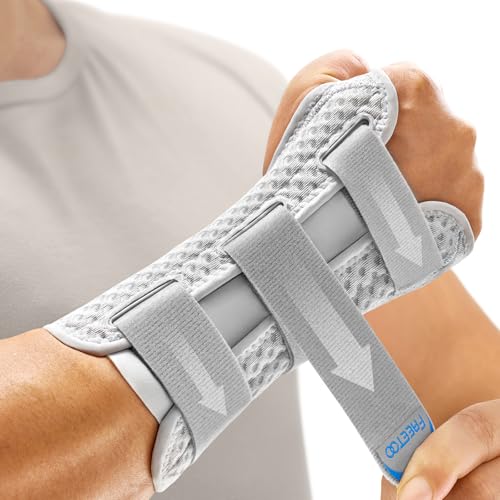
The FREETOO stands out because it combines a medical-grade removable metal palmar splint with two plastic dorsal splints in a package that weighs only 80 grams. That dual-sided support means the wrist stays locked in neutral extension while the hand can still grip a mouse or a steering wheel without the brace shifting. The 3mm fabric is thin enough to wear under a long-sleeve shirt all day without looking bulky.
Three adjustable straps let you set a light compression for daytime typing or crank it down for overnight immobilization. Users consistently report that the Lycra lining prevents chafing even during eight-hour work sessions, and the reversible design eliminates the need to buy a separate left and right brace. The trade-off is that the metal stay must be removed before machine washing, which adds a small step to the cleaning routine.
Real-world feedback highlights the brace’s effectiveness for pregnancy-related carpal tunnel and post-fracture recovery, with multiple users noting that the breathability kept their skin dry through the night. The value lies in the dual-sided splint system—most braces at this level only stabilize one plane.
Why it’s great
- Dual-sided splint limits both palmar and dorsal wrist movement
- 3mm fabric breathes well and fits under clothing
- Reversible design works for either hand
Good to know
- Metal stay requires removal before washing
- May feel too minimal for severe acute tendonitis flare-ups
2. ARMSTRONG AMERICA Thumb Spica Splint & Wrist Brace
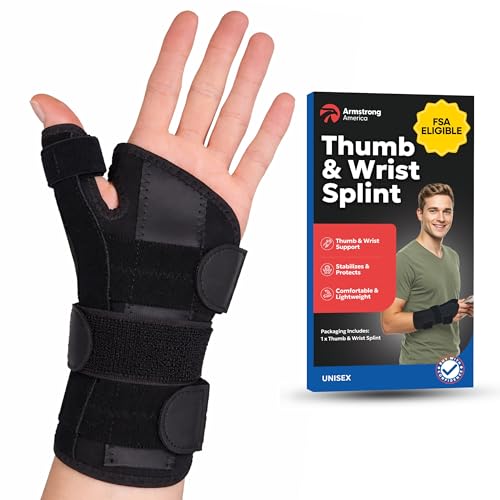
When tendonitis travels into the thumb—a condition known as De Quervain’s tenosynovitis—a standard wrist sleeve won’t cut it. This ARMSTRONG AMERICA brace uses a rigid aluminum strip that runs along the thumb and locks the CMC joint, preventing the painful pinch and twist motions that aggravate the tendon sheath. The neoprene body provides consistent compression without cutting into the thenar eminence.
The hook-and-loop closure system allows fine adjustment around the wrist and forearm, which is critical because De Quervain’s creates swelling that changes hour by hour. Users with very small wrists or hands have reported that the Small/Medium size fits perfectly, and the brace stays in place during sleep. The trade-off is that the neoprene lining can feel warm during extended daytime wear, and the thumb loop may pinch at the web space if over-tightened.
Customer reviews emphasize that this brace outperformed three other brands for thumb-related pain, specifically because the aluminum stay doesn’t bend out of shape under pressure. It is a specialized tool for tendonitis that involves the thumb, not a general-purpose sleeve.
Why it’s great
- Aluminum thumb stay immobilizes CMC joint effectively
- Adjustable strapping allows swelling compensation
- Excellent fit for smaller hand sizes
Good to know
- Neoprene can trap heat during all-day wear
- Thumb web space may feel tight on wider hands
3. FEATOL Wrist Brace Night Support

The FEATOL is built specifically for overnight wear, with two fixed plastic splints that hold the wrist in a neutral position while you sleep. This prevents the unconscious wrist flexion that inflames the tendon sheath during the night—a common trigger for morning stiffness. The three-strap hook-and-loop closure extends up the forearm, so the brace won’t slide off during sleep even if you toss and turn.
Users consistently note that the material is breathable and the padding around the splint edges prevents pressure points on the ulnar side. The sizing runs slightly small, so buyers with larger frames should order up, but the range from 5.4 to 10 inches covers most adults. The splints are non-removable, which means the brace maintains consistent geometry wash after wash, but you cannot customize the angle like you can with a metal stay.
The primary complaint is that the Velcro straps can loosen over months of nightly use, but replacements are inexpensive. For tendonitis sufferers who wake up with a stiff, painful wrist each morning, this brace directly addresses the root cause.
Why it’s great
- Fixed dual splints maintain consistent night-time neutral angle
- Extended forearm strap prevents overnight slipping
- Breathable padding avoids edge pressure points
Good to know
- Non-removable splints limit customization
- Velcro straps may lose grip after several months
4. UptoFit Copper Wrist Compression Sleeve

The UptoFit sleeve takes a completely different approach—no splints, no straps, just a continuous 4-way stretch compression tube made from a copper-infused nylon-spandex blend. This is the option for users whose tendonitis is mild or intermittent and who need freedom of motion more than rigid immobilization. The 25% copper fiber content is marketed for anti-microbial and circulation benefits, but the real value here is the even, non-slip compression that stays put during physical activity.
The seamless construction means no Velcro to snag on clothes and no metal to poke. However, because there is no splint, this sleeve will not prevent the wrist from bending into painful positions during sleep. It is a compression-only tool, suitable for daytime symptom management rather than night-time correction.
Some users report that the thumb hole can cut into the web space if the sizing is off, and the compression may feel too tight across the palm for wider hands. The copper-infused fabric also loses elasticity faster than traditional nylon blends—several reviews mention loosening after two to three weeks of daily wear.
Why it’s great
- Ultra-light and invisible under clothing
- Seamless knit avoids pressure points and snags
- Good for maintaining circulation during active recovery
Good to know
- No splint means no night-time immobilization
- Copper fabric may lose elasticity within weeks
5. CopperJoint Wrist Brace Pair

CopperJoint delivers a pair of compression sleeves, making it the only entry here that supports both wrists simultaneously—an important consideration for tendonitis caused by symmetrical activities like typing, gaming, or crocheting. The 4-way stretch fabric is copper-infused nylon, designed to provide even compression across the wrist and lower palm without bunching at the thumb base. The pull-on design means no straps to adjust, which simplifies application but removes the ability to fine-tune pressure.
Users with small wrists report that the compression is consistent and that the sleeves allow full finger dexterity for delicate tasks. The material is thicker than the UptoFit sleeve, providing a snugger feel that some prefer for sports or gym use. However, sizing appears inconsistent—multiple reviews note that following the measurement chart yields a looser fit than expected, requiring a size down for optimal compression.
The thumb-hole cutout is a common pain point, with several users finding it too small or poorly positioned, leading to chafing after extended wear. These sleeves work best as a lightweight daytime support for mild tendonitis rather than a therapeutic night brace. The copper infusion does not provide any measurable clinical benefit beyond the compression itself.
Why it’s great
- Pair packaging supports both wrists for symmetrical conditions
- Thick 4-way stretch provides consistent compression
- Pull-on design is quick and tool-free
Good to know
- Thumb hole may chafe during prolonged wear
- Sizing runs loose; consult reviews before ordering
FAQ
Should I sleep with a compression sleeve for wrist tendonitis?
How tight should the compression sleeve feel on an inflamed tendon?
Can I type with a tendonitis compression sleeve on?
How does a tendonitis sleeve differ from a carpal tunnel brace?
Is copper-infused fabric worth it in a compression sleeve?
Final Thoughts: The Verdict
For most users, the compression sleeve for wrist tendonitis winner is the FREETOO Reversible Wrist Brace because it combines a removable metal splint with a 3mm breathable fabric and three adjustable straps—enough support to unload the tendon during the day and enough comfort to wear overnight. If your tendonitis involves significant thumb pain or a De Quervain’s diagnosis, grab the ARMSTRONG AMERICA Thumb Spica Splint for its aluminum thumb stay. And for early-stage or mild tendonitis where you just need compression during movement, nothing beats the UptoFit Copper Compression Sleeve for its seamless, ultra-light profile.

Mo Maruf
I created WellFizz to bridge the gap between vague wellness advice and actionable solutions. My mission is simple: to decode the research and give you practical tools you can actually use.
Beyond the data, I am a passionate traveler. I believe that stepping away from the screen to explore new environments is essential for mental clarity and physical vitality.