Our readers keep the lights on and my smoothie glass nicely filled. As an Amazon Associate, I earn from qualifying purchases.
Specs are compiled from manufacturer listings and verified buyer reviews and can change over time — please confirm the key details on the product page before buying.
A sleeping bag that won’t go back into its sack is a camping nightmare. You wrestle, you shove, and you still lose half your trunk space to one piece of gear. The right compression sack solves that—it squeezes your bag down tight so everything else actually fits in your pack.
I’m Mohammad Maruf — the founder and writer behind WellFizz. This guide is built by comparing the manufacturers’ published specifications and the patterns across verified customer reviews, so you get each pick’s real strengths and trade-offs instead of marketing spin.
You need a compression sack for sleeping bag that shrinks your bulky gear down to a manageable size. Here is the straight, honest breakdown of the best options on Amazon right now, sorted by use case and budget so you can pick the one that fits your gear.
Our Picks at a Glance

How To Choose The Best Compression Sack For Sleeping Bag
A compression sack is a simple piece of gear, but a wrong pick means a ripped bag or a soggy sleeping bag on a wet morning. Here are the three specs that separate a great sack from a frustrating one.
Capacity: Match It To Your Sleeping Bag
Compression sacks are measured in liters. A tiny 5-liter bag is perfect for a summer down bag, but a bulky synthetic winter bag needs at least 35 liters. If you squeeze a huge bag into a too-small sack, you’ll stress the seams and break the buckles.
Water Resistance: Dry Bag vs. Splash Guard
A “waterproof” compression dry bag uses a roll-top seal and keeps your bag bone-dry even if you drop it in a creek. A “water-resistant” sack only handles light rain. If you kayak camp or hike in the rain, the roll-top seal is a must.
The Fabric and Strap Count
The denier (D) number tells you how tough the fabric is: 30D is featherlight but fragile, 70D is a great balance, and 210D is tank-like. Look for at least 3 compression straps for even squishing—4 straps is even better for bulky bags.
Quick Comparison
| Model | Best For | Capacity | Weight | Water Protection | Amazon |
|---|---|---|---|---|---|
| OneTigris 25L★ Best Overall | Budget / military surplus bag | 25 liters | 176 grams | Water-resistant 3000mm fabric | Amazon |
| HIKEMAN 53LAlso Great | Huge gear / bulk storage | 53 liters | 0.35 lbs | Water-resistant coating | Amazon |
| Sea to Summit eVac | Waterproof + compression combo | 5 liters | 0.22 lbs | Waterproof (10,000mm) | Amazon |
| Sea to Summit Lightweight | Travel / carry-on packing | 8 liters | 0.19 lbs | Water-resistant coating | Amazon |
In‑Depth Reviews
1. OneTigris Sleeping Bag Compression Stuff Sack, 25L
Our pick — over 4★ from 350+ verified ratings; the strongest balance of quality and price.
The affordable workhorse that squeezes a military surplus bag with room to spare.
At 176 grams (0.39 pounds), compared to the Sea to Summit eVac at 0.22 pounds and built from 210T Plaid Dacron fabric with a PU coating that offers 3000mm water resistance—enough to shrug off light rain. The 25-liter capacity fits most 1-person bags, and buyers confirm it holds a US military intermediate cold bag with room for a liner and pillow. Strong UTX buckled straps let you attach it to the side of a backpack.
Compared to the HIKEMAN’s 53-liter max, the OneTigris at 25 liters still handles a standard synthetic bag well. The side straps are not permanently attached and can slip when tightened, so you need to check them before a hike. One buyer mentioned the material smells like a pool float initially—air it out before packing. For the price, it is a reliable option if you are on a tight budget and do not need full waterproofing.
Value and Capacity
- 25 liters fits a surplus bag plus liner and pillow
- 3000mm water resistance handles camp drizzle
- Attachable straps for backpack side carry
Two Annoyances
- Side straps slip under heavy tension; need readjustment
- Initial chemical smell that requires airing out
Reach for this if: you need a budget-friendly 25-liter sack for a standard bag and do not mind a little pre-trip setup.
Look elsewhere if: you plan to compress a bulky winter bag—the 25L will be too tight—or you need truly waterproof protection.
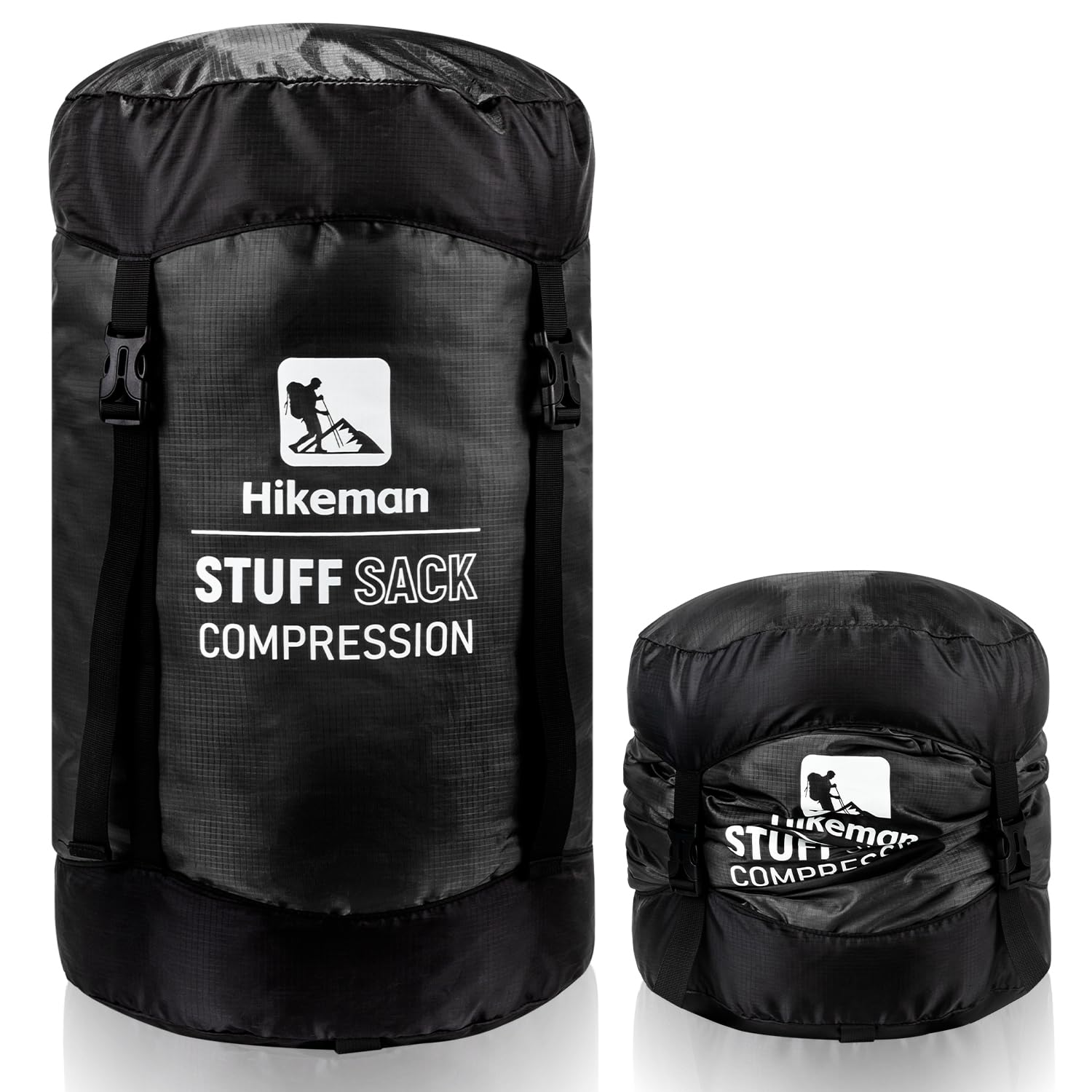
2. HIKEMAN Compression Sack, 12L/19L/32L/46L/53L
The warehouse-on-demand that swallows a winter bag whole.
This HIKEMAN sack is the biggest in the lineup at 53 liters—over ten times the capacity of the Sea to Summit eVac’s 5 liters. For a bulky synthetic 0°F bag or even a queen-sized quilt, this is the only sack that fits without a fight. The 210T tear-resistant polyester with a water-resistant coating keeps the damp out, but it is not a true waterproof dry bag.
Compared to the OneTigris at 176 grams, this 0.35-pound sack earns its weight with four adjustable straps (two strong compression straps and two quick-release buckles) for even, predictable squishing. Buyers report reviving sleeping bags that had not fit into their own sacks in 10 years—the sack compressed the bag to a fraction of its size. The only catch is that the largest 53L size is overkill for a compact down bag, so match the size to your actual gear.
Huge Capacity Win
- 53-liter max capacity fits the bulkiest winter bags and blankets
- Four compression straps distribute tension evenly
- Bottom carry handle makes pulling from a pack easy
One Trade-off
- Water-resistant, not fully waterproof for river crossings
- Largest size adds a little weight compared to ultralight options
Grab this if: you own a massive sleeping bag or blanket and want the most space-saving squeeze for your money.
Look elsewhere if: your bag is a compact down model; you will find a smaller, lighter sack more efficient.
3. Sea to Summit eVac Compression Dry Bag

The dry bag that breathes out air but never lets water in.
This is the only pick that offers true waterproof protection—a roll-top closure plus a 10,000mm waterhead rating (the measure of how much water pressure the fabric can take before leaking) on the body, and a valve-free air-permeable 40D nylon base that lets you push air out without letting moisture in.
A 5-liter version is shown here, but owners mention that the 35L fits a bulky synthetic bag and the 8L fits down bags, so pick the size that matches your gear. The four compression straps (two ladderlock and two side-release buckles) with a patent-pending field-replaceable buckle mean you won’t toss the sack if a buckle snaps on the trail. The catch is that the black top hood can pull off during strap tightening, requiring a quick re-adjust.
Bone-dry guarantee: The only compression sack here that you can drop in a stream without your sleeping bag getting wet.
Versatile sizing: Customers note 35L fits bulky synthetic bags; 8L fits down bags; 5L fits summer bags and layers. Measure your bag first.
Perfect for: kayak campers, canoe trippers, and anyone who sleeps in rain-heavy climates.
Consider skipping if: your bag is already packed deep inside your backpack and you never expect submersion.
4. Sea to Summit Lightweight Compression Sack, 8L

Squishes your king comforter flat enough for a carry-on.
At just 0.19 pounds, this 8-liter sack (versus the HIKEMAN 53L at 0.35 pounds), yet reviewers point out compressing a king-size comforter with duvet cover to fit into a suitcase side. The 70D PU-coated nylon (bluesign-approved) with a white interior coating makes finding dark items easy and sheds moisture. Three compression straps (two ladderlock and one side-release buckle) with an attached flip-top lid prevent strap tangling.
Compared directly to the HIKEMAN, this sack is built for travel and backpacking, not bulk storage—the 8-liter capacity is best for down bags, clothes, or a compact synthetic bag. One reviewer noted it compresses clothes to roughly one-third their original size, making it an excellent choice for carry-on packing. The catch is that compressed shape becomes a hard ball that can be awkward to fit into a rigid suitcase; it works best inside a backpack or duffel.
Packing Power
- Reduces bulky items to about one-third of original volume
- Flip-top lid keeps straps organized and tangle-free
- Durable 70D nylon with moisture-shedding interior coating
Shape Issue
- Compressed ball shape can be tough to fit into a hard-shell suitcase
- Not fully waterproof—only water-resistant coating
Right for: travel backpackers and anyone who needs to pack a big duvet or down jacket into a rolling suitcase.
Skip if: you need waterproof protection for wet-weather hiking.
Understanding the Specs
Denier (D) — Fabric Toughness
Denier is the weight in grams of 9,000 meters of a single fiber. Higher numbers mean thicker, tougher fabric. A 30D sack (like the Ultra-SIL) is super light but more prone to punctures. A 70D sack (like the Sea to Summit Lightweight) is a durable balance. A 210D sack (like the OneTigris) is tough but heavier. For backpacking, 70D is the balance; for car camping, 210D is fine.
Water Resistance vs. Waterproof
A water-resistant coating (often PU or DWR) beads rain off but will not hold up to submersion. A waterproof compression dry bag, like the Sea to Summit eVac, uses a roll-top closure and taped seams to keep water out completely—even if you drop the bag in a river. The eVac also has an air-permeable base that lets you push air out while keeping water out. For backpacking in the rain, a waterproof sack is worth the extra weight.
FAQ
How do I know what size compression sack to buy for my sleeping bag?
Can I use a compression sack for things other than a sleeping bag?
Is a waterproof compression sack worth the extra money?
How many compression straps do I really need?
Will a compression sack damage my sleeping bag’s loft?
What does “210T” mean in fabric terms?
Can I wash my compression sack?
Is a heavier sack like the HIKEMAN worth it for car camping?
Final Thoughts: The Verdict
Across the board, the compression sack for sleeping bag winner is the HIKEMAN 53L because it blends massive capacity, four strong straps, and a wallet-friendly price into one package that fits bulky winter bags and queen quilts easily. If you want true waterproof protection for wet-weather hiking, grab the Sea to Summit eVac. And for ultralight gram-counters who need a tiny sack for a down puffy or summer bag, the standout is the Sea to Summit Ultra-SIL.
How We Picked
We do not accept paid placement. Every pick is matched to a real buyer and a real use-case; we do not hands-on test units.
Sources & Methodology
Specifications: manufacturer listings and product documentation. Review insights: verified customer reviews, as of July 2026. Pricing: not shown on this page (it changes often); check the current price via the retailer link.
As an Amazon Associate, WellFizz earns from qualifying purchases. This does not affect which products we feature.
Related Guides

Mo Maruf
I created WellFizz to bridge the gap between vague wellness advice and actionable solutions. My mission is simple: to decode the research and give you practical tools you can actually use.
Beyond the data, I am a passionate traveler. I believe that stepping away from the screen to explore new environments is essential for mental clarity and physical vitality.