Our readers keep the lights on and my smoothie glass nicely filled. As an Amazon Associate, I earn from qualifying purchases.
Specs are compiled from manufacturer listings and verified buyer reviews and can change over time — please confirm the key details on the product page before buying.
If you spend your day on your feet — whether you are a nurse, teacher, or just running errands — you know that heavy, tired feeling that settles into your legs by mid-afternoon.
I’m Mohammad Maruf — the founder and writer behind WellFizz. This guide is built by comparing the manufacturers’ published specifications and the patterns across verified customer reviews, so you get each pick’s real strengths and trade-offs instead of marketing spin.
The right pair needs to deliver real graduated pressure, stay put without rolling, and be comfortable enough to forget you are wearing them. That is what we sorted for in this roundup of the best compression hose for women.
Quick Picks
- Medical Compression Pantyhose for Women Men (Myshear) — Best Overall
- 2 Pairs Sheer Compression Socks for Women (BSERA) — Best Value
- Compression Pantyhose for Women (B0D6YLTJKF) — Solid Budget Pick
- Compression Pantyhose for Women Footless (Orgood) — Flexibility Pick
- 20-30mmHg Compression Pantyhose for Women (XUANSHOW) — Multi-Pack Value
How To Choose The Best Compression Hose For Women
Picking the right compression hose is about matching the pressure level to your real problem, whether that is mild swelling at the end of a shift or managing a condition like varicose veins. Skip the guesswork by focusing on the compression rating, the length, and the fabric feel.
Compression Level (mmHg)
The number tells you how firm the squeeze is. A 15-20 mmHg level is gentle — good for travel, mild tiredness, or prevention during pregnancy. A 20-30 mmHg level is medical-grade, meaning it pushes harder at the ankle and loosens as it goes up. That is the level doctors typically recommend for swelling, varicose veins, or standing all day.
Style: Knee High vs. Pantyhose
Knee highs stop below the knee and are easier to put on, but they do not support the upper leg or prevent fluid pooling behind the knee. Full pantyhose or tights cover the whole leg and waist, which helps with circulation from thigh to ankle, but they are harder to get on and off.
Fit and Fabric
A blend of nylon and spandex (around 85% nylon / 15% spandex) gives the stretch and breathability you need for all-day wear. Reinforced heels and toes prevent early rips. If your measurements fall between sizes on the chart, going up a size usually gives a more comfortable fit without losing too much compression.
Quick Comparison
| Model | Best For | Compression Level | Style | Material Blend | Amazon |
|---|---|---|---|---|---|
| Medical Compression Pantyhose (Myshear) | Full-leg support | 20-30 mmHg | Pantyhose / Closed Toe | 75% Nylon, 25% Spandex | Amazon |
| 2 Pairs Sheer Compression Socks | Everyday wear & travel | 15-20 mmHg | Knee High | 85% Nylon, 15% Spandex | Amazon |
| Compression Pantyhose 20-30mmHg (B0D6YLTJKF) | Value full-length | 20-30 mmHg | Pantyhose / Closed Toe | — | Amazon |
| Compression Pantyhose Footless (Orgood) | Footless flexibility | 20-30 mmHg | Footless | — | Amazon |
| 20-30mmHg Compression Pantyhose (XUANSHOW) | Premium multi-pack | 20-30 mmHg | Footless | — | Amazon |
In‑Depth Reviews
1. Medical Compression Pantyhose for Women Men (Myshear)
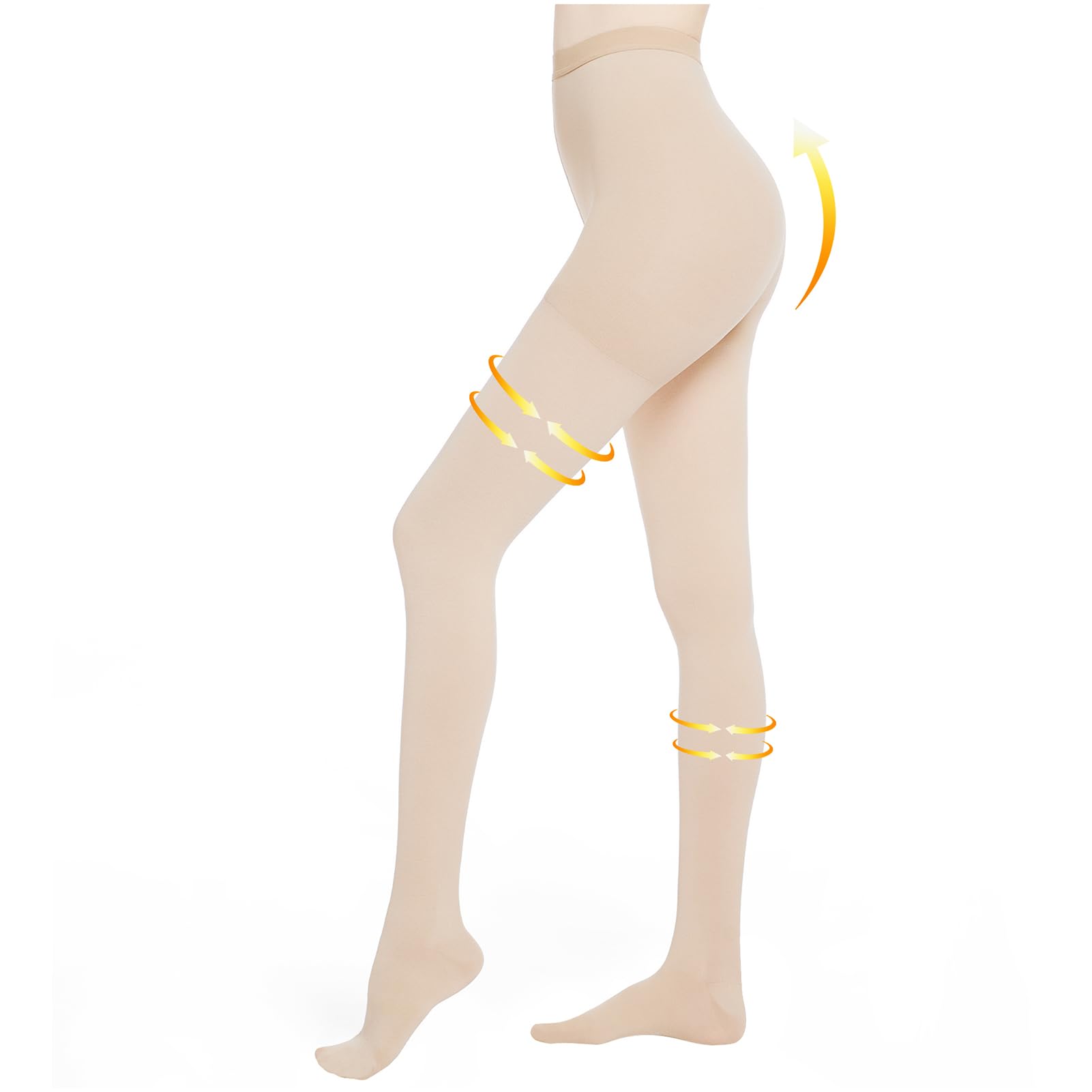
The full-coverage pair that stops fluid pooling behind the knee.
This is the set to grab if your tiredness runs from your ankles all the way up to your thighs. The 20-30 mmHg graduated compression (meaning it squeezes hardest at the ankle and gradually loosens toward the waist) targets varicose veins, edema, and that heavy feeling after a long shift. Buyers report it “prevents fluid pooling in knees unlike socks,” which is the exact reason someone would move from knee-highs to full tights. The material blend of 75% nylon, 20% spandex, and 5% elastic fibers makes it opaque and soft against the skin.
Some owners mention the sizing chart can be tricky — one review suggests sizing down if you want the full compression effect. Another person (5’9″, 115 lbs) chose a Small and found it comfortable. The wider waistband and roomy toe area were called out as thoughtful extras. At 5.29 ounces, it is light enough to pack for travel.
Unlike the sheer 15-20 mmHg knee highs from BSERA below, these provide firmer, full-leg support and stay put through 12-hour shifts, per the reviews. The reinforced crotch design is meant to extend the lifespan, though a few buyers mention the fabric can sag slightly in the butt area after washing.
What works
- 20-30 mmHg full-leg graduated compression stops knee fluid pooling
- Roomy toe area and wider waistband improve comfort
- Thick, durable fabric at a price that beats stockings costing 2-3x more
Watch out for
- Sizing chart inconsistent; may need to size up or down depending on your build
- Can be difficult to pull on, especially for shorter individuals
- No petite size option — shorter customers note extra fabric bunching
Reach for this if: You need full-leg medical-grade support for long shifts or managing edema and want a budget-friendly alternative to pharmacy brands.
Look elsewhere if: You are under 5’2″ or need easy on/off — the tight weave can be a wrestling match for smaller frames.
2. 2 Pairs Sheer Compression Socks for Women (BSERA)

The sheer knee-high you forget you are wearing, even in summer.
If you just want something light for travel or daily desk life, these are a great starting point. The 15-20 mmHg level is lighter than the 20-30 mmHg models above (buyers call it “easy compression”), so it handles mild swelling and tired legs without the struggle of putting on a medical-grade tight. Made from 85% nylon and 15% spandex, the fabric is thin enough to wear with sandals while still giving a graduated squeeze from ankle to knee.
One reviewer noted their “doctor noted no ankle fluid retention,” which backs up the claims for circulation support. The non-binding top band stays put without digging in, and the heel and toe reinforcements help them survive repeated machine washing. At roughly half the cost of a single pair of premium hose, you get two pairs in soft beige or black.
The big trade-off versus the Myshear pantyhose is that these stop at the knee. That means they do not prevent fluid from pooling behind the knee (as the Myshear review notes), and you miss the thigh and waist support. A few buyers mention they feel too tight even when sizing up — one person ordered two sizes up and still found them uncomfortable.
Why they work
- Sheer, breathable fabric good for hot weather and discreet under clothing
- Two pairs included at a very reasonable price
- Easy to pull on and off compared to 20-30 mmHg tights
Where they fall short
- No thigh or hip support — knee-only coverage
- Some wearers find them too tight even after sizing up significantly
- Not heavy-duty enough for managing diagnosed edema or varicose veins
Pick these for: Air travel, office work, or mild daily leg fatigue where you want a barely-there feel under pants or skirts.
Pass if: You need the firmer 20-30 mmHg support or full-leg coverage for conditions like edema or varicose veins — you will outgrow these fast.
3. Compression Pantyhose for Women (B0D6YLTJKF)

The no-frills full-length option if you just need the pressure.
This pair skips the extra marketing and delivers the basics: a 20-30 mmHg closed-toe pantyhose at the same price point as the BSERA socks. The product description is minimal, but the spec sheet confirms it is a full-leg support hose targeted at varicose veins and edema. If you are already familiar with compression wear and want a straight replacement without paying for a brand name, this fits the bill.
Because this product has no customer reviews yet, you are betting on the spec alone. The 20-30 mmHg level is the same firmness used in medical-grade stockings, so the therapeutic pressure should be there. The trade-off is the unknown on fit, durability, and how the fabric feels after a few washes compared to more established picks like the Myshear or BSERA pairs.
The obvious competitor here is the Myshear pantyhose at the same price — but Myshear has dozens of reviews confirming its sizing quirks and durability. Without those same data points for this product, consider it a value gamble for buyers who already know their perfect size in a 20-30 mmHg tight.
Bottom line: A functional, low-risk buy if you know exactly what 20-30 mmHg feels like and do not need hand-holding from reviews. skip it if you prefer a well-tested brand with known fit.
Best for: experienced compression users who want a cheap backup pair — the risk is low because the price matches the simplest products on this list.
Not for: first-time buyers who need sizing guidance, reviews, or a clear picture of the fabric feel.
4. Compression Pantyhose for Women Footless (Orgood)

Full leg compression without trapping your toes.
If you hate having your toes squeezed or want to wear your own socks over the top, the footless style is your move. This Orgood pair delivers 20-30 mmHg graduated compression from ankle to waist — the same firmness as the Myshear tights — but leaves your feet completely bare. That makes it easier to pair with regular socks or sandals, and it removes the hassle of aligning toes inside a closed toe.
There are no customer reviews yet for this product, so its durability and fit are unproven in the real world. The manufacturer is Orgood, a newer name in compression wear. The 20-30 mmHg rating puts it in the medical-grade category, but without user feedback, the actual pressure feel and fabric quality remain unknown.
Compared to the full-foot Myshear tights, you lose the foot compression (which helps with foot swelling and circulation), but you gain the ability to wear this under capris or with open-toe shoes. If you need foot support alongside leg compression, the closed-toe Myshear or the budget pantyhose are better choices.
The call: A niche pick for people who specifically need footless compression. Without reviews, treat this as an educated guess — the spec says 20-30 mmHg, but the feel is unconfirmed.
Try it if: You want full-leg support without foot coverage, especially for wearing under cropped pants or with toe-free shoes.
pass on it if: You rely on foot compression for swelling or have sensitive toes that benefit from the gentle squeeze of a closed toe.
5. 20-30mmHg Compression Pantyhose for Women (XUANSHOW)

Two pairs of footless medical-grade tights for the price of one premium pair.
XUANSHOW bundles two pairs (beige and black) of 20-30 mmHg footless compression tights, making this a smart choice if you need a rotation. The compression level matches the firmest options on this list, targeting lymphedema, edema, and varicose veins. The footless design keeps your toes free, similar to the Orgood pair above, but you get two pairs here.
No customer reviews are available for this product either. The maker claims the 20-30 mmHg level and footless style, and the size range goes from S to 2XL. Without real-world fit data, your best bet is to measure your ankle, calf, and thigh against the size chart closely. The price for two pairs sits above the Orgoods single pair, but below many pharmacy-brand options.
Compare this to the BSERA socks: those are knee-high and 15-20 mmHg for a lower price. XUANSHOW gives you double the pairs at a firmer compression in a full-length cut, but both lack the extensive user feedback that the Myshear tights have. If you are comfortable gambling on an unreviewed product, this is the best value for quantity at the highest pressure level.
Perks
- Two pairs included (beige and black) at a competitive price
- 20-30 mmHg footless design for full-leg support without foot squeeze
- Available in sizes S through 2XL
Risks
- No customer reviews to confirm fit, durability, or actual compression feel
- Footless design does not address foot or ankle swelling
- Brand is less established than some alternatives on this list
Grab if: You need two pairs of firm, footless, full-leg compression at a bulk-friendly price and are okay trying an unreviewed product.
Avoid if: You want a single proven pair you can trust out of the package — pick the Myshear tights instead.
Understanding the Specs
mmHg — The Squeeze Level
The mmHg number (millimeters of mercury) tells you how much pressure the hose apply. 15-20 mmHg is gentle — think a light hug that helps with minor tiredness on a long flight. 20-30 mmHg is firm medical-grade support — the kind that actually pushes blood upward to reduce swelling and prevent fluid buildup. Most doctors start prescribing at 20-30 mmHg for varicose veins or edema.
Graduated Compression
This means the hose are tightest at your ankle and gradually loosen as they move up your leg. The design uses your body’s natural blood flow — pushing used blood up toward the heart instead of letting it pool. A true graduated compression hose will have the mmHg rating listed at the ankle, and the pressure decreases by about 50% by the time it reaches the thigh.
FAQ
Should I get 15-20 mmHg or 20-30 mmHg compression?
Can I wear compression hose to bed?
How do I know what size to buy?
Do compression hose cause blood clots?
How long do compression hose last?
Can I wear compression hose with open-toe shoes?
Why do my compression hose keep rolling down?
Are compression hose safe during pregnancy?
What is the difference between knee-highs and pantyhose for leg swelling?
Can I machine wash compression hose?
Final Thoughts: The Verdict
Across the board, the best compression hose for women winner is the Medical Compression Pantyhose (Myshear) because it delivers full 20-30 mmHg graduated compression for under, with buyer feedback confirming it prevents the knee-pooling that knee-highs miss. If you want something lighter for travel or a desk job, grab the 2 Pairs Sheer Compression Socks (BSERA). And for two pairs of firm footless tights at a competitive price, the 20-30mmHg Compression Pantyhose (XUANSHOW) is a solid budget multi-pack gamble.
How We Picked
We do not accept paid placement. Every pick is matched to a real buyer and a real use-case; we do not hands-on test units.
Sources & Methodology
Specifications: manufacturer listings and product documentation. Review insights: verified customer reviews, as of July 2026. Pricing: not shown on this page (it changes often); check the current price via the retailer link.
As an Amazon Associate, WellFizz earns from qualifying purchases. This does not affect which products we feature.

Mo Maruf
I created WellFizz to bridge the gap between vague wellness advice and actionable solutions. My mission is simple: to decode the research and give you practical tools you can actually use.
Beyond the data, I am a passionate traveler. I believe that stepping away from the screen to explore new environments is essential for mental clarity and physical vitality.