Our readers keep the lights on and my smoothie glass nicely filled. As an Amazon Associate, I earn from qualifying purchases.
Specs are compiled from manufacturer listings and verified buyer reviews and can change over time — please confirm the key details on the product page before buying.
Does a composting toilet smell in a tiny house? That is the make-or-break question. In a small space, an odor leak turns your entire home into a problem zone. The four toilets here solve that by separating urine from solids, pulling air through a quiet fan, and keeping your space fresh — no black tank or chemicals needed.
I’m Mohammad Maruf — the founder and writer behind WellFizz. This guide is built by comparing the manufacturers’ published specifications and the patterns across verified customer reviews, so you get each pick’s real strengths and trade-offs instead of marketing spin.
Wiring a van conversion or finishing a cabin bathroom? Finding the best composting toilet for tiny house living depends on size, ventilation, how the toilet separates liquids, and how often you are willing to empty the tanks.
Quick Picks
- Cuddy Composting Toilet – Odorless, Waterless & Self-Contained — Best Overall
- OGO Origin Composting Toilet – 12V Electric Agitator — Easiest Daily Routine
- Separett Villa Urine-Separating Compost Toilet — High-Capacity Classic
- Thinktank Composting Toilet, White — Low-Exposure Design
How To Choose The Best Composting Toilet For Tiny House
Buying a composting toilet for a tiny house is different from buying one for a weekend cabin — you live with it every day. The right pick balances a compact shape, reliable odor control, and an emptying schedule that does not dictate your week. Here are the three specs that matter most when comparing models side-by-side.
Urine diversion is the non-negotiable
If urine and solids mix, you get a wet, smelly pile that takes weeks to break down and creates a strong ammonia odor. A urine-diverting toilet separates liquids at the bowl — the liquid goes into a sealed bottle or is piped to a drain, while solids stay dry in the main bin. Every product in this list uses urine diversion, but how well the separator works (and how easy it is to clean) varies. Buyers report that a poorly shaped separator can make wiping awkward, which is worth checking in the reviews before you buy.
Capacity is about your emptying tolerance
A 3.9-gallon solids bin might sound big, but the real bottleneck is the liquid tank. A toilet with a 2.4-gallon urine bottle will need more frequent emptying than one with a larger liquid setup. The larger the liquid reservoir and the easier it is to carry to a drain, the less often you deal with the messy part of upkeep. The solids bin gets emptied every two to three weeks depending on use, which for most tiny house dwellers is manageable.
Ventilation flexibility saves installation headaches
Some toilets require you to cut a hole in your roof or wall for an external vent pipe. Others include a built-in 12V fan and a carbon filter that lets you skip the drilling entirely. If your tiny house is already finished, a self-contained model with a filter is the simpler install. If you are building from scratch and want maximum odor removal, an external vent is the more permanent solution.
Quick Comparison
| Model | Best For | Dimensions | Weight | Urine Bottle | Amazon |
|---|---|---|---|---|---|
| Cuddy | Best Overall Balance | 17″ x 15.2″ x 16.5″ | 28 lbs | 3.9 gal solids bin | Amazon |
| OGO Origin | Tiny Footprint + Electric Agitator | 15″ x 16″ | 28 lbs | 2.4 gal | Amazon |
| Separett Villa | High-Capacity, No Mixing | 26.5″ x 18″ x 21.3″ | 34 lbs | Large (unlisted) | Amazon |
| Thinktank | Waste Isolation & Ease of Cleaning | — | 30 lbs | Bag-lined solids bin | Amazon |
In‑Depth Reviews
1. Cuddy Composting Toilet – Odorless, Waterless & Self-Contained
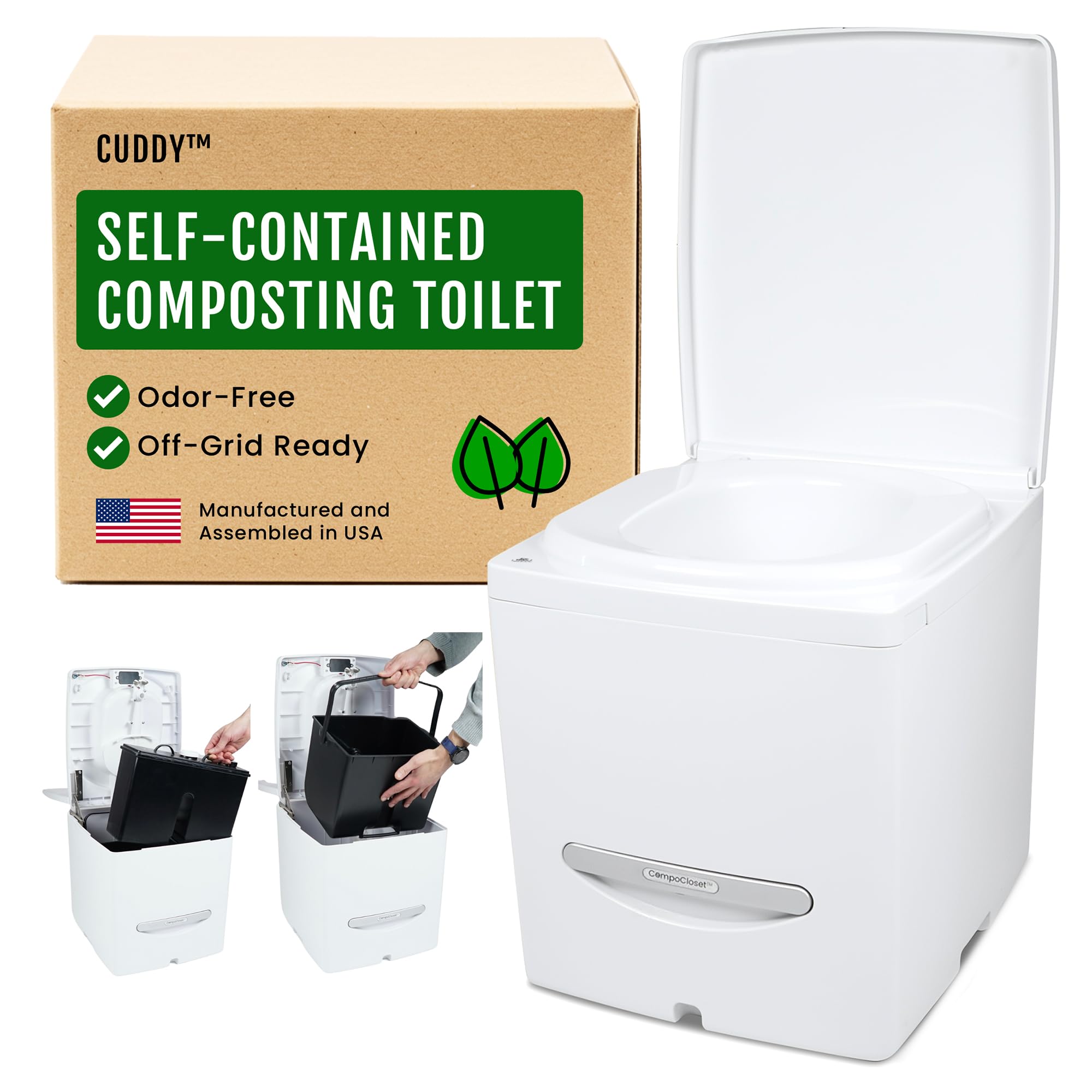
The compact box that owners mention delivers zero smell from day one.
At just 17 inches deep and 15.2 inches wide, the Cuddy fits a tiny house bathroom without dominating the room. You can move it at 28 pounds to clean — and its square shape lets you tuck it flush against a wall. The built-in 12V fan and carbon filter mean you do not have to cut an external vent hole, though the option is there if you want it.
You empty the urine bottle every few days — an LED fill light takes the guesswork out of that — and the 3.9-gallon solids bin every two to three weeks. The manual agitator handle (a crank that stirs the compost) breaks up the pile after each use, which keeps air flowing through the chamber. Customers note that if you overfill the bin, the agitator can push material out — so sticking to the recommended schedule matters. One owner mentioned using four Polident tablets in the urine bottle to completely knock out any scent, calling the toilet “awesome” and confirming it is “sturdy” and “feature-rich.”
The Cuddy is the most balanced pick here. — it measures 17 inches deep by 15.2 inches wide by 16.5 inches high, while the Separett Villa measures 26.5 inches by 18 inches by 21.3 inches, and it does not force you to pick between convenience and odor control. The manual agitator takes a second of effort each use, but that small trade-off buys you a simpler mechanical design with fewer parts to fail.
Why it earns the top spot
- Smallest overall footprint among the mid-range options (17″D x 15.2″W)
- No external vent needed thanks to the integrated fan and carbon filter
- Buyers consistently report zero odor with proper use
One honest limitation
- Manual agitator requires a turn after every use — not hands-free
- Urine bottle fills in two days for two people, so expect regular emptying
The everyday pick: Reach for the Cuddy if you want a no-drill install, reliable odor control, and a footprint that squeezes into tight corners.
Where it falls short: If you never want to touch a handle or remember to mix, an electric agitator model like the OGO may suit you better.
2. OGO Origin Composting Toilet – 12V Electric Agitator
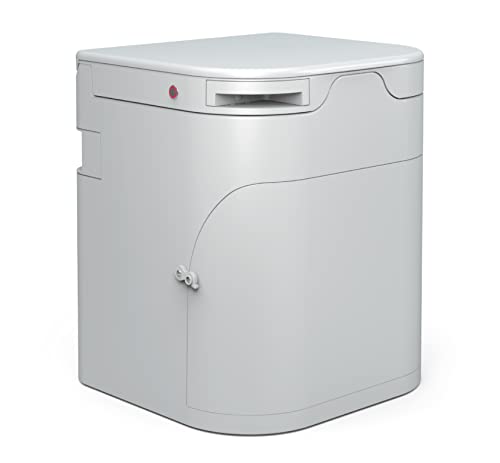
The 15-inch-wide toilet with a push-button motor that replaces the manual crank.
The OGO Origin fits where every inch counts. — at 15 inches wide, it is narrower than the Cuddy and goes into corners most composting toilets cannot reach. The standout feature is the push-button electric agitator (a 12V motor that mixes the solids with a single press), so you never have to turn a handle. This makes the daily routine feel closer to a standard toilet experience.
The 2.4-gallon urine bottle gives you about 25 to 30 uses before you need to empty it. Reviewers point out that for two people it fills in under two days, and some wish the bottle were larger. One long-term reviewer warned that the urine catch fills fast and the unit needs a dedicated plumbing pipe for a truly hands-off setup. The toilet runs on 12V power (cable included) and comes with a venting hose for external routing, though the fan itself helps manage odors even without it.
Compared to the Cuddy, the OGO trades a slightly smaller solids bin for the convenience of the electric mixer. At 28 pounds, it weighs the same as the Cuddy and is six pounds lighter than the Separett Villa. The OGO is built in the USA from polypropylene (a durable plastic), and the manufacturer backs the plastic components with a 5-year warranty and the electrical parts with a 1-year warranty.
The hands-free advantage
- Electric agitator eliminates the manual mixing step entirely
- Narrowest footprint in the list (15″ wide) for tight Sprinter/Transit layouts
- Scandinavian-style design that looks like a permanent fixture, not a camping accessory
Where you feel the squeeze
- Urine bottle capacity is on the smaller side — expect more frequent liquid dumps
- One buyer found the urine/solids separator sits too high, making cleaning awkward
The hands-down choice for anyone who hates cranking: Pick the OGO if you want a clean, modern look and a button-push instead of a handle turn after every use — the only toilet here that goes that far on convenience.
The small-tank reality: At 2.4 gallons, the urine bottle means you will empty it roughly every day and a half with two full-time users, so plan your routine around that.
3. Separett Villa Urine-Separating Compost Toilet

The largest solids chamber here — no mixing, no chemicals, and wall-mountable.
The Separett Villa is the biggest and heaviest toilet in this lineup. at 34 pounds and 26.5 inches deep. That size buys you a high-capacity solids chamber that does not require any mixing or additives — you simply let the waste dry naturally using the urine-diverting design and the built-in ventilation. For a tiny house with more floor space, this means fewer trips to the compost pile and less hands-on maintenance overall.
It runs completely waterless and requires no plumbing connection — a major advantage when you are off-grid. The wall-mounted installation option is unique among these picks; it keeps the floor clear for cleaning. But because the unit measures 26.5 inches by 18 inches by 21.3 inches, compared with the Cuddy at 17 inches by 15.2 inches by 16.5 inches, it demands a dedicated corner that many tiny houses cannot spare. The seat material is PVC, which is easy to wipe down but feels different from the polypropylene used on the other models.
The Separett Villa lacks customer reviews in our data, so long-term reliability and odor control remain unconfirmed. On paper, it is the best choice for someone with a larger tiny house or a stationary cabin who wants maximum capacity and minimal daily fiddling.
The capacity argument
- Largest solids chamber — longest interval between emptying cycles
- No mixing, no chemicals, no additives required
- Wall-mountable to free up floor space
Where it costs you space
- 26.5-inch depth is significantly bigger than any other pick here
- At 34 pounds it is the heaviest, making installation and cleaning more of a chore
Reach for it if space is not your constraint: The Separett Villa suits a small cottage or a generously sized tiny house where you value fewer maintenance cycles over a compact footprint.
Look elsewhere if your build is tight: The Cuddy or OGO will give you the same core function in roughly half the depth.
4. Thinktank Composting Toilet, White
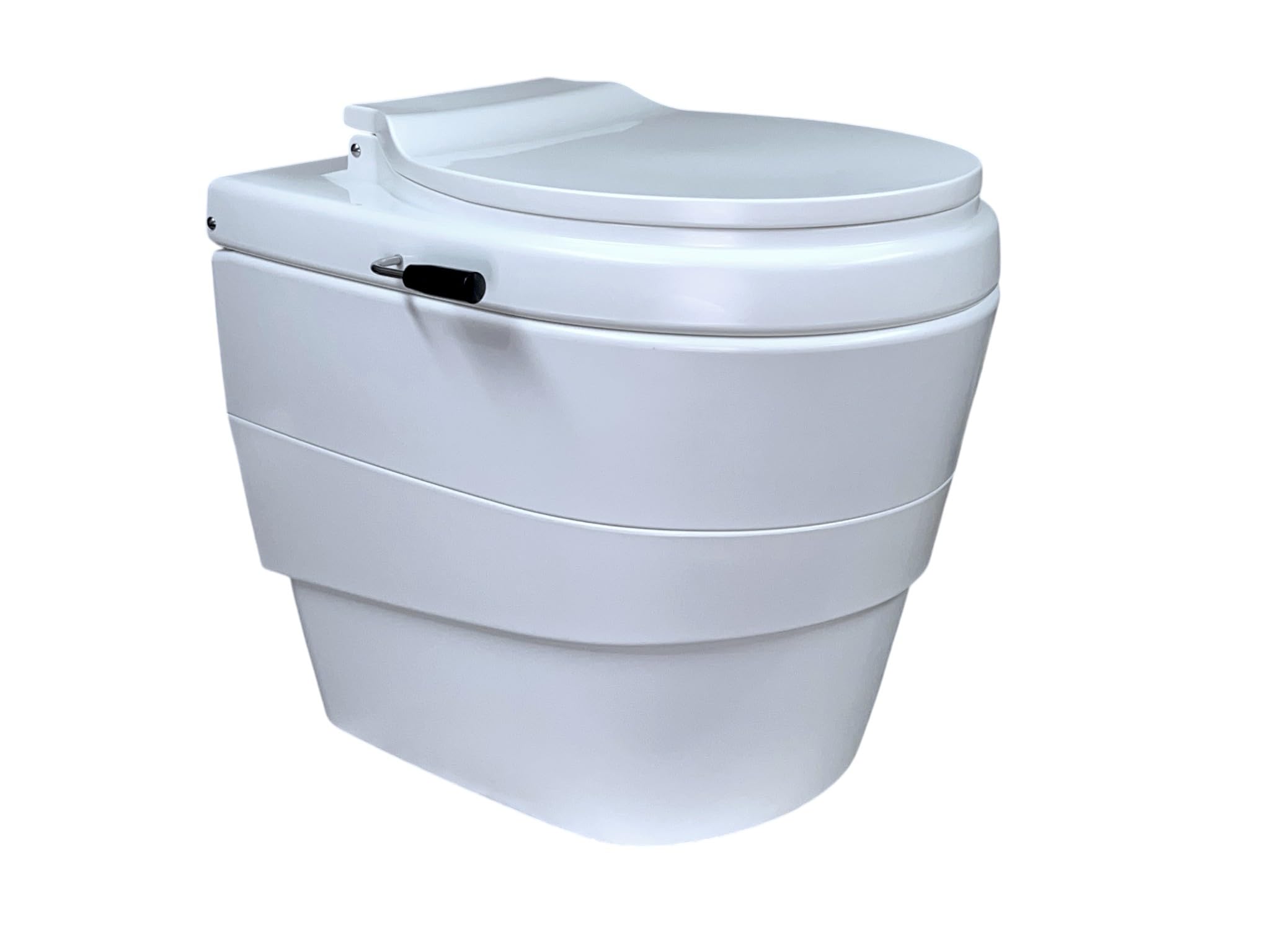
A patented trap door hides waste completely — no aiming required, even for men standing.
The Thinktank takes a different approach to the composting toilet problem. Instead of relying on a urine-diverting bowl design that requires aiming, it uses a patented trap door that hides the solid waste from view entirely. You sit, you go, the waste drops into a bag-lined container, and the door closes. The manufacturer states it is designed especially for women — no aiming needed — and even allows men to stand, which is unusual for a urine-diverting toilet.
It uses separate air intake and exhaust pipes, which the maker claims means no loss of heated or cooled air from your tiny house — a real consideration if you are running a small HVAC system. At 30 pounds, it is two pounds heavier than the Cuddy and OGO but four pounds lighter than the Separett Villa. The included components are thorough: two 16-inch vent pipes, a wall adapter for 110V (standard home voltage), 12V wires for battery or solar, a solid waste container, and 10 waste bags.
The design sounds promising for users who want minimal waste exposure, but without buyer feedback, it is hard to confirm how well the trap door mechanism holds up over daily use or how easy the bag-lined bin is to empty compared to the standard open-bin approach of the other models.
The cleanliness angle
- Trap door keeps waste hidden from sight at all times
- Men can stand, and women do not need to aim — rare in this category
- Comes with both AC and DC power adapters for flexible off-grid hookup
What we still need to learn
- No customer reviews available to confirm long-term reliability or odor performance
- Vent pipe installation requires wall or roof penetration, unlike the filter-based Cuddy
Try it if the gross-out factor is your main barrier: The Thinktank hides the waste and removes awkward aiming — a rare combination.
Proceed with caution: Without verified buyer experiences, durability and odor control are unconfirmed — the established Cuddy or OGO may be safer bets for full-time use.
Understanding the Specs
Urine Diversion vs. Mixed Composting
A toilet that separates urine from solids at the bowl keeps the solid waste dry. Dry waste produces almost no smell, breaks down slowly, and does not attract flies. Mixed composting toilets (which you sometimes see in garden settings) require a carbon source like sawdust and frequent turning to avoid ammonia — the urine-diverting approach is simpler for a tiny house because you never have to manage a wet pile.
12V Fan and Carbon Filter Systems
Most composting toilets use a small 12V fan (the same voltage as your van or tiny house battery bank) to pull air down through the solids bin and out through a carbon filter or an external vent pipe. This creates negative pressure inside the bowl, so air flows in from the room rather than odors escaping out. A carbon filter absorbs smells when you cannot run a pipe through the roof. Buying a toilet with a filter bank that is easy to replace every few months saves you from a smelly surprise later.
FAQ
How often do I need to empty a composting toilet in a tiny house?
Does a composting toilet smell if I use it in a small space?
Can I install a composting toilet without cutting a hole for a vent?
What is the difference between a composting toilet and a cassette toilet?
How does the electric agitator on the OGO work?
Can men stand while using a urine-diverting toilet?
What do I do with the solid compost?
How much power does a composting toilet draw?
What composting medium should I use inside the solids bin?
What causes the urine bottle on the OGO to fill so quickly?
Final Thoughts: The Verdict
For most tiny house dwellers, the best composting toilet for tiny house living is the Cuddy because it delivers the best balance of a compact footprint, a built-in filter that avoids drilling, and a solid track record of zero-odor performance from buyers. If you want to skip the manual mixing handle entirely, grab the OGO Origin for its push-button electric agitator and narrow 15-inch width. And if you have the floor space and want the longest stretch between emptying cycles, the Separett Villa offers the largest solids chamber in a wall-mountable package.
How We Picked
We do not accept paid placement. Every pick is matched to a real buyer and a real use-case; we do not hands-on test units.
Sources & Methodology
Specifications: manufacturer listings and product documentation. Review insights: verified customer reviews, as of July 2026. Pricing: not shown on this page (it changes often); check the current price via the retailer link.
As an Amazon Associate, WellFizz earns from qualifying purchases. This does not affect which products we feature.

Mo Maruf
I created WellFizz to bridge the gap between vague wellness advice and actionable solutions. My mission is simple: to decode the research and give you practical tools you can actually use.
Beyond the data, I am a passionate traveler. I believe that stepping away from the screen to explore new environments is essential for mental clarity and physical vitality.