Our readers keep the lights on and my smoothie glass nicely filled. As an Amazon Associate, I earn from qualifying purchases.
Clay soil holds water like a sponge and turns brick-hard when dry, suffocating roots before they can establish. The right compost punches through that dense structure, creating the air pockets and drainage pathways your garden desperately needs.
I’m Mohammad Maruf — the founder and writer behind WellFizz. I have spent countless hours cross-referencing lab reports, application rates, and real-world gardener feedback to find the amendments that physically break down clay’s tight particle bonds.
After analyzing dozens of formulations, I landed on five top-tier options that transform heavy clay into friable, living soil. These are the very best choices when you search for compost for clay soil.
How To Choose The Best Compost For Clay Soil
Not all composts work the same on clay. A fluffy peat-based mix will wash away, while a dense manure product can lock up drainage even tighter. Focus on these three factors before you open a bag.
Particle Size & Texture
Coarse, gritty particles physically prop clay platelets apart. Greensand delivers that grit with mineral persistence, while fine worm castings coat the soil in a biological gel that glues aggregates together. Look for a blend that includes both sand-sized shards and a fibrous organic backbone.
Slow-Release vs. Fast-Release Nutrients
Clay already holds onto nutrients, so you do not want a compost that dumps a high-nitrogen load all at once. Slow-release sources like glauconite greensand or worm castings feed over months rather than weeks, matching the steady breakdown pace of clay soils without burning tender roots.
Microbial Inoculation
The organisms in compost do the real heavy lifting on clay: they excrete glues that bind particles into stable crumbs. Composts fortified with endo and ecto mycorrhizae (like the Espoma option below) jump-start that process, creating the pore space that native clay lacks.
Quick Comparison
On smaller screens, swipe sideways to see the full table.
| Model | Category | Best For | Key Spec | Amazon |
|---|---|---|---|---|
| Espoma Land & Sea Gourmet Compost | Premium | Boosting microbial life in clay | 24 lbs, lobster & crab meal, mycorrhizae | Amazon |
| Brut Cow Compost | Premium | Adding pure, filler-free bulk to clay | 1 cu ft, additive-free cow manure | Amazon |
| R&M Organics Premium Compost | Mid-Range | Improving moisture retention in heavy clay | 10 lbs, dairy cow manure, low odor | Amazon |
| Mountain Valley Worm Castings | Mid-Range | Gentle biological activation for clay | 6 lbs, OMRI-certified, neutral 7.0 pH | Amazon |
| Lancaster Greensand | Budget | Mechanically breaking clay compaction | 5 lbs, glauconite, rich in potassium & iron | Amazon |
In‑Depth Reviews
1. Espoma Organic Land and Sea Gourmet Compost

This 24-pound bag packs a dual punch for clay: the lobster and crab meal adds chitin, which feeds the specific bacteria that break down tough organic residues, while the proprietary Myco-Tone blend delivers both endo and ecto mycorrhizae. Those fungi extend root reach into the tightest clay pores, creating channels that persist for seasons.
Users report a noticeable boost in vegetable production and healthier foliage within weeks of incorporation. The granules are dry and lightweight, so they spread evenly without clumping — important when you are trying to distribute a fine layer across a dense clay bed without creating surface crust.
The 1-cubic-foot bag covers roughly 30 square feet at a quarter-inch depth, making it a solid choice for targeted transplants or amending container mixes. Gardeners who reused old potting soil with this amendment saw larger tomatoes and more productive zucchini compared to unamended clay.
Why it’s great
- Chitin-rich seafood meal accelerates fungal growth in clay
- Mycorrhizae physically open pore space in compacted soil
- Dry granule format prevents clumping during application
Good to know
- Higher cost per pound than manure-only options
- Best results when mixed into top 4-6 inches of clay
2. Brut Cow Compost – 1 Cubic Foot
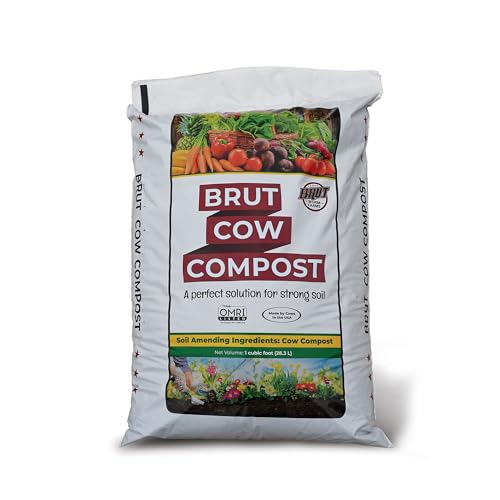
Brut’s cow compost is as close as you can get to raw, unadulterated organic matter without fillers or synthetic boosters. At 1 cubic foot, it provides the volume needed to build a substantial organic layer on top of clay — the kind of mass that worms and soil microbes need to colonize and gradually pull downward into the subsoil.
The material has been aerated and tested to eliminate burn risk, a critical safety factor when amending clay because the dense structure traps any excess ammonia. First-time growers have used a 3:2 ratio of this compost to potting soil with outstanding early growth on tomatoes started from seed.
It also works as a top-dressing for flower beds and roses, where its slow-release nutrient profile prevents the sudden nitrogen flushes that upset clay’s delicate balance. The coarse texture is uniform enough to spread with a shovel without forming lumps.
Why it’s great
- Large bag provides enough mass to build soil structure
- Safe, aerated formula won’t burn roots in dense clay
- No fillers or synthetic chemicals to disrupt biology
Good to know
- Heavier bag may be difficult to carry for some users
- Best applied as a thick layer rather than a thin top-dress
3. R&M Organics Premium Organic Compost – 10 lb
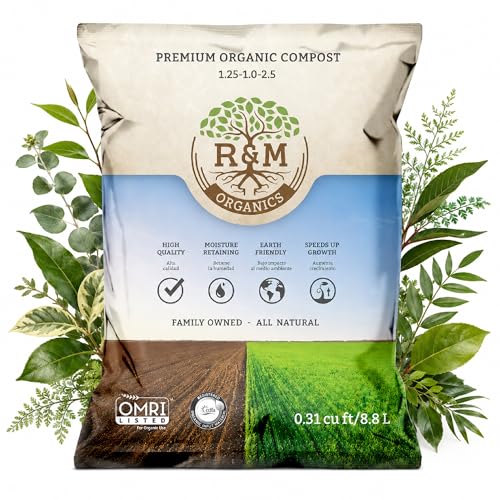
R&M’s fully composted dairy cow manure has an unusually fine, soil-like texture that integrates seamlessly into clay without separating into layers. Its primary benefit for clay is moisture retention — the compost holds water in the root zone while the clay below it slows drainage, giving plants a consistent hydration window between rains.
One customer rescued dying azaleas after a roof-wash chemical exposure, and another revived a yellowing tomato plant within a week of mixing this compost into a 27-gallon planter. The low-odor processing means you can use it indoors for container plants without worrying about the barnyard smell that puts off houseplant enthusiasts.
The 10-pound bag is manageable for small to medium projects, and the recommended mixing ratio of 5 parts soil to 1 part compost makes it easy to calculate for raised beds or individual transplant holes.
Why it’s great
- Fine texture blends uniformly with clay without layering
- Low odor makes it usable for indoor and outdoor projects
- Rapid results visible on stressed plants within one week
Good to know
- 10-pound bag covers less area than cubic-foot options
- May need reapplication each growing season for heavy clay
4. Mountain Valley Seed Company Earth Worm Castings – 6 lb

Worm castings are the gold standard for biological soil amendments, and Mountain Valley’s OMRI-certified version gives you a clean, nearly odorless product that won’t mask the natural smell of your garden. The 6-pound bag (roughly 1 gallon) is enough to mix into several large containers or a small raised bed, delivering the slow-release NPK and beneficial bacteria that clay desperately needs.
The neutral 7.0 pH is a huge advantage for clay, which often swings acidic or alkaline depending on the region. Applying these castings does not rock the pH boat, so you can add them freely without needing a soil test every season. One user reported that a single application after repotting with coco peat and perlite completely resolved a fungus gnat infestation — likely because the castings supported predatory soil microbes.
You can also brew these castings into a liquid tea for drip-feeding established plants throughout the growing season, stretching the bag’s value far beyond a one-time soil incorporation.
Why it’s great
- Neutral pH protects clay from extreme swings
- Odorless and clean for indoor container use
- Can be used as dry amendment or brewed into compost tea
Good to know
- Small bag volume limits coverage for large garden beds
- Fine particles may wash away if applied as top-dress on sloped clay
5. Lancaster Agriculture Products Greensand – 5 lb
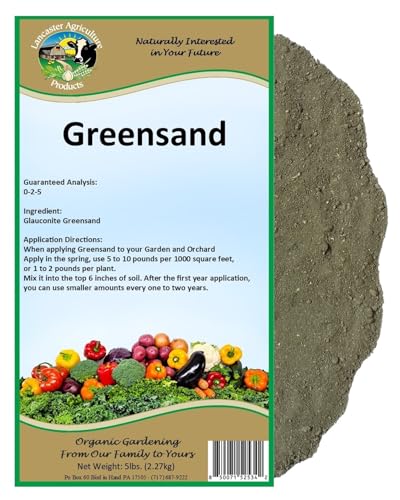
Greensand is not technically a compost, but it is the single best mineral companion for any organic compost on clay. The glauconite particles are coarse and angular, which physically wedges clay platelets apart to create lasting aeration channels. It also delivers potassium and iron in slow-release forms that clay soils naturally lack.
Texas gardeners with heavy clay report that this greensand helped Live Oak, Magnolia, and Crape Myrtle trees push out vigorous new growth. The recommended application range of 5 to 50 pounds per 1,000 square feet gives you flexibility: use the lower end for maintenance and the higher end for building new beds out of raw clay.
Because it is completely inert in terms of nitrogen, greensand pairs safely with any manure or worm-based compost without risking nutrient overload. Use it as a base amendment, then top with a biological compost for microbial activity.
Why it’s great
- Gritty texture mechanically breaks apart clay structure
- Provides potassium and iron without nitrogen overload
- One application lasts several seasons in slow-draining soil
Good to know
- Not a stand-alone compost; must be mixed with organic matter
- Higher application rates increase weight significantly
FAQ
How deep should I incorporate compost into clay soil?
Can I use greensand alone to fix clay soil?
How often should I reapply compost to clay in subsequent seasons?
Final Thoughts: The Verdict
For most users, the compost for clay soil winner is the Espoma Organic Land and Sea Gourmet Compost because it combines seafood-derived chitin with a proven mycorrhizal blend to physically and biologically pry clay apart. If you want maximum bulk to build new beds from scratch, grab the Brut Cow Compost. And for a budget-friendly mineral punch that opens clay without nitrogen risk, nothing beats the Lancaster Greensand.

Mo Maruf
I created WellFizz to bridge the gap between vague wellness advice and actionable solutions. My mission is simple: to decode the research and give you practical tools you can actually use.
Beyond the data, I am a passionate traveler. I believe that stepping away from the screen to explore new environments is essential for mental clarity and physical vitality.