Our readers keep the lights on and my smoothie glass nicely filled. As an Amazon Associate, I earn from qualifying purchases.
Specs are compiled from manufacturer listings and verified buyer reviews and can change over time — please confirm the key details on the product page before buying.
Your kitchen scraps and yard clippings pile up fast. If you just let them sit, they turn into a smelly, pest-attracting mess. A rotating bin fixes that by letting you mix the material for quicker breakdown without ever using a pitchfork. The best compost bin outdoor models add a second chamber so one batch finishes while you start the next.
I’m Mohammad Maruf — the founder and writer behind WellFizz. This guide is built by comparing the manufacturers’ published specifications and the patterns across verified customer reviews, so you get each pick’s real strengths and trade-offs instead of marketing spin.
The seven outdoor compost bins ranked below range from simple tumblers to a cedar bin with nearly 174 gallons of capacity. Each has a job it handles best, so you can match a compost bin outdoor to exactly how much waste your household actually produces.
Quick Picks
- EJWOX 43 Gallon Dual Chamber Tumbling Composter with Integrated Thermometer — Best Overall
- FCMP Outdoor HOTFROG 37-Gallon Dual-Chamber Tumbling Composter — Fastest Results
- Marcytop Compost Tumbler, 45 Gallon Large Dual Chamber Rotating Composter — Highest Capacity Drum
- VEVOR Compost Bin, 43-Gal Dual Chamber Composting Tumbler — Best Value
- Nova Microdermabrasion 43 Gallon Outdoor Dual Chamber Tumbling Composter — Budget Champion
- Outsunny Tumbling Compost Bin Outdoor 360° Dual Chamber Rotating Composter 43 Gallon — Best Airflow
- Greenes Fence Premium Cedar Wood Composter, 173.92 Gallons — Maximum Volume Pick
How To Choose The Best Compost Bin Outdoor
Every outdoor compost bin has to balance three things: how much waste it holds, how easy it is to turn, and how quickly it breaks stuff down. A tumbler spares your back, but a stationary bin can handle way more volume. The choice really depends on your yard size, how much organic waste your household makes, and if you want finished compost this season or next year.
Dual Chamber Versus Single Chamber
A dual chamber means you fill one side while the other side finishes. When the first side is done, you harvest it and switch. That creates a nonstop flow of compost rather than a single batch every few months. Single-chamber tumblers are simpler and cost less, but you have to empty the whole thing before starting fresh, which interrupts the cycle.
Capacity in Gallons
Most outdoor tumblers fall in the 37- to 45-gallon range, which suits a small-to-average household with a garden. If you have a huge yard or generate a lot of kitchen waste, a stationary bin like the cedar option below packs nearly 174 gallons. More volume means more compost faster, but also a heavier bin that can be tough to rotate when full.
Build Material and Weather Resistance
Polypropylene (PP, a durable plastic) and polyethylene (another common plastic) are the standard tumbler materials because they are lightweight and UV-resistant. Steel frames add stability, but look for corrosion-resistant coatings if you live in a wet climate. Cedar bins require no assembly beyond sliding boards into posts, and wood naturally handles moisture, though it will eventually weather over years of sun and rain.
Quick Comparison
| Model | Best For | Capacity | Material | Weight | Amazon |
|---|---|---|---|---|---|
| EJWOX 43 Gallon (Product 4) | Monitoring temperature | 43 gallons | Alloy Steel, Polypropylene | 23.3 lbs | Amazon |
| FCMP Outdoor HOTFROG 37 Gal (Product 6) | Fast results | 37 gallons | Polyethylene | — | Amazon |
| Marcytop 45 Gallon (Product 5) | Largest dual-chamber drum | 45 gallons | Polypropylene (PP) | — | Amazon |
| VEVOR 43 Gal (Product 2) | High load capacity | 43 gallons | Plastic | 21.9 lbs | Amazon |
| Nova Microdermabrasion 43 Gal (Product 1) | Budget dual chamber | 43 gallons | Metal, Polypropylene (PP) | 21.5 lbs | Amazon |
| Outsunny 42.3 Gal (Product 3) | Budget with ventilation | 42.3 gallons | Alloy Steel | 22.0 lbs | Amazon |
| Greenes Fence Cedar (Product 7) | Maximum volume | 173.92 gallons | Cedar Wood | 46.0 lbs | Amazon |
In‑Depth Reviews
1. EJWOX 43 Gallon Dual Chamber Tumbling Composter with Integrated Thermometer
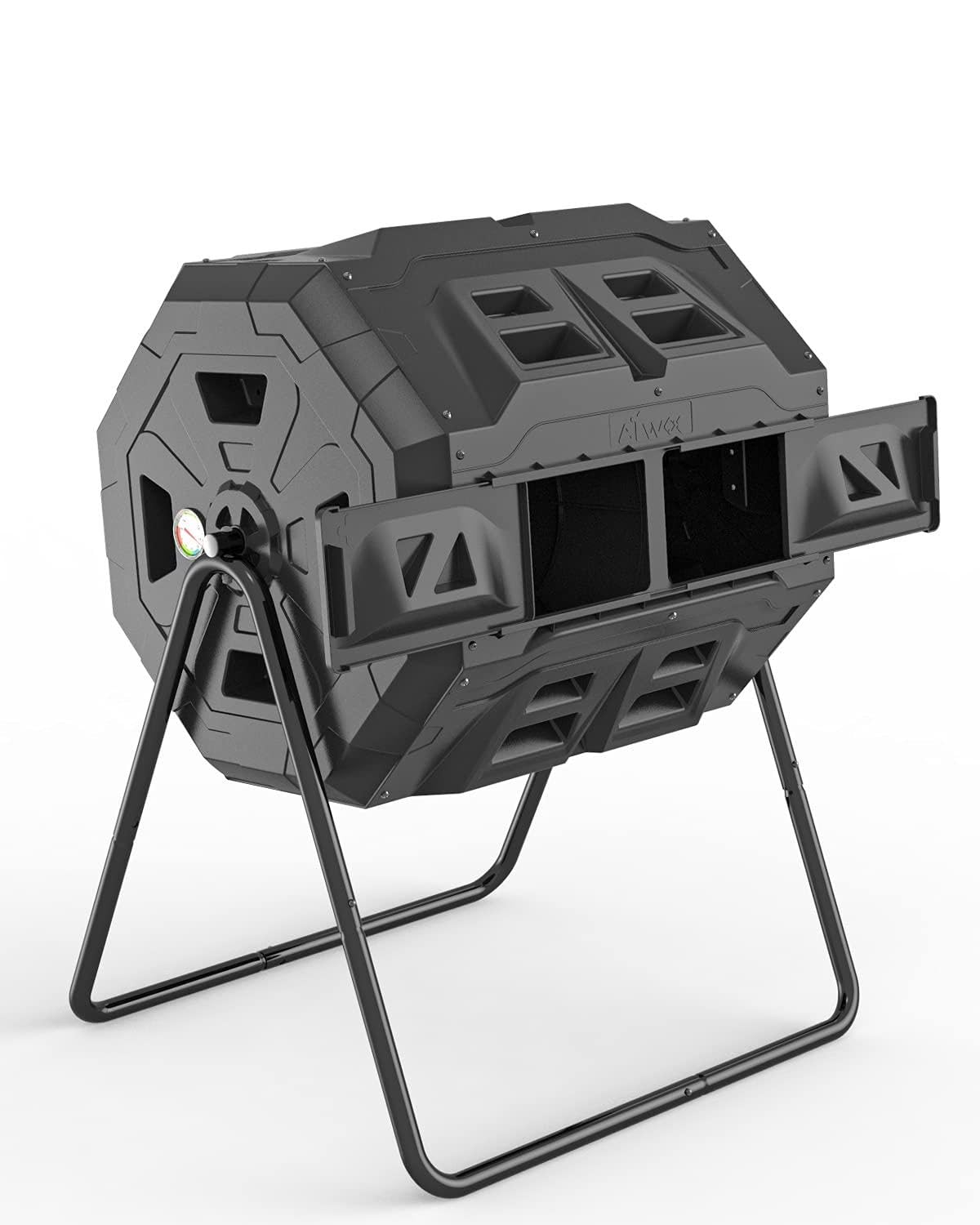
This is the only pick that tells you the exact temperature inside the pile so you know it is cooking without opening the drum.
The biggest mystery in composting is whether the center of your pile is hot enough to break down material fast. The EJWOX solves that with a built-in thermometer (a gauge on the side) — you glance at it without lifting a lid or losing heat. It holds 43 gallons and splits into two chambers so you can let one batch finish while you load the other side with fresh scraps. That dual-chamber setup means you get a steady output, unlike the single-chamber Outsunny bin you have to empty completely before restarting.
Buyers report the assembly takes about 45 minutes solo and that the rolls are smooth and easy to spin. The frame is galvanized steel (coated to resist rust), and the plastic panels are high-density polypropylene (PP, a durable plastic). One reviewer did note the thermometer might not read the absolute internal temperature perfectly, but it gives you a clear trend — and that alone helps you decide whether to add more browns or turn the barrel again.
At 23.3 pounds, it is noticeably heavier than the Nova Microdermabrasion model (21.5 pounds) — that extra heft comes from the thicker frame and the metal base, which means it sits more stable when you spin it.
Why It Leads the List
- Thermometer lets you track decomposition heat in real time without opening the drum and losing steam.
- Dual-chamber design: one side cooks while the other loads, keeping a steady supply of finished compost.
- Rust-resistant galvanized steel frame holds up to weather better than painted steel.
Minor Fine Print
- Center divider is a single slip-in piece that does not lock in — reviewers suggest it can shift if overfilled.
- Doors could benefit from a bungee cord if you want extra security against raccoons.
For the data-driven gardener: If you want to manage the internal temperature for faster breakdown, the EJWOX’s thermometer and dual chambers give you a real edge over tumblers that leave you guessing.
One limit to consider: The thermometer may not be precisely calibrated, so treat it as a useful guide rather than a lab instrument.
2. FCMP Outdoor HOTFROG 37-Gallon Dual-Chamber Tumbling Composter
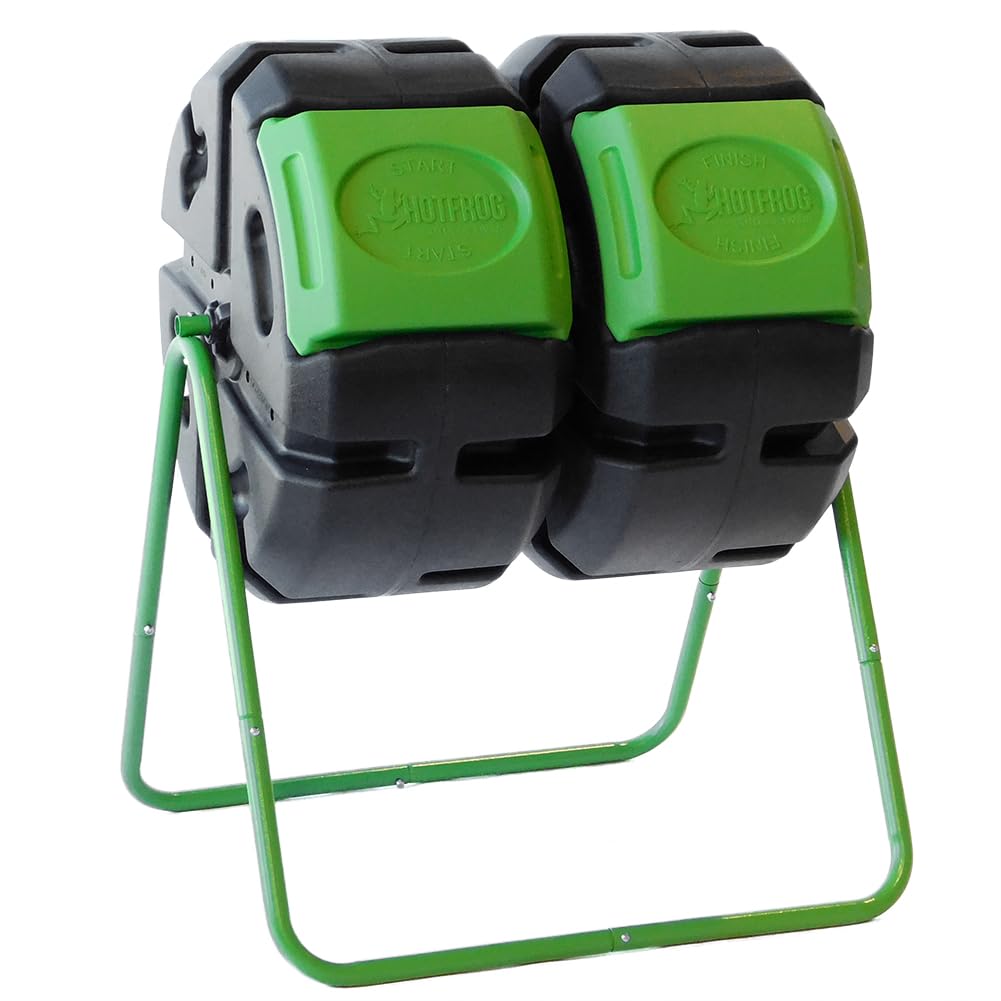
FCMP Outdoor claims this tumbler can give you finished compost in as little as two weeks when conditions are right.
The manufacturer says that with hot sun, the right balance of greens and browns, and a tumble every 2–3 days, you can get usable compost in roughly two weeks. The secret is the 37-gallon cylindrical drum that rotates without the flat spots some octagonal bins develop. Large sliding doors make filling and emptying straightforward, and the doors are fully removable so you can swap which chamber is active.
Owners mention assembly at around 15 minutes with a helper for the cross-bar step, and that the bin spins smoothly even when it is full of heavy wet material. The frame is corrosion-resistant powder-painted galvanized steel, and the drum is UV-inhibited recycled polyethylene (a plastic treated to resist sun damage) — so it won’t become brittle after a couple of summers in direct sun. It is made in Canada, which is a nice durability signal if you are in a climate with harsh winters.
One recurring note from owners is that the assembly instructions are printed on a sticker inside the barrel — easy to miss if you throw away the packaging. Spot that first and you will save yourself ten minutes of head-scratching.
What Speeds It Up
- Cylindrical shape has no flat internal corners where material gets stuck — every turn mixes everything.
- Sliding doors seal well enough to keep pests out but open wide for easy dumping.
- UV-inhibited polyethylene resists sun damage better than basic plastic.
When It Slows Down
- 37 gallons is smaller than the 43- and 45-gallon competitors — big households may outgrow it.
- Sliding doors can be a bit stiff at first; some reviewers had to work them back and forth to loosen them.
Choose it for speed: If getting compost in two to three weeks sounds appealing and you have a small-to-medium household, the HOTFROG’s design is engineered for fast cycles.
Pass if you need max capacity: At 37 gallons it falls short of the 45-gallon Marcytop, so heavy-volume composters should look at the larger drums below.
3. Marcytop Compost Tumbler, 45 Gallon Large Dual Chamber Rotating Composter
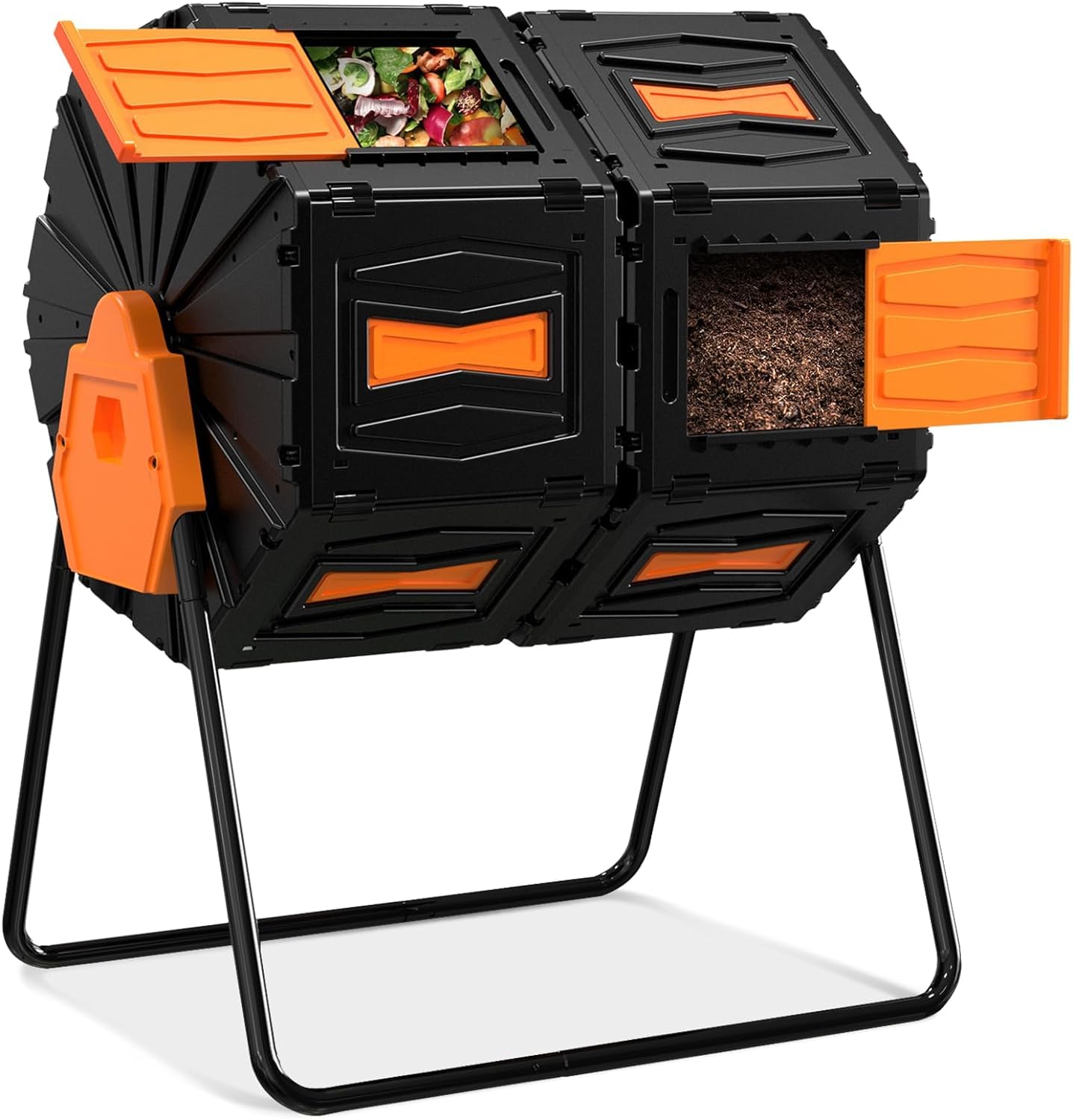
This is the biggest double-barrel in the lineup — 45 gallons split into two 22.5-gallon chambers, which is more than the 42.3-gallon Outsunny model.
Extra-thick polypropylene (PP) panels and a reinforced powder-coated steel frame make the Marcytop feel solid from the moment you open the box. Buyers describe the assembly as a nearly tool-free LEGO-like process, with one owner knocking it out in 40 minutes using a rubber mallet and a screw gun. That ease of setup is a welcome contrast to the 50-plus screws required for the Nova Microdermabrasion bin.
The hexagonal shape includes deep fins and multiple aeration holes that break up clumps as you rotate. The maker says you only need to spin it 5–6 times every few days. Customers note that once the drums are loaded with wet kitchen waste, turning can get a bit tough — but that is true of any tumbler at this scale. One smart tip from a long-term owner: keep the two drums unattached so you can tumble one at a time rather than heaving the whole 45-gallon mass.
At 2 inches taller than the Outsunny model (roughly 43 inches assembled versus 37.75 inches), it is easier to access without bending too low, which makes a difference when you are shoveling finished compost into a wheelbarrow.
What Stands Out
- 45 gallons is the largest dual-chamber capacity on this list — more room means less frequent layering.
- Snap-together panel system drastically cuts assembly time compared to screw-heavy designs.
- Bright orange doors make it easy to spot which side is finished and which side is cooking.
Watch For
- No built-in thermometer — you have to judge internal temperature by feel or buy a separate probe.
- The hexagonal shape means some material can get stuck in the corners unless you break it up manually.
Best for the volume-conscious: If you want the biggest dual-chamber drum available, the Marcytop delivers space and build quality you will notice.
Skip if you want a thermometer: The EJWOX above is a better pick if tracking internal heat matters more than raw capacity.
4. VEVOR Compost Bin, 43-Gal Dual Chamber Composting Tumbler

The frame on this 43-gallon tumbler is rated to carry up to 110 pounds of material — the highest load capacity on the list.
VEVOR built its 43-gallon tumbler with thick, solid plastic panels and a tubular steel base that lifts the drum to chest height — a detail that makes a real difference when you are spinning a full load. The octagonal shape includes internal grooves that break up clumps as you roll. Reviewers point out that the sliding doors are easy to use and that the unit keeps out rodents effectively. One owner said assembly took about 45 minutes on a flat table, and that it is fairly intuitive even if the printed instructions are minimal. A smart warning from that same reviewer: avoid using a power screwdriver because the screws can distort easily in the plastic.
Comparing it to the Outsunny model (which is also 42.3 gallons and octagonal), the VEVOR’s steel base feels more stable, and the extra 0.4 pounds in weight (21.9 vs 21.5) comes from the thicker frame material. The maker also claims a 110-pound load-bearing capacity, which is the highest stated rating on this list — meaning the frame is overbuilt for the typical 43-gallon load.
BPA-free and UV-resistant, the plastic is designed to survive direct sun, rain, and snow without turning brittle. A couple of reviewers noted scratches on the stand pieces from the start, but the structural quality earned consistent 5-star ratings.
The Value Argument
- Chest-height steel frame saves your back — no bending to spin the barrel.
- 110-pound load capacity gives you a big safety margin even when the drum is packed with heavy wet waste.
- Sliding doors seal well enough to keep raccoons and mice out.
Where It Cuts Corners
- Assembly instructions are sparse — you need to figure some steps out on your own.
- Paint on the stand can scratch during shipping; not structural, but cosmetic damage is common.
Reach for it if you want a sturdy frame: The steel base and 110-pound rating make the VEVOR feel more permanent than many plastic-heavy competitors at the same price tier.
Think twice if you dislike assembly puzzles: If you prefer instructions that walk you through every step, the Nova Microdermabrasion bin below has clearer directions.
5. Nova Microdermabrasion 43 Gallon Outdoor Dual Chamber Tumbling Composter

This is the cheapest way to get a 43-gallon dual-chamber tumbler — and it even comes with garden gloves.
The specs line up well with pricier models. The barrel is made from polypropylene (PP) with a metal frame, and the 28.7 x 25.4 x 36.4-inch dimensions feel familiar to anyone who has assembled a similar octagonal bin. Shoppers say that the material feels sufficiently sturdy and that the unit is easy to tumble even without a handle. One reviewer specifically noted: “Makes compost in a little over a month in hot weather.”
The catch is assembly volume — there are more than 50 screws to drive. Owners strongly recommend using an electric screwdriver to avoid an hour of manual turning. The instructions are workable but not great; one couple put it together without arguments, which they considered a minor miracle in itself. The two small doors are fine for filling but less ideal for emptying — you may need to tip the barrel or use a catchment bin underneath.
It also comes bundled with a pair of garden gloves, a small but thoughtful extra that saves you a trip to the hardware store when you are ready to start handling compost.
Why It Is a Bargain
- 43-gallon dual-chamber design at the lowest list price on this list — tough to top for value.
- All-black color absorbs sun better in cooler climates to speed up decomposition.
- Free garden gloves included means you can start composting immediately.
Where You Feel the Cost
- Assembly requires 50+ screws — set aside a full hour with a power driver.
- Small doors make it awkward to scoop out finished compost compared to larger-opening models.
Choose it for the lowest price: If your budget is tight and you need a real 43-gallon dual chamber, the Nova Microdermabrasion bin delivers the core function without cutting capacity.
Upgrade if you hate screw-heavy assembly: The Marcytop’s snap-together panels save you roughly 30 minutes of frustration for the higher price.
6. Outsunny Tumbling Compost Bin Outdoor 360° Dual Chamber Rotating Composter 43 Gallon
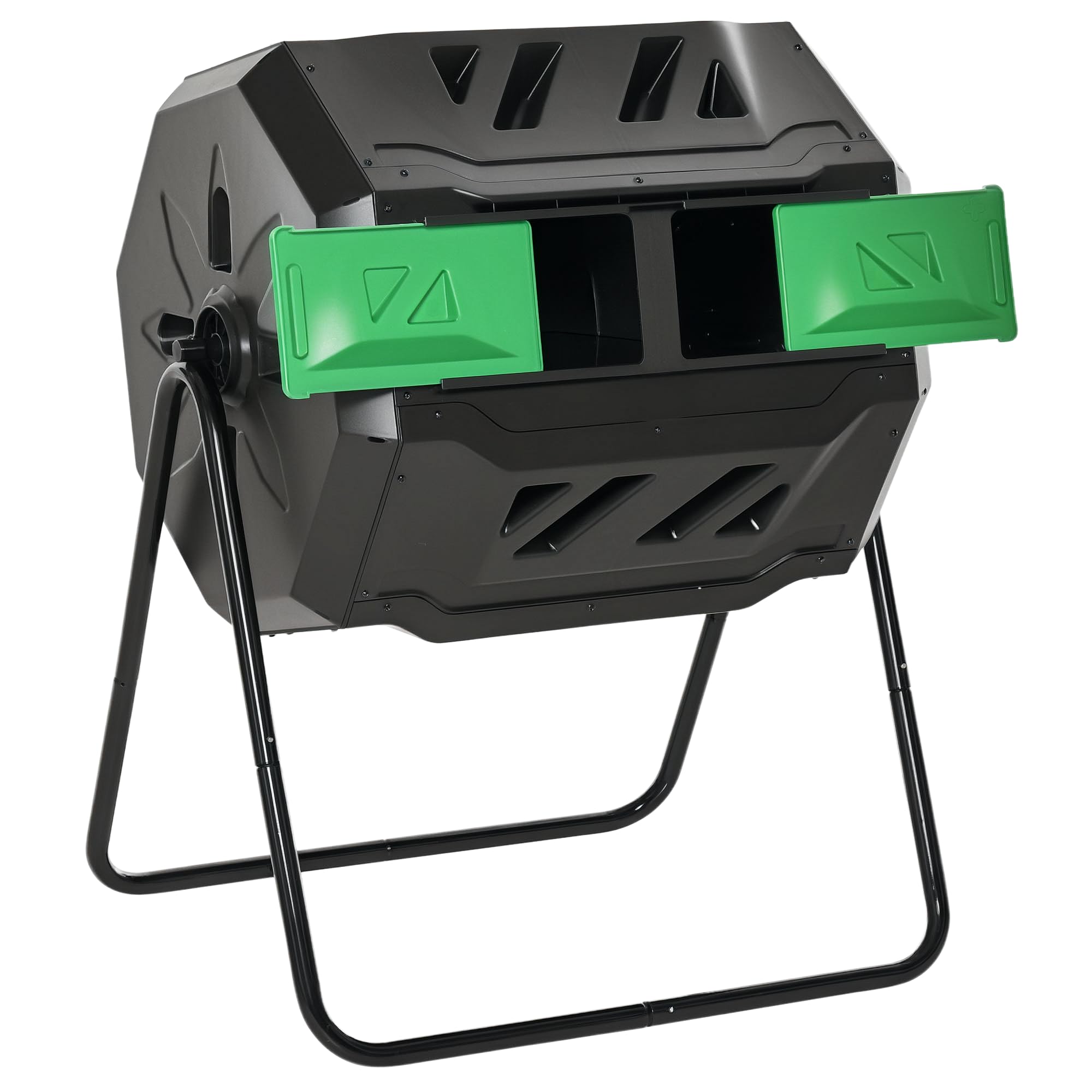
The defining feature here is 16 ventilation holes that allow oxygen into the pile so decomposition stays aerobic (with air), which reduces bad smells.
Outsunny’s composter stands at 37.75 inches tall with an octagonal drum made from polypropylene (PP) and an alloy steel base. Those 16 ventilation holes let oxygen flow into the pile, which is critical for aerobic bacteria to break down material without turning the bin into a sour, anaerobic (without air) mess. Buyers report that in summer heat, it turns kitchen scraps into rich dirt in about a month.
Assembly is manageable with two people, though some owners mention the center divider does not lock neatly into the grooves. It still works fine, but the fit is not perfect. One reviewer pointed out that fruit flies can breed around the air holes and escape when you open the doors — an honest trade-off for the airflow benefit. The sliding doors help control both flies and odors when they are sealed.
At 22 pounds it is among the lighter full-size tumblers, and the steel frame feels solid enough to handle a season of regular use. Some owners found that it leaks juice if the moisture balance is off, a minor mess that suggests keeping a bin or tray underneath to catch drips.
The Airflow Advantage
- 16 dedicated ventilation holes promote aerobic decomposition that reduces bad smells.
- Sliding doors are large enough to add material easily and seal securely.
- Spins smoothly and is simple to operate once assembled.
The Known Quirks
- Center divider does not sit perfectly in its grooves — cosmetic but not functional.
- Can leak liquid if you add too many wet greens without balancing with browns.
Choose it for ventilation: If you have struggled with smelly compost piles, the 16 air holes keep oxygen moving through the drum, which helps the good bacteria thrive.
Pass if you compost in a wet climate: The juice leak issue might annoy you if you cannot place a tray under the bin.
7. Greenes Fence Premium Cedar Wood Composter, 173.92 Gallons

This stationary cedar bin swallows nearly 174 gallons — roughly four times the volume of the largest tumbler here — and needs no assembly tools.
Unlike every other pick on this list, the Greenes Fence composter does not spin. It is a 36 x 36 x 31-inch square wooden bin made from 3/4-inch-thick North American cedar boards that slide into four corner posts. Assembly takes under 30 minutes with nothing but a rubber mallet — no screws, no bolts, no drill. That simplicity is a huge relief if you have ever spent an hour wrangling a plastic tumbler.
The capacity is massive: 173.92 gallons. That makes it ideal for households with large gardens, multiple people generating kitchen waste, or anyone who wants to pile up fall leaves and let them rot in bulk. Because it is open at the bottom (sitting directly on the ground), drainage is better than any tumbler, and earthworms can crawl up into the pile to speed up breakdown naturally. Owners mention that the cedar scent is pleasant and that the slats slide together easily.
The trade-off is that you have to turn the pile yourself with a pitchfork or aerating tool. No tumbling means more physical effort, and the long-term durability of cedar is measured in years, not decades — though the manufacturer says the wood is sanded and natural, so it will weather gracefully.
Why Go Stationary
- Nearly 174 gallons of capacity — dwarfs every tumbler on the market for serious bulk composting.
- Tool-free assembly takes minutes, not hours, with no hardware to lose.
- Expandable into a two- or three-bin system using Greenes add-on kits.
What You Give Up
- No tumbling mechanism — you must manually turn the pile with a fork or tool.
- Less secure against digging pests compared to a sealed rotating drum.
Perfect for volume composters: If you have a big yard, lots of leaves, and the strength to turn a pile every couple of weeks, the Greenes Fence cedar bin delivers the most space per dollar.
Skip if you want convenience: The FCMP HOTFROG or the VEVOR tumbler require far less physical effort for the average home composter.
Understanding the Specs
Capacity — Gallons
The number of gallons tells you how much kitchen and yard waste the bin can hold at once. A 37- to 45-gallon tumbler fits a typical household of two to four people who garden regularly. The 174-gallon stationary bin suits large families or intensive gardeners who generate piles of leaves and grass clippings. More capacity means you can layer more material and let it break down in bulk, but it also means heavier loads when you turn the bin or scoop out the finished compost.
Dual Chamber vs Single Chamber
A dual-chamber bin splits the drum into two separate compartments. You fill one side and let it mature while you add fresh scraps to the other. When the first side finishes, you harvest and swap. That cycle lets you have a continuous supply of finished compost rather than waiting months for a single batch to complete. Single-chamber tumblers are simpler and cheaper, but you have to empty the entire drum before you can start a new round.
FAQ
Will a compost bin outdoor attract rats or raccoons?
How often do I need to turn a tumbling compost bin?
Can I compost cooked food and meat in an outdoor compost bin?
How long does it take to get finished compost in a tumbler?
What is the difference between a dual chamber and a single chamber compost tumbler?
Do I need a compost thermometer?
What is the best location for an outdoor compost bin?
How do I keep my compost from smelling bad?
Can I use a tumbler in winter?
Is a wooden compost bin better than a plastic tumbler?
Final Thoughts: The Verdict
For most people, the compost bin outdoor winner is the EJWOX 43 Gallon Dual Chamber Tumbling Composter because the built-in thermometer removes the guesswork from monitoring decomposition heat and the dual chambers let you produce a steady supply of compost. If you want the absolute fastest processing time, grab the FCMP Outdoor HOTFROG 37-Gallon Tumbler. And for massive volume on a budget, the Greenes Fence Premium Cedar Wood Composter holds four times the capacity of any plastic drum at a similar premium price.
How We Picked
We do not accept paid placement. Every pick is matched to a real buyer and a real use-case; we do not hands-on test units.
Sources & Methodology
Specifications: manufacturer listings and product documentation. Review insights: verified customer reviews, as of July 2026. Pricing: not shown on this page (it changes often); check the current price via the retailer link.
As an Amazon Associate, WellFizz earns from qualifying purchases. This does not affect which products we feature.

Mo Maruf
I created WellFizz to bridge the gap between vague wellness advice and actionable solutions. My mission is simple: to decode the research and give you practical tools you can actually use.
Beyond the data, I am a passionate traveler. I believe that stepping away from the screen to explore new environments is essential for mental clarity and physical vitality.