Our readers keep the lights on and my smoothie glass nicely filled. As an Amazon Associate, I earn from qualifying purchases.
Nothing ruins a clean kitchen faster than a compost bag that splits under the weight of a wet coffee filter or starts degrading before you make it to the curb. The wrong bag leaves you with a mess of sludge and frustration, not a virtuous circle of food scrap recycling. Finding a bag that stays intact through three days of scraps, ties off without tearing, and actually breaks down in the right conditions is the real challenge for anyone managing a household compost routine.
I’m Mohammad Maruf — the founder and writer behind WellFizz. I spend my time cross-referencing certifications like BPI’s ASTM D6400 and OK Compost Home against real-world customer reports to identify which compostable liners survive daily use without disintegrating prematurely.
Whether you’re feeding a curbside pickup program or building a backyard pile, choosing the right liner keeps the process clean and odor-free. This guide evaluates five top-rated options to help you find the best compost bags for your specific bin type and waste volume.
How To Choose The Best Compost Bags
Compostable bags are not all the same. The material formulation, certification level, and thickness dictate how well a bag holds up during a week of kitchen waste. Focus on these three factors to avoid tearing, leaking, or buying a bag that won’t break down in your specific composting system.
Certification Level: Industrial vs. Home Composting
BPI certification (ASTM D6400) confirms a bag will break down in a commercial composting facility where temperatures reach 140°F. These bags will not necessarily decompose in a cold backyard pile. If you compost at home, look for OK Compost HOME certified bags, which are formulated to break down at lower temperatures. Many bags carry both certifications, giving you flexibility regardless of your disposal method.
Thickness: The Mil Number Matters
Compostable bag thickness is measured in mils (one mil equals 0.001 inch). A 0.75 mil bag is lightweight and suitable for dry scraps, while a 1.0 mil bag provides noticeable extra tear resistance for wet food waste, coffee grounds, and heavier loads. Anything above 0.9 mil is generally considered heavy-duty for kitchen use. Thicker bags also resist the premature degradation that can happen when moisture and heat are present.
Bag Style: Drawstring vs. Tie-Top
Drawstring bags offer the convenience of cinching closed without touching the waste, which is ideal for daily kitchen use. However, drawstrings add a small amount of non-plant-based material in some designs. Tie-top bags with flaps or simple knot closures are simpler and often cheaper, but require you to handle the bag directly. Match the style to how frequently you empty your bin and your tolerance for contact with food scraps.
Quick Comparison
On smaller screens, swipe sideways to see the full table.
| Model | Category | Best For | Key Spec | Amazon |
|---|---|---|---|---|
| OrangeBio 13 Gallon | Mid-Range Tie | All-around durability & home composting | 0.9 mil thickness | Amazon |
| UNNI Drawstring 13 Gallon | Premium Drawstring | Convenient cinch closure & heavy waste | 1.0 mil thickness | Amazon |
| SUPERBIO Drawstring 13 Gallon | Premium Drawstring | Industrial compost programs & tear resistance | 1.0 mil thickness | Amazon |
| BEIDOU-PAC Flap Tie 13 Gallon | Mid-Range Tie | Budget-friendly & lightweight daily waste | 0.75 mil thickness | Amazon |
| TERRACOR 13 Gallon | Mid-Range Tie | Plant-based strength & standard bins | 0.9 mil thickness | Amazon |
In‑Depth Reviews
1. OrangeBio 13 Gallon Compostable Trash Bags
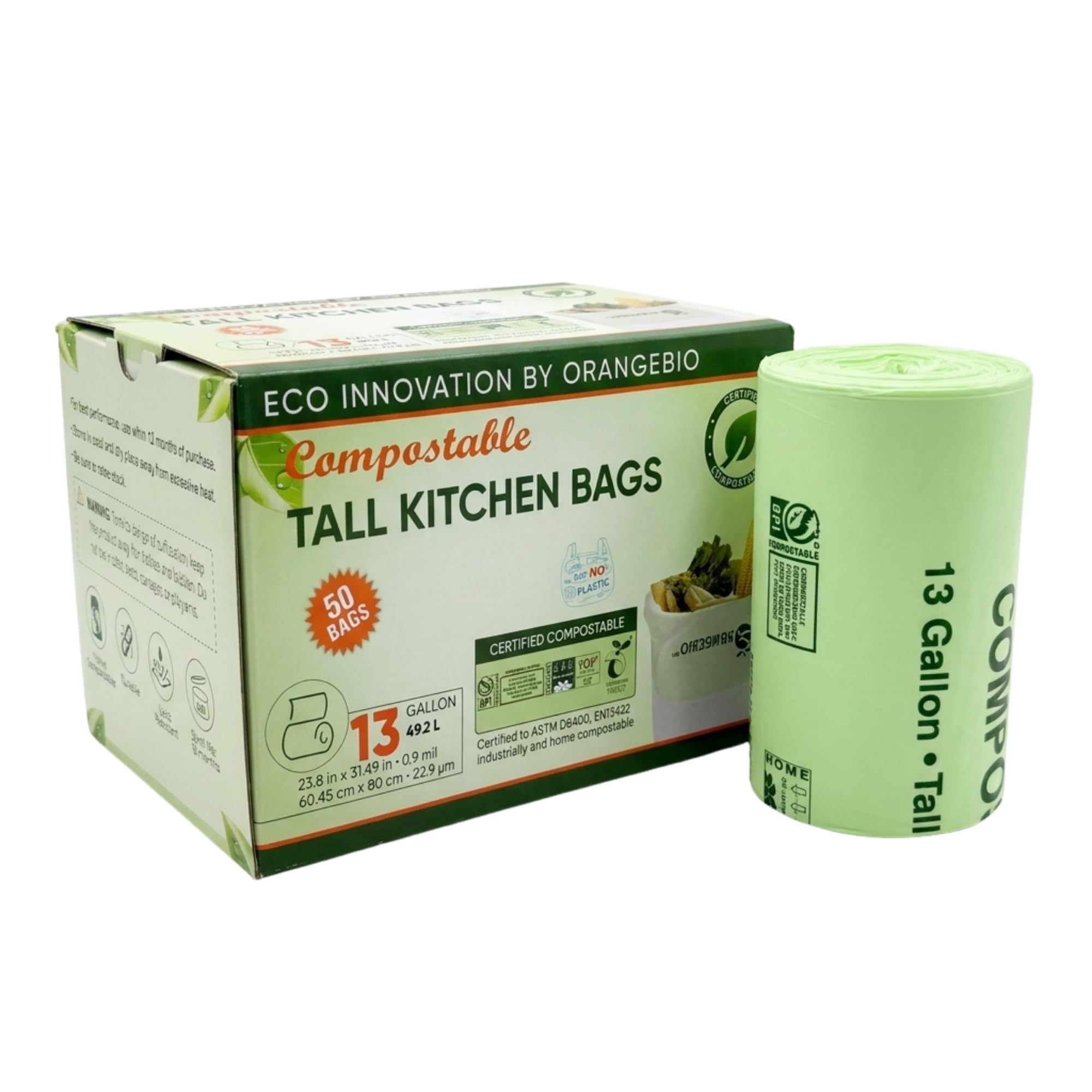
The OrangeBio bags hit the sweet spot between strength and certification. At 0.9 mil, they are noticeably thicker than many mid-range options, providing the tear and leak resistance needed for a standard kitchen bin filled with wet coffee grounds and vegetable peels. Measuring 23.8 x 31.5 inches, they fit most 13-gallon tall cans without sagging or slipping. The star-sealed bottom adds structural integrity, so you can load them up without worrying about the seam giving way.
These bags carry both BPI (ASTM D6400) and OK Compost Home certification, meaning they will break down in backyard piles and industrial facilities alike. The fully plant-based, plastic-free construction makes them food-grade safe, which is a plus if you are collecting scraps for garden composting. Multiple customer reviews confirm the bags hold up over three days of wet waste without leaking, though users warn that storing the box in direct sunlight will cause the bags to become brittle and tear.
The tie-top design is straightforward — no drawstring, but the material is flexible enough to knot securely. With 50 bags per roll, the per-bag value is strong for a bag that delivers both home compostability and daily durability. Just keep the roll in a cool, dark cabinet to preserve its shelf life.
Why it’s great
- 0.9 mil thickness provides reliable leak resistance for wet food scraps
- OK Compost Home certified for backyard composting flexibility
- 100% plant-based, plastic-free, and BPA-free construction
Good to know
- Box must be stored away from sunlight to prevent premature brittleness
- Tie-top closure requires manual knot-tying (no drawstring)
2. UNNI Compostable Drawstring Bags, 13 Gallon

UNNI is a well-known name in the compostable bag space, and this drawstring model justifies that reputation with a full 1.0 mil thickness and triple-certification pedigree. The extra mil over standard 0.75 or 0.9 mil bags gives you noticeable tear resistance for heavier loads — think melon rinds, large eggshell batches, and any sharp-edged food scraps. Customers report these bags rarely split at the bottom seam, even when the bin is packed full before pickup day.
The drawstring closure is a genuine convenience upgrade over tie-top bags. It cinches tightly without requiring you to touch the waste, which is helpful for daily kitchen use. UNNI carries BPI (ASTM D6400), OK Compost HOME, and CMA (Compost Manufacturing Alliance) certifications, giving you the broadest possible composting backup.
At 30 bags per roll, the count is lower than the 50-count options, which makes the per-bag cost higher. But the heavier mil rating and drawstring convenience justify the premium for users who prioritize tear-proof performance and easy tying over raw bag count.
Why it’s great
- 1.0 mil thickness handles heavy, wet, or sharp food scraps without tearing
- Drawstring closure allows easy, hands-free tying and lifting
- Triple-certified (BPI, OK Compost HOME, CMA) for maximum composting assurance
Good to know
- Only 30 bags per roll; lower count than comparable tie-top options
- Wet waste left for multiple days can cause early bottom degradation
3. SUPERBIO 13 Gallon Compostable Drawstring Kitchen Waste Bag
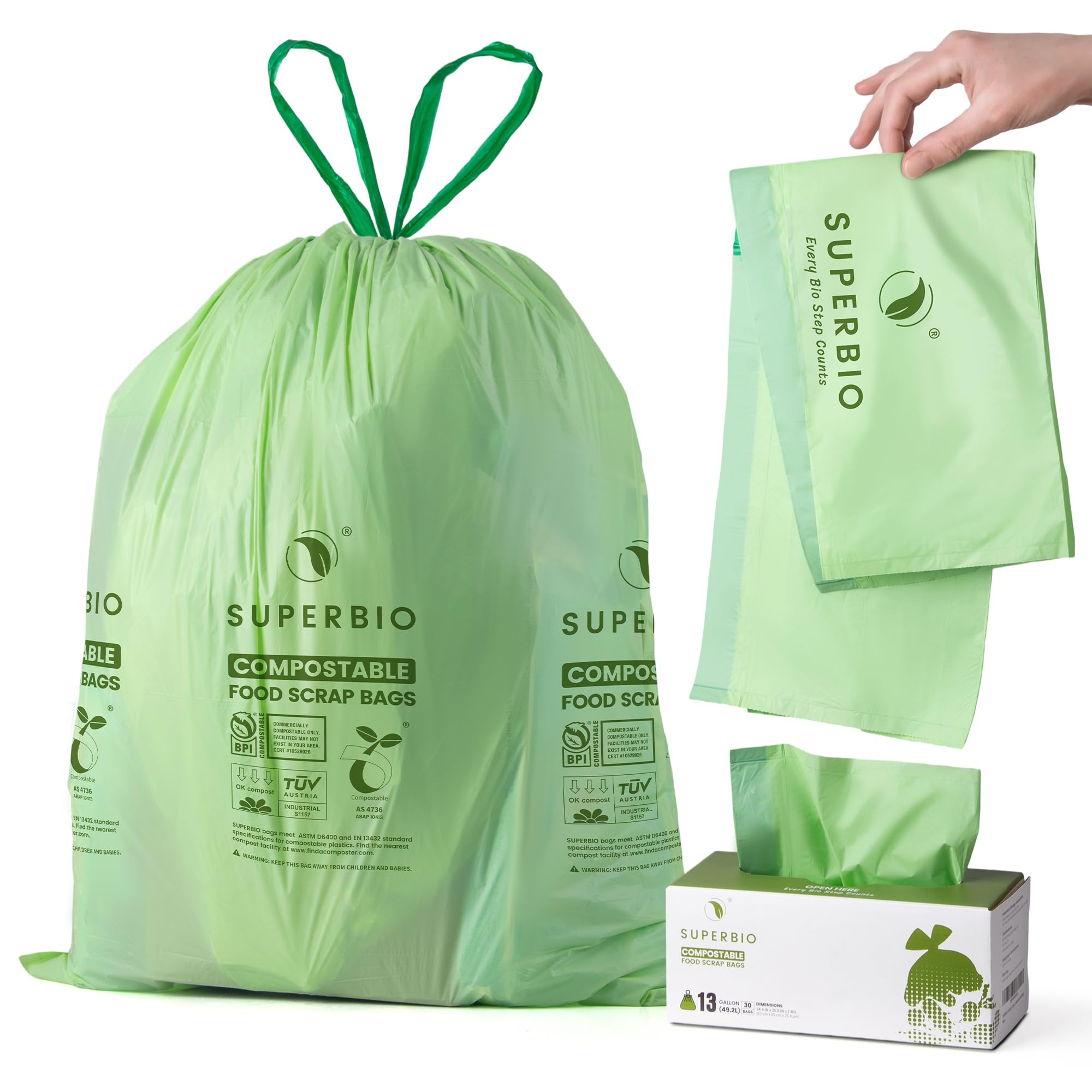
SUPERBIO targets users who send their food waste to an industrial composting facility. This bag carries BPI, Seedling, and OK Compost INDUSTRIAL certification (ASTM D6400 and EN 13432), meaning it is optimized for high-temperature commercial composting rather than a backyard pile. The 1.0 mil thickness places it in the same heavy-duty tier as UNNI, with a similarly tear-resistant construction that customers describe as leak-proof for wet kitchen waste.
The drawstring design is generous, with a cinching mechanism that holds tight even when the bag is loaded near capacity. The dimensions (25.2 x 25.6 inches) give it a slightly taller and wider profile than some other 13-gallon bags, making it a good fit for under-sink bins with a larger footprint. Customer feedback is very positive on structural integrity: multiple reviews note that the bags do not develop weak spots or pinprick holes when holding damp waste over a three-day cycle.
The main limitation is the certification scope. If you rely on home composting, these bags are not guaranteed to break down in a cold pile. Additionally, the shelf life is around one year (typical for compostable bags), and the packaging may vary between shipments as SUPERBIO updates its packaging design. For industrial compost users, this is a top-tier performer.
Why it’s great
- 1.0 mil thickness offers strong resistance to tears and leaks
- Drawstring closure provides convenient, no-contact tying
- Seedling and OK Compost INDUSTRIAL certified for commercial facilities
Good to know
- Not certified for home composting; works best in industrial heat environments
- Packaging design may vary between shipments due to a transition period
4. BEIDOU-PAC 13 Gallon Flap Tie Compostable Trash Bags
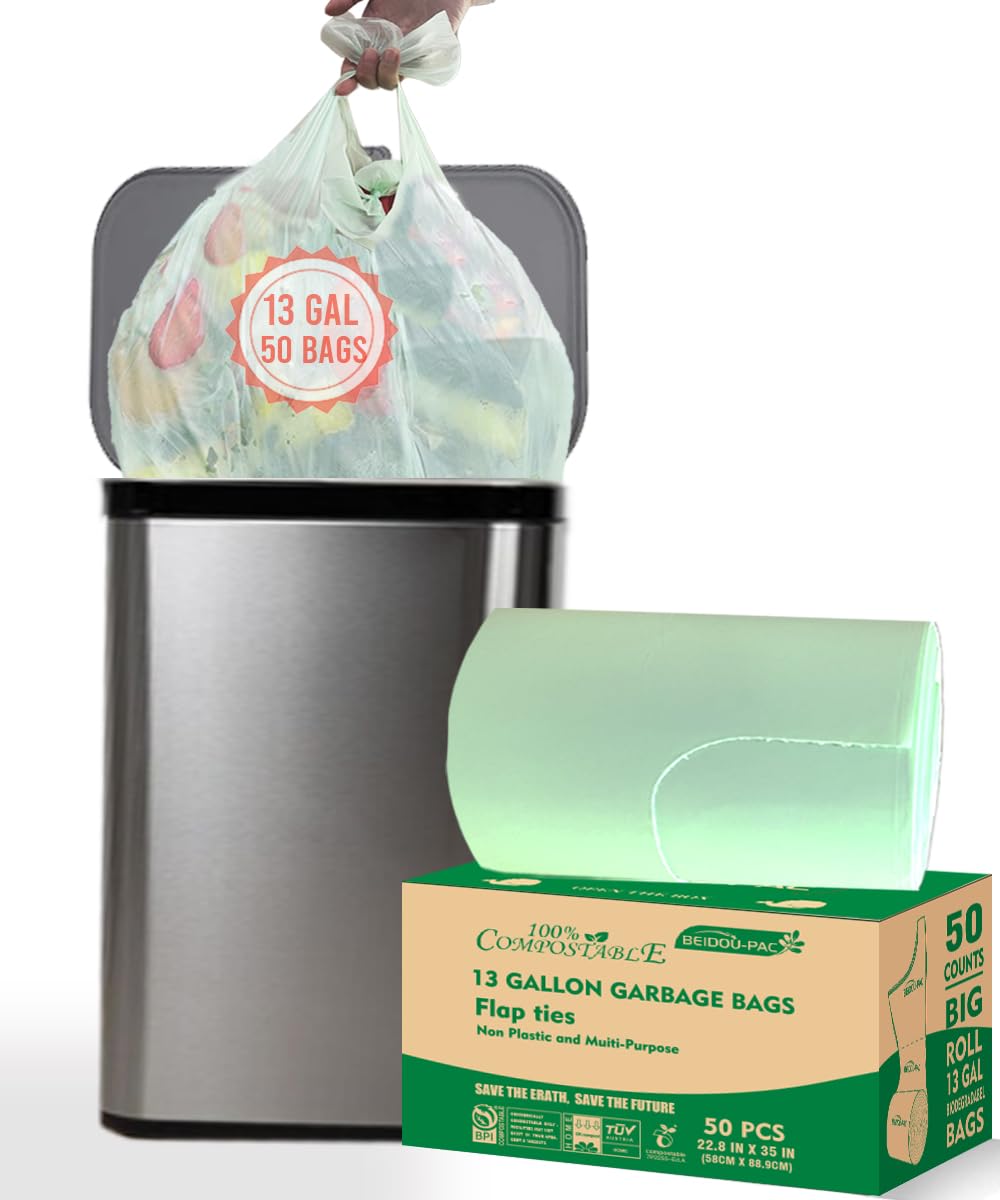
BEIDOU-PAC offers a budget-friendly entry into compostable liners without sacrificing certification. These bags come in at 0.75 mil, which is on the thinner side, but they are BPI and OK Compost Home certified — a combination usually found on pricier bags. The 22.8 x 35-inch dimensions are slightly narrower than some competitors, but they still fit standard 13-gallon tall kitchen bins well. The flap-tie closure is a small upgrade over a simple open-top bag, giving you a built-in way to secure the bag after tying.
Customer feedback highlights a mixed experience with durability. Many users find the bags perfectly adequate for dry kitchen scraps like vegetable peels and coffee grounds, noting that they hold up well and are easy to separate along the perforated roll. However, a subset of reviews mentions that the bags can develop micro-tears under the pressure of sharp waste or when moisture accumulates at the bottom. One reviewer specifically warned against using these for heavy or sharp items, as the thin material can fail unexpectedly.
For a daily-use kitchen bag handling mostly dry or moderately wet waste, the BEIDOU-PAC delivers strong value. The certification breadth (home and industrial) is impressive at this price tier. But if your bin regularly collects soup remnants, heavy fruit rinds, or glass-sharp bones, the thinner material may test your patience.
Why it’s great
- BPI and OK Compost Home certified at a budget-friendly price point
- Flap-tie closure offers a built-in securing method
- Pre-perforated roll makes individual bag separation quick and clean
Good to know
- 0.75 mil may develop micro-tears with wet or sharp waste
- Narrower dimension (22.8 inches) may fit some bins less snugly
5. TERRACOR 13 Gallon Compostable Trash Bags
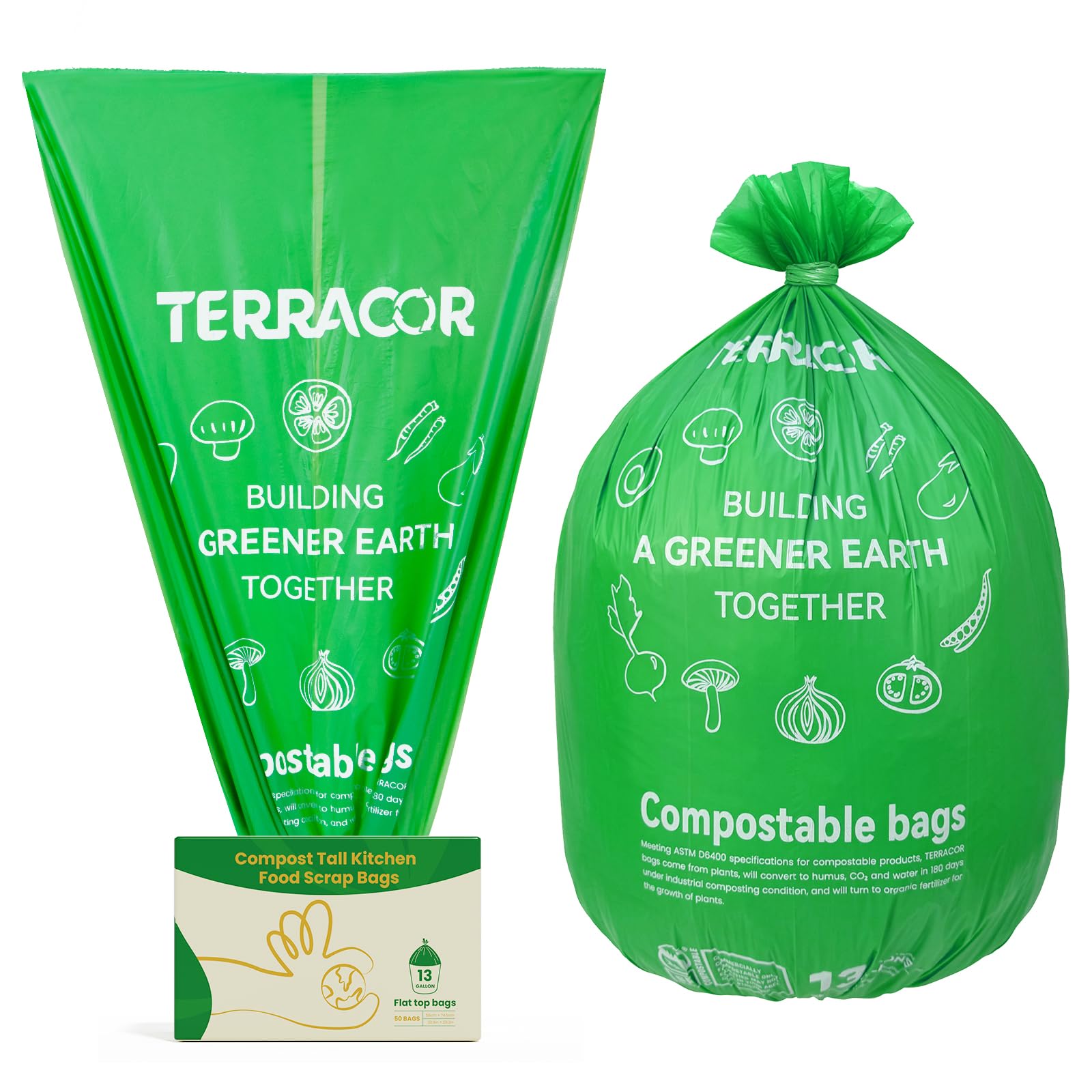
TERRACOR delivers a sturdy mid-range option at 0.9 mil, matching the thickness of the OrangeBio bags. The material blend uses PLA and PBAT — two plant-based resins that provide a good balance of flexibility and tensile strength. These bags are BPI certified (ASTM D6400), confirming they will break down in an industrial composting facility within 180 days. The manufacturer recommends changing the bag every two days for hygiene, which aligns with best practices for wet waste management.
Customer reviews are positive, with multiple users calling the bags “sturdy” and “durable.” One reviewer noted they fit a 1.3-gallon countertop compost bin perfectly, remaining intact even after freezing (a common practice to reduce odors before pickup day). Another user found the bag strong enough for use beyond the kitchen, repurposing it for general household waste without issue. The dispenser box design earned praise for being compact and easy to store on a shelf or under the sink.
The bag count is generous at 50 per roll, giving you a solid cost-per-bag ratio. The tie-top style is simple and reliable, though some users may prefer a drawstring for easier handling. If you are looking for a mid-range, well-reviewed bag with solid material specs and industrial compost certification, TERRACOR is a strong contender.
Why it’s great
- 0.9 mil thickness provides good durability for daily kitchen waste
- Compact dispenser box fits neatly under the sink
- 50 bags per roll offers a favorable per-bag value
Good to know
- BPI certified for industrial composting only, not home composting
- Tie-top closure requires knot-tying (no drawstring option)
FAQ
How long do compostable bags last before they start degrading in storage?
Can I put compostable bags in my backyard composting pile?
Why does my compostable bag develop small holes at the bottom after a few days?
Final Thoughts: The Verdict
For most users, the best compost bags winner is the OrangeBio 13 Gallon Compostable Trash Bags because they combine 0.9 mil thickness, OK Compost Home certification, and plant-based construction at a strong per-bag value. If you want the drawstring convenience of a heavy-duty bag, grab the UNNI Compostable Drawstring Bags. And for an industrial-compost-focused option with maximum tear resistance, nothing beats the SUPERBIO Compostable Drawstring Bag.

Mo Maruf
I created WellFizz to bridge the gap between vague wellness advice and actionable solutions. My mission is simple: to decode the research and give you practical tools you can actually use.
Beyond the data, I am a passionate traveler. I believe that stepping away from the screen to explore new environments is essential for mental clarity and physical vitality.