Our readers keep the lights on and my smoothie glass nicely filled. As an Amazon Associate, I earn from qualifying purchases.
Factory speakers blend everything together, turning a crisp snare hit and a growling bassline into one muddy mess. A component speaker system separates those sounds so you actually hear each instrument on its own, and finding a set that does that well without breaking your budget is the real trick. This guide cuts through the marketing to show you exactly which component speakers deliver genuine separation, clean highs, and punchy midrange for your car.
I’m Mohammad Maruf — the co-founder and writer behind WellFizz. This guide is built by comparing the manufacturers’ published specifications and the patterns across verified customer reviews, so you get each pick’s real strengths and trade-offs instead of marketing spin.
Your car’s audio system is only as good as its weakest link, and upgrading to a quality set of component speakers is the single most dramatic improvement you can make to your daily drive’s soundstage and clarity.
How To Choose The Best Component Speakers
Picking the right component speakers comes down to matching three things: your car’s available mounting space, your amplifier’s power, and the type of sound you prefer. These four factors will guide you to the right set.
Power Handling: RMS vs. Peak
RMS (continuous power) is the number that actually matters. It tells you how much power a speaker can handle cleanly all day long. Peak power is a burst rating that means very little in real use. A speaker rated for 80W RMS will play louder and cleaner than one rated for 400W peak but only 40W RMS.
Sensitivity: How Loud for How Much Power
Measured in decibels (dB), sensitivity tells you how much volume you get from one watt of power. A speaker rated at 92dB sensitivity will play noticeably louder than an 88dB speaker when both are given the same power from your head unit or amp. Higher sensitivity is your friend if you plan to run speakers off a factory stereo without an external amplifier.
Tweeter Material: Silk vs. Metal
Silk dome tweeters produce a warm, smooth treble that rarely sounds harsh, even at high volumes. Metal dome tweeters (usually aluminum or titanium) can sound more detailed and “airy” but can also become fatiguing or bright if not paired with a good crossover. For most daily drivers, silk domes are the safer, more forgiving choice.
Quick Comparison
On smaller screens, swipe sideways to see the full table.
| Model | Category | Best For | Key Spec | Amazon |
|---|---|---|---|---|
| Infinity Reference 6530CX | Mid-Range | Balanced, fatigue-free listening | 6.5″ Plus One woofer | Amazon |
| Polk Audio DB6502 | Premium | Marine & outdoor durability | IP56 splash-proof rating | Amazon |
| Alpine S2-S65C | Mid-Range | Hi-Res Audio certification | 40kHz frequency response | Amazon |
| KICKER 46CSS654 | Mid-Range | Flexible tweeter mounting | EVC deep-bass motor | Amazon |
| DS18 ZXI-62C | Premium | High-volume SPL builds | Kevlar cone, 240W peak | Amazon |
| Focal ASE165 Auditor EVO | Premium | Audiophile soundstage | French-built, 75W RMS | Amazon |
| JBL Club 64C | Premium | Patented Plus One cone area | 3-ohm impedance, 92dB | Amazon |
| Memphis PRX60C | Budget | Loud and punchy on a budget | Polypropylene cone | Amazon |
| H YANKA HCP-65 | Budget | Entry-level price, high power | 92dB sensitivity, 4 ohms | Amazon |
In‑Depth Reviews
1. Infinity Reference 6530CX 6-1/2″ Component Speaker System
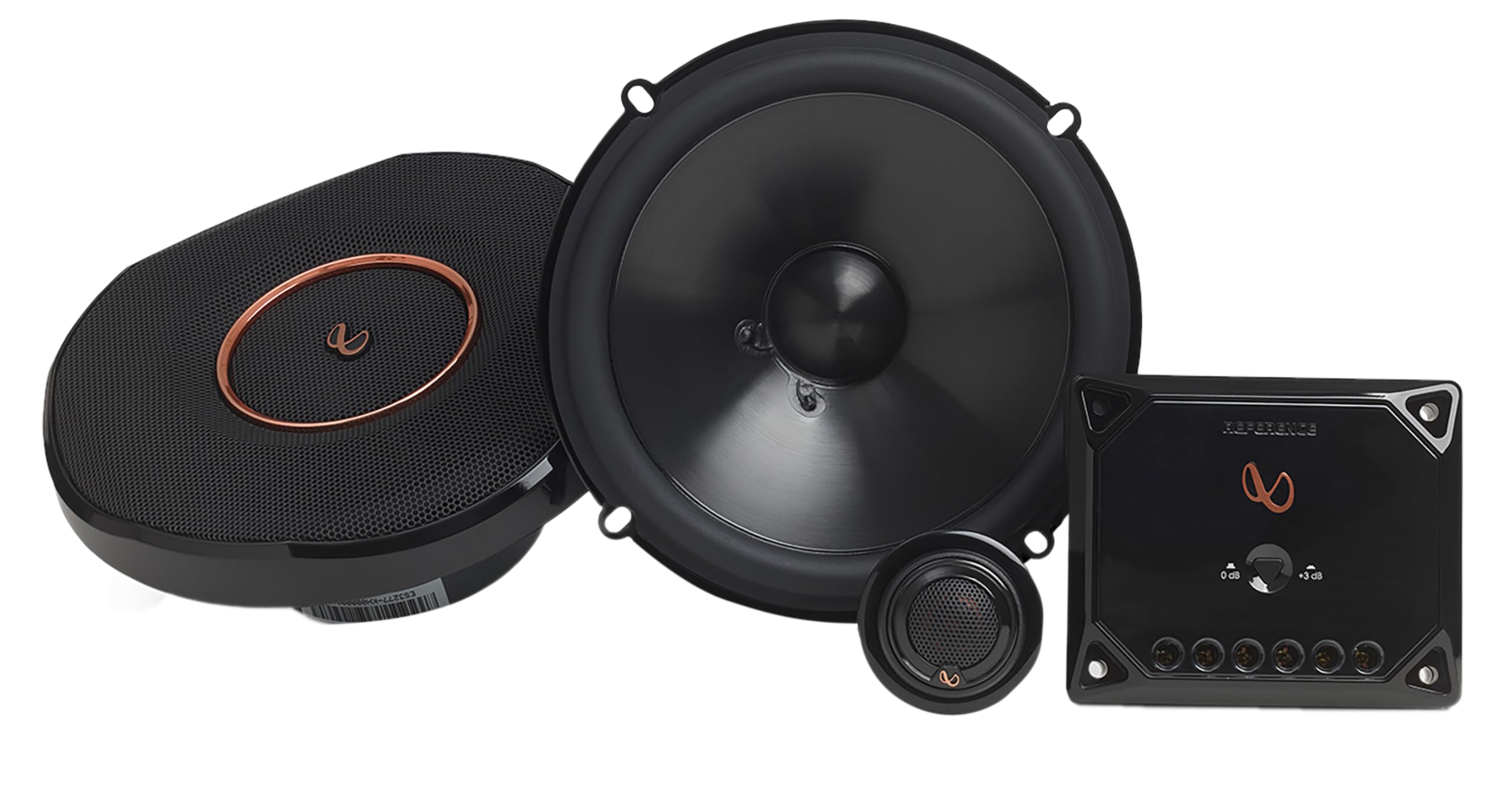
With a sensitivity rating of 92 dB, the Infinity Reference 6530CX is the top pick for anyone who wants to listen for hours without ear fatigue. Buyers report the tweeters are “clean and well-rounded, not bright or fatiguing” — that matters because harsh tweeters are the number-one reason people turn down good music on a long drive.
These use an oversized Plus One woofer that gives you more cone area than a standard 6.5-inch, which means deeper bass and fuller midrange without needing a bigger speaker hole. The sensitivity sits high enough that a modest 60W RMS amp drives them easily, and the newly engineered basket fits most factory locations without chopping up your door panel. The 6530CX beats the H YANKA HCP-65 in sound refinement by a wide margin — where the HCP-65 distorts at 50W, the Infinity stays clean well past that.
One honest limit: the crossover boxes are large, and the tweeter wire is only 4 inches long, so you will need 16-gauge wire to extend it during install. But for the money, these deliver a balanced, fatigue-free soundstage that outperforms JBL, Pioneer, and Alpine in the same price bracket — the clear choice for long-haul listeners who value clarity over volume.
Why it’s great
- Non-fatiguing silk-like textile tweeter
- Plus One cone adds real bass depth
- Oversized basket fits many factory holes
Good to know
- Crossovers are physically large
- Tweeter wire needs extension
- Best performance requires an external amp
2. Polk Audio DB6502 DB+ Series 6.5″ Component System

Versus the top-pick Infinity 6530CX, the Polk DB6502 gives up some acoustic refinement but gains an IP56 marine certification — meaning it shrugs off rain, humidity, UV rays, and salt spray without rusting or degrading, thanks to coated steel baskets and weather-tested components. The Infinity beats it on pure sound, but the Polk leads on durability if your speakers live in a Jeep with the doors off or a boat.
Polk’s Dynamic Balance technology uses laser imaging to find the ideal combination of cone and surround materials, so the 6.5-inch polypropylene woofer and 3/4-inch silk dome tweeter produce clean, distortion-free sound even at high volumes. In a 2017 Jeep JK, owners mention fitting these with a simple 2-inch port hole and getting “amazing clarity” with a nearly flat EQ. The tweeters swivel for imaging, and the external crossover keeps highs and lows directed to the right drivers.
One thing to know: it reaches down to 35Hz, but the bass is tight and punchy rather than booming — customers note the stock speakers in an 09 Silverado went deeper but with distortion. Choose the Polk DB6502 over the top pick if you drive a convertible, a convertible SUV, or spend weekends on the water — it will still sound great next season.
Where it shines
- IP56 certified for marine and outdoor use
- Swivel tweeter for flexible sound imaging
- 100W RMS handling with low distortion
Worth noting
- Bass is tight, not thumping
- Wiring crossovers can be fiddly
- Some buyers saw burned tweeters, likely from used stock
3. Alpine S2-S65C Next-Gen S-Series 6.5″ Component Set

You are the type who notices the difference between a 44.1kHz MP3 and a high-res FLAC file. The Alpine S2-S65C is Hi-Res Audio certified, meaning it can reproduce frequencies all the way up to 40kHz — that is double what a standard CD offers and well beyond what most speakers can even attempt. For a 6.5-inch component set at this price, that kind of frequency extension is rare.
Alpine’s HAMR (High Amplitude Multi-Roll) surround pushes the woofer further than a standard rubber surround, which gives you real bass authority without needing a subwoofer immediately. The cone is a composite of polypropylene, glass fiber, and mica — a mix that keeps weight low and stiffness high so the speaker moves fast and stops fast. Buyers running these in a 2025 Honda Civic report they are a “big upgrade from factory,” noting the tweeters add high-end clarity that was completely missing from the stock system.
The catch: without an amp feeding these at least 80W RMS, you are leaving most of their potential on the table. Running them off a head unit alone gives decent sound but not the crisp, layered experience they are capable of. Pair them with a small 4-channel amp and a sub, and this set becomes an entry-level audiophile system.
What stands out
- Hi-Res Audio certified, 40kHz top end
- HAMR surround for deeper bass
- Lightweight composite cone, low distortion
The trade-offs
- Needs 80W RMS amp to fully perform
- Bass is decent but not subwoofer-level
- Speaker grilles sold separately
4. KICKER 46CSS654 CS-Series 6.5″ Component System

The single number that matters most in this category is bass extension from a 6.5-inch woofer, and the KICKER 46CSS654 scores unusually deep low-end reach thanks to its Extended Voice Coil (EVC) design. The heavy-duty motor and magnet structure let the woofer move further without losing control, so you hear bass notes with weight and definition instead of a muddy thud. Reviewers point out these are a “massive upgrade from stock” in a Toyota Corolla, even running off the head unit alone.
The downside: phase plugs in the woofer center eliminate distortion at high volumes, which is great for clarity, but it means the speaker is less forgiving of a low-quality source signal. If your head unit is noisy, you will hear it. The neodymium tweeter magnets allow louder highs without extra power, and the three tweeter mounting options (flush, angled, surface) make installation in tricky factory locations much easier.
At this price point, the KICKER competes directly with the Infinity 6530CX, trading slightly less midrange refinement for deeper bass and more flexible tweeter placement. If your car has weird sail-panel or A-pillar angles, the mounting versatility alone makes this the better pick for the price.
The upsides
- EVC motor for deep, controlled bass
- Three tweeter mounting options
- Neodymium magnets for louder highs
Keep in mind
- Phase plugs amplify source noise
- Best paired with a subwoofer
- UV-treated foam surround needs care in extreme heat
5. DS18 ZXI-62C 6.5″ 2-Way Component System with Kevlar Cone

What you actually get at this lower price is a Kevlar cone, the same material in bulletproof vests, stiff enough to handle 80W RMS and 240W peak without flexing or breaking. The 89dB sensitivity is modest, but that is because the cone is designed for power handling over efficiency.
One buyer ran these in a motorcycle with minimal space and called them “perfectly clear,” while another fit them into a 2018 Mustang GT with the factory 9-speaker system and said they sounded “far better than stock, with subtle treble and improved midrange.” The 30W RMS tweeter can be mounted on the grill assembly or remotely, and the included passive crossover splits the signal cleanly.
The limit: mounting holes in some dashboards are slightly bigger than the DS18’s frame, so you may need an adapter ring. The Kevlar cone also means the speaker takes more power to wake up — without a solid amp, they can sound flat. If you are building a loud SPL system or drive something that needs speakers to compete with wind noise, the ZXI-62C is built for that — making it the exact budget buyer it is perfect for.
Why we’d pick it
- Kevlar cone resists distortion at high power
- 80W RMS / 240W peak handling
- Flexible tweeter mounting options
A few caveats
- 89dB sensitivity needs a strong amp
- May need adapter rings for some cars
- Warranty process requires effort
6. Focal ASE165 Auditor EVO Series 6.5″ 2-Way Component Kit

This set is perfect for the audiophile who prizes soundstage precision and imaging over sheer volume or bass impact. Developed in France, the Focal ASE165 Auditor EVO Series 6.5″ 2-Way Component Kit focuses on revealing the space between instruments, with a black lacquered tweeter and carefully tuned crossover. At 75W RMS, it is easy to amplify but rewards a quality source and amp pairing like the Kicker Key 200.4, which buyers call a “perfect synergy” for immersive sound quality.
The tweeter can be surface mounted or fully integrated into the factory location, and exclusive Focal technologies—including the butyl surround and treated paper cone—aim for neutrality rather than hype. Shoppers say the highs can sound “tinny” before EQ adjustment, but once dialed in, the clarity beats muddled midrange from other brands. The build quality is solid enough that buyers call them “well worth the coin.”
One gentle caution: like most Focal sets, the midbass is polite rather than punchy. If you need door-panel-rattling low end without a sub, the KICKER or Alpine will serve you better. But if you want to hear the texture of a guitar string or the breath behind a vocal, the Auditor EVO is the set that delivers that nuance.
Strong points
- French-developed for precision soundstage
- Black lacquered tweeter, premium finish
- Easy to amplify, works with quality amps
Before you buy
- Highs can sound tinny before EQ
- Midbass is modest without a sub
- Premium price for a niche sound signature
7. JBL Club 64C 6-1/2″ Two-Way Component Speaker System

The JBL Club 64C sits in a sweet spot where most competitors charge more for less. At a 3-ohm nominal impedance, these draw more current from your amp than a standard 4-ohm speaker, which means they can deliver higher volume without cranking the gain — useful if your amp is modest. The patented Plus One woofer cone gives you more physical cone area than other 6.5-inch speakers, which translates to higher sensitivity (92dB) and deeper bass output.
JBL also includes a tweeter output level control that lets you boost the tweeter by 0dB or +3dB, so you can adjust for a tweeter placement that is behind a grille or in a reflective surface. The Starfish tweeter mounting adapter is designed to fit behind factory grilles, which matters if you want an invisible upgrade. Buyers in a 2007 Chrysler 300C call the silk dome tweeters “natural” with “no ear fatigue,” while a 4Runner owner praises the included adapter rings for a perfect fit.
One reviewer noted the Amazon packaging was poor — a non-padded bag crushed the box — so order carefully. For the money, the Club 64C offers more features (adjustable tweeter level, Starfish mount, plus one cone) than any other premium pick here, but the 3-ohm impedance means you should check your amp is stable at that load.
What we like
- Patented Plus One cone for more output
- Adjustable tweeter level (0dB / +3dB)
- Starfish adapter fits behind factory grilles
The downsides
- 3-ohm impedance needs amp compatibility check
- Packaging can arrive damaged
- Best with an amp, not head unit alone
8. Memphis PRX60C Power Reference Series 6.5″ Component Speakers

At 92 dB sensitivity, the Memphis PRX60C is the pick for budget-conscious buyers who want real component architecture without paying premium prices. You get a polypropylene cone woofer with a butyl rubber surround, a separate poly dome tweeter, and a proper external crossover — the exact same architecture that expensive sets use. Buyers report running these through a 4-channel amp and finding them “super loud and punchy,” even with the top down at 70 mph.
What you give up is low-end authority: buyers installing these in a 2024 Camry note they have “nice mid and high range” but lack bass. The PRX60C is designed for OEM factory applications, so the fitment is very close to stock in most cars, but in a 2005 Tundra, one buyer had to trim a small plastic tab to make them work. The crossover is separate, meaning you get real component separation — a genuine upgrade over coaxial speakers that fake it.
If your budget is tight and you are planning to add a subwoofer later, the PRX60C is the perfect front-stage stopgap. They pair well with a modest 4-channel amp and will give you clean, loud sound without the entry-level distortion that plagues cheaper coaxials. For the price, you simply cannot beat real component sound.
Why it’s great
- Real component design at a budget price
- Polypropylene cone and butyl surround
- Loud and punchy with a basic amp
Good to know
- Lacks bass depth without a sub
- May need minor trim for some cars
- Not recommended for head-unit-only setups
9. H YANKA HCP-65 6.5″ Component Car Speakers, 800 Watt

Against the top pick’s 90dB sensitivity, the H YANKA HCP-65 claims 92dB, but its 800W peak power rating is double the top pick’s 400W peak — a number that does not hold up under real use. You get two 6.5-inch paper cone woofers, two silk dome tweeters, and two crossovers in the box, everything needed for a full component setup. Buyers on a tight budget call it “amazing for the price” and report strong bass in a sealed box.
The honesty here: the 400W RMS rating is optimistic. Multiple buyers confirmed that the speakers distort at only 50W, not the advertised 150W, and one buyer mentioned the sound is narrow, centered around 1–3kHz, with poor mid and high clarity. The paper cone and rubber surround build quality looks solid, but the performance does not match the peak power claims. These are best suited for someone who wants component separation on a strict budget and is not expecting audiophile detail.
If your total budget for speakers is limited and you already have a decent amp, the HCP-65 will give you louder, clearer sound than factory coaxials. But if you can stretch the budget even a little, the Memphis PRX60C or Infinity 6530CX will give you significantly better sound quality for not much more money. Choose this over the top pick only when your speaker budget cannot exceed the HCP-65’s entry-level price and you accept its narrow, distortion-prone output as the trade-off for component separation.
Where it shines
- Full component set at the lowest price
- Silk dome tweeters for smooth highs
- 92dB sensitivity works with weaker amps
Worth noting
- Distorts far below rated power (50W)
- Narrow frequency range, poor mid clarity
- Peak power claims are misleading
Understanding the Specs
RMS vs. Peak Power
RMS (Root Mean Square) is the continuous power a speaker can handle for hours. Peak power is a brief burst rating that means almost nothing in real life. When comparing speakers, always look at RMS first — a speaker with 80W RMS will be louder and cleaner than one with 400W peak but only 40W RMS.
Sensitivity (dB)
Measured in decibels (dB), sensitivity tells you how loud a speaker gets from one watt of power at one meter. A 92dB speaker sounds twice as loud as an 85dB speaker with the same power. Higher sensitivity is better if you are running without an external amplifier.
Crossover
A crossover is the electronic circuit that splits the audio signal so low frequencies go to the woofer and high frequencies go to the tweeter. In component speakers, an external crossover gives you cleaner separation than a cheap capacitor built into a coaxial speaker.
Impedance (Ohms)
Impedance, measured in ohms (Ω), is the electrical resistance the speaker presents to the amplifier. Most car speakers are 4 ohms. Some are 2 ohms or 3 ohms, which draw more current for more volume but require an amp stable at that load. Check your amp’s manual before buying non-standard impedance speakers.
FAQ
What is the difference between component and coaxial speakers?
Do I need an amplifier for component speakers?
Will 6.5-inch component speakers fit my car?
Can I install component speakers myself?
What does silk dome tweeter mean?
Final Thoughts: The Verdict
For the majority of shoppers, the component speakers winner is the Infinity Reference 6530CX because it delivers balanced, non-fatiguing sound that works with a wide range of amps and cars. If you want marine-grade durability for a Jeep or boat, grab the Polk Audio DB6502. And for the best value in a Hi-Res certified package, the Alpine S2-S65C is the set that gives you future-proof frequency extension at a price that still leaves room for an amplifier.

Mo Maruf
I created WellFizz to bridge the gap between vague wellness advice and actionable solutions. My mission is simple: to decode the research and give you practical tools you can actually use.
Beyond the data, I am a passionate traveler. I believe that stepping away from the screen to explore new environments is essential for mental clarity and physical vitality.