Our readers keep the lights on and my smoothie glass nicely filled. As an Amazon Associate, I earn from qualifying purchases.
In competitive gaming, a single frame can be the difference between a clutch victory and a respawn timer. Choosing a monitor with a slow response time or a low refresh rate is a direct handicap, introducing perceptible ghosting and input lag that your opponents will exploit. This guide dissects the narrow specifications that matter most for twitch-reaction titles, cutting through the marketing noise to identify the displays that offer a genuine performance advantage.
I’m Mohammad Maruf — the founder and writer behind WellFizz. I’ve spent countless hours analyzing panel technologies, refresh rate curves, and motion clarity metrics to separate true gaming hardware from overpriced advertising.
To find the very best displays for apex-level play, you need a monitor that combines a high native refresh rate with a sub-1ms pixel transition and adaptive sync. This guide ranks the top contenders to help you land your next best competitive gaming monitor.
How To Choose The Best Competitive Gaming Monitor
The market is dense with marketing jargon, but the decision for competitive play boils down to a few critical hardware specs. Ignore contrast ratio for a moment; focus on the engine that drives your reaction speed.
Refresh Rate vs. Response Time: The True Dynamic Duo
A high refresh rate (240Hz, 360Hz, 500Hz) determines how many unique frames the panel can display per second, directly affecting how fluid motion appears. The response time (measured in milliseconds GtG) dictates how fast a pixel can change from one color to another, which governs ghosting and motion blur. A 360Hz monitor with a 1ms response time will look clearer than a 360Hz panel with a 4ms delay. Both numbers must be excellent; one cannot compensate for the other in fast-paced environments.
Panel Technology: IPS vs. Fast IPS vs. QD-OLED
Traditional IPS panels offer decent viewing angles but can suffer from slow pixel transitions. Fast IPS improves this significantly, providing near-instant response times without the overshoot issues found in some TN panels. QD-OLED panels combine quantum dots with OLED, producing near-instant 0.03ms response times and infinite contrast ratio, but they require careful burn-in management and are generally more expensive. For purely competitive titles, a Fast IPS or QD-OLED is the current gold standard.
Resolution and the Frame Rate Trade-Off
1080p (Full HD) is still the standard for esports because it allows even mid-range GPUs to push frame rates high enough to saturate a 360Hz panel. QHD (1440p) offers a sharper image but demands significantly more GPU horsepower to maintain a high frame rate. If your graphics card cannot consistently output 240+ frames per second at 1440p, you are wasting the monitor’s potential. Choose your resolution based on your hardware’s actual performance, not just the box spec.
Adaptive Sync: G-Sync Compatible vs. FreeSync Premium
Adaptive sync technologies (G-Sync and FreeSync) synchronize the monitor’s refresh rate with the GPU’s frame output, eliminating screen tearing without the input lag penalty of traditional V-Sync. FreeSync Premium ensures a minimum of 120Hz at FHD resolution with low frame rate compensation. G-Sync Compatible certification means Nvidia has validated the monitor for stutter-free operation. For a competitive setup, either standard works, but ensure compatibility with your specific graphics card.
Quick Comparison
On smaller screens, swipe sideways to see the full table.
| Model | Category | Best For | Key Spec | Amazon |
|---|---|---|---|---|
| ASUS ROG Strix XG27ACDNG | QD-OLED | 360Hz QHD Domination | 0.03ms GtG response | Amazon |
| Samsung Odyssey OLED G6 G60SD | QD-OLED | 360Hz & Anti-Burn-In | Dynamic Cooling System | Amazon |
| INNOCN GA27M1Q | QD-OLED | 500Hz High-FPS Gaming | 500Hz native refresh rate | Amazon |
| MSI MPG 271QRX | QD-OLED | Competitive 360Hz Play | 0.03ms GtG, 360Hz | Amazon |
| Acer Predator X27U W1 | QD-OLED | Budget-Friendly OLED | 0.03ms GtG, free sync | Amazon |
| AOC Q27GAZD | QD OLED | Entry-Level QD-OLED | 0.03ms GtG, 240Hz | Amazon |
| Alienware AW2723DF | Fast IPS | 240Hz QHD IPS | 280Hz overclocked | Amazon |
| ASUS ROG Strix XG259QNS | Fast IPS | 380Hz FPS Esports | 0.3ms response time | Amazon |
| Alienware AW2523HF | Fast IPS | 360Hz 1080p Pure Speed | 0.5ms GtG response | Amazon |
| LG 27GR83Q-B | IPS | Value 240Hz 1440p | 240Hz, 1ms GtG | Amazon |
| CRUA 27″ 360Hz | IPS | Budget 360Hz 1440p | 360Hz refresh rate | Amazon |
In‑Depth Reviews
1. ASUS ROG Strix 26.5” 1440P QD-OLED Gaming Monitor (XG27ACDNG)

The ASUS ROG Strix XG27ACDNG delivers a near-perfect balance of speed and image quality for competitive titles. Its 26.5-inch QHD QD-OLED panel refreshes at 360Hz and achieves a 0.03ms GtG response time, effectively eliminating motion blur in fast strafes and flick shots. The custom heatsink and ASUS OLED Care+ work together to reduce burn-in risk, a legitimate concern with OLED panels during long static HUD sessions.
Color accuracy is outstanding out of the box, covering 99% of the DCI-P3 gamut with a Delta E < 2 difference, making this monitor viable for content creation between matches. VESA DisplayHDR 400 True Black compliance gives HDR scenes depth without the washed-out look of cheaper IPS panels. The DisplayWidget Center software lets you adjust settings like overdrive and OLED care using a mouse, bypassing the on-screen display joystick.
Input connectivity includes DisplayPort 1.4, HDMI 2.1, and USB-C, ensuring compatibility with modern GPUs and consoles. The stand offers tilt, swivel, height, and pivot adjustments, though the height range is slightly limited compared to some competitors. The 3-year warranty with burn-in coverage is a strong vote of confidence in the panel’s longevity. This monitor performs at the highest tier for frame chasing.
Why it’s great
- 360Hz refresh rate paired with 0.03ms response time for zero ghosting.
- Custom heatsink and OLED Care+ reduce burn-in risk effectively.
- 3-year warranty includes burn-in coverage for long-term peace of mind.
Good to know
- Height adjustment range is less generous than some competitors.
- Pixel cleaning pop-up can interrupt gameplay until disabled in settings.
- Requires high-end GPU to saturate 360Hz at QHD resolution.
2. Samsung 27” Odyssey OLED G6 (G60SD)

Samsung’s Odyssey OLED G6 brings a unique Dynamic Cooling System to the competitive monitor space, using a pulsating heat pipe to dissipate heat 5x better than traditional graphite sheets. This thermal management, combined with logo and taskbar detection algorithms, directly targets burn-in prevention, a frequent barrier for gamers considering OLED. The 27-inch QHD QD-OLED panel offers a 360Hz refresh rate and a 0.03ms response time, delivering exceptionally fluid motion.
The Glare Free technology is particularly effective, reducing reflections from ambient light sources so that the deep black levels and near-infinite contrast remain visible even in a brightly lit room. AMD FreeSync Premium Pro support includes Low Framerate Compensation, ensuring a tear-free experience even when your frame rate dips below the VRR range. The monitor’s slim profile, at just 3.9mm at its thinnest point, is a bonus for desk aesthetic.
A notable trade-off is the reliance on a small joystick for the power button, which some users report can be fragile over time. The absence of a dedicated remote control for a monitor at this price point is a minor inconvenience. Connectivity includes HDMI 2.1 and DisplayPort, and the stand offers full ergonomic adjustments. For competitive players who prioritize burn-in safety alongside speed, this is a well-engineered solution.
Why it’s great
- Dynamic Cooling System with heat pipe for superior burn-in prevention.
- Glare Free coating retains deep blacks in bright rooms.
- FreeSync Premium Pro with low framerate compensation for tear-free play.
Good to know
- Power button joystick has been reported as fragile by some users.
- Requires external remote for full control; not included with all units.
- HDR mode disables the built-in monitor speakers.
3. INNOCN 27″ 2K QHD 500Hz Gaming Monitor (GA27M1Q)
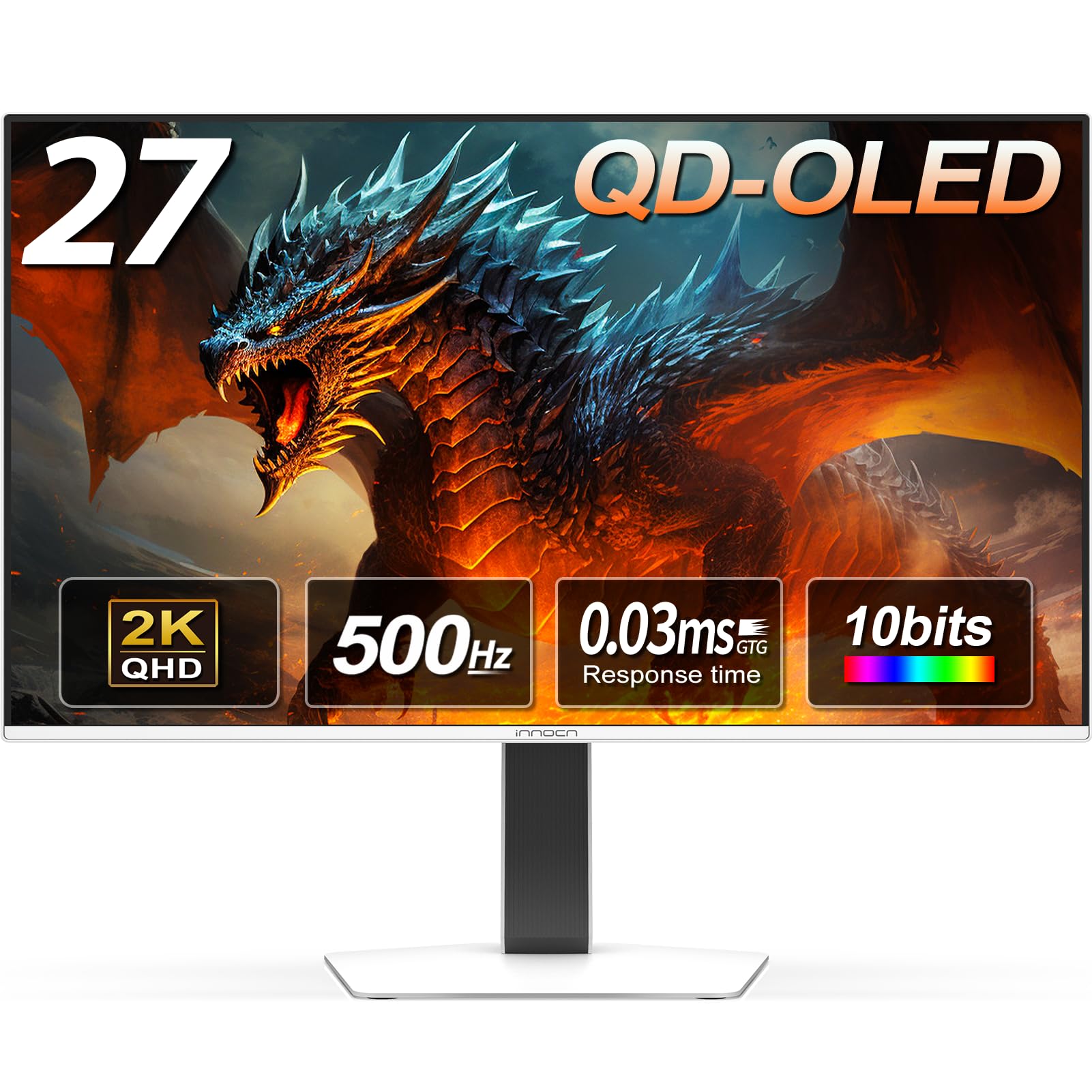
The INNOCN GA27M1Q is the highest native refresh rate monitor on this list at 500Hz, making it the ultimate choice for players whose GPUs can push frame rates into the stratosphere. The 27-inch QHD QD-OLED panel maintains a 0.03ms GtG response time, ensuring that each of those 500 frames is displayed without smearing. It supports a variable refresh rate range from 48Hz all the way to 500Hz, covering 240Hz, 360Hz, and 480Hz along the way.
Color performance is excellent with 99% DCI-P3 coverage and a 1,500,000:1 contrast ratio, delivering vivid colors and inky blacks that make enemy models pop against dark backgrounds. G-Sync Compatibility is certified, so Nvidia GPU users get a tear-free experience without extra hardware. The monitor includes a fully adjustable stand with height, tilt, swivel, and pivot, plus VESA 100x100mm mount support.
To achieve the full 500Hz refresh rate, you will need a high-end CPU and GPU combination, such as a 9800X3D paired with a 7900 XTX or better. The built-in speakers are surprisingly usable for casual audio, but competitive players will still favor a dedicated headset. The price point places it in the premium tier, but it undercuts many name-brand 360Hz QD-OLED options while offering significantly more bandwidth.
Why it’s great
- Industry-leading 500Hz native refresh rate for maximum fluidity.
- QD-OLED panel with 0.03ms response and 99% DCI-P3 coverage.
- Excellent value compared to other high-refresh QD-OLEDs.
Good to know
- Requires a top-tier CPU/GPU to push the frame rate to 500Hz.
- Color and brightness may need manual tuning out of the box.
- Brand recognition is lower than ASUS or Samsung for some buyers.
4. MSI MPG 271QRX QD-OLED

The MSI MPG 271QRX QD-OLED is a meticulously engineered 27-inch display for gamers who want zero compromise on image fidelity. The 360Hz refresh rate and 0.03ms GtG response time are standard for this tier, but MSI’s QD Premium Color certification ensures a Delta E ≤ 2 color difference, providing professional-grade accuracy. The VESA DisplayHDR True Black 400 certification means HDR content looks punchy with deep blacks and no blooming.
MSI includes OLED Care 2.0, a suite of features that include pixel shift and panel refresh to reduce burn-in risk during long gaming sessions. The monitor also features a KVM switch, allowing you to control two devices with a single keyboard and mouse setup, which is practical for gamers who also use a work laptop. Console Mode provides full 48 Gbps HDMI 2.1 bandwidth, ensuring compatibility with PS5 and Xbox Series X at 4K 120Hz or QHD 360Hz.
The adjustable stand offers height, tilt, and swivel adjustments, though the base is somewhat bulky. The Gaming Intelligence App allows for customization of viewing settings per game profile. Some users report a minor purple tint on certain viewing angles, a known characteristic of QD-OLED that is generally not visible in normal seating positions. For a pure competitive QD-OLED, this is a top contender.
Why it’s great
- QD Premium Color certification with Delta E ≤ 2 for accurate colors.
- Integrated KVM switch for dual-device control.
- OLED Care 2.0 provides robust burn-in protection features.
Good to know
- Stand base is bulky and consumes desk space.
- Some users notice a slight purple tint on specific angles.
- Limited height adjustment range on the included stand.
5. Acer Predator X27U W1 QD-OLED
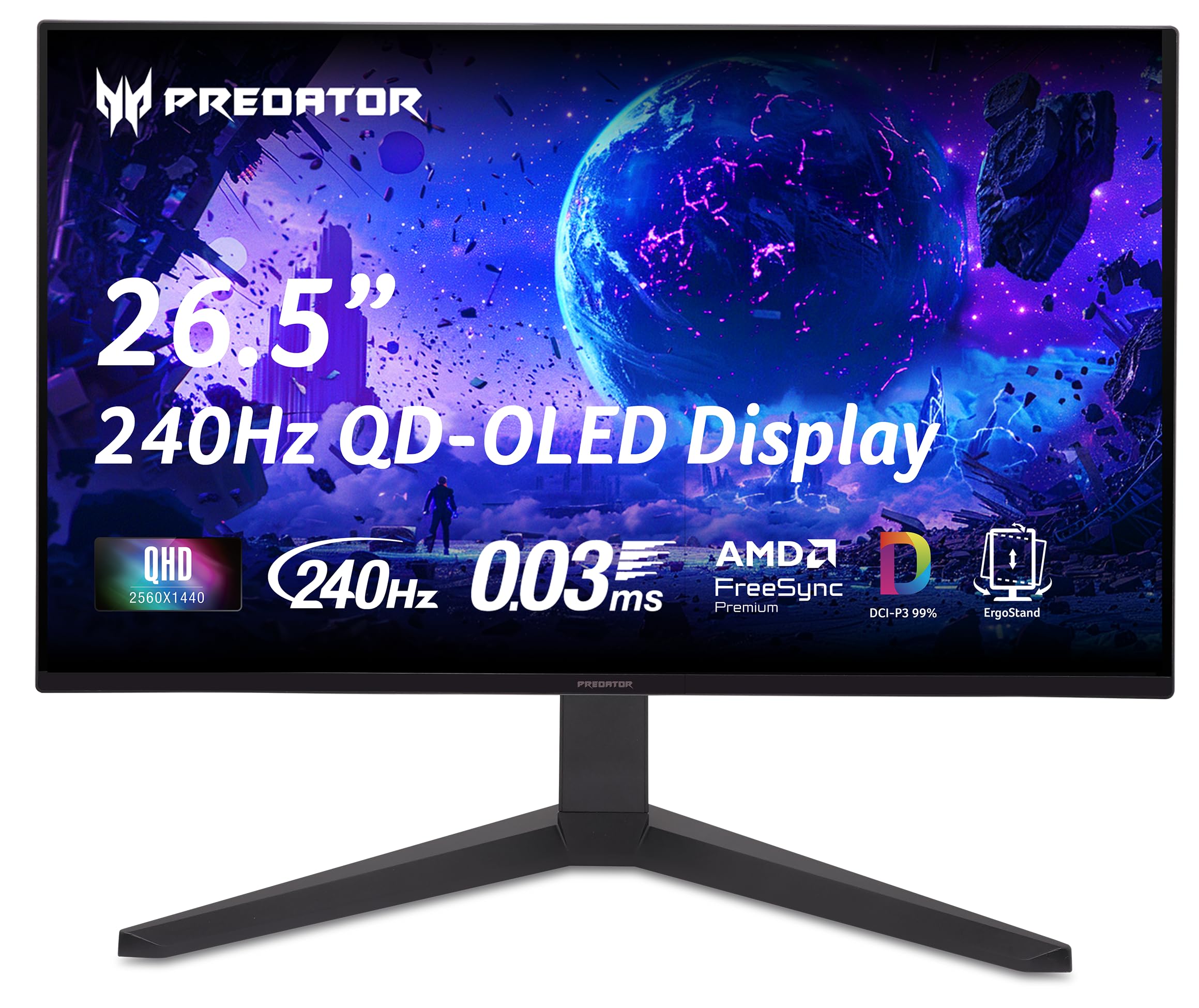
The Acer Predator X27U W1 brings QD-OLED performance to a more accessible price point without cutting corners on the core competitive spec. The 26.5-inch WQHD (2560×1440) panel features a 240Hz refresh rate and a 0.03ms GtG response time, which is more than sufficient for the vast majority of competitive players. The true 10-bit color depth and DCI-P3 99% coverage produce vibrant, accurate colors that elevate everything from game textures to HDR cutscenes.
AMD FreeSync Premium certification ensures a tear-free experience down to low frame rates, and the monitor is validated as G-Sync Compatible. The ZeroFrame design minimizes bezel distractions, keeping your focus on the action. The stand includes full ergonomic adjustments, including height, pivot, swivel, and tilt, allowing you to find the perfect angle for long sessions.
Brightness is competent but not class-leading; the panel is not as punchy as some higher-priced QD-OLEDs in a very bright room. The plastic build quality feels slightly less premium than the ASUS or Samsung alternatives. The on-screen display is comprehensive but cluttered, with many submenus. For the price, this is the most accessible entry point to competitive-grade QD-OLED gaming.
Why it’s great
- Delivers genuine QD-OLED color and 0.03ms response at a lower cost.
- Full ergonomic stand with height, pivot, and swivel adjustments.
- ZeroFrame bezel design maximizes the screen-to-body ratio.
Good to know
- Brightness is adequate but not as high as premium-tier QD-OLEDs.
- Plastic build does not feel as robust as metal alternatives.
- OSD menu is cluttered with many repetitive options.
6. AOC 27″ QD OLED Gaming Monitor (Q27GAZD)
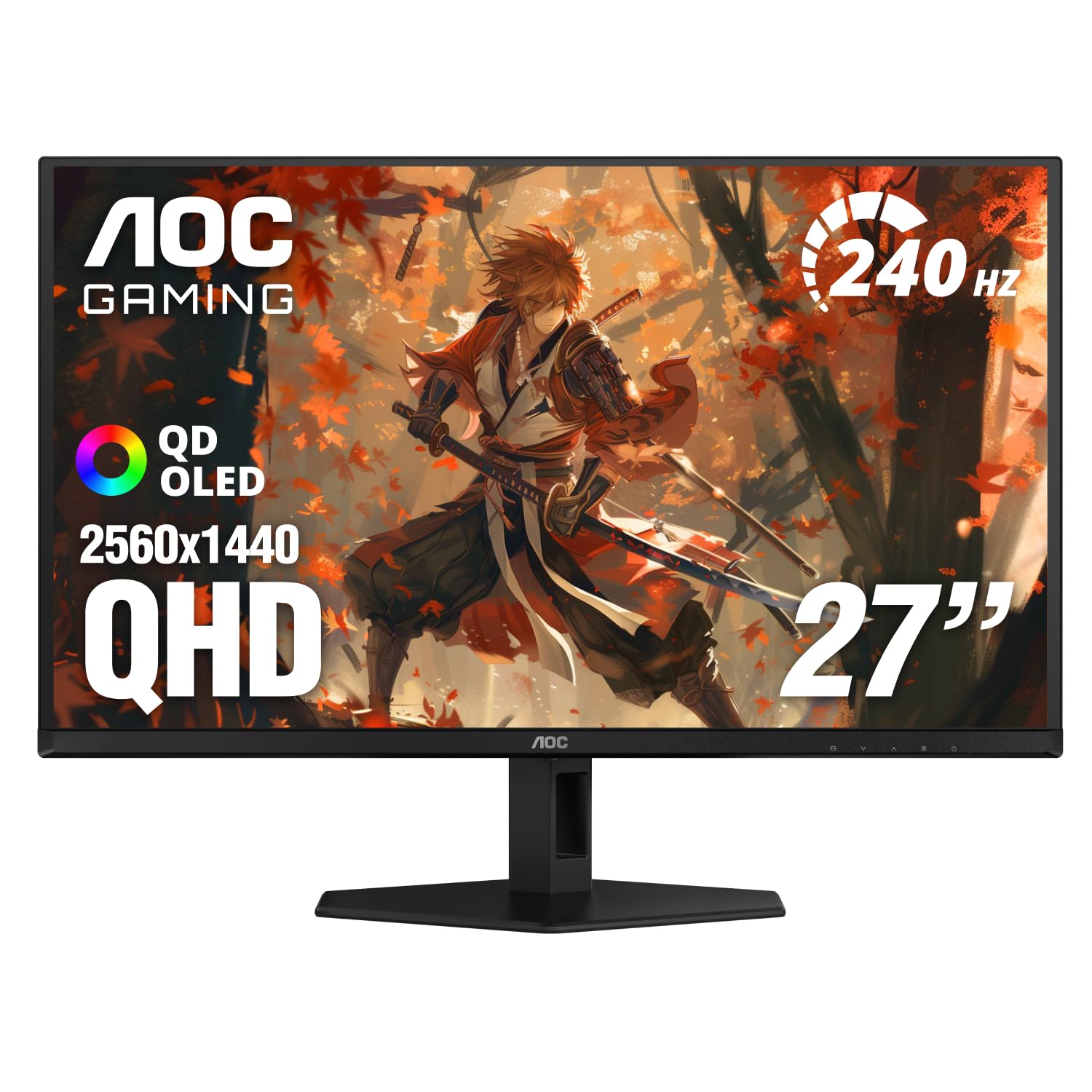
The AOC Q27GAZD is a 27-inch QHD QD OLED monitor designed to bring the benefits of next-gen panel technology to a budget-conscious competitive gamer. It features a 240Hz refresh rate and a 0.03ms GtG response time, which is identical to many more expensive models in terms of pure pixel transition speed. The HDR400 True Black certification means dark scenes retain shadow detail without the gray glow of standard HDR400 IPS panels.
Color coverage is broad, with 147.6% sRGB and 110.2% DCI-P3, resulting in rich, saturated colors that make in-game details pop. Adaptive-Sync compatibility works with both G-Sync and FreeSync, providing a tear-free experience on both Nvidia and AMD GPUs. The monitor is VESA mountable, which is good because the included stand is functional but feels basic and lacks smooth height adjustment.
One limitation is the lack of HDMI 2.1; the HDMI ports are capped at 165Hz, so you must use DisplayPort to achieve the full 240Hz refresh rate. The glossy QD-OLED surface reflects ambient light more than matte IPS panels, so a controlled lighting environment is ideal. Some users have reported minor issues with the protective film, but the panel itself delivers exceptional contrast and response for the price.
Why it’s great
- True 0.03ms GtG response time with QD OLED color depth.
- HDR400 True Black for excellent contrast in dark game scenes.
- Broad color gamut coverage with 110% DCI-P3.
Good to know
- HDMI limited to 165Hz; requires DisplayPort for 240Hz.
- Glossy screen reflects room light and may require dimmer rooms.
- Included stand is basic and lacks smooth height adjustment.
7. Alienware 27″ Gaming Monitor (AW2723DF)

The Alienware AW2723DF is a 27-inch QHD Fast IPS monitor that competes directly with OLED panels on speed while retaining the traditional IPS advantages of durability and no burn-in. It offers a native 240Hz refresh rate that can be overclocked to 280Hz, paired with a 1ms GtG response time. The IPS Nano Color technology covers 95% of the DCI-P3 color space, providing vibrant colors that are consistent across the entire 178-degree viewing angle.
NVIDIA G-Sync Compatible certification ensures a stutter-free experience with Nvidia graphics cards, and VESA DisplayHDR 600 certification gives it a brightness advantage over many budget OLEDs, reaching 450 nits typical peak. The Legend 2.0 design includes a fully adjustable stand with height, tilt, swivel, and pivot, plus AlienFX lighting for aesthetic customization. The 3-year warranty is a solid bonus.
HDR performance is good for an IPS panel, but it cannot match the true black levels of OLED due to the 1000:1 contrast ratio. The monitor lacks HDMI 2.1, so console gaming at high refresh rates is limited. Backlight bleed is minimal but present on some units, which is typical for IPS panels. For a durable, fast, and color-accurate IPS alternative, this is a strong mid-range contender.
Why it’s great
- 280Hz overclocked refresh rate with 1ms GtG response time.
- IPS Nano Color delivers vivid 95% DCI-P3 color coverage.
- VESA DisplayHDR 600 provides higher peak brightness than standard IPS.
Good to know
- HDR performance is limited by 1000:1 IPS contrast ratio.
- No HDMI 2.1 port for high-refresh console gaming.
- Some units may show minor backlight bleed in dark scenes.
8. ASUS ROG Strix 25” Esports Gaming Monitor (XG259QNS)

The ASUS ROG Strix XG259QNS is purpose-built for the esports arena, using a 24.5-inch Fast IPS panel with a blistering 380Hz overclocked refresh rate and a 0.3ms response time. The 1080p (Full HD) resolution is a deliberate choice that allows modern GPUs to easily saturate the high refresh rate, making this monitor ideal for games like Counter-Strike 2, Valorant, and Apex Legends. ASUS Extreme Low Motion Blur Sync (ELMB SYNC) technology can be activated simultaneously with variable refresh rate, eliminating both ghosting and tearing.
The 110% sRGB color gamut provides accurate, punchy colors, and the monitor supports HDR10 with 400 nits of peak brightness. The DisplayWidget Center software is a standout feature, allowing you to adjust OSD settings directly with a mouse, which is far more convenient than fumbling with a joystick during a match. The stand offers full height, tilt, swivel, and pivot adjustments.
Some users report that overclocking to 380Hz can introduce stability issues, and the difference from 360Hz is imperceptible in most scenarios, so running it at the native 360Hz is recommended. The lack of HDMI 2.1 limits console bandwidth, but this is a PC-first monitor. The 3-year warranty and burn-in-free IPS panel make this a low-risk, high-performance choice for competitive players.
Why it’s great
- 380Hz OC refresh rate with 0.3ms Fast IPS response time.
- ELMB SYNC eliminates ghosting and tearing simultaneously.
- DisplayWidget Center software for easy OSD control via mouse.
Good to know
- Overclocking to 380Hz may cause instability; 360Hz native is recommended.
- 1080p resolution may feel less sharp for desktop use.
- No HDMI 2.1, limiting high-refresh console performance.
9. Alienware 25 Gaming Monitor (AW2523HF)

The Alienware AW2523HF is a 24.5-inch Fast IPS monitor that brings a 360Hz variable refresh rate and a 0.5ms GtG response time to the competitive 1080p segment. It is certified for both AMD FreeSync Premium and VESA AdaptiveSync Display, ensuring a stutter-free experience across GPU brands. The hexagonal base is a clever design choice, optimizing desk space for mouse and keyboard movement, a detail appreciated by pro gamers.
Color performance is solid with 99% sRGB coverage, providing accurate and vibrant colors for FPS titles. The monitor includes an integrated retractable headset hanger, keeping your desk tidy during long sessions. The stand offers full height, tilt, swivel, and pivot adjustments, making it easy to find a comfortable viewing angle. Brightness peaks at 400 nits, which is more than sufficient for most indoor environments.
The 1080p resolution on a 24.5-inch screen results in a pixel density of 90 PPI, which is good for gaming but text may not appear as sharp as a 27-inch 1440p monitor. For pure competitive shooters, this size and resolution combination is still the most common choice among esports professionals due to the high frame rate ceiling. The monitor lacks HDMI 2.1, limiting its future-proofing for next-gen consoles.
Why it’s great
- 360Hz refresh rate with 0.5ms GtG response for ultra-smooth gameplay.
- Hexagonal base design frees up desk space for mouse movement.
- Integrated retractable headset hanger for a cleaner setup.
Good to know
- 1080p resolution may look less sharp for content consumption.
- No HDMI 2.1 for high-refresh console compatibility.
- Stand is stable but lacks a built-in cable management channel.
10. LG 27GR83Q-B UltraGear
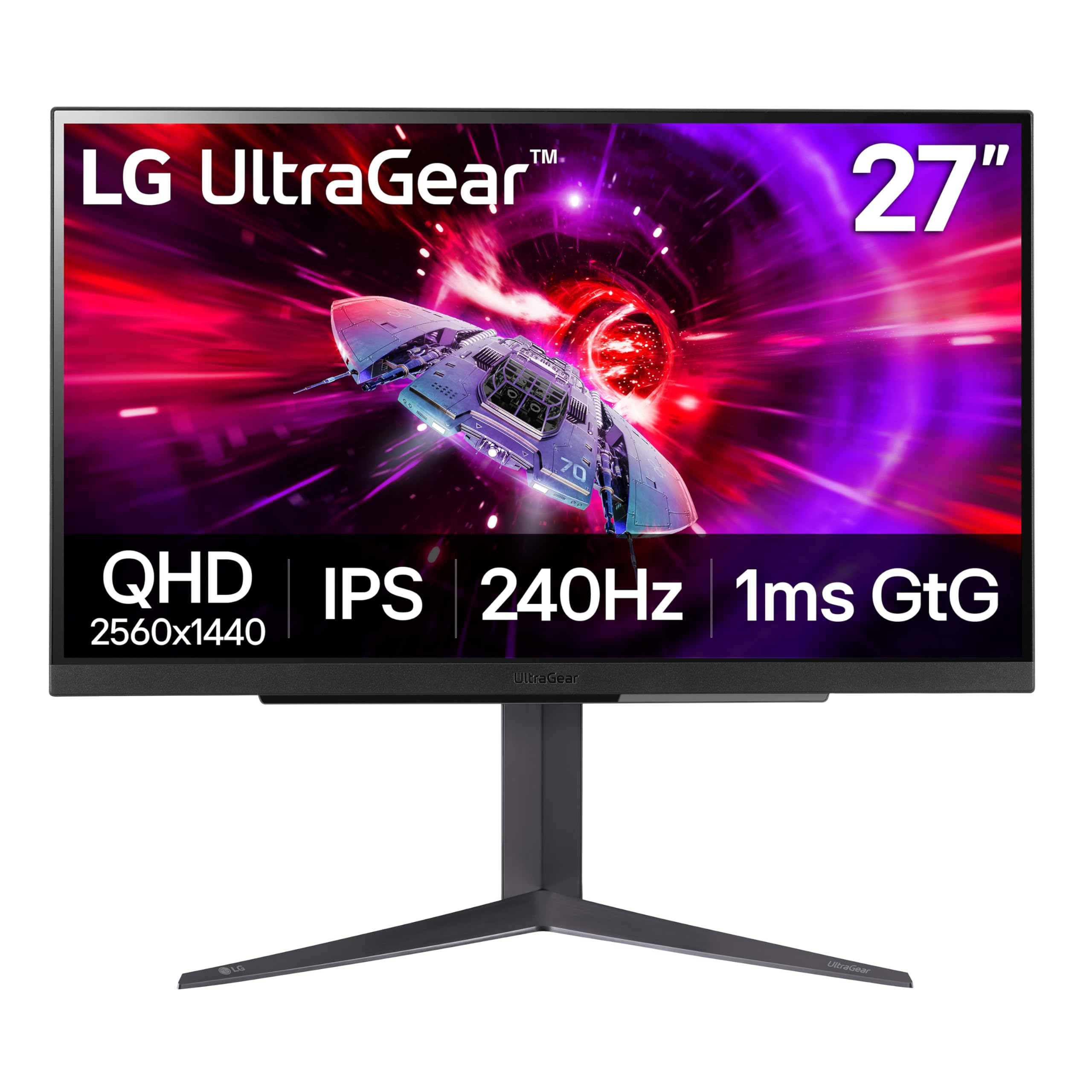
The LG 27GR83Q-B UltraGear is a budget-friendly 27-inch QHD IPS monitor that offers a 240Hz refresh rate and a 1ms GtG response time for a very competitive price. It supports both HDMI 2.1 and DisplayPort 1.4, making it one of the more future-proof options in the lower price tier for both PC and console gaming. The 95% DCI-P3 color gamut and VESA DisplayHDR 400 provide good color vibrancy and dynamic contrast for the price.
NVIDIA G-Sync Compatible and AMD FreeSync Premium validation ensure smooth tearing-free gameplay across a wide range of frame rates. The monitor includes features like Dynamic Action Sync for reduced input lag and Black Stabilizer for better visibility in dark scenes. The stand offers height, tilt, and pivot adjustments, though the movement is somewhat stiff.
Quality control reports mention the occasional stuck pixel, so it is wise to inspect the unit upon arrival. The IPS panel exhibits typical 1000:1 contrast, so black levels are grayish in a dark room. For the price, this monitor delivers the core competitive specs of high refresh rate and low response time without breaking the bank. It is a solid entry point for transitioning from 1080p 144Hz.
Why it’s great
- 240Hz QHD IPS with 1ms GtG for smooth competitive gameplay.
- HDMI 2.1 and DisplayPort 1.4 for modern PC and console support.
- G-Sync Compatible and FreeSync Premium for wide GPU support.
Good to know
- IPS contrast ratio results in grayish black levels in dark rooms.
- Some users have reported stuck pixel issues out of the box.
- Stand adjustments feel stiff and lack smooth operation.
11. CRUA 27″ 360Hz 2K Gaming Monitor

The CRUA 27-inch 360Hz monitor is the most affordable way to get a 1440p display at 360Hz, offering an aggressive price-to-spec ratio. The IPS panel covers 120% sRGB and supports a wide 178-degree viewing angle, delivering accurate colors for a budget monitor. It includes AMD FreeSync support to reduce screen tearing, though it lacks official G-Sync compatibility certification.
Connectivity includes HDMI 2.1 (limited to 144Hz at QHD) and DisplayPort 1.4 (required for the full 360Hz), plus built-in speakers and a 3.5mm audio jack. The stand is fully adjustable with height, tilt, swivel, and pivot support, which is uncommon at this price point. The tool-free snap-on bracket makes assembly quick and simple. RGB ambient lighting adds a gaming aesthetic.
Build quality is acceptable for the price, but the materials feel less premium than the competitors. The built-in speakers are weak and not suitable for serious gaming. Color uniformity may vary slightly across units. This monitor is a viable option for budget-constrained competitive players who prioritize high refresh rate and QHD resolution over brand name and premium build.
Why it’s great
- Lowest price entry point for a 360Hz QHD display.
- Fully ergonomic stand with tool-free assembly.
- IPS panel with 120% sRGB color coverage and 178° viewing angles.
Good to know
- No official G-Sync compatibility certification.
- Built-in speakers are weak and not recommended for gaming.
- Build quality and materials feel less premium than name brands.
FAQ
Is 240Hz enough for competitive gaming or do I need 360Hz?
Will QD-OLED burn in if I play the same game with a static HUD for hours?
Why do many esports pros still use 1080p monitors instead of 1440p?
Final Thoughts: The Verdict
For most users, the best competitive gaming monitor winner is the ASUS ROG Strix XG27ACDNG because it offers the ideal combination of 360Hz refresh rate, 0.03ms QD-OLED response, and robust burn-in warranty coverage for serious competitive play. If you want a higher refresh ceiling and have the GPU horsepower, grab the INNOCN GA27M1Q for its 500Hz QD-OLED panel. And for a budget-conscious entry into high-refresh gaming, nothing beats the value of the CRUA 27-inch 360Hz.

Mo Maruf
I created WellFizz to bridge the gap between vague wellness advice and actionable solutions. My mission is simple: to decode the research and give you practical tools you can actually use.
Beyond the data, I am a passionate traveler. I believe that stepping away from the screen to explore new environments is essential for mental clarity and physical vitality.