Our readers keep the lights on and my smoothie glass nicely filled. As an Amazon Associate, I earn from qualifying purchases.
Whether you are plotting a course through dense forest or trying to pinpoint your location on a topo map, a reliable compass for orienteering separates a confident route from a guess. The wrong tool introduces errors in bearing readings that compound with every step, turning a simple navigation exercise into a frustrating search for landmarks. You need a baseplate or sighting compass that balances readability, weight, and mechanical precision for real map-and-compass work.
I’m Mohammad Maruf — the founder and writer behind WellFizz. I have spent hundreds of hours cross-referencing customer field reports, declination adjustment mechanisms, needle damping speeds, and the real-world durability of these navigational instruments to build this guide for serious outdoor enthusiasts.
This guide ranks the most capable models by their bearing accuracy, sighting design, and low-light usability to help you find the best compass for orienteering that fits how you actually navigate terrain.
How To Choose The Best Compass For Orienteering
Orienteering demands a compass that offers more than just a magnetic needle. You need precise reference points for taking bearings from a map and accurate declination compensation to correct for the difference between magnetic north and true north. The right choice depends on your typical terrain, whether you compete on a marked course or navigate wilderness off-trail.
Sighting Method: Baseplate vs. Mirror vs. Lensatic
A standard baseplate compass works fine for quick bearings on open trails. For orienteering, a mirror sighting compass allows you to simultaneously sight a distant landmark and read the bearing on the capsule, which eliminates the parallax errors common with basic baseplate models. Lensatic compasses, with their wire-and-slit sighting system, offer the highest precision for long-distance bearings but are less convenient for map plotting due to the absence of a transparent baseplate.
Adjustable Declination
Fixed declination sets your compass to one geographic region. An adjustable declination mechanism lets you dial in the local magnetic variation, removing the need to add or subtract degrees manually every time you take a bearing. For serious orienteering, this feature saves critical seconds and prevents mental math errors.
Needle Damping and Stability
Liquid-filled capsules dampen needle oscillation so the bearing settles quickly. In cold conditions, a thinner damping fluid or a high-quality sapphire jewel bearing keeps the needle responsive. A needle that takes more than three seconds to stop is a liability when you need a fast bearing on a monitored course.
Quick Comparison
On smaller screens, swipe sideways to see the full table.
| Model | Category | Best For | Key Spec | Amazon |
|---|---|---|---|---|
| Silva Ranger 2.0 | Premium Baseplate | Instruction & field accuracy | Mirror sight, 1:24k scale | Amazon |
| Suunto MC-2 NH | Premium Mirror | Precision bearings & emergency signaling | Mirror sight, jewel bearing | Amazon |
| Silva Expedition S | Premium Expedition | Night navigation & avalanche assessment | Full luminous, slope card | Amazon |
| Sun Company ProSight | Mid-Range Sighting | Budget mirror compass with declination | Adjustable declination, clinometer | Amazon |
| Silva Explorer PRO | Mid-Range Baseplate | Daytime map work & slope measurement | Multiple scales, slope card | Amazon |
| Suunto A-30 | Entry-Level | Lightweight hiking & basic orienteering | Compact, luminescent markings | Amazon |
| Cammenga Model 27 | Military Lensatic | Rugged terrain & extreme conditions | Phosphorescent, aluminum | Amazon |
In‑Depth Reviews
1. Silva Ranger 2.0 Compass

The Silva Ranger 2.0 is the benchmark for orienteering instruction and field navigation. Its mirror sighting system eliminates parallax error by letting you see the capsule and your target simultaneously, and the built-in declination adjuster keeps your bearings true without mental math. The baseplate includes USGS 1:24k, 1:25k, 1:50k, and GPS scales, plus a slope card for measuring gradient and extra distance.
Users consistently praise the hot-stamped markings that do not rub off, the DryFlex rubber grip that prevents slipping in wet hands, and the breakaway safety lanyard that doubles as a declination adjustment key. The capsule dampens the needle quickly and the clinometer is intuitive for measuring hillside angles. At about 86 grams, it remains light enough for long course days.
The luminous markings are limited to the needle and two reference points, which means night navigation requires a headlamp. Some users note the plastic feels less substantial compared to older Swedish-made Silva models, though the durability track record remains excellent with instructors reporting decades of use.
Why it’s great
- Mirror eliminates bearing parallax error
- Includes 1:24k USGS and 1:50k map scales
- Hot-stamped markings resist wear
- Easy-to-use declination adjuster
Good to know
- Luminous markings are weak on the needle
- Plastic feels lighter than older models
- Lanyard could be more secure
2. Suunto MC-2 NH Compass

The Suunto MC-2 NH is a mirror sighting compass built for precision bearing work in challenging terrain. Its integrated mirror not only facilitates accurate aiming but also doubles as an emergency signaling reflector. The liquid-filled capsule with a high-grade steel needle and jewel bearing delivers smooth, stable readings across a wide temperature range without sticking.
The included clinometer measures slope gradients and elevation changes, which is essential for mountaineering and backcountry exploration. The detachable snap-lock lanyard keeps the compass secure while moving but releases quickly for map work. Bright luminescent markings on the bezel and needle make low-light readings possible.
One notable design choice is the quadrant bezel system that displays bearings as 30° SE instead of 150°. Experienced navigators find this intuitive, but newcomers will need mental conversion. The clinometer mechanism has been described as imprecise by some users, giving only a rough slope estimate rather than a precise measurement.
Why it’s great
- Accurate jewel bearing needle with fast damping
- Mirror usable for signaling in emergencies
- Sturdy build with rubber grip zones
- Good low-light visibility on bezel markings
Good to know
- Quadrant bezel requires mental conversion for azimuth users
- Clinometer is only accurate for rough estimates
- Protective film on mirror must be removed manually
3. Silva Expedition S Compass

The Silva Expedition S is purpose-built for navigation in low-light and winter conditions. Every critical marking — bezel, capsule, and travel arrow — has enhanced luminous pigment that stays visible for up to four hours after charging with a flashlight or daylight. The Dryflex housing and silicone rubber feet keep the baseplate stable on wet maps.
Beyond standard orienteering scales (1:24k, 1:25k, 1:50k), the Expedition S includes a slope card for calculating avalanche risk and determining the difficulty of a climb. The mirror sighting system features a 45-degree angle assist for taking bearings on steep slopes. The scale lanyard is soft and bendable, allowing you to place the scale directly on your map route.
At only 86 grams, the Expedition S is lightweight for a full-featured mirror compass. The clinometer is intuitive for slope measurement. Some users report that the luminous charge on the needle is initially very bright but fades faster than the bezel markings, so expect to re-charge it before a critical night bearing.
Why it’s great
- Full luminous markings for night navigation
- Slope card for avalanche risk calculation
- 45-degree mirror assist for steep bearings
- Waterproof and shockproof construction
Good to know
- Needle luminous charge fades faster than bezel
- Black model has limited glow bits on needle
- Packaging mix-ups reported with Silva Ranger
4. Sun Company ProSight Sighting Map Compass

The Sun Company ProSight delivers adjustable declination, a sighting mirror, and a clinometer at a price point that undercuts established Scandinavian brands without sacrificing core features. The rotating bezel is ultra-luminous, making this one of the brightest budget-friendly compasses for low-light orienteering. The protective cover keeps the mirror safe in a pack and opens to a full-sized sight.
The baseplate includes four map scales (1:24k, 1:25k, 1:50k, 1:100k), inch and millimeter rulers, a 3X magnifying lens, and silicone anti-slip foot pads. The breakaway safety lanyard adds peace of mind when bushwhacking. Users consistently note that the declination adjustment is easy to set and stays locked in place during use.
The clinometer works for measuring landmark height but can interfere with the needle if the compass is not held perfectly level. The declination screw is easy to turn but can be accidentally unset if pressed against gear. Despite these minor quirks, the ProSight offers excellent value for orienteers who want mirror precision without paying premium prices.
Why it’s great
- Bright luminous markings rival pricier models
- Easy-to-set adjustable declination
- Includes clinometer for height measurement
- Breakaway lanyard and 5-year warranty
Good to know
- Declination screw can be accidentally unset
- Clinometer may interfere with needle if not level
- Made in Taiwan, not Europe
5. Silva Explorer PRO Compass

The Silva Explorer PRO is a no-frills baseplate compass optimized for daytime map work with a rich set of integrated tools. The baseplate includes 1:24k, 1:25k, 1:40k, and 1:50k scales along with a dedicated slope card for measuring gradient and extra distance. The built-in adjustable declination mechanism removes the guesswork from magnetic variation correction.
The DryFlex rubber grip provides a secure hold even with wet or gloved hands, and the magnifying lens is positioned for easy precision map reading. The luminous markings on the bezel and travel arrow are functional for dusk conditions but are not bright enough for full night navigation without an external light source. The capsule dampens well and the needle settles fast.
One limitation is that only the needle and two small reference dots on the baseplate are luminous, while the bezel ring itself lacks glow pigment. The degree markings on the lower bezel ring are printed small and can be hard to read in dim light. For daytime orienteering courses and recreational map-and-compass use, however, the Explorer PRO is a capable and accurate tool.
Why it’s great
- Clean, easy-to-read daytime markings
- Adjustable declination with large adjustment wheel
- Slope card for measuring gradient
- Sturdy construction with rubber grip
Good to know
- Limited luminous coverage on bezel
- Small degree markings on lower ring
- Needle luminous pigment is dim
6. Suunto A-30 Compass

The Suunto A-30 is a compact baseplate compass that punches above its size for orienteering fundamentals. Measuring only 4.5 inches long, it fits easily in a pocket or map case without weighing you down. The high-grade steel needle with jewel bearing provides accurate readings, and the liquid-filled capsule stabilizes the needle quickly for fast bearings.
Luminescent markings on the cardinal points and bezel make it usable from dusk through early night, and the magnifying lens aids in reading fine topo map details. The transparent baseplate features metric scales and a fixed declination suited for the Northern Hemisphere. Users frequently describe it as their go-to compass for day hikes and basic orienteering courses.
The thin red print on the baseplate is difficult to read without a white background, which can lead to declination errors if you are trying to use the printed guide. The fixed declination limits its utility if you travel between regions with different magnetic variations. For lightweight orienteering within a single zone, however, the A-30 is a reliable companion.
Why it’s great
- Lightweight and packable design
- Bright luminous markings on bezel
- Fast-dampening needle for quick bearings
- Trusted Suunto build quality
Good to know
- Red baseplate print is hard to read
- Fixed declination, not adjustable
- No mirror or sighting system
7. Cammenga Model 27 Lensatic Compass
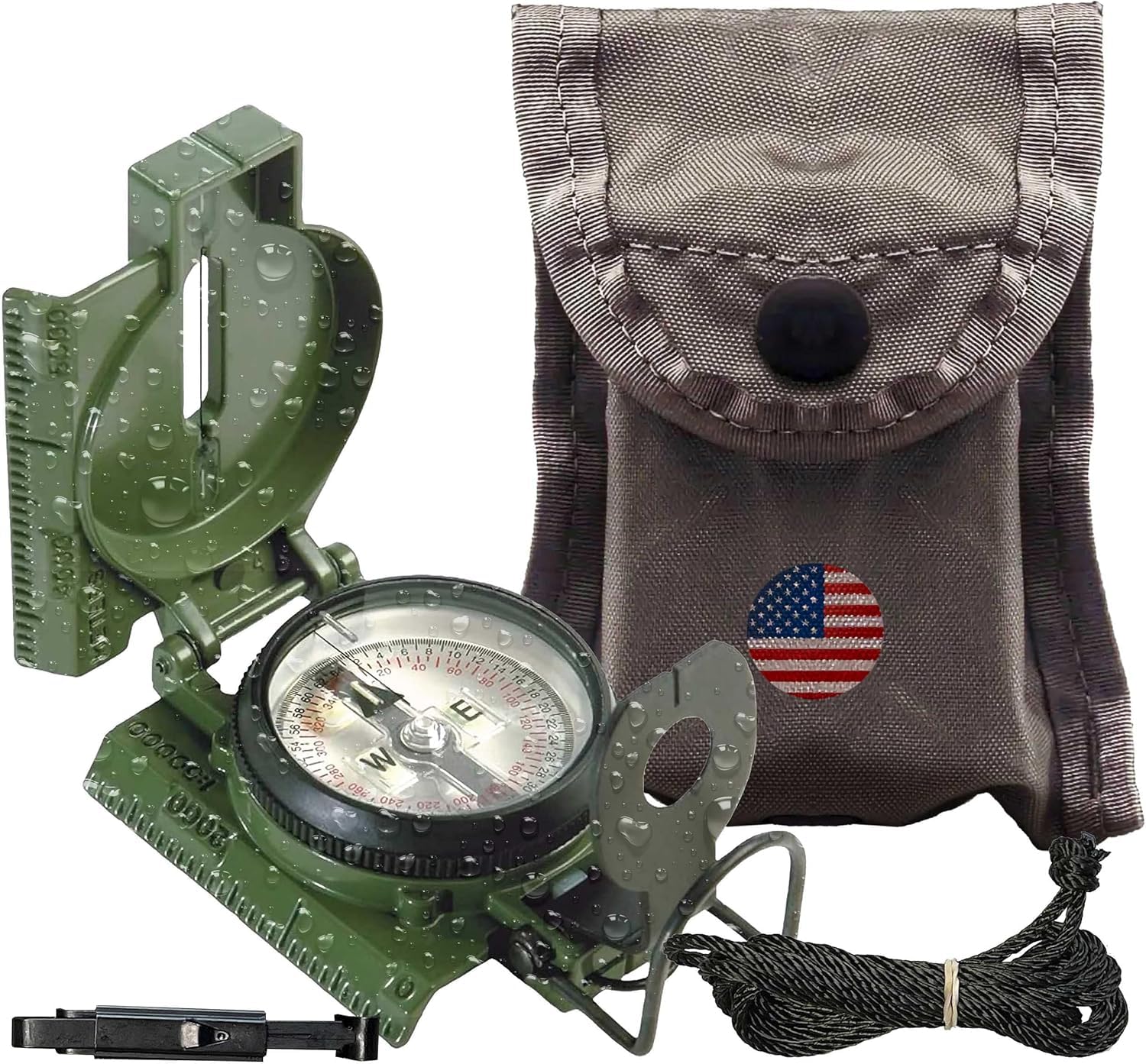
The Cammenga Model 27 is the only lensatic compass on this list, built to withstand extreme punishment thanks to its aluminum frame and shockproof, sandproof, and waterproof construction. Unlike a baseplate compass, the lensatic system uses a magnifying lens and sighting wire for pinpoint accuracy over long distances, making it the preferred choice for military field navigation and search-and-rescue operations.
The phosphorescent markings glow brightly after a short charge and remain visible for hours, offering a practical alternative to tritium-filled models that lose brightness over a decade. The 1:50,000 scale is standard for military topo maps, and the tactile 3-degree clicks on the bezel allow you to set bearings by feel in complete darkness. The included waterproof pouch protects the compass when not in use.
The lensatic design is less convenient for map plotting because there is no transparent baseplate to align with grid lines. You will need a separate protractor for precise map work. The hinge on the cover can be extremely tight at first, requiring some break-in. Proper sighting technique is critical for accuracy, so beginners should practice before relying on it for a course.
Why it’s great
- Nearly indestructible aluminum construction
- Phosphorescent glow lasts hours without tritium
- Tactile bezel clicks for blind operation
- Made in the USA
Good to know
- No baseplate for quick map work
- Requires separate protractor for plotting
- Tight cover hinge needs breaking in
FAQ
What does adjustable declination mean for orienteering?
Should I choose a baseplate or a mirror compass for orienteering?
How often do I need to reset the declination on my compass?
Can I use a lensatic compass for map work?
Final Thoughts: The Verdict
For most users, the best compass for orienteering winner is the Silva Ranger 2.0 because its mirror sighting system, adjustable declination, and wide range of map scales cover every requirement from instruction to wilderness navigation. If you want the brightest low-light performance for winter or night courses, grab the Silva Expedition S. And for extreme durability and long-distance bearing precision, nothing beats the Cammenga Model 27 lensatic compass.

Mo Maruf
I created WellFizz to bridge the gap between vague wellness advice and actionable solutions. My mission is simple: to decode the research and give you practical tools you can actually use.
Beyond the data, I am a passionate traveler. I believe that stepping away from the screen to explore new environments is essential for mental clarity and physical vitality.