Our readers keep the lights on and my smoothie glass nicely filled. As an Amazon Associate, I earn from qualifying purchases.
Specs are compiled from manufacturer listings and verified buyer reviews and can change over time — please confirm the key details on the product page before buying.
You need a compass that helps you read a map, not just follow a glowing dot. That means a tool that points north reliably, lets you set declination (the angle between magnetic north and true north on your map), and takes accurate bearings without constant fiddling. This guide compares seven compasses using their published specs and what actual buyers report, so you can pick one you trust before the trail gets fuzzy.
I’m Mohammad Maruf — the founder and writer behind WellFizz. This guide is built by comparing the manufacturers’ published specifications and the patterns across verified customer reviews, so you get each pick’s real strengths and trade-offs instead of marketing spin.
Whether you are planning a weekend hike or serious backcountry orienteering, what matters is a compass that holds its accuracy, adjusts easily to your local declination, and has a clear sighting system. This breakdown of the compass for land navigation will help you find the right match for your skill level and budget.
Our Picks at a Glance


How To Choose The Best Compass For Land Navigation
A compass for land navigation needs to do more than just point north. You rely on it to set a bearing on a map, walk that line in the woods, and get back if the trail disappears. The features that separate a useful tool from a frustrating one are specific and measurable.
Adjustable Declination Is Essential
Magnetic north and the north on your map are rarely the same. The difference is called declination. A compass with an adjustable declination setting lets you offset this difference permanently, so every bearing you take is automatically corrected. Without it, you have to add or subtract degrees in your head on every reading, which is where mistakes happen.
Baseplate vs. Lensatic Design
A baseplate compass has a clear, flat bottom that sits directly on your map, making it easy to plot bearings and measure distances with the printed scales. A lensatic compass, like the classic military design, uses a magnifying lens and a sighting wire for very precise aiming at a distant landmark. Baseplate compasses are better for map work; lensatic compasses excel at taking fast, accurate bearings on a visible target.
A Sighting Mirror or Lens For Accuracy
To take a bearing, you need to look at a distant landmark and read the compass dial at the same time. A sighting mirror lets you see the landmark and the dial together in one view, which eliminates parallax error. A lensatic system uses a wire and a magnifying lens for the same purpose. Without a sighting system, you just hold the compass in front of you and guess.
Needle Dampening and Global Use
A needle that swings wildly and takes several seconds to settle is a distraction. Good compasses use a liquid-filled capsule to dampen the needle, making it settle quickly. A “global needle” is balanced so it works in both the northern and southern hemispheres, which matters if you travel across the equator.
Quick Comparison
| Model | Best For | Type | Weight | Declination | Amazon |
|---|---|---|---|---|---|
| SUUNTO MC-2★ Best Overall | All-around professional accuracy | Baseplate with mirror | 2.56 oz | Adjustable | Amazon |
| Pathfinder Sighting CompassBest Value | Best value teaching tool | Baseplate with mirror | 2.6 oz | Adjustable (twist-lock) | Amazon |
| Sun Company ProMap | Ultra-light map work | Baseplate (no mirror) | 0.04 kg (1.4 oz) | Scale only | Amazon |
| Sun Company ProSight | Budget mirror compass | Baseplate with mirror | 0.12 kg (4.2 oz) | Adjustable | Amazon |
| Silva Explorer PRO | Reliable daytime navigation | Baseplate (no mirror) | — | Adjustable | Amazon |
| Silva Ranger 2.0 | Professional mirror sighting | Baseplate with mirror | 3.0 oz (86 g) | Adjustable | Amazon |
| Cammenga Lensatic | Rugged military lensatic | Lensatic | 0.46 lb (7.4 oz) | Fixed | Amazon |
In‑Depth Reviews
1. SUUNTO MC-2 Compass
Our pick — over 4.5★ from 800+ verified ratings; the strongest balance of quality and price.
The professional’s choice for reliable accuracy in a compact, feature-rich baseplate mirror compass.
You get a compass that solves the two biggest annoyances in the field: holding it level and setting declination. The global needle (balanced for both hemispheres) swings smoothly and settles fast without needing you to keep the compass perfectly flat — a real help when you are standing on uneven ground. The built-in declination adjustment uses a micro screwdriver that stays put once you set it, so you are not re-zeroing every time you pull it out. Owners mention the mirror with top and bottom notches makes sighting bearings and even measuring altitude straightforward.
At 2.56 ounces, the SUUNTO MC-2 weighs nearly the same as the Pathfinder below (2.6 ounces), but customers note it feels more sturdy. One reviewer who upgraded from an older Silva noted the Suunto has no air bubbles in the liquid capsule. The clinometer (a tool for measuring the steepness of a slope) works well, and the luminescent markings help in low light. A few users expressed concern about performance below -15°F, but for most three-season navigation, this compass is tough to top.
What stands out
- Global needle reduces the need to hold the compass level
- Built-in declination adjustment stays locked
- Includes clinometer for measuring slope steepness
What to watch
- Some buyers worry about bubbles forming in extreme cold below -15°F
- Premium price compared to entry-level options
Reach for it: You want a versatile, do-it-all compass with professional features that you can rely on for years of hiking and orienteering.
Look elsewhere: If your budget is tight or you only need a basic compass for casual park walks, this is more tool than you need.
2. Pathfinder Sighting Compass
A feature-packed mirror compass that punches well above its price for scouts and beginners.
The Pathfinder packs almost every feature you would find on compasses costing three times as much. It includes easy twist-lock declination adjustment (buyers specifically call this out as “the right teaching compass”), a clear mirror for sighting, a 2-degree click bezel, a clinometer, a 3x magnifying lens, a survival whistle, and an LED light on the lanyard. The solid hinge on the mirror lid holds firmly in place, which matters when you are sighting a bearing one-handed.
At 4.3 inches long, the Pathfinder is longer than the SUUNTO MC-2 (3.9 inches), which makes the map scales and the luminous dial easier to read. Reviewers consistently mention the excellent value, with one buyer saying it is “a great compass loaded with ALL the features you’ll need.” The build is mostly plastic, so it is light at 2.6 ounces, but it feels durable enough for teaching orienteering to a whole team.
Loaded features
- Twist-lock declination adjustment that is easy to set and stays put
- Includes mirror, whistle, LED light, and magnifier
- Great price for a teaching or starter compass
Build notes
- Mostly plastic construction may not survive heavy abuse
- Not ideal for extreme professional field use
Grab it for: Scouts, orienteering teams, or anyone wanting a full-featured compass without spending a lot.
skip it if: You need a compass for daily professional use in harsh environments and want all-metal durability.
3. Sun Company ProMap Compass

An ultra-light baseplate compass that is easy to pack but demands steady hands.
At just 0.04 kilograms, this is lighter than the Sun Company ProSight (0.12 kilograms). That makes it the lightest compass in this lineup — ideal if you weigh every gram in your pack. It includes six measurement scales (miles and kilometers at various ratios), a rotating bezel with a declination scale, and a 3x magnifying lens for map reading. The break-away safety lanyard is a practical touch for keeping it accessible.
The catch is that this is a baseplate-only compass with no sighting mirror. One reviewer notes “it works ok, slower responses and MUST be pretty level” to get a good reading. Without a mirror or a lensatic system, you are squinting over the top to take a bearing, which introduces room for error. If you are a serious trekker, you want something with a faster settling needle and a sighting system.
Why it packs light
- Ultra-light at 0.04 kg, great for minimalist packing
- Six map scales for working with different map types
- Includes built-in magnifier for reading map symbols
Limitations
- No sighting mirror — less accurate for long-distance bearings
- Must be held very level; needle response is slow
Best for: Backpackers who want a lightweight backup compass or beginners practicing map work at a desk.
Not for: Orienteers or hikers who need precise bearings in uneven terrain.
4. Sun Company ProSight Compass

A mirror compass with a bright luminous dial that brings most Suunto features at a lower price.
One buyer sums it up: “Great compass, not made in China!” — it is made in Taiwan. This ProSight brings adjustable declination, a sighting mirror with a protective cover, a clinometer for measuring landmark height, a 3x magnifier, four map scales, and a silicone anti-slip foot pad onto the baseplate. The luminous rotating bezel charges quickly from daylight and stays very bright, according to multiple reviews, making it a strong choice for low-light navigation.
The downside is that the mirror is glass, which some reviewers point out could affect durability if dropped. A few reviewers also mention the declination setting can be accidentally unset if you twist the bezel carelessly. But for the price, this is a serious alternative to the SUUNTO MC-2 for anyone who wants a mirror compass without the premium cost.
Why it shines
- Very bright luminous markings for low-light use
- Includes mirror, clinometer, and anti-slip feet
- Adjustable declination stays set during normal use
Potential issues
- Glass mirror may crack if dropped on rocks
- Clinometer can interfere with needle if not held level
Pick it for: A cost-effective mirror compass with great illumination for pre-dawn or dusk hikes.
Consider another: If you need a completely bomb-proof compass for heavy field use and are worried about glass breaking.
5. Silva Explorer PRO Compass

A sturdy, no-mirror baseplate compass with excellent daytime reliability and a slope card.
Silva’s Explorer PRO stands out for its DryFlex rubber grip, which makes it easy to handle even with cold or wet hands. It has a built-in adjuster for magnetic declination, a magnifying lens for map work, and a slope card for measuring slope steepness and extra distance. The needle is well-dampened and settles quickly, and shoppers say it is accurate and reliable even in ferrous mountain terrains where some compasses get thrown off by magnetic rocks.
However, the luminosity is a weak point. One reviewer calls the North needle “very dim” and says it fades within two minutes, making night use poor without an external light source. Another notes the degree markings on the outer bezel are hard to read. If you mostly navigate in daylight, this is a strong, durable choice. For night navigation, the SUUNTO MC-2 or Sun Company ProSight are better options.
Daylight strengths
- DryFlex rubber grip provides confident handling in wet conditions
- Well-dampened needle settles fast for quick bearings
- Slope card helps measure extra distance on steep terrain
Nighttime weakness
- Luminous markings fade quickly, not reliable for night use
- No sighting mirror — less precise for long-distance aiming
Great for: Day hikers who want a reliable, comfortable compass with good grip and accurate bearings.
Not ideal if: You regularly navigate after dark or need a mirror for precise long-distance sighting.
6. Silva Ranger 2.0 Compass

The mirror compass instructors swear by for teaching accurate, parallax-free navigation.
Buyers consistently call the Silva Ranger 2.0 the gold standard for navigation classes. The large mirror eliminates parallax error (the shift in reading when you view the dial from an angle) when you sight a bearing, which is critical for beginners learning to trust their gear. Upgrades from the original include a breakaway lanyard with a declination adjustment key and a slope/avalanche card. The baseplate markings are hot-stamped, meaning they won’t rub off over time, and rubber feet on the bottom reduce sliding on the map.
One instructor notes this compass “likely lasts 30 years,” and the global compass works in both hemispheres. The weak point, according to some reviews, is the luminous markings — the needle can be undetectable in darkness, and the paint on the lid can wear off. The orange model has glow bits, while the black model does not. For most daytime navigation, this is a durable and intuitive tool.
Top-tier teaching tool
- Large mirror eliminates parallax error for precise bearings
- Hot-stamped markings are durable and won’t rub off
- Rubber feet and DryFlex grip for stable map handling
Areas to note
- Poor luminosity — needle is hard to see in full darkness
- Some buyers report plastic feels less premium than expected
Choose it for: Navigation courses, professional fieldwork, and anyone who wants a mirror compass built to last decades.
Think twice: If you need reliable glow-in-the-dark performance without carrying a headlamp.
7. Cammenga Lensatic Compass
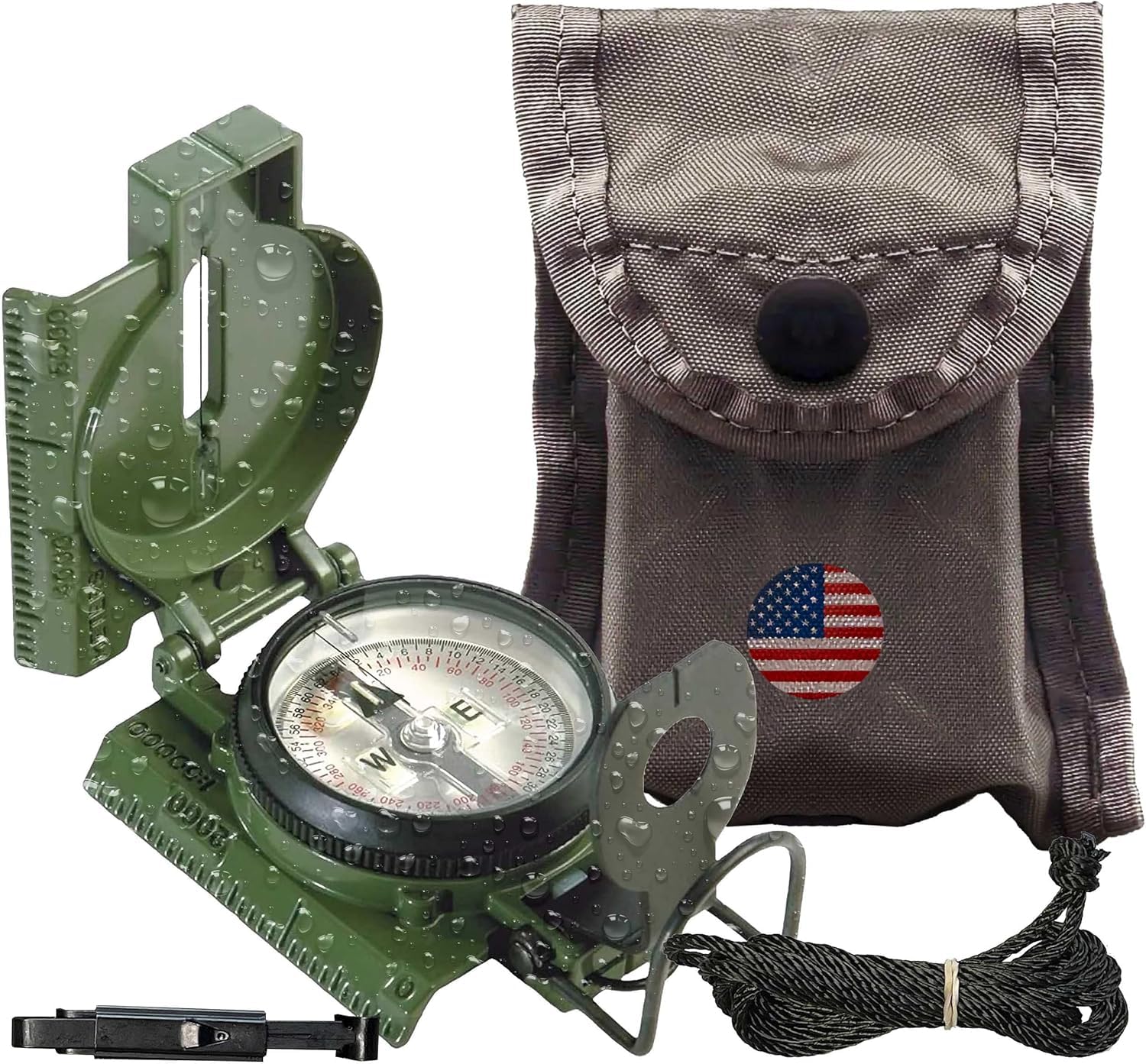
A shockproof, waterproof lensatic compass built to survive the toughest missions.
Unlike any other compass in this lineup, the Cammenga uses a precision lensatic sighting system — you hold it to your eye, line up the sighting wire, and read the bearing through a magnifying lens. This gives you pinpoint accuracy on a distant landmark that baseplate compasses cannot match. It is made in the USA with a rugged aluminum frame, is shockproof and waterproof, and comes with a waterproof pouch.
This is a heavy-duty tool at 0.46 pounds. It has no adjustable declination — you must do the math yourself or use it with a map that already accounts for local declination. Owners mention the phosphorescent markings need charging from an external light source (unlike the military tritium version), but for most users, that is not a dealbreaker. One reviewer wanted to ensure the cover hinge was loosened before first use because it was very tight.
Built for extremes
- Lensatic sighting system provides very precise long-distance bearings
- Aluminum frame is shockproof and waterproof
- Made in the USA to military standards
Trade-offs
- No adjustable declination — requires mental math for map work
- Heavier and bulkier than any baseplate compass here
Ideal for: Military-style navigation, extreme environments, or users who want a bomb-proof single-purpose sighting tool.
Not for: Map-and-compass work where quick declination adjustment is needed.
Understanding the Specs
Declination Adjustment
This is the mechanism that offsets the difference between magnetic north (where your compass points) and true north (the north on your map). An adjustable declination setting lets you dial in your local offset, so every bearing you take is automatically corrected. Without it, you have to manually add or subtract the declination angle every time, which leads to errors. All serious land navigation compasses have this feature.
Sighting System — Mirror vs. Lensatic
A sighting mirror lets you see a distant landmark and the compass dial in the same reflected view, giving you a very accurate bearing without parallax error. A lensatic system uses a magnifying lens and a sighting wire — you hold the compass to your eye and line up the wire on the target. Lensatic compasses are faster for getting a bearing on a visible object, while mirror compasses are more versatile for map work.
FAQ
Should I get a baseplate compass or a lensatic compass for land navigation?
What is adjustable declination and why does it matter?
How do I know what declination to set on my compass?
What does a sighting mirror on a compass do?
What is a global needle?
How heavy should a good land navigation compass be?
Can a compass form bubbles in extreme cold?
What is the difference between a clinometer and a slope card?
Final Thoughts: The Verdict
For most buyers, the compass for land navigation winner is the SUUNTO MC-2 because it combines a global needle, reliable declination adjustment, a mirror sighting system, and a clinometer in a compact and durable package that pros trust. If you want a budget-friendly mirror compass with great low-light visibility, grab the Sun Company ProSight. And for a bomb-proof lensatic compass built for extreme conditions, the Cammenga Lensatic Compass is the one to pick.
How We Picked
We do not accept paid placement. Every pick is matched to a real buyer and a real use-case; we do not hands-on test units.
Sources & Methodology
Specifications: manufacturer listings and product documentation. Review insights: verified customer reviews, as of July 2026. Pricing: not shown on this page (it changes often); check the current price via the retailer link.
As an Amazon Associate, WellFizz earns from qualifying purchases. This does not affect which products we feature.
Related Guides

Mo Maruf
I created WellFizz to bridge the gap between vague wellness advice and actionable solutions. My mission is simple: to decode the research and give you practical tools you can actually use.
Beyond the data, I am a passionate traveler. I believe that stepping away from the screen to explore new environments is essential for mental clarity and physical vitality.