Our readers keep the lights on and my smoothie glass nicely filled. As an Amazon Associate, I earn from qualifying purchases.
Specs are compiled from manufacturer listings and verified buyer reviews and can change over time — please confirm the key details on the product page before buying.
Picking your first compass is a lot like picking a map app — you want a tool that simply tells you where north is, without a manual the size of a novel. The problem is that most beginner guides throw every possible spec at you at once, mixing up “declination,” “bearing,” and “clinometer” until you stop reading. This guide strips that noise away.
I’m Mohammad Maruf — the founder and writer behind WellFizz. This guide is built by comparing the manufacturers’ published specifications and the patterns across verified customer reviews, so you get each pick’s real strengths and trade-offs instead of marketing spin.
After looking through dozens of choices, I settled on nine models that a true beginner can actually learn on. These are the exact compasses that get the job done without wrecking your budget, and this guide makes it simple to find your compass for beginners with no confusion.
Our Picks at a Glance


How To Choose The Best Compass For Beginners
Most first-time compass buyers pick the one that looks toughest — all metal, heavy, military-style. That is almost always the wrong move. For learning, you want a transparent baseplate compass (the kind you can place flat on a map) because it lets you see the map underneath and actually practice taking a bearing. A heavy metal body blocks your view and makes it much harder to learn the basics.
Start With A Baseplate Compass
A baseplate compass (also called an orienteering compass) is a rectangle of clear acrylic with a liquid-filled capsule in the middle. The see-through plate is what lets you line up your map with north. Without a clear baseplate, you are just waving a pointer around — you never learn how a bearing transfers from the map to the ground. Every pick on this list either has a transparent baseplate or a mirror-sighting window that sits on a clear plate.
Declination Adjustment Matters More Than You Think
Declination is the difference between magnetic north (where the needle points) and true north (the top of your map). In some parts of the US that gap runs 10 degrees or more — enough to send you a mile off course in 6 miles. An adjustable declination dial lets you set that offset once and forget it. A beginner compass without this feature forces you to do math in your head, which is exactly how people get lost. Most picks on this list include it, and the few that skip it are noted honestly.
Luminous Paint Keeps You From Fumbling
A dial that glows after you charge it with a flashlight or sunlight buys you two things: you can shoot a bearing at dusk, and you do not need to dig a headlamp out in the middle of a night navigation. A few compasses here pull up to 4 hours of glow from a short light soak. That matters if your hike runs late or you are learning night orienteering with a group.
A Sighting Mirror Helps Accuracy Instantly
A mirror compass includes a small folding mirror with a notch at the top. When you hold the compass at eye level, you see both your target (through the notch) and the compass dial (reflected in the mirror) at the same time. This massively improves your bearing accuracy because you are aiming at a distant landmark, not guessing past the edge of the plastic. Mirror compasses cost a little more, but beginner shooters hit their bearings on the first try far more often with a mirror than without.
Quick Comparison
| Model | Best For | Baseplate | Adjustable Declination | Sighting Mirror | Amazon |
|---|---|---|---|---|---|
| SUUNTO A-30★ Best Overall | Reliable, simple navigation | Yes | No | No | Amazon |
| INMAKER CompassBest Value | Budget-friendly metal body | No | No | Yes (prism) | Amazon |
| TurnOnSport Boy ScoutLearning Pick | Learning mirror sighting | Yes | Yes | Yes | Amazon |
| Pathfinder Sighting Compass | Scout multi-tool | Yes | Yes | Yes | Amazon |
| Sun Company ProMap | Ultra-light map work | Yes | Scale only | No | Amazon |
| Silva Starter 1-2-3 | Scout group training | Yes | No | No | Amazon |
| HKDiRedy Compass | Rugged kids/ beginner | No | Yes (bezel) | No | Amazon |
| Silva Explorer 2.0 | Night hiking | Yes | No | No | Amazon |
| Sun Company ProSight | Full-featured learning | Yes | Yes | Yes | Amazon |
In‑Depth Reviews
1. SUUNTO A-30 Compass
Our pick — over 4.5★ from 750+ verified ratings; the strongest balance of quality and price.
The crowd-favorite clear winner that is simple, accurate, and built by a trusted brand.
If you only buy one compass, this is the one. The SUUNTO A-30 is a classic baseplate compass that gets everything right: a high-grade steel needle rides on a jewel bearing (a tiny sapphire pivot that reduces friction so the needle settles fast), the transparent baseplate has metric scales and a magnifying lens for reading map details, and the markings glow after light exposure so you can still navigate at dusk. It measures 4.49 inches long and 2.4 inches wide — small enough to tuck into a shirt pocket or pin to a backpack strap.
The thing the owner community raves about — mentioned over 130 times — is its sheer build quality. Reviewers call it solid, sturdy, and simple to use. Repeat buyers report buying a second one for a spouse or for their orienteering kit. The few criticisms are honest: the red print on the capsule is thin and hard to read against a dark background (you need white paper underneath), and the declination is fixed, not adjustable. That means you need to account for magnetic north offset using a map marker or mental math, which is fine for a beginner learning the ropes but worth knowing before you buy. The overall consensus from a massive user base is clear.
Go for the SUUNTO A-30 if you want a rock-solid, straightforward compass that will last through seasons of hiking, school orienteering, and lazy map lunches. It does not have a sighting mirror or a survival whistle, so if you want a multi-tool, look further down the list.
What Wins People Over
- Rock-solid build quality that owners praise for its stability and feel.
- Multiple map scales (metric) for accurate measuring on different map types.
- Luminous markings — charge them with a flashlight and they stay visible during a late hike.
The Honest Trade-Offs
- Red print on the dial is thin and hard to read unless you have light behind the base.
- Fixed declination means you must calculate the magnetic offset yourself or skip it.
Reach for this if: you want a straight-ahead, no-batteries navigation tool that just works and is built to last.
Think twice if: you need an adjustable declination dial for accurate map navigation in high-offset areas.
2. INMAKER Compass Hiking with Whistle
A heavy-duty military-style compass that feels expensive but costs far less than a nice dinner.
The INMAKER Compass is a different breed from the baseplate designs above. It is made from heavy-duty die-cast zinc alloy (a dense metal that resists corrosion and impacts) and fits in your hand like a small, solid puck. The liquid-filled capsule is vacuum-sealed so the 360-degree dial stays stable and never tilts, which means a steady reading even if your hand shakes on a rocky ridge. Key features include a sighting line, a magnifier viewer, a tripod mount hole on the bottom, a reading eyepiece, a slope ratio chart, and an adjustable prism for precise aiming.
Owners are surprised at the quality for the money — the phrase “exceeded my expectations” shows up repeatedly. The metal whistle hits 120 decibels (loud enough to alert a group from a distance), and the reflective lanyard helps you spot the compass on a dark car seat. The main gap: this compass has no transparent baseplate, so you cannot lay it flat on a map to measure a bearing the standard way. It is a lensatic-style compass, which is great for sighting a distant landmark but less intuitive for learning map-and-compass navigation from scratch. Buyers also note there are no beginner instructions — you need to already know how to use a prism or figure it out.
Pick the INMAKER if you want a rugged, go-anywhere compass that lives in your bug-out bag or glovebox. skip it if your first goal is learning to plot bearings on a paper map — the SUUNTO A-30 or a baseplate compass is a better teacher.
Why It Stands Out
- Heavy die-cast zinc alloy body that feels premium and survives drops.
- Comprehensive kit: 120 dB whistle, reflective lanyard, and tripod mount.
- Liquid-filled capsule with a stable, quick-to-settle dial.
What It Lacks
- No transparent baseplate — you cannot lay it on a map.
- No beginner instructions; you need to know how to use a prism sight.
Who this fits: the outdoor enthusiast who wants a tough, pocketable compass for general direction-finding and survival preparedness.
Who should pass: anyone who wants to learn map-and-compass navigation with a transparent baseplate.
3. TurnOnSport Boy Scout Sighting Compass
The budget mirror compass that teaches you real sighting technique without the premium price tag.
The Boy Scout Sighting Compass from TurnOnSport packs a sighting mirror, adjustable declination, a clinometer, and a global needle into a package that measures 4.1 inches by 2.5 inches. The mirror folds open at a 45-degree angle, letting you see both your distant target through the notch and the compass dial in the reflection. That technique alone cuts bearing error almost to zero for a novice. The declination dial adjusts via a worm screw (a fine-thread gear that holds your setting stable), so you set the local magnetic offset once and then shoot bearings directly on the map.
Reviewers call it an excellent value — better quality than most compasses in its price range, with features you usually see on models costing much more. The acrylic baseplate is clear and has both 1:24,000 and 1:50,000 map scales (the standard USGS topographic map scales). The bezel felt stiff to a few owners at first but loosens up after a few rotations. The mirror quality gets mixed notes: it works fine for sighting but is not optically perfect. The biggest practical complaint is there is no dedicated storage slot for the tiny declination adjustment key — several people simply taped it to the lanyard.
This is the compass to grab if you are a Scout leader, an orienteering instructor, or a parent teaching their child how to navigate with a map. It is also a perfect second compass for an experienced hiker who wants a lightweight backup that still dials in declination.
Core strength: an adjustable declination mirror compass that functions at the same level as compasses two or three times its price, pairing a sighting mirror with a global needle that works in both hemispheres.
The catch: the mirror is not high-end glass, and the adjustment key has nowhere convenient to live on the body.
4. Outdoor Guardian Pathfinder Sighting Compass

An all-in-one navigation kit with a mirror, a whistle, and an LED so you are never left in the dark.
The Pathfinder Compass is the Swiss Army knife of beginner compasses. It combines a sighting mirror, an adjustable declination dial, a clinometer (for measuring the height of a tree or the steepness of a slope), a 3x magnifying lens, 6 measurement scales on the baseplate, an emergency survival whistle, and a small LED light on the lanyard. The global needle works correctly in both the northern and southern hemispheres, and the luminous dial keeps you reading bearings in low light after a quick charge. It weighs 2.6 ounces and measures 4.3 inches by 2.5 inches.
Orienteering teams and Scout groups are the biggest fans — the feedback emphasizes that the quality is high and the price is excellent considering the feature set. The declination adjustment uses a simple twist-and-lock mechanism that holds its setting even when bouncing inside a pack. The bezel clicks in 2-degree increments, which is precise enough for practical navigation. The only recurring downside is the whistle, which some find less loud than expected, and a rare report that the LED stopped working after a few uses. The mirror itself is clear and well-hinged. Considering the number of features packed in, this holds up as a solid traveler.
Grab the Pathfinder if you want one device that covers navigation, signaling, and measurement — great for Scout camping trips, wilderness training, or as a gifts-for-adventurers choice. It leans plastic on the body, so if you demand metal construction, the INMAKER above is a stiffer (but less feature-rich) alternative.
Feature depth: adjustable declination with 2-degree click bezel, sighting mirror, clinometer, 6 map scales, magnifying lens, LED light, and whistle — everything a new navigator needs in one compact package.
Materials reality: the body is mostly plastic, which keeps weight down but does not feel as rugged as a full-metal compass.
5. Sun Company ProMap Compass

A featherlight baseplate compass so easy to carry you will forget it is there until you need it.
At just 1.3 ounces (36 grams), the Sun Company ProMap is the lightweight champion of this list. It is a clear acrylic baseplate compass with a rotating bezel, a declination scale (a printed reference for setting the magnetic offset — not a dial you turn, but a printed guide), a 3x magnifying lens built into the plate, and six measurement scales. The scales include miles at 1:24,000 and 1:62,500 and kilometers at 1:25,000 and 1:50,000, which covers almost every USGS topo map you will encounter. A break-away safety lanyard is included so the compass rips free if it snags on a branch.
Owners praise this as a “perfect starter compass” that is smooth and accurate. It works well with US Military maps, and several people use it for orienteering and Feng Shui measurement alike. The main caution in the reviews is that it must be held perfectly level to get a stable reading — the needle response slows down if you tilt it, so you cannot take quick bearings while running. A few owners note the plastic feels a bit thin compared to a Suunto, but at this weight and price that trade-off is expected.
This is the compass to throw in a summit pack or keep as a lightweight spare. It does not have a sighting mirror or a clinometer, so it is pure map-and-compass navigation — no frills, just accurate basics at half the weight of most competitors.
Where It Shines
- Ultralight 1.3 oz (36 g) — barely noticeable in a pack.
- Six map scales cover USGS, military, and metric maps.
- Built-in 3x magnifying lens for reading fine map details.
Where It Falls Short
- Slow needle response — must be very level to get a quick reading.
- No adjustable declination dial (printed scale only).
Best for: the ultralight backpacker or hiker who wants a map tool, not a survival kit.
pass on it if: you need a quick, tilt-tolerant compass for running orienteering or rough terrain.
6. Silva Starter 1-2-3 Compass

A no-fuss baseplate compass that keeps the whole map visible and the instruction simple.
The Silva Starter 1-2-3 is exactly what its name promises: the entry-level compass that “just works” according to the owner base. It is a classic clear baseplate design with a liquid-filled capsule, a turnable housing (the rotating ring that sets your bearing), and both millimeter and inch rulers along the edges for map measurement. It comes with a detachable, safety-release lanyard. The map scales are 1:25,000 and 1:50,000, which covers the most common topographic maps. The dimensions are 6 inches long by 2 inches wide.
The crowd loves this one for group use — Scout troops, schools, and orienteering clubs buy them in multiples. The feedback highlights that it is accurate, easy to read, and has survived rain, mud, and heat without issues. The big missing feature is adjustable declination. The compass has a non-adjustable capsule, so you either do the math yourself or write the local offset on a piece of tape stuck to the base. Some owners actually prefer this because it removes a dial they could accidentally spin. The build quality scores high across the board, and the limited 2-year warranty gives some confidence.
Grab the Silva Starter 1-2-3 if you are buying compasses for a group — classroom sets, Scout troops, or kids’ outdoor programs. It is simple enough that a young beginner can learn the three steps of taking a bearing without getting distracted by extra dials. Pass on it if you want a compass that accounts for magnetic offset without pencil-and-paper math.
Simplicity champion: a clear, waterproof baseplate with a turnable housing and no extra gadgets — just the needle and the map.
The missing feature: no declination adjustment; you must calculate the offset with a mental or written note.
7. HKDiRedy Compass Hiking Survival
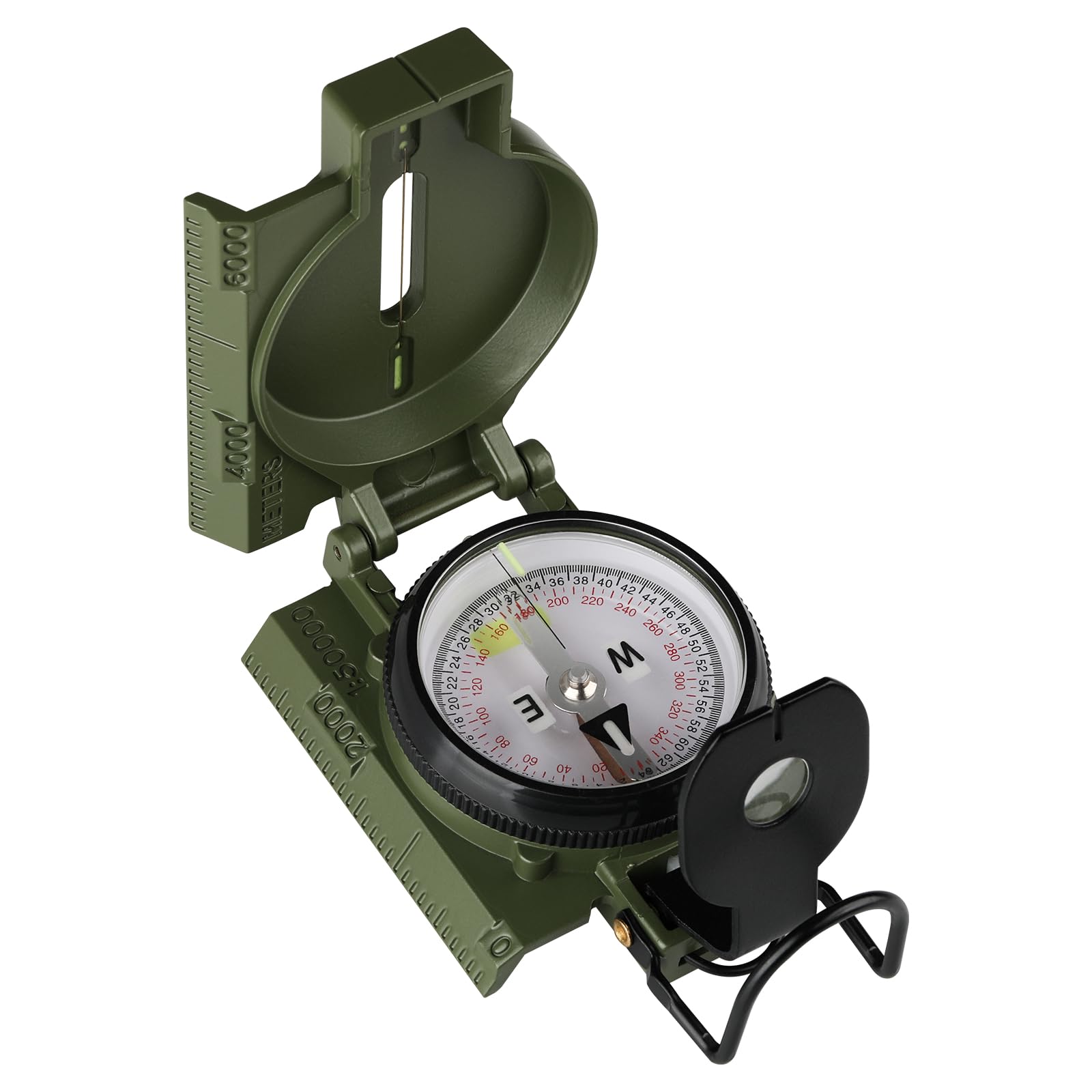
A machined aluminum body that survives drops where plastic compasses would crack.
The HKDiRedy Compass is built for abuse. It is machined from high-strength aluminum alloy with a scratch-resistant anodized finish, making it the most physically durable compass on this list. Inside, a precision-calibrated floating dial sits in a bubble-free liquid-filled capsule, and the 360-degree bezel rotates smoothly. The dial uses both tritium (a radioactive gas that glows without needing a charge — it lasts for years) and super-bright luminous paint, so you can read it all night without a flashlight. It measures 4.33 inches by 2.48 inches and weighs 0.09 pounds. The kit includes a nylon carry pouch and a lanyard.
Owners say the compass is lightweight, easy to read, and works great for teaching kids the cardinal directions. The quality scores well, with many people buying it for Scout orienteering classes. However, the accuracy ratings are mixed — some find it spot-on while others report it is not very accurate. The overall build quality also gets mixed feedback, with some calling it well-made and others saying it feels cheap. This seems like a case of manufacturing variance, so if you buy one, check it against a known bearing before trusting it on a critical trip. The tritium glow is a genuine bonus for night use.
The HKDiRedy is a good choice for a general outdoor kit or a first compass for a child, thanks to its durable metal shell and clear dial. But if you need pinpoint accuracy for serious orienteering or map navigation, go with one of the baseplate compasses higher on this list.
Toughness Perks
- Aluminum alloy body is far more drop-resistant than plastic.
- Tritium and luminous paint for all-night visibility without charging
- Includes a nylon carry pouch and reinforced lanyard.
Accuracy Concerns
- Accuracy is inconsistent between units according to owner reports.
- No transparent baseplate — cannot lay flat on a map for plot work.
Ideal for: a kid’s first compass, a bug-out bag tool, or any scenario where the compass may get banged around.
Not for: precision map navigation or anyone who needs guaranteed accuracy from the start.
8. Silva Explorer 2.0 Compass

A glow-in-the-dark baseplate compass that stays readable for hours after a quick light zap.
The Silva Explorer 2.0 steps up from the Starter model with a key night-navigation feature: luminous markings that stay visible for up to 4 hours once activated by daylight or a flashlight. The capsule also has red and black N/S lines that make it easier to orient the compass in low light without second-guessing which end points north. The body is plastic but covered in a DryFlex rubber grip (a textured rubber coating that gives you traction even with wet or cold hands), making it comfortable to handle in the rain. It is 5 inches long and 8 inches wide. The map scales include 1:24,000 and 1:62,500 in miles.
Owners call it a great teaching tool — and it has replaced at least one 50-year-old compass, according to a long-time owner. It is accurate for map plotting, easy to read, and durable enough for family outdoor adventures. The main point of agreement on the negative side is the lack of adjustable declination. Explorer 2.0 has a declination scale inside the capsule (a reference line), but you must physically rotate the capsule to align it, which is less precise than a dedicated dial. A few owners also say the plastic pieces on the lanyard are poorly fitting.
Pick the Explorer 2.0 if you hike at dawn or dusk, or if you want a compass that is clearly readable in challenging light without needing a headlamp. It is a solid step up from the Starter model for anyone who plans to navigate after the sun drops.
Best feature: the luminous markings hold their glow for up to 4 hours after activation — enough for a full night navigation exercise without recharging.
The trade-off: no easy adjustable declination; you must manually align the capsule’s built-in scale, which is more fiddly than a dedicated dial.
9. Sun Company ProSight Sighting Compass

A professional-grade mirror compass that matches premium brands for half the price.
The Sun Company ProSight is the most feature-rich compass on this list and the clear pick if you want to learn real navigation technique. It combines a full sighting mirror (with a protective cover that doubles as a signal mirror), an adjustable declination dial, a clinometer in the dial for measuring landmark heights, a 3x magnifying glass, 4 map scales, inch and millimeter rulers, silicone anti-slip foot pads on the base, and a break-away safety lanyard. The dial is ultra-luminous (bright enough to read after just a short light charge), and the mirror is glass — not plastic — which gives a clearer reflection but is more fragile if dropped. It measures 4.2 inches by 2.6 inches.
The feedback from owners is consistent: this compass has most of the same features as a Suunto but costs roughly half the price. The declination adjustment is highlighted as easy to set and it stays put, unlike some competing models where the ring slips. The included instructions are thorough, covering how to set declination, take bearings, and use the clinometer. The few drawbacks are that the glass mirror can break if the compass is dropped on rock, and some users found that the clinometer can interfere with the needle if the compass is not held perfectly level. Overall, the community sees this as a high-quality, well-designed learning tool.
The ProSight is the compass to buy if you are serious about progressing from “point north” to “plot a bearing, measure a slope height, and navigate a multi-leg route.” It covers every skill a beginner will eventually learn without requiring an upgrade for years.
Why It Is Worth It
- Fully adjustable declination eliminates mental math for magnetic offset.
- Glass sighting mirror with protective cover for precise bearing work.
- Ultra-luminous dial — extremely bright after a short charge.
The Fine Print
- Glass mirror is more fragile than plastic if the compass is dropped.
- Clinometer can bump the needle if the compass is not held flat.
Ideal for: the motivated beginner who wants to master sighting, declination, and clinometer skills all on one device.
Consider another if: you need a bomb-proof survival compass; the glass mirror and plastic body are less rugged than the metal INMAKER.
Understanding the Specs
Declination Adjustment
Declination is the difference between true north (the top of a map) and magnetic north (where the needle actually points). In places like the Pacific Northwest, that gap can be 15 degrees — enough to miss your campsite by nearly 2 miles after a 7 mile hike. An adjustable dial lets you dial in that offset once, so every bearing you shoot is automatically accurate. Compasses without this feature force you to do addition or subtraction in your head, which is a common source of beginner error. If you plan to navigate with a paper map, get one with adjustable declination.
Sighting Mirror
A sighting mirror is a small folding mirror on a hinge, usually part of the compass cover. When you hold the compass at eye level, you see your target landmark through a notch at the top of the mirror, while simultaneously reading the compass dial in the mirror reflection. This technique is far more accurate than holding the compass flat in your palm and guessing. It is the single biggest skill upgrade a beginner can make, and any compass with a mirror will help you learn faster. The mirror also doubles as an emergency signal mirror if you are lost.
FAQ
What is the best compass for a beginner?
Is a compass with adjustable declination worth it for a beginner?
What is the difference between a baseplate compass and a mirror compass?
Can a compass give a correct reading in both the northern and southern hemispheres?
How long does a compass needle last?
What map scales should a beginner compass have?
Is a luminous dial important on a compass?
What does a clinometer do on a compass?
Final Thoughts: The Verdict
Picking the right compass for beginners depends on how you want to use it. If you want one rock-solid compass that the orienteering community swears by and will outlast your hiking boots, the SUUNTO A-30 is the default winner. If you want a complete learning toolkit with a sighting mirror, adjustable declination, and a clinometer — without paying for a second compass later — the Sun Company ProSight is the one to grab. For a tight budget that still gives you real features, the TurnOnSport Boy Scout Sighting Compass is a near-perfect deal. And for a group buy — Scout troop, classroom, or family set — the Silva Starter 1-2-3 keeps things simple and cheap enough to buy in bulk. Every compass here will point you north. The right one will also teach you where you are going.
How We Picked
We do not accept paid placement. Every pick is matched to a real buyer and a real use-case; we do not hands-on test units.
Sources & Methodology
Specifications: manufacturer listings and product documentation. Review insights: verified customer reviews, as of July 2026. Pricing: not shown on this page (it changes often); check the current price via the retailer link.
As an Amazon Associate, WellFizz earns from qualifying purchases. This does not affect which products we feature.
Related Guides

Mo Maruf
I created WellFizz to bridge the gap between vague wellness advice and actionable solutions. My mission is simple: to decode the research and give you practical tools you can actually use.
Beyond the data, I am a passionate traveler. I believe that stepping away from the screen to explore new environments is essential for mental clarity and physical vitality.