Our readers keep the lights on and my smoothie glass nicely filled. As an Amazon Associate, I earn from qualifying purchases.
Specs are compiled from manufacturer listings and verified buyer reviews and can change over time — please confirm the key details on the product page before buying.
Taking a smartphone near the water is a gamble you don’t need to take. A dedicated compact waterproof camera gives you sharp photos and videos underwater without the fear of dunking your expensive phone — and the right one makes your beach days, snorkel trips, and rainy hikes low-maintenance.
I’m Mohammad Maruf — the founder and writer behind WellFizz. This guide is built by comparing the manufacturers’ published specifications and the patterns across verified customer reviews, so you get each pick’s real strengths and trade-offs instead of marketing spin.
To find the best camera for your next adventure, you need to weigh waterproof depth, photo resolution, battery life, and ease of use — and these are the exact factors I used to rank the very best options in my search for the ultimate compact waterproof camera.
Quick Picks
- Maxmango V08 Pro 49FT Underwater Camera — Best Overall
- OM System OLYMPUS Tough TG-7 Red — Premium Pick
- PENTAX WG-8 Green All-Weather Camera — Deepest Dive
- PENTAX WG-90 Blue — Macro Master
- Ricoh WG-80 Orange — Workhorse Value
- 8K Underwater Camera, 90MP 50FT WiFi — Tech Forward
- 8K Underwater Camera, WiFi 33FT 70MP — Budget Champion
- Minolta Waterproof Digital Camera 48MP, 16FT — Entry Level
How To Choose The Best Compact Waterproof Camera
Buying a waterproof camera isn’t just about finding the cheapest model. You want a camera that survives your adventures and actually takes photos you want to keep. Here is what to focus on.
Waterproof Depth & Build
The depth rating tells you how far down you can take the camera without a special housing. A 33-foot or 50-foot rating is fine for snorkeling and shallow dives. If you plan serious scuba diving, look for a camera rated to at least 45 feet. Check for shockproof and dustproof ratings too — these matter when you drop the camera on a rocky shore or use it on a sandy beach.
Photo & Video Resolution
More megapixels (MP) means you can enlarge and crop your photos without losing detail. Entry-level cameras start around 48MP, while mid-range models go up to 70MP or 90MP. For video, 4K is the standard for smooth, detailed footage. Some newer cameras offer 8K, which gives you even more flexibility to pull still frames from your videos. Remember that a higher megapixel count in the specs doesn’t always mean better low-light performance — sensor size and processing matter too.
Battery Life
Waterproof cameras use built-in or removable lithium-ion batteries. Look for a battery capacity of at least 1800mAh for a full day of casual shooting. A camera with a removable battery is a big plus — you can swap in a fresh one during a long day trip instead of waiting for a recharge. Battery weight listed in grams is a clue to physical size and capacity: heavier batteries tend to last longer.
Ease of Use & Extra Features
A dual-screen setup (rear display plus a front selfie screen) makes framing underwater selfies and vlogs much easier. WiFi connectivity lets you transfer photos to your phone and share them on social media without waiting until you get home. Autofocus speed matters underwater, where light is low and subjects move. Look for cameras with dedicated underwater shooting modes that adjust color and contrast for the blue underwater light.
Quick Comparison
| Model | Best For | Waterproof Depth | Photo Resolution | Battery Capacity | Amazon |
|---|---|---|---|---|---|
| 8K Underwater Camera, WiFi 33FT 70MP | Budget-friendly all-rounder | 33 FT | 70 MP | 2500 mAh | Amazon |
| Minolta Waterproof Digital Camera 48MP | Entry-level casual use | 16 FT | 48 MP | Lithium Ion | Amazon |
| Maxmango V08 Pro 49FT | Snorkeling and adventure | 49 FT | 90 MP | Lithium Ion | Amazon |
| 8K Underwater Camera, 90MP 50FT WiFi | Depth and video quality | 50 FT | 90 MP (75MP effective) | 1800 mAh | Amazon |
| PENTAX WG-90 Blue | Rugged durability | 39.8 FT | 16 MP | Lithium Ion | Amazon |
| Ricoh WG-80 Orange | Harsh conditions workhorse | 46 FT | 16 MP | Lithium Ion | Amazon |
| PENTAX WG-8 Green | Advanced features and macros | 65 FT | 20 MP | Lithium Ion | Amazon |
| OM System OLYMPUS Tough TG-7 | Premium performance and macro | 50 FT | 12 MP | Lithium Ion | Amazon |
In‑Depth Reviews
1. Maxmango V08 Pro 49FT Underwater Camera
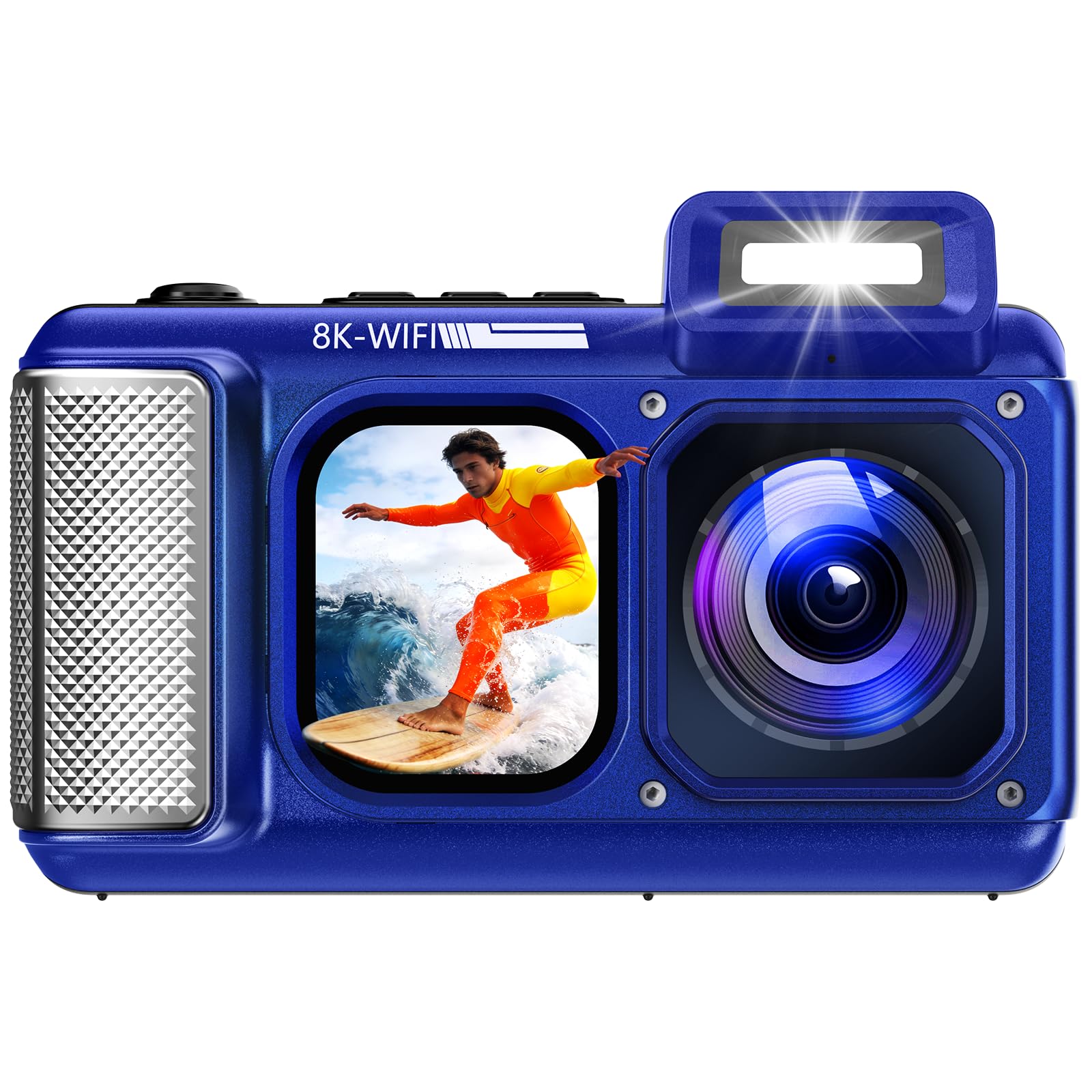
Floats on water and survives drops, making it ideal for snorkelers.
At 49 feet waterproof, the Maxmango V08 Pro goes deeper than the Minolta (a 3.1x gap in depth) and still keeps a compact profile. Its 8K video and 90MP photo resolution give you very sharp underwater captures — 88% more photo resolution than the 48MP Minolta, so you can crop your reef shots and still keep fine detail. Buyers report it delivers “excellent 4K underwater camera; vibrant, clear photos” and that it “floats”, which is a huge relief when you are snorkeling and the camera slips from your hand.
The dual screen setup — a 2.88-inch front touchscreen and a 2.01-inch rear display — makes self-framing easy, whether you are taking a selfie at the surface or recording a dive buddy. Its double-lock battery door is designed to reduce water leaks, and the rugged body is dustproof and shockproof. The included 32GB card and WiFi transfer within 5 meters mean you can share your best underwater shots to social media before you even leave the beach.
Unlike the bulkier premium options, this camera weighs just 5 grams for the battery alone, making it one of the lightest in its class. It is a very balanced pick for casual snorkelers and frequent beach-goers who want strong specs without paying a premium.
Real-world edge: The double-lock door and floating design give beginners confidence that a basic snap-seal camera does not.
One honest trade-off: The 5-gram battery is very light, which means you may want to carry a spare for full-day trips.
Reach for it if: you snorkel or dive regularly and want 8K video, a floating body, and easy photo sharing built in.
Consider another if: you need professional-level controls or a hot-shoe for external flash — that is the TG-7 territory.
2. OM System OLYMPUS Tough TG-7 Red

Pocket-sized macro powerhouse with F2.0 lens for extreme close-ups.
If you care about image quality above all else, the OM System TG-7 is the camera serious underwater photographers reach for. It uses a high-resolution F2.0 lens — a bright aperture that lets in much more light than the typical f/3.5 lens on budget models — so your reef shots stay sharp and colorful even in low underwater light. It is waterproof to 50 feet (15 meters), shockproof from a 7-foot drop, crushproof up to 220 pound-force, and freezeproof to 14°F, so you can take it from the beach to the snow without worry.
Its real superpower is the variable macro system. You can capture subjects as close as 1 centimeter from the end of the lens, and with five dedicated underwater modes — including an underwater microscope mode and underwater HDR — you get detail that budget dual-screen cameras simply cannot match. Owners mention that the “excellent macro camera for land/water” and the “rugged, waterproof, shockproof, freeze-proof” build make it a trustworthy companion for serious divers and nature photographers.
Buyers do point out that “low-light performance similar to phones” and that buttons “may stick after saltwater”, so you need to rinse it fresh after every saltwater use. It is pricier than the rest, but for professional-level control, raw shooting, and 4K video at 120 fps, it delivers a significant step up from every other pick here.
Standout feature: The F2.0 lens combined with 5 underwater modes gives you vibrant, crisp shots even in cloudy water — something phone cameras cannot do.
The real catch: Battery life is good but dies without warning, as one reviewer found — buy a spare if you shoot all day underwater.
Best for: the diver or macro enthusiast who wants the best image quality and won’t compromise on ruggedness.
skip it if: your budget is tight or you only want a casual vacation camera — the Maxmango is better value for the occasional snorkeler.
3. PENTAX WG-8 Green All-Weather Camera

Deepest compact at 65 feet with 2-hour continuous underwater operation.
The PENTAX WG-8 is the one you bring when the adventure goes below the typical 50-foot limit. It is waterproof to 20 meters (about 65 feet), which beats the 50-foot limit of the TG-7 and the 49-foot depth of the Maxmango. This camera can run for up to two hours continuously underwater, and its shockproof construction handles a fall from 1.6 meters. With approximately 20 effective megapixels, it gives you high-resolution images with low noise and high dynamic range.
What sets the WG-8 apart is its 5x optical zoom lens starting at 28mm wide-angle and the six-bulb LED ring light with variable brightness — ideal for macro close-ups in dark underwater crevices. It doubles as a webcam for live-streaming, and the built-in GPS and digital compass are very handy for geotagging your dive sites or hiking spots. Customers note it is a “durable, waterproof camera for active use (ocean, river, beach)” with “sharp photos” that is “simple for kids”.
One reviewer noted a reliability issue, saying the camera “dies every time it gets wet” and the warranty process was poor — that is a real risk you should weigh. But if you need 65-foot depth, high-quality 4K video, and the most complete outdoor feature set (GPS, compass, webcam), the WG-8 is the most capable compact underwater camera here.
Game-changing feature: The variable-brightness six-bulb LED ring light lets you light up macro subjects perfectly — no other compact has this.
Honest concern: Waterproof reliability complaints exist, so test the seals carefully before your first deep dive.
Take this if: you need the deepest waterproof rating, GPS tagging, and serious macro potential.
Look elsewhere if: any waterproof failure risk is unacceptable — the TG-7 has a better track record for sealing.
4. PENTAX WG-90 Blue

Six LED macro lights around the lens illuminate tiny subjects evenly.
The WG-90 is the more affordable sibling of the WG-8 that still brings serious macro capability. Its six LED macro lights are positioned right around the lens barrel to give you bright, even illumination on subjects as tiny as a grain of sand — perfect for capturing the details of coral polyps or shrimp. It is waterproof to 14 meters (about 39.8 feet) for up to two hours, shockproof from a 1.6-meter drop, and freezeproof to -10°C, so you can take it from a tropical reef to a snowy hike.
Image quality comes from a back-illuminated 16-megapixel CMOS sensor with a top sensitivity of ISO 6400. This sensor handles low-light underwater scenes better than the budget 48MP sensors, which often produce noise at higher ISOs. The Underwater and Underwater Movie shooting modes are programmed to tune color based on real underwater image data, so your shots look natural rather than washed out blue. Reviewers point out it is “lightweight” and “easy to use”, and the Digital Microscope mode “captures clear, vivid images of a microscopic world”.
Its 16-megapixel resolution is lower than the spec-sheet numbers of 48MP or 90MP cameras, but real-world users note that the WG-90 delivers more usable detail because the sensor and processing engine are better. If macro photography is your interest — whether on land or underwater — this camera is designed for that task first.
Best angle: The six macro lights are positioned to avoid shadows, giving you museum-quality macro shots that no other compact can match.
Trade-off: At 16MP you won’t be making large prints, and the 39.8-foot depth limit means it is not for deep scuba.
Best for: the macro enthusiast or diver who wants dedicated underwater flash for tiny subjects.
Not for: someone who prioritizes high megapixel numbers or deep diving — the Maxmango or WG-8 are better for those uses.
5. Ricoh WG-80 Orange

Industrial-grade build proven to survive 5+ years in harsh conditions.
Ricoh (Pentax’s parent brand) builds the WG-80 for people who genuinely abuse their gear — construction workers, field researchers, and outdoor guides. It is waterproof to 14 meters (46 feet) for up to two hours, shockproof, freezeproof, and crushproof. The bright orange color makes it hard to misplace on a muddy site or in a dark dive bag. It uses the same back-illuminated 16-megapixel CMOS sensor as the WG-90, delivering excellent high-sensitivity and low-noise characteristics.
The six LED macro lights around the lens barrel are identical in design to the WG-90, providing uniform macro lighting. The Underwater and Underwater Movie modes tune color for underwater use. One buyer mentioned the WG-80 was used in “tough conditions for over 5 years” and praised its “durability and easy macro mode”. The aperture range of F3.5-F5.5 is standard for this class, and the 4:3 aspect ratio sensor is common among waterproof compacts.
The honest limitation is that the sensor and processing engine are from earlier generations — shoppers say that the “basic specs haven’t changed since the WG-30”. The controls are a bit sluggish, and the 12-bit color depth is lower than the TG-7’s 12-bit (same in theory, but processing is different). Still, for the price of a mid-range model, you get a rugged camera that actually lasts years in harsh environments.
Why it stands out: The proven 5-year reliability in industrial settings makes it the most durable camera here per dollar.
Downside: The sensor and UI are dated — expect slow response times compared to newer models.
Perfect for: tradespeople, researchers, or anyone who needs a camera that survives drops, dust, and water daily.
Look elsewhere if: you want fast autofocus and modern touchscreen controls — the Maxmango is smoother.
6. 8K Underwater Camera, 90MP 50FT WiFi
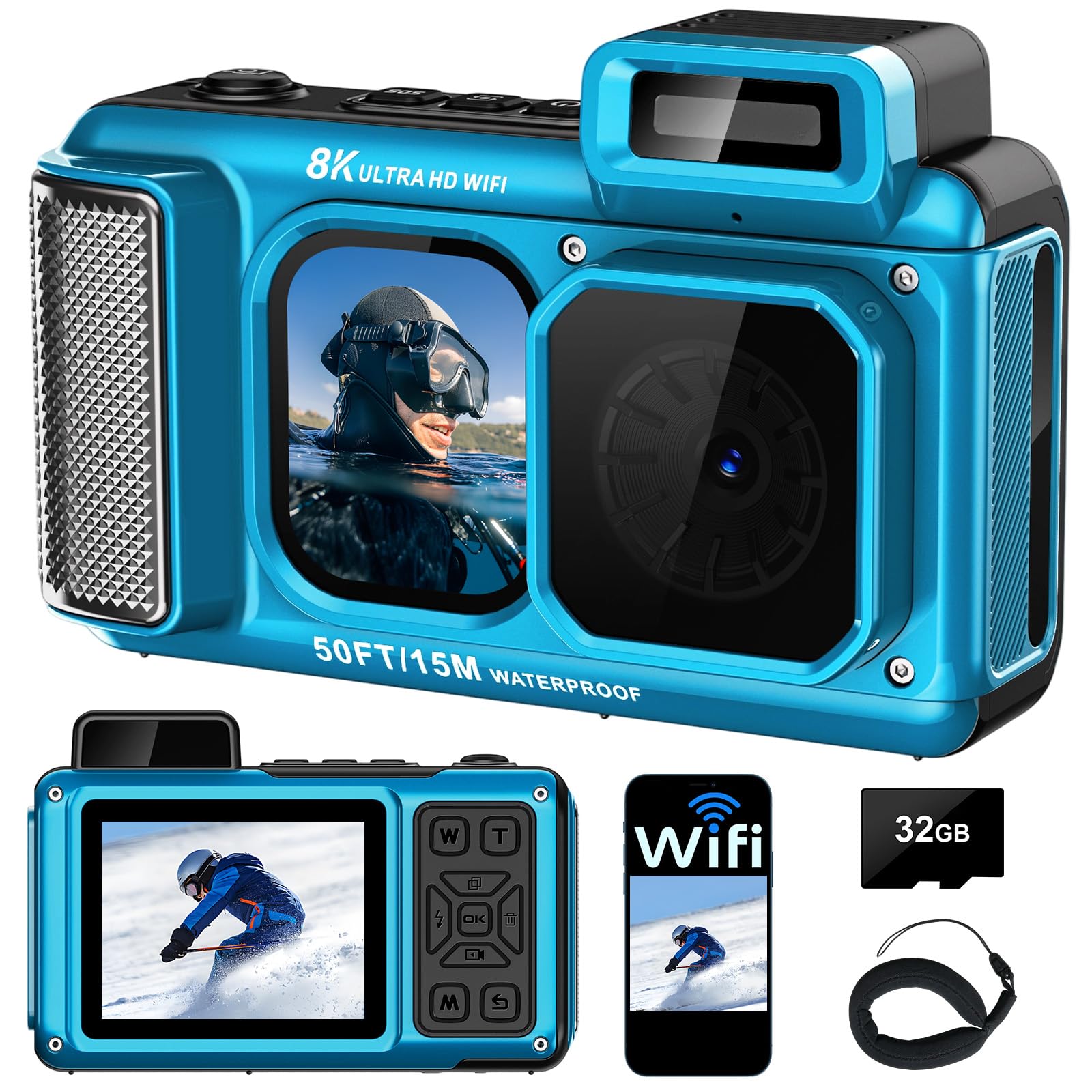
50-foot depth with touchscreen controls and 18x digital zoom.
This SiSuSy camera pushes the spec ceiling for its price tier with 50-foot waterproofing, 8K video, an effective 75MP photo resolution, and an 18x digital zoom — that is 12% more zoom than the 16X Minolta. The 3.0-inch rear touchscreen makes navigating menus and reviewing footage easy, and the 2.0-inch front screen helps frame selfies. The IP68 rating means it is thoroughly sealed against dust and water, and the shockproof body handles drops on sandy beaches.
Battery life is rated for 90-plus minutes of continuous recording from the 1800mAh pack. When you compare this to the 2500mAh in the 33FT model, you get less total recording time, but the trade-off is deeper depth and a more user-friendly touch interface. Buyers confirm it “exceeded my expectations” and that “8K video sharp with vibrant colors” — but also note that “battery drains faster with continuous 8K shooting”. The built-in WiFi lets you transfer videos to your phone in under a minute.
One shortcoming is that the effective still resolution is 75MP, not the full 90MP the sensor can theoretically capture — this is common in budget 8K cameras. And the battery weight is 14 grams, heavier than the 5-gram Maxmango battery, which hints at a physically larger battery pack. For a mid-range camera, it offers a very attractive mix of depth, video quality, and modern controls.
Biggest plus: The 3-inch rear touchscreen is genuinely usable underwater and in bright sunlight, unlike button-only interfaces.
Warning: Digital zoom at 18x reduces image quality — use optical zoom on the Pentax if you want true close-up resolution.
Go for it if: you want a bright touchscreen, 8K video, and 50-foot depth without paying premium prices.
Not ideal if: you need all-day battery life for video — the 1800mAh pack runs out faster when shooting 8K continuously.
7. 8K Underwater Camera, WiFi 33FT 70MP for Snorkeling
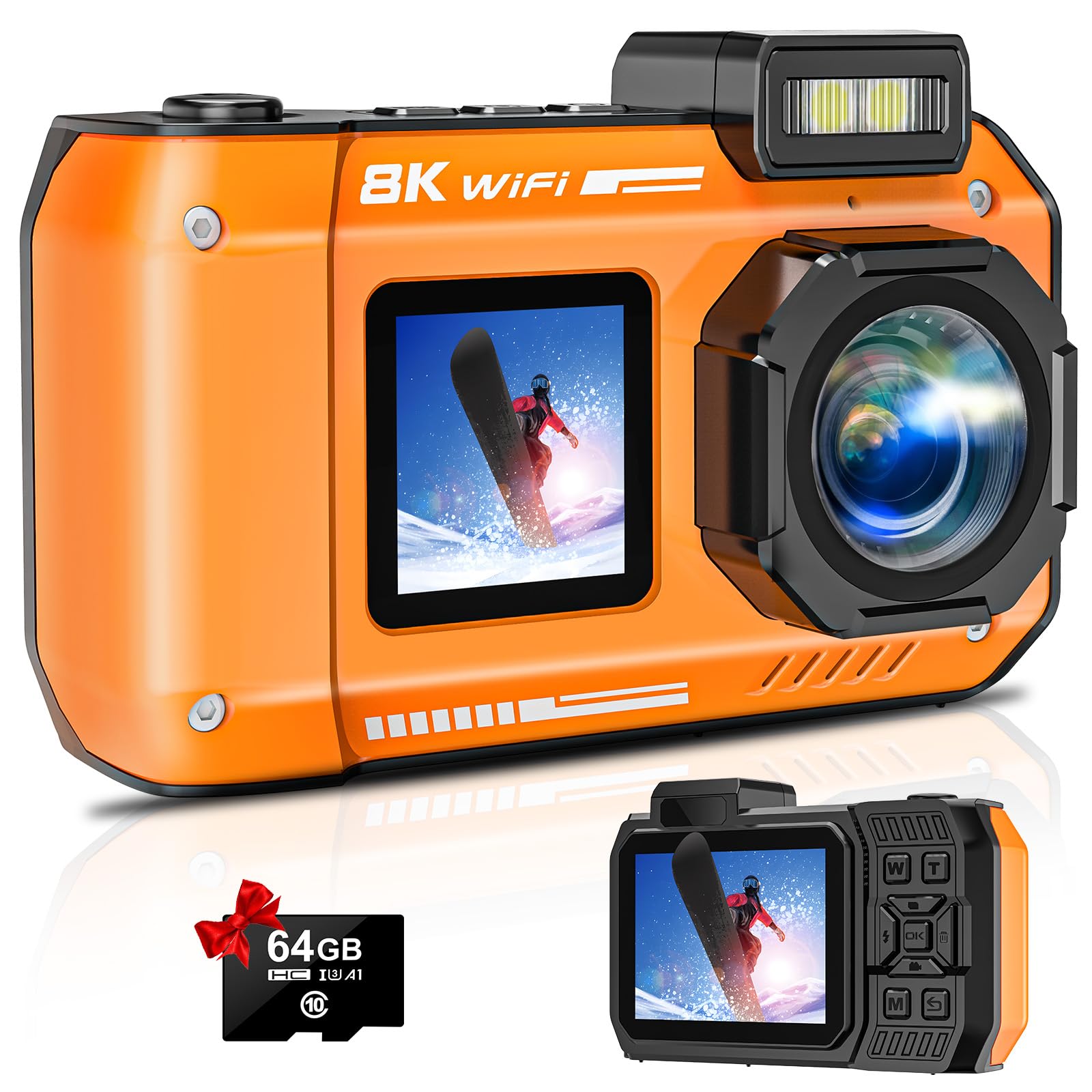
2500mAh battery offers longest runtime for budget-conscious snorkelers.
This Ruysaie camera is the most budget-friendly entry that does not feel like a toy. It captures 8K video and 70MP photos, is waterproof to 33 feet, and its 2500mAh battery delivers up to 2.5 hours of continuous recording — buyers confirm the “2500mAh battery lasts long”, which is double the 90-minute battery life of the 50FT touchscreen model. The built-in SOS light is a thoughtful safety feature for beach trips and night swimming.
The dual-screen design uses a 2.88-inch front screen and a 1.44-inch rear screen with a 4:3 aspect ratio — different from the 16:9 ratio of the Minolta, so you get a more vertical view that some find better for framing. The 64GB included memory card stores up to 8,000 photos, meaning you do not have to buy extra storage. Autofocus works down to 1.97 inches for macro shots, and the camera supports WiFi for sharing. Buyers report “photo quality is surprisingly good” and “underwater photos come out nice”.
The WiFi feature has a real problem — multiple owners mention the app “doesn’t work at all” and the camera’s WiFi function is essentially non-functional. You can still transfer files via USB-C to a computer, but the out-of-box sharing experience is broken. If you can live without WiFi, this is the best value for money. Its 14-gram battery is roughly three times heavier than the Maxmango’s battery, which correlates with its long runtime.
Top reason to buy: The 2500mAh battery and included 64GB card mean you can shoot all day without charging or buying extras.
The clear catch: WiFi app is non-functional per multiple reviews — you will need to transfer via cable to your computer.
Best for: budget-conscious travelers who prioritize battery life and don’t mind cable-based photo transfers.
Not for: anyone who relies on WiFi sharing — the Maxmango’s WiFi actually works.
8. Minolta Waterproof Digital Camera 48MP, 16FT

Entry-level pool camera with dual screens but severe shutter lag.
The Minolta MN60WP is the most affordable waterproof option on this list, but its limits are real. It is waterproof to only 16 feet — that is 3.1x shallower than the 50-foot models, so you cannot take it beyond shallow snorkeling. It shoots 48MP photos and 4K UHD video with 16X digital zoom and anti-shake, but the image quality suffers because the lens is digital-only (no optical zoom). The dual screens (2.7-inch rear, 1.8-inch front) make selfies easy, and the 16:9 aspect ratio is standard for video.
The honest take from buyers is harsh. One owner reported “terrible battery life (~dozens of pics), slow charging” and noted that the “digital zoom only, worthless” and the “hard buttons” are difficult to press. Another said the camera has “a delay from pressing the button and taking photos”, making action shots impossible. The included 32GB card and carrying case are nice, but the camera itself has low responsiveness and poor build quality — buyers describe it as “cheap plastic, junky feel”.
This camera is very clearly only for the shallowest use, like a kid’s first camera for the backyard pool. Its 16.5-gram battery is the heaviest on the list, yet it still delivers poor battery life — a sign of an inefficient processor. If you have even a slightly larger budget, the 33FT model with 2500mAh battery is a huge step up in usability and endurance.
One good point: It comes with a 32GB card, pouch, and wrist strap so you can start shooting immediately.
Main reason to skip: Awful battery life (dozens of shots per charge) and severe shutter lag make it un usable for most real-world photo needs.
Only buy if: your budget is absolutely minimum and you only need a camera for shallow pool splashes with zero time pressure.
Everyone else: spend a little more on the 33FT Ruysaie or the Maxmango — the experience gap is enormous.
Understanding the Specs
Waterproof Depth (Feet / Meters)
This is the most critical spec for any waterproof camera. It tells you how deep you can take the camera without ruining it. A 33-foot (10-meter) rating works for snorkeling and splashing at the beach. A 50-foot (15-meter) rating allows shallow scuba dives. The deepest compact waterproof cameras go to 65 feet (20 meters) — beyond that, you need a separate dive housing. Always check if the rating is for “still water” or “moving water” (swimming vs. high-pressure jets). Most good compact cameras also list a time limit at depth — typically two hours.
Photo Resolution (Megapixels) & Video Quality
Megapixels (MP) measure how many million pixels make up a photo. Higher numbers like 48MP, 70MP, or 90MP let you crop or print larger without the image getting blurry. But more MP is not always better — a 16MP camera with a large, high-quality sensor (like the Pentax WG series) can produce sharper, cleaner images than a 48MP camera with a tiny, noisy sensor. For video, 4K (3840 x 2160 pixels) is the standard for sharp underwater footage. 8K (7680 x 4320) gives you even more detail and the ability to pull high-resolution still frames from video.
FAQ
How deep can a compact waterproof camera go?
Does a higher megapixel count mean better underwater photos?
Can I use a waterproof camera in saltwater?
What is the difference between digital zoom and optical zoom?
How long does the battery last on a waterproof camera?
Is a dual-screen camera useful for selfies?
Can I use a compact waterproof camera for macro photography?
Do all waterproof cameras come with a memory card?
How do I connect a waterproof camera to my phone?
What does IP68 rating mean on a waterproof camera?
Final Thoughts: The Verdict
For most buyers, the best compact waterproof camera is the Maxmango V08 Pro because it combines genuine 8K video, a floating body, 49-foot depth, dual screens, and reliable WiFi at a very fair mid-range price. If you are serious about underwater macro photography and want professional-grade image quality, grab the OM System OLYMPUS Tough TG-7 for its F2.0 lens and dedicated microscope modes. And for the budget-conscious traveler who just needs long battery life and a simple camera that works at the beach, the 8K Underwater Camera with 2500mAh battery is the best value pick — just be sure you are okay transferring photos via cable.
How We Picked
We do not accept paid placement. Every pick is matched to a real buyer and a real use-case; we do not hands-on test units.
Sources & Methodology
Specifications: manufacturer listings and product documentation. Review insights: verified customer reviews, as of July 2026. Pricing: not shown on this page (it changes often); check the current price via the retailer link.
As an Amazon Associate, WellFizz earns from qualifying purchases. This does not affect which products we feature.
Related Guides

Mo Maruf
I created WellFizz to bridge the gap between vague wellness advice and actionable solutions. My mission is simple: to decode the research and give you practical tools you can actually use.
Beyond the data, I am a passionate traveler. I believe that stepping away from the screen to explore new environments is essential for mental clarity and physical vitality.