Our readers keep the lights on and my smoothie glass nicely filled. As an Amazon Associate, I earn from qualifying purchases.
Specs are compiled from manufacturer listings and verified buyer reviews and can change over time — please confirm the key details on the product page before buying.
You pick up a tiny tripod, set your camera on it, and watch it sag. It is a frustrating moment that kills the shot. The real challenge with a compact tripod is getting real stability for your gear without needing a full-sized bag to haul it. Most models fail on one side or the other. This guide covers the seven most reliable compact tripods available, showing you which ones actually provide solid support in a small size.
I’m Mohammad Maruf — the founder and writer behind WellFizz. This guide is built by comparing the manufacturers’ published specifications and the patterns across verified customer reviews, so you get each pick’s real strengths and trade-offs instead of marketing spin.
You might shoot with a mirrorless camera (a compact interchangeable-lens camera without a mirror box), a compact DSLR (a digital single-lens reflex camera), or just want a stable base for your phone. These are the best compact tripod options, picked for real-world stability, build quality, and how easily they pack.
Quick Picks
- K&F CONCEPT Mini Desk Tripod, 21.6” Compact Small Tripod with Ball Head — Best Overall
- SmallRig Portable Carbon Fiber Tabletop Tripod Kit, 17” Compact Mini Desktop Tripod with Video Head — Best for Video
- SIRUI Compact Mini Desktop Tripod, 20″ Aluminum Portable Small Tabletop Tripod Stand — Best Load-to-Weight
- NEEWER Portable Travel Mini Tabletop Tripod, Aluminum Alloy 20”/ 50cm Desktop Desk Tripod — Best Height Range
- AOKA 15.75″/0.99 lbs Mini Carbon Fiber Tripod, Compact Pocket Travel Tabletop Tripod — Ultralight Choice
- SmallRig Mini Tripod for Camera, Updated Desktop Tabletop Tripod with Arca-Type Compatible QR Plate — Best Budget Value
- Manfrotto MTPIXIMII-B, PIXI Mini Tripod with Handgrip for Compact System Cameras — Pocket Grip
How To Choose The Best Compact Tripod
A compact tripod looks simple, but a few key specs make the difference between a wobbly prop and a reliable shooting base. Here is what to focus on.
Load Capacity vs. Your Camera Weight
Your tripod head needs to hold more than just the camera body — account for the lens, flash, microphone, or cage (a metal frame you mount around a camera for accessories) you might attach. Check the maximum load capacity on the ball head or pan head, not just what the legs can theoretically support. A small tripod that handles 4.4 lbs (about 2 kg) can easily support a mirrorless camera with a standard zoom lens. But a heavier DSLR with a telephoto lens (a long lens that magnifies distant subjects) needs a model rated for 11 lbs (5 kg) or more. Buy for the heaviest rig you actually use, not your lightest.
Material: Aluminum vs. Carbon Fiber
The leg material directly affects how much your tripod weighs in your bag and how well it absorbs vibrations. Aluminum legs are heavier but more affordable and very durable — they handle bumps and drops well. Carbon fiber legs are lighter (ideal for travel) and dampen vibrations better for sharper long-exposure shots (photos that take several seconds), but they cost more. If you shoot mostly indoors on desks or tables, aluminum is perfectly fine. If you hike with your gear, the weight savings of carbon fiber quickly add up.
Leg Sections and Locked Length
More leg sections (typically 3 to 5) let the tripod fold shorter for storage while reaching higher when extended. The folded length tells you if it fits in your bag — a model that folds to 9 inches is pocketable, while one that folds to 18 cm (about 7 inches) is even more compact. The trade-off is that more sections mean more locking mechanisms, which can be slightly slower to set up and introduce more potential points of wobble if not tightened well. For most buyers, a 3 or 4-section leg design offers the best balance of reach and compactness.
Head Type: Ball Head vs. Pan Head
The tripod head determines how you position your camera. A ball head uses a single ball joint for fast, free-form angle adjustments — you loosen one knob, tilt the camera anywhere, and lock it. This is the most common type for still photography and general use. A pan head (also called a fluid head) provides separate controls for horizontal pan and vertical tilt, allowing smoother, more controlled movements for video. Choose a ball head for quick photos and a pan head if you shoot a lot of video footage.
Quick Comparison
| Model | Best For | Max Load | Leg Material | Folded Length | Amazon |
|---|---|---|---|---|---|
| K&F CONCEPT Mini Desk Tripod | Premium stability | 13.22 lb / 6 kg | Aluminum | 23.5 cm | Amazon |
| SmallRig Carbon Fiber Tabletop Tripod Kit | Video & long exposures | 22 lb legs / 6.6 lb head | Carbon Fiber | 290 mm / 11.4 in | Amazon |
| SIRUI Compact Mini Desktop Tripod | Highest load-to-weight ratio | 17.64 lb / 8 kg | Aluminum | 18 cm / 7 in | Amazon |
| NEEWER Portable Travel Mini Tripod | Value & height range | 11 lb / 5 kg | Aluminum | 170 mm / 6.7 in | Amazon |
| AOKA Mini Carbon Fiber Tripod | Ultralight backpacking | 6.6 lb / 3 kg | Carbon Fiber | 10.04 in / 255 mm | Amazon |
| SmallRig Mini Tripod BUT2664 | Budget-friendly all-rounder | 44 lb legs / 4.4 lb head | Aluminum | 9 in | Amazon |
| Manfrotto PIXI Mini Tripod | Pocket grip for vloggers | — | Technopolymer & Aluminum | 135 mm / 5.3 in | Amazon |
In‑Depth Reviews
1. K&F CONCEPT Mini Desk Tripod, 21.6” Compact Small Tripod with Ball Head
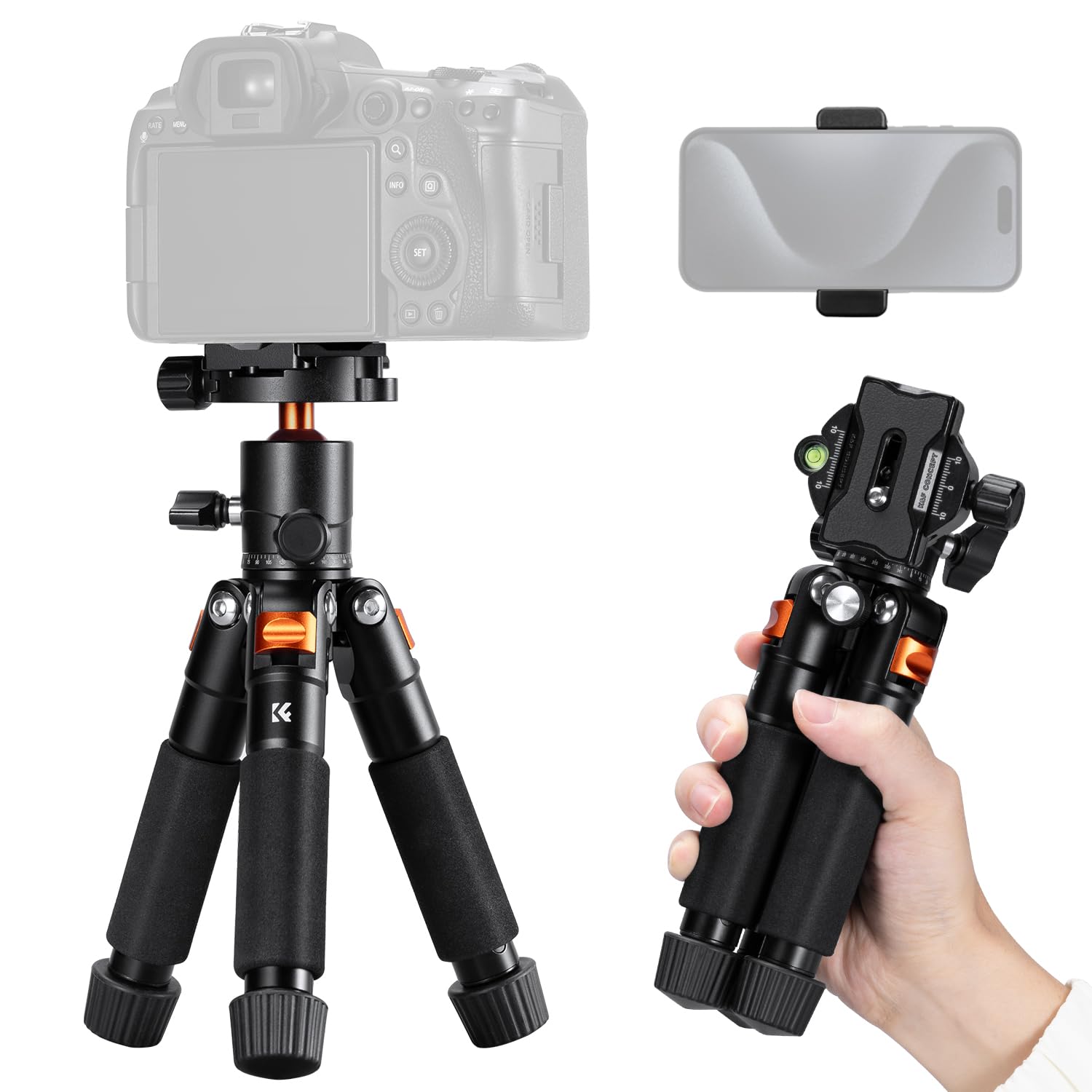
This K&F CONCEPT holds up to 13.22 lbs (6 kg) without tipping — enough for a heavy mirrorless rig like a Canon R6 Mark II.
Carry a larger DSLR and need a tabletop stand that won’t buckle? This is your pick. Its 22 mm aluminum legs are noticeably sturdier than the SmallRig Mini Tripod BUT2664, which handles a smaller 4.4 lb head load. Reviewers report it supports a Canon R50 and R6 Mark II without any strain. The 5-section legs with quick locks give you a flexible height range up to 21.6 inches.
The ball head rotates 360° and tilts vertically 90°, so you can frame portrait and landscape shots without moving the whole tripod. A reversible center column lets you drop the camera close to the ground for low-angle macro work (close-up photography of small subjects). Non-slip rubber feet and a built-in spirit level (a small bubble vial that shows if the surface is level) help you level the shot on uneven surfaces without guesswork. At 645 grams (about 1.4 lbs), it is heavier than the 410-gram SmallRig Mini Tripod, but that extra weight brings stability you feel immediately.
It also comes with a universal phone holder, so you can swap between camera and smartphone without buying extra adapters. Buyers mention the screw-out leg extensions add even more versatility on uneven terrain, and the compact reverse-fold storage makes it easy to pack. You get the most confident compact tripod here if your camera is on the heavier side — the SIRUI may fold smaller, but the K&F’s 22 mm legs feel more planted under weight.
Smart Build Highlights
- 22 mm aluminum legs provide a stable base for heavier cameras
- Reversible center column for very low-angle shots
- Includes both a quick-release plate and universal phone holder
One Real Trade-off
- At 645 grams, it is noticeably heavier than smaller tabletop options — not ideal for ultralight packing
Reach for this if: You shoot with a full-frame mirrorless or compact DSLR and want a tabletop tripod that can handle the weight without feeling flimsy.
Look elsewhere if: Every gram in your bag matters and you shoot only with a lightweight point-and-shoot or phone.
2. SmallRig Portable Carbon Fiber Tabletop Tripod Kit, 17” Compact Mini Desktop Tripod with Video Head
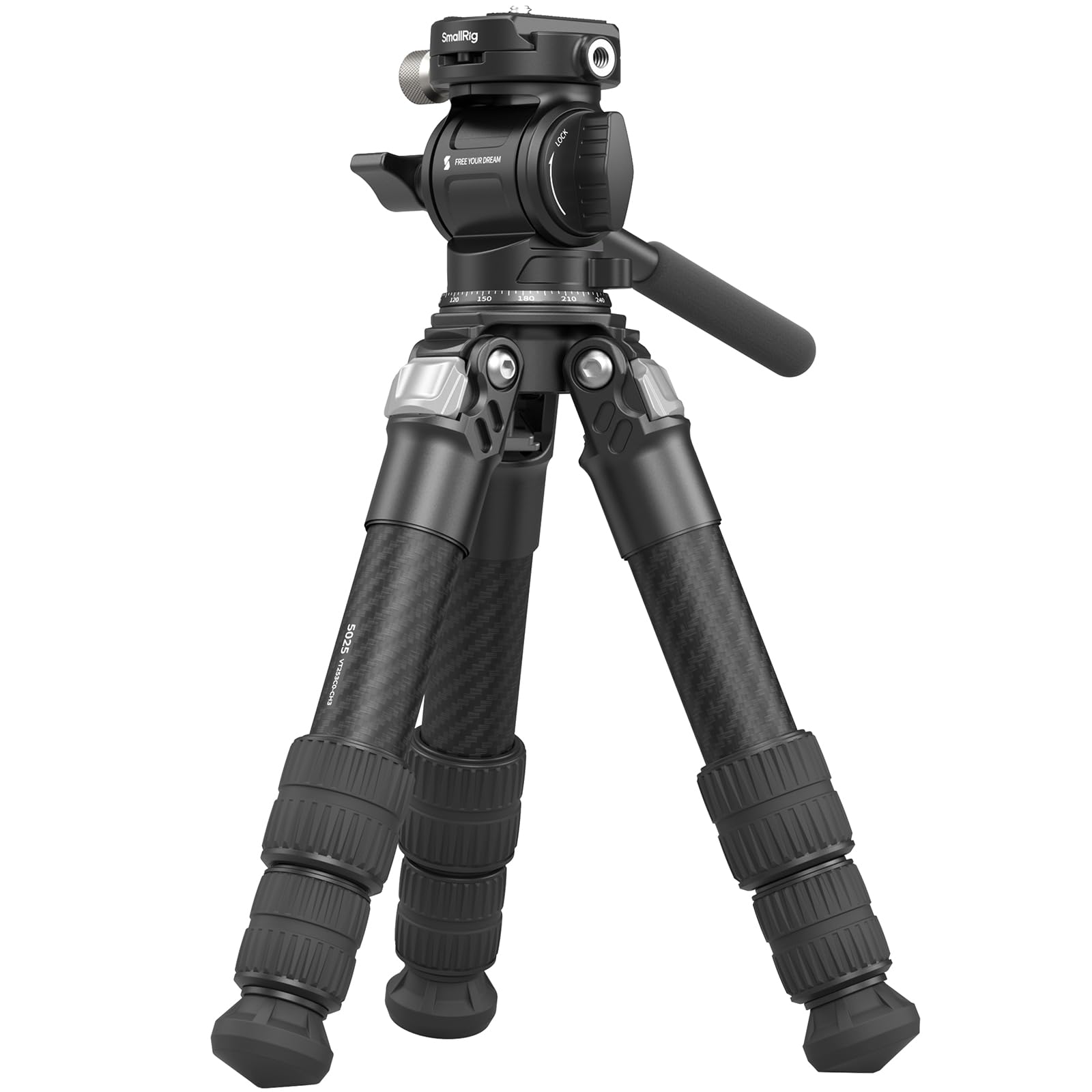
This SmallRig uses a dedicated pan head (a fluid-style head with a handle for smooth video movement) rather than a ball head — your video pans will glide rather than jerk.
Most compact tripods use a ball head, which is frustrating for video because you cannot control the pan and tilt separately. This SmallRig kit solves that. It tilts +90°/-70° and swivels a full 360°. You get fixed damping (a consistent resistance that makes panning feel smooth) — so your footage avoids that abrupt start-stop look.
The legs are 1-inch thick carbon fiber tubes (25.5 mm), which keep the total weight at 845 grams while supporting up to 22 lbs (10 kg) on the legs and 6.6 lbs (3 kg) on the video head. That is plenty for a mirrorless camera with a cage (a metal frame for accessories) and external microphone. The tripod extends to 17 inches (432 mm) and folds down to 11.4 inches (290 mm) for storage. Replaceable metal foot spikes screw into 3/8″-16 UNC holes (standard threaded holes), giving you a better grip on soft ground outdoors — swap them back to rubber feet for indoor tabletops.
Buyers report the compact folded size makes it a strong companion for rooftop or travel shooting. One reviewer noted that “foot spikes connected to 3/8″-16UNC screw holes” allow outdoor use that most tabletop tripods cannot handle. If smooth panning for video is your goal, this is the most purpose-built compact tripod here — unlike the K&F CONCEPT, which uses a ball head for stills.
Video Features
- Pan head with fixed damping and a handle for smooth pan/tilt control
- Carbon fiber legs absorb vibrations better than aluminum for sharp video
- Replaceable metal foot spikes for outdoor use on soft terrain
Consider This
- The 3-section leg design reaches only 17 inches — shorter than some 5-section models for standing use
Best suited for: Content creators and vloggers who need controlled panning for video and want carbon fiber vibration dampening.
Not for: Still photographers who want a quick ball head — the pan head takes more time to adjust for each shot.
3. SIRUI Compact Mini Desktop Tripod, 20″ Aluminum Portable Small Tabletop Tripod Stand

A tripod that folds to just 7 inches (18 cm) yet holds up to 17.64 lbs (8 kg) — that is more capacity than the K&F CONCEPT in a smaller folded size.
This SIRUI has a stunning spec: it folds a full 2.2x shorter than the SmallRig Mini Tripod BUT2664’s 9-inch folded length, yet carries more weight than any other pick here except the SmallRig Carbon Fiber’s leg rating. It weighs 0.8 kg (1.76 lbs), which is about 3.3x heavier than the tiny 0.24 kg Manfrotto PIXI, but the weight is justified by that immense load margin.
The 5-section aluminum legs extend to a maximum height of 20 inches (52 cm), and the detachable center column can reverse for ground-level macro shots (close-ups of small objects). A quick angle adjustment lever offers three leg positions (10°, 36°, and 68° relative to horizontal), so you can splay the legs wide for stability on uneven surfaces. The ball head has a U-shaped notch for vertical shooting — tilt the camera 90° for portrait orientation without shifting the center column. A 1/4″ threaded hole on the top lets you attach a magic arm (a flexible arm for accessories) for a microphone or LED light, making this a small desk studio base.
Buyers scanning the product data will note that the folded length of 18 cm (7 in) is the same as the NEEWER’s 170 mm (6.7 in) folded size. The SIRUI gives you more height than the SmallRig Mini Tripod (20 inches vs 9 inches) while folding much shorter than its own extended length.
Standout Specs
- Folded length of 18 cm (7 in) is among the most packable in this class
- 17.64 lb maximum load covers even heavy DSLR + telephoto setups
- 1/4″ and 3/8″ threaded holes for accessories like a counterweight hook
One Limitation
- 5-section legs take longer to extend and lock than simpler 3-section designs
Ideal for: Photographers who want maximum load capacity in the smallest possible folded package — great for travel with heavy gear.
Pass if: You prioritize super-fast setup and only carry a lightweight mirrorless or phone.
4. NEEWER Portable Travel Mini Tabletop Tripod, Aluminum Alloy 20”/ 50cm Desktop Desk Tripod

You get an adjustable height range from 6.7 to 19.7 inches (17 to 50 cm) — wide enough for low-angle macro or near eye-level on a desk.
The NEEWER’s 1.5-inch leg diameter is 69% thicker than the 0.89-inch legs on the SmallRig Mini Tripod BUT2664, which contributes to its 11 lb (5 kg) maximum load — enough for most DSLRs and mirrorless rigs. You adjust across 5 leg sections to go from a low macro position to near eye-level on a table.
The 360° ball head has a built-in bubble level (a spirit level vial that shows if the surface is level) and uses an Arca-type quick-release plate (a standard-shaped plate that works with many tripods). This makes swapping between cameras easy. Reviewers report the “sturdy, well-built tripod” is great for mounting a radar chronograph on an indoor range — a real-world test of stability. Some owners mention the leg locks are tight initially but loosen with use. One buyer mentioned the center column locking mechanism can drift slightly under heavy weight. At 27.14 ounces (about 770 grams), it is heavier than the 410-gram SmallRig Mini Tripod but offers noticeably thicker legs and greater height flexibility.
The NEEWER’s maximum extended height of 50 cm (500 mm) is roughly 3.7x the length of the Manfrotto PIXI’s 135 mm folded size. The NEEWER packs down to 170 mm (6.7 inches), making it still compact enough for a camera bag side pocket.
Why It Stands Out
- Wide height range from 6.7 to 19.7 inches fits many shooting scenarios
- 1.5-inch leg diameter provides solid stability for a tabletop model
- Arca-type quick-release plate is compatible with many camera rigs
Watch For
- Proprietary quick-release plate incompatible with some popular straps like Black Rapid
Perfect for: Anyone who wants a single tripod that goes low for macro and high enough for seated desktop shooting without spending premium money.
skip it if: You need a tripod that stands at eye level — 19.7 inches is still a tabletop height.
5. AOKA 15.75″/0.99 lbs Mini Carbon Fiber Tripod, Compact Pocket Travel Tabletop Tripod
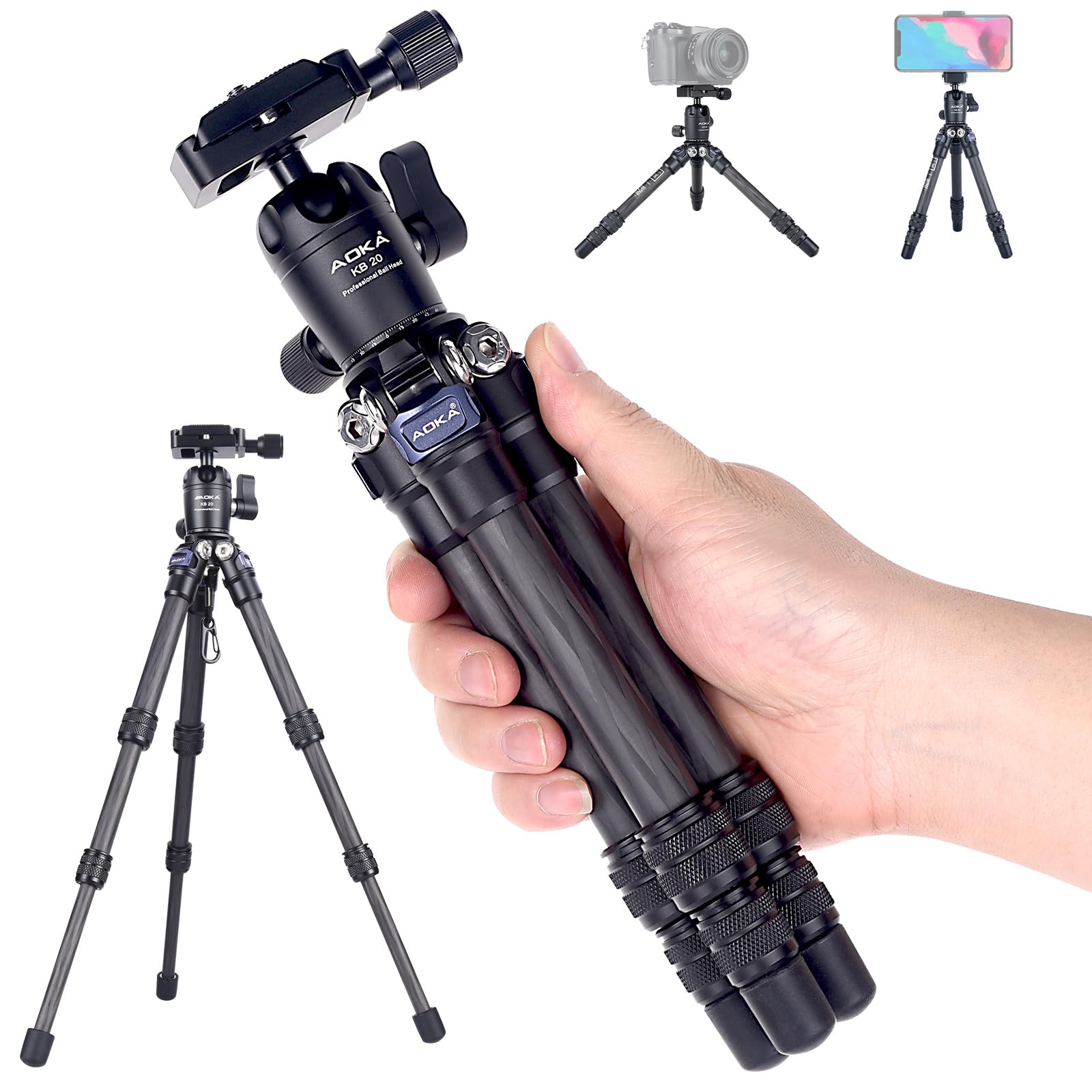
At just 0.99 lbs (450 grams), the AOKA is about half the weight of the K&F CONCEPT (645 grams) — you can stash it in a jacket pocket.
It uses high-strength carbon fiber legs (0.62-inch diameter) and an aluminum alloy CNC-machined (computer-controlled precision-cut) ball head. The maximum load is 6.6 lbs (3 kg), which covers mirrorless cameras, phones, and even a compact projector, but will not handle a full-frame DSLR with a heavy telephoto lens.
Extended height is 15.75 inches (400 mm), and it retracts to 10.04 inches (255 mm) with a folded diameter of 2.44 inches (62 mm). The leg height adjustment uses a knob-type twist lock — you turn it just a quarter-turn to loosen or tighten, which is faster than flip-locks for some users. The quick-release plate design lets you pop the camera on and off quickly without re-leveling. AOKA states they have specialized in tripod manufacturing for over 10 years, and the build quality shows in the precise machining on the head components.
Because it weighs under a pound, you can stash it in a jacket pocket or the side mesh of a daypack without feeling the bulk. The trade-off for that featherweight construction is a lower maximum load — 6.6 lbs works well for a Sony A7C or Fujifilm X-T5 with a standard zoom, but you will want the SIRUI or K&F CONCEPT for heavier gear.
Travel Perks
- Carbon fiber legs keep weight under 1 pound for easy carry
- Quarter-turn knob leg locks are fast to adjust
- Compact retracted size fits in most bag pockets
Capacity Limit
- 6.6 lb max load is too low for heavy DSLR + telephoto combos
Best for: Travel photographers and hikers who prioritize low weight over heavy load support and shoot with mirrorless cameras or phones.
Not enough for: Those who regularly mount a full-frame body with a large lens — look at the SIRUI or K&F CONCEPT instead.
6. SmallRig Mini Tripod for Camera, Updated Desktop Tabletop Tripod with Arca-Type Compatible QR Plate

Customers note the SmallRig BUT2664 “handles 2-3lb mirrorless SLR” without trouble — it is the budget-friendly all-rounder that actually works.
It weighs only 410 grams (0.89 lbs) and folds to 9 inches, making it a true desk-to-bag companion. The aluminum alloy legs support up to 44 lbs (about 20 kg) in total leg capacity, but the ball head is rated for 4.4 lbs (2 kg) — that is your real limit. That 4.4 lb limit means it works well for typical mirrorless bodies with a kit lens, but it is noticeably lower than the 13.22 lb rating on the K&F CONCEPT.
The ball head is laser-engraved with 5° increments from 0° to 330°, letting you track progressive panning for panoramic shots. A 3-position leg angle adjustment system gives you flexible splaying options. The Arca-Swiss compatible quick-release plate has a rubber-padded mount to protect your camera from scratches. Reviewers describe the build as “shockingly stable” with rubber feet that grip well on desks and smooth surfaces. One buyer called it “a wonderful mini tripod” with tension screws that feel firm and reliable even when holding a macro setup with a slider.
The main difference from the pricier SmallRig Carbon Fiber kit is the ball head (fast stills) instead of a pan head (smooth video) and the heavier aluminum material. At 0.89-inch leg diameter, it is noticeably slimmer than the 1.5-inch NEEWER legs, but for lightweight cameras under 4.4 lbs, that is not a problem. The included hex wrench had a minor fit issue reported by one buyer, but most agreed it is “great price and very sturdy build.”
Smart Buys
- Lightweight 410 g build with all-metal construction feels premium
- Arca-Swiss quick-release plate is a standard mount for most gimbals and L-brackets
- Rubber feet grip well and prevent slipping on smooth surfaces
Heads Up
- 4.4 lb ball head limit means heavy DSLR + flash rigs are out of bounds
Grab this for: A very affordable yet sturdy tripod that supports mirrorless cameras up to about 3 lbs — buyers confirm the real-world capability.
Pass if: You need to mount a full-frame DSLR or you shoot video and want a dedicated pan head.
7. Manfrotto MTPIXIMII-B, PIXI Mini Tripod with Handgrip for Compact System Cameras

The PIXI’s legs close together to form a comfortable handgrip — you hold it like a pistol grip and shoot stable video one-handed.
At just 0.24 kg (0.53 lbs) and 135 mm (5.3 inches) long, it is the smallest and lightest product here. To put that in perspective, it is about 3.7x shorter than the NEEWER’s 500 mm length, and 3.3x lighter than the SIRUI’s 0.8 kg.
The ball head locks automatically when you release the button — set the angle, let go, and it holds firm. It uses a universal 1/4-inch screw thread, compatible with compact system cameras (CSC), entry-level DSLRs, and smartphones (with Manfrotto’s KLYP phone mount). Despite its tiny size, it is made in Italy from technopolymer (a durable engineered plastic) and aluminum. The 1.3-inch leg diameter is thicker than the SmallRig BUT2664’s 0.89 inches, which helps the PIXI feel planted on a desk for its size class.
The trade-off is clear: no adjustable leg sections, no height extension, and a maximum load suitable for small cameras only. It is not meant to replace a full tripod — it is a grip-first accessory that doubles as a very stable tabletop stand. Perfect for a vlogger who wants smooth handheld pans and the occasional desk shot, or for a compact camera user who values pocketability above all else.
Unique Feature
- Legs close into a comfortable handgrip for one-handed video capture
- Automatic ball head lock secures the angle when you release the button
- Extremely compact at 135 mm and 0.24 kg — fits in a coat pocket
Compromises
- No adjustable leg sections or height — it is a set-and-place tripod only
- Not suitable for heavy DSLRs or large lenses
Use this when: You want a pocket-sized grip for handheld video that also works as a quick desk stand for a compact camera or phone.
pass on it if: You need adjustable height, or you shoot with a heavier full-frame mirrorless or DSLR rig.
Understanding the Specs
Ball Head vs. Pan Head
The head type on a tripod determines how you angle your camera. A ball head uses a single ball joint — loosen one knob, tilt the camera freely in any direction, and tighten. It is fast for still photography. A pan head (sometimes called a fluid head) has separate controls for side-to-side panning and up-and-down tilting, often with a small handle. This gives smoother, more controlled movement for video. For photos, a ball head is easier and quicker. For video, a pan head avoids jerky footage.
Load Capacity (Head vs. Legs)
Many tripod specs list two load numbers — one for the legs and one for the head. The leg capacity is always higher because aluminum or carbon fiber tubes bear vertical weight easily. But the head capacity is the actual limit for your camera because the head has small moving parts and locking mechanisms. Always check the ball head or pan head maximum load. For example, a tripod may have legs rated at 44 lbs but a head rated at only 4.4 lbs — put a 10 lb camera on it, and the head will slip even though the legs stand firm.
Folded Length vs. Extended Height
The folded length (how short the tripod gets when legs are collapsed) tells you if it fits in your bag. The extended height (fully raised) tells you how useful it is on location. These two numbers are always different, and the number of leg sections determines the ratio. A 3-section leg tripod might fold to 11 inches and extend to 17 inches. A 5-section leg tripod might fold to 7 inches and extend to 20 inches. More sections mean more compact storage but more parts to lock and unlock. Decide what matters more: tiny folded size for travel, or faster setup with fewer sections.
Leg Material: Aluminum vs. Carbon Fiber
Aluminum is heavier, more affordable, and very durable. It conducts vibrations more readily, so you might see slightly less sharpness in long exposures if the tripod is bumped. Carbon fiber is lighter (usually by 25–40%) and naturally dampens vibrations better, leading to sharper long-exposure shots (photos that take several seconds). It is also more expensive and can crack under extreme impact, while aluminum bends but rarely breaks. For desk use, aluminum is perfectly fine. For travel where you carry the tripod for hours, carbon fiber is worth the extra cost. For heavy cameras, the thickest aluminum legs (22 mm or more) are often more rigid than thin carbon fiber.
FAQ
Will a compact tripod support my DSLR with a telephoto lens?
What does the 1/4-inch screw on top of the tripod mean?
How does a ball head lock work and is it secure?
Can I use a compact tripod with my smartphone?
What is the difference between Arca-Swiss and proprietary quick-release plates?
How do I clean and maintain a compact aluminum or carbon fiber tripod?
Is a 3-section or 5-section leg design better for a compact tripod?
Can I use a compact tripod for long exposure night photography?
What does the bubble level on a tripod do and do I need one?
Are compact tripods allowed as carry-on luggage on planes?
Final Thoughts: The Verdict
For most people, the compact tripod winner is the K&F CONCEPT Mini Desk Tripod because it combines a high 13.22 lb load capacity with a stable 22 mm aluminum leg design and a flexible height range, all at a reasonable weight for the capability it offers. If you want a portable video-focused setup with smooth panning, grab the SmallRig Carbon Fiber Tabletop Tripod Kit with its dedicated fluid head and vibration-dampening carbon fiber legs. And for maximum portability without sacrificing load capacity, the standout is the SIRUI AM-TT50, which folds to just 7 inches yet supports a remarkable 17.64 lbs.
How We Picked
We do not accept paid placement. Every pick is matched to a real buyer and a real use-case; we do not hands-on test units.
Sources & Methodology
Specifications: manufacturer listings and product documentation. Review insights: verified customer reviews, as of July 2026. Pricing: not shown on this page (it changes often); check the current price via the retailer link.
As an Amazon Associate, WellFizz earns from qualifying purchases. This does not affect which products we feature.

Mo Maruf
I created WellFizz to bridge the gap between vague wellness advice and actionable solutions. My mission is simple: to decode the research and give you practical tools you can actually use.
Beyond the data, I am a passionate traveler. I believe that stepping away from the screen to explore new environments is essential for mental clarity and physical vitality.