Our readers keep the lights on and my smoothie glass nicely filled. As an Amazon Associate, I earn from qualifying purchases.
Carrying a full-size tripod defeats the purpose of traveling light, yet a flimsy tabletop stand leaves you squinting at blurry long exposures. The sweet spot is a compact travel tripod that folds small enough to vanish in a daypack but locks solid enough to hold a mirrorless body and a zoom lens steady in a breeze.
I’m Mohammad Maruf — the founder and writer behind WellFizz. I’ve spent hundreds of hours cross-referencing load capacities, leg-section counts, folded lengths, and real-world user torque tests to separate the genuinely portable rigs from the ones that wobble the moment you touch the shutter.
This guide breaks down seven models that balance packability with real stability, from sub-12-inch pocket stands to full-height carbon fiber units. If you want the most reliable best compact travel tripod for your specific shooting style, these are the only options worth considering.
How To Choose The Best Compact Travel Tripod
Not every small tripod delivers small wobble. The key is matching the leg architecture, head quality, and material to the weight of your gear and the environments you shoot in. Here are the three factors that separate a travel-ready companion from a frustrating compromise.
Leg Sections, Tube Diameter, and Folding Logic
A tripod with five leg sections folds shorter than a four-section model, but each extra joint adds a potential vibration point and reduces the maximum tube diameter at the bottom. Look for a top tube diameter of at least 22mm if you plan to use a 70-200mm lens, and prefer four-section legs over five unless absolute packability is your only priority. The locking mechanism matters too — twist locks save space but can freeze in cold weather, while flip locks are faster to adjust but add a few millimeters of bulk.
Ball Head Capacity and Damping
A miniature ball head rated for 8kg might still creep under a 2kg setup if its locking mechanism relies on a plastic interface. Look for an all-metal ball head with a separate tension adjustment knob and a panoramic base that rotates independently. The Arca-Swiss quick release plate standard is strongly preferred over proprietary mounts because it lets you swap between a tripod head and a monopod or clamp without changing plates.
Minimum Working Height and Center Column Design
The best compact travel tripods can get your camera within a few inches of the ground for macro or low-angle work. A removable or invertible center column makes this possible without sacrificing stability at full extension. Models that allow you to detach the center column entirely and mount the ball head directly on the spider are the most versatile for ground-level photography.
Quick Comparison
On smaller screens, swipe sideways to see the full table.
| Model | Category | Best For | Key Spec | Amazon |
|---|---|---|---|---|
| Peak Design Travel Tripod Carbon Fiber | Premium | Pro-level stability in a water-bottle form | 20 lb capacity / 15.4″ folded | Amazon |
| NEEWER LITETRIP LT32 | Premium | Versatile carbon fiber with quick leveling | 22 lb capacity / 17″ folded | Amazon |
| SIRUI AM-223 | Premium | Ultra-compact low-angle tabletop work | 15 kg capacity / 12.1″ folded | Amazon |
| K&F CONCEPT 64″ Carbon Fiber | Mid-Range | Full-height travel tripod on a budget | 17.6 lb capacity / 16.3″ folded | Amazon |
| AOKA Mini Carbon Fiber | Mid-Range | Backpack-friendly desk and ground stand | 6.6 lb capacity / 10″ folded | Amazon |
| NEEWER Basics 72″ | Budget | Entry-level full-size tripod with monopod mode | 13.2 lb capacity / 17″ folded | Amazon |
| GEOMETRICAL Pocket Tripod PROv2 | Budget | Wallet-sized phone stand for everyday carry | 11g weight / credit card sized | Amazon |
In‑Depth Reviews
1. Peak Design Travel Tripod Carbon Fiber

Peak Design rethought the travel tripod from the ground up, and the result is a carbon fiber column that folds to the diameter of a water bottle yet supports up to 20 pounds. The unique leg deployment mechanism lets you extend all four sections in seconds without flipping or rotating anything, and the twist locks are satisfyingly crisp. At 1.29 kg, it’s light enough to clip to the outside of a daypack but feels dense and confidence-inspiring when loaded with a full-frame DSLR and a telephoto zoom.
The single-ring ball head is polarizing — it uses one adjustment ring for tension and locking, which makes micro-adjustments slower than a traditional dual-knob head. However, the built-in phone mount that pops out of the center column is a clever touch for hybrid shooters. The integrated hook lets you hang a bag for extra stability in wind, and the reversible column gets you to ground level without tools.
Owners praise the build quality and the lifetime warranty, though some note the leg clips can pinch skin during rapid setup. The removable head accepts third-party units via an adapter, but the proprietary ring mechanism means you lose the ultra-compact folded size if you swap heads. For photographers who shoot frequently and pack aggressively, the weight-to-stability ratio remains the benchmark.
Why it’s great
- Folded package is the smallest for its load capacity
- Setup and takedown are genuinely fast and intuitive
- Built-in phone mount adds versatility without extra parts
Good to know
- Single-ring ball head slows precise framing adjustments
- Proprietary leg clip design can catch skin
- Premium price puts it out of reach for casual users
2. NEEWER LITETRIP LT32

The NEEWER LITETRIP LT32 delivers near-flagship features at a mid-range price point. Its 26mm top tube sections are thicker than most compact tripods, and the spring-loaded flip buckles allow leg adjustment without the pinching risk of Peak Design’s clips. The ball head features a ±15° quick-leveling base that makes horizon corrections effortless on uneven terrain, and the panoramic rotation is buttery smooth thanks to the 30mm diameter metal construction.
Detaching the center column reduces the minimum height to 19cm, which is excellent for macro or low-angle wildlife shots. The Arca-Swiss quick release plate is compatible with Peak Design’s Capture system, though some users report the clamp doesn’t grip all third-party plates equally. Two 1/4-inch accessory threads on the spider let you attach a magic arm for an LED panel or microphone.
At 1.18 kg, it’s lighter than the Peak Design while carrying a slightly higher rated load, though the head’s clamping force is best suited for mirrorless bodies rather than heavy DSLRs with battery grips. The included spiked feet screw into the rubber pads for grip on loose soil, making it genuinely versatile across hiking, travel, and studio environments.
Why it’s great
- Thick 26mm tubes provide excellent vibration damping
- ±15° quick-leveling base saves setup time on hillsides
- Removable spike feet handle sand, mud, and rock
Good to know
- Ball head may creep under heavy telephoto lenses
- QR plate compatibility is not universal across Arca brands
- Center column detaches but doesn’t invert without partial disassembly
3. SIRUI AM-223 Carbon Fiber Mini Tripod

The SIRUI AM-223 is a mini tripod that prioritizes rock-solid stability over height. With a maximum working height of 16 inches and a folded length of just 12.1 inches, it fits inside a jacket pocket or the side pocket of a camera cube. The 10-layer carbon fiber legs weigh only 0.73 kg but carry an impressive 15 kg rating, meaning it comfortably supports a gripped DSLR with a 70-200mm f/2.8 without any leg sag or joint flex.
The B-00K ball head includes a separate panning knob and a tension adjustment ring, giving you finer control over heavy loads than most integrated heads at this size. Owners note the head’s safety release can gouge the head body if overtightened, but the locking mechanism itself holds firm even with professional glass. The leg angle stops at three positions, and the removable rubber feet reveal metal spikes for grip on ice or loose dirt.
This tripod is not for anyone who needs eye-level shooting without a table or rock. Its strength is ground-level macro, long-exposure astro with the legs splayed flat, or use as a stable tabletop stand for video calls and product shots. The included carry bag is padded and fits the tripod with the head attached, making it a grab-and-go companion for photographers who already own a full-size tripod but want a secondary ultra-portable rig.
Why it’s great
- 15 kg capacity is overkill for mirrorless, perfect for heavy DSLR kits
- 10-layer carbon fiber legs are lightweight and stiff
- Removable spikes handle outdoor terrain well
Good to know
- Low 16-inch max height limits standing use
- Ball head safety release can scratch the head body
- Center column not included; SL-100 sold separately for extra height
4. K&F CONCEPT 64″ Carbon Fiber Travel Tripod
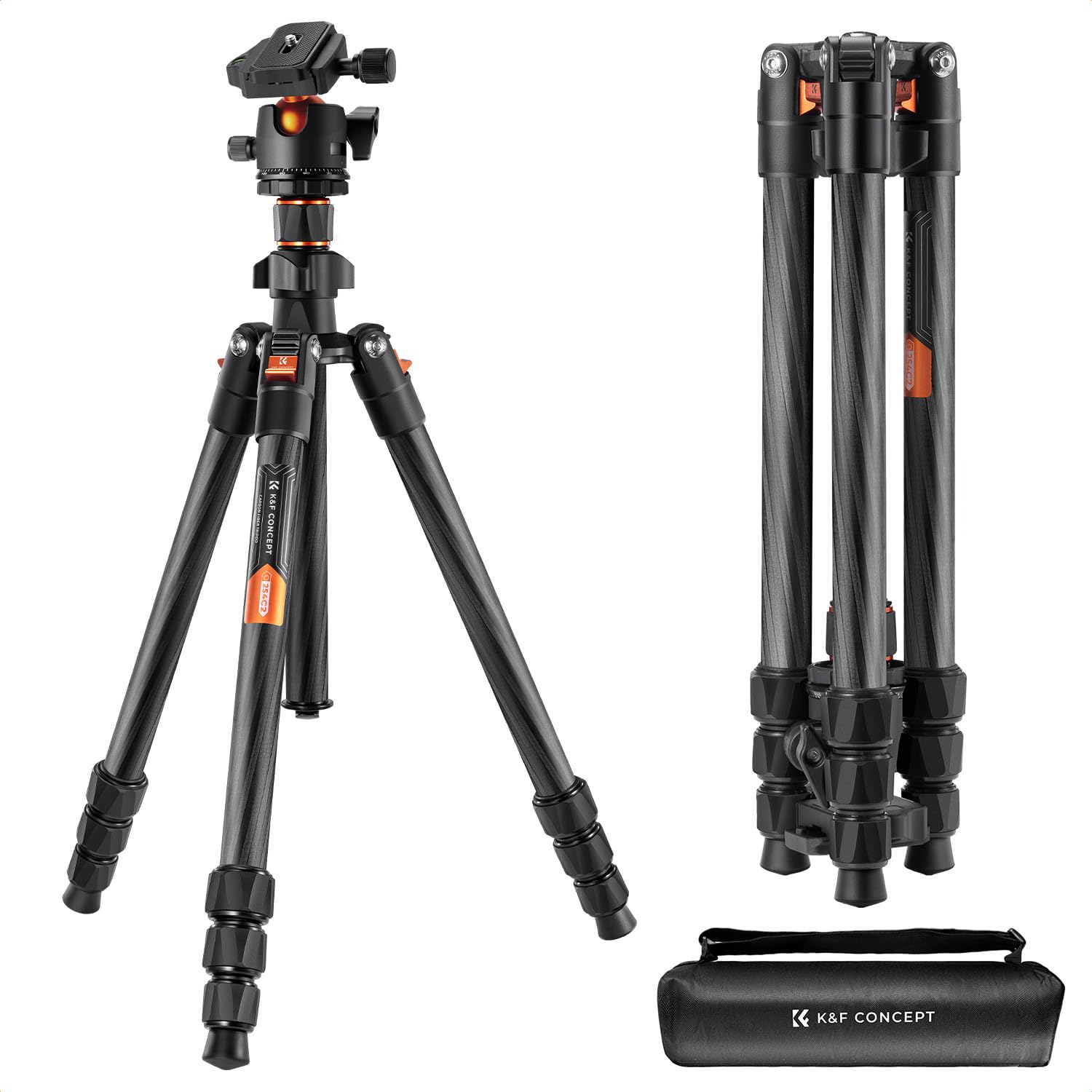
The K&F CONCEPT 64-inch model bridges the gap between budget aluminum tripods and premium carbon fiber units. It folds to 16.3 inches and weighs 2.5 pounds — light enough for a day hike but tall enough for a 5-foot-10 photographer to shoot without hunching. The 36mm metal ball head provides smooth 360-degree panning, and the twist leg locks are dust-resistant and operate smoothly even after exposure to sand or sea spray.
The center column can be inverted for low-angle macro shots, and K&F includes a short center column for reducing the minimum height further. However, the ball head’s locking mechanism uses some plastic components, and several owners recommend upgrading to an all-metal head for long-term reliability under heavier loads. The Arca-Swiss quick release plate works with most standard clamps, and the built-in bubble level is reasonably accurate.
For the price, the build quality punches above its weight class. The carbon fiber weave is consistent, the leg angle locks are positive, and the carrying bag includes a padded divider. It’s a strong choice for the enthusiast photographer who wants a full-height travel tripod without spending Peak Design money, provided you’re okay swapping the head down the line.
Why it’s great
- Full 64-inch height pairs well with a compact folded length
- Carbon fiber construction keeps weight manageable at 2.5 lbs
- Invertible center column and short column option add versatility
Good to know
- Ball head includes plastic parts; metal upgrade recommended for heavy gear
- No integrated weight hook for wind stability
- Carrying bag is functional but not padded as well as premium options
5. AOKA Mini Carbon Fiber Tabletop Tripod
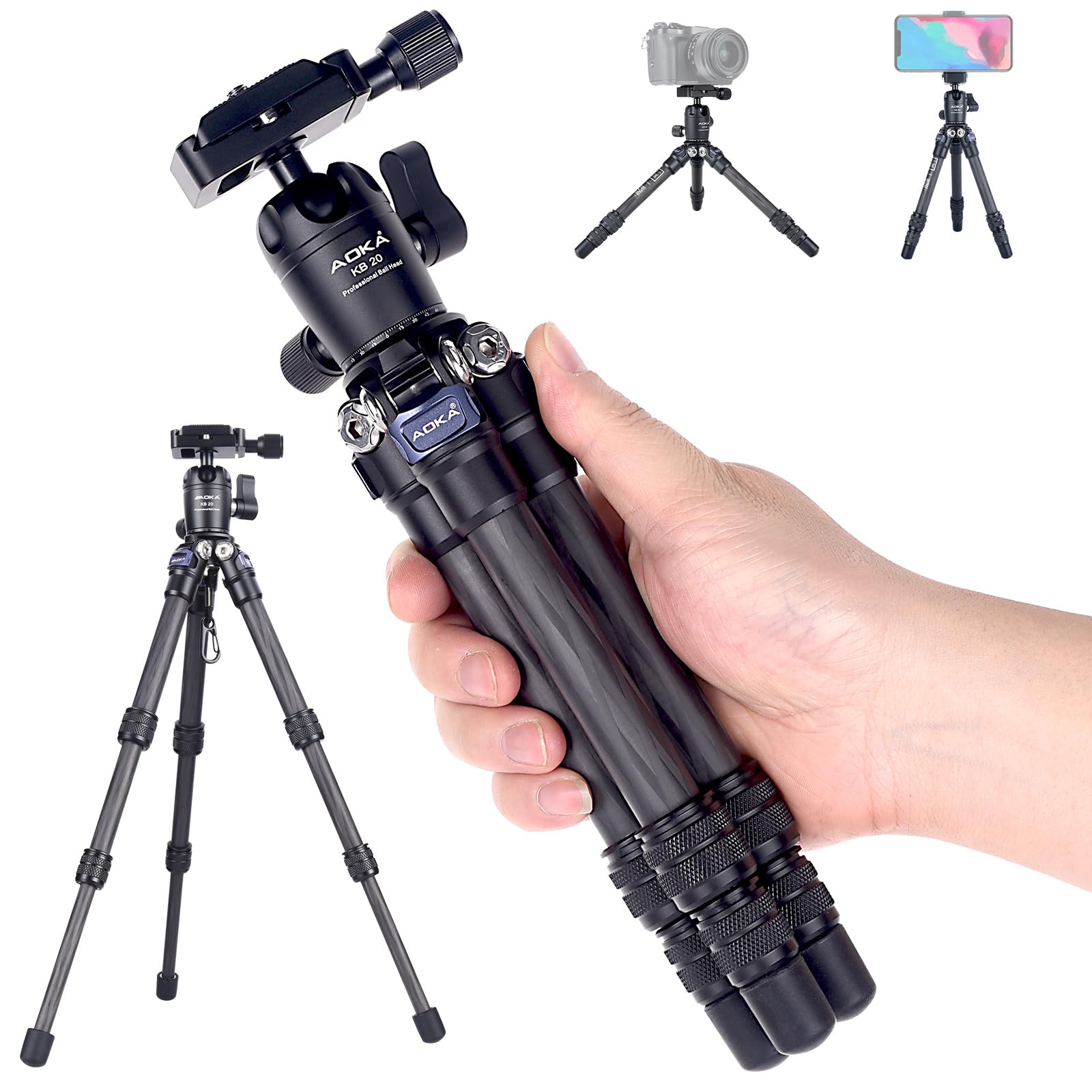
The AOKA mini tripod is designed for photographers who want a real carbon fiber platform that disappears into a jacket pocket. At 10 inches folded and 0.99 pounds, it’s lighter than a can of soda yet supports up to 6.6 pounds — enough for a mirrorless body with a compact zoom. The ball head uses a quick-lock lever instead of a twist knob, letting you adjust angle and lock in one motion.
The leg locks are twist-style but require only a quarter turn to release, which speeds up deployment significantly. The included phone clamp is well-made and grips securely without scratching. Owners praise the machining quality of the aluminum alloy components and note that the carbon legs feel comparable to much more expensive Manfrotto units. The center extender adds height but must be unscrewed from the ball head to stow in the bag — a small friction point during fast setups.
This tripod is best for timelapses on a picnic table, product photography on a desk, or as a lightweight hiking companion for phone and lightweight camera steady shots. It will not hold a pro DSLR with a 24-70mm f/2.8 without some instability, but with a small lens it’s rock solid. The included carabiner can anchor it to a backpack strap for quick access during trail shooting.
Why it’s great
- Folded length of 10 inches fits any bag pocket
- High-quality carbon fiber legs and CNC aluminum parts
- Quick-lock ball head lever saves time during adjustments
Good to know
- Maximum 15.75-inch height limits it to tabletop or low-ground shooting
- Unstable with heavy telephoto or standard zoom lenses
- Center extender must be detached and carried separately
6. NEEWER Basics 72″ Travel Tripod Monopod

The NEEWER Basics 72-inch tripod is the definition of value: it includes a ball head, a phone holder, a carrying bag, and the ability to detach one leg to form a monopod — all at an entry-level price that undercuts most competitors by a wide margin. The aluminum legs are heavier than carbon fiber at 2.9 pounds, but the tradeoff is a durable build that can handle occasional bumps on rocky trails without concern.
The ball head supports 360-degree panning and 90-degree tilt, though the head itself is basic and may not hold a heavy DSLR at extreme angles without drifting. The twist leg locks are functional but require more turns than the flip-lock systems on the NEEWER LITETRIP. Owners consistently report the tripod feels sturdier than expected for the price, especially once the center column hook is weighted with a bag.
The monopod conversion is genuinely useful for hike-and-shoot photographers who want a walking stick that doubles as a stabilizer. However, the phone holder is plastic and may not securely grip larger flagship phones with thick cases. For beginners or casual shooters who need a full-height tripod for occasional use, this is the practical choice that leaves budget for a better head upgrade down the line.
Why it’s great
- Converts to a monopod for hiking versatility
- 72-inch max height works for tall users
- Includes phone holder and carrying bag out of the box
Good to know
- Aluminum construction is heavier than carbon fiber alternatives
- Ball head and quick release plate are basic; upgrade recommended
- Center column rotation during panning requires careful screw tightening
7. GEOMETRICAL Pocket Tripod PROv2
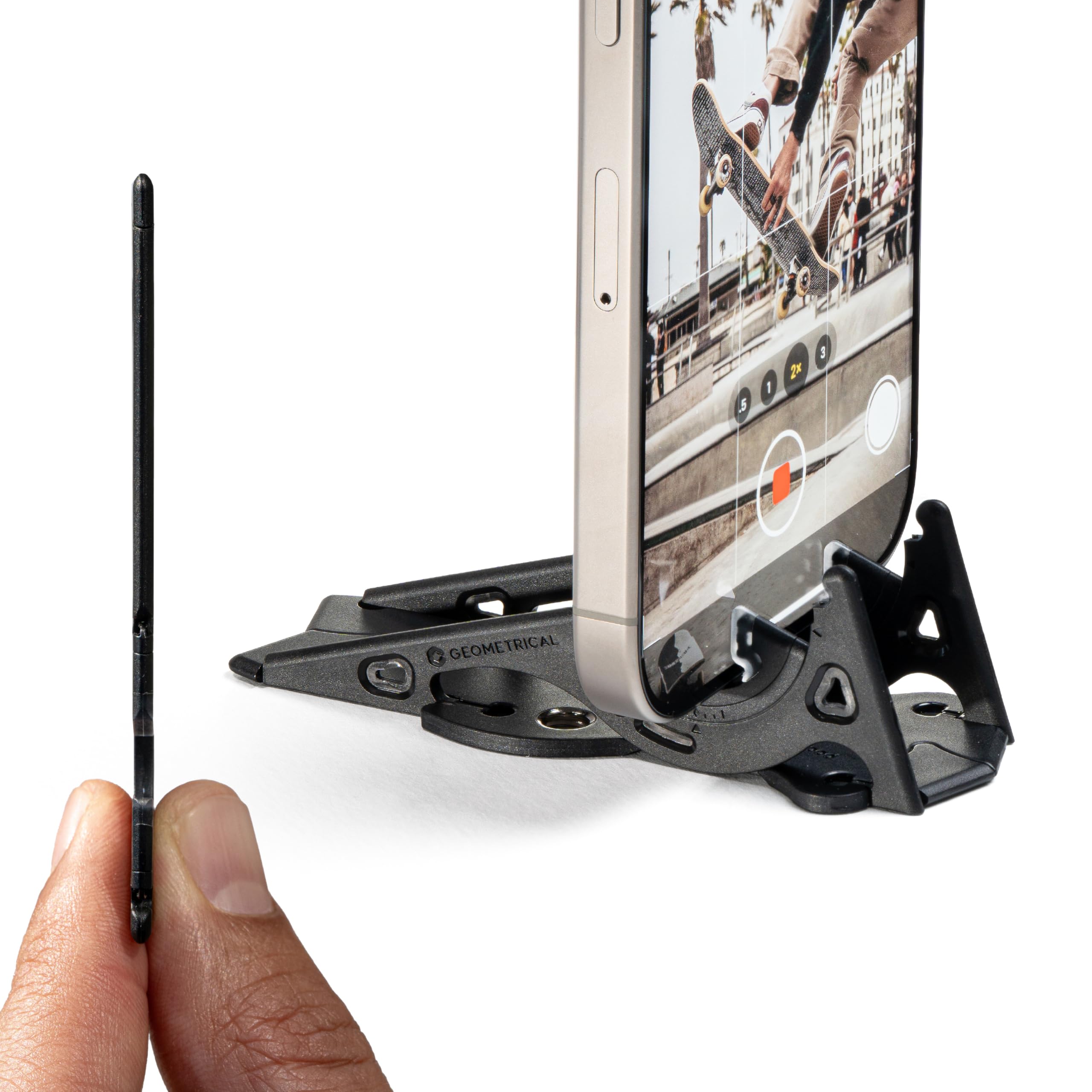
The GEOMETRICAL Pocket Tripod PROv2 abandons the traditional leg-and-head design entirely. It’s a 2.29mm-thin card that lives in your wallet and unfolds into a phone stand with a circular rail that lets you adjust the tilt angle precisely. At 11 grams, it’s lighter than most keychains, and the included 1/4-inch-20 thread adapter lets you mount a phone onto standard photography gear like sliders or full-size tripods.
The build quality is surprisingly premium — the carbon fiber composite doesn’t flex, and the circular rail holds the phone at any angle without slipping. Users report it holds iPhone Pro Max models with ease, though thick cases can interfere with the fit. The adapter system works well with most phones thinner than 12.5mm, and the vertical-plus-horizontal orientation makes it ideal for TikTok and Instagram content creators who shoot on the go.
This is not a substitute for a full tripod. It cannot support a camera, it has no height, and it relies on finding a flat surface. But for the specific use case of a phone stand that disappears until needed, nothing else on this list beats its portability. The price is higher than most would expect for a piece of plastic, but owners routinely call it a buy-once product that saves their back from hunching over tables.
Why it’s great
- Fits in a wallet alongside credit cards
- Adjustable tilt angle stays locked during use
- 1/4-20 thread expands compatibility with camera gear
Good to know
- Phone-only design; no camera support
- Thick phone cases may prevent secure fit
- Requires a flat surface — useless on grass or rocks
FAQ
How short should a compact travel tripod fold to fit in a carry-on?
Is carbon fiber worth the extra cost over aluminum for a travel tripod?
Can I use a full-size DSLR with a mini tabletop travel tripod?
Final Thoughts: The Verdict
For most users, the best compact travel tripod winner is the NEEWER LITETRIP LT32 because it delivers excellent carbon fiber build quality, thick 26mm leg tubes, and a versatile quick-leveling head at a price that fits serious enthusiasts. If you want the absolute smallest folded package and highest load capacity in a water-bottle form, grab the Peak Design Travel Tripod Carbon Fiber. And for ground-level macro or a secondary ultra-portable rig, nothing beats the SIRUI AM-223 for rock-solid low-angle stability.

Mo Maruf
I created WellFizz to bridge the gap between vague wellness advice and actionable solutions. My mission is simple: to decode the research and give you practical tools you can actually use.
Beyond the data, I am a passionate traveler. I believe that stepping away from the screen to explore new environments is essential for mental clarity and physical vitality.