Our readers keep the lights on and my smoothie glass nicely filled. As an Amazon Associate, I earn from qualifying purchases.
Choosing a compact spotting scope means balancing raw magnification against the reality of carrying it miles into the backcountry. A full‑size 80mm unit delivers light‑gathering power, but the weight and length punish your pack. The best options here use clever optical designs—short Maksutov‑Cassegrain tubes or folded prism systems—to shrink the footprint without collapsing detail at 300 yards and beyond.
I’m Mohammad Maruf — the founder and writer behind WellFizz. I’ve spent hundreds of hours cross‑referencing optical specifications, customer reliability reports, and real‑world field of view data to find the compact scopes that actually deliver usable clarity at every zoom stop.
Whether you are glassing a ridgeline for elk or checking bullet holes at the range, the best compact spotting scope keeps your kit light without forcing you to squint through a tunnel.
How To Choose The Best Compact Spotting Scope
Three variables separate a truly compact spotter from a conventional scope that simply has a short barrel: optical architecture, prism quality, and the tripod interface. Understanding each prevents you from buying a scope that is small on paper but useless in the field.
Optical Architecture: Refractor vs. Maksutov-Cassegrain
Conventional refractor spotting scopes use a long objective lens to gather light, which forces the body to be long. A Maksutov-Cassegrain design folds the light path with a corrective meniscus lens and a secondary mirror, packing 700–1250mm of focal length into a tube often under 12 inches. This makes Mak scopes dramatically shorter and lighter than equivalent aperture refractors, though the fixed magnification eyepiece limits zoom flexibility unless you buy a zoom eyepiece separately.
Prism Type and Coating Quality
BAK4 prism glass has a higher refractive index than BK‑7, which translates to a rounder exit pupil and brighter image, especially at dawn and dusk. Pair that with a fully multi‑coated lens—multiple anti‑reflective layers on every air‑to‑glass surface—and you get contrast that doesn’t wash out when you push the zoom past 40x. Scopes that only say “multi‑coated” without the “fully” qualifier likely leave the rear lenses bare.
Field of View and Eye Relief
Compact scopes often sacrifice field of view at high magnification. Look for a spec that gives you at least 90 feet at 1000 yards at the wide end of the zoom range. Eye relief matters more than most buyers realize: if you wear glasses, you need at least 14–16mm of eye relief to avoid smudging the eyepiece while seeing the full image. Twist‑up eyecups are a must for quick adjustment between glassed and bare‑eyed use.
Quick Comparison
On smaller screens, swipe sideways to see the full table.
| Model | Category | Best For | Key Spec | Amazon |
|---|---|---|---|---|
| Vortex Diamondback HD | Premium | Low‑light hunting, long‑range glassing | HD optical system, 108 ft field of view | Amazon |
| Celestron MAK 90mm | Premium | Digiscoping, astronomical use | 1250mm focal length, 90mm aperture | Amazon |
| Celestron Mini Mak 70mm | Mid‑Range | Backpacking, moon & nature viewing | 700mm focal length, 11‑inch tube | Amazon |
| Gosky Flagship 25-75×80 | Mid‑Range | Target shooting up to 200 yards | 23mm eyepiece, 98 ft field of view | Amazon |
| WOZEL 25-75×80 | Mid‑Range | All‑in‑one starter kit | 80mm fully multi‑coated objective | Amazon |
| Bushnell Trophy Xtreme | Mid‑Range | Range use, durable hard case | Fully multi‑coated, 1.7° field of view | Amazon |
| Athlon Optics Talos 20-60×80 | Budget‑Friendly | Entry‑level, cityscape viewing | Fully multi‑coated, 1.57° field of view | Amazon |
In‑Depth Reviews
1. Vortex Optics Diamondback HD Spotting Scope

The Diamondback HD uses high‑density extra‑low dispersion glass to cut chromatic aberration and deliver edge‑to‑edge sharpness at every zoom step. With a 20–60x eyepiece and 85mm objective, its field of view measures 108 feet at 1000 yards on the wide end—generous for a scope in this size class. The helical focus wheel lets you dial in fine adjustments with one finger, a feature shooters appreciate during timed range sessions.
Argon purging and O‑ring sealing keep the optics fog‑ and waterproof, and the Armortek lens coating repels oil and scratches when you wipe off trail grit. The built‑in sunshade extends to block glare without adding removable parts that can get lost. At 3.8 pounds it is light enough for a day pack but stable on a tripod, especially with the Arca‑Swiss compatible foot that skips extra mounting plates.
The trade‑off is the premium price tag—the Diamondback sits at the top of the range. But the VIP warranty, which transfers with the scope and covers any damage, turns the upfront cost into a long‑term investment that competes with units costing twice as much.
Why it’s great
- HD glass eliminates color fringing at high magnification
- Arca‑Swiss and 1/4‑20 dual mounting options
- Transferable lifetime warranty with no receipt required
Good to know
- Premium price may exceed casual birdwatcher budgets
- Requires a quality tripod for shake‑free use at 60x
2. Celestron MAK 90mm Angled Spotting Scope

Celestron’s 90mm Maksutov‑Cassegrain folds 1250mm of focal length into a body just over 15 inches long. The 39x magnification with the included 32mm Plössl eyepiece delivers crisp terrestrial detail at distances beyond two miles, and the 45° erect image diagonal makes group viewing comfortable without everyone crowding a straight eyepiece. The 8×21 erect image finderscope helps you acquire distant targets quickly.
Optically, the Mak design eliminates chromatic aberration almost entirely, giving you contrasty images of moon craters, Saturn’s rings, or a deer bedded in a timber line. The unit accepts standard 1.25‑inch astronomical eyepieces, so you can swap in a 24mm Panoptic for wider field of view or a 7mm Nagler for higher power. The accessory shoe also allows digiscoping with a DSLR T‑ring, making it a true hybrid for both wildlife and astrophotography.
The main catch is the included 32mm eyepiece—functional but not exceptional. Many users upgrade to a Celestron 8‑24mm zoom eyepiece for variable magnification without swapping glass. The backpack is padded but basic, and a robust tripod like a Manfrotto is recommended because the scope’s weight demands a stable base for sharp images.
Why it’s great
- Mak design delivers long focal length in a short tube
- Accepts 1.25‑inch telescope eyepieces for upgrade flexibility
- Excellent for both daytime wildlife and nighttime lunar views
Good to know
- Eyepiece upgrade recommended for best performance
- Heavier than refractor scopes of similar aperture
3. Celestron Mini Mak 70mm Angled Spotting Scope

The Mini Mak 70mm weighs only 2 pounds and measures 11 inches, making it the most packable scope in this roundup. The Maksutov‑Cassegrain design crams 700mm of focal length into that short body, and the built‑in 25‑75x zoom eyepiece lets you adjust power without carrying extra glass. At the low end you get a usable 1.55‑degree field of view, which is enough to track moving birds or scan a ridgeline.
Image quality is solid for the size: at 25x the view is sharp and bright, and you can identify Saturn as a planet with a visible ring band in good conditions. The included tabletop tripod has slow‑motion controls that help you fine‑tune the aim, though the tripod legs are short and pick up vibration when you touch the focuser. Many users replace the little tripod with a full‑sized unit for stable daytime viewing beyond 300 yards.
The 70mm aperture limits light gathering at high magnification—expect the image to dim noticeably past 50x. But for a scope that disappears into a daypack and doubles as a grab‑and‑go astronomy tool, the convenience trade‑off is reasonable. The Celestron limited lifetime warranty backs the build.
Why it’s great
- Extremely light and short for true packability
- Built‑in zoom eyepiece eliminates swapping lenses
- Accepts standard 1.25‑inch eyepieces for upgrades
Good to know
- Tabletop tripod is wobbly; budget for a sturdy replacement
- High magnification images dim significantly in low light
4. Gosky Flagship 25-75×80 Spotting Scope
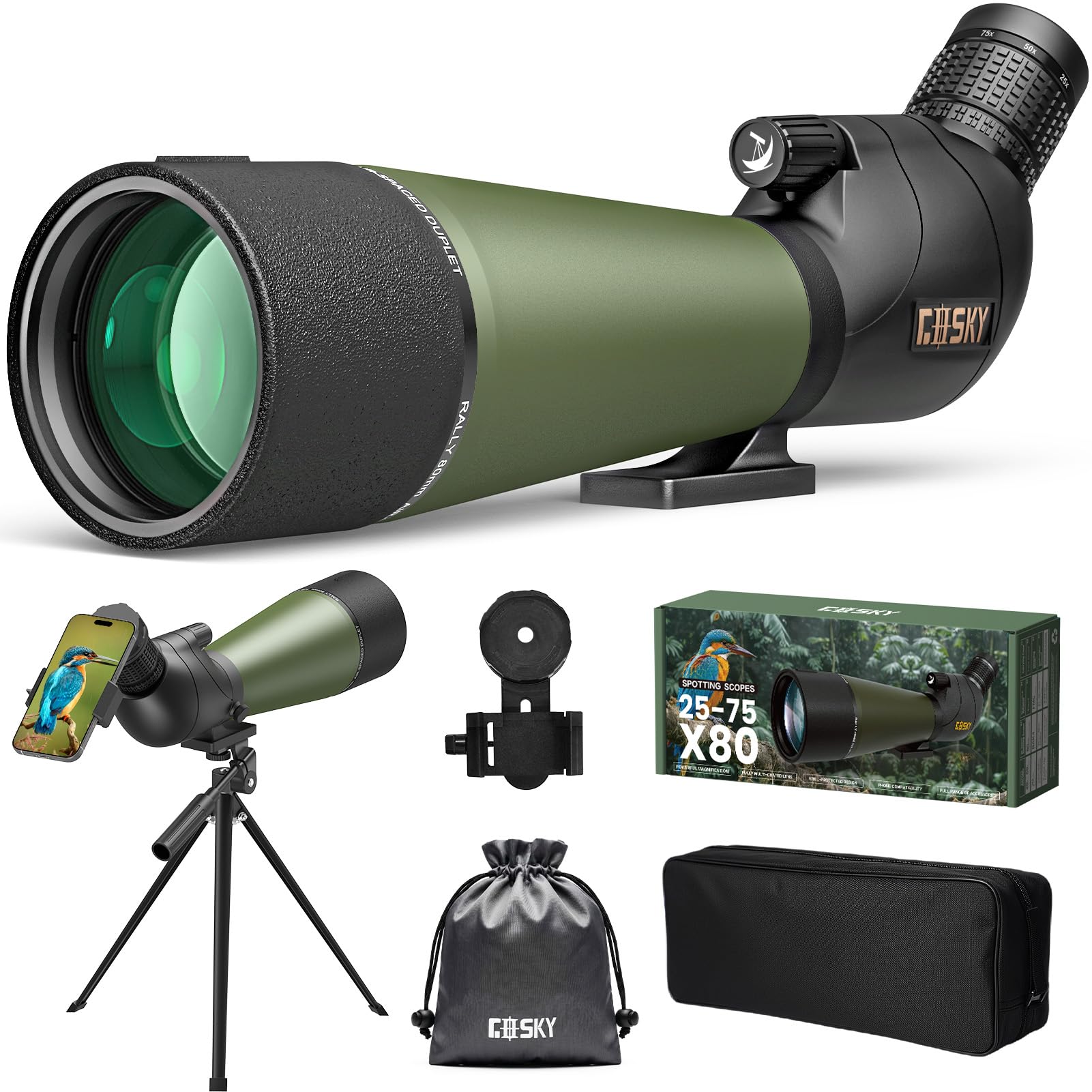
The Gosky Flagship uses a 23mm eyepiece—larger than many scopes in this price bracket—to deliver a 98‑foot field of view at 1000 yards on the low end. The 80mm objective and BAK4 prism system hold the image bright and sharp through the middle of the zoom range. The rotating body ring lets you adjust the eyepiece angle without moving the tripod, a feature shooters appreciate when checking targets from a seated position.
Nitrogen filling and O‑ring sealing make the scope waterproof and fogproof for humid range days or sudden rain. The rubber‑armored body provides a secure grip even with cold or wet hands, and the retractable sunshade reduces glare on bright afternoons. The included tabletop tripod is functional but lightweight; users who want a taller setup should plan to swap it out. The quick‑phone adapter works for digiscoping but the alignment fiddly.
Customer feedback is overwhelmingly positive, with repeated mentions of clear target verification at 200 yards and sharp wildlife viewing at moderate distances. The scope has sold over 500,000 units since its original release, a vote of confidence in reliability. The soft carrying case and lens caps keep everything organized for transport.
Why it’s great
- 23mm eyepiece provides a generous 98‑ft field of view
- Nitrogen‑filled and O‑ring sealed for all‑weather use
- Rotating body ring for comfortable eyepiece positioning
Good to know
- Phone adapter requires patience to align properly
- Tabletop tripod is adequate but not for tall users
5. WOZEL 25-75×80 Spotting Scope with Tripod
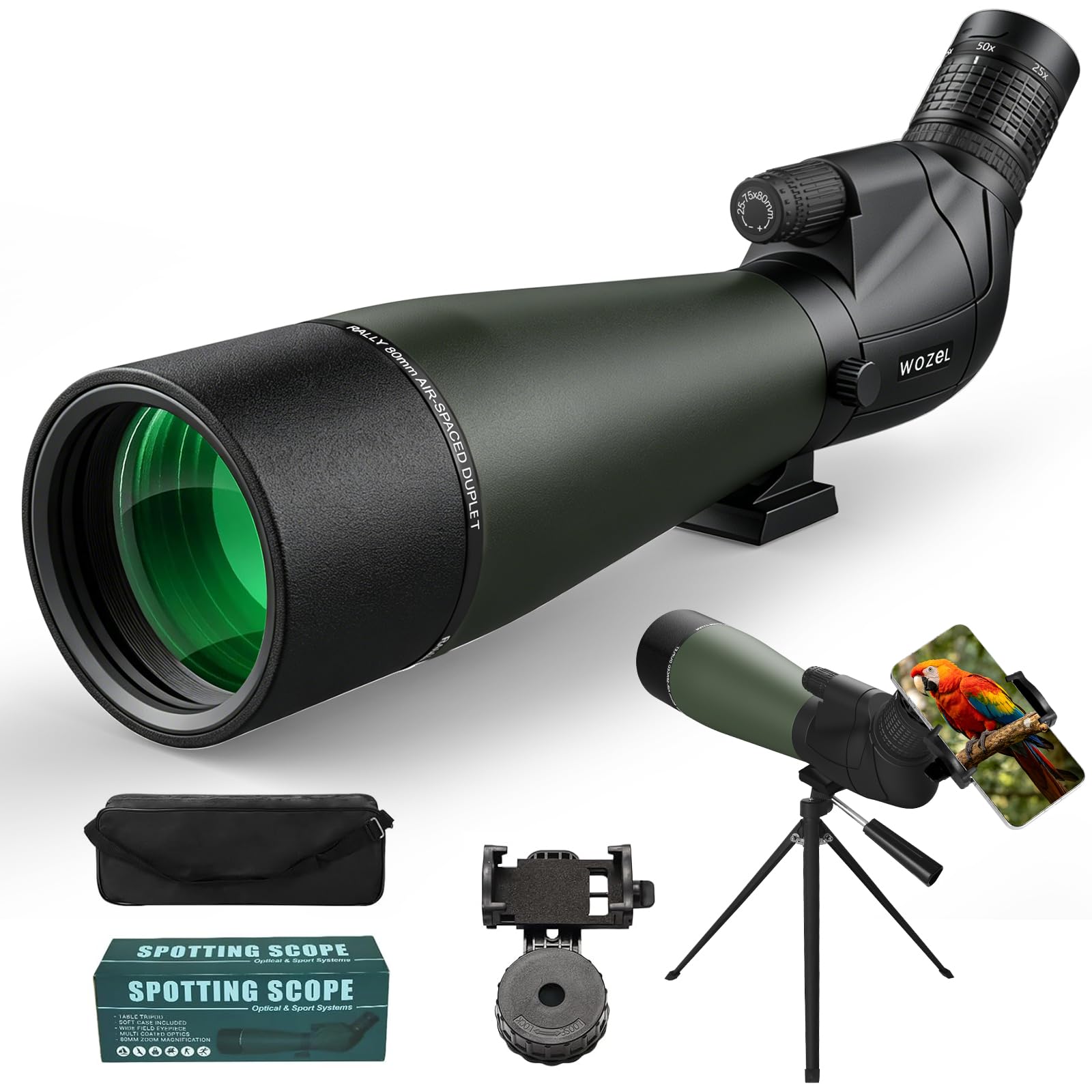
WOZEL’s 25‑75×80 kit bundles a fully multi‑coated spotting scope with a tripod, phone adapter, carrying bag, lens covers, and cleaning cloth—everything you need out of the box. The 80mm green‑film objective and BAK4 prism produce bright, vivid images that impressed testers when viewing deer at several hundred yards. The 82.9‑ to 48‑foot field of view per 1000 yards is typical for this class and keeps targets in the frame at lower magnifications.
The mechanical build is solid: the quick‑focus knob works with one hand, and the retractable sunshade cuts glare without detaching. Nitrogen filling makes it fogproof in cold weather, and the O‑ring seal protects against accidental submersion. The tripod includes side‑to‑side and vertical adjustments, and the aluminum legs stay stable in moderate wind. The carrying bag fits the scope with the tripod attached for quick deployment.
The phone adapter is the weak link—lining up the smartphone camera with the eyepiece takes trial and error, and the adapter can slip if not tightened carefully. Buyers who do not need the adapter will appreciate the core optics at a price that undercuts most 80mm kits. For casual birding and range trips, the WOZEL delivers reliable performance without requiring additional purchases.
Why it’s great
- Complete kit with tripod, bag, and phone adapter included
- Fully multi‑coated BAK4 optics produce vivid, bright images
- Nitrogen‑filled for fog‑free operation in temperature shifts
Good to know
- Phone adapter alignment is finicky and prone to slipping
- Tripod legs are short; best used on even ground
6. Bushnell Trophy Xtreme Spotting Scope

The Bushnell Trophy Xtreme is built for hunters who need a rugged scope that can bounce around in a truck. It comes with both a hard carrying case with padded latches and a soft case, plus a tabletop tripod that doubles as a window mount. The fully multi‑coated optics provide best‑in‑class brightness for a scope at this price level, making it effective for spotting game in low light at dawn or dusk.
At 20x the image is crisp and usable for confirming animal identification at medium distances. As you crank the zoom toward 60x, resolution softens noticeably and the field of view narrows. The focus shift across the zoom range means you need to refocus each time you change power. The straight eyepiece design is preferred by users who shoot from a vehicle, but can require a higher tripod for comfortable standing use.
The build includes a tethered front lens cap and a sunshade that extends from the front band. A rotation button with click stops lets you adjust the eyepiece angle. The unit is waterproof for brief immersion, but the overall construction feels more like a durable field tool than a precision optical instrument. It performs best when used between 20x and 30x.
Why it’s great
- Hard and soft case included for rugged transport
- Tabletop tripod doubles as a car window mount
- Fully multi‑coated glass delivers bright images at low power
Good to know
- Image softens significantly at 40x and above
- Focus shifts when changing magnification, requiring re‑focus
7. Athlon Optics Talos 20-60×80 Spotter Scope

The Athlon Talos 20‑60×80 punches above its price point with fully multi‑coated optics that deliver clear views out to 800 yards. Regular users report reading .17 HMR bullet holes at 100 yards and .22‑250 hits at 200 yards with no chromatic aberration or barrel distortion. The 80mm objective and nitrogen‑purged body keep the image bright and prevent internal fogging during temperature swings.
At 20x the field of view is 1.57 degrees—enough to track moving targets at the range or scan a valley. The zoom ring turns smoothly, and the built‑in sunshade extends to reduce lens flare. The package includes a tabletop tripod that is functional for seated use but best replaced with a full‑sized tripod for standing glassing sessions. The scope fits into the included carry case with room for accessories.
The biggest limitation is short eye relief, which can cause the image to black out if your eye is not aligned perfectly. Shooters who wear glasses will struggle to see the full field of view without smudging the eyepiece. For the price, the glass quality rivals scopes costing twice as much, making this a strong entry‑level choice for new shooters and birders who want a big aperture without a big budget.
Why it’s great
- Clear images to 800 yards with no color fringing
- Fully multi‑coated glass for high light transmission
- Nitrogen‑purged for fog‑proof performance in cold weather
Good to know
- Short eye relief makes it awkward for eyeglass wearers
- Included tripod is lightweight and best used at seated height
FAQ
What makes a spotting scope truly compact and not just short?
Can I use a compact spotting scope for digiscoping?
Is a 70mm objective enough for target shooting at 200 yards?
Final Thoughts: The Verdict
For most users, the best compact spotting scope winner is the Vortex Diamondback HD because its HD glass, Arca‑Swiss compatibility, and VIP warranty cover every scenario from low‑light hunting to high‑magnification target verification. If you want a scope that doubles as a telescope for lunar and planetary astronomy, grab the Celestron MAK 90mm. And for backpacking trips where every ounce matters, nothing beats the Celestron Mini Mak 70mm in sheer packability and versatility.

Mo Maruf
I created WellFizz to bridge the gap between vague wellness advice and actionable solutions. My mission is simple: to decode the research and give you practical tools you can actually use.
Beyond the data, I am a passionate traveler. I believe that stepping away from the screen to explore new environments is essential for mental clarity and physical vitality.