Our readers keep the lights on and my smoothie glass nicely filled. As an Amazon Associate, I earn from qualifying purchases.
Small speakers often compromise clarity for compactness, but the latest generation of powered monitors proves that you can get studio-grade detail, deep bass extension, and versatile connectivity without sacrificing desktop real estate. Whether you’re mixing tracks, gaming, or just enjoying your favorite playlist, the right pair transforms your listening experience.
I’m Mohammad Maruf — the founder and writer behind WellFizz. My research for this guide involved analyzing frequency response curves, amplifier topologies, driver materials, and connectivity standards across dozens of models to separate marketing claims from measurable performance.
After comparing nine models across price tiers, I’ve narrowed the field to the options that deliver genuine value. This guide to the best compact powered speakers will help you find the set that matches your space, usage, and budget without guesswork.
How To Choose The Best Compact Powered Speakers
Selecting the right pair goes beyond picking the most affordable option. You need to match the speaker’s driver configuration, amplifier power, connectivity options, and acoustic design to your specific room size and intended use. Here’s what to prioritize.
Driver Size and Woofer Material
Driver diameter directly determines how much air the speaker can move, which translates to bass extension. A 3.5‑inch woofer can produce solid mid‑bass but typically rolls off around 80 Hz. A 4‑inch or 4.5‑inch driver extends deeper, often down to 60 Hz or lower. Woofer material also matters: woven carbon fiber offers fast transient response, aluminum provides stiffness for low distortion, and paper or composite cones deliver a warmer tone. For near‑field desktop use, a 4‑inch driver is the sweet spot between size and low‑end authority.
Amplifier Topology and Power Rating
Class‑D amplifiers are now standard in compact active speakers because they run cool, save space, and deliver clean power at lower cost. Class‑AB amplifiers, found in some premium models, offer slightly warmer harmonic character but generate more heat. RMS power (continuous, not peak) is the honest spec: 15–25 watts per channel is enough for near‑field listening at moderate levels, while 40+ watts per channel provides headroom for dynamic peaks without distortion. Bi‑amplification, where separate amps drive the woofer and tweeter, improves clarity and channel separation.
Connectivity and Input Flexibility
Your source devices dictate which inputs you need. RCA and 3.5 mm aux are universal for computers, turntables, and media players. Balanced TRS or XLR inputs reject noise over longer cable runs, which matters if your interface is across the room. USB‑C input delivers a pure digital signal directly from your computer, bypassing your device’s internal DAC. Bluetooth 5.0 or higher enables wireless streaming from your phone or tablet — multi‑point pairing lets you switch between two devices without re‑pairing. Front‑panel headphone jacks and volume knobs add everyday convenience.
Crossover Design and Tuning Controls
The crossover network splits the audio signal between woofer and tweeter. A well‑designed crossover produces a seamless transition with no audible dip or peak in the midrange. High‑ and low‑frequency trim controls let you compensate for room acoustics — boosting bass in a dead room or cutting treble near a reflective wall. Some models offer preset voicings (Music, Monitor, Custom) that alter the EQ curve for different content. For critical listening, a flat, neutral response with minimal DSP processing is preferred.
Quick Comparison
On smaller screens, swipe sideways to see the full table.
| Model | Category | Best For | Key Spec | Amazon |
|---|---|---|---|---|
| ADAM Audio D3V | Premium | Producers & audiophiles | 1.5″ D-ART ribbon tweeter + dual 3.5″ passive radiators | Amazon |
| Kanto ORA4 | Premium | Hi‑Fi desktop & gaming | 140W bi‑amplified Class‑D, 4″ aluminum concave woofers | Amazon |
| PreSonus Eris E4.5 BT | Mid‑Range | Studio monitoring & multimedia | 4.5″ woven composite woofer, 25W/side Class‑AB | Amazon |
| Pioneer DJ DM‑40D | Mid‑Range | DJ practice & production | 4″ woofer with DECO convex diffuser, 2‑way DSP mode | Amazon |
| Audio‑Technica AT‑SP3X | Mid‑Range | Turntable & casual listening | 76mm drivers, Bluetooth multi‑point, bass boost | Amazon |
| Edifier MR3 | Mid‑Range | Budget studio monitoring | 3.5″ mid‑low driver, Hi‑Res Audio certified, Bluetooth 5.4 | Amazon |
| Mackie CR3.5 | Value | Desktop gaming & streaming | 3.5″ woven woofer + silk dome tweeter, tone knob | Amazon |
| Edifier R1280T | Value | Entry‑level home audio | 4″ full range unit, 13mm silk dome tweeter, remote control | Amazon |
| Micca PB42X | Value | Desktop music listening | 4″ woven carbon fiber woofer, 15Wx2 Class‑D | Amazon |
In‑Depth Reviews
1. ADAM Audio D3V Active Desktop Monitoring System
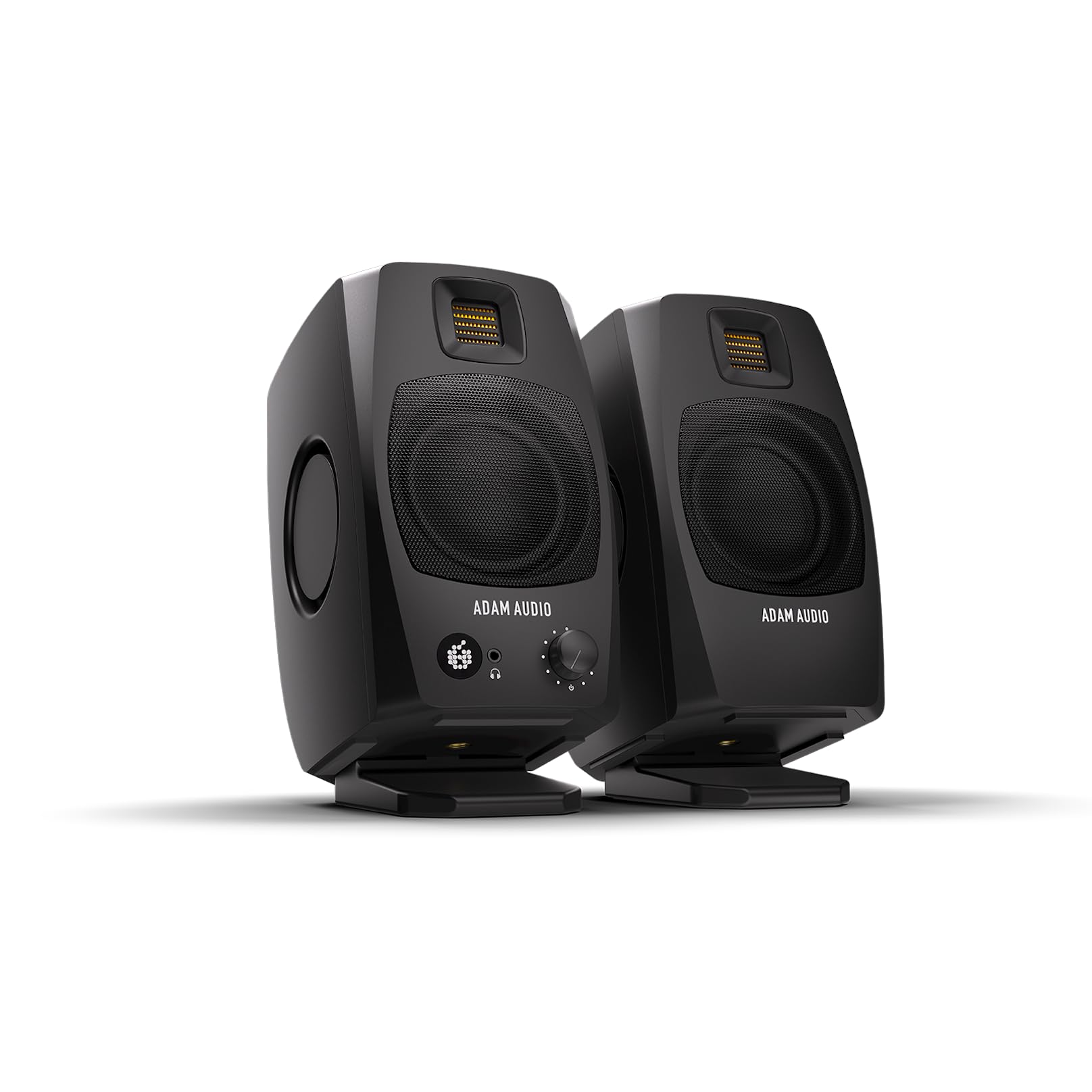
The ADAM Audio D3V brings a genuine ribbon tweeter — the 1.5‑inch D‑ART (Desktop Accelerated Ribbon Tweeter) — to a compact powered monitor, delivering the same detailed, non‑fatiguing high‑frequency reproduction found in ADAM’s larger studio monitors. Each pair packs 80 watts of amplification per speaker driving a 3.5‑inch aluminum woofer, plus dual 3.5‑inch passive radiators on each side that extend bass response down to 45 Hz. The result is a surprisingly full, punchy low end that defies the speakers’ tiny footprint.
Connectivity covers USB‑C for direct digital input from a computer, along with balanced 1/4‑inch TRS and RCA analog inputs. The backplate includes DSP‑powered switches to compensate for placement near walls or corners, and the front panel offers a headphone jack and volume knob. The included detachable monitor stands angle the speakers 15 degrees upward toward your ears — a thoughtful ergonomic touch that improves imaging in near‑field setups.
Listeners report extremely loud output for the size, with a 3D soundstage and excellent separation. The only caveat: an initial firmware bug that muted highs at low volume and enabled auto‑sleep has been patched via a downloadable update, so be sure to apply it after unboxing. For serious near‑field monitoring, the D3V is a compact powerhouse that rivals much larger systems.
Why it’s great
- Authentic D‑ART ribbon tweeter for detailed, smooth highs
- Passive radiators deliver 45 Hz bass extension from a 3.5″ driver
- USB‑C input bypasses your computer’s internal DAC
- 15‑degree angled stands included for optimal ear alignment
Good to know
- Requires firmware update to fix low‑volume high‑frequency roll‑off
- No Bluetooth — purely wired connectivity
- Proprietary interconnect cable between speakers
2. Kanto ORA4 Powered Reference Speakers

The Kanto ORA4 delivers 140 watts of DSP‑tuned, bi‑amplified Class‑D power from a compact pair of 4‑inch aluminum concave cone woofers and 3/4‑inch silk dome tweeters. Bi‑amplification means separate amplifier channels drive the woofer and tweeter, reducing intermodulation distortion and improving clarity across the frequency range. Frequency response extends from 60 Hz to 22 kHz, and the 80 Hz automatic low‑pass crossover engages seamlessly when you add a subwoofer.
Input options cover everything: USB‑C for a pure digital path from your computer, Bluetooth 5.0 for wireless streaming, and RCA for analog sources. The magnetically shielded woofers let you place the speakers next to a CRT monitor without picture distortion — a nod to retro gaming setups. Two 1/4‑inch‑20 threaded inserts on the rear and bottom allow wall or stand mounting.
User feedback consistently praises the ORA4’s balanced, non‑fatiguing sound — it’s warm enough for long listening sessions yet accurate enough for light mixing. The plastic cabinet feels less premium than the price suggests, but the acoustic performance more than compensates. Some listeners recommend a light EQ to open up the soundstage, though many find the stock tuning excellent with proper placement away from walls. For a versatile desktop powerhouse that handles everything from gaming to critical listening, the ORA4 is our top pick.
Why it’s great
- Bi‑amplified 140W Class‑D delivers clean, distortion‑free sound
- USB‑C, Bluetooth 5.0, and RCA cover all modern sources
- Automatic 80 Hz subwoofer crossover for easy system expansion
- Magnetic shielding allows placement next to CRT monitors
Good to know
- Plastic cabinet may feel less solid at this price point
- Some users report needing EQ for optimal soundstage depth
- Speakers are not labeled L/R; volume knob determines channel
3. PreSonus Eris E4.5 BT Near Field Studio Monitors

The PreSonus Eris E4.5 BT has earned a loyal following among producers and desktop listeners alike for its balanced, accurate sound and generous feature set. Each monitor pairs a 4.5‑inch woven composite woofer with a 1‑inch ultra‑low‑mass silk dome tweeter, driven by 25 watts per side of Class‑AB amplification. The slightly larger woofer compared to most desktop models provides noticeably deeper bass extension and better midrange presence without requiring a subwoofer in smaller rooms.
Input flexibility is a strong suit: balanced 1/4‑inch TRS, RCA, and a front‑panel stereo 1/8‑inch aux input let you connect multiple sources simultaneously. Bluetooth 5.0 adds wireless freedom for streaming from a phone or tablet. High‑ and low‑frequency trim controls on the rear panel let you compensate for placement‑induced tonal shifts — helpful when you can’t position the speakers optimally.
Customer reviews consistently highlight the speakers’ detailed, fatigue‑free sound for near‑field use. The included Studio One Prime and Studio Magic plug‑in suite adds substantial value for producers starting out. A common minor complaint: some units exhibit a slight hiss or buzz that may become noticeable in very quiet environments, possibly a quality control variation. For a true studio monitor that also works beautifully for multimedia, the Eris E4.5 BT is a compelling choice.
Why it’s great
- 4.5″ woofer provides deeper bass than typical desktop monitors
- Balanced TRS inputs for noise‑free long cable runs
- Acoustic tuning controls adjust response to room placement
- Includes Studio One Prime production software suite
Good to know
- Some units may produce audible hiss in quiet rooms
- No remote control for volume adjustment
- Bluetooth connection can occasionally be finicky
4. Pioneer DJ DM‑40D Desktop Monitor System

The Pioneer DJ DM‑40D is purpose‑built for DJs and producers who need clear, punchy sound for cueing and mixing. Its 4‑inch woofer and DECO convex diffuser create an expanded sweet spot and 3D stereo imaging, while a two‑way sound mode switch toggles DSP settings optimized for DJ mixing or music production. The Class‑D amplifier operates at 96 kHz sampling for clean, low‑noise output.
Connectivity includes RCA and mini‑jack inputs, plus a front‑panel headphone socket for private monitoring. The time‑aligned woofer and tweeter ensure frequencies arrive at your ears simultaneously, improving transient accuracy. The compact black design fits neatly alongside a DJ controller or mixer.
Reviewers praise the DM‑40D’s punchy, loud output and easy integration with DJ gear. However, the sound signature is not neutral — it emphasizes bass and upper highs while scooping upper mids, which can make vocals and guitar detail sound recessed. This voicing works well for beat‑matching and energetic listening but may tire ears during long production sessions. For DJ‑centric use, it’s excellent; for critical mixing, a flatter monitor is preferable.
Why it’s great
- Two‑way DSP mode tailored for DJing vs production
- DECO convex diffuser creates wide, immersive soundstage
- Time‑aligned drivers improve transient clarity
- Front‑panel headphone jack for easy monitoring
Good to know
- Not neutral — upper mid scoop affects vocal clarity
- No Bluetooth on the standard model
- Can cause listening fatigue in long sessions
5. Audio‑Technica AT‑SP3X Bookshelf Speakers

Audio‑Technica’s AT‑SP3X is a compact bookshelf speaker designed to pair seamlessly with their turntables, but it works equally well as a general‑purpose desktop system. The 76mm dynamic drivers deliver full‑range audio with a bass boost switch that adds low‑end presence for parties or bass‑heavy genres. Bluetooth multi‑point pairing lets you stay connected to two Bluetooth devices simultaneously — switch between your turntable and phone without re‑pairing.
Wired connectivity is handled by dual RCA jacks on the rear. The top‑panel power button includes an LED indicator, and a volume control dial provides tactile adjustment. The AC adapter ships with three international plug adapters, making this a travel‑friendly option for international setups. The compact black plastic cabinet keeps weight low at under five pounds per pair.
User reviews consistently note the AT‑SP3X gets surprisingly loud for its size, with a bass‑forward character that some find a touch heavy at higher volumes. The clear, crisp audio and easy Bluetooth toggling between sources are frequently praised. For vinyl enthusiasts who want a simple, good‑looking speaker that pairs perfectly with an Audio‑Technica turntable, this is a natural fit.
Why it’s great
- Bluetooth multi‑point stays paired to two devices at once
- Bass boost switch adds low‑end energy when desired
- Ideal companion for Audio‑Technica turntables
- Includes international plug adapters for global use
Good to know
- Bass can feel heavy at high volume on some tracks
- Plastic cabinet limits acoustic refinement
- No balanced inputs for professional setups
6. Edifier MR3 Powered Studio Monitor Speakers

The Edifier MR3 punches well above its price bracket by delivering Hi‑Res Audio certification (flat response from 52 Hz to 40 kHz) and a comprehensive connectivity suite that includes balanced TRS, RCA, and AUX inputs plus Bluetooth 5.4 with multi‑point connection. Each speaker houses a 3.5‑inch mid‑low driver paired with a 1‑inch tweeter, driven by 18 watts RMS per channel for a peak SPL of 92.5 dB. The MDF cabinet reduces unwanted resonance, keeping the sound clean at moderate volumes.
A three‑mode switch lets you toggle between Music, Monitor, and Custom voicings, and the EDIFIER ConneX app offers in‑depth EQ personalization. The front‑panel headphone output is convenient for late‑night listening. The compact black or white design fits unobtrusively on any desk.
User feedback is overwhelmingly positive, with many calling the MR3 the best‑sounding option in its price tier. The sound is described as neutral, detailed, and punchy, with tight bass and zero hiss. One minor workflow note: Bluetooth volume is not fully controllable from the source device — you’ll need to use the physical knob or app. For budget‑conscious buyers who refuse to compromise on sound quality, the MR3 is a standout.
Why it’s great
- Hi‑Res Audio certified with extended 40 kHz frequency response
- Balanced TRS inputs for professional interfaces
- Bluetooth 5.4 with multi‑point for two‑device streaming
- App‑based EQ for detailed sound customization
Good to know
- Bluetooth volume requires physical knob or app control
- 3.5″ woofer limits deep sub‑bass extension
- Plastic enclosure feels less premium than wooden cabinets
7. Mackie CR3.5 Creative Reference Powered Studio Monitors

Mackie’s CR3.5 combines a 3.5‑inch woven woofer and a silk dome tweeter with a tone knob that lets you dial in extra bass and treble sparkle on the fly — perfect for switching between studio monitoring and casual listening. A unique location switch optimizes the speaker’s EQ for desktop (near‑field) or bookshelf (far‑field) placement, addressing a common room‑acoustics issue that many competitors ignore.
Input options include TRS and RCA for audio interfaces and playback devices, plus a 3.5 mm input for gaming consoles and PCs. A front‑panel headphone output and volume knob keep controls accessible. The 10.2‑pound pair feels solid on the desk, with a black vinyl wrap that looks clean and professional. Foam isolation pads are included to decouple the speakers from the surface.
Reviewers consistently describe the CR3.5 as having fantastic clarity and surprising low‑end authority for 3.5‑inch drivers. The tone knob is a genuine differentiator — it allows instant tuning between a flat monitor response and a more fun, bass‑boosted voicing for games and movies. The only downside is the lack of Bluetooth, which limits wireless convenience. For desktop gamers and streamers who want one speaker that does both work and play, the CR3.5 is a smart choice.
Why it’s great
- Tone knob adds bass/treble boost without menu diving
- Desk/bookshelf location switch optimizes EQ for placement
- Clear, balanced sound with excellent detail for the size
- Includes foam isolation pads and multiple cables
Good to know
- No Bluetooth — wired only
- 3.5″ drivers limit maximum SPL in larger rooms
- Plastic and vinyl wrap construction feels mid‑grade
8. Edifier R1280T Powered Bookshelf Speakers

The Edifier R1280T is a time‑tested entry‑level bookshelf speaker that prioritizes simplicity and broad compatibility. Its 13mm silk dome tweeter handles highs smoothly, while the 4‑inch full‑range driver delivers a natural midrange that works well for vocals and acoustic instruments. The 42‑watt RMS amplifier provides enough headroom for moderate‑sized rooms, and the classic MDF wood cabinet with wood‑effect vinyl looks at home in living rooms, dens, or offices.
Input connectivity is limited to two 3.5mm AUX inputs — you can connect two sources simultaneously without unplugging, but there’s no Bluetooth, USB, or digital audio support. An included remote control lets you adjust volume from across the room, and bass/treble knobs on the side panel offer basic EQ shaping. Setup is straightforward: plug the speaker‑to‑speaker wire into the passive speaker, connect your source to the active speaker, and power on.
Customers appreciate the R1280T’s clear, honest sound for the price, though many note that deep bass requires a separate subwoofer. The speakers pair well with entry‑level turntables like the Audio‑Technica LP60X. For a no‑frills powered speaker that just works, the R1280T remains a popular starting point for vinyl newcomers and casual listeners on a budget.
Why it’s great
- Classic wood cabinet adds aesthetic warmth to any room
- Dual AUX inputs allow two source connections simultaneously
- Remote control provides convenient volume adjustment
- Side‑panel bass and treble knobs offer basic tonal tuning
Good to know
- No Bluetooth or digital inputs limit modern connectivity
- Lacks deep bass extension — subwoofer recommended
- Speaker wire connection between units is less convenient
9. Micca PB42X Powered Bookshelf Speakers

The Micca PB42X has become a cult favorite among budget‑minded audiophiles for its remarkably balanced sound and high component quality. Each speaker pairs a balanced woven carbon fiber woofer with a high‑performance silk dome tweeter, separated by a highly optimized crossover that delivers an open, dynamic midrange. The 4‑inch woofer produces impactful bass for its size, rolling off gracefully below 80 Hz rather than attempting artificial extension. A built‑in Class‑D amplifier provides 15 watts per channel, sufficient for near‑field listening in residential rooms.
The ported enclosure extends low‑frequency output without the boxiness common in sealed budget speakers. Magnetic grilles are a welcome touch at this price, keeping the front surface clean. Connectivity is basic: RCA inputs only — no Bluetooth, no USB, no remote. The included speaker wire uses a twist‑type connector that some find fiddly, but it’s functional.
Reviewers consistently highlight the PB42X’s exceptional vocal clarity and sweet, neutral treble. The bass is clean and defined but lacks sub‑60 Hz impact, so a separate subwoofer is recommended for bass‑heavy genres. At higher volumes, the treble can become slightly harsh and the bass a bit boomy — these are best kept at moderate desk levels. For listeners who prioritize midrange transparency and imaging over raw bass, the PB42X delivers stunning performance at a budget‑friendly price.
Why it’s great
- Woven carbon fiber woofer provides fast, clean transient response
- Exceptionally clear vocals and natural midrange
- Silk dome tweeter delivers smooth, non‑fatiguing highs
- Magnetic grilles keep the front face clean
Good to know
- RCA‑only input limits modern device compatibility
- Requires subwoofer for deep bass reproduction
- Twist‑type speaker‑wire connector can be fiddly to install
FAQ
What is the difference between powered speakers and passive speakers?
Do I need a subwoofer with compact powered speakers?
Can I use studio monitors for casual listening and gaming?
How important is room placement for compact speakers?
What does Bluetooth multi‑point mean and why do I need it?
Final Thoughts: The Verdict
For most users, the best compact powered speakers winner is the Kanto ORA4 because it combines versatile USB‑C, Bluetooth, and RCA connectivity with 140 watts of bi‑amplified power and a balanced, non‑fatiguing sound that works for gaming, music, and light production. If you want a true ribbon tweeter and don’t need Bluetooth, the ADAM Audio D3V delivers unmatched detail and bass extension from a tiny footprint. And for budget‑conscious buyers who refuse to sacrifice clarity, the Edifier MR3 packs stunning value with Hi‑Res certification and balanced inputs at a fraction of the price.

Mo Maruf
I created WellFizz to bridge the gap between vague wellness advice and actionable solutions. My mission is simple: to decode the research and give you practical tools you can actually use.
Beyond the data, I am a passionate traveler. I believe that stepping away from the screen to explore new environments is essential for mental clarity and physical vitality.